







Abstract

The present authors have recently proposed a method to identify the martensite start temperature, 1 which has been the object of a discussion.2,3 Bhadeshia has now provided a second set of comments 4 which are addressed below.
On the expansion coefficient of austenite, we agree with Bhadeshia's comments that determination of Ms is difficult, if not suspect, when dilatometry records exhibit significant non-linearity in the fully austenitic temperature range. (In this regard, it should be recalled that the data discussed in this particular example were from Ref. 5, in which no mention of this issue was made.) Clearly, neither method should be applied where significant non-linearity exists in the measured austenite expansion (as is the case in the example discussed). However, it is also the case that in most recordings obtained the dilatometry data do not show a perfectly linear austenite expansion. The purpose of our example was to illustrate the sensitivity of the offset method and the need to publish the temperature range used to define the tangent used as a reference. Either method would conceal the issue. As stated in our first reply 3 (paragraphs 3 and 4), it has never been claimed that the Ms,KM avoids the problem; rather, the discussion concerned only the set of parameters which should be published with the results.
Regarding Bhadeshia's comments 4 concerning Fig. 3 of Ref. 1, it should be emphasised that the purpose of the work was not to define or identify a ‘better’ method but simply to discuss the respective merits of the two methods. It is with this perspective that we have mentioned the ‘K–M method’ as giving a ‘better representation of the transformation as a whole’, and not simply as a better method.
We also agree that Ms,KM as identified in Fig. 3 of our response 3 ‘underestimates’ the measured martensite start temperature. However, as we have indicated, but perhaps insufficiently explained, there are cases where the measured martensite start temperature may differ from the real martensite start temperature as a result of experimental issues. In the course of the present discussion, we have demonstrated1,3 that early measured transformation onset could be related to specimen heterogeneity and have distinguished two cases: (i) where the heterogeneity is extrinsic (temperature gradient in the specimen, surface effect, etc.), Ms,KM will be better adapted to approach the real Ms value of the material at hand; (ii) if, on the contrary, the heterogeneity is intrinsic, then indeed the offset method proposed by Bhadeshia will be best suited to identify Ms.
In his second set of comments, Bhadeshia
4
states that the
As highlighted in our previous discussions,
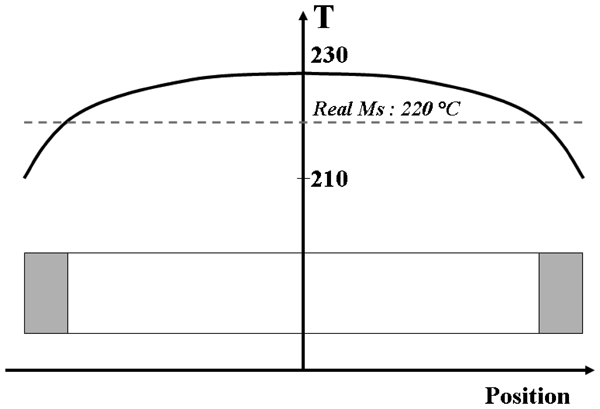
Schematic illustration of the example discussed in the text, in which a temperature gradient in the specimen causes transformation at the extremities to take place before it occurs at the centre. Because temperature measurements are typically carried out only at the specimen centre, the onset of transformation is associated with the measured temperature (here, a temperature of 230°C or greater is likely to be identified as Ms using the offset method). The overestimation of Ms will become greater as the onset is measured with increased accuracy, but will not, for all that, be much better related to the actual Ms temperature of the material. The present authors have shown this hypothesis to be quantitatively consistent with measured gradient in the Baehr 805 dilatometer and with typical amplitudes for the ‘slow-start’ phenomenon 1
In summary, our discussion does not aim at establishing a ‘better’ method but to assess the advantages of each method. It is clear and agreed that the offset method is best suited to determine the actual onset of transformation during cooling. However, when extrinsic heterogeneities are present (which is always the case in the experience of the present authors), this true expansion onset does not necessarily correspond to the ‘real’ martensite start temperature.
As to the practical aspects of the method and the use made of the Ms measurements within numerical simulation software packages, the present authors would suggest that this is a subjective matter that may best be left for users to decide.