







Abstract
The roles of CeO2 additive during preparation of in situ TiB2/Al composite, alleviating particle settlement in composite melt and significantly improving particle dispersion in final microstructure, are studied in this paper. It is evidenced that the CeO2 additive reacts with Al melts to release Ce solute into the melts, and the released surface active Ce is absorbed in the Al/TiB2 interfaces without any other reaction products. First principles calculations show that the interfacial energy of Al/TiB2 interfaces is reduced owing to the presence of Ce in Al/TiB2 interfacial area. Therefore, the wettability of molten Al on TiB2 surface is increased and the dispersion of TiB2 particles in Al matrix is eventually improved.
Introduction
The Al–Ti–B master alloy and in situ TiB2/Al composite prepared by an exothermic reaction among K2TiF6, KBF4 salts and Al melts have been extensively investigated due to good grain refining performance of master alloy1–3 and higher specific strength and good wear resistance of composite.4–6 A large amount of information7–12 on microstructures indicates that TiB2 particles distribute along grain boundaries in a form of particle agglomerations. It is easier for the larger particle agglomerations to deposit in the composite melt, which results in the formation of depleted and aggregative zones of TiB2 particles in the solidified casting. It was reported that when the composite is produced with high volume fraction TiB2, the particle agglomerations will weaken the reinforcing effects of TiB2 particles, which accordingly reduces its final properties.13,14 Thus, the distribution control of TiB2 particles in aluminium matrix is important for producing TiB2/Al composite with high specific modulus and strength and Al–Ti–B master alloys with good grain refining performance via casting technique.10–15 Han et al. 10 indicated that the morphology of TiB2 agglomerations in the Al–Ti–B alloys could be changed into loose coral-like by applying high intensity ultrasound in the melts. Jha and Dometakis 15 reported that Mg and Zr as surface active additives could improve the dispersion of TiB2 particles in aluminium matrix, and suggested that the decrease in interfacial energy of Al/TiB2 interfaces by adding surface active elements is responsible for the dispersion improvement. However, their inferences need experimental or theoretical evidence. Meanwhile, our report 14 has shown that the addition of CeO2 during preparation of TiB2/Al composite is helpful for alleviating the deposition of TiB2 particles in the melts and accordingly improves the particle distribution in the final microstructure. However, the role of CeO2 in the composite has not been analysed in detail. Thus, although the importance of interfacial energy of particle/matrix on the particle dispersion in in situ and ex situ composites has been proposed,14–17 the addition of surface active element on interfacial energy is necessary to be experimentally or theoretically investigated further.
The exploration of interfacial energy of Al–Ce/TiB2 interfaces is crucial to exactly understand the action mechanism of CeO2 in TiB2/Al composite. To date, no applicable experimental methods are available to quantitatively investigate the metal/reinforced particle interfacial energy in composite melt. Recently, the first principles method has been successfully applied in the study on metal/ceramic interfacial adhesion, such as Al/TiB2, Al/AlB2, Al/Al3Ti, Al/Mo2B, Nb/Al2O3, Ni/ZrO2, Ni/Al2O3, Fe/WC, Al/α–Al2O3, Al/WC and Al/TiN,18–27 which can not only accurately provide the atomic structure of interface but also quantitatively predict the interfacial energy. It is the primary purpose of this paper to examine the effects of CeO2 additive on the dispersion of TiB2 particles in in situ TiB2/Al composite by analysing the existent forms and distribution of Ce element and its influence on the interfacial energy of Al/TiB2 interfaces using first principles methods.
Experimental and computational details
Experimental procedure
The in situ 5 vol.- TiB2/Al composite was prepared by an exothermic reaction process among K2TiF6, KBF4 and Al melts. The composite was remelted, and 0·5 wt- CeO2 powder was added to the melt at 1103 K. The melt was held for 15 min and then was cast into graphite mould at 1023 K. To explore the roles of CeO2 additive in TiB2/Al composite, the composites with and without CeO2 were remelted in Al2O3 crucible with φ30×100 mm and held for 10 min at 1053 K in a 5 kW electrical furnace. Then, the crucible was removed from the furnace and rapidly quenched in cold water. The distribution of TiB2 particles in composite melt was analysed by observing the microstructure of samples taken at the same height of two remelting composite rods.
A Sirion 200 field emission scanning electron microscope (FE-SEM) was employed to study particle distribution in Al matrix, and a Nova Nano 230 FE-SEM equipped with energy dispersive X-ray spectroscopy (EDS) attachment was employed to study distribution of Ce element in the composite. Microstructural analysis of composite was carried out on a JEM-2010F field emission transmission electron microscope (FE-TEM); thin foils were prepared by the ion milling technique.
Computational details and interface model geometry
Calculations of the interfacial energy of Al–Ce/TiB2 interfaces were based on our earlier report on Al/TiB2 interfaces.
18
The interface orientation relationship of  was also adopted in this paper.28–30 A (1×1) interfacial supercell with a five-layer Al (111) slab with Ce atom being placed on a symmetric seven-layer TiB2 (0001) slab was used, which is thick enough to ensure the bulk-like interior interface.18,31 We have proved that the stacking sequence of Al/TiB2 interfaces in the steady state Al–5Ti–1B alloy was Ti terminated HCP, wherein the interfacial Al atoms reside atop the second layer sites of TiB2.
18
Meanwhile, the surface active element, Ce, prefers to localise in the interfacial area. Thus, in the present calculation, the model of Al–Ce/TiB2 interfaces was established by replacing an interfacial Al atom with a Ce atom in the Al(111)/TiB2(0001) interface with the stacking sequence of Ti terminated HCP, as shown in Fig. 1. The free surfaces of the Al and TiB2 slabs with the in plane periodicity were separated by a 10 Å vacuum to prohibit their interactions. To compensate the mismatch between TiB2 and Al surfaces and satisfy the periodic boundary conditions in a supercell calculation, the coherent interface approximation was adopted,25,26 where the Al slab was modestly stretched by 5·75 to be commensurate with the TiB2 slab. All atoms in the supercells were allowed to freely relax in three directions during geometry optimisation.
was also adopted in this paper.28–30 A (1×1) interfacial supercell with a five-layer Al (111) slab with Ce atom being placed on a symmetric seven-layer TiB2 (0001) slab was used, which is thick enough to ensure the bulk-like interior interface.18,31 We have proved that the stacking sequence of Al/TiB2 interfaces in the steady state Al–5Ti–1B alloy was Ti terminated HCP, wherein the interfacial Al atoms reside atop the second layer sites of TiB2.
18
Meanwhile, the surface active element, Ce, prefers to localise in the interfacial area. Thus, in the present calculation, the model of Al–Ce/TiB2 interfaces was established by replacing an interfacial Al atom with a Ce atom in the Al(111)/TiB2(0001) interface with the stacking sequence of Ti terminated HCP, as shown in Fig. 1. The free surfaces of the Al and TiB2 slabs with the in plane periodicity were separated by a 10 Å vacuum to prohibit their interactions. To compensate the mismatch between TiB2 and Al surfaces and satisfy the periodic boundary conditions in a supercell calculation, the coherent interface approximation was adopted,25,26 where the Al slab was modestly stretched by 5·75 to be commensurate with the TiB2 slab. All atoms in the supercells were allowed to freely relax in three directions during geometry optimisation.
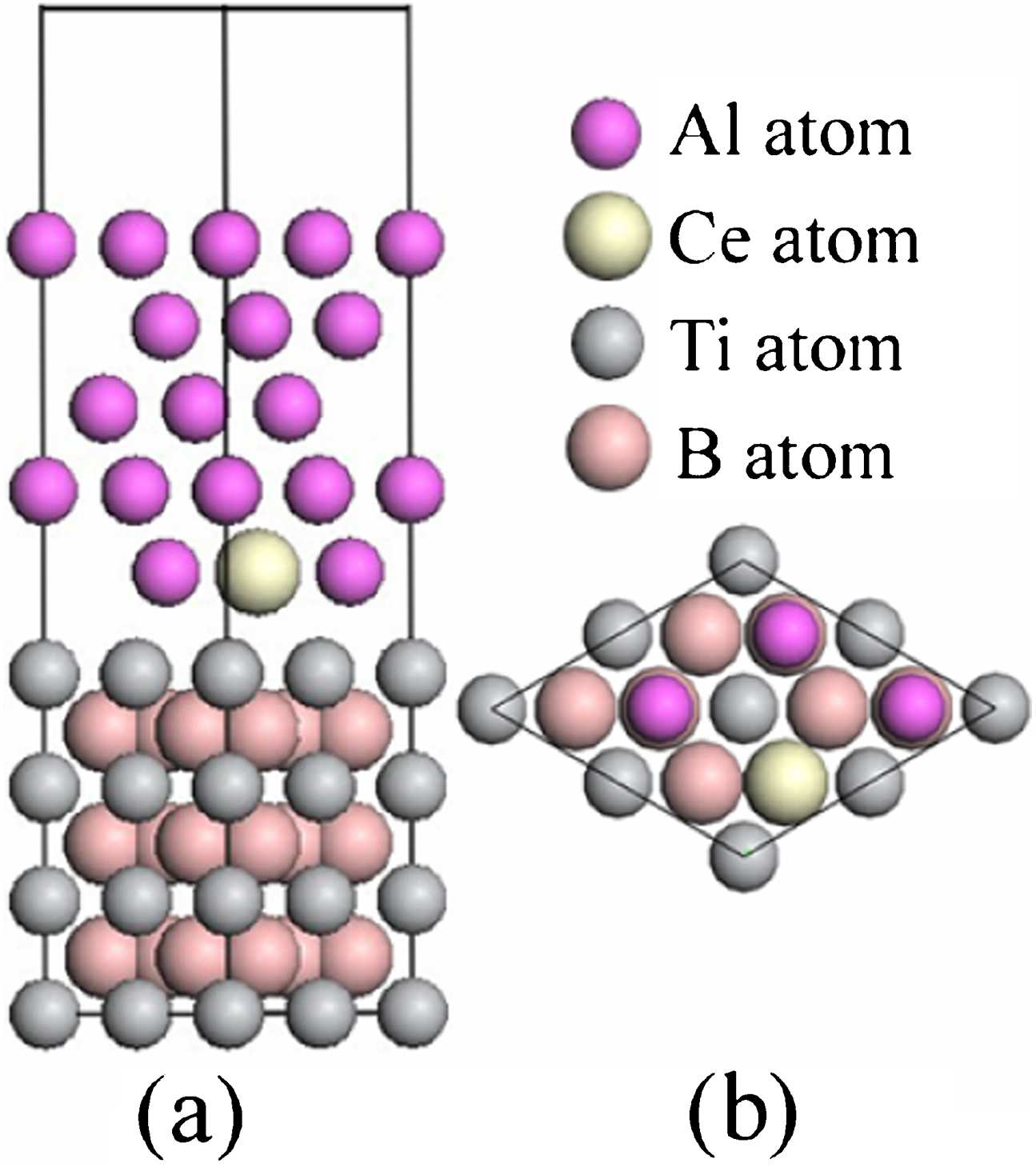
Model of Al–Ce/TiB2 interface atomic structure
First principles calculations were performed using the total energy plane wave pseudopotential method based on the density functional theory with the generalised gradient approximation of Perdew et al.32,33 The minimum total energy was achieved by automatically relaxing the internal coordinates in all directions using Broyden–Fletcher–Goldfarb–Shanno algorithm. 34 The ultrasoft pseudopotential was used for Ce atoms, which generated that the atomic configuration was 4f15d16s2. A plane wave cutoff energy of 380 eV was employed in the calculations, which assured a total energy convergence of 10−6 eV atom−1. Brillouin zone sampling was performed using 4×4×4 and 1×1×1 Monkhorst–Pack k point meshes for Ce bulk and Al–Ce/TiB2 interface calculations respectively.
Results and discussion
Effect of CeO2 additive on microstructure of TiB2/Al composite
Figure 2 shows the SEM microstructures of the TiB2/Al composites with and without CeO2 after remelting and rapidly quenching in cold water. TiB2 particles in the composite melt without CeO2 are in a form of agglomerations, and the agglomeration size is ∼5–15 μm, as shown in Fig. 2a and c. With CeO2 being added into composite melt, the distribution of TiB2 particles is evidently improved, as shown in Fig. 2b and d. Most of TiB2 particles uniformly distribute in the matrix, and the size of single particle is <2 μm. It is indicated that the role of CeO2 additive is to improve the dispersion of TiB2 particles in composite melt.
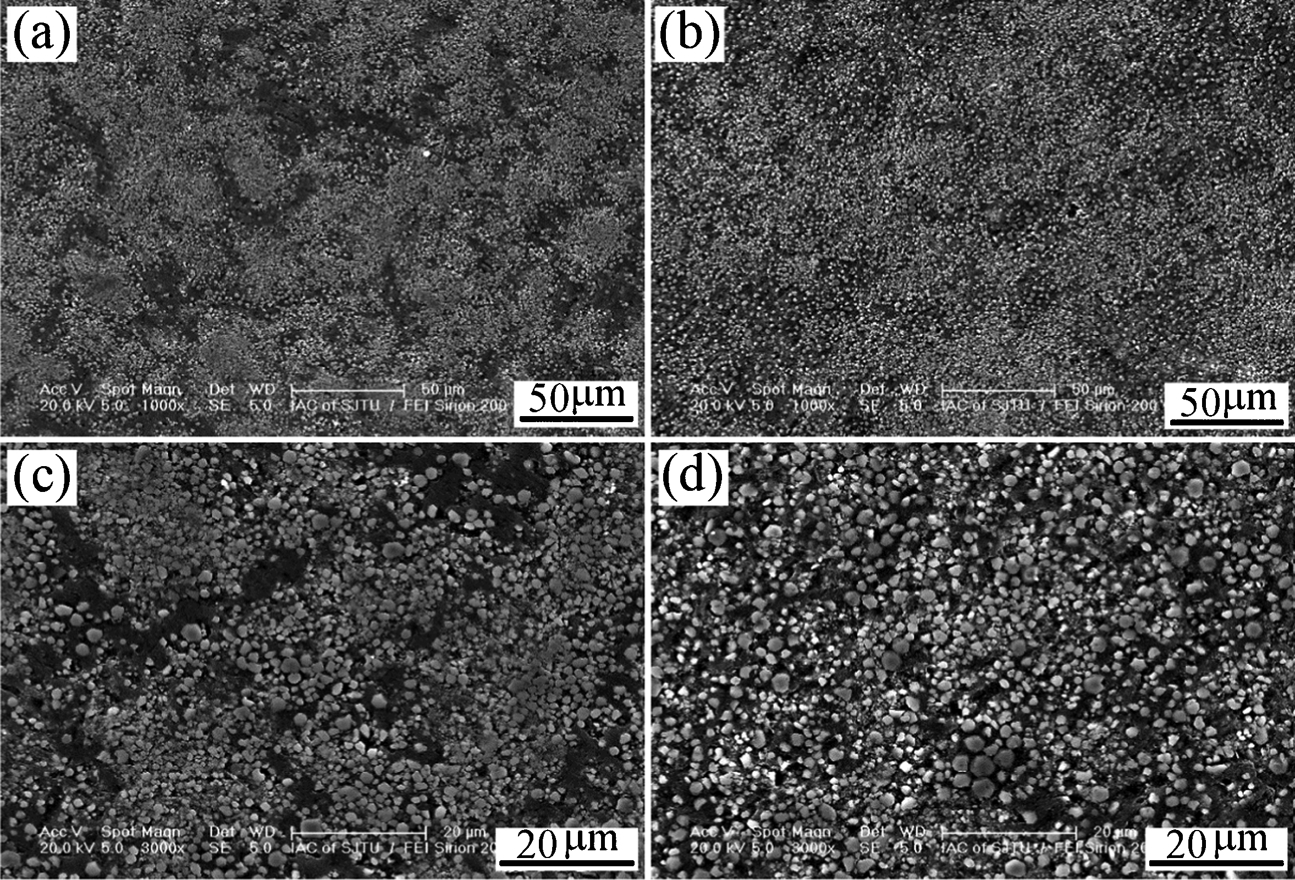
Microstructures (SEM) of composite a, c without and b, d with CeO2 after remelting and rapidly quenching in cold water
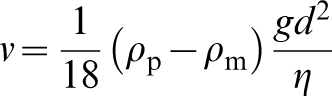
In the case of metal matrix composites, the dispersion of reinforced particles within the matrix depends simultaneously on the moving velocity of particles in melt and the solidification rate of matrix alloy during solidification process. When the solidification rate of matrix alloy is larger than the moving velocity of particles, the particles are captured by the advancing solid/liquid interface and uniformly distribute within the final microstructure. On the contrary, the particles are pushed by the advancing solid/liquid interface and eventually segregate in the last solidification regions, such as grain boundaries and interdendritic regions. According to the stokes equation on the moving velocity of particle in melt:
35
With CeO2 being added into the melts, the following reaction may happen:

The Gibbs free energy for the above reaction at 1100–1200 K can be calculated by the following equation:

When the CeO2 additive is added, the melt temperature is 1103 K in the experiment. The thermodynamic analysis shows that CeO2 will react with Al to release Ce solute in the composite melt. 36 The SEM microstructure and element planar distribution for a polished surface of the composite with CeO2 additive are shown in Fig. 3. It can be confirmed by the distributions of Ti and B elements that the polygonal particles in Fig. 3a are TiB2. Meanwhile, the released Ce mainly distributes on the surface of TiB2 particles, that is, the Al/TiB2 interfaces, as shown in Fig. 3e and f. Although the Ce solute is absorbed in the Al/TiB2 interfaces, the interfaces are clean and directly bonded without any other reaction products as observed by TEM of interface in Fig. 4.
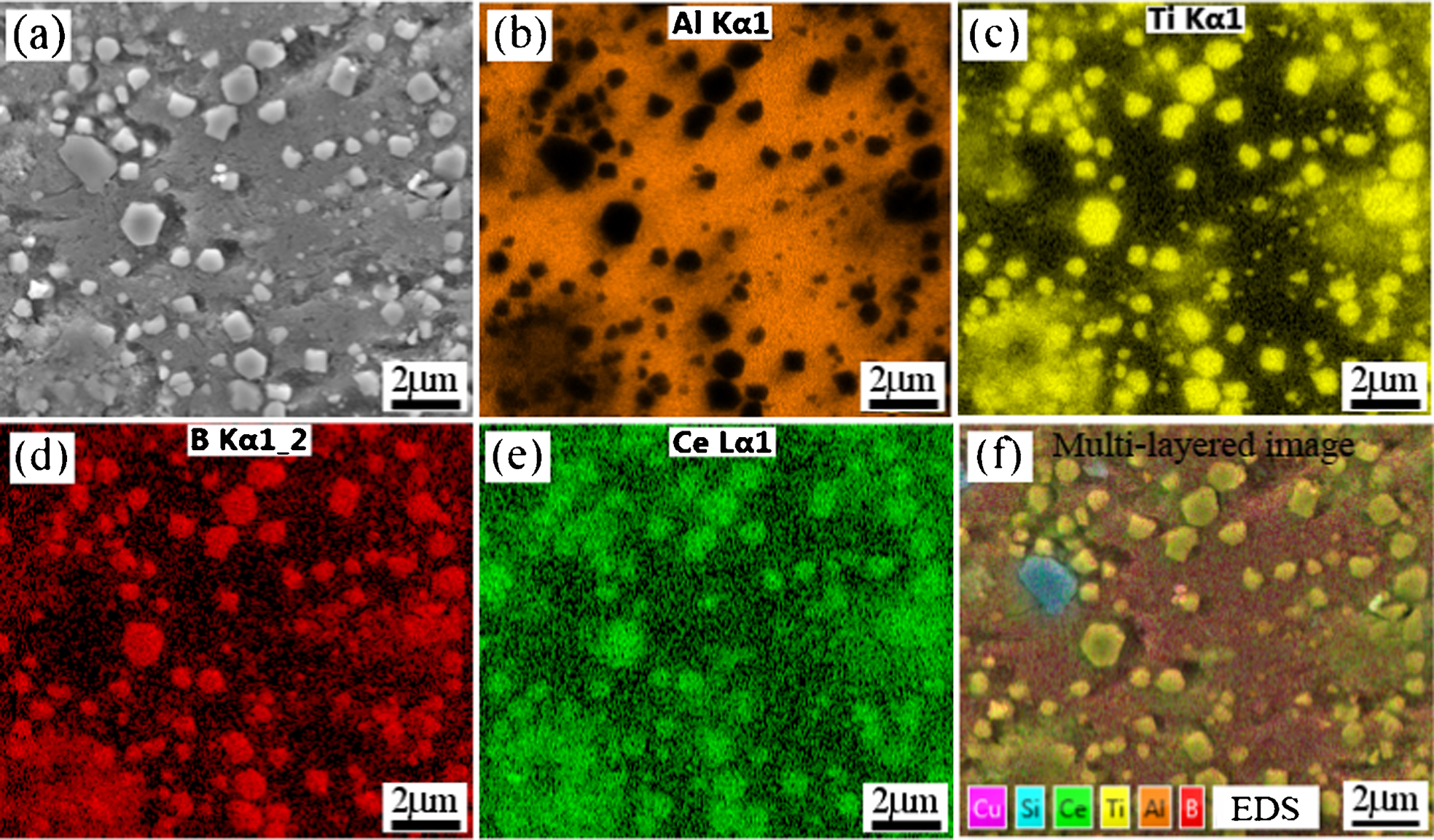
a SEM microstructure and b–f element planar distribution of polished surface of composite with CeO2
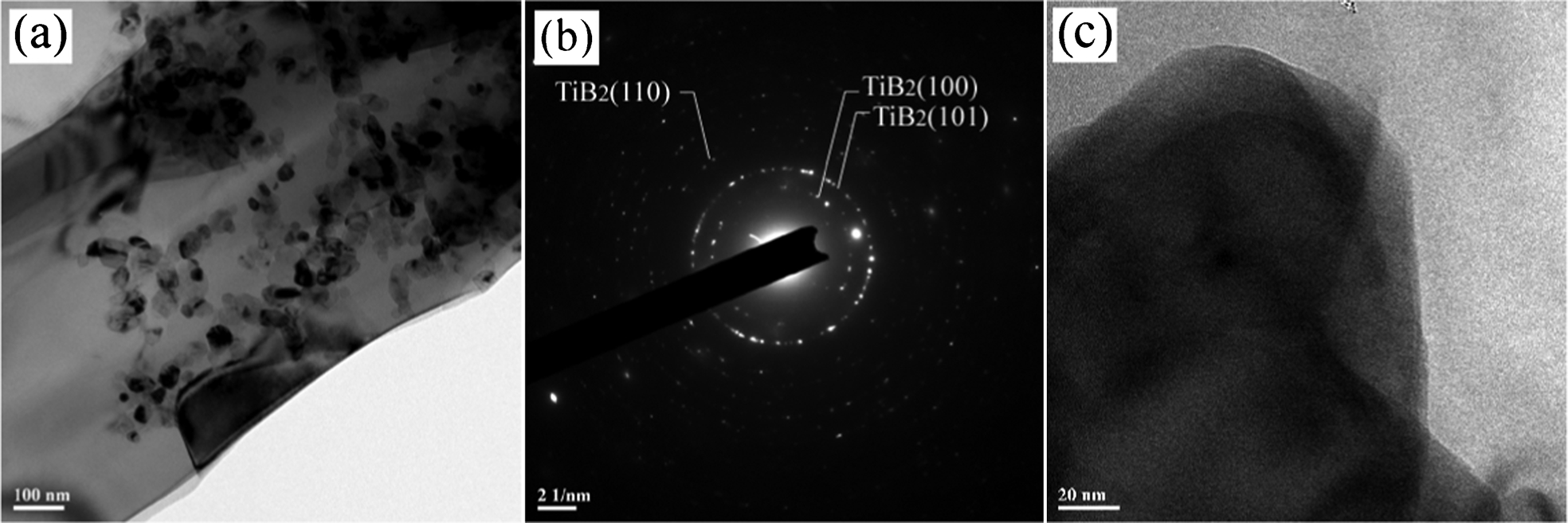
Bright field images (TEM) of a composite with CeO2, b corresponding selected area diffraction pattern and c Al/TiB2 interface
Interfacial energy calculation of Al–Ce/TiB2 interfaces
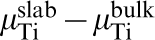
To further analyse the effect of surface active Ce element on the interfacial energy of Al/TiB2 interfaces in a thermodynamic sense, the interfacial energy of Al–Ce/TiB2 interfaces was calculated. The calculation methodology in the literature25,31,37 was employed in this paper, wherein the chemical potentials of Ti, B and Ce atoms were taken into account. The interfacial energy, γ, can be given by the following equation:

 ,
,  and
and  are the chemical potentials of the bulk TiB2, Al and Ce respectively;
  is the chemical potentials of Ti in the slab; and
  and σAl are the surface energies of TiB2 and Al respectively. Parameters used for the calculation of interfacial energy are given in Table 1. The interfacial energy of Al–Ce/TiB2 interfaces can be obtained by equation (4) and is compared with that of the Al/TiB2 interfaces reported in our earlier study,
18
as shown in Fig. 5. It is seen that the interfacial energy of Al–Ce/TiB2 interfaces is lower than that of Al/TiB2 interfaces over the entire range of the Ti chemical potential.
and σAl are the surface energies of TiB2 and Al respectively. Parameters used for the calculation of interfacial energy are given in Table 1. The interfacial energy of Al–Ce/TiB2 interfaces can be obtained by equation (4) and is compared with that of the Al/TiB2 interfaces reported in our earlier study,
18
as shown in Fig. 5. It is seen that the interfacial energy of Al–Ce/TiB2 interfaces is lower than that of Al/TiB2 interfaces over the entire range of the Ti chemical potential.
Interfacial energies of Ti terminated HCP Al/TiB2 interfaces and Al–Ce/TiB2 interfaces as function of
, i.e. difference between Ti chemical potential in slab and its value for pure Ti bulk phase; vertical dashed lines indicate ultimate Ti chemical potential values where bulk TiB2 could form
Parameters used for calculation of interfacial energy of Al–Ce/TiB2 interfaces

 /eV
/eV /eV
/eV /eV
/eV /eV
/eV /J m−2
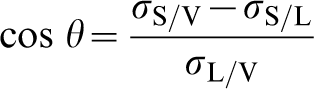
According to Young's equation38,39
Conclusions
The roles of CeO2 additive in TiB2/Al composite have been investigated by experiment and first principles methods. It is found that TiB2 particles in the composite melt without CeO2 additive are in a form of agglomerations, while the particle dispersion is evidently improved and the isolated TiB2 particles exist in composite melt with CeO2 being added. The CeO2 additive reacts with Al melts to release Ce solute in the composite melt. The absorption of the released surface active Ce element in the Al/TiB2 interfaces without any other reaction products is responsible for the reduction of the interfacial energy of Al/TiB2 interfaces. Thereby, the wettability of molten Al on TiB2 surface is improved and the dispersion of TiB2 particles in composite melt is improved. It is proved that the interfacial energy of particles/matrix interfaces plays an important role in governing the dispersion and agglomeration of reinforced particles in the metal matrix.
Footnotes
Acknowledgments
The authors wish to acknowledge the support of the National Natural Science Foundation of China (grant nos. 51001074 and 51274141) and National High Technology Research and Development Program of China (863 project) (grant no. 2008AA03A239). At the same time, the authors are grateful to the Instrumental Analysis Center of Shanghai Jiao Tong University for help in microstructure analysis.