







Abstract
Casting of titanium can be successfully used in prosthodontic applications, but it demands special machines and protection gas to avoid oxidation of the metal. The aims of this study are to investigate the bond compatibility between porcelain and titanium using three-point bending, oxide adherence and thermal expansion tests, and to compare the results with those of a conventional titanium–porcelain system. Titanium alloy surfaces were modified with Nb, YG8 and silicon electrode by electrospark surface modification process. The effect of electrospark surface depositing (ESD) layers on bond strength of titanium to porcelain was evaluated comparatively. Some reasons about bond strength of titanium to porcelain were discussed. Results indicate that ESD modified layer prepared in atmosphere using Si electrode can obtain the strongest bonding to porcelain. The ESD modified layer show metallurgical bond to Ti substrate. In addition, the facts that rough surface can help to improve physic bond, similar nature can also help to chemical link and compact ESD layer represent good high temperature oxidation resistance are the reasons that enhance good bond strength of titanium to porcelain.
Introduction
Metal–porcelain restorations have been used successfully in prosthodontic applications for several years because of their several advantages, such as low density, appropriate mechanical properties, good corrosion resistance, self-cleaning effect and excellent biocompatibility.1,2 Recently, noble alloys have gradually been replaced by base metal alloys. Titanium has been used in metal–porcelain restorations due to low weight, high strength/weight ratio, good corrosion resistance, excellent biocompatibility, low thermal conductivity and reasonable price. Casting of titanium can be carried out, but it demands special machines and protection gas to avoid oxidation of the metal. However, there are many pending problems on titanium–porcelain bonding. Some titanium–porcelain systems appear to be susceptible to oxide layer, which can cause weaker bond strength. In addition, other factors affecting titanium–porcelain bond to be considered are listed as follows:
growth of an oxide layer on titanium at elevated temperatures
adherence of the self-formed oxide to the titanium substrate
bonding by fusion of the self-formed oxide to the porcelain
stress developed at the interface because of an mismatch in thermal expansion coefficients.3,4
Among these drawbacks,5–7 the inferior behaviour of titanium/porcelain interfacial bond is an especially fatal key, resulting in the restricted reliably use of titanium–porcelain. The success of the titanium–porcelain restoration depends acutely on the success of the bonding between porcelain and titanium. Acceptable restorations require titanium and porcelains to be chemically, thermally, mechanically and aesthetically compatible. 8
An effective strategy for improvement of titanium–porcelain adherence is the use of a suitable intermediate layer, which may prevent excessive oxidation at firing temperature and obtain superior the system integrity. In order to strengthen the titanium–porcelain bonding strength, Cai et al. characterised the effects of surface modifications on cast titanium surfaces and titanium–porcelain adhesion. 9 Hussaini and co-workers reported the bond strength between a low fusing porcelain and commercially pure cast titanium by using airborne particle abrasion and hydrochloric acid. 10 Their results indicated that the combination of airborne particle abrasion and bonding agent provided the greatest improvement in titanium–porcelain bond strength. Analyses by SEM/EDS and microhardness measurements indicated that the surface changes on the cast commercially pure (CP) titanium after the surface modifications. Modifications of cast CP titanium surfaces with aqueous caustic baths are simple and effective ways to improve titanium–porcelain adhesion. In other references, Cr, 11 NbN, 12 TiAlN (Ref. 13) and ZrSiN (Ref. 14) were also used to improve titanium–porcelain adhesion. However, there are still some disadvantages in the modification technology such as in the sake of clinical reliability, safety and cost. 15 In our research opinion, titanium alloy surfaces have been modified by electrospark surface deposited (ESD) modification process, and ESD induces an infiltration of the electrode materials to the substrate surface, forming high strength and superior corrosion resistance with the high frequency power. 16 Thus, a strong metallurgical union combination can exists between the deposited layer and the substrate to avoid the dangers of hydrogenated titanium.
The purpose of this study was to investigate the effect of ESD layers on the bonding strength of titanium–porcelain and develop a new method to solve the modification of titanium alloy surfaces. To our knowledge, this is the first report investigating the use of titanium–porcelain for increasing the bond strength by ESD, which has been widely used in the treatment of titanium surface due to low cost and simple operation.
Experimental
Materials and methods
Substrate materials used were titanium alloy Ti–6Al–4V, with the following nominal composition (wt): Ti–6·03Al–4·02V–0·3Fe–0·1C–0·01H–0·05N–0·1O. Specimens were cut into 25×3×0·5 mm. The surfaces were polished with abrasive SiC papers of 240–1000 grit and ultrasonically washed in by ethanol and pure water.
Electrospark surface deposited modified layer was prepared by ESD with SQ-2 type strengthening equipment. For the treatment, the pulse power supply was employed. Nb with Φ5 mm diameterand YG8 (92WC+8Co) hard alloy and Si with Φ3 mm diameter were used as deposition electrodes. The samples as the cathode were modified in silicone oil medium or in air to prepare interlayer. Before porcelain, the materials were prepared by machinery and Al2O3 sand blasting of 50 μm (at a pressure of 0·2 MPa, from a distance of 1 cm, with a 45° angle). The preparation of the materials includes mechanical polishing and cleaning in acetone, ethanol and distilled water by ways of ultrasonic for several times and dried at room temperature for microstructure characterisation and porcelain application.
For casting titanium alloy specimens, thin bonding porcelain (super porcelain Ti-22 powder, Noritake) was applied to the central portion (8×3 mm) of the specimen surface. According to the protocol ISO 9693, after the porcelain was fired, 0·2 mm opaque porcelain was applied in a masking layer, as it was a common practice with the porcelain fused to metal technique, and fired. 0·8 mm dentin porcelain was applied onto opaque porcelain using a custom-made jig that controlled the position and the thickness of the porcelain.
After firing, the bond strength test was performed with a three-point bending device on a universal testing machine. The specimens were placed with the porcelain facing down in the bending apparatus with rounded supporting rods 20 mm apart and loaded at the centre with a rounded bending piston (radius, 1·0 mm). Force was applied at a constant rate of 0·5 mm min−1. The fracture force Ffail (N) was measured for failure of specimen by a deboning crack occurring at one end of the porcelain layer. The debonding/crack initiation strength τb was calculated by the equation τb = k×Ffail, where the coefficient k was a function of the thickness of the metal substrate and the value of Young's modulus of the used metallic material (k = 4·7).
Low fusing porcelain for titanium was used, and the sintering conditions are shown in Table 1. For increasing sintering temperatures, the porcelain layer thickness decreases. The porcelain at 800°C generated the thinnest film. Moreover, regardless of the sintering temperatures, surfaces were least susceptible to oxidation as it was specimens.
Sintering conditions of titanium–porcelain

Characterisation
The surface morphology and the cross-section structure of ESD modified structures were evaluated by SEM (JSM6460, JEOL, Japan). The element composition analysis of the fractured face was evaluated by an energy dispersive X-ray spectroscope (INCA-300, Oxford, UK). X-ray diffraction measurements were carried out on a D/max-2200pc X-ray diffractometer (Rigaku, Japan) Cu K α (λ = 0·154 nm) radiation at 40 mA. The diffractograms were recorded in the 2θ range of 20–90° with a 2θ step size of 0·02°. The microstructure of the coating layer was analysed by the glow discharge spectrum on a GDA-750 glow discharge spectrometer (Germany). According to ASTM G54-77, a high temperature oxidation experiment of the ESD layer is also carried out, which is a static oxidation test. The sample is placed in the resistance furnace and oxidised for 100 h. The loss of weight was measured in a high precision electronic analytical balance (Shimadzu AUW220D).
Results
Performance of modified layer by ESD
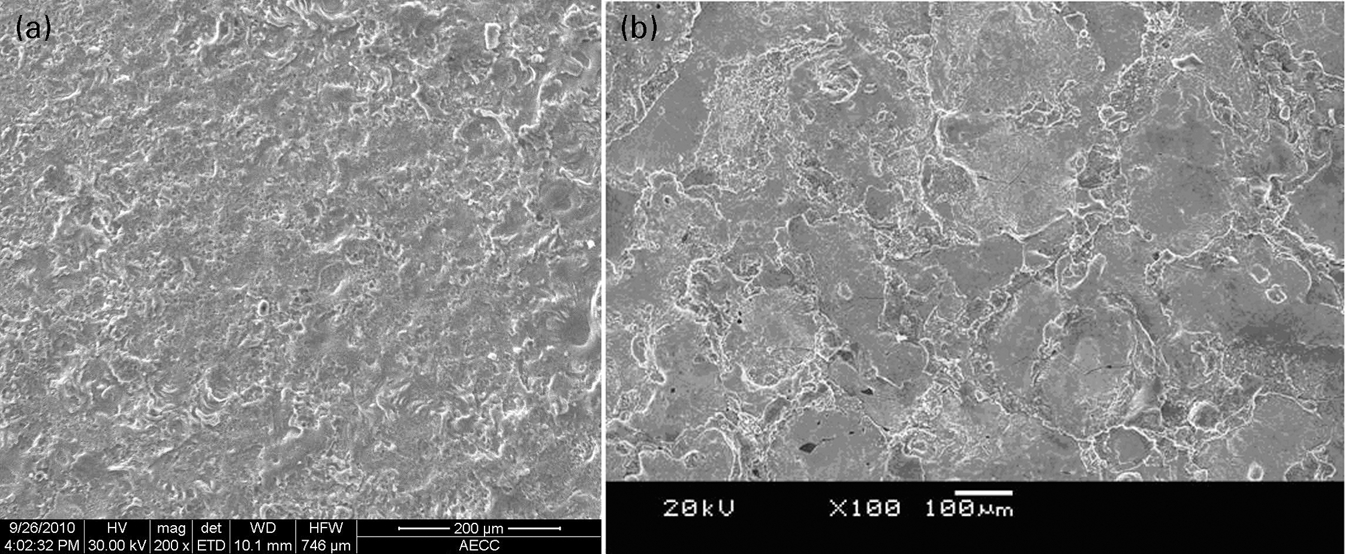
Figure 1 represents a cross-section of a control specimen before and after sandblasting. It indicated that the electrode material transferred to the titanium alloy surface and formed complex compounds in the discharge process. Those compounds, derived from electrode and substrate materials, transformed the strengthening point under the cooling effect and then the electrode surface coated at the substrate surface to form a strengthening layer with the electrode repeatedly discharging gradually. The results show that the ‘melting’ characteristics of deposited layers prepared by Nb/YG8 electrodes in the air and Si electrode in the silicone oil are obvious, and their roughness of deposited layer is small. However, deposited layers prepared by Si electrode in the air is increased (Ra is 1·45 μm) and show globular fungi form characters. It is not only attributed to the splash degree for the reactants in the air and the silicone oil medium, it is but also relative to the thermal pulverisation and mechanical wear for Si electrode in discharge treatment process. In addition, the modified layer prepared in the air is easier to crack than that in the silicone oil, which is a common phenomenon in the deposition of titanium electrospark.
a before sandblasting; b after sandblasting
General properties of different ESD layers on the titanium alloy surface are shown in Table 2. Compound compositions of intermediate layer were confirmed by X-ray diffraction results analysis. The thicknesses of titanium under different conditions were calculated according to the conventional cross-sectional metallographic examination method. Those results suggested that the thickness of the materials is dependent on the electric parameters, time and the environmental factors.
General properties of ESD on titanium alloy surface
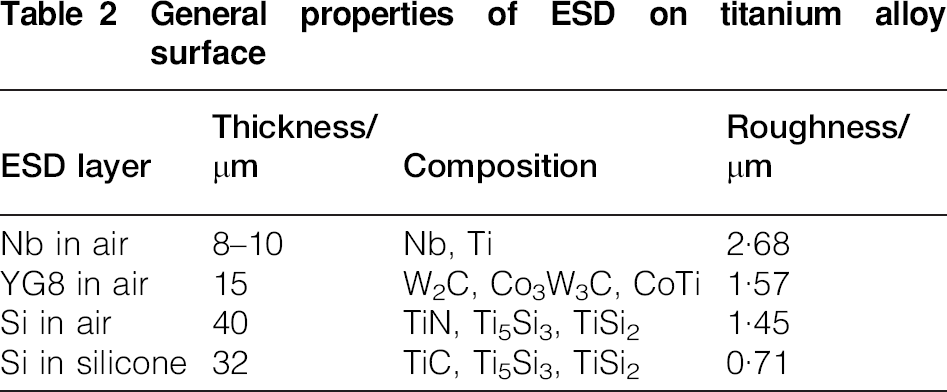
Nb was deposited to form the mutual soluble layer, while the modification of the cemented carbide electrode is the formation of carbides and metal compounds. The main component of deposition layer is porcelain for Si electrode in the two media. The roughness and the thickness of the two former are increased, which is attributed to the discharge parameters and discharge splash. However, the roughness of the latter two is decreased, due to the delay in semiconductor silicon discharge and the electrode pulverisation. The results also show that both N and Si are involved in the reaction under the air and silicone oil environment.
Figure 1b shows that the pollutants on the surface can be effectively removed with Al2O3 sandblasting treatment. It is beneficial to bond for the titanium–porcelain. The competition between skinning and coursing could improve the effective area of mechanical bonding (the value of the Ra for the modified Si layer in the air decreased to 1·05 μm).
From the section of the ESD layer, the layer and the substrate are bound tightly, without obvious boundaries. Figure 2 shows the typical morphology of the Si layer profile. It is indicated that the strengthening layer combined well with the substrate. Figure 3 is the elemental distributions along the depth of ESD layers in silicone oil. The results show that the composition of the modified layer changes gradient, which shows that the modified layer has both the composition of substrate and electrode after the metallurgical reactions. The ESD processing integrates the deposition layer and the substrate into a new system, achieving the combination of the atoms, which is the guarantee for the titanium–porcelain bonding.
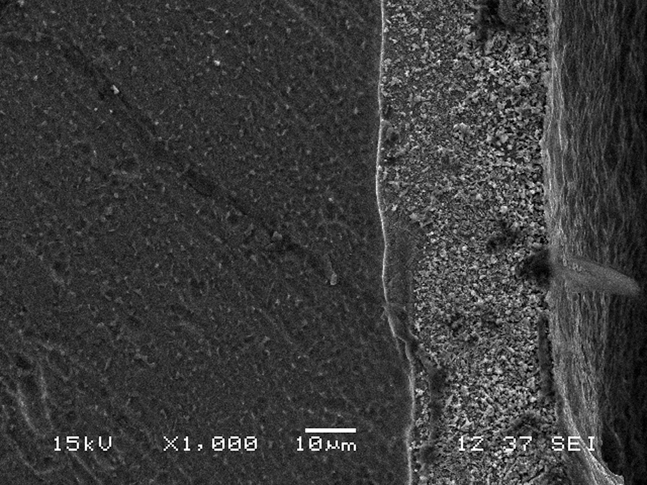
Imagine (SEM) of cross-section of specimen prepared by Si electrode in silicone oil medium
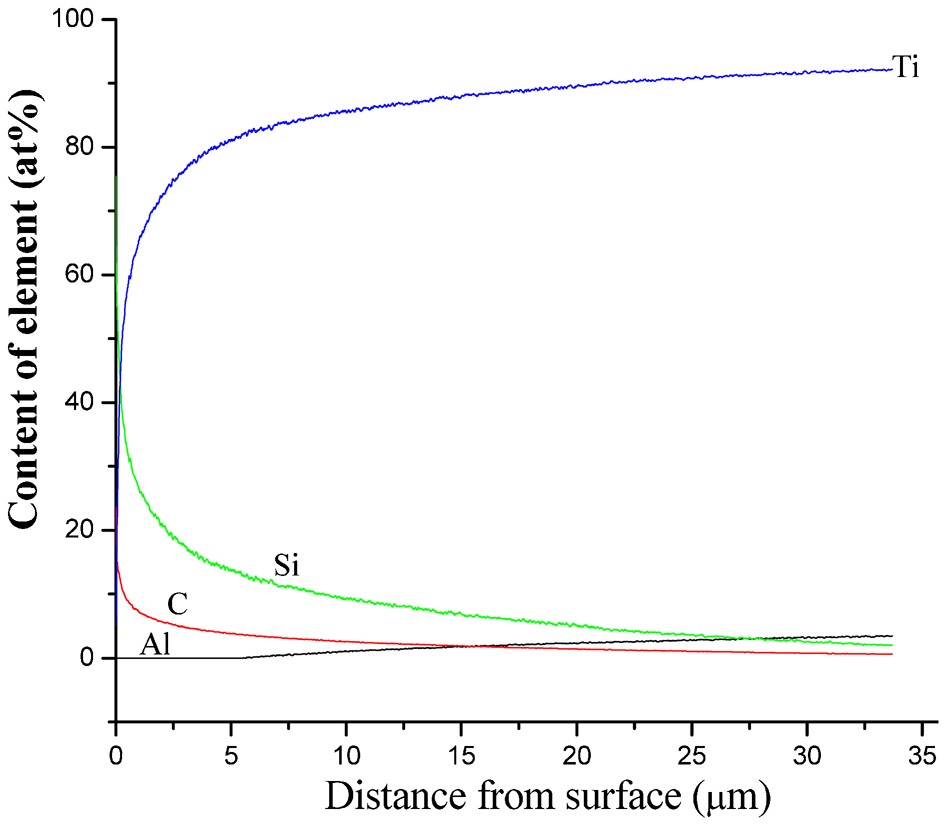
Elemental distributions along depth of ESD layer prepared by Si electrode in silicone oil media
Bond properties for titanium–porcelain
Figure 4 shows the bonding properties of the modified layer for the different depositions of titanium–porcelain. The bonding strength for Si in the air is optimality condition, which has improved significantly for titanium–porcelain bond strength (increased by 42). While the bonding strength for YG8 and Nb is similar with the Si in the air, which is improved ∼30 and 25 respectively. This trend is in good agreement with previous observations about the substrate binding strength. 17 Based on the results, the appropriate ESD can enhance the titanium–porcelain to meet the clinical needs.
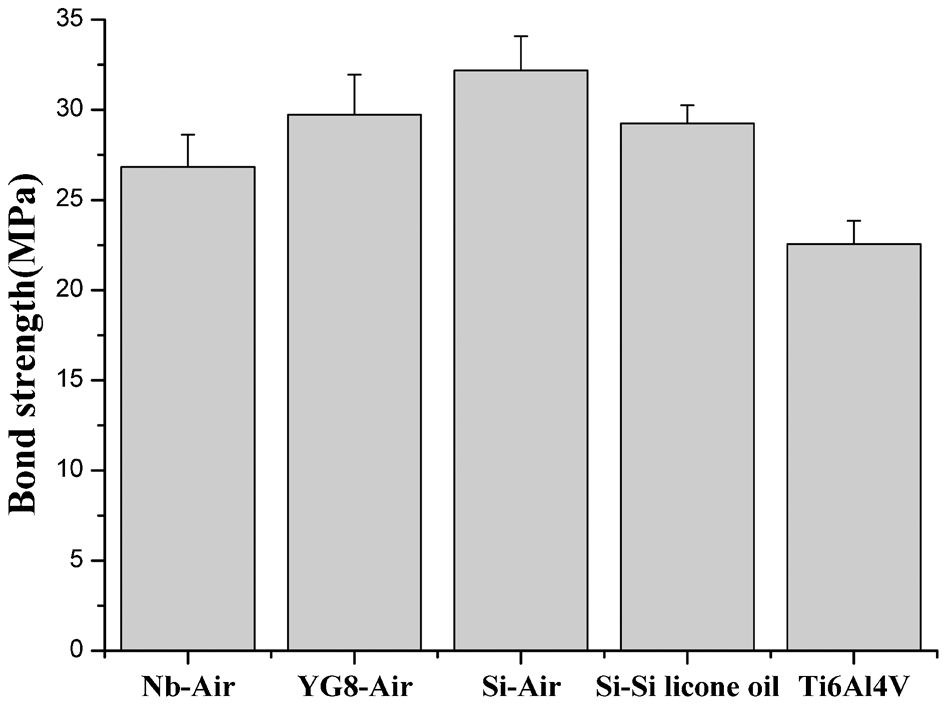
Bond strength comparison of all specimens
Images (SEM) of the titanium/porcelain interfaces are shown in Fig. 5. The images of the cross-section of the tested base titanium–porcelain specimens demonstrated that the interface of the titanium specimen had less porosity than that of the sample sintered conventionally.
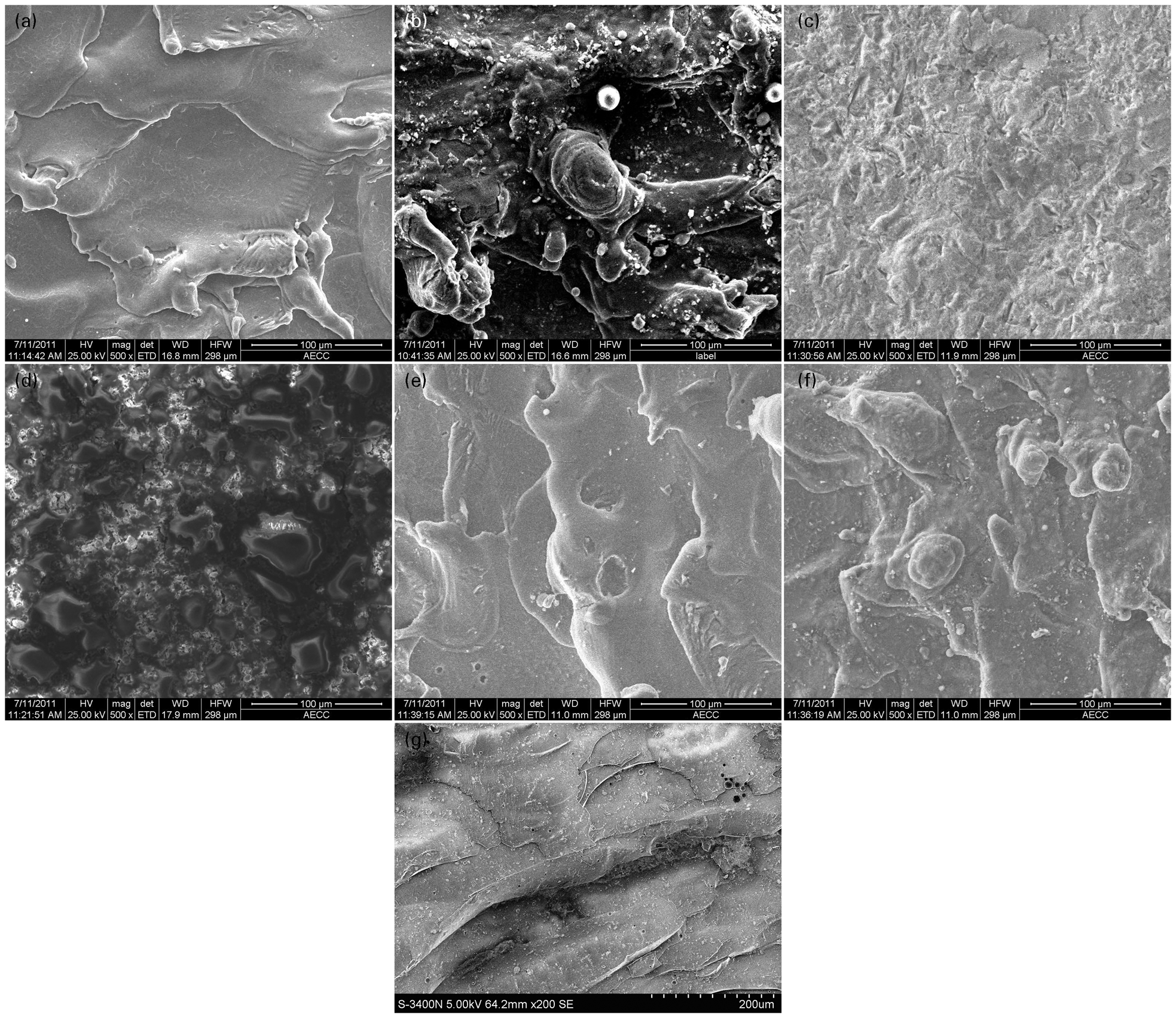
a titanium sintering treatment; b titanium debonding; c YG8 modification layer sintering treatment; d YG8 modification layer debonding; e Nb modification layer sintering; f Nb modification layer debonding; g Si modification layer prepared in air debonding
In fact, a white layer of Ti oxide may form at porcelain sintering temperature on uncoated titanium by physical examination. If removing the oxide with tweezers, it demonstrated that the oxide was extremely non-adherent. Figure 5a showed that the titanium surface, without using a bonding agent, had a poor metal–porcelain bond. The titanium–porcelain systems using modification such as YG8 and Nb showed better bonding and interfacial characteristics (Fig. 5d and f). The titanium–porcelain system exhibited an appearance of metal/porcelain interface similar to that of the titanium surface system only after sintering treatment (Fig. 5c and e). Lower bond strength between titanium and different porcelains was reported previously by others. In the present study, the bond strengths of the titanium–porcelain specimens are increased.
The characteristics of the residual porcelain on the separation interface are observed due to the similar properties of the roughness. From the section of ESD layer in the. 5g, the fracture mode for titanium–porcelain is the mixed fracture of adhesion and cohesion. The images of the titanium surface after debonding demonstrated residual porcelain retained on the metal surface for all groups. This observation indicates a combination of cohesive and adhesive bond failures. However, more traces of porcelain were observed on specimens that were treated with the combination of airborne particle abrasion and bonding agent, which may indicate that the failure was primarily adhesive for the rest of the groups.
Imaged of cross-sections of tested specimens demonstrated that the fracture line was located more often between ceramic and metal for all the groups except for specimens that were treated by the airborne particle abrasion and bonding agent combination, where the fracture line, in some areas, occurred primarily within the porcelain material.
Bond strength factors for titanium–porcelain
Based on the above analyses, it is obvious that for protective coating is essential to prevent the formation of excessive titanium–porcelain in order to maintain a compact bond of Ti and porcelain. Because titanium possesses large negative Gibbs energy of oxidation, continued oxidation could occur resulting from reduction of the oxides in the porcelain via displacement reactions. Therefore, porcelain induced oxidation at elevated temperature may result in a substantial decrease in oxide adherence to titanium. Up to now, there is limited information regarding the bonding strength between dental porcelain and titanium. Many researchers are concerned about the effective methods to improve the titanium–porcelain bond.
Improved titanium–porcelain bond strength on sandblasted titanium surfaces is the key to the surface engineering. Since the titanium can be involved by the substrate at the high temperature, titanium–porcelain compatibility is important in the making of ceramic–metal restorations.
In the studies on high temperature processing of titanium substrate and the interface coordination, the most important is how to inhibit the oxidation in the process of high temperature porcelain. Therefore, many methods are used to resist the oxidation, such as preoxidation, 18 the oxygen coatings (Au, Cr, NbN, TiAlN and ZrSiN) and microarc oxidation. Among them, the ESD layer of silicone oil in the preparation is better than the sedimentary layers in the air dense and integrity, which have better high temperature oxidation resistance. High temperature oxidation resistance of Nb and carbide modified layer is also good and thus effectively protects the oxidation of the titanium alloy substrate to reduce the bond strength. Figure 6 shows the high temperature oxidation behaviour comparison of ESD layers by Si electrode (750°C). The results indicate that the basis for the titanium–porcelain strong binding is the excellent antioxidant ability. Among them, the ESD layer prepared by Si oil shows the best antioxidant ability with the compactness and integrity, which can protect the titanium alloy substrate to reduce the bond strength.
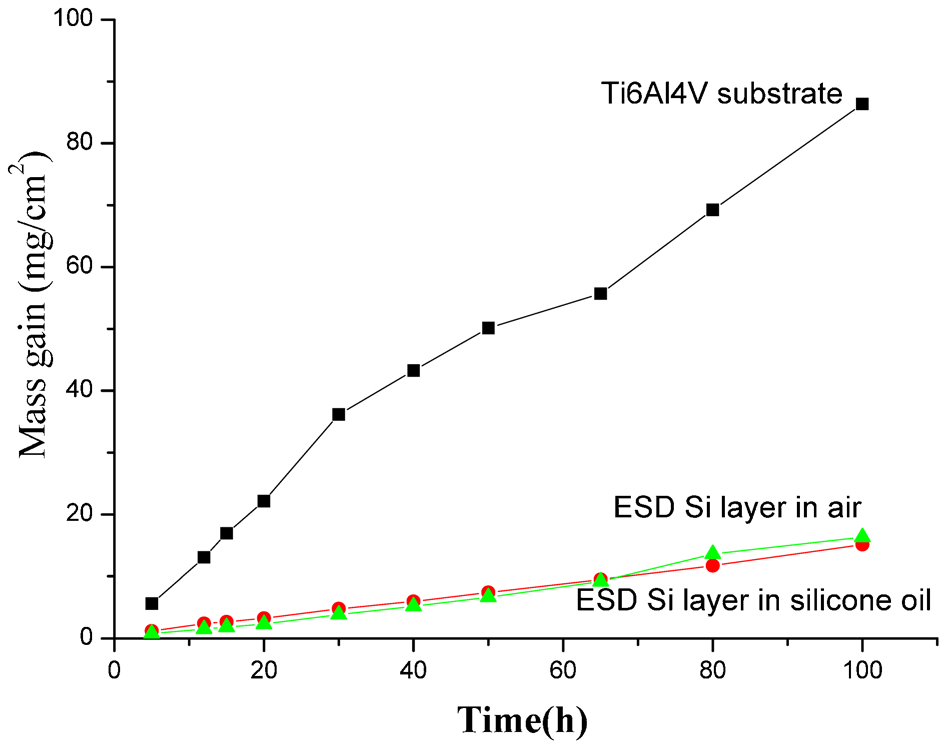
Comparison of oxidation behaviour of ESD layers at 750°C
The oxide layer formed after pretreatment process gave rise to the occurrence of chemical bonding at the titanium–porcelain interface during sequential firing, thereby preventing the initiation of failure from taking place at this interface.
The results demonstrated that there was a strong chemical correlation between oxide adherence and area fraction of retained porcelain on the titanium at high temperature. When an oxide layer was of insufficient thickness to prevent complete dissolution by the fusing porcelain, the porcelain came into direct contact with the alloy surface, leading to poor adherence. Könönen and Kivilahti elucidated that the Si component of porcelain could diffuse through the thin oxide layer into the bulk titanium, whereby forming the brittle ESD layer of Ti5Si3 containing some oxygen. This situation resulted in the absence of porcelain remaining on the metal substrate.
The ESD layer could react to improve the interface effect, which is the similar process of the sintering on the porcelain compound and dental porcelains. The metallurgic reaction can make a great change of the interatomic fusion to enhance the bond strength for titanium–porcelain.
In order to realise the transition fusion of heterogeneous materials, we also study the effect of titanium–porcelain bonding on metals, porcelains and metal compounds containing porcelain material substances. It proved that the failure of the titanium–porcelain predominantly occurred at the titanium/oxide interface. The ESD layer was more strongly bonded to the porcelain than titanium. The poor adhesion of the ESD with the substrate was due to the thermal stress arising from large lattice mismatch and the large difference in coefficient of thermal expansion between Ti and layer during cooling.
In addition, the mechanical riveting cooperation is also able to help improve titanium–porcelain bond strength. The roughness of the ESD for Nb modified layer increases the effective area of the connection. The rough surface of titanium–porcelain by ESD modification is easy to form a chemical connection.
Conclusions
Within the limits of this study, the following conclusions were drawn.
The titanium–porcelain bonding strength can be improved by ESD with Si electrode, which has increased by 42 significantly.
Electrospark surface deposited layer prepared in air with Si electrode was metallurgy strong connection with titanium. The rough surface not only enhances the physical combination with the porcelain but also improves the titanium–porcelain bonding strength with chemical combination.
The results of the oxide adherence test showed that the oxides formed on the alloys examined in the present study are sufficiently adherent to their substrates to produce adequate porcelain bonds.
The matching of titanium–porcelain combinations appeared to be the main factor for an optimal metal–porcelain bond.
Footnotes
Acknowledgements
The authors are grateful to Professor D.X. Liu for giving research support. We are also grateful for financial support from the National Natural Science Foundation of China (grant no. 51278407) and the State Key Program of Shaanxi Province Natural Science Foundation Project (grant no. 2012JZ7003).