







Abstract
Spinel LiSr0·1Cr0·1Mn1·8O4 was synthesised by high temperature solid state method in order to enhance the electrochemical performance. The LiSr0·1Cr0·1Mn1·8O4 (LSCMO) materials were characterised by X-ray diffraction (XRD), scanning electron microscopy (SEM) and electrochemical tests. The XRD and SEM studies confirm that LSCMO had spinel crystal structure with a space group of Fd3m, and the particle of LSCMO shows irregular shape. The cyclic voltammetry data illustrated that the heavy current charge–discharge performance of LMO was improved by Sr2+ and Cr3+ doping. The galvanostatic charge–discharge of LSCMO cathode materials was measured at 1, 5, 10 and 20 C. The results indicated that LSCMO improved the capacity retention.
Introduction
Spinel LiMn2O4 (LMO) 1 is one of the most development prospect anode for rechargeable lithium batteries. Compared with other anode such as LiCoO2,2,3 LiNiO2,4,5 LiNi0·5Mn1·5O4,6,7 Li2S,8–10 LiFePO4 and 11,12 spinel LMO exhibits many advantages such as non-toxic, higher energy density and environment friendly.13–15 However, LMO suffers fast capacity during cycling, especially at high load charge–discharge.16,17 Following are the reasons for the disadvantage:18–19
the slow dissolution of manganese due to LiPF6 and H2O in the electrolyte21,22
the low conductivity of the LMO leads to difficulties in deintercalation of Li+.
In recent years, many researchers all over the world have made great efforts to improve the cycling performance of LMO at high load charge–discharge.24,25 One of the most important aspects is the substitution of a heterogeneous atom into the host LMO structure of cathode materials, 26 doping Fe3+, 27 Co3+,28,29 Al3+,30–34 Cr3+,35,36 Ti2+,37,38 Li+, 39 Zn2+, 40 Mg2+, 41 Ga3+, Ni2+ 40,42 Se2+, 43 La3+ (Refs. 44 and 45) and so on, which contributes to the improvement of conductivity of the cathode materials as well as the electrochemical performance of the battery. The abjection and insertion of Li+ are easier because the size of the abjection and insertion channel of Li+ was changed. The other is surface modification; 26 it is an effective way to improve cathode performance. The most commonly used coating materials are metal oxides, such as La2O3, 46 CaO, 47 ZnO, 48 Al2O3, 49 MgO, 50 Cr2O3, 51 etc.
In the present study, we have focused on how the cycling and high current charge–discharge performance can be effectively improved by Sr2+ and Cr3+ doping. LiSr0·1Cr0·1Mn1·8O4 (LSCMO) spinel has been prepared by high temperature solid state method, which is commonly used in industry.
Experimental
Preparation for lithium ion secondary battery by Sr2+ and Cr3+ doping
The LSCMO powder was prepared by solid state method, Li(CH2COO).2H2O [analytical reagent (AR) pure], Mn(CH2COO) .4H2O (AR pure), Sr(NO3)2 (AR pure) and Cr2O3 (AR pure) were mixed into ball mill at the mole ratio of Li/Mn/Si/Cr (1·1∶1·8∶0·1∶0·1) (extra lithium was added for its consumption in preparation by the solid state method). The mixture was preheated for 4 h at 450°C at a heating rate of 2°C min−1 within an atmosphere furnace, followed by reheating at 750°C for 40 h at a heating rate of 4°C min−1 to get pure LSCMO powder.
Physical characterisation
X-ray diffraction (XRD) was performed on a DX-2700 X-ray diffractometer with Cu Kα radiation sources (1·5406 Å). X ray diffraction measurements were carried out by step scanning with an angular range of 10–90° and a step width of 0·03°. The chemical composition of the powder was analysed by inductively coupled plasma–atomic emission spectroscopy (ICP-AES). The particle morphologies were examined using an EVO-18 SEM with a microscope magnification of ×10 000 at a voltage of 20·0 kV. Electron diffraction spectroscopy (EDS) was applied to determine the elements of powders together with SEM in large field of view.
Electrochemical characterisation
The electrochemical measurements were carried out on half cells. A mixture of 80 wt- of each active material and 10 wt- of acetylene black was added to an N-methyl-2-pyrrolidene solution containing 10 wt- of polyvinylidene fluoride. The slurry was then coated on an aluminium current collector. Then, the slurry was dried at 80°C for 18 h in a vacuum chamber. The coated cathode foil was pressed and cut into circular sheets of 16 mm diameter.
The experiment cells were packaged in an Ar filled glovebox. The cell comprises a positive electrode, a diaphragm Celgard2300 as the separator, a piece of lithium plate as anode electrode and 1M LiPF6 dissolved in a mixture of ethylene carbonate and dimethyl carbonate (volume ratio of 1∶1) as the electrolyte. The experiment cells were charge–discharge on a battery tester (CT3008W-5V 5mA-S 4, china) between 3·00 and 4·35 V(Li/Li+) with a current density of 1, 5, 10 and 20 C. Cyclic voltammetry (CV) studies were carried out at a scan rate of 0·10 mV s−1 between 3·20 V and a maximum value of 4·40 V using electrochemical workstation (CHI600D).
Results and discussion
Analysis of XRD
Figure 1 shows the XRD patterns of LSCMO, LMO mixed Sr(NO3)2, Cr2O3, Cr2O3 and Sr(NO3)2. The LSCMO powder has a well defined spinel structure with a space group of Fd3m.46,52 It is found that the diffraction peaks at 2θ = 19·22, 36·75, 37·88, 44·79, 48·45, 58·16, 64·76 and 68·89° are relative to the crystal planes of (1 1 1), (3 1 1), (2 2 2), (4 0 0), (3 3 1), (5 1 1), (4 4 0) and (5 3 1). No impurity is detected. Compared with the XRD of LSCMO and LMO mixed Cr2O3 and Sr(NO3)2. It is clear that LSCMO is significantly different from LMO mixed Cr2O3 and Sr(NO3)2. It is indicated that doping is different from mixture. The lattice parameters and ICP-AES data of LMO and LSCMO are summarised in Table 1. The full width at half maximum (FWHM) values of the (400) diffraction lines of LMO decline with Sr2+ and Cr3+ doping. This indicates that the LSCMO might have higher crystallinity, better ordering of local structure and lower lattice strain. 53 The compositions of the LMO and LSCMO were determined to be Li1·12Mn1·89O3·98 and Li1·09Sr0·09Cr0·11Mn1·88O3·94.
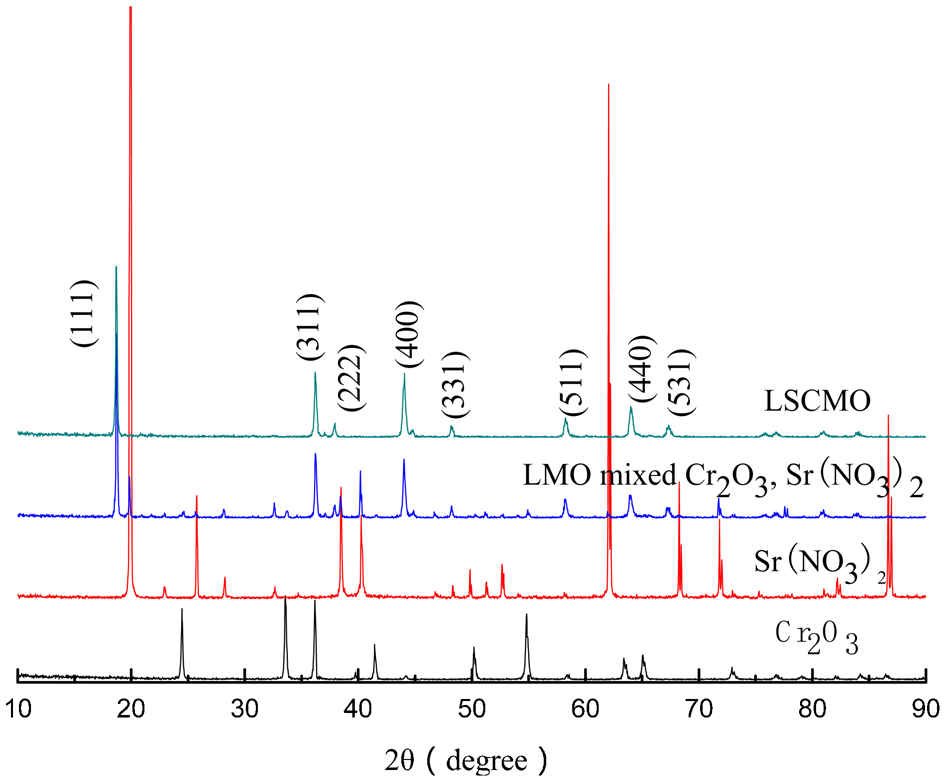
X-ray diffraction patterns of samples
Average lattice constants and FWHMs at (400)

Scanning electron microscopy and EDS
The morphology of samples was investigated using SEM and EDS. It can be seen that the LMO powders are in the order of 200–1000 nm from Fig 2a. Figure 2b and c showed the SEM of LiCr0·1Mn1·9O4 and LiSr0·25Mn1·75O4. Thirunakaran found that, at lower chromium concentrations (x = 0·10 and 0·20), the particles remain as fine of average grain size below 500 nm. Subramania explained that product is porous in nature. This feature facilitates easy access of battery electrolyte and thereby increases the number of active sites, which is desirable for good battery activity. 54 The particles of LSCMO show irregular shape and are uneven from 800 to 2000 nm (Fig. 2d). The diameter of particle size increases after Sr2+ and Cr3+ doping. In the EDS image (Fig. 2e), Au element is detected because the sample was sprayed gold during processing. There are Sr and Cr elements in addition to the Li, Mn and O signals. This indicated that Sr and Cr element exist as part of LMO morphology.
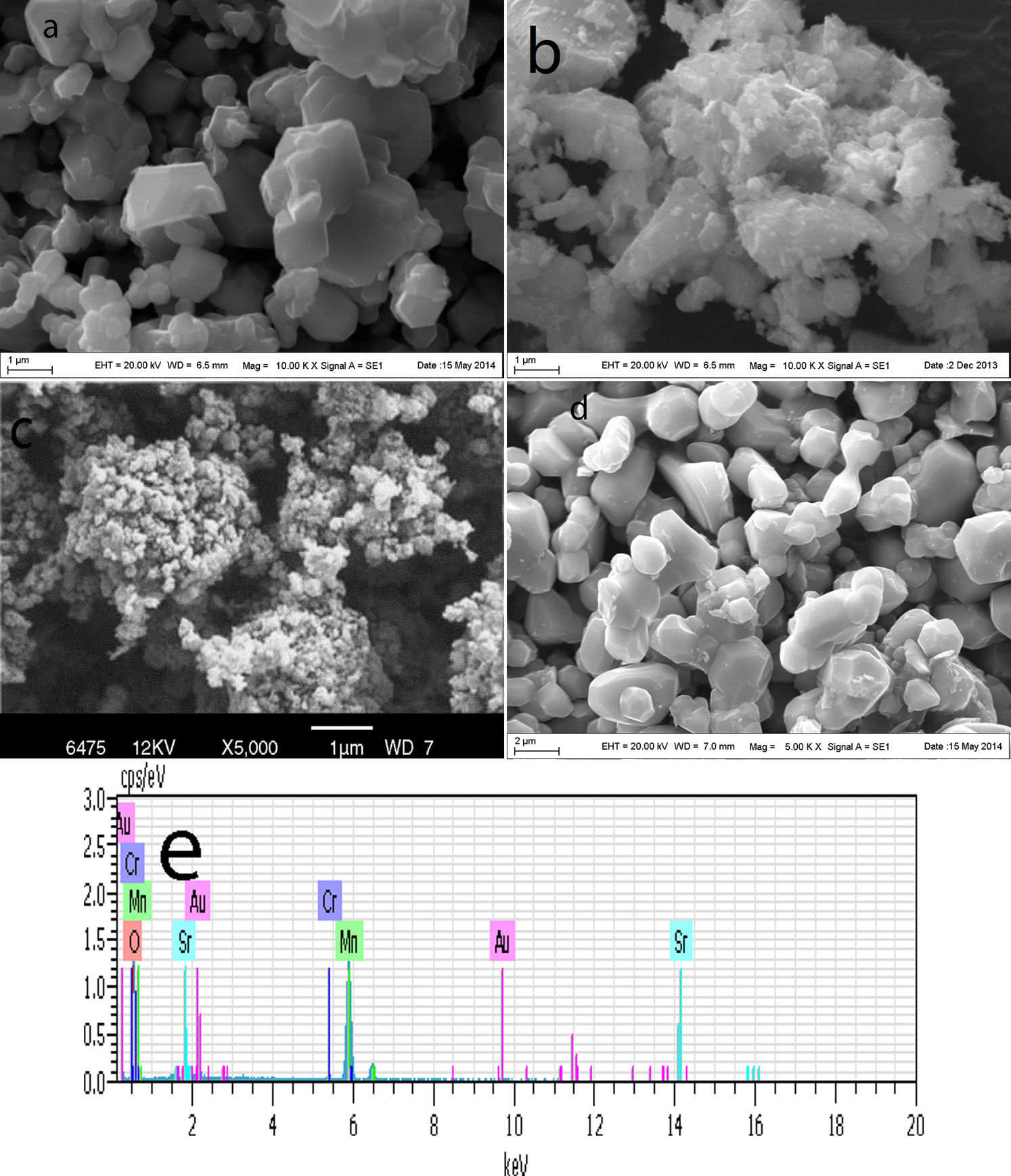
a–d images (SEM) of samples (a LMO, b LiCr0·1Mn1·9O4, c LiSr0·25Mn1·75O4, 54 d LSCMO) and e EDS of LSCMO powder
Cyclic voltammetry study
Figure 3 displays the CV of the LMO and LSCMO electrodes in the potential range of 3·20–4·40 V(Li/Li+) at a scan rate of 0·10 mV s−1. Two pairs of redox peaks appear in CVs, which locate at 4·14/4·01 V and 4·02/3·82 V for LSCMO electrode and 4·20/4·02 V and 4·04/3·81 V for LMO electrode. It is known that these two pairs of current peaks originate from two reversible phase–phase transitions of LMO during intercalation and deintercalation processes.
32
Intercalation and deintercalation of Li+ detected great growth in peak current after doping, which promotes the high current charge–discharge performance for the battery. The chemical diffusion coefficient of Li+ ion  is an important factor to influence the kinetic of the electrode materials.
55
The
is an important factor to influence the kinetic of the electrode materials.
55
The  can be calculated from equation (1)
56
can be calculated from equation (1)
56

 and C0 are the peak current (A), the charge transfer number, the electrode area (cm2), the chemical diffusion coefficient (cm2 s−1) and the bulk concentration of Li+ ions.
32
We can conclude that the
and C0 are the peak current (A), the charge transfer number, the electrode area (cm2), the chemical diffusion coefficient (cm2 s−1) and the bulk concentration of Li+ ions.
32
We can conclude that the  of LSCMO is higher than
  of LMO. The results implied that the sample of LSCMO would have a better rate capability than LMO.
31
of LMO. The results implied that the sample of LSCMO would have a better rate capability than LMO.
31
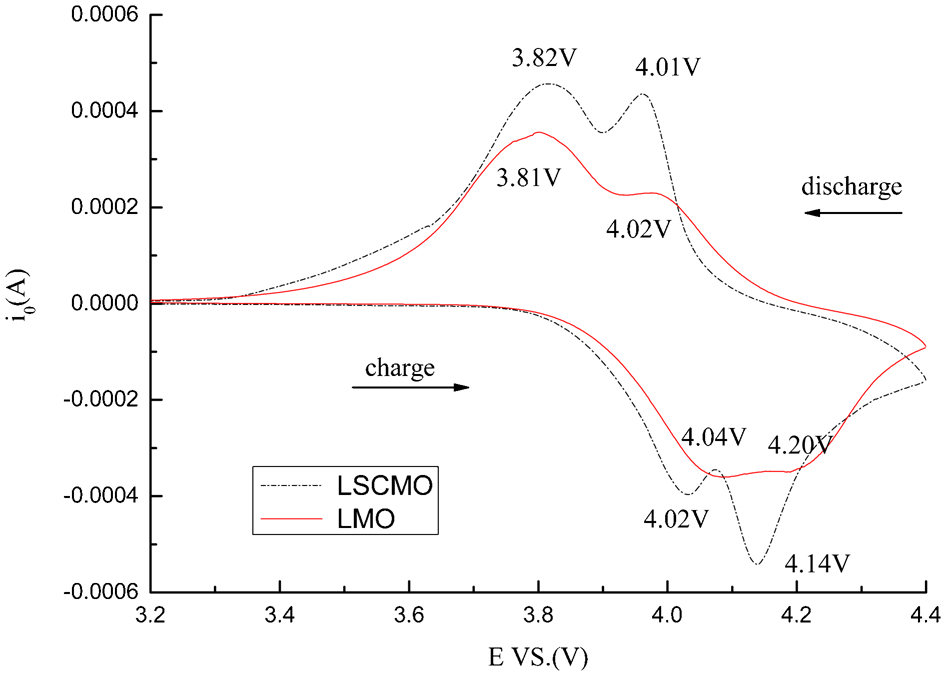
Cyclic voltammograms of LMO and LSCMO electrodes in potential range of 3·20–4·40 V [E versus Li (V)] at a scan rate of 0·10 mV s−1
Analysis of charging–discharging and cyclic performance
The electrochemical properties of samples were systematically investigated using their charge–discharge capacity and cycling stability. Figure 4a displays the initial charge–discharge curves of LSCMO between 3·00 and 4·35 V at currents of 1, 5, 10 and 20 C. The charge–discharge curves showed the discharge capacity is 128 mA h g−1 at 1 C and still remains 100 mA h g−1 at 20 C. The LiCr0·04Mn1·96O4 cell showed that the discharge capacity is 122 mA h g−1 at 0·5 C and remains 112 mA h g−1 after 50 cycles. 36 Figure 4b displays the initial charge–discharge curves of LMO between 3·00 and 4·35 V at currents of 1, 5 and 10 C. The charge–discharge curves showed that the discharge capacity is 122 mA h g−1 at 1 C and still remains 46 mA h g−1 at 10 C. Compared with Fig. 4a, it demonstrates that the large current charge–discharge performance of LMO was improved by Sr2+ and Cr3+ doping. We examine the cyclic performance of half cells with LSCMO under current densities of 1, 5, 10 and 20 C (Fig. 4c). For LSCMO, the discharge capacity declined from 128 to 116 mA h g−1 at 1 C, with a capacity loss of 93·75 after 100 cycles. The capacity retention ratios after 100 cycles of LSCMO are 90·18 at 5 C, 86·95 at 10 C and 78·96 at 20 C. Figure 4d shows that cyclic performance of half cells with LMO under current densities of 1, 5 and 10 C. The capacity retention ratios after 100 cycles of LMO are 76·66 at 1 C, 43·95 at 5 C and 26·66 at 10 C. The cyclic performance of the LMO was improved by Sr2+ and Cr3+ doping.
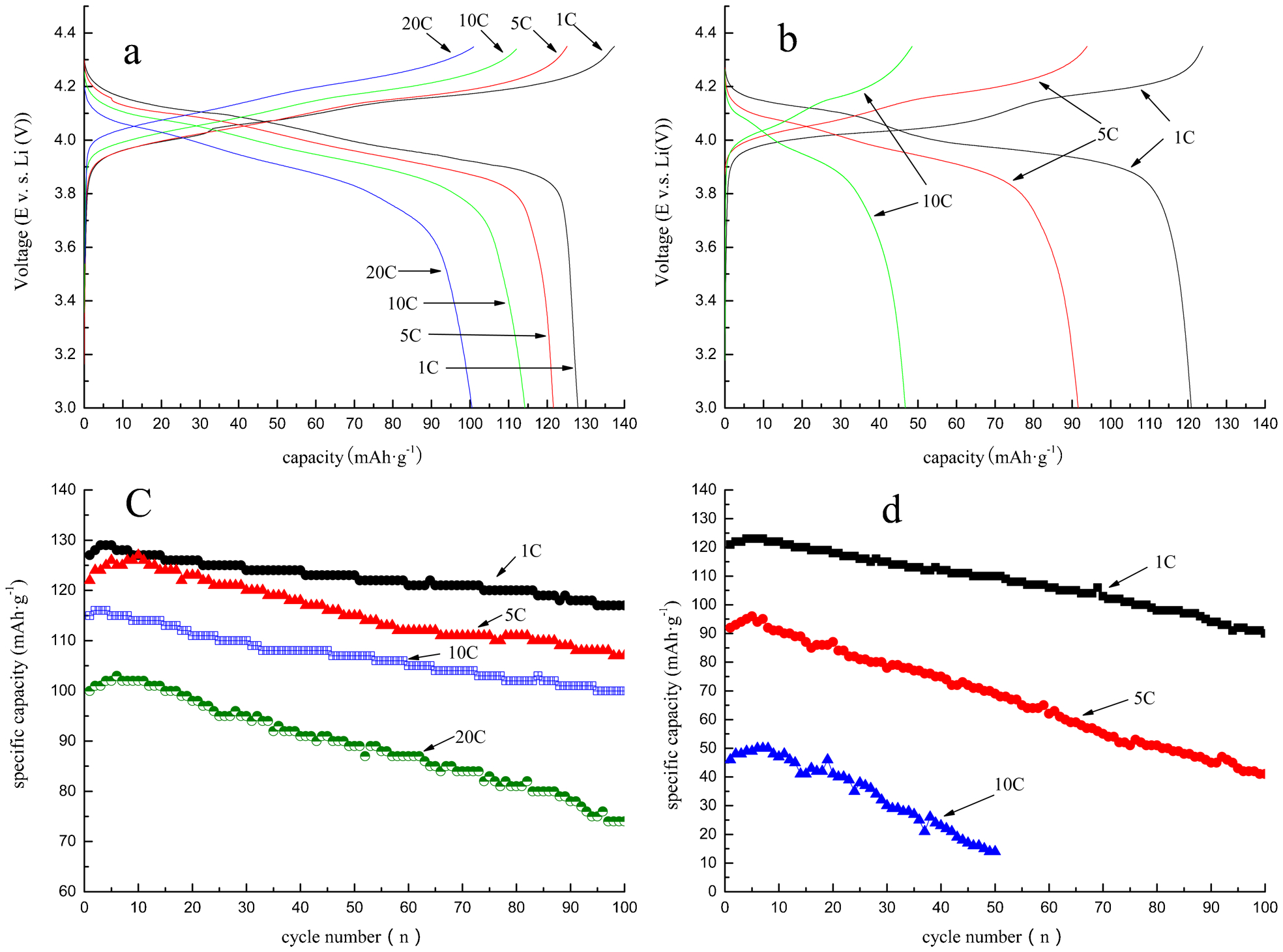
a initial charge–discharge curves of LSCMO; b initial charge–discharge curves of LMO; c cyclic performance of LSCMO; d cyclic performance of LMO
Conclusions
In the present work, spinel LSCMOs have been prepared by high temperature solid state method. The LSCMO particles show irregular shape and are uneven from 800 to 2000 nm, and they had spinel crystal structure with a space group of Fd3m. The CV results implied that the sample of LSCMO would have a better rate capability than LMO. The charge–discharge curves of LSCMO showed that the discharge capacity is 128 mA h g−1 at 1 C and still remains 100 mA h g−1 at 20 C. The capacity retention ratios after 100 cycles of LSCMO are 90·18 at 5 C, 86·95 at 10 C and 78·96 at 20 C. The cyclic performance of the LMO was improved by Sr2+ and Cr3+ doping.
Footnotes
Acknowledgements
The present work was supported by the Building Fund (grant no. 13-051-38) and Opening Project (grant nos. 2012KFMS04 and 2013KFMS01) of Guangxi Key Laboratory of Automobile Components and Vehicle Technology.