







Abstract
The impact test was carried out to investigate the intermediate temperature brittleness of single crystal Ni based superalloy. The samples were impacted at the velocity of ∼5 m s− 1. The results showed that the impact toughness also exhibited intermediate temperature brittleness, which is similar to the situation in tensile. The samples showed the highest impact toughness at 600°C but exhibited the lowest impact toughness at 760°C. Results showed that the variety of impact toughness was due to the deformation mechanism. At 600°C, a/2 < 110> dislocation slips on the {111} slip system were attributed to the high impact toughness; however, a/2 < 110> dislocation slips from octahedral {111} planes to cubic {100} planes resulted in significant work hardening, leading to the decrease of impact toughness.
Introduction
Ni base superalloys performed so well as the gas turbine blade because of their excellent creep strength, thermal fatigue resistance and oxidation resistance. 1 Owing to its relatively high contents of refractory elements such as W, Mo and Nb, it has been reported that the superalloy can exhibit the minimum value in their tensile ductility. This behavior is named intermediate temperature brittleness (ITB). 2 The ITB behavior has been reported in many superalloys.2–4 For superalloys, the most important factors are as follows: (i) instability of γ′ precipitates during exposure to high temperatures; (ii) deformation mechanisms, which lead to strain localisation; and (iii) embrittlement of grain boundaries by carbide particles or enrichment with trace elements. 5 Currently, researchers pay great attention to investigate the ITB behavior at intermediate temperature for a long time. He et al. 2 showed that the localised slip, which led to glide plane decohesion, caused the poor ductility of an equiaxed Ni base superalloy. In addition, Lian et al. 6 showed that the dominant deformation mechanism is a transition process from γ′ shearing by dislocations to climb assisted bypassing. However, the strain localisation that was mainly caused by stacking faults led to the ductility minimum for a directionally solidified nickel base superalloy. 1 Liu et al. 7 and Luo et al. 8 showed that the dislocation microstructure was inhomogeneous due to the formation of dislocation concentrations with high density tangling at intermediate temperatures. Although it is well accepted that γ′ is sheared by a/3 < 112>, the corresponding super lattice stack fault is the main reason for the ITB behavior during tensile test. Recently, an interesting result shows that the ITB behavior can be influenced by the strain rates. The decrease of strain rate could increase the possibility of cross-slip of dislocations from the {111} to {100} planes, which is consistent with the improvement of the tensile ductility. 9 According to the contents mentioned above, it can be seen that the ITB behavior is influenced by many factors including grain boundaries, deformation mechanism and strain rate. In addition, it is well accepted that the ITB behavior unusually emerged during the tensile test. However, our previous results show that this behavior can be presented during impact test, where the grain boundaries may be the main reason. 10
Hence, in the present study, single crystal alloy is normally selected as an experimental material and the impact test is performed to investigate the ITB behavior at high temperature so that the impact toughness and fracture microstructure of the samples are analysed, and possible fracture mechanism is discussed, which may contribute to comprehending the ITB behavior.
Experimental
The nominal composition of DD32 Ni base alloy was shown in Table 1. The master alloy was melted in a vacuum induction furnace and then directionally solidified into [001] single crystal rods using Bridgman withdraw technique. The single crystal samples were cast in the [001] direction at the temperature gradient of ∼80°C cm− 1 with a constant withdrawal rate of 6 mm min− 1. The orientation of each bar was determined by electron backscatter diffraction. Samples with 8° within [001] orientation were used in this investigation. All specimens were subjected to standard heat treatment comprising a two-step solution treatment and a two-step aging treatment, 1290°C/4 h+1280°C/4 h+1150°C/4 h+870°C/24 h, and air cooled to room temperature. The temperature fluctuation was maintained within ± 5°C throughout the heat treatments. Standard Charpy-U notch samples of 10 mm × 10 mm × 55 mm having 2 mm depth with a 1 mm root radius were machined longitudinally from the heat treated bars according to GB/T 229-2007 standard. Tests were performed at 20°C, 600°C, 760°C and 800°C at an impact velocity of ∼5 m s− 1. Samples tested at high temperatures were preheated in a muffle furnace for 20 min. The time difference between taking samples out of the muffle furnace and actual impact was less than 3 s. Each impact toughness value represents an average value of two test results. Scanning electron microscopy (SEM) and transmission electron microscopy (TEM) were used to examine the microstructure and deformation structure.
Nominal composition of DD32 alloy (wt. )

SEM was used to examine the microstructure and fracture microstructure. Metallographic samples were mounted, ground and polished in a conventional manner with 150, 400, 800, 1000 and 2000 grit emery paper, followed by mechanical polishing with 2.5 and 1 μm diamond paste. The samples for SEM observation were chemically etched in a solution consisting of 40 mL C2H5OH+1.5 g CuSO4+20 mL H2O. TEM foils for microstructure analysis were cut from nearing the fracture surfaces of the samples impacted at elevated temperatures normal to the loading axis. They were prepared electrolytically by twin jet thinning in a mixed solution of 10 perchloric acid and 90 ethanol at − 20°C and then observed with JEOL 2000FX TEM operated at 200 kV.
Results
Microstructure
The microstructures of the single crystal alloy are shown in Fig. 1. As can be seen, the γ′ precipitates have cuboidal morphology consisting of cuboid particles of 0.73 μm average edge (Fig. 1a). After standard heat treatment, γ′ precipitates, which have cuboidal morphology in an average size of 0.5 μm (Fig. 1b), are much regular than as cast, and the spaces between the cuboids are less large. MC carbide particles with an irregular blocky morphology were mainly located at interdendritic regions (Fig. 1c).
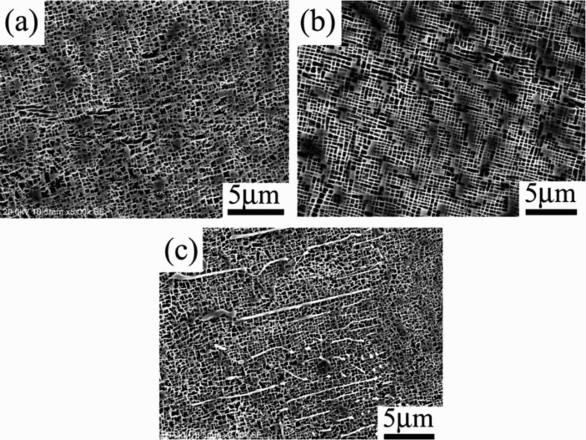
Microstructures of DD32 alloy: a as cast; b heat treated; c MC carbide particles
Impact toughness
The impact toughness as a function of temperature is shown in Fig. 2. It can be seen that the maximum impact toughness value occurs at 600°C. Significantly, above 600°C, the impact toughness instead increases as temperature increases. The impact toughness shows a minimum value at 760°C, which is similar to that at 20°C, and then it increases slightly at 800°C. The above experimental results indicate that the impact toughness exhibits a minimum value at high temperature, which has never been observed before in single crystal alloy.
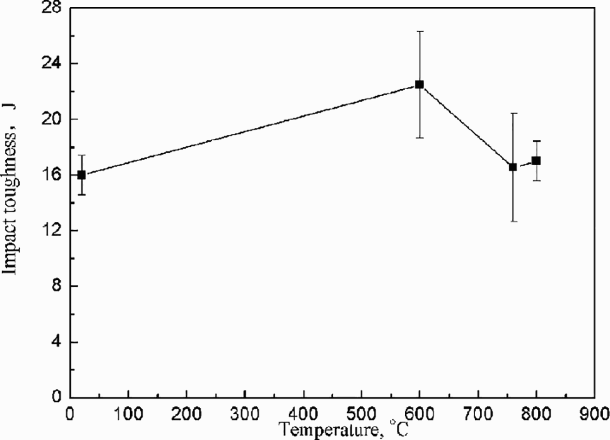
Impact toughness versus impact temperatures
Failure characteristics
The macrofractographs of the impact samples are shown in Fig. 3. It can be seen that all samples exhibit the intergranular fracture mode. However, the three typical regions, i.e. the fibrous zone, the radiation zone and the shear lip zone, are not presented clearly on the fracture surfaces (Fig. 3). Some secondary cracks are visible in these samples. According to impact toughness characteristics, it is said that that the fibrous zone may prevent the propagation of cracks from resulting in the higher impact toughness. However, in this investigation, the region of the fibrous zone is not clearly identified, so the centre of the fracture surface is investigated in this experiment.
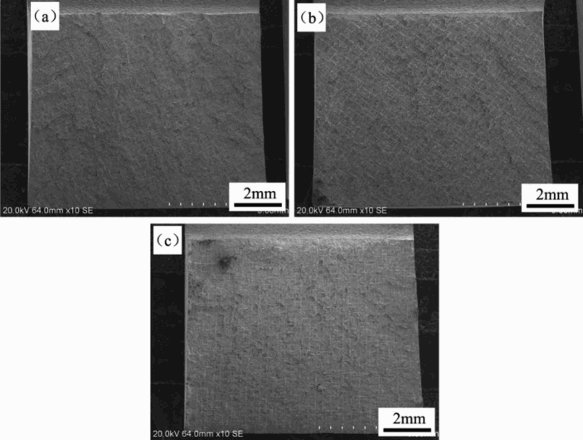
Macrofractographs of samples impacted at a room temperature, b 600°C and c 760°C
Typical SEM images of the impact fracture surfaces at various temperatures are shown in Fig. 4, which shows cleavage steps, slip bands and microdimples in these fracture surfaces. It can be seen clearly from Fig. 4a that cracked MC carbide particles are presented on the cleavage fracture surface of the sample impacted at 20°C, indicating that cracks initiated at MC carbide particles are due to high stress concentration, which may lead to the low impact toughness. Slip bands could be observed on the fracture surface of sample impacted at 600°C, which is shown in Fig. 4b. The lines in Fig. 4b show an almost pattern with 60° angles between them, and in face centred cubic crystal structure, the {111} planes also display a 60° symmetry. Therefore, the observed slip bands may result from deformation occurring along {111} planes. The motion of dislocation on {111} planes can relieve the stress concentrations, resulting in the modest increase in plastic flow.11,12 In addition, the presence of slip lines with 60° angles observed on the fracture facets is in accordance with Tomota's slipping off mechanism. 13 Therefore, the samples can absorb more energy during the impact fracture process. As the evidence of homogeneous deformation, the shallow dimples are presented on the fracture surface of sample impacted at 760°C, which is shown in Fig. 4c. The formation of dimples can absorb more energy during the impact fracture process. To our surprise, the impact toughness of sample impacted at 760°C is remarkably lower than that of sample impacted at 600°C, which goes against the well recognised fact that samples impacted at elevated temperatures possess the higher impact toughness. The impact toughness of nickel free austenitic stainless steels decreases with decreasing temperatures. 14 In contrast to the impact toughness below room temperature, the impact toughness at high temperature was also investigated by some investigators. As for 1045 steel, the impact toughness increased with increasing temperature and was in excess of 200 J at 923 K. In addition, the impact toughness increases gradually to 600 K and then begins to decrease with increasing temperature in Fe–40Al alloys. 15 There was no variation in the impact toughness of Fe–36Al alloy impacted from room temperature to 473 K due to the combined effects of high strain rate and temperature sensitivity of plastic flow.16,17 This is due to the combined effects of high strain rate and temperature sensitivity of plastic flow. 18
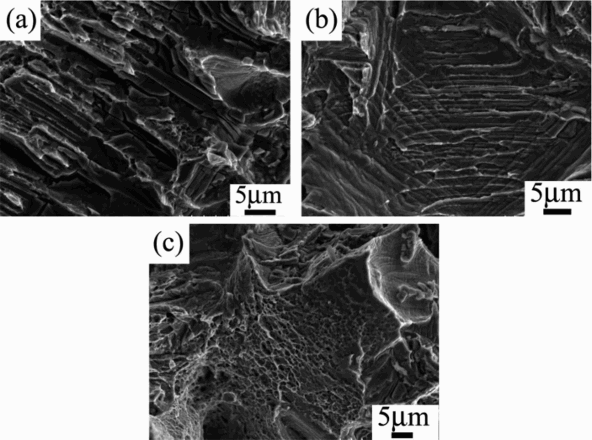
Fracture surfaces of samples after impact at a 20°C, b 600°C and c 760°C
The fracture characteristics of samples are thought to be formed by a shear mechanism, which is a process that would be necessarily accompanied by plastic flow. The microstructures perpendicular to fracture surface of samples impacted at 20°C, 600°C and 760°C are shown in Fig. 5. When impacted at 20°C, samples exhibit low impact toughness, showing signs of limited capacity for plastic flow. The deformation trapped in a narrow slip bands is observed on perpendicular cross-sections to the fracture surface. The deformation bands are straight and trapped in a small region, as shown in Fig. 5a, which subsequently promote crack propagation. 19 With the increasing temperature, the MC carbide particles are preferable to retard crack propagation as shown in Fig. 5b, which, together with the observation of slip bands, well indicates the evidence of homogeneous deformation (Fig. 4b). Therefore, the samples can absorb more energy during impact fracture process due to high plastic flow. However, the crack that propagates along the interface between MC carbide particles and matrix (Fig. 5c) may reduce the impact toughness. The precipitation of the carbide on the grain boundaries might decrease the impact toughness due to lower bonding strength of the grain boundaries. 20 As a result, it suggests that the deformation on regions closed to the MC carbide particles is more likely to occur due to lower bonding strength, which is in agreement with the results of Shi and Han 21 and Lian et al. 22
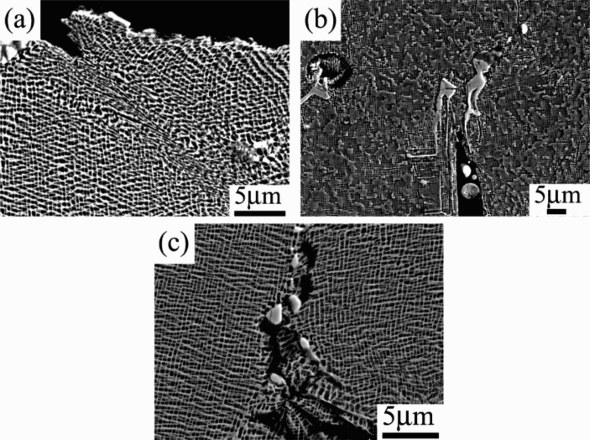
Fracture subsurface regions of samples after impact at a 20°C, b 600°C and c 760°C
Deformation structure
The deformation structures of samples impacted at elevated temperature are examined by TEM as shown in Fig. 6. It can be seen that few dislocations are in the γ matrix, while the dislocations tangle at the γ/γ′ interface. In addition, there are also a few dislocations a/2 < 110> cutting into the γ′ precipitates, which is shown in Fig. 6a. This indicates that only one {111} slip system is activated; in other words, non-work hardening occurs by intersection of dislocations. It can also be observed that the matrix dislocation was cut into γ′ in pairs coupled by APB (marked by arrow).
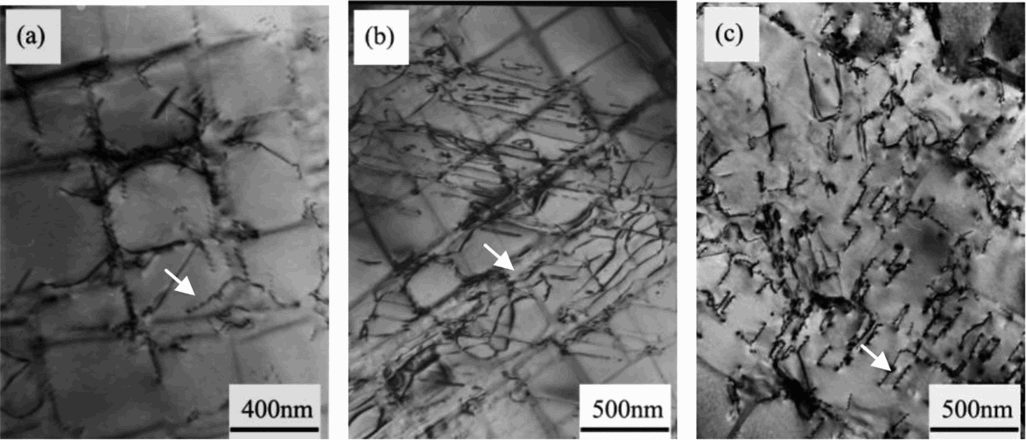
Deformation structures of samples after impact at a 20°C, b 600°C and c 760°C
It is difficult for dislocations to move in the matrix and the further plastic deformation zone during impact test. As temperature rises to 600°C, the slip bands can be observed in Fig. 6b, where the slip bands are mostly constricted in the matrix, indicating that the γ′ shearing by a/2 < 110> dislocation does not occur in the slip bands. High density dislocation is restricted in the matrix channel, which indicates the occurrence of multiple slip. The observation of slip bands is the evidence of homogeneous deformation. The samples with homogeneous deformation could exhibit high impact toughness at 600°C. However, few of the slip bands can be observed in samples impacted at 760°C as shown in Fig. 6c. It shows that the dislocation appearance differs significantly from the deformation tested at 600°C, and it can be also observed that the matrix dislocation was cut into γ′ in pairs, which indicates the occurrence of multiple slips. Intersection between dislocations from different slip systems could result in significant work hardening, which is in accordance with the decrease of strain energy in Fig. 7. It indicates that it is difficult for dislocations to move in matrix and the further plastic deformation zone during fracture; therefore, the variation of impact toughness must be attributed mainly to the deformation mechanism.
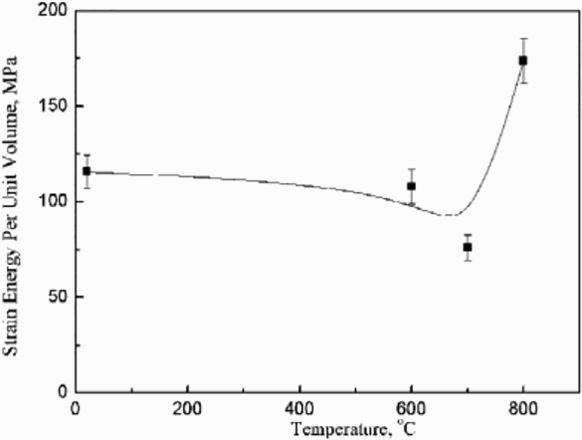
Strain energy per unit volume versus temperature
Discussion
Since the impact tests are carried out at high temperatures, it is believed that the temperature sensitivity of the plastic deformation ability is mainly associated with corresponding impact toughness. Generally, the initiation energy and the propagation energy constitute the impact energy during a Charpy impact test. It has been suggested by several authors that the impact energy is significantly influenced by the propagation energy. 23
The impact toughness increases with plasticity, which is related to fracture propagation energy.
23
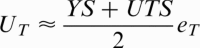
The strain energy per unit volume (UT) absorbed by tensile specimens before fracture for each condition, as shown in Fig. 7, are determined in the following equation
24
:
The propagation energy is mainly associated with plastic deformation during impact fracture process. The crack initiation usually occurs at the interface of MC carbide particles and matrix, and propagates along the slip bands due to high strain concentration. The high amount of local shear stress in slip bands is thought to cause the less plastic deformation of sample impacted at 20°C. With the increase of temperature, the deformation occurred on {111} planes of sample impacted at 600°C. It can be infer that the separation of {111} planes is ascribed to the high density of dislocations. The pile up dislocations on the {111} slip planes increase rapidly during deformation; consequently, the separation of the active deformation planes occurs in samples impacted at 600°C. 12 Thus, dislocations slip on {111} planes occurred because thermal activation can contribute to the increase of impact toughness.
However, the shallow dimples are found on the fracture surfaces of sample impacted at 760°C (Fig. 4c), and it is apparent that the ductile rupture is caused by the dimples, which will successively nucleate, grow and coalesce during rupture. The toughness is dependent on the failure characteristic. The shallow dimples can absorb more energy during failure.25,26 In this case, the rupture obeys the criterion of critical void growth. According to the void growth model of Rice and Tracey
27
:
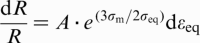
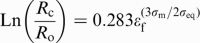
From the above analysis, the key point is the production of low fracture strain εf at high temperature. Some investigations show that The Ni based superalloy can deform by several mechanisms such as dislocation bypassing, dislocation shearing and dislocation gliding. In addition, a transition from shearing to gliding, which leads to the decrease in ductility, has been observed at high temperatures (650–850°C). 24 It is well known that γ′ precipitate has a unique characteristic that its strength increases with temperature. The increased strength of γ′ precipitate is ascribed to the thermally activated cross-slip of dislocations from octahedral {111} planes to cubic {100} planes at high temperatures. 29 The operation of intersection slip bands creates dislocation debris and thus produces more barriers for cross-slip, which eventually decreases the fracture strain.
Additionally, the carbide particles also play an important role in the reduction of impact toughness. Ma 30 showed that the carbides, accompanied always with inclusion, that are formed in the interdendritic area with high concentration of alloying elements may cause inhomogeneous deformation. Similarly, the silicon particle has influence on impact toughness: the smaller the particle size, the higher the impact toughness. 31 The dislocation pile up in the interface of carbide particles and matrix during deformation leads to high local stress concentration, which can cause separation of the interfaces, accelerate the propagation of cracks and subsequently promote localised decohesion. 22 As a result, the significant reduction in the fracture strain is allowed during the fracture process.
Conclusions
The impact toughness of single crystal alloy is investigated in the temperature range between 20°C and 800°C. The conclusions of our investigations are as follows. The samples impacted at 600°C show the highest impact toughness but drop sharply at 760°C. The variety of impact toughness is probably due to plastic deformation ability at high temperature. At 600°C, the slip that occurs by thermal activation can contribute to the increase of impact toughness. The shearing of γ′ precipitate could decrease impact toughness at 760°C.
Acknowledgements
This work is financially supported by the Yunnan Province Academy School Cooperation (project no. 2012IB002), the National Natural Science Foundation of China (grant nos. 51331005 and 51401210) and the China Postdoctoral Science Foundation (grant no. 2014M550481). The authors are grateful for those supports.