







Abstract
Metal droplet losses in slags are an important issue in copper industry. One significant aspect that promotes the entrainment of metal droplets in the slag is their attachment to spinel solids. In the present study, the wetting behaviour of copper alloys on spinel substrates has been investigated in the presence and absence of a slag phase. At first, the attachment was investigated using a synthetic slag containing spinel particles. Microstructural analysis of quenched slag reveals the presence of microdroplets sticking onto a surface of the spinel particles. Second, the metal–spinel interaction was investigated using the sessile drop technique. Wetting angle measurements were performed between Cu–Ag alloys and MgAl2O4 substrates. A non-wetting behaviour between the alloys and substrates was observed. The results suggest that the oxygen partial pressure and the amount of Ag in the alloy both influence the wetting behaviour.
Introduction
Slags are essential in copper and other pyrometallurgical processes, acting as collectors for specific groups of metals and for the elimination of unwanted impurities. A decantation step is often used in the process, allowing the phase separation between matte/metal and slag. However, industrial Cu smelters, in primary and secondary production, suffer from metal rich droplet losses in slags due to imperfect phase separations. These metal losses are a very important factor confining the overall metal recovery. 1 To minimise these losses and further improve the efficiency of industrial processes, it is essential to gain a more fundamental understanding of the characteristics and origin of these metal losses.
It is currently well accepted that copper losses in slags are attributed to both chemical dissolution of copper as copper oxide and mechanical entrainment of Cu containing droplets.2–4 Chemical losses are caused by the solubility of copper in the sulphide and oxide form for primary copper production and mainly in oxide form for secondary copper production. Chemical dissolution of copper is determined by thermodynamic parameters of the system such as the oxygen partial pressure,2,5 6 –7 the temperature, the composition of the slag and matte phase2,5–7 and the chemical activity of the metal. 2 These losses are intrinsic to copper pyrometallurgical processes.
Mechanically entrained droplets are attributed to a variety of sources. In primary copper production, the droplets are mostly entrained as matte or metallic droplets, while in secondary copper production, these losses are under the form of metallic Cu droplets. In the literature, a lot of researches have been performed on the losses in primary copper production. Based on this research, it can be stated that mechanically entrained droplets are attributed to a variety of sources. Although not a lot of the literature data exist on droplet losses during secondary copper production, some similarities between the mechanisms influencing this phenomenon might be expected. The first important source originates from gas producing reactions dispersing metal into the slag. As suggested by Minto and Davenport, 8 SO2 bubbles that nucleate at the bottom of the furnace can elevate a surface film of matte into the slag.8–10 The second source is the dispersion of copper or copper sulphide, which precipitates due to the decrease in the copper solubility in the slag, for example, in zones with a lower temperature or different local oxygen potential due to inhomogeneity of the process. 9 The copper losses can also originate from operational procedures typically performed in pyrometallurgical processes such as charging or tapping. Mechanical entrainment during tapping can occur due to the rise of a denser layer, which can take place while flowing around obstructions in the vessel. 3 This physical dispersion of the denser phase into the slag by mixing can originate from several sources such as turbulence, gas injections or pouring of one phase into the other.3,11 In addition, the penetration of metallic copper in refractory also causes Cu losses during production. 12 The abovementioned sources have been studied thoroughly and reported in the literature. However, there is another possible cause of mechanical droplet losses, namely, the attachment of droplets to solids in the slag, which hampers decantation. These solids are often found to have a spinel structure. Even though the phenomenon has been reported by Ip and Toguri 9 and Andrews, 11 so far limited experimental or industrial data concerning this observation are reported in the literature.
A better understanding of the interactions between metal droplets and solids in slags is a prerequisite to further improve the phase separation in pyrometallurgical processes, and requires a fundamental and systematic investigation. Therefore, different methodologies have been applied in the literature. A commonly used approach is to study the metal losses in slags by sampling procedures performed on industrial and/or lab scale using industrial and/or synthetic slags. However, little attention has been given on the investigation of the sticking behaviour of metal droplets onto solids. Therefore, a dedicated experiment was carried out using a synthetic slag system to verify the interaction between metal droplets and the solids present in the slag. As industrial slag systems can be complex, a synthetic slag system has been used in order to exclude undesired complications as much as possible.
In phase separations, surface tension and surface tension driven flows appear to also have an important influence apart from gravity, as shown by Lau and co-workers. 13 Therefore, much effort has been put in the determination of the surface and interfacial tension of liquid metals, slags and mattes, and a significant amount of experimental data are available concerning the surface tension of copper alloys.14–19 The present paper will focus specifically on the losses of metallic Cu droplets in secondary Cu production. As mentioned above, little data are available for the secondary copper production. However, as secondary sources become increasingly important, a dedicated set of experiments on this topic is relevant. With respect to the wetting behaviour between metals and oxides, a lot of experiments have already been performed, as summarised by Eustathopoulos and Drevet. 20 A distinction is made between reactive and non-reactive systems. Non-reactive systems reach equilibrium in < 10− 1 s for millimetre sized droplets, while slower spreading kinetics is a strong indication of the presence of interfacial reactions. 21 With respect to the specific wettability of spinel substrates with metals, Kozlova and Fukami performed experimental studies on the wettability between MgAl2O4 spinel substrates and iron. Nevertheless, to the author's knowledge, no experimental studies on the wettability between copper alloys and spinel substrates are available in the literature.22 23 –24
The present study focuses on the investigation phenomenon of copper based metal droplets sticking onto spinel solids, and the role of the slag. Two complementary methods have been applied for that purpose. The first method is a microscopic investigation of the sticking behaviour of droplets onto spinel substrates in the presence of an industrially relevant synthetic slag (PbO–CaO–SiO2–Cu2O–Al2O3–FeO–ZnO). Additionally, the interaction of spinel substrates with Cu alloys is investigated in detail in the absence of slag using sessile drop experiments. In the present study, MgAl2O4 was selected to represent spinel materials, as this is one of the most stable commercially available materials. The wetting behaviour of Cu and Cu–Ag alloys with MgAl2O4 substrates under various oxygen partial pressures has been investigated.
Experimental
Metal–slag interactions study
Slag melting procedure
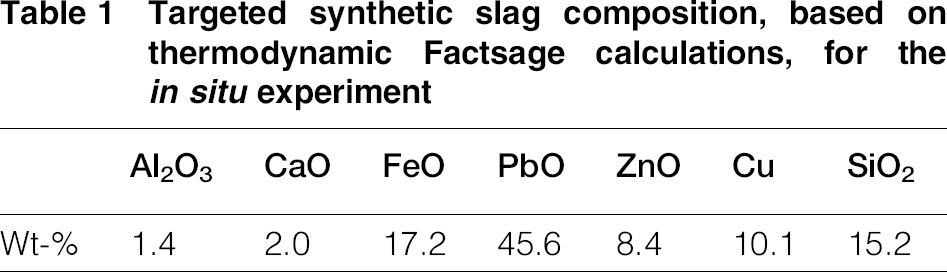
Slags were prepared by melting oxides of appropriate quantities. Thermodynamic calculations using FactSage 6.4 thermochemical package (FACT and FT oxid databases) were performed in order to determine an appropriate composition in the spinel primary phase field. The final targeted slag composition, based on thermodynamic FactSage calculations, for the in situ experiment, is shown in Table 1. FeO was added as a combination of metallic iron and hematite, while CaO was added as limestone. Oxide mixture of 720 g of the targeted composition was placed in an Al2O3 crucible (500 mL). A protective SiC crucible, surrounding the Al2O3 crucible, was used for the melting process in an inductive furnace (Indutherm, MU3000). The mixture was heated up to a temperature of 800°C, while a protective N2 atmosphere is established above the slag. At 800°C, the N2 atmosphere was replaced by a CO/air mixture with volume ratio of 1:2.44, corresponding to an oxygen partial pressure  of 10− 7 atm, at a constant flowrate of 60 L h
− 1
. The slag was then further heated up to 1200°C and kept 15 min at this temperature to melt all components. The slag was homogenised by bubbling N2 through the liquid mixture for 15 min. A sample was taken from the molten slag by quickly dipping a cold sampling bar into the slag, by which a slag layer ‘sticks’ around the bar due to the temperature difference. Subsequently, the bar with the slag was quickly quenched directly into water in order to freeze the microstructure. Subsequently, the slag granules were dried in a dry chamber at 150°C.
of 10− 7 atm, at a constant flowrate of 60 L h
− 1
. The slag was then further heated up to 1200°C and kept 15 min at this temperature to melt all components. The slag was homogenised by bubbling N2 through the liquid mixture for 15 min. A sample was taken from the molten slag by quickly dipping a cold sampling bar into the slag, by which a slag layer ‘sticks’ around the bar due to the temperature difference. Subsequently, the bar with the slag was quickly quenched directly into water in order to freeze the microstructure. Subsequently, the slag granules were dried in a dry chamber at 150°C.
Targeted synthetic slag composition, based on thermodynamic Factsage calculations, for the in situ experiment
Characterisation and analysis
The obtained slag sample was embedded, ground and polished using 9 and 3 μm diamond pastes. The sample was analysed using light optical microscopy (Keyence VHX-S90BE) and scanning electron microscopy (SEM; FEI Quanta 450 with field emission gun). The latter was used to measure the phase compositions, using energy dispersive X-ray spectroscopy (EDAX, EDX) with an acceleration voltage of 20 keV.
Wetting behaviour of Cu alloys on spinel substrates study
Substrate preparation
For the production of MgAl2O4 substrates, spark plasma sintering was used, based on methods proposed by various authors.24 25 –26 The MgAl2O4 powder (Alfa Aesar, MgAl2O4 powder 99; 325 mesh powder) was sintered under a load of 60 MPa at a temperature of 1300°C. The MgAl2O4 plates were subsequently annealed at 1000°C for 3 h. The sintered and annealed MgAl2O4 samples were polished using a 9, 3 and 1 μm diamond pastes. The substrate surface roughness was measured by a Talysurf profilometer, and the typical surface profile of the substrate is shown in Fig. 1. It was found that the roughness parameter RA, the arithmetic average of the roughness profile, has an average value of 0.60 ± 0.19 μm. The relatively high value of RA can be explained by the porosity of the substrate. More details concerning the sintering process were described in our previous work. 27
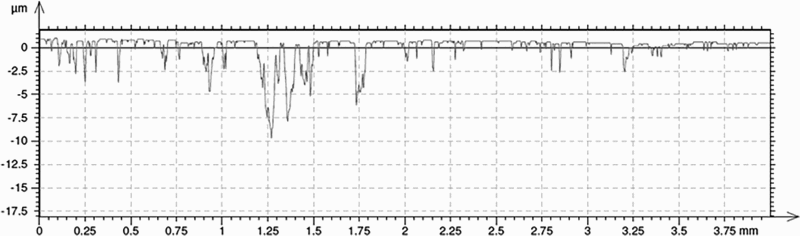
Substrate profile analysis for MgAl2O4 substrate obtained by Talysurf profilometer
Cu alloy production
For the choice of an appropriate Cu phase, CuAg alloys were selected in order to exclude possible practical constraints. Cu–Pb and Cu–Zn alloys were not considered due to the relatively long duration of the experiment and the fact that Pb and Zn have high vapour pressures, resulting in their evaporation. Cu–Fe alloys would require a specific  control. Moreover, these elements are less noble than Cu.
Cu–Ag alloys were produced using an inductive microgranulation furnace (Indutherm, GU500), allowing to produce granules with proper dimensions for the contact angle measurements. Three compositions of Cu–Ag alloys were selected (5, 12.5 and 30 wt- Ag). Appropriate amounts of the metals were weighed and melted under a protective Ar atmosphere in graphite crucibles. Once molten, the high frequency magnetic field ensured mixing of the alloying elements during 15 min. Subsequently, the alloy was granulated into proper grains.
Sessile drop experiments
The wetting behaviour was investigated in a gas tight horizontal tube furnace. A schematic representation of the set-up used is shown in Fig. 2. The alloy granule of ∼0.25 g was placed on the MgAl2O4 substrate and located in the hot zone of the furnace. Before starting the experiment, the granules were etched using a H2O/HCl 1:1 solution to remove the outer oxide layer. The substrate with Cu alloy granules was levelled using an alignment laser. The substrate and alloy were then heated to 900°C in a high purity argon atmosphere. Subsequently, a CO/CO2 atmosphere was introduced, and the sample was further heated to 1120 or 1200°C. A specific oxygen partial pressure was established using a controlled CO/CO2 mixture. Five different oxygen partial pressures were selected and applied throughout the course of one measurement, i.e. 10− 13, 10− 11, 10− 10, 10− 9 and 10− 8 atm. In order to let the copper equilibrate with each CO/CO2 mixture, an equilibration time of 60 min was applied for every CO/CO2 ratio. Digital mass flow controllers were used to control the gas flows into the furnace. The complete process, starting from the melting of the droplet, was monitored by a video camera (VCR) through a quartz window located at one end of the horizontal alumina tube. The camera was placed on a tripod, which was precisely aligned with the spinel substrate. The focus and magnification of the camera were set before the experiment. The contact angle was determined based on the captured images, using ImageJ software. Therefore, the low bond axisymmetric drop shape analysis plug-in was applied, which is based on the fitting of the Young–Laplace equation to the image data. 28
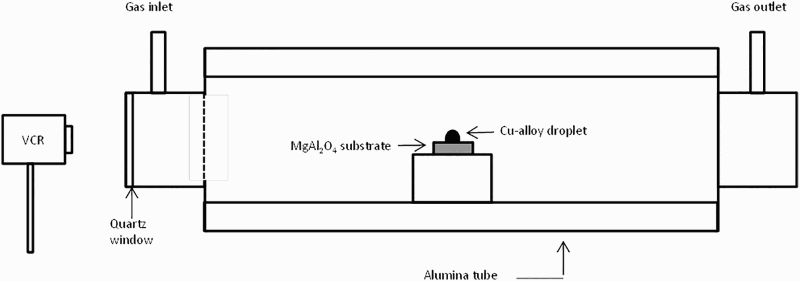
Schematic diagram of experimental set-up to determine contact angle using sessile drop approach
Characterisation and analysis
After each experiment, the droplet samples with the substrate were embedded in a resin and subsequently ground until the cross-section between the alloy and the substrate is visible. The cross-section was then polished using a 9, 3 and 1 μm diamond pastes. The samples were analysed using SEM and EDX with an accelerating voltage of 20 keV.
Results and discussion
Observation of sticking droplets towards spinel solids in slag
A general overview of the microstructure of the slag sample is shown in Fig. 3. Three main phases can be observed: i.e. spinel solids (the light grey phase), liquid slag (the darker grey phase) and copper droplets (the white phase). It can be assumed that the microdroplets present in this microstructure were present at high temperatures, as the quenching was sufficiently fast to avoid copper precipitation from the slag.
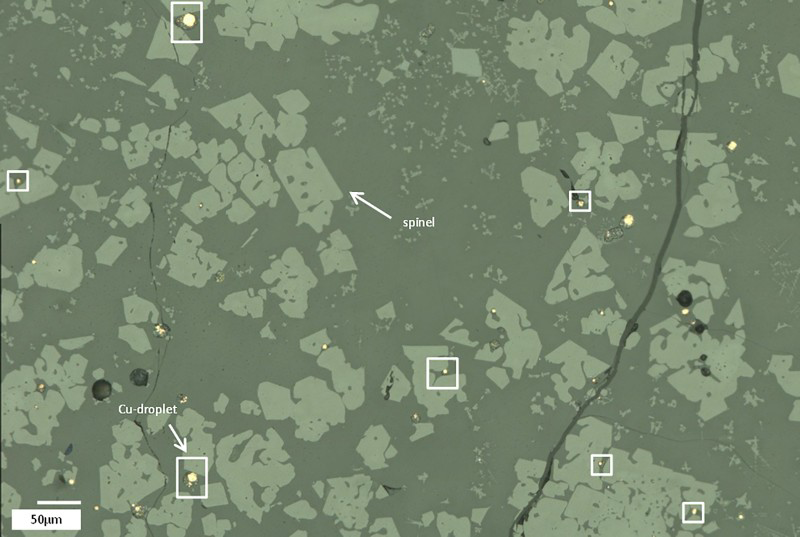
General overview of microstructure (LOM) of quenched slag system containing droplets; copper droplets attached to spinels are indicated using white boxes
The majority of the copper droplets shows a tendency to stick to spinel particles present in the slag phase, as indicated in Fig. 3, hindering phase separation and consequently preventing the droplet from settling down towards the underlying copper liquid. In Fig. 4, more detailed microstructures of the attached droplets are shown. A clear interaction can be observed between the spinel substrates and copper droplets in the considered slag system. The droplet tends to adapt its shape locally to the spinel particle. It can be observed that some copper droplets are totally surrounded by spinel solids, and some droplets stick on one side of the spinel solid.
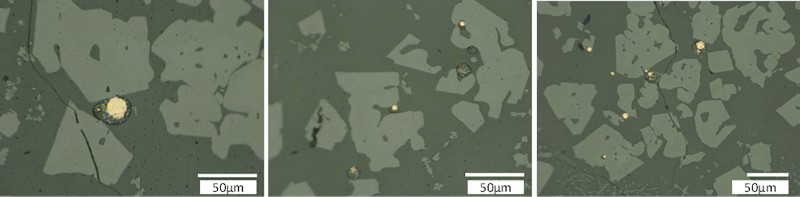
Detailed microstructures (LOM) of sticking droplets onto spinel particles present in slag
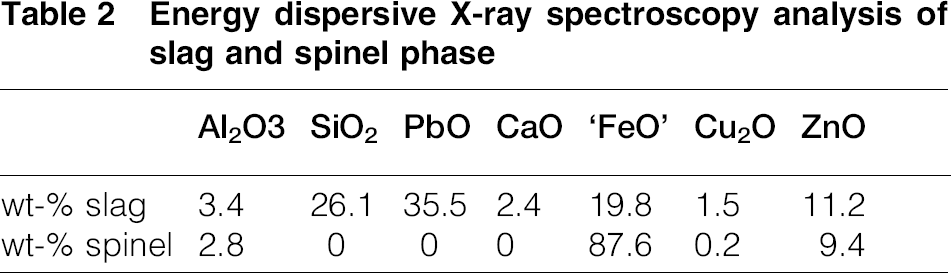
The results of the EDX analysis on the spinel solids and slag phase are given in Table 2. For the spinel particles and the slag phase, the total sum of FeO and Fe2O3 is defined as ‘FeO’. The average chemical formula of the spinel solids is  . The metal droplets in this synthetic system are Cu–Pb droplets; as for the present experimental conditions, some Pb is dissolved in the Cu droplets. The droplets show the presence of a lead rich border and a Cu rich core, as indicated in Fig. 5. This may be attributed to the fact that quenching requires a specific, although limited, time which might still be sufficient to induce a phase separation between Cu and Pb, due to the insolubility of Pb and Cu at lower temperatures.
Energy dispersive X-ray spectroscopy analysis of slag and spinel phase
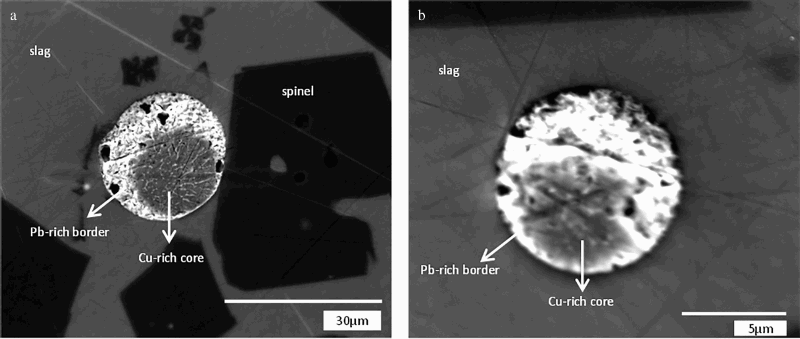
Microstructures (SEM) of a sticking and b non-sticking droplet
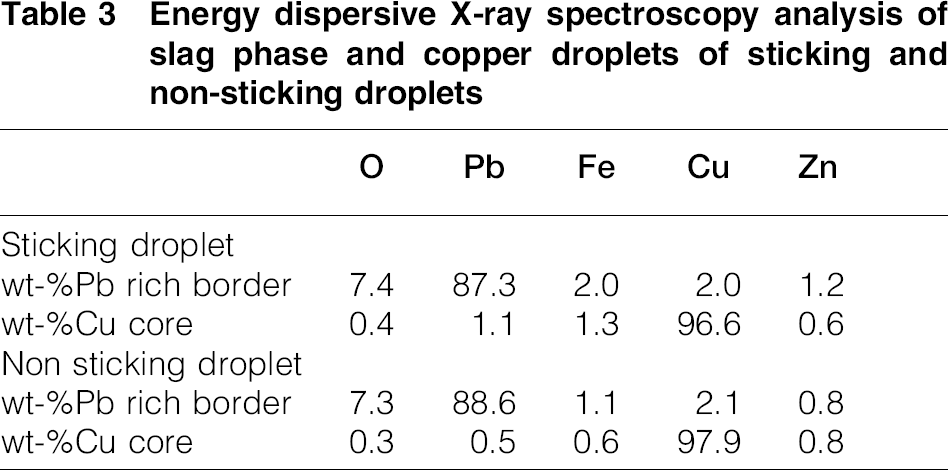
Although most droplets were attached to spinel particles, individual non-sticking droplets were also observed. Both sticking and non-sticking droplets in the slag phase have been compared. The composition data of the sticking and non-sticking droplets, given in Table 3, show no significant differences. It should be noted, however, that a two-dimensional image of a three-dimensional system was observed from the cross-section. Therefore, a possible interaction of the non-sticking droplet with a spinel particle that was not visible could not be excluded. Other factors such as the local composition of the spinel solids, slag system and the oxygen level might also affect the behaviour of the copper droplets. As the phenomenon is influenced by a number of different factors, which also interact with each other, the complexity of the system increases. Therefore, detailed analysis under more generic conditions will be necessary in order to gain insight on the phenomenon.
Energy dispersive X-ray spectroscopy analysis of slag phase and copper droplets of sticking and non-sticking droplets
Contact angle measurements
In order to gain insights on the copper–spinel interaction, the wetting behaviour was investigated in the absence of the slag phase. Therefore, sessile drop experiments were performed under a controlled atmosphere, as schematically illustrated in Fig. 6. Owing to the very high stability, MgAl2O4 was selected to represent the spinel phase for the sessile drop experiments. Pure copper and Cu–Ag alloys have been selected, representing alloys that are stable at high temperature, miscible at 1200°C but immiscible at lower temperatures.
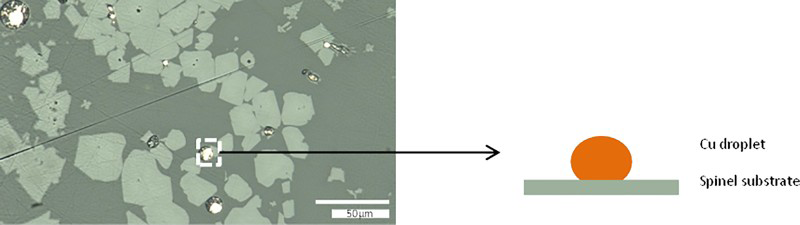
Schematic representation of basic concept of sessile drop measurements
Progress of sessile drop experiment
The melting and wetting behaviours of Cu–5 wt-Ag directly after melting and heating to a temperature of 1200°C are shown in Fig. 7 using the captured images. Based upon these images, contact angles were determined. The evolution in time of the contact angle of liquid Cu–5 wt-Ag when heated up to 1200°C and kept for 60 min at a specific oxygen partial pressure is given in Fig. 8. Directly after melting, the liquid droplet reached its equilibrium shape. After melting and upon further heating, the droplets show a very small decrease in the contact angle, which was verified with contact angle measurements. This change can possibly be explained by the influence of the increasing temperature, although the small variations were within the experimental error of the image analysis software program. Similar observations were made for all Cu–Ag alloys.
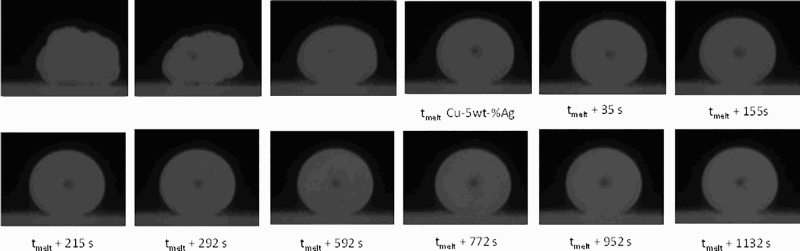
Evolution of grain shape and illustration of wetting behaviour for the Cu–5 wt-Ag alloy
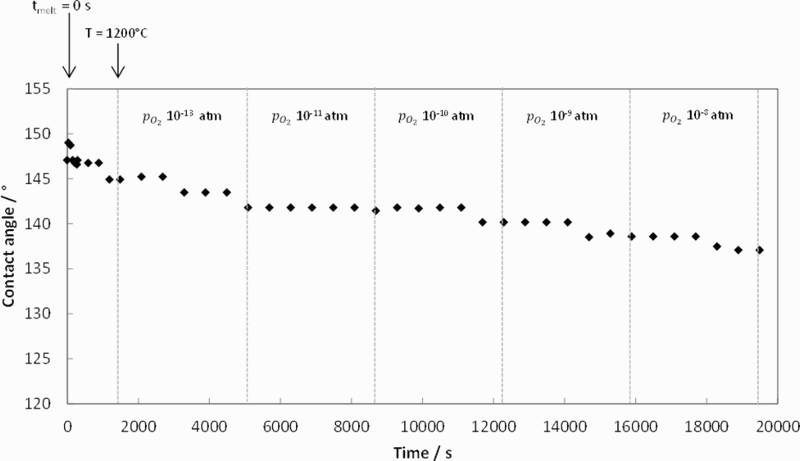
Evolution of contact angle for Cu–5 wt-Ag throughout experiment as function of oxygen partial pressure
After reaching 1200°C, a stepwise variation of the oxygen partial pressure was applied. Figure 9 shows the evolution in wetting behaviour for the Cu–5 wt-Ag alloy, which accompanied these changes in the applied oxygen partial pressures. An equilibration time between the alloy and the atmosphere was allowed. Owing to the variation of the oxygen partial pressure during the experiment, a gradual stepwise decrease in the contact angle was observed as well. Figure 8 illustrates this behaviour for the Cu–5 wt-Ag. The other alloys behaved in a qualitatively similar manner. The changes in contact angle with the oxygen partial pressure are clear from Fig. 8 and will be discussed in more detail in the section on ‘Influence of oxygen on wetting behaviour’.

Wetting behaviour of Cu–5 wt-Ag for different applied oxygen partial pressures leaving 1 h of equilibration time between alloy and atmosphere
As contact angles were determined on the gathered images of the droplets, different attempts were also made to obtain the values of the apparent surface tension of our samples. Three methods were tested, namely, the Dorsey, 21 the Bashforth and Adams 29 and the Rotenberg 30 methods. These methods presume that droplets are large enough so that the amplitude of the gravitational force modifies the spherical cap shape observed when surface forces predominate. However, Figs. 7 and 9 show small droplets, which are not flattened at their apex, i.e. the influence of the gravity is negligible, and reliable values for the surface tension could not be obtained. Therefore, the wetting behaviour of the Cu–Ag alloys on MgAl2O4 substrates will be only discussed in terms of contact angles, and no apparent surface tensions will be derived from the data.
Influence of alloying Ag on wetting behaviour
Figure 10 shows the influence of the Ag content on the contact angle between the different CuAg alloys and the MgAl2O4 substrates for the different oxygen partial pressures. High contact angles were observed for all alloys. However, a clear trend as a function of the Ag content was observed as well. A steady increase in the contact angle with Ag content together with a maximum at 12.5 wt-Ag was visible for the present set of alloys. At high Ag content (30 wt-Ag), a value similar to the 5 wt-Ag alloy was observed. Apart from the amount of Ag, the oxygen partial pressure also affected the wetting behaviour. This observation will be discussed in more detail in the next section.
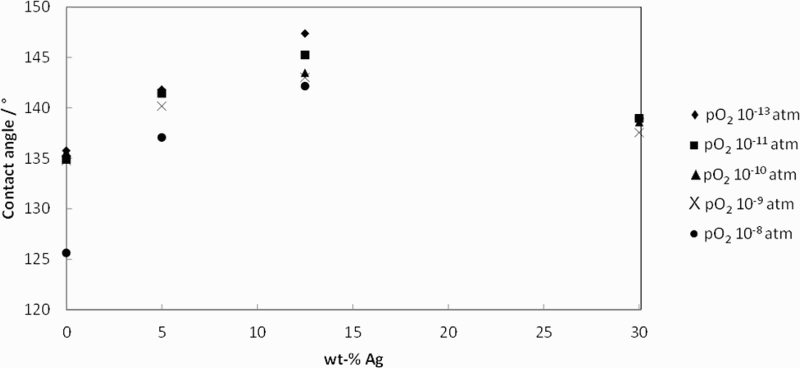
Variation of contact angle as function of weight per cent of Ag present in slag
Siwiec and his co-workers
31
studied the wettability of Cu–Ag alloys in a comparable compositional range on Al2O3 and MgO substrates under a protective Ar atmosphere. Their results did not show a strong variation of the contact angle as a function of the amount of Ag in the alloy. For pure copper, a larger contact angle was observed for Al2O3 compared to CuAg alloys, while for MgO, a smaller contact angle was observed. It should be noted that their experiments were performed under a protective Ar atmosphere and with other wt- of Ag present in their alloys. To be able to compare their results to ours, we define a relative order of the interfacial tension for every oxygen partial pressure, which we calculate using Young's equation

 represents the contact angle. Literature data from Siwiec et al.,
17
Novakovic et al.
18
and Fima and Sobczak
32
for γlv for CuAg alloys at 1200°C are shown in Fig. 11. Although experimental conditions concerning the oxygen content in the atmosphere were not given for these data, they were collected and fitted to a second order polynomial, as shown in Fig. 11. Under the assumption that γsv is constant for all experiments, a change in the term
represents the contact angle. Literature data from Siwiec et al.,
17
Novakovic et al.
18
and Fima and Sobczak
32
for γlv for CuAg alloys at 1200°C are shown in Fig. 11. Although experimental conditions concerning the oxygen content in the atmosphere were not given for these data, they were collected and fitted to a second order polynomial, as shown in Fig. 11. Under the assumption that γsv is constant for all experiments, a change in the term 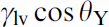 is directly linked to a change in γsl. This leads to the following relative order in the interfacial tension between CuAg alloys and MgAl2O4
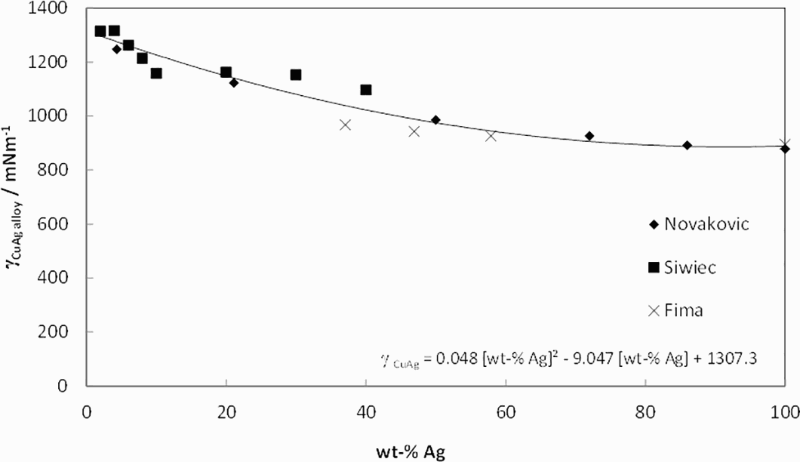

To investigate whether a chemical interaction had occurred during the experiment, the cross-sections between MgAl2O4 and the alloys were investigated. The copper/MgAl2O4 interface after slow cooling down under protective argon atmosphere is shown in Fig. 12. No reaction area could be detected at the interface between both phases, indicating that this is a non-reactive system. Some copper oxides, probably formed during cooling, were visible at the copper/MgAl2O4 interface. Thermodynamic calculations using FactSage thermochemical package 6.4 were performed to study the interaction between MgAl2O4 and Cu for the different oxygen partial pressures (10− 13, 10− 11, 10− 10, 10− 9 and 10− 8 atm) and during cooling, using the FactPS, FToxid, FTmisc and FScopp databases. These calculations indicated that only at an oxygen partial pressure of 10− 8, a very small amount of Cu2O (0.109 wt-) should be present under equilibrium conditions at 1200°C. When the temperature was lowered from 1200 to 750°C, the calculations showed that copper should transform to Cu2O under equilibrium conditions. Although thermodynamic equilibrium will most probably not be reached, the calculations give an indication and, as such, confirm the observation of the copper oxide formation during the cooling.
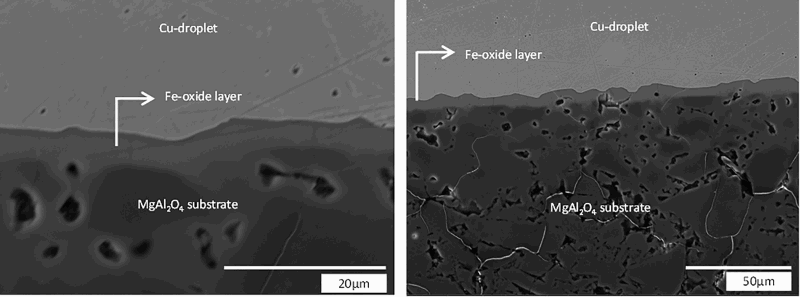
Microstructural (SEM) cross-section of the Cu–MgAl2O4 interaction zone
Influence of oxygen on wetting behaviour
The contact angles for Cu and the CuAg alloys as a function of the oxygen partial pressure are represented in Fig. 13. Pure copper showed a significant lower contact angle for an oxygen partial pressure of 10− 8 (Fig. 13). It is generally known that surface properties of liquid alloys are influenced by the presence of surfactant species, of which oxygen could be considered as the most important surface active element. 33 The effect of oxygen on liquid Cu gas is widely discussed in the literature. Experimental data from Lee et al., 15 Nexhip et al. 16 and Ip and Toguri, 9 and their comparison with other literature data, show that an increase in the oxygen partial pressure causes a decrease in the copper surface tension. Although there is an agreement that oxygen has an effect, there is some scatter on the critical oxygen partial pressure for which this influence of oxygen becomes detectable. This scatter might be explained due to scatter and/or differences in the different experimental set-up's used in the previous studies. Moreover, the different experiments in the literature have been performed at different temperatures, and it has been observed by Morita and Kasama 34 that temperature has an important effect on the influence of oxygen on the surface tension of Cu. For oxygen partial pressures higher than 10− 8 atm, the surface tension tends to decrease for decreasing temperatures. The effect of oxygen on the solid/liquid interfacial tension is less documented. Nevertheless, it can be stated that the Cu/Cu2O equilibrium has a significant effect for the wetting behaviour. In research concerning the wetting behaviour between coper–oxygen alloys on alumina, it could be observed that the contact angle decreased (170° → 85°) with increasing oxygen partial pressure (10− 20 → 10− 2 atm). 35 For higher oxygen concentrations ( < 5 wt-), significant lower contact angles (10–27°) were observed, which can be explained by the formation of Cu2O and other oxide containing phases. 35
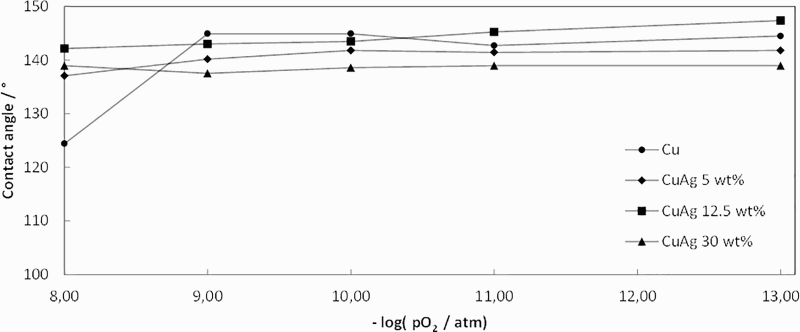
Variation of contact angle as function of partial oxygen pressure for studied Cu and CuAg alloys
It appeared that, in our range of oxygen partial pressures, the influence of oxygen on the contact angle is much clearer for pure copper, as compared to the copper–silver alloys. Cu–5 wt-Ag and Cu–12.5 wt–Ag showed a slight decrease in the contact angle for higher oxygen levels, while Cu–30 wt-Ag did not show any detectable change of contact angle under different oxygen partial pressures. As stated by Lee et al. 15 and Fima et al., 36 this can be attributed to the accumulation of Ag at the surface in CuAg alloys, which is responsible for the observed difference in the oxygen adsorption behaviour. In addition, the presence of Ag affects the activity of Cu, which influences the Cu/Cu2O equilibrium and determines the wetting behaviour
Conclusions
Copper droplet losses have to be minimised in pyrometallurgical industry, as these losses reduce the plant efficiency. In the present study, we first investigated the interaction between metallic copper based droplets and spinel substrates in a synthetic slag system. Attached Cu–Pb droplets towards spinel particles were observed, whereby the shape of the droplet adapts its shape locally to the form of the spinel particle. This phenomenon appears to be influenced by an interplay between different factors such as the composition of the copper droplet and the slags system and the level of oxygen present in both alloy and slag. Further insights in this complex interaction were obtained by a more generic approach.
Therefore, we have determined the contact angle between liquid Cu and CuAg alloys and MgAl2O4 substrates for various oxygen partial pressures. A non-wetting behaviour was observed for all alloys, with a high contact angle when Ag was present. The worst wetting behaviour was obtained for 12.5 wt-CuAg, which can possibly be attributed to a change in the interfacial tension between the substrate and alloy. For our range of oxygen partial pressures, the pure copper showed an improved wetting for a partial oxygen pressure of 10− 8 atm. For the CuAg alloys, a less explicit effect of the oxygen was observed, indicating the combined effect of concentration of oxygen in the environment together with the alloy composition.
Footnotes
Acknowledgements
The authors wish to thank the Agency for Innovation by Science and Technology in Flanders (IWT, project no. 110541) and Umicore for its financial support. In particular, M. van Camp, L. Coeck, S. Bodvin, K. van Ostaeyen, E. Boydens, A. van Gool and the technical staff of Umicore R&D are thanked for their support with the experiments and characterisation. Dr R. Mukhlis, Mr S. Ahmad and Dr A. Khaliq are thanked for the help with performing the sessile drop experiments. K. Vanmeensel wants to thank the Research Fund Flanders (FWO) for his postdoctoral fellowship.