







Abstract
Phase transformations during hot rolling is determined for the forged and β heat treated TC21 titanium alloys. The results show that β heat treatment has a great effect on phase constitution. Three types of precipitates, namely, α2, ω and (Ti, Zr)5Si3 phase is observed in the rolled forged materials, whereas the rolled β heat treated materials exhibites the presence of lamellar α and type 2α precipitate. The influence of β heat treatment on the phase transformations has been discussed on the basis of alloying elements, and β heat treatment can eliminate or decrease elemental segregation.
Introduction
The Ti–6Al–3Mo–2Sn–1Cr–2Zr–2Nb–0.2Si (TC21) alloy is a recently developed structural titanium alloy for aircraft applications due to its high strength and good damage tolerance properties,1,2 and usually considered to be more difficult to process due to higher yield/tensile ratio and lower elastic modulus. 3 However, many studies have shown that the fine equiaxed microstructure can promote the formability of titanium alloys at lower temperature, which contributes to following material processing. 4 Moreover, fine equiaxed microstructure provides a substantial increase in strength and ductility.5,6 Therefore, microstructure refinement is one of effective methods that can enhance the workability of TC21 alloy. Since the 1980s, studies indicate that the acicular microstructure obtained through β heat treatment after deformation can be transformed to a fine equiaxed microstructure (∼1 μm).2–6
The mechanical properties of titanium alloys are affected by not only the common phases (α and β) but also precipitates.7–10 For TC21 titanium alloy, the more experiments focus on the effect of the common phases on mechanical properties.1,3 However, less attention is paid to studies on precipitates [such as α2 (DO19), ω (non-close packed hexagonal) and silicide] during deformation or heat treatment of TC21 alloys. Studies on the precipitates of TC21 alloys are not only few but also divergent: in the researches of Dang et al. 11 and Wang et al., 12 it was reported that Ti2AlNb phase existed in TC21 alloy. Nb3Si and α2 precipitates have been observed in the studies of Zhu et al. 13 and Fei et al. 14 study respectively. Hence, this paper studies structural feature and composition of precipitates and the effect of β heat treatment on the precipitates of TC21 titanium alloy.
Experimental
The material used in the present work consisted of hot forged (forging first at 1100°C and finally at 900°C) bar stock of TC21 titanium with an equiaxed α microstructure (with a grain size of ∼6 μm), as shown in Fig. 1 a. The chemical composition of the material is (by wt-) 6·3Al–2·13Sn–2·89Mo–1·63Cr–2·3Zr–2·02Nb–0·11Si–82·62Ti. The β transus temperature of the material was ∼940°C. The material was β heat treated at 970°C for 1 h and water quenched to develop an acicular microstructure comprising a 100–200 μm prior-β grain size (Fig. 1b). Both the hot forged and the β heat treated material variants were rolled at 900°C to a strain of 1.2, followed by water quenching.
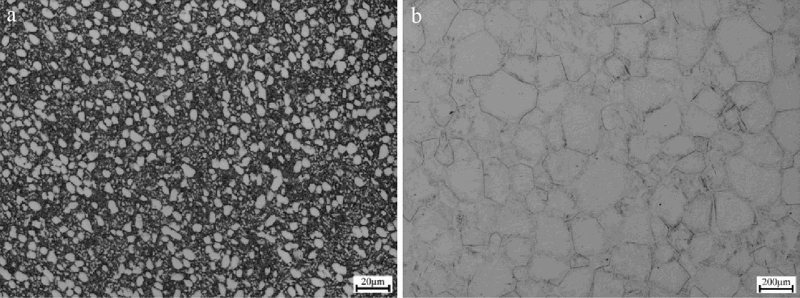
Initial microstructures of a forged material and b β heat treated material used in the present study
The examinational microstructure in both rolled materials was carried out using an Olympus optical microscope (OM), a JMS-6460 SEM equipped with an Oxford energy dispersive spectroscopy (EDS) system and a JEOL 2100F TEM equipped with an Oxford INCA energy TEM 200 EDS system.
Results
Optical microscope microstructure
Typical OM images for the rolled samples are shown in Fig. 2. The deformation of hot forged material at 900°C leads to an equiaxed microstructure with an α-grains of size about 3–5 μm (Fig. 2a). The morphology and size of primary α phase hardly change when comparing Fig. 1a with Fig. 2a. This effect may be attributed to the following factors: first, in the present deformation temperature, it has been shown that the hardness of α phase is significantly larger than that of β phase. Second, higher friction stress and internal strength are observed for α/α phase boundaries when compared to those for α/β phase boundaries. 15 It is concluded that the deformation for forged material is much easier in β phase and interface rather than in α phase. Optical microscope examination of the β heat treated material rolled at 900°C reveals a homogeneous microstructure consisting of very fine (∼0.5 μm in diameter) globular grains (Fig. 2b). As previously mentioned, it illustrates that the β heat treated material during rolling goes through dynamic recrystallisation and the separation of α lamellae by boundary splitting. 2 Simultaneously, mass transport, which results from the chemical potential gradient due to curvature at the interface, enlarges the recrystallised α grain to a size larger than the original plate thickness. 3 In this study, the β heat treatment is favourable for refinement of microstructure.

Optical microscopy images for a forged and b β heat treated materials after rolling
β phase→ω phase transformation
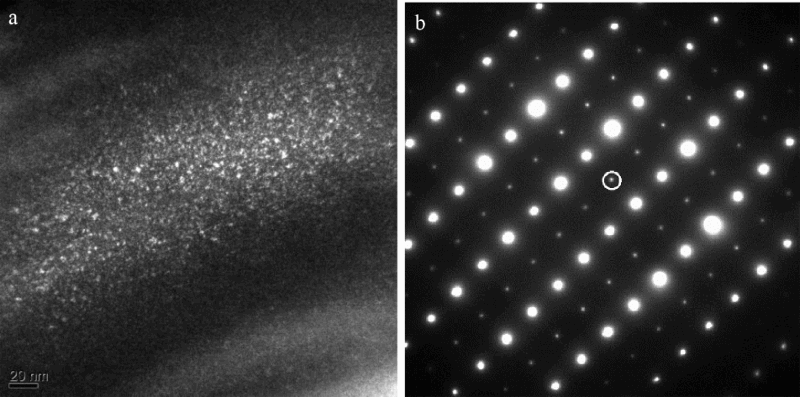
Transmission electron microscopy results from the forged material rolled at 900°C are shown in Fig. 3. The selected area diffraction pattern (SADP) from the material, taken at [110]β, comprises two set patterns (Fig. 3a). In addition to the β matrix reflections, there are distinct ω reflections at the 1/3 and 2/3 {1–1–2} positions. Dark field (DF) image is obtained using one of the ω reflections in Fig. 3a, as shown in Fig. 3b, and sub-1 nm scale ω precipitates are observed in the β matrix. However, no evidence of ω formation is observed by selected area diffraction studies of the β heat treated material rolled at 900°C. It suggests that β heat treatment may suppress the ω phase transformation.
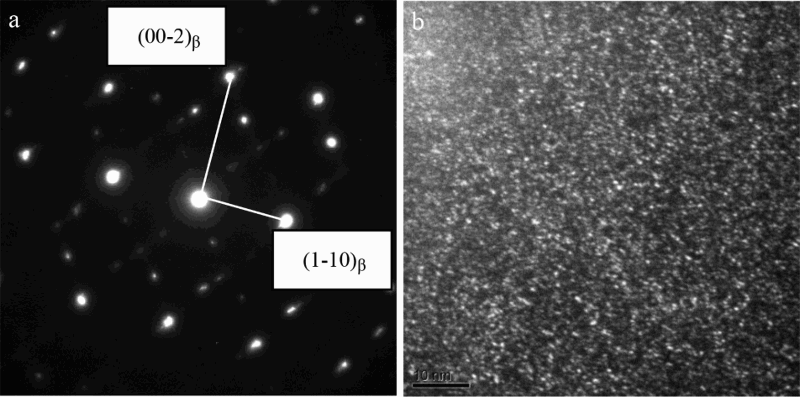
a SADP of [110]β zone axis; b DF TEM image recorded using one of ω reflectionsPrecipitation of ω particles in forged material rolled at 900°C
Metastable β→α transformation
Hexagonal, α precipitates formation are observed in the β heat treated material rolled at 900°C (Fig. 4). The bright field image confirms that α precipitates are lamellar, as shown in Fig. 4a. The corresponding SADP (Fig. 4b) comprises α and β phase patterns. The orientation relationship between the α and β phases is {110}β//{0001}α,[111]β//[11–20]α, which is referred to as a Burgers relationship. Very fine α phase particles precipitated in the β matrix, as illustrated in Fig. 4c, which is the DF image using an α phase reflection (Fig. 4d). Such diffraction pattern has been analysed to illustrate that α phase is a Burgers orientation relationship with the β matrix. Another fine α phase laths are found in the β matrix (Fig. 4e). The complex diffraction pattern is shown in Fig. 4f. It is evident that ‘arced’ reflections are observed, which implies the existence of type 2α. 16 In addition to β and ω reflections, there are quite faint additional reflections located near the 1/2 (1–1–2) β locations in the forged material rolled at 900°C, as shown in Fig. 3a. Early studies indicate that these additional reflections result from tiny α particles, which nucleate and grow from the β/ω interface. 17 In present studies, the DF image of α phase cannot be taken utilising [110]β or other β zone axis, which may be due to the low intensity of its diffraction maxima and the low volume fraction of extremely small α precipitates. Additionally, no lamellar α and type 2α precipitates are observed in the rolled forged material, which suggests that ω phase formation retards the β → α transformation.
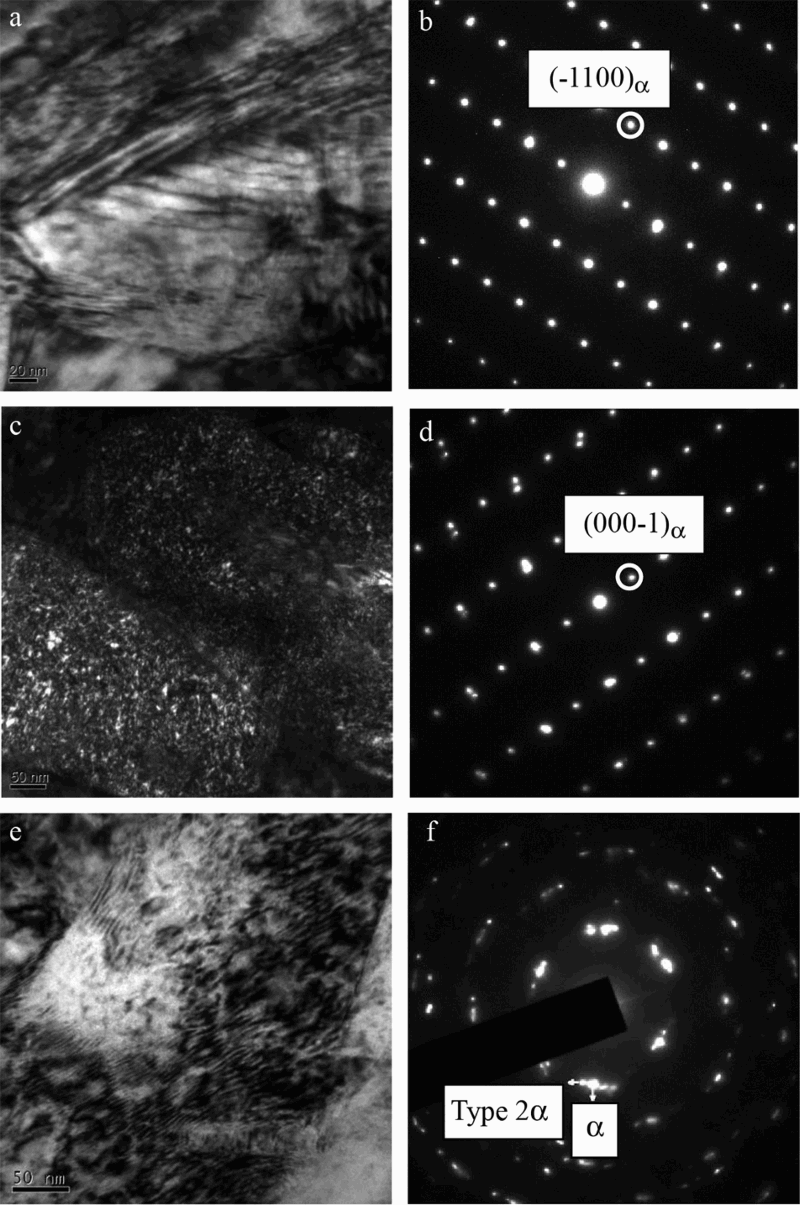
a bright field (BF) image showing α lamellae; b SADP of [111]β zone axis from α lamellae in a; c DF image showing α particles; d SADP of [111]β zone axis showing α particles reflections; e BF image showing type 2α laths; f SADP showing type 2α reflectionsImages (TEM) of α phase in β heat treated sample rolled at 900°C
Intermetallics
Figure 5 shows the formation of equiaxed silicides in the forged material rolled at 900°C. Within the β matrix, equiaxed silicides with a diameter of ∼200 nm in diameter are found (Fig. 5a). The EDS analysis indicates that the precipitates contain significant amounts of Si, Ti and Zr. We assume the stoichiometry of the silicide to be (Ti, Zr)xSiy. Figure 5b is a SADP from the silicide in Fig. 5a. The analysis of the SADP also suggests that the silicides could be indexed as (Ti, Zr)5Si3, which is hexagonal. Its lattice parameters based on SADP analysis is established as a = 7.94 nm and c = 5.54 nm. Moreover, DF image (Fig. 6) also suggests that the nanometre scale α2 precipitates present in the forged material. Finally, no evidence of silicide or α2 precipitate is observed by selected area diffraction studies in the β heat treated materials rolled at 900°C, which indicates that β heat treatment has a great effect on intermetallic phases of TC21 titanium alloy during rolling.
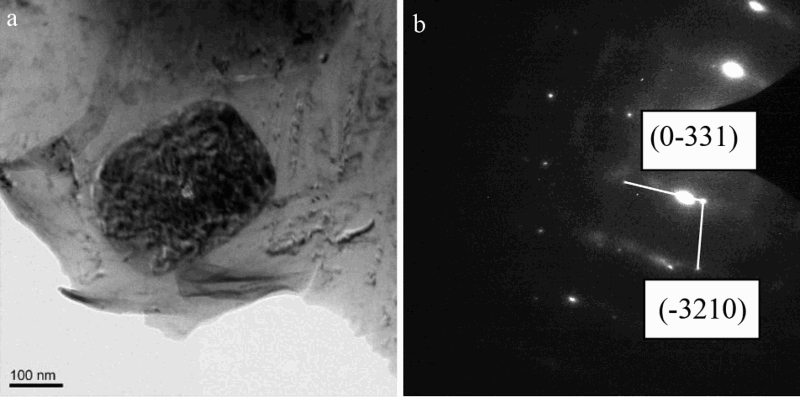
a silicides precipitates; b SADP of (Ti, Zr)5Si3 precipitatesImages (TEM) of forged material rolled at 900°C
a DF image showing α2 precipitates; b corresponding SADPImages (TEM) of forged material rolled at 900°C
Discussions
From the above analysis, β heat treatment has a great influence on the microstructural features of rolled TC21 alloy (Table 2). From the data in Table 2, β heat treatment suppresses the formation of α2 phase. There are many factors affecting the precipitation behaviour of α2 in titanium alloys, including the alloying element, processing history, heat treatment and oxygen content.1,18,19 Earlier research reported that the α2 phase could occur in Ti alloys when the Al content reaches 12 at- (∼7 wt-Al). 20 However, previous reports18,21 showed that α2 phase is observed under specific heat treatment conditions when average Al content is < 7. It is interesting that the Al content (>7 wt-) in α/α2 phase regions is noticeably higher than the average Al content of the α phase (∼6 wt-) in both alloys above, implying the existence of some Al rich regions. In present study, α2 precipitates are only found in the rolled forged material. The Al content in the α/α2 region reaches 7.56 wt- for the rolled forged material, as shown in Table 1. For rolled β heat treated material, the Al contents in α and β phases are almost the same, which indicates that β heat treatment suppresses compositional segregation. This is easy to understand: first, β heat treatment results in the diffusion and redistribution of the alloying elements throughout the alloy, namely, to eliminate or decrease elemental segregation resulted from arc melting or forging. 22 Second, the globularisation of α lamella in the β heat treated material during rolling is able to decrease or eliminate the enrichment of Al of the curved interface by mechanisms of mass transport, indicating that microsegregation in this material is suppressed during rolling. The experiments in the present study have confirmed the interpretation: as shown in Table 1, Al contents in α and β phases are 5.76 and 5.88 wt- respectively, which clearly indicates that there is minimal compositional segregation within the rolled β heat treated material. Therefore, the β heat treatment can suppress the precipitation of α2 phase.
Energy dispersive spectroscopy data of different phases in both rolled materials/wt-

Several investigators in titanium alloys have indicated that increasing Al content reduces the volume fraction of ω precipitate, even retard ω phase precipitation and lead to the preferential formation of alternative decomposition products such as α phase.23,24 As shown in Table 1, the Al contents of the β phase in the rolled forged material and the rolled β heat treated material are 3.24 and 5.88 wt- respectively. In the present study, the formation of α phase observed in the rolled β heat treated material where the ω phase is absent indicates that this may be related to higher Al content.
Microstructure feature found from two rolled materials

There are many reports on observation of (Ti, Zr)5Si3 in titanium alloys25,26 where (Ti, Zr)5Si3 precipitation occurs when Si content is higher than 3, and temperature is no less than 1050°C.27,28 Precipitation of (Ti, Zr)5Si3 in TC21 titanium alloy is believed to be associated with the enrichment of Si at higher temperatures ( ≥ 1050°C). In the present case, (Ti, Zr)5Si3 precipitations are found in the forged material rolled at 900°C. Therefore, we think that (Ti, Zr)5Si3 precipitations occur during arc melting or initial β-forging.
Conclusions
As the result of rolling at 900°C to a strain of 1.2, the forged and β heat treated materials consist of an coarse grains with a grain size of 3–5 μm and fine grains whose size does not exceed 0.5 μm respectively. Three types of precipitates, α2, ω and (Ti, Zr)5Si3 phases, have been identified in the rolled forged material. β heat treatment suppresses ω phase formation and promotes α phase formation. β heat treatment results in the diffusion and redistribution of the alloying elements and can contribute to eliminate or decrease elemental segregation in the forged material.
Acknowledgements
The present research was sponsored by the National Natural Science Foundation of China (grant no. 51301010).