







Abstract
The effects of isothermal holding time on precipitation behaviour and resultant hardness were investigated in detail. Of particular note, with prolonged isothermal holding time at 650, 700 and 750° C, the hardness peak moves to a higher value, nearly remains unchanged, and to a lower value, respectively. It has been demonstrated that the nanometer–sized particles can nucleate at migrating γ/α interface for both rapid or slow transformation kinetics, and the changes in hardness are mainly related to precipitation behaviour. Regardless of isothermal holding time, the hardness increases as the transformation temperature decreases due to particle size and particle spacing refinement.
Introduction
There are many approaches to enhance the strength of steel materials, such as grain refinement, solid solution strengthening, precipitation hardening and dislocation strengthening.1–6 Among these strengthening approaches, the precipitation hardening plays a significant role in increasing the strength of hot rolled microalloyed steels, without sacrificing ductility and hole expansion.2,7 In addition, the precipitation behaviour, precipitation mechanism and precipitation hardening have been further elucidated.8–16 Moreover, the effects of isothermal holding temperature and time on sheet spacing, particle size and particle spacing and the orientation relationships between ferritic matrix and precipitated particles were also investigated.8–10,13,15 It has been demonstrated that the precipitation reactions can take place during or after γ to α transformation, resulting in interphase precipitation or random precipitation. For interphase precipitation, the sheet spacing, particle spacing and particle size are associated with isothermal transformation temperature and time, 10 and the sheet spacing, particle spacing and particle size decrease as the transformation temperature decreases, resulting in a greater strength.8,9 However, there are few reports focusing on the influence of isothermal holding time on sheet spacing, interphase or random precipitated particle size, and resultant hardness distributions. Furthermore, it is also necessary to understand the correlations between precipitation characteristics and isothermal transformation time.
In the present work, the precipitation characteristics during isothermal γ to α transformation and resultant hardness distributions in a low carbon vanadium–titanium bearing steel were revealed. The influence of isothermal holding time on precipitation behaviour, transformation behaviour and Vickers hardness were studied using optical microscopy (OM), transmission electron microscopy (TEM) and Vickers hardness tester. The correlations between precipitation characteristics and isothermal transformation behaviour were elucidated in detail.
Experimental
Sample preparation
The steel was melted in a vacuum induction furnace and cast into an ingot. The chemical composition of the steel is listed in Table 1. The ingot was hot forged into a large scale square billet (70 × 90 × 500 mm3) at first, and then a small billet (70 × 90 × 120 mm3) was cut from this large scale square billet. This small billet was homogenised in a box type electrical resistance furnace at 1200°C for 2 h, hot rolled in seven passes to a 12 mm thickness plate at the temperature range of 1100–1000°C, and finally cooled to ambient temperature in water. In addition, before the preparation of thermal simulation specimens, the plate was further homogenised in a box type electrical resistance furnace at 1200°C for 5 h, followed by water quenching and removing decarburisation layer. The thermal simulation specimens were prepared from as quenched plate along the transverse direction and machined into cylindrical specimens of 79 mm length and 10 mm diameter, with the central 15 mm length further machined down to 6 mm diameter.
Chemical composition of investigated vanadium–titanium bearing steel/mass-

Thermomechanical simulation
The thermomechanical simulation tests were conducted on a Gleeble 3800 thermomechanical simulator. Based on solubility product equations (1) and (2),17,18 the solubility temperature of (V1 − x
,Ti
x
)C was estimated to be ∼1131°C, without considering titanium content in TiN. So, the specimens were reheated to 1200°C at a heating rate of 10°C s− 1 and held for 300 s to dissolve all of carbides, and then compression deformed at 1050°C and 900°C with the same reduction of 3 mm and strain rate of 5 s− 1 in order to refine austenitic microstructure. Subsequently, the specimens were cooled to different temperatures of 750, 700 and 650°C and isothermally held at above individual temperature for different time of 0, 10, 30, 60, 300 and 600 s, and then water quenched to ambient temperature to investigate precipitation characteristics and transformation kinetics during isothermal γ (austenite) to α (ferrite) transformation. The details of these treatments are shown in Fig. 1.


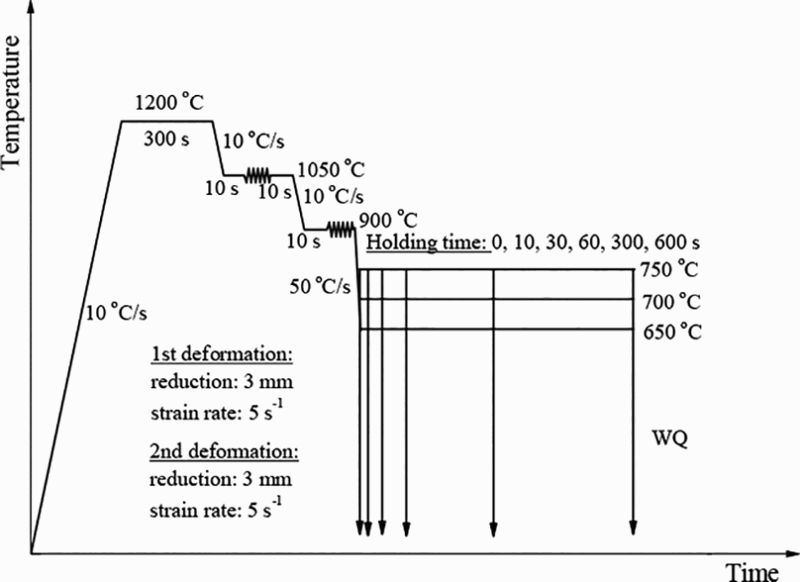
Schematic of thermomechanical simulation process
Microstructural characterisations
The specimens for the observation of OM (Leica DMIRM) were prepared from the cylindrical specimens. Their surface underneath the thermocouple was mechanically polished and etched in 4 nital solution. Transmission electron microscopy specimens were prepared by cutting slices with 500 μm thickness from the corresponding metallographic specimens. These slices were mechanically thinned to 50 μm thickness from both sides using silica papers, followed by punching to prepare round discs with 3 mm diameter. Subsequently, the discs were further thinned using a twin jet electropolisher (StruersTenuPol-5) at a voltage of 30 V and temperature range of − 30 to − 20°C. The electrolyte consisted of perchloric acid of ∼9 and absolute ethyl alcohol of ∼91. They were examined on a field emission TEM (FEI Tecnai G2 fig20) operated at 200 kV.
Vickers hardness measurements
In order to confirm precipitation hardening effect within ferrite grains. The Vickers hardness measurements were performed on a Vickers hardness tester (FM-700) using a load of 10 g, which was chosen to restrict indentations within the ferrite grains, so the effects of grain or phase boundaries and neighbouring martensite can be avoided. The testing standard followed the guidelines of ISO 6507-1: 2005(E),19,20 while a diamond indenter is forced into the surface of the tested specimens, and then the diagonal length (d1 and d2) of the indentation left in the surface after removal of the diamond indenter is measured. At last, the Vickers hardness can be calculated using the equation HV = 0.1891 × F/d2 (F, force; d, mean value of d1 and d2). Moreover, ≥ 60 ferrite grains were measured for each metallographic specimen; thus, the errors could be greatly reduced.
Results and discussion
Ferrite transformation kinetics
The volume fractions of ferrite were determined by measuring the area of ferrite with the help of Adobe Photoshop CS2 and Image-Pro Plus software. Moreover, ≥ 10 pictures obtained from different regions of each metallographic specimen were chosen to measure the volume fractions of ferrite in order to reduce errors. On the basis of measured results, the ferrite transformation kinetic curves were plotted, as shown in Fig. 2. It can be seen that all ferrite transformation kinetic curves show S shape. Below the isothermal holding time of 10 s, only a little ferrite is formed. When the isothermal holding time increases to 30 s, the ferrite volume fraction dramatically increases to ∼80 for the isothermal transformation temperature of 700°C, showing fastest transformation kinetics, and there is also a pronounced increase in the ferrite volume fraction for the isothermal transformation temperatures of 750 and 650°C. With further increasing the isothermal holding time to 60 s, the ferrite volume fractions reach ∼90 for the isothermal transformation temperatures of 650 and 700°C, while the ferrite volume fraction still remains a lower increase rate for the isothermal transformation temperature of 750°C. After that, only a little fresh ferrite is formed for the isothermal transformation temperatures of 650 and 700°C, but the ferrite volume fraction continues to increase for the isothermal transformation temperature of 750°C.
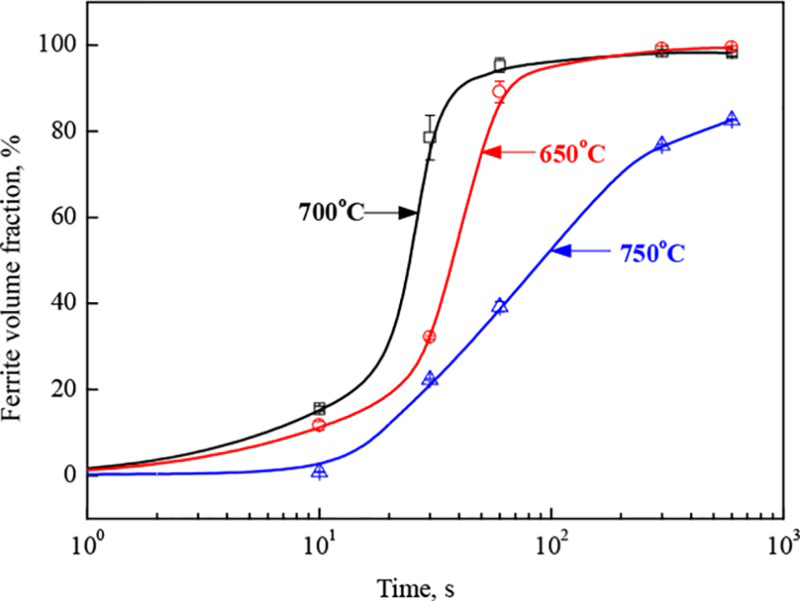
Ferrite transformation kinetics: ferrite volume fractions are function of isothermal holding time and transformation temperature
Vickers hardness
Because only a little ferrite is formed at different transformation temperatures for ≤ 10 s, the Vickers hardness within ferrite grains at different transformation temperatures for 30, 60, 300 and 600 s was measured using a Vickers hardness tester with a load of 10 g, which was chosen to restrict indentations within ferrite grains to avoid the effects of grain or phase boundaries and neighbouring martensite on hardness of ferrite. The measured results are shown in Fig. 3. Regardless of isothermal holding time, the hardness peak moves to a high value as the isothermal transformation temperature decreases from 750 to 650°C, indicating that a greater precipitation hardening was achieved by decreasing transformation temperature, and this result is consistent with previous reports.8,9,21 However, it is interesting to note that the hardness peak moves to a low value with prolonging isothermal holding time at the transformation temperature of 750°C (by comparison of Fig. 3a, d, g and j), suggesting that the number fraction of ferrite grains with higher precipitation hardening is lowered by prolonging isothermal holding time. In contrast, the hardness peak moves a high value with prolonging isothermal holding time at the transformation temperature of 650°C (by comparison of Fig. 3c, f, i and l). Meanwhile, note that a great amount of ferrite grains with the hardness ≤ 280 HV are observed at the isothermal holding time of 30 and 60 s, while the isothermal holding time increases to 300 and 600 s, and the number fraction of ferrite grains with the hardness ≤ 280 HV is dramatically reduced, indicating that the precipitation hardening effect is strongly enhanced with increasing isothermal holding time at the transformation temperature of 650°C. However, at the transformation temperature of 700°C, although the hardness peak does not vary with the isothermal holding time, Fig. 3k shows that the number fractions of ferrite grains with different hardness become similar. Hence, besides the transformation temperature, the precipitation behaviour is also affected by the isothermal holding time.
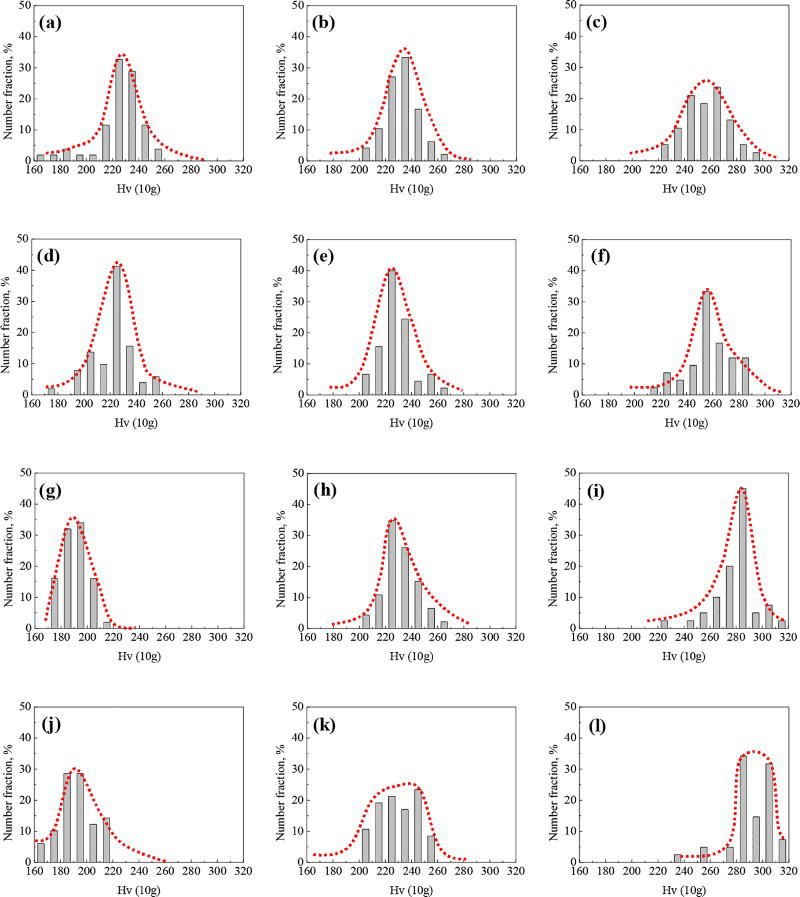
Vickers hardness distributions of steel isothermally transformed at 750°C for a 30 s, d 60 s, g 300 s and j 600 s; at 700°C for b 30 s, e 60 s, h 300 s and k 600 s; and at 650°C for c 30 s, f 60 s, i 300 s and l 600 s
Additionally, the average Vickers hardness was also calculated from the above mentioned hardness, as shown in Fig. 4. Regardless of isothermal holding time, the hardness increases as the isothermal temperature decreases. With prolonging isothermal holding time, the average hardness decreases at first and then nearly remains unchanged for 750°C, nearly remains unchanged for 700°C, and increases for 650°C.
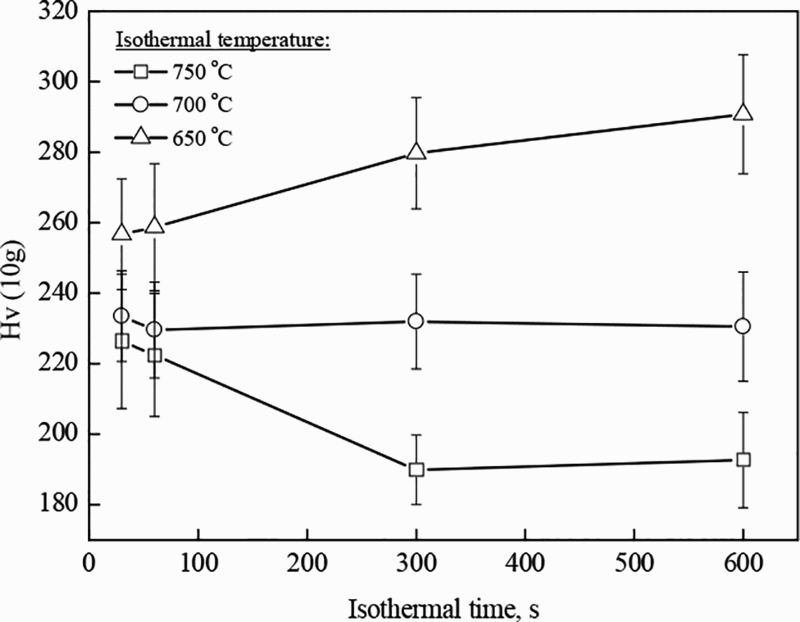
Vickers hardness with isothermal holding time at different transformation temperatures
Precipitation characteristics
The TEM images of the steel treated at 750°C for 30 and 600 s are presented in Fig. 5. Regardless of the isothermal holding time at the transformation temperature of 750°C, both interphase precipitation and random precipitation could be observed; moreover, the interphase precipitation was always observed in numerous ferrite grains. However, in some ferrite grains, despite the thin foils were carefully tilted at different double tilt angles, only random precipitated particles could be observed. In addition, Kestenbach et al. 3 also indicated that the presence of random precipitated particles in some regions must be a real phenomenon. Hence, it was a real phenomenon that the precipitation reaction also occurred after isothermal γ to α transformation. In addition, it is worth noting that the sheet spacing decreases as the isothermal holding time is prolonged (by comparison of Fig. 5b and e). Moreover, ∼20 TEM pictures obtained from different ferrite grains of each thin foil were chosen to measure the sheet spacing, and the measured results are shown in Fig. 6. It can be seen that the sheet spacing decreases from 44 to 37 nm with prolonging the isothermal holding time. These results show that the interphase precipitation interaction has taken place during the whole isothermal γ to α transformation (seen in Fig. 2) and the sheet spacing is relatively fine at the later stage of transformation. The sheet spacing is associated with γ/α interface velocity, which decreases with the isothermal γ to α transformation proceeding, and the decrease in γ/α interface velocity leads to fine sheet spacing. 10
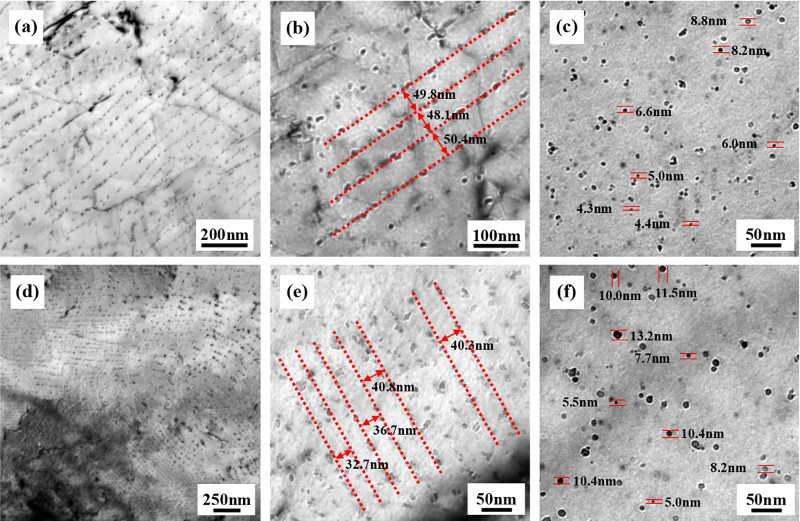
TEM images with isothermal holding time of a–c 30 s and d–f 600 s at transformation temperature of 750°C
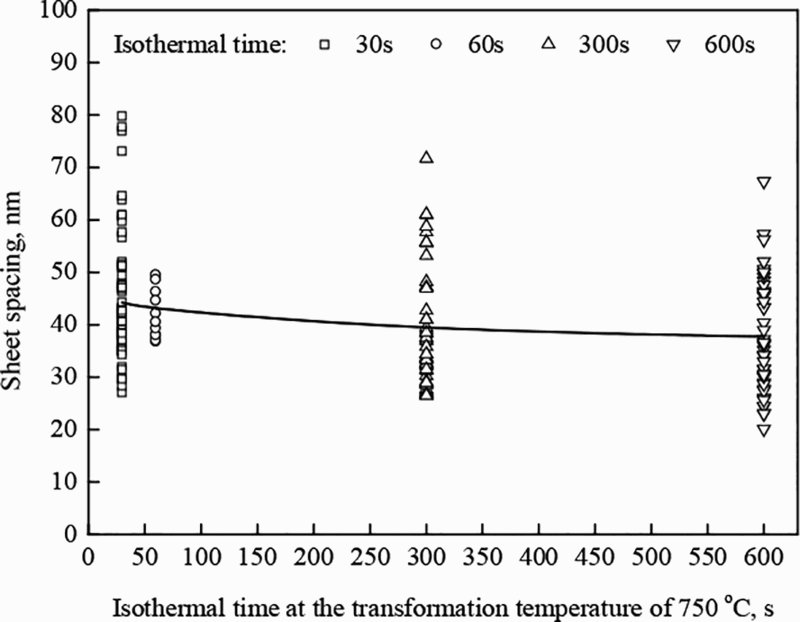
Effect of isothermal holding time on sheet spacing at isothermal transformation temperature of 750°C
Besides the changes in sheet spacing, it is also noted that the particle size is also affected by the isothermal holding time. Meanwhile, in order to differentiate the coarsening behaviour of interphase and random precipitated particles, the size of interphase and random precipitated particles was measured alone, as shown in Fig. 7. Regardless of precipitation types, all particle size slightly increases as the isothermal holding time is prolonged. The particle size increases from 6.6 to 7.2 nm and from 6.8 to 8.5 nm for the interphase and random precipitated particles with increasing isothermal holding time respectively, indicating that the interphase precipitated particles are slightly coarsened, while the random precipitated particles are obviously coarsened.
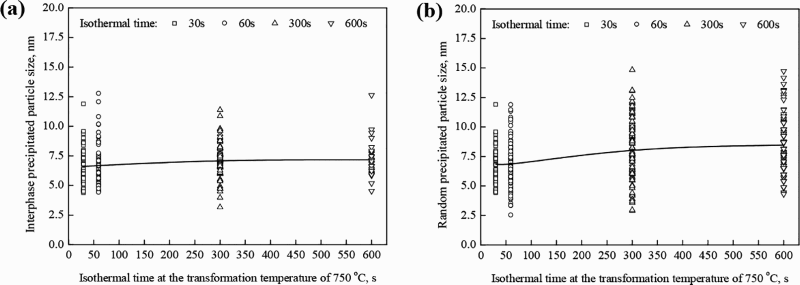
Effect of isothermal holding time on size of a interphase and b random precipitated particles at transformation temperature of 750°C
Although the sheet spacing becomes finer with prolonging isothermal holding time, Chen et al. 10 indicated that the particle spacing increases as the transformation proceeds. The decrease in sheet spacing will enhance precipitation hardening effect, while the increase in particle size and particle spacing will lower precipitation hardening. In addition, Fig. 2 shows that the volume fraction of martensite reaches ∼80 and 60 for the short isothermal holding time of 30 and 60 s respectively. So, the high density of mobile dislocation can be introduced to accommodate volume expansion around martensite. 22 However, the indentations are always far from martensite, so the effect of martensite on hardness of ferrite phase may be neglected. Hence, the changes in hardness are mainly related to precipitation behaviour.
The TEM images of the steel treated at 700°C for 30 and 300 s are exhibited in Fig. 8, showing that despite the ferrite transformation kinetics is fastest, the nanoscale precipitated particles are also formed at γ/α interface during transformation. Moreover, the sheet spacing in Fig. 8a is similar with that in Fig. 8b. Figure 2 shows that the ferrite volume fraction reaches ∼80 when the isothermal holding time increases up to 30 s, indicating that the interphase precipitation is mainly formed at this stage. Hence, it can be deduced that the changes in sheet spacing may be neglected with further prolonging isothermal holding time.
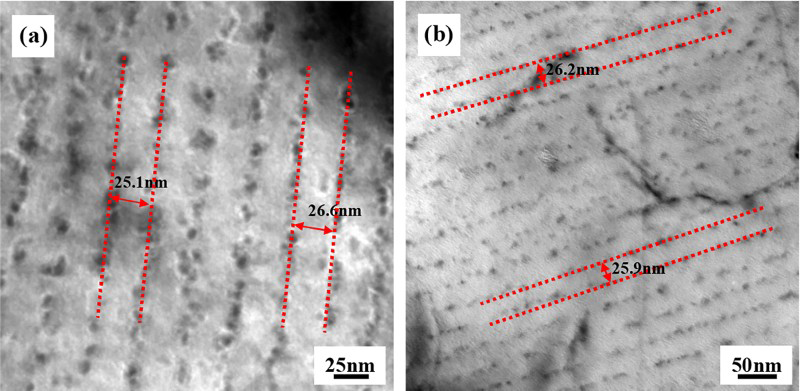
TEM images with isothermal holding time of a 30 s and b 300 s at transformation temperature of 700°C
The TEM images of the steel treated at 650°C for 30 and 300 s are presented in Fig. 9. Although many regions of thin foils were observed, the interphase precipitated particles were not observed. This phenomenon may be attributed to relatively rapid transformation kinetics and lower diffusion coefficient of vanadium and titanium. However, the sufficient precipitation hardening can be also achieved by these nanometer sized particles with the diameter ranging from 2.6 to 4.2 nm and fine particle spacing. On the one hand, the coarsening kinetics of precipitated particles can be significantly lowered at the lower isothermal temperature of 650°C. On the other hand, some nanometer sized particles can be further precipitated from ferrite matrix. Hence, the average hardness increases and the hardness peak moves to a high value with prolonging isothermal holding time.
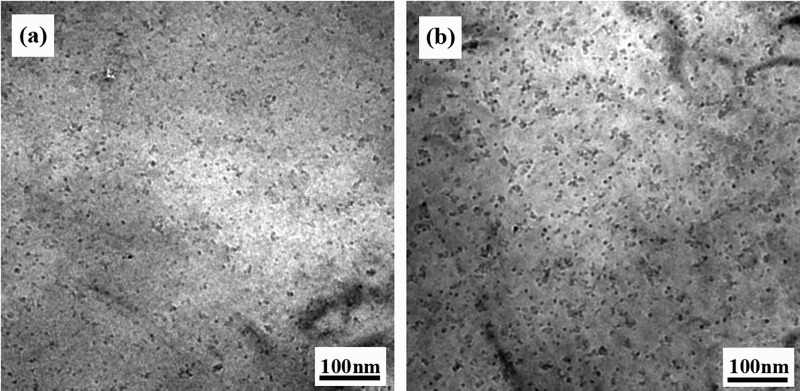
TEM images with isothermal holding time of a 30 s and b 300 s at transformation temperature of 650°C
From above mentioned results, it can be seen that the sheet spacing was significantly refined by decreasing isothermal transformation temperature from 750 to 700°C and the particle size was slightly refined, resulting in an increase of average hardness by lowering the isothermal transformation temperature from 750 to 700°C. Although the interphase precipitation is not observed at 650°C, the particle size and particle spacing are so small that the highest precipitation hardening is obtained.
Conclusions
Precipitation characteristics during isothermal γ to α transformation and resultant hardness in a low carbon vanadium–titanium bearing steel were investigated by means of Vickers hardness measurements and TEM observations, and the following conclusions were drawn.
The kinetics of γ to α transformation is fastest and slowest for 700 and 750°C respectively. With increasing the isothermal holding time, the hardness peak moves to a higher value for 650°C, nearly remains unchanged for 700°C and moves to a lower value for 750°C. Regardless of isothermal holding time, the average hardness increases as the transformation temperature decreases. The nanometer sized particles can nucleate at migrating γ/α interface in spite of rapid or slow transformation kinetics. Although the interphase precipitation is not observed at 650°C, the highest hardness is obtained due to particle size and particle spacing refinement. TEM observations of the steel treated at 750°C for different isothermal holding time show that the random precipitated particles can be easily coarsened, while the interphase precipitated particles seem to be hardly coarsened. In addition, the sheet spacing decreases as the transformation proceeds.
Footnotes
Acknowledgements
This research is supported by project funded by China Postdoctoral Science Foundation [Grant no. 2014M560217] and the National Natural Science Foundation of China [Grant no. 51204049].