






Abstract
The effect of Zr addition on the toughness and microstructure of coarse grained heat affected zone (CGHAZ) in Al deoxidised low carbon steel was investigated. In this present work, the specimens (Zr free and Zr added) were subjected to weld thermal cycle with heat input of 54, 80 and 100 kJ cm− 1 at 1350°C peak temperature using thermal simulator. The typical inclusions were characterised by scanning electron microscopy, and the chemical composition of the inclusions was determined by energy dispersive spectroscopy. The nanoscale precipitates were analysed by transmission electron microscopy and energy dispersive spectroscopy. It was verified that the occurrence of Zr in steel mostly exists in the form of oxide inclusions, but a few in the form of solid solution state and Zr containing precipitates when the concentration of Zr is 0.015. The improvement of CGHAZ toughness is obtained when the heat input is 80–100 kJ cm− 1. The possible reasons about the effects of Zr on the toughness of CGHAZ, including Zr containing inclusions, precipitates and microstructure characteristics, were also discussed.
Keywords
Introduction
Zirconium has a strong chemical affinity, in decreasing order, for oxygen, nitrogen, sulphur and carbon, and is soluble in steel with reasonable amount, which results in the functions of Zr in steelmaking, hot rolling and other thermomechanical treatments that were universally concerned in recent years. In 2015, Baker 1 reviewed the role of Zr in microalloyed steels. Based on this literature, it can be found that several workers have exerted a tremendous interest on the influences of Zr in steel, including sulphide shape control, precipitates and austenite grain growth. Simultaneously, Baker 1 also pointed out that there were some other researchers considering the investigations of Zr on weldability in microalloyed steel for affecting the heat affected zone (HAZ) microstructure.
In the 1990s, Takamura and Mizoguchi 2 have proposed a concept of oxide metallurgy using non-metallic inclusions to induce intragranular acicular ferrite (IAF) structure. Since then, the investigation concerning the influence of Zr oxides on the toughness and microstructure of coarse grained heat affected zone (CGHAZ) in terms of oxide metallurgy has been widely discussed. Despite this, most of the investigations have poured attention into the addition of trace Zr into the steel deoxidised by Ti, and the corresponding typical inclusions are mainly identified as complexes of Ti x O y and ZrO2 or ZrO2–MnS. As an example, Guo et al., 3 Shi et al., 4 and Wang et al. 5 reported that the microstructure and impact toughness of the HAZ can be improved by nucleating IAF on the ZrO2–MnS in Ti–Zr deoxidised microalloyed steel. In addition, Chai et al. 6 also investigated the effect of Zr bearing inclusions on the IAF formation in the HAZ, and they harbored the idea that Ti–Zr–O compound oxide can nucleate the IAF, while single phase ZrO2 cannot. Wakoh et al. 7 studied the effect of Ti–Zr oxide particles on MnS precipitation in low S steels, and they held the view that an ocean of fine MnS phases could precipitate on Mn–Si–Ti–Zr complex oxide particles, which are also observed to be the effective nuclei for IAF. Chen et al. 8 examined the microstructure and the characteristics of the inclusions embedded in ferrite matrix in simulated CGHAZ of a Ti–Zr treated high strength low alloy, and they emphasised that Ti2O3–ZrO2–Al2O3–MnS complex inclusions can promote the acicular ferrite formation in HAZ.
Aluminium is intensively applied as a main deoxidiser in the production of medium and thick plates due to its cheap cost and strong affinity for oxygen. However, by comparison, the investigations on the addition of trace Zr into the steel deoxidised by Al have been underdeveloped. In 2011, Jiang et al. 9 studied the influence of Zr bearing inclusions on the IAF formation in Zr–Al deoxidised low carbon steel. They concluded that [ZrO2–TiO x )–(SiO2–MnO–(MnS)] can be favourable nucleation site for IAF, whereas ZrO2–MnS inclusions cannot develop the IAF formation, which is frowned on the results of literatures.3–5,10 It should be pointed that the microstructure and toughness of CGHAZ in Zr–Al deoxidised low carbon steel were still not deeply performed. As reported by Takamura and Mizoguchi, 2 different deoxidisation process would be paramount to control the nature of complex oxides produced, and not all the produced oxides can be able to function as sites for ferrite precipitation. Therefore, it is overwhelmingly indispensable to verify the Zr addition on the microstructure and toughness of CGHAZ in Al deoxidised low carbon steel.
The present article is a successive study of the author's previous work. Our previous work 11 has focused on the influence of Zr addition on the phase transformation and precipitates to establish the relationship between Zr content and mechanical properties in Al deoxidised low carbon steel. In that work, it is demonstrated that the appropriate strength and impact toughness can be well balanced by adding 0.015 Zr into the steel through sulphide modification, ferrite promotion, grain refining strengthening and precipitation strengthening. In this present work, the effect of 0.015 Zr addition on the toughness and microstructure of CGHAZ in Al deoxidised low carbon steel has been further investigated. In order to evaluate the simulated microstructure and toughness in CGHAZ, the specimens (Zr free and Zr added) were subjected to weld thermal cycle with heat input of 54, 80 and 100 kJ cm− 1 at 1350°C peak temperature using thermal simulator. In particular, the possible reasons about the effects of Zr on the toughness of CGHAZ, including Zr containing inclusions, precipitates and microstructure characteristics, were also discussed.
Experimental
Two steels of chemical composition listed in Table 1 were vacuum smelted and cast into ingots. The S1 steel was melted and Al killed in the conventional manner. As regards the S2 steel, Al and Zr were used for deoxidation. In the experiment, Zr (added by Fe–50 Zr alloy) was deliberately added into the melts while keeping the amounts of the other alloying elements constant. Afterwards, the inductively coupled plasma–atomic emission spectrometry and inductively coupled plasma–optic emission spectrometry were used for evaluating the total Zr and soluble Zr in Zr added steel respectively. The ingots were then rolled into 13 mm plate using thermomechanical control process, with a cooling rate of 10°C s− 1 and a final cooling temperature of 400°C. The detailed description of the process is given in our previous studies.12,13 The mechanical properties are as follows: yield strength 448 MPa (S1), 468 MPa (S2); tensile strength 545 MPa (S1), 566 MPa (S2); average transversal impact toughness (–40°C) 120 J (S1), 192 J (S2), which was reported in the previous paper. 11
Chemical composition of test steels/wt-

Weld simulation was performed on a thermomechanical simulator to investigate impact toughness and microstructural evolution changes in CGHAZ among the two steels. Specimens were machined into the dimensions of 11 × 11 × 55 mm. Weld thermal cycle curves were determined by the 2D-Rykalin mathematical model to simulate the welding process for 20 mm plate. 14 The welding thermal cycle parameter is schematically presented in Fig. 1. The heating rate for the thermal cycles was 100°C s− 1, and the peak temperature was 1350°C. Times (t8/5) of 40, 85 and 137.5 s were used to simulate weld heat inputs of 54, 80 and 100 kJ cm− 1 respectively. After these simulations, the specimens were machined into standard Charpy-V-notch samples with dimensions of 10 × 10 × 55 mm and then subjected to impact tests at − 20°C on a ZBC2502-D Impact Testing Machine. The fracture surfaces of impact samples were examined by scanning electron microscopy (SEM, Shinadzu SSX-550). Inclusion characteristics of the steels were observed with SEM (Hitachi S-3400N) equipped with an energy dispersive spectrometer (EDS). The nanometer sized precipitates among the two steels were also investigated with transmission electron microscopy (TEM, TECNAIG20) with the assistance of EDS. Samples were sectioned, and the surface underneath the thermocouple was polished and etched in 3 nital solution for the observation of by both optical microscope (ZEISS-Axio Imager M2m) and FETM (Ultra Plus, ZEISS) equipped with EDS.

Schematic diagram of welding thermal cycle
Results
Inclusion characteristics
Figure 2 shows the SEM-EDS of typical inclusions in steels. As seen in Fig. 2a, the inclusions in Zr free steel are irregular Al2O3–MnS composite phase. After adding Zr into the melt, a multitude of the Al2O3–ZrO2 composites associated with a small amount of Mn and S was detected besides a few Al2O3 phase, as shown in Fig. 2b. It indicates that the Al2O3 inclusions can be largely modified into Al2O3–ZrO2 after addition with 0.015 Zr.
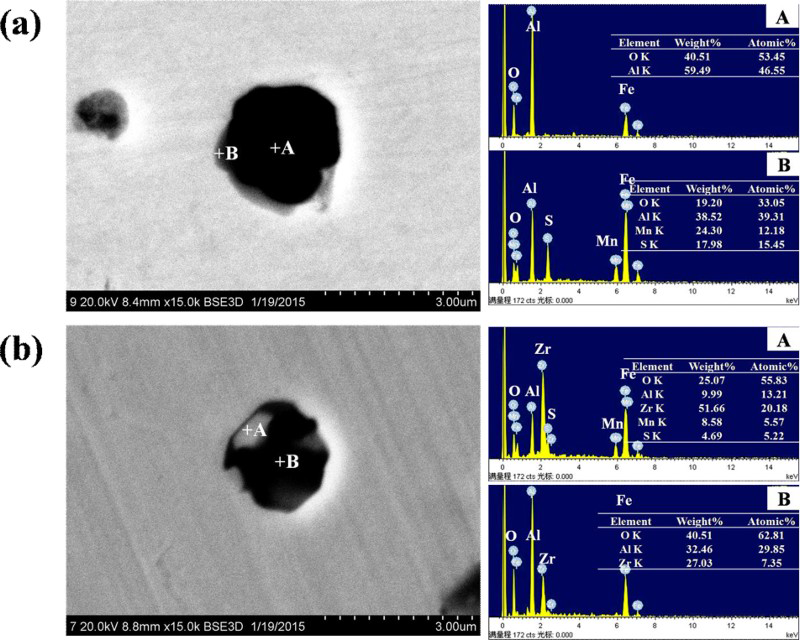
SEM-EDS of typical inclusions in steels: a S1; b S2
In addition, the size distribution and number density of inclusions in the two steels were characterised using SEM and observing 64 visual fields of each sample at a magnification of 500, and the values of them were analysed quantitatively using Image Pro Plus 6.0 image analysis software. The analysis results are presented in Fig. 3. It is seen that although many Al2O3 inclusions are modified by Zr addition, the size distribution and number density of inclusions do not change greatly.
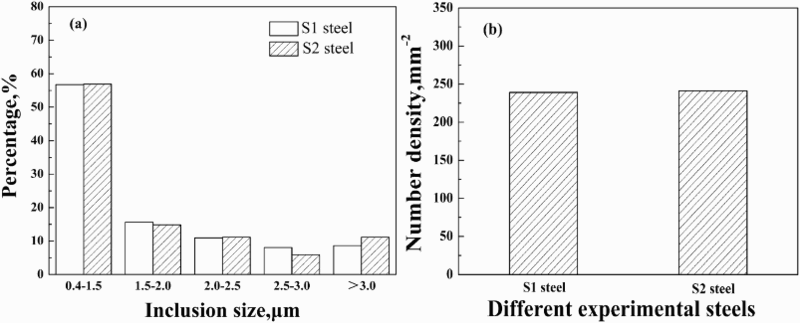
Characteristics of inclusions in steels: a size distribution of inclusions; b number density of inclusions
TEM analysis of precipitates
The nanoscale precipitates were further analysed by TEM-EDS, and the results are presented in Fig. 4. As shown in Fig. 4a, for the S1 steel, the detected precipitates are characterised to be rich of Nb, Cu, and Ti, whose morphology is mainly observed to be cuboidal shapes. For the Zr added steel, besides the Nb–Ti rich precipitates, it also contains plenty of Zr containing particles, which are observed in the presence of Nb, Ti, Cu and Zr (Fig. 4b). Spurious Cu peaks are generated by the copper mesh grid during TEM measurements. It is noted that the measurement accuracy of C and N is difficult to guarantee; thus, C and N are not shown in the spectrum processing. Quantitatively, about 200 Zr free and Zr containing particles were randomly selected, and the average size of the two types precipitates was counted using Image Pro Plus 6.0 image analysis software. Consequently, the average size of Zr free particles is identified to be 82.5 ± 46.0 nm, while that of the Zr containing particles is 4.82 ± 4.20 nm, suggesting that the precipitates are much smaller in Zr bearing steel than in Zr free steel.

Characteristics of precipitates in two steels: a S1; b S2
Impact toughness of CGHAZ
Figure 5 exhibits the variation of impact toughness in the CGHAZ with different heat inputs for the two steels, where the impact toughness at 0 kJ cm− 1 corresponds to transverse toughness of the base metal at the temperature of − 20°C. It is very interesting that, for the two steels, the average impact toughness of CGHAZ shows a trend of increasing first and then decreasing with the heat input from 0 to 100 kJ cm− 1. It is mentioned that the maximum impact toughness for the S1 steel corresponds to 54 kJ cm− 1, while that of S2 steel corresponds to 80 kJ cm− 1. By comparison, when the heat input of welding is 54 kJ cm− 1, the impact toughness retains a high level of 200 J above for both samples. However, increasing the weld heat input to 80 kJ cm− 1 abruptly lowers the average impact toughness to 53 J for the S1 steel, whereas it maintains a high level of 300 J for the S2 steel. On further increasing the weld heat input to 100 kJ cm− 1, the average impact toughness drops continuously to 22 J in the S1 steel, while it still remains at a level of 200 J in the S2 steel.

Charpy impact toughness of CGHAZ at different heat inputs: a S1; b S2
Fracture surfaces of CGHAZ
The fracture appearances of CGHAZ samples from simulated welds are shown in Fig. 6. At the heat input of 54 kJ cm− 1, as seen in Fig. 6a and d, both of the fractures consist of dimples, suggesting a typical ductile facture characteristic. 15 For the fractures of 80 kJ cm− 1 (Fig. 6b and c), it is noted that the fracture for the S1 sample exhibits a brittle fracture, whereas it consists of dimples in S2 sample. Even for that of 100 kJ cm− 1 (Fig. 6f), it remains a ductile facture characteristic for the S2 sample.

Fracture surfaces of CGHAZ with different weld heat inputs of steels: a–c S1 steel at 54, 80 and 100 kJ cm− 1 respectively; d–f S2 steel at 54, 80 and 100 kJ cm− 1 respectively
Microstructures of CGHAZ
Figure 7 shows the microstructures of the CGHAZ at different heat inputs for S1 steel. In the present study, the classification of microstructures was carried out using the category of ISIJ. 16 As seen in the figures, when the heat input of welding is 54 kJ cm− 1, the microstructure consists of bainitic ferrite (BF), quasi-polygonal ferrite (QF) and granular bainitic ferrite (GF) together with a small amount of pearlite and intragranular ferrite (IGF). Increasing the heat input to 80 kJ cm− 1, plenty of coarse grain boundary ferrites (GBFs) are detected along prior austenite grain boundaries, and a small amount of widmanstätten ferrite (WF) side plates is also characterised at grain boundaries as parallel plates with the same crystallographic orientation. On further increasing the weld heat input to 100 kJ cm− 1, the size of GBF is sharply increased. Besides the GBF and WF, a certain amount of polygonal ferrite is detected. Hence, it can be inferred that the high heat input thermal cycle (80 and 100 kJ cm− 1) leads to significant austenite grain coarsening and some brittle microstructures form, such as GBF and WF, which are overwhelmingly detrimental to toughness in CGHAZ. 17

Microstructures of CGHAZ at different heat input for S1 steel: a, b 54 kJ cm− 1; c, d 80 kJ cm− 1; e, f 100 kJ cm− 1
Figure 8 represents the microstructures of the CGHAZ at different heat inputs for S2 steel. As seen from the figures, when the heat input is 54 kJ cm− 1, it is noted that the microstructure is dominated as IGF, GF and BF. Moreover, it can be found that the volume fraction of IGF is significantly increased after Zr addition. For 80 kJ cm− 1, the amount of IGF, BF and GF tends to be reduced, while that of QF is significantly increased. It is very interesting that no GBF and WF are detected in these samples, as shown in Fig. 8c and d. In addition, further increasing the heat input to 100 kJ cm− 1, the microstructure is mainly dominated by QF. It is suggested that the CGHAZ microstructure is refined by the addition of Zr into steel.

Microstructures of CGHAZ at different heat input for S2 steel: a, b 54 kJ cm− 1; c, d 80 kJ cm− 1; e, f 100 kJ cm− 1
Discussion
Effect of Zr containing inclusions
According to the available literatures, most of the investigations about the effect of Zr on the CGHAZ toughness have invariably been studied from the point of view of the ferrite nucleation by the Zr oxide inclusions. Based on the microstructure characteristics of CGHAZ, a certain amount of IGF structures are also observed, as shown in Fig. 8. To examine this, the etched microstructures of the S2 steel were further carefully characterised by SEM and EDS, and 50 associated inclusions were randomly selected.
The locations of some quintessential Zr containing inclusions in Zr added samples are shown in Fig. 9. It can be found that the morphology of the detected IGF grains is mainly divided into two types in the Zr added sample. The first type shows a ferrite grain surrounding an inclusion. The related ferrites tend to be polygonal shape, which can be demonstrated to be intragranular polygonal ferrite 17 or intragranular ferrite idiomorphs, 18 as shown in Fig. 9a. The second type shows a number of acicular ferrite grains that formed in association with an inclusion, which can be identified as IAF,17,19 as shown in Fig. 9b and c. In both cases, it is generally accepted that these ferrite grains are all nucleated from these non-metallic inclusions. The similar results about the IGF grains developed by inclusions were reported by Jin et al. 20 They have found that TiN particle tends to develop the first type ferrite formation, and Ti2O3 particle tends to benefit the second type ferrite formation. However, in the present study, it is noted that the composition of the associated inclusions does not change remarkably among both of the two type ferrites. It means that even the same Al2O3–ZrO2–(MnS) particle may play different roles on the promotion of IGF grains during transformation from γ-Fe to α-Fe. Nevertheless, it can be clearly found that both of them contributed to the refinement of microstructures. Owing to the fact that inclusion number density (see Fig. 3) in the present study is still much lower compared to the optimum number density for developing IGF formation reported by Laurent and Gilles, 21 the amount of IGF grains is relatively low in these thermal simulation samples. Despite this, the formation of IGF in CGHAZ caused by Zr might be a factor for explaining the improvement of the toughness. 17

SEM images and corresponding EDS analysis showing Zr oxide inclusions in thermal simulation microstructures of S2 steel
Effect of precipitates
As described above, it is manifested that the Zr containing precipitates, which are demonstrated to be < 10 nm in size, are much smaller than the Zr free precipitates in the present study. Baker et al.1,22 have compared the size of Nb, Ti and Zr containing precipitates in C–Mn microalloyed steel. They proposed that the (Zr,Nb,Ti)N particles with cuboidal shapes are identified to be 0.1 μm to several micrometres, while the fine spherical particles of ZrC are founded to be 10–100 nm. Therefore, based on the size and morphology of the precipitates in the present study, it can be cautiously but reasonably asserted that these two types of precipitates tend to be (Nb,Ti)N and (Nb,Ti,Zr)C respectively.
Titov et al. 23 compared the crystallisation and precipitation behaviours of TiC and ZrC in a Fe–0.05–0.03C alloy. They found that the TiC particles at γ boundaries dissolved after 60 min, resulting in the abnormal grain growth. However, in the case of ZrC precipitation, the ZrC particles at interdendritic region dissolve and continuously reprecipitate at γ boundaries up to 180 min, thereby resulting in the normal grain growth. In the present study, although the concerned Zr containing particles are not the pure ZrC, their average sizes are even below 1/10 of the common (Nb,Ti)N precipitates. Based on the Zener equation, Manohar et al. 24 have concluded that the size of the precipitates with a significant pinning effect is < 100 nm, and the precipitation of the particle size is smaller and the pinning effect is more obvious. From this point of view, such fine Zr containing precipitates in Zr added sample may quite naturally result in the refinement in primary austenite grains through strong pinning effect, thereby suppressing the GBF and WF formation and obtaining refined microstructures. Based on the microstructure characteristics of the Zr bearing and Zr free steels, it can be clearly seen that most of the related CGHAZ microstructures cannot directly obtain the characteristics of the primary austenite grain except for those of the Zr free steel at 80–100 kJ cm− 1 heat input. Consequently, the prior austenite grain size measurements are not directly given in the present paper. However, it can be cautiously but reasonably asserted that the prior austenite grain size could be refined especially for the Zr bearing steel with 80–100 kJ cm− 1 heat input because no GBF and WF were detected in these samples. In fact, our previous research 11 has concluded that the primary austenite grain can be refined by 0.015 Zr addition, which can also be a further evidence for this speculation. As a consequence, the refinement microstructure in Zr added steel should be a major factor in enhancing the toughness because grain refinement strengthening can improve the toughness and tensile properties of the steel simultaneously.
Effect of microstructures
As stated above, for Zr added sample, the microstructure of CGHAZ is mainly dominated by QF when the heat input is 80 and 100 kJ cm− 1, while no GBF and WF are detected. On one hand, our recent research 11 has focused on the influence of Zr addition on the phase transformation and confirmed that the addition of Zr has a significant effect in promoting the transformation of proeutectoid ferrite during the cooling rate from 0.1 to 30°C s− 1. Therefore, it can be also provided as a further evidence for the results of the obtained continuous cooling transformation characteristic in the previous study. 11 As ferrite is a ductile phase due to its low carbon content in solid solution, it usually possesses a relatively high toughness value. Furthermore, in 1995, Krauss and Thompson 16 reviewed the ferrite microstructure in continuously cooled low and ultralow carbon steels, and proposed that the continuously cooled low carbon steels with QF microstructures showed the potential of excellent combinations of strength and ductility. Therefore, the QF dominated microstructures for the Zr added steel could be another reason to account for improving the toughness of CGHAZ.
On the other hand, Zr has an atomic radius of 0.160 nm, but that of iron is 0.127 nm, which is 27 (δM) higher than the radius of the iron atom [calculated by equation (1)]. Therefore, as solute atoms, Zr is difficult to diffuse, whereas it preferentially segregates at the grain boundaries or phase boundaries. In fact, a similar result was reported by Li et al.
25
In this way, the solute Zr (∼20 × 10− 6) could drag the grain boundaries and inhibit the extensive growth of austenite grain, thereby suppressing the GBF and WF formation and thus obtaining refined microstructures.

Conclusions
The effect of Zr addition on the toughness and microstructure of in CGHAZ in Al deoxidised low carbon steel has been investigated. The basic conclusions are the following:
When the concentration of Zr is 0.015, the occurrence of Zr in steel mostly exists in the form of oxide inclusions, but a few in the form of solid solution state and Zr containing precipitates. The Zr containing inclusions are Al2O3–ZrO2–MnS composite phase, and the precipitates tend to be (Nb,Ti,Zr)C. Moreover, most of the detected Zr containing precipitates, which are identified to be < 10 nm, are much smaller than the Zr free particles. Two types of IGF nucleated on the Zr containing inclusions are detected, including a ferrite grain surrounding an inclusion and a number of ferrite grains formed in association with an inclusion. Both of them contributed to the refinement in microstructures. Excellent impact toughness of CGHAZ with 80–100 kJ cm− 1 heat input is obtained by 0.015 Zr addition, and the improved impact toughness of CGHAZ in Zr bearing steel is attributed to the suppression of GBF and WF and to the promotion of IGF and QF.
Footnotes
Acknowledgements
We wish to thank the National Natural Science Foundation of China for providing financial support during this study (project nos. 51374059 and 51374060). We also appreciate Professor Lijun Wang (Northeastern University) and Professor Deyong Wang (Schoow University) for the discussion about the study.