







Abstract
The thermal decomposition sequence of hydrous nickel–magnesium silicates from Colombia and Brazil was studied under air/Ar atmosphere from room temperature up to 750°C by differential scanning calorimetry–thermogravimetry followed by X-ray diffraction and scanning electron microscopy analyses. Differential scanning calorimetry curves of the samples obtained showed three endothermic peaks at 100, 250 and 600°C due to the release of free water, the dissociation of goethite and the release of crystalline water respectively. To determine the mineral species and microtexture, the ores were studied by scanning electron microscopy. Scanning electron microscopy–energy dispersive spectroscopy analyses showed that the ores are rich in Mg and Mg–Fe silicates, Cr spinel, Mn oxide, goethite and silica and exhibit complex alteration texture. X-ray diffraction analyses of Colombia-2 and Mirabela (Brazil) after the experiments showed that the dehydroxylation produces an amorphous intermediate phase, which is supposed to be due to the exsolution of silica. However, Colombia-1 sample, which was confirmed to contain antigorite mineral, was observed to undergo dehydration and recrystallisation simultaneously.
Introduction
Nickel laterite ore deposits are formed by chemical weathering of nickeliferous peridotite rocks. In general, a laterite ore deposit consists of four zones in order of increasing depth: a hematite cap, a limonitic laterite deposit, a silicate laterite deposit and peridotite rock. As to the iron content, there exist two types of nickel laterites. A low iron containing ore is of garnieritic type, whereas a high iron containing ore is of limonitic type (Diaz et al., 2004).
Although the laterite ores represent ∼80% of the total nickel reserves, the nickel production is dominated by processing of sulphide ores; this is due to the complex mineralogy of laterite ores and difficulties in production technology (Diaz et al., 2004). Nickel laterite ores, where nickel occurs in oxide form, represent a significant resource of nickel. Nickel is extracted from laterite ores by hydro- or pyrometallurgical routes, depending on the nature of the gangue. In general, the silicate laterites with high magnesia can be treated by roast reduction followed by ammonia leaching or by pyrometallurgical processes, whereas low magnesia and high iron limonitic ores are usually treated by hydrometallurgical processes (Diaz et al., 1988).
An important group of nickel bearing minerals in the silicate laterite deposits is the garnierites, which is a general name for the hydrous nickel–magnesium silicates, such as serpentine, clay and chlorite. Garnierites are known for the fine grained nature, poor crystalline order and especially the occurrence as an intimate mixture of two or more above mentioned silicates (Hang and Brindley, 1973). Serpentine consists of lizardite, antigorite, chrysotile and nepouite (high percentage of nickel) minerals. Vermiculite and talc are clay minerals, whereas chlorite consists of e.g. clinochlore mineral. In serpentine, clay and chlorite, Fe and Ni can replace Mg to some extent, while Al can replace Si or Mg to a lesser extent.
When dehydration of nickel serpentine minerals was investigated (Ball and Taylor, 1963; MacKenzie and Meinhold, 1994), an intermediate phase was observed to form in a temperature range between the endothermic dehydration reactions and the exothermic recrystallisation. This intermediate phase is largely disordered and thus has high chemical reactivity. As a consequence, there may be a period of time during which nickel oxide is in an unstable state and available for reduction. After crystallisation of the amorphous phase to forsterite (olivine) and enstatite (pyroxene), the reduction of nickel oxide becomes more difficult. An inhomogeneous mechanism for dehydroxylation of serpentine minerals was proposed by Ball and Taylor (1963). Its basic assumption is that no oxygen is lost from those regions of crystal, where the topotactic change occurs.
In conventional pyrometallurgical processing, the laterite ore is dried, calcined and sometimes reduced in a rotary kiln, and smelted in an electric furnace in the presence of carbon. A better knowledge of the behaviour of nickel bearing minerals at high temperatures could form an important basis for understanding the requirements for nickel reduction. The aim of this work is to study the behaviour of three different hydrous nickel–magnesium silicate ores during heat treatment to 750°C, in order to determine the microstructures and phases that formed as a result of dehydroxylation and to detect the phases where nickel is predominantly abundant after dehydroxylation.
Experimental
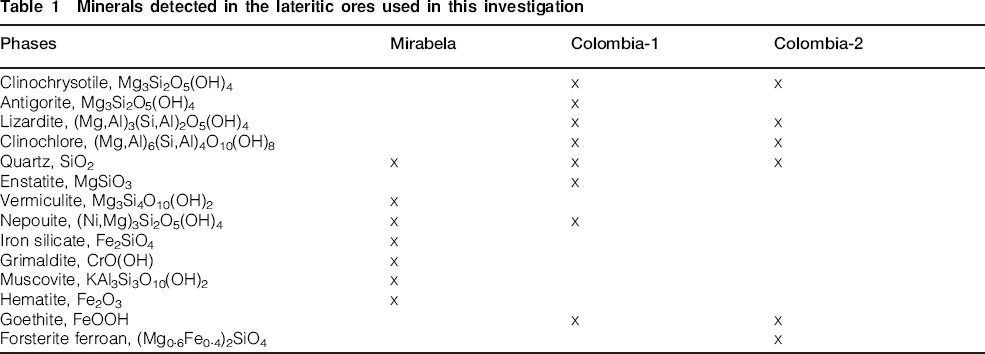
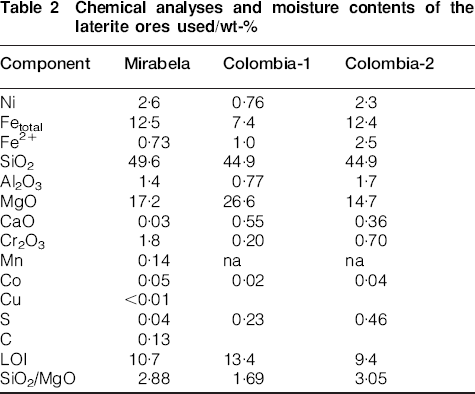
Three hydrous nickel–magnesium silicate ores were investigated in this study. One was from a Brazilian (Mirabela) deposit and the others from Cerro Matoso S.A. mine (Colombia-1 and Colombia-2), Colombia. Their phase analyses and typical chemical compositions are presented in Tables 1 and 2 respectively.
Minerals detected in the lateritic ores used in this investigation
Chemical analyses and moisture contents of the laterite ores used/wt-%
The ores include nickel hydrous magnesium silicates (garnierite), which are green minerals due to their NiO content. Minerals of this group contain Mg and Si as major cations, with little Fe, Al and Ni (Chen et al., 2004). The Colombian ores consist of serpentine and chlorite group minerals (Gleeson et al., 2004), whereas the Brazilian ore is a mixture of clay and serpentine (Colin et al., 1990). According to Table 1, the Colombian laterite contains serpentine minerals with a general formula of (Mg, Fe)3Si2O5(OH)4 (antigorite, clinochrysotile, lizardite and nepouite) and with minor amounts of chlorite (Mg, Fe, Al)6(Si, Al)4O10(OH)8 (clinochlore), while the Brazilian laterite contains clay Mg3Si4O10(OH)2 (talc and vermiculite) with minor amounts of serpentine.
Chemical analyses of the materials (Table 2) show that they are complex with major oxides as silica, magnesia and iron oxide. The moisture content of the samples is quite high, which is typical for laterite ores. Water is partly as water trapped between silicate layers (additional water), but mainly as chemically bonded water (hydroxyl groups), which is evaporated during heat treating. The total loss on ignition (LOI) contents were measured by heating up to 1100°C under dry, flowing nitrogen. The 1100°C was taken as the upper limit for determining the LOI, since the dehydroxylation of phyllosilicates occurs at >900°C.
The ores were crushed in a laboratory ball mill and screened with a 500 μm mesh size sieve before use. They were characterised using an X-ray diffractometer (XRD; Bruker AXS DFocus) and a scanning electron microscope–energy dispersive spectroscope (SEM–EDS; FEG-SEM Jeol JSM 700F and Oxford INCA-Energy and Wave). The differential scanning calorimetry–thermogravimetry (DSC–TG) experiments were carried out by using a simultaneous thermal analyser (Netzsch STA 449C Jupiter), which allows measurement of mass changes and thermal effects at the same time. In a typical experiment, a laterite sample, ∼50 mg, was charged into an alumina crucible and heated under dry argon (purity: 99·999%) or air from room temperature up to 750°C by using a constant heating rate of 10°C min−1. The TG curves were normalised by taking into account the buoyancy correction of Ar and air. After heating, the sample was cooled down to room temperature under argon atmosphere in order to prevent rehydration and oxidation. The cooled sample was then examined by XRD and SEM–EDS for phase, mineralogical and morphological determinations.
Results
Figure 1a and b shows the DSC curves for the three nickel laterite ores under Ar and air respectively. The DSC curves show that the samples undergo three endothermic processes. The low temperature endothermic peaks around 100 and 250°C are caused by the removal of free water and by the dissociation of goethite respectively (O'Connor et al., 2006). The high temperature endothermic peak around 600°C is attributed to the loss of crystalline water by dehydroxylation reactions (Mackenzie, 1971). A gentle bowing endothermic peak around 700°C appears to consist of two overlapping processes, most clearly seen in the Colombia-1 sample. This peak is probably due to a multistage dehydroxylation process.
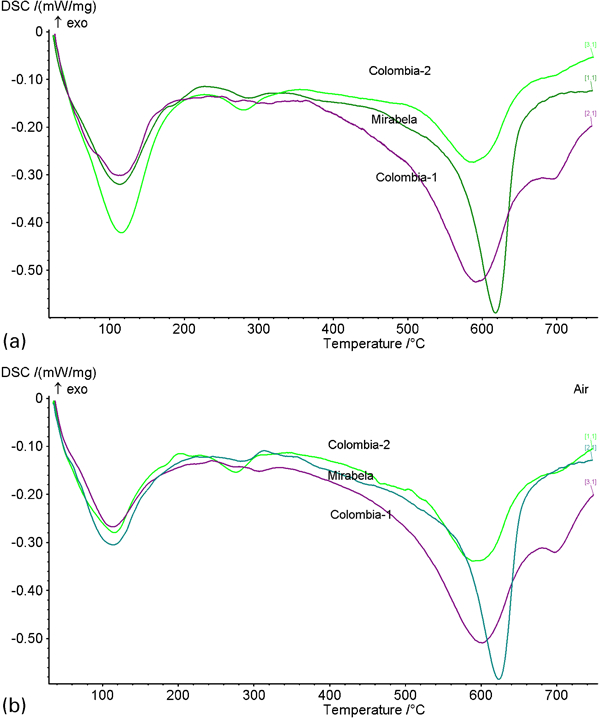
Differential scanning calorimetry curves for Mirabela, Colombia-1 and Colombia-2 ores, when heating up to 750°C in a argon and b air atmospheres
Figure 2 shows the weight loss (H2O and 2H2O) arising from 2(OH) and 4(OH) groups in the mineral formula for clay and serpentine respectively. The shape of the weight loss curves depends on the dehydration energy of the compounds. Besides, the occurrence of iron in the ores might induce changes in the thermal behaviour and in the shape of TG curves of silicates. In Colombia-2, the Fe2+ content is higher than those in Colombia-1 and Mirabela, which should lead to higher oxidation rate of ferrous to ferric iron (Fe2+→Fe3+) by the air. The TG curves do not, however, support this assumption. According to Fig. 2, the additional water is lost slowly over a range 250–550°C, followed by rapid loss of crystalline water in the temperature range 550–700°C. The removal of crystalline water is related to ∼8% weight loss, due to the disintegration of the minerals’ crystalline lattice. This kind of behaviour is typical for serpentine–vermiculite (Mirabela) and for serpentine–chlorite mixtures (Colombia-1 and Colombia-2) (Mackenzie, 1971).
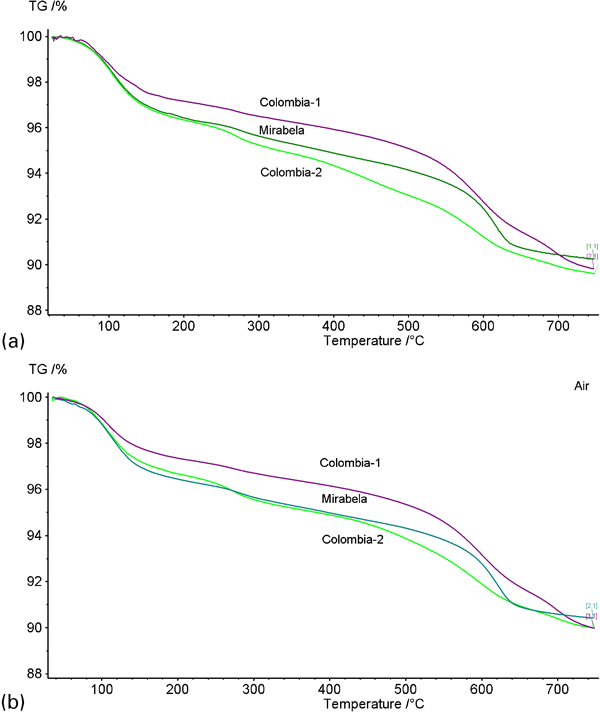
Thermogravimetry curves for Mirabela, Colombia-1 and Colombia-2 ores, when heating up to 750°C in a argon and b air atmospheres
Electron micrographs of materials have been recorded to show their morphological characteristics. Figures 3–5 show the SEM images of examined samples before and after the heat treatment. The complexity of the mineral texture and their heterogeneity were already demonstrated in Table 1. While garnierites are fine grained minerals with inhomogeneous character and generally poor crystalline order, they appear to be very appropriate materials for SEM observations (Rhamdhani et al., 2009a, b).
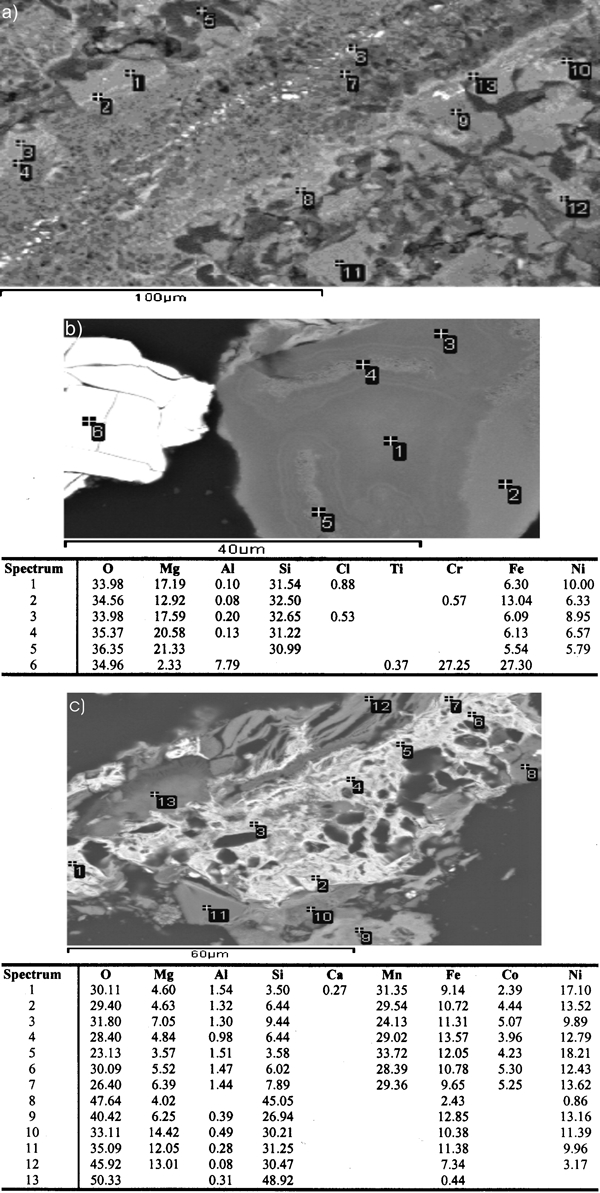
Microstructures of the Ni laterite ore Mirabela: a initial structure [1, 10: chromite; 2: nickel containing Mg silicate rich in iron; 3–6 and 7–9: nickel containing (Mg, Fe) silicates], b after heat treatment to 750°C in argon and c in air atmospheres
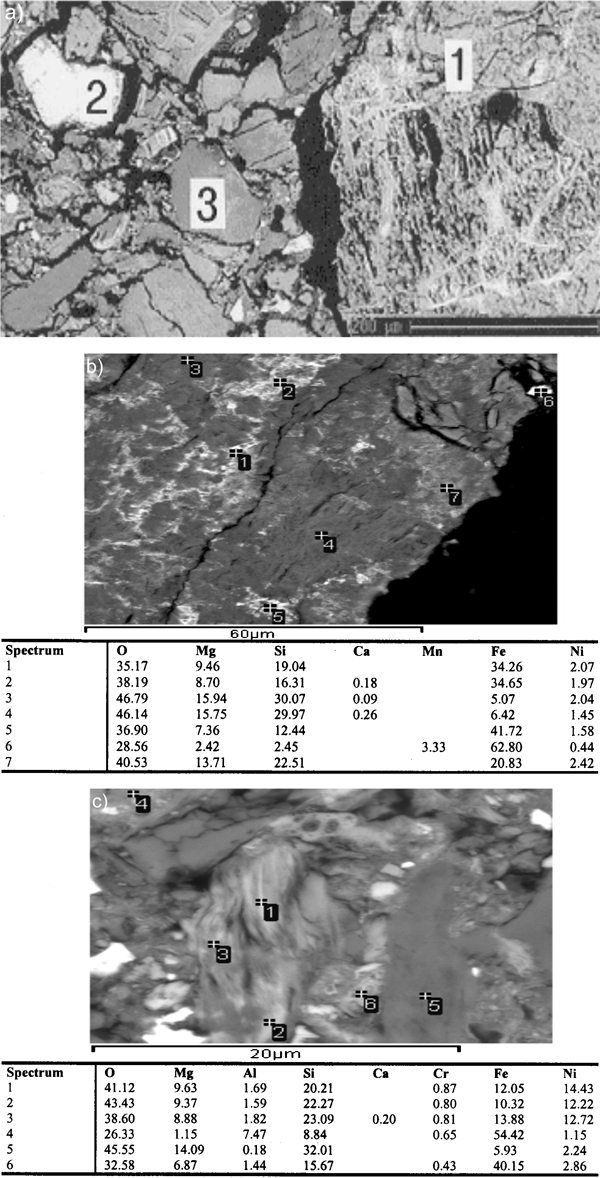
Microstructures of the Ni laterite ore Colombia-1: a initial structure (1: silicate; 2: goethite; 3: silica), b after heat treatment up to 750°C in argon and c in air atmospheres
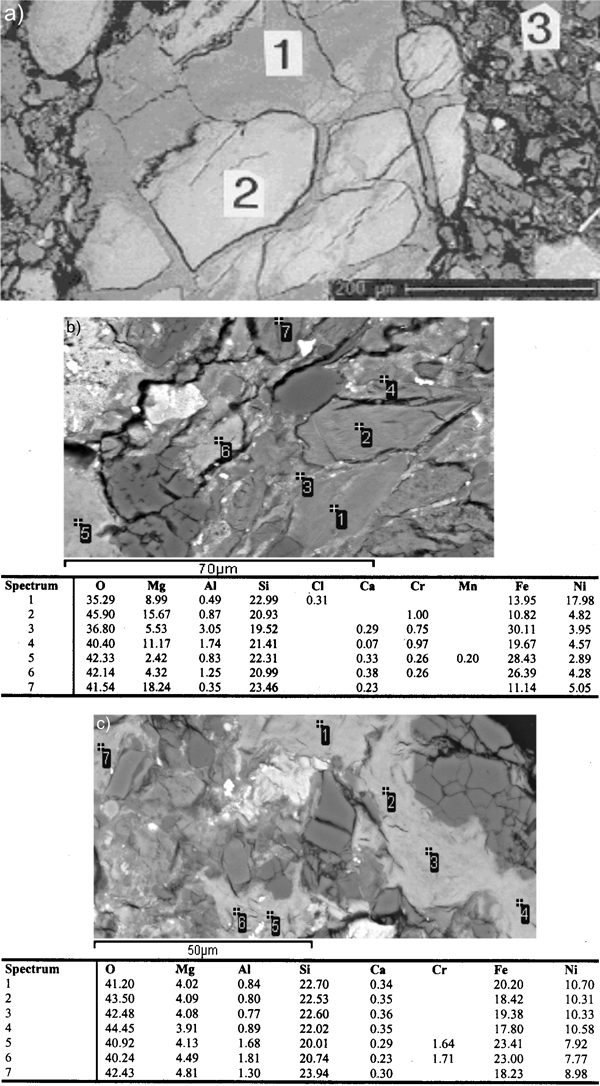
Microstructures of the Ni laterite ore Colombia-2: a initial structure (1: silicate; 2: goethite; 3: silica), b after heat treatment to 750°C in argon and c in air atmospheres
It can be seen from Figs. 3a, 4a and 5a that the initial laterite structures before heat treatment exhibit a complex mineral texture with a wide variety of morphologies. The bright coloured particles are Cr spinel (Fig. 3a), the coarse light grey grains are goethite (Figs. 4a and 5a) and the coarse grey particles are serpentine (Figs. 3a and 5a); whereas in Colombia-1 (Fig. 4a), serpentine occurs as skeletal shape grains and the coarse and fragmented light grey particles are quartz (Figs. 4a and 5a). Nickel is present mainly in serpentine and in subordinate amounts in goethite.
Figures 3b, 3c, 4b, 4c, 5b and 5c show the general morphology of the ores after the thermal treatment under argon and air. The dark grey particles are Mg–Ca (diopside), Mg–Fe and Mg–Fe–Al silicates (mainly talc); the bright particles are Cr spinel. Nickel is present mainly in Mg–Fe–Al and Mg–Fe silicates respectively. In Fig. 3c, the coarse, light coloured particles are a manganese oxide phase (asbolite) that contains a considerable amount of Ni and Co, whereas the grey regions have lower nickel contents. The grey particles, (Cr, Fe, Al, Ca, Mg)3O4 spinels, in the Mg–Fe–Al silicate matrix presented in Figs. 4c (marks 1, 2, 3) and 5c (marks 5 and 6), contain a large amount of nickel. Various new phases were also formed, which can be distinguished by hues. Point analyses of the samples showed that the nickel content varies from particle to another and even within the same particle.
X-ray diffraction analyses were carried out for the samples to identify the phases present before and after heating. X-ray diffraction patterns before heating (Figs. 6a, 7a and 8a) show that the raw materials used are mixtures of serpentine, chlorite and clay minerals. The XRD peak around 12° on 2θ scale is ascribed to serpentine minerals, while for clay minerals the peak is around 6° on 2θ scale (Botsis et al., 2008; Bunjaku et al., 2010).
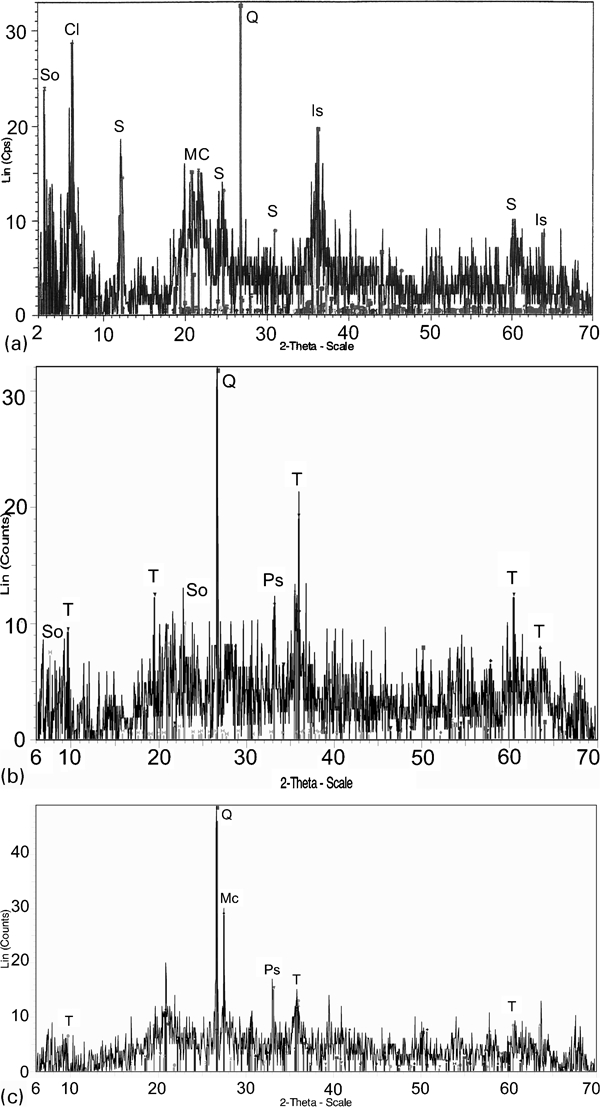
X-ray diffractograms for Mirabela ore: a initial ore and b after heat treatment to 750°C in argon and c in air atmospheres [C: cristobalite; Cl: clay; Is: iron silicate; M: maghemite; Mc: microcline; Q: quartz; S: serpentine (nepouite); So: silicon oxide; Ps: potassium aluminium silicate; T: talc]
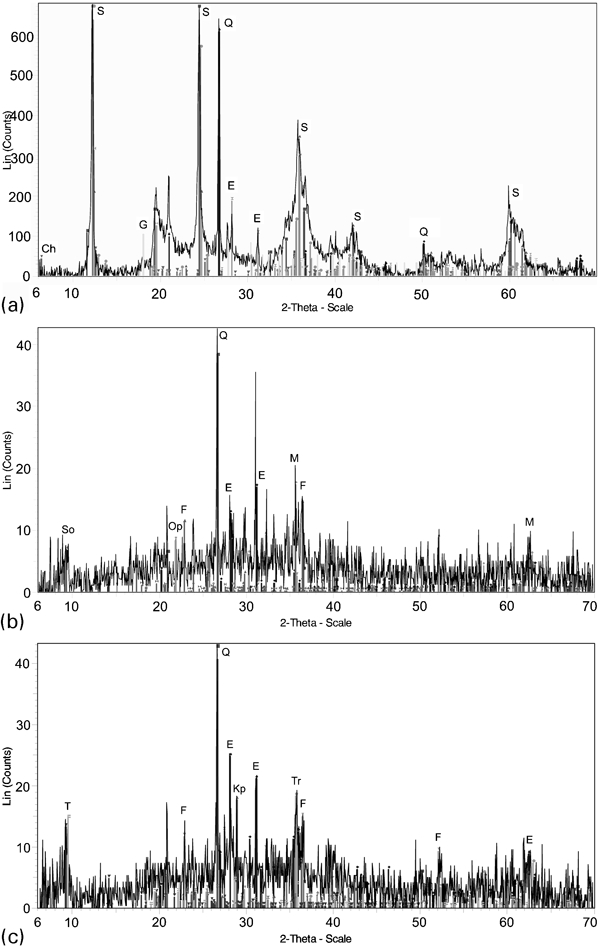
X-ray diffractograms for Colombia-1 ore: a initial ore, b after heat treatment to 750°C in argon and c in air atmospheres [Ch: chlorite; E: enstatite; F: forsterite ferran; G: goethite; Kp: kaliophilite; M: maghemite; Op: opal; Q: quartz; S: serpentine (antigorite, clinochrysotile, lizardite and nepouite); So: silicon oxide; Tr: trevorite]
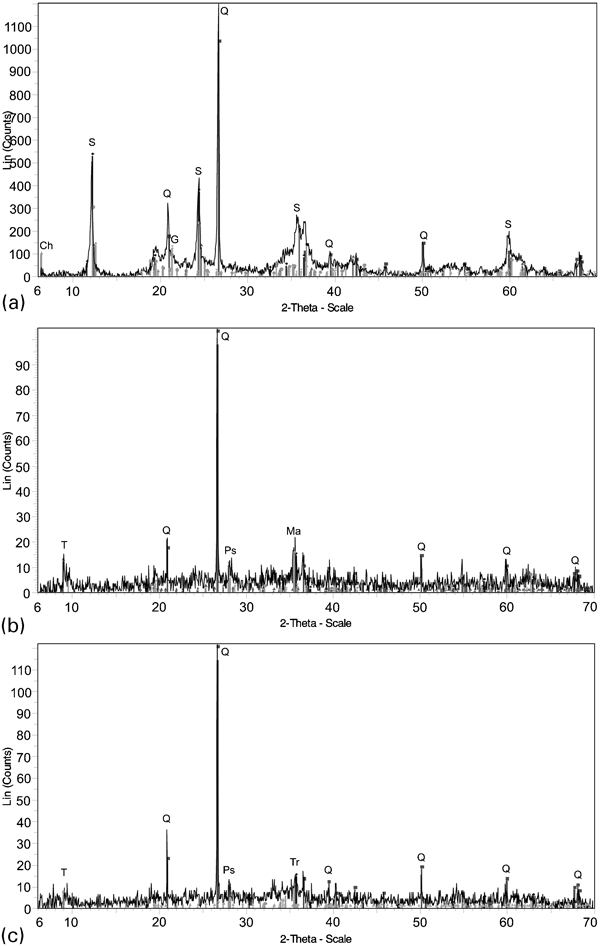
X-ray diffractograms for Colombia-2: a initial ore, b after heat treatment to 750°C in argon and c in air atmospheres [Ch: chlorite; G: goethite; Ma: magnetite; Ps; potassium silicate; Q: quartz; S: serpentine (clinochrysotile and lizardite); T: talc; Tr: trevorite]
As can be noticed from the XRD patterns, all samples showed a development of a long spacing phase, characterised principally by the broad diffraction peak around 7–9° on 2θ scale. The fact that the long spacing phase is usually in the range 7–9° suggests a talc-like arrangement. In addition, silicon dioxide and quartz are formed in all samples, which is in accordance with the literature data on the dehydration of serpentine and clay minerals (Hang and Brindley, 1973).
X-ray results of Colombia-1 showed that forsterite and enstatite phases have been formed (Fig. 7b and c), which indicates simultaneous dehydroxylation and recrystallisation of magnesium silicate as a consequence of heating up to 750°C. Whereas Mirabela and Colombia-2 undergo a transformation into an intermediate phase, and forsterite as well as enstatite have not been formed (Figs. 6b, c and 8b, c). Therefore, it appears that the type of serpentine minerals in the ore affects the transformation of this magnesium hydrosilicate to new phases.
Discussion
The DSC curves obtained showed three endothermic peaks in all samples. The low temperature endothermic peaks around 100 and 250°C are due to the removal of free water and the dissociation of goethite respectively. The high temperature endothermic peak around 600°C is generated by dehydroxylation reactions. The observations are in agreement with the previous investigations for dehydroxylation of hydrous nickel–magnesium silicates (Mackenzie, 1970; Hang and Brindley, 1973; Daenuwy and Dalvi, 1997; Vieira Coelhoa et al., 2000; O'Connor et al., 2006).
When comparing the final weight loss of the samples (Fig. 2) and their initial moisture content (Table 2), it can be concluded that in Colombia-1 and Mirabela ores, there was still some crystalline water left in the structure at 750°C, which explains that the dehydroxylation is clearly a two-stage or a multistage process. The presence of crystalline water in some minerals was also confirmed by the XRD analyses after the experiments. Similar multistage dehydroxylation has also been reported by MacKenzie and Meinhold (1994) as well as Brindley and Wan (1975).
As a result of the heat treatment, the microstructures have been degraded due to the dehydroxylation reactions. The appearance of the microstructure has changed after the removal of water. Cracks have also appeared around the particles which do not contain water. Based on the available information, dehydroxylation of a mineral such as serpentine has been suggested to proceed by migration of H+ ions to a reaction site where water is formed and liberated. The process includes a converse migration of cations, Mg2+ and Si4+ to maintain electric neutrality (Ball and Taylor, 1963). Therefore, the dehydroxylated laterite calcine has been variously described as largely disordered, partly disordered and semi-amorphous, but preserving some original lattice order. Its composition has been considered to contain the same Mg/Si atomic ratio as the parent phase (MacKenzie and Meinhold, 1994; Rhamdhani et al., 2009a, b).
In the current experiments, the ores were heated to 750°C in order to avoid the exothermic recrystallisation reaction, which has been established to occur around 800°C (Zevgolis et al., 2009; Bunjaku et al., 2010). Around 800°C, olivine (forsterite) and pyroxene (enstatite) crystallise from the amorphous phase, which is consistent with the MgO–NiO–SiO2 equilibrium diagram (Campbell and Roeder, 1968). The term olivine is used as a generic name for the solid solution, where Ni2+ ions replace Mg2+ ions of the olivine structure (Mg, Ni)2SiO4. Once nickel is tied up in olivine, the reduction becomes very difficult and needs much stronger reduction conditions compared with pyroxene.
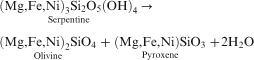
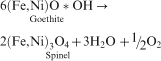
Phase analyses of the Colombia-1 after heating show the formation of olivine and pyroxene phases. This indicates simultaneous dehydroxylation and closely followed recrystallisation of magnesium silicate to olivine (Mg, Fe, Ni)2SiO4 and pyroxene (Mg, Fe, Ni)SiO3 by reaction (1)
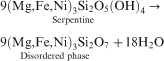
In general, it has been suggested that the dehydroxylation of serpentine minerals proceeds by the formation of a disordered phase (Ball and Taylor, 1963; Brindley and Hayami, 1965; Brindley and Wan, 1975; Harris et al., 2009), attributed to a multistage sequence and it should proceed by reaction (2). This is in agreement with the results obtained for Colombia-2 and Mirabela ores. The XRD analyses after experiments showed that olivine and pyroxene phases had not formed, i.e. the recrystallisation was not initiated but an intermediate phase was formed
The frequent occurrence of nickel in early formed olivine and pyroxene in ultrabasic and basic igneous rocks in the Earth's crust has been explained to result from high chemical potential of oxygen and temperature in the geological process, in which the minerals and rocks were generated. A process such as serpentinisation may cause redistribution of nickel between silicates and oxides. The MgSiO3–Ni2SiO4 phase diagram shown in Fig. 9 represents the distribution of nickel between anhydrous silicates and stability of nickel–magnesium olivine (orthosilicate) and pyroxene (metasilicate) relative to the constituent oxide. The diagram was calculated by using MTDATA 4·81 software and Mtox 6·0 database (http://www.npl.co.uk/advanced- materials/measurements-techniques/modelling/mtdata).
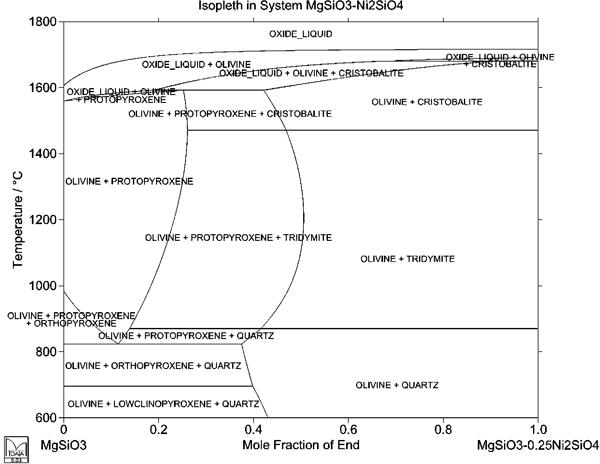
An isopleth along the MgSiO3–Ni2SiO4 joint in the MgO–NiO–SiO2 system
In the present study, the formation of olivine and pyroxene at 750°C under normal pressure, reaction (1), for Colombia-1 is in accordance with the phase diagram illustrated in Fig. 9. It can be seen that ortho- and clinopyroxene–olivine phases are stable at low temperatures, whereas the olivine–protopyroxene assembly is formed at high temperatures. On the contrary, Colombia-2 and Mirabela behave differently in experimental conditions forming amorphous phase by reaction (2). This divergent behaviour of different ores in thermal treatment can have influence on e.g. reduction which is currently under investigation.
Conclusion
According to the XRD and chemical analyses of three nickel laterite ores, it can be concluded that the ores are mixtures of silicate minerals, such as serpentine, clay and chlorite. The SEM images gave knowledge about their morphology and suggest that they have a complex and heterogeneous phase structure, with varying contents of the major elements, such as Mg, Si, Fe, Ni, Al, Co, Mn and Cr. The assay alternates from one particle to another and from mineral to mineral within the same sample, conformable with the serpentine–clay–chloride mixtures.
Most of nickel is present in crystal lattices of serpentine minerals. Nickel also occurs with cobalt, manganese and iron oxides in the limonite phases. Aluminium is present in chromite (spinel), serpentine as well as in the goethite lattices.
The DSC observations revealed that all samples develop three endothermic peaks at 100, 250 and 600°C caused by the removal of free water, the thermal dissociation of goethite and dehydroxylation reactions respectively.
The SEM images showed that as a result of heat treatment, the ore microstructures have been disrupted and crystalline water was partially evaporated, which brought about the formation of cracks and redistribution of nickel in the particles. The nickel was observed mainly in Fe–Mg–Al and Mg–Fe silicates, but high nickel contents were also found in Cr spinels and Mn oxides.
The formation of new phases (talc-like, amorphous, forsterite and enstatite) seems to depend on the type of initial serpentine minerals of the ore. The presence of antigorite (Colombia-1) results in a simultaneous dehydroxylation and recrystallisation of magnesium silicate to forsterite and enstatite. Colombia-2 and Mirabela contain no antigorite and as a result of heating, intermediate phases have been formed. Depending on the minerals in the initial ores, an intermediate phase, which is easily reducible, can thus be formed. After the crystallisation of the amorphous phase to new phases (enstatite and olivine), the nickel will be bonded in enstatite and especially firmly in olivine phase, consequently the reduction of nickel oxide becomes more difficult.
Footnotes
Acknowledgements
Outotec Research Oy and Outokumpu Oyj have been supporting in this investigation financially. The authors are also grateful to Outotec Research Oy for the XRD, mineralogical and microanalyses. The DSC–TG studies by the research group for materials processing and powder metallurgy of the Aalto University are also acknowledged.