







Abstract
Strontium titanate SrTiO3 nanopowders have been successfully prepared through oxalate precursor route using Egyptian celestite ore. Celestite ore was reduced with the carbon at the annealed temperature of 1100°C for 3 h to obtain water soluble strontium sulphide that treated with a dilute hydrochloric acid to produce strontium chloride. The formed strontium chloride and titanium dioxide were mixed with a certain amount of oxalic acid to form strontium titanium oxalate complexing precursors. The effect of oxalic acid molar ratio, annealing temperature, time and hydrogen peroxide additive on the crystal structure, crystallite size and microstructure was systematically studied. The results revealed that a well crystallite single phase of SrTiO3 nanopowders was achieved in the presence of hydrogen peroxide using 1·5 molar ratio of oxalic acid at the annealing temperature of 1000°C for 1 h. The crystallite size of the formed powders increased with increasing annealing temperature and time. The crystallite size was in the range between 50 and 80 nm. The SEM images of the formed SrTiO3 particles appeared as cube-like structure. The band gap energy and the direct current resistivity of the produced powders were ∼3·6 eV and 4·403×104 Ω m respectively for the sample in the presence of 10% hydrogen peroxide annealed at 1000°C for 2 h.
Introduction
Strontium titanate SrTiO3 is a paraelectric cubic structured perovskite material at room temperature. It exhibits a large dielectric constant of ∼300 of the sintered ceramics. At temperatures <105 K, its cubic structure transforms to tetragonal ferroelectric phase. Furthermore, SrTiO3 has various physical properties because of its ferroelectricity, thermoelectricity with a thermal conductivity of 12 W m−1 K−1, photocatalysis and superconductivity at temperatures <20 K. In addition, it has good mechanical strength with the Mohs hardness of 5·5, high thermal and chemical stability, low dielectric loss, a low coefficient of thermal expansion of 9·4×10−6 °C−1, a high melting temperature of 2080°C, a refractive index of 2·31–2·38 nearly identical to that of the diamond and semiconductor with a band gap of ∼3·2 eV (Branković et al., 2004; George et al., 2009; Ianculescu et al., 2007). However, the characterisation and properties of strontium titanate are responsible for their widespread applications in the manufacture of thermistors, multilayer ceramic capacitors, electro-optical devices, electromechanical devices, dynamic random access memory, infrared detectors, oxygen sensor, nitrogen oxides NOx photo degradation internal combustion engine and solar cells. Moreover, superconducting quantum interference device is fabricated using superconductor thin films developed on SrTiO3 (Branković et al., 2004; Chen et al., 2009; George et al., 2009; Ianculescu et al., 2007). Recently, photoluminescence of blue light emission from the Ar+irradiated SrTiO3 and electron doped SrTiO3 single crystals at room temperature has been reported (George et al., 2009). In addition, it is reported that strontium titanate shows considerable activities for the water splitting into H2 and O2 in stoichiometric ratio under UV irradiation (Puangpetch et al., 2010). There are various synthesis methods applied to prepare SrTiO3 powders including conventional solid state reaction (Taibi and Kermoun, 1999), coprecipitation (Balaya et al., 2006; Roy and Bera, 2005), hydrothermal synthesis (Jitputti et al., 2007; Zhang et al., 2004), solvothermal synthesis (Yang et al., 2009), combustion synthesis including oxalate precursor route (Chen et al., 2009; George et al., 2009; Ishikawa et al., 2008; Liu et al., 2008), mechanochemical reaction (Hungra et al., 2004; Wang et al., 2007), molten salt method (Puangpetch et al., 2008) and sol–gel (Vaidyanathan et al., 2006; Wang et al., 2001). The oxalate precursor route is the most intensely examined route for generating SrTiO3 from complex precursor. The use of an inexpensive inorganic salt precursor improves the cost effectiveness of the powder production which facilitates the synthesis of the crystallised powder with ultrafine particle size and high purity (Rashad et al., 2007).
On the other hand, celestite ore SrSO4 is the main source for the production of most of the strontium compounds. Over 95% of the world production is consumed by the chemical industry for conversion to various strontium compounds. The most common commercial process for producing strontium compounds from celestite ore is the ‘black ash’ process (Hessien et al., 2009). From our knowledge, in a published work, the process of the synthesis of strontium titanate using celestite ore with titanium hydroxide gel by hydrothermal method at 250°C in a 5M KOH solution was found to be completed after 96 h of treatment (Hernandez et al., 2009). No work has been published on the synthesis of strontium titanate from celestite ore using oxalate precursor method.
The present study aims at synthesising strontium titanate nanopowders using oxalate precursor route from Egyptian celestite ore and pure rutile. The effect of annealing temperature, annealing time, oxalic acid molar ratio and hydrogen peroxide concentration on the crystal structure, crystallite size and microstructure was systematically studied. The change in the optical and electrical properties was determined.
Experimental
Materials
Celestite ore SrSO4 is present in Egypt mainly in, namely, Wadi Essel with reserves of 2·3 million tons. The elemental analysis of the sample was performed using X-ray fluorescence spectrometry (XRF; Philips 1410).
Rutile TiO2 (99·8%) is produced from Egyptian ilmenite ore via smelting and sulphate leaching of titania rich slag.
Pure oxalic acid and hydrogen peroxide were used for organic acid precursor processing.
Procedure
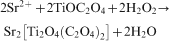
Ore sample was ground to −200 mesh (−75 μm) and treated with hydrochloric acid to remove the calcium carbonate and the other acid soluble salts. After filtrating, cleaning and drying the insoluble SrSO4 salt, coke was used as the reducing agent with a carbon/SrSO4 mole ratio of 2∶1. The produced mixture was subjected to reduction treatment at 1100°C for 3 h in the presence of nitrogen gas to reduce the insoluble SrSO4 to the soluble strontium sulphide SrS. Then, the produced SrS was dissolved in deionised water and hydrochloric acid. The formed SrCl2 solution was filtered to remove unreacted coke and silica. The strontium titanate powders were prepared using organic acid precursor method using a solution of the dissolved SrCl2 from celestite ore and titanium dioxide TiO2 (99·8% purity) in the presence of stoichiometric amount of organic acid (oxalic 99·5% purity) with the addition of different amounts of hydrogen peroxide (5–10%). The molar ratios of Sr2+/Ti4+ ions were stable at 1. The molar ratio of the oxalic acid was added according to the reaction of 1 mole of the acid with both Sr2+ and Ti4+ ions according to the following equations (Rashad et al., 2007, 2008; Tang and Chen, 2007)




The solution was stirred and gently evaporated at 80°C till a clear, viscous resin was obtained, and then it was dried at 110°C for 24 h. The dry precursors were heated (calcined) at a rate of 10°C min−1 in static air atmosphere up to required different temperatures from 900 to 1100°C at different calcined times of 1–3 h.
Characterisation
The final products were characterised using X-ray diffraction (XRD) on a Bruker axis D8 diffractometer using Cu Kα radiation (wavelength λ = 1·5406 Å). The average crystallite size of the powders was estimated automatically from corresponding XRD data using X-ray line broadening technique employing the classical Debye–Scherrer formula for the most intense peak (110) plane determined from the XRD data. The micrographs of SrTiO3 samples were examined by direct observation via scanning electron microscopy (SEM; JSM-5400). The optical properties were measured using UV–visible–near IR spectrophotometer (Jasco-V570). The direct current (DC) resistivity was measured using a 4339B Agilent high resistance meter.
Results and Discussion
Characterisation of celestite ore
Table 1 shows the chemical analysis of celestite ore (Wadi Essel Area, Red Sea Coast, Egypt) using XRF. The celestite ore contains mainly 45·12%SrO and 34·87%SO3 in addition to 10·23%CaO.
Chemical composition of Egyptian celestite ore
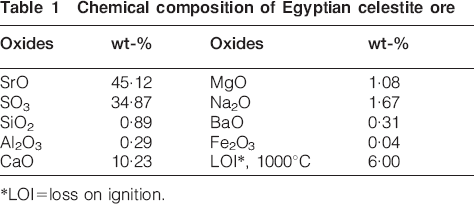
*LOI = loss on ignition.
The reduction of celestite ore with coke in the presence of nitrogen gas led to the formation of soluble strontium sulphide SrS. The complete reduction of the strontium sulphate to strontium sulphide was observed for the sample reduced at 1100°C for 3 h as mentioned in our previous work (Hessien et al., 2009).
Synthesis of strontium titanate
The XRD pattern of the produced powder in the presence of 1·0 molar ratio of oxalic acid and in the absence of hydrogen peroxide annealed at 1000°C for 2 h is shown in Fig. 1. It can be noticed that four different phases of cubic strontium titanate (JCPDS no. 84-0444), tetragonal Sr2TiO4 (JCPDS no. 72-2041), titanium oxide Ti4O7 (JCPDS no. 50-0787) and rutile TiO2 (JCPDS no. 87-0710) were formed. The XRD patterns of the produced strontium titanate powders prepared at different oxalic acid molar ratios from 1·1 to 1·5 in the presence of 10% hydrogen peroxide annealed at 1000°C for 2 h are illustrated in Fig. 2. The results showed that the increase in the oxalic acid molar ratio led to the formation of a well crystalline strontium titanate SrTiO3 phase. With the oxalic acid molar ratio of 1·1, strontium titanate SrTiO3 powders were formed with traces of the TiO2 phase. However, at a higher oxalic acid molar ratio of 1·5, a well crystalline single phase of SrTiO3 was obtained. The peaks related to SrTiO3 phase at 2θ of 22·75, 32·39, 39·94, 46·47, 57·77, 67·80 and 77·18° were present. These peaks are ascribed to (100), (110), (111), (200), (211), (220) and (310) diffraction planes of cubic strontium titanate phase (SrTiO3) (JCPDS card no. 84-0444). The crystallite sizes of the obtained powders from the most intense peak (110) were 80 and 60 nm at oxalic acid molar ratios of 1·1 and 1·5 respectively. The role of hydrogen peroxide exhibits some important advantages such as significantly lower temperatures of synthesis and shorter reaction time, avoiding the milling and homogenising of raw materials and of final product. As a result, the metal titanates obtained are of higher purity, with fine crystalline structure and homogeneous grain size composition (Tang and Chen, 2007).
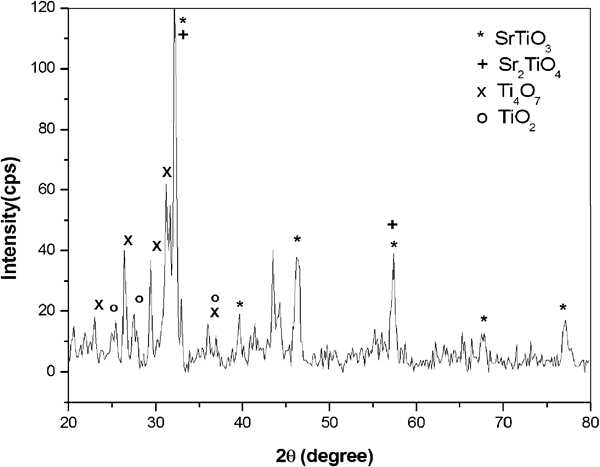
X-ray diffraction pattern of produced strontium titanium oxide powders in absence of hydrogen peroxide with oxalic acid molar ratio of 1·0 annealed at 1000°C for 2 h
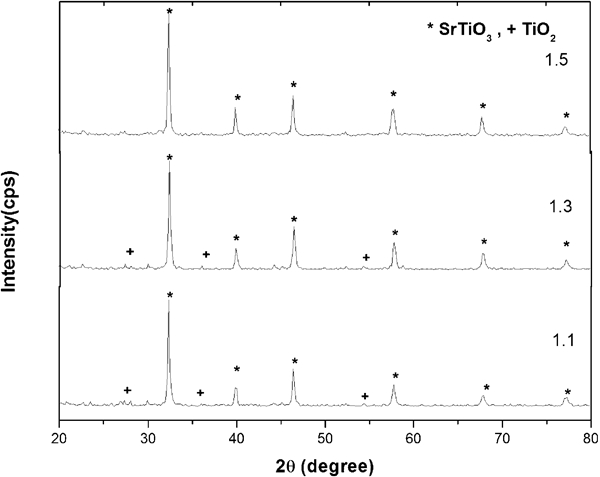
X-ray diffraction patterns of produced strontium titanium oxide powders in presence of 10% hydrogen peroxide at different oxalic acid molar ratios annealed at 1000°C for 2 h
Figure 3 shows the XRD patterns of the obtained strontium titanate in the presence of 10% hydrogen peroxide using the oxalic acid molar ratio of 1·5 at different calcination temperatures from 900 to 1100°C for 2 h. The results indicated that tetragonal Sr2TiO4 (JCPDS no. 72-2041) was formed as the impurity phase with cubic strontium titanate SrTiO3 at 900°C. Increasing the annealing temperature up to 1000 and 1100°C led to the formation of the single phase of strontium titanate phase. The crystallite size of the produced powders was increased by increasing the calcination temperature. It increased from 50 to 60 then to 70 nm at temperatures of 900, 1000 and 1100°C respectively.
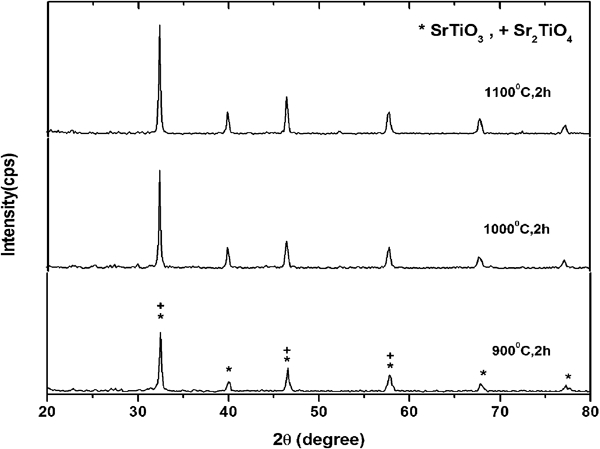
X-ray diffraction patterns of produced strontium titanium oxide powders in presence of 10% hydrogen peroxide annealed at different temperatures for 2 h at oxalic acid molar ratio of 1·5
The XRD patterns of the produced strontium titanate at different hydrogen peroxide concentrations of 5 and 10% using the oxalic acid molar ratio of 1·5 annealed at 1000°C for 2 h are given in Fig. 4. It can be observed that at the low hydrogen peroxide concentration of 5%, traces of monoclinic titanium oxide Ti3O5 phase was formed with the main strontium titanate phase. With the hydrogen peroxide concentration of 10%, a well crystalline single phase of strontium titanate nanopowders was observed. The crystallite size of the formed powders at the low hydrogen peroxide concentration (5%) was 70 nm compared with 60 nm at the H2O2 concentration of 10%.
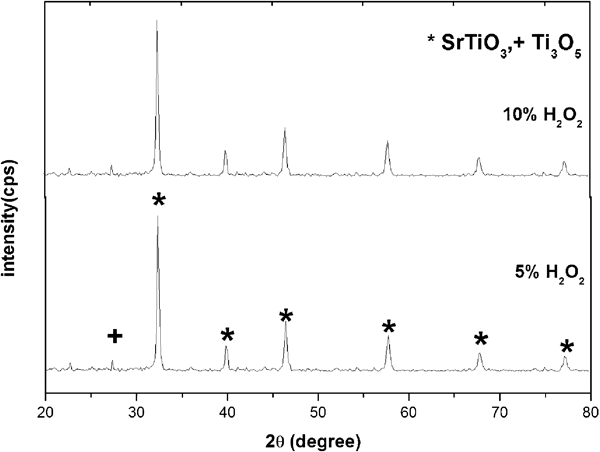
X-ray diffraction patterns of produced strontium titanium oxide annealed at 1000°C for 1 h with 5 and 10% hydrogen peroxide with oxalic acid molar ratio of 1·5
Figure 5 shows the XRD patterns of the produced strontium titanate powders annealed at 1000°C for different times from 1 to 3 h in the presence of 10% hydrogen peroxide. It can be seen that a pure single phase of the produced strontium titanate was obtained at different studied annealing times. The crystallite size of the obtained powders was slightly changed at different annealing times.
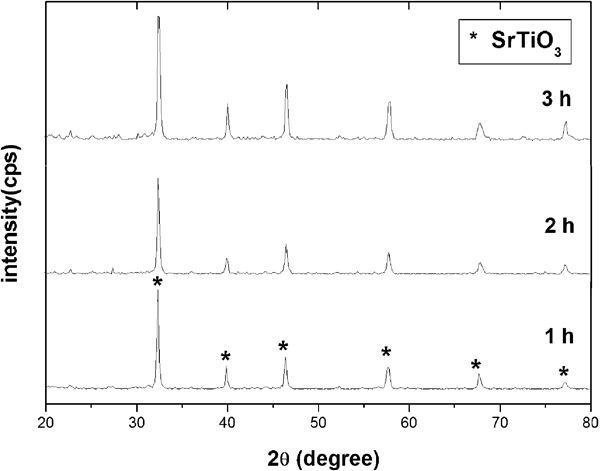
X-ray diffraction patterns of produced strontium titanium oxide in presence of 10% hydrogen peroxide with oxalic acid molar ratio of 1·5 annealed at 1000°C for different times
The SEM images of the strontium titanate powders produced using different molar ratios of oxalic acid, different calcination temperatures of 900 and 1000°C and different hydrogen peroxide concentrations of 5 and 10% were given in Fig. 6. The micrographs showed that the microstructures of the strontium titanate particles were cubes and homogenous and the grains were very fine. However, the only change that appeared is that the particle size at the oxalic acid molar ratio of 1·3 (Fig. 6a) is higher than that at the oxalic acid molar ratio of 1·5 (Fig. 6b). Furthermore, the image of the strontium titanate samples synthesised at 900°C (Fig. 6c) showed that the particles had a cube-like structure with nearly a uniform size distribution and also contained some agglomeration. The grain size of the formed powders for the annealed sample at 900°C is lower than that of the sample annealed at 1000°C (Fig. 6b) which agrees with the data given by the XRD patterns applying Debye–Scherrer equation. Figure 6d shows the SEM image of the obtained powders in the presence of 5% of hydrogen peroxide. It can be observed that the cube-like structure of the obtained powders was formed compared with the pure cube-like shape obtained at high hydrogen peroxide.
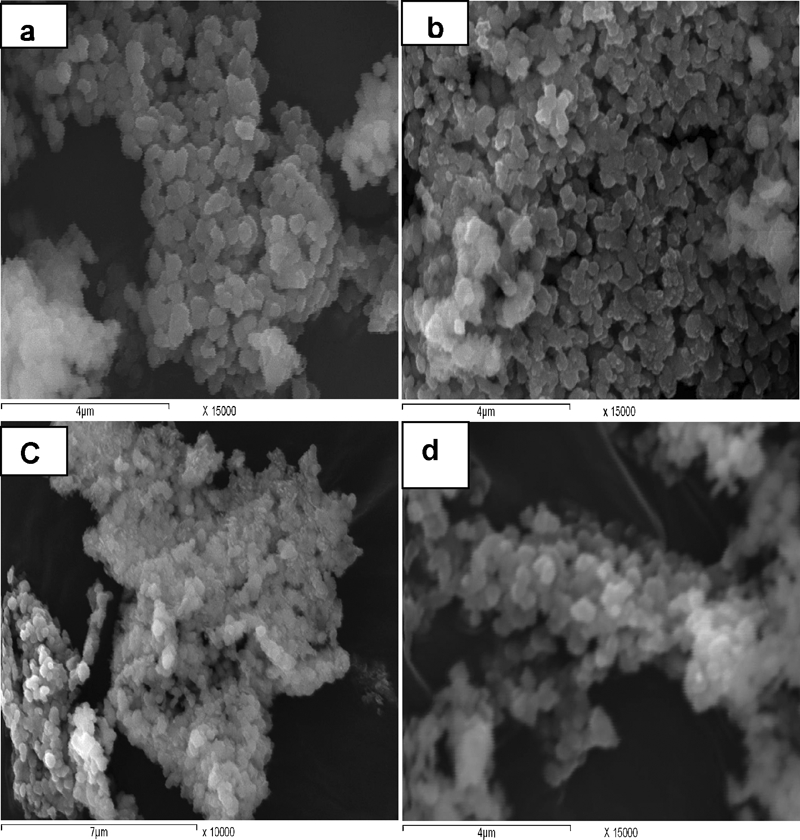
Images (SEM) of produced strontium titnate annealed at a 1000°C, 10%H2O2 and oxalic acid ratio of 1·3, b 1000°C, 10%H2O2 and oxalic acid ratio of 1·5, c 900°C, 10%H2O2 and oxalic acid ratio of 1·5 and d 1000°C, 5%H2O2 and oxalic acid ratio of 1·5
The optical transmittance spectrum in the wavelength range of 200–1000 nm for the produced pure strontium titanate annealed at 1000°C for 1 h in the presence of 10% hydrogen peroxide with the oxalic acid molar ratio of 1·5 is shown in Fig. 7. The results revealed that with increasing wavelength longer than 240 nm, the increase in the transmittance absorbance was observed and the transmission dropped rapidly at 313 nm. The transparency of the samples exhibited a sharp decrease in the UV region, as viewed from the transmittance spectra. This decrease was caused by the fundamental absorption of light. Considering the high absorption region, the transmittance T with the absorption coefficient α follows the simple relation (Tang and Tang, 2003)


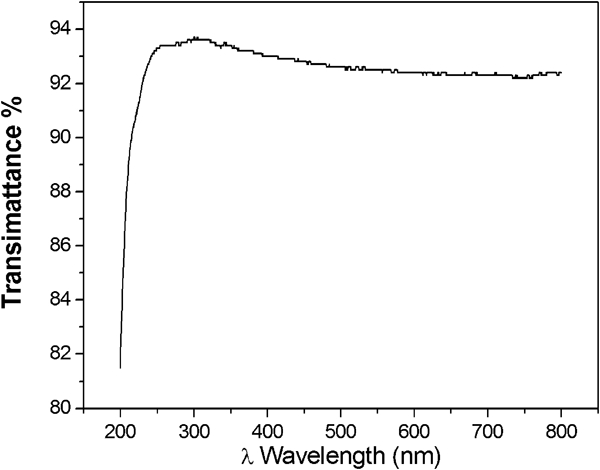
Ultraviolet–visible transmittance spectra of formed SrTiO3 in presence of 10% hydrogen peroxide with oxalic acid ratio of 1·5 annealed at 1000°C for 1 h
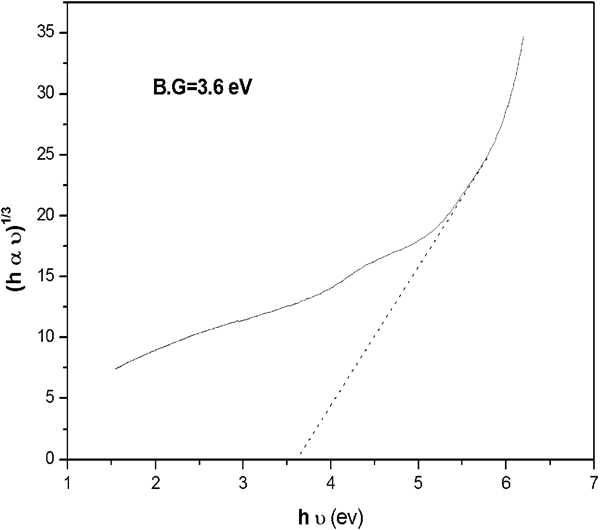
Plot of [α(hν)]1/3 versus photon energy hν of formed SrTiO3 in presence of 10% hydrogen peroxide with oxalic acid ratio of 1·5 annealed at 1000°C for 1 h
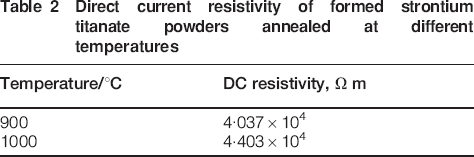
The DC resistivity of the produced strontium titnate powders annealed at 900 and 1000°C for 1 h is shown in Table 2. It can be observed that the DC resistivity was increased by increasing the annealing temperature due to the formation of a well crystalline strontium titnate phase.
Direct current resistivity of formed strontium titanate powders annealed at different temperatures
Conclusion
Strontium titanate nanoparticles have been successfully synthesised from Egyptian celestite ore and pure rutile via oxalate precursor route. The celestite ore was reduced with carbon to form water soluble SrS which was treated with hydrochloric acid to form strontium chloride. The formed strontium chloride and titanium dioxide were mixed with the 1·0–1·5 molar ratios of oxalic acid to form strontium titanium peroxo-oxalate complexing precursors which were annealed at different annealing temperatures from 900 to 1100°C for different times from 1 to 3 h in the presence of 5 and 10% hydrogen peroxide. The results indicated that single phase of strontium titanate nanopowders was obtained at annealing temperatures from 1000 to 1100°C for different times from 1 to 3 h in the presence of 10% hydrogen peroxide using 1·5 molar ratio of oxalic acid. The crystallite size of the obtained powders was increased with increasing annealing temperature and time. The crystallite size of the produced powders was in the range between 50 and 80 nm. The microstructures of the produced SrTiO3 particles appeared as cube-like structure. The band gap of the formed SrTiO3 was 3·6 eV. A higher DC resistivity of 4·4037×104 Ω m was achieved for pure SrTiO3 calcined at 1000°C for 1 h.