







Abstract
The rate of leaching of iron from ilmenite (FeTiO3) in hydrochloric acid (HCl) solutions is greatly enhanced by the presence of ultraviolet (UV) light. The magnitude of the air purged UV light illuminated leaching rate is approximately twofold higher than the N2 purged leaching rate under dark conditions. The enhanced rate is attributed to the photo dissociation of polymeric titanium oxy species via oxidising radicals OH and HO2 formed through Fe3+/Fe2+/H2O Fenton type reactions. Photo dissociation and consequent non-deposition of polymer species in the pores of ilmenite particles cause the chemical reaction between FeTiO3 and HCl acid in stirred solutions to become the rate determining step. The addition of H2O2 to the reaction mixture, in the presence and absence of UV light, further enhances iron leaching rate, confirming the role of radical species.
Introduction
Titanium dioxide (TiO2) is one of the extensively used materials in a number of industrial applications such as paints, paper, semiconducting material, etc. The main source of TiO2 in the global market originates from the naturally occurring ilmenite. Pyrometallurgical methods (Mohanty and Smith, 1993; Mackey, 1994) and hydrometallurgical methods (Lanyon et al., 1999; Ogasawara and de Araujo, 2000; Lasheen, 2005) are the two widely used industrial methods to extract titanium dioxide from ilmenite minerals. Conversion of ilmenite into synthetic rutile has become an important research area due to the shortage of natural rutile. Mahmoud et al. (2004) have reported five types for the production of synthetic rutile from ilmenite, where all the processes mainly depend on the reductive and/or oxidative pretreatment of ilmenite. Synthetic rutile production from ilmenite through the Becher process (Becher, 1963; Becher et al., 1965) is the major feedstock for the production of titania pigments and it is widely used in Australia over 30 years. Removal of iron and other impurities such as Mn3O4, Al2O3, CaO, Cr2O3 and MgO is essential for the production of pigment grade TiO2. The soda ash roasting method has been reported (Lahiri and Jha, 2001, 2009) for the production of synthetic rutile, where rare earth oxides and impurities from lower grade titaniferous become water soluble in Fe–Ti–O–Na system and can be selectively separated out. The enhanced separation was attributed to the lattice strains and subsequent fracturing developed by ions such as Na+, K+ and Al3+, which facilitates the reaction between entrapped iron oxide inside the complex structure with alkali and alumina. Various physical, inorganic and thermodynamic aspects of titaniferous ores were also investigated by Jha et al. (2008), and they have reported that the efficiency of selective separation of impurities such as lanthanides and actinides is reported based on chemical analysis of the materials derived after leaching. van Dyk et al. (2002) have extensively studied the kinetics of ilmenite dissolution in hydrochloric acid (HCl) solutions. Their work reports the investigation of the particle size, acid concentration, temperature, stirring speed, acid to ilmenite molar ratio and additives used on the dissolution. Their proposed mechanism suggests under what conditions the rate determining step for the ilmenite leaching in HCl will operate. In this study, we have found that the rate of dissolution of ilmenite is greatly enhanced by subjecting the reaction medium to the ultraviolet (UV) light and a possible mechanism is discussed.
Experimental conditions
Ilmenite samples were obtained from Lanka Mineral and Sands Ltd in Sri Lanka and used as it is. X-ray diffraction (XRD) analyses were performed using a Stoe STADI/P powder diffractometer and SEM images were obtained using a Jeol JSM-5600 instrument. Phase purity and identity were confirmed by X-ray powder diffraction using a STOE Stadi P transmission diffractometer (Cu Kα1 = 1·5406 Å) and an EDX Inca Energy System. The SEM images were obtained using a Jeol JSM-5600 instrument. Particle sizes were analysed from SEM images using ImageJ software. The UV irradiation was carried out using a Philips medium pressure Hg arc 250 W lamp. The lamp and reaction vessel were kept at constant position during this study to avoid any variations. In a typical experiment, 5·0 g of ilmenite was mixed with 50·00 mL HCl solution. In the case of nitrogen purged experiments, commercially available gas was used with approximate nitrogen content of ∼98%. Total dissolved iron was determined using atomic absorption spectrometry in experiments involving H2O2 (model GBC 932 plus) and standard colorimetric 1, 10-phenanthroline test, which has been reported in a previous study (Priyadarshana and Jayaweera, 2009). Mixture was allowed to sit in the dark for 30 min before ultraviolet–visible (UV–Vis) spectroscopy analysis, during which time characteristic reddish orange colour developed. The UV–Vis absorption measurements were carried out using a ThermoSpectronic Heλios α and JASCO V-570 UV–Vis–near infrared spectrophotometers.
Results and Discussion
The XRD pattern of the ilmenite sample used in this work closely matches with the previously published XRD pattern (Gao et al., 2008). The absence of peaks corresponding to other materials such as hematite suggests that the sample is fairly pure and has the rhombohedral FeTiO3 structure. The SEM images show that the average particle size is about 100±25 μm.
The ilmenite leaching reaction in HCl solutions can be described by the following chemical equation

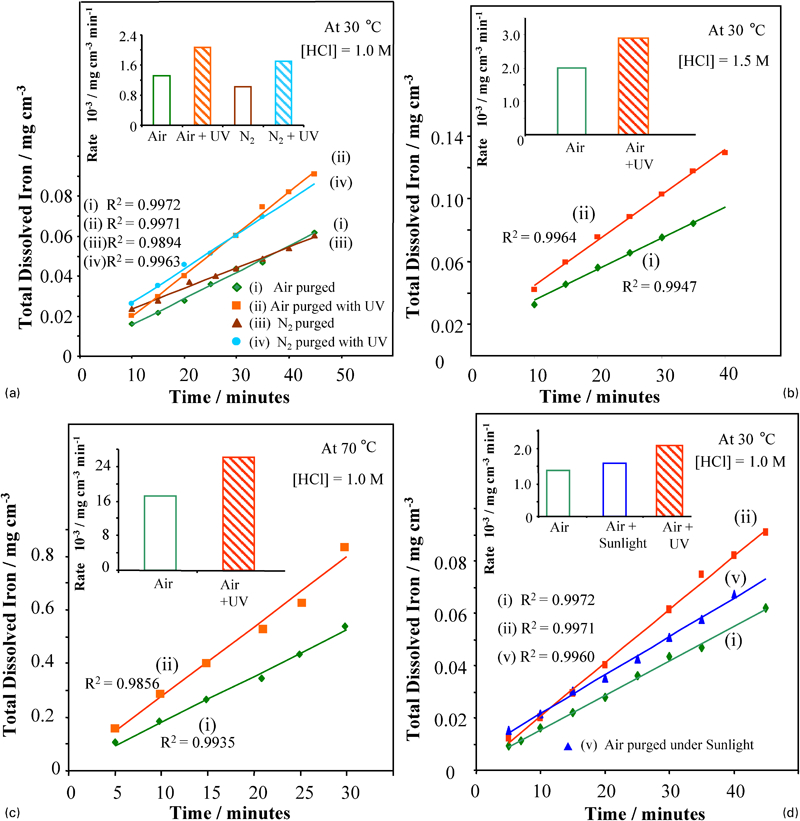
Leaching of iron from ilmenite in a 1·0M, b 1·5M HCl solutions at 30°C, c 1·0M HCl solution at 70°C and d 1·0M HCl, 30°C sunlight experiment: (i) air purged and under dark; (ii) air purged and under UV irradiation; (iii) N2 purged and under dark; (iv) N2 purged and under UV irradiation; (v) air purged and under sunlight; inserted: rates of dissolutions (5·0 g of FeTiO3 in 50·00 mL of HCl was used)
In order to understand the effect of UV radiation on the rate of dissolution of ilmenite, UV–Vis absorption spectroscopic analysis was performed as a function of time, in the presence and absence of UV light. Figure 2a shows the UV–Vis absorption spectra accumulated for the supernatant solution as a function of dissolution time in the absence of UV light. The supernatant solution produces two well defined absorption peaks at 272 and 334 nm and increases their intensities with the dissolution time. Figure 2b shows the absorption spectra accumulated for the supernatant solution as a function of dissolution time in the presence of UV light. During spectral accumulation, UV light was blocked. What is interesting is that absorbance values are somewhat lower in the case of UV irradiated dissolution when compared with an experiment without UV. This effect is more visible, when the intensities of 272 and 334 nm peaks are plotted with dissolution time. It clearly shows that both peaks have lower absorbance values, indicating a steady state photo induced dissociation of either a Ti or Fe species formed during dissolution. The stability of both Ti and Fe species generated during dissolution was investigated by separating the supernatant solution from ilmenite particles and subjecting it to UV irradiation and keeping a reference solution in the dark. Figure 3a shows the UV–Vis absorption spectra accumulated, subjecting the separated supernatant solution to the UV radiation. It clearly indicates a drop of intensities of both peaks at 272 and 334 nm. This drop halts at a certain level and further irradiation does not decrease the absorbance. The controlled experiment (Fig. 3b) shows no change in the absorbance, suggesting that dissolved species are stable under dark conditions. Therefore, findings suggest that a component in the solution undergoes UV induced degradation. The absorption spectrum of TiCl4 in concentrated HCl solution, in the presence of very small amount of water, shows a blue shift for the λmax of 276–228 nm. This is due to the formation of titanium oxychloride (TiOCl2) species and further addition of water causes to form colloidal TiO2 particles as shown in reaction (2)

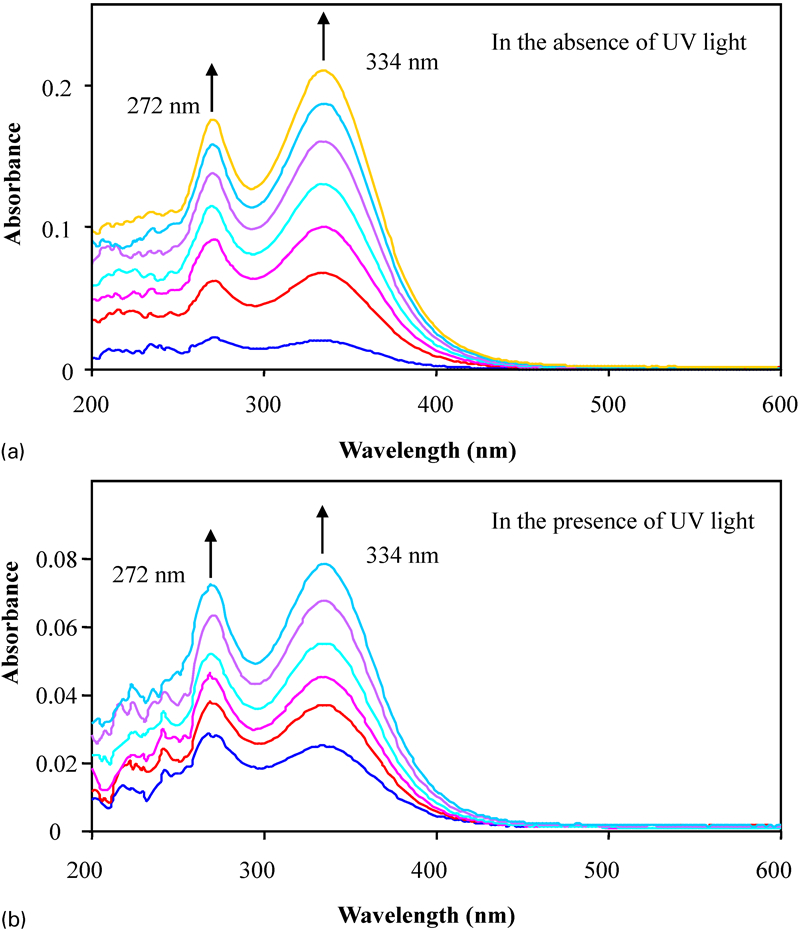
Ultraviolet–visible absorption spectra accumulated for supernatant solution during dissolution of 5·0 g of FeTiO3 in 50·00 mL of 1·0M HCl, as function of time:
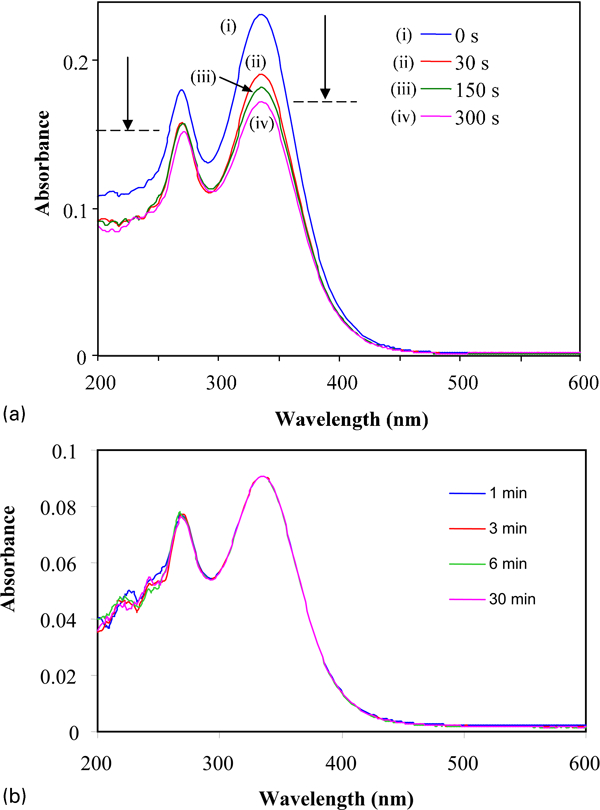
Ultraviolet–visible absorption spectra of supernatant solution, separated out from ilmenite particles after 50 min dissolution of 5·0 g of FeTiO3 in 50·00 mL of 1·0M HCl, as function of time:
van Dyk et al. (2002) have reported that, once the concentration of Ti(IV) exceeds a value of 10−3M and at [H+] >0·5M, Ti(IV) polymerises in HCl solutions. Therefore, the diffusion of the Ti(IV) polymer chains away from the ilmenite particles acts as the rate determining step in the leaching process. In a recent study, Cottineau et al. (2008) have reported the synthesis and characterisation of photosensitive titanium oxopolymers. It has been found that TiOCl2 in HCl is hydrolysed into polymeric form of titanium oxides as evident from X-ray absorption spectroscopic experiments. Fowles et al. (1968) have reported the most likely structures for the complexes TiOCl2, 2L type as oxygen bridged dimers or polymers. Also they have not ruled out the presence of Ti-Cl→Ti bridged structures. What is clear from our finding is that the enhanced rate for the iron leaching from ilmenite arises as a result of UV induced degradation of Ti polymer species or precursor(s) formed during dissolution. This facilitates the diffusion of degraded products away from the ilmenite HCl interface and minimises the deposition of Ti(IV) polymeric species in the pores of ilmenite particles. As a result, rate determining step becomes the chemical reaction between ilmenite and HCl, enhancing the rate of leaching. Furthermore, leaching studies under air purged conditions have shown the highest rate in the presence of UV light. This enhancement could be explained by the highly reactive oxidising radical species such as OH, HO2 and H2O2 formed through Fe2+/Fe3+/H2O Fenton type reactions (Bauer et al., 1999; Kassinos et al., 2009) as shown below





 .
.
The effect of radical species and hydrogen peroxide (H2O2) on the rate of leaching was investigated by adding 10·00 mL of 6% (w/v) H2O2 into the leaching medium maintaining the HCl concentration at 1·0M. Results obtained in the presence and absence of UV light are shown in Fig. 4. These experiments clearly confirm the role of Fe2+/Fe3+ driven Fenton process and the reactions of OH and HO2 species on the enhancement of rate of leaching of iron from ilmenite. In the presence of UV light, photo Fenton reactions generate more hydroxyl radical species, further enhancing the rate of dissolution (reactions (8) and (9))







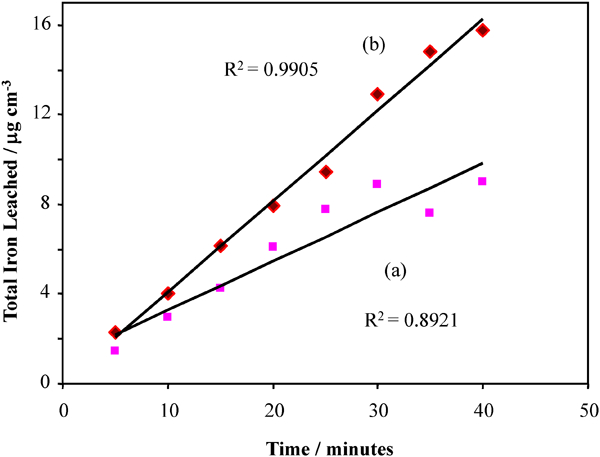
Leaching of iron from ilmenite in 1·0M HCl in presence of H2O2 at 30°C under conditions of a air purged and under dark and b air purged and under UV irradiation (5·0 g of FeTiO3 in 1·0M HCl and 10·00 mL of 6% (w/v) H2O2; total volume 50·00 mL)
Experiments performed allowing only the HCl solution to expose to the UV light and blocking UV light falling to the ilmenite particles, showed similar rates for the iron dissolution. This confirms that there is no influence arising from ilmenite band gap excitation and the rate of dissolution enhancement is due to the degradation of polymeric species in the solution phase.
Summary
The rate of leaching of iron from ilmenite in HCl solutions is greatly enhanced when exposed to UV radiation. The UV light enhanced leaching was attributed to the photo induced decomposition of titanium oxy polymers formed and non-deposition in pores of ilmenite particles. The enhanced dissolution takes place both at elevated temperatures and at higher HCl concentrations. Air purged dissolution in the presence of UV radiation shows a higher rate. This enhancement arises from the oxidising radical species such as OH and HO2 formed through Fe3+/Fe2+/H2O photo reactions. The addition of H2O2 into the reaction medium further enhances the rate, generating more radical species.
Footnotes
Acknowledgements
The authors would like to thank Dr Chamara Jayasundara and Chami Patabendige at St Andrews University, Scotland, UK for the XRD and SEM support, and Lanka Mineral and Sands Ltd in Sri Lanka for providing ilmenite samples.