







Abstract
Separation of zinc and lead from an aqueous nitrate medium using supported liquid membrane with di(2-ethylhexyl)phosphoric acid (D2EHPA) as mobile carrier was studied. Celgard-2500, a microporous polypropylene film, was used as the solid support for the liquid membrane with a plate and frame type of cell used for the experiments. The effects of different parameters such as pH of feed solution (1–3·5), D2EHPA concentration in the membrane phase (10–100 mol m−3), acid concentration in strip solution and flowrate of the aqueous solution on separation of lead and zinc were studied. It was observed that zinc flux across the membrane increased with pH of the feed solution up to 3·0 and thereafter decreased while zinc flux increased with the D2EHPA concentration in the membrane phase up to 75 mol m−3 and thereafter decreased. The flowrate of 100 mL min−1 was sufficient to reduce the resistances due to the aqueous boundary layer while 950 mol m−3 H2SO4 was found sufficient to strip the metals from the membrane phase in the strip phase. Under the study conditions, the copermeation of lead with zinc was observed to be negligible.
Introduction
Metal bearing ores, waste byproducts and most other materials of metal are processed through hydrometallurgical or heating the mineral before hydrometallurgical treatment routes to bring the metal value into solution. In most cases, the leach liquors are complex and lean; they are often found in association with metals such as lead, zinc, cadmium, iron, magnesium etc. Also they yield dilute solutions assaying 1–10 g L−1 of metal ions at a pH around 1·0–2·0 (Jung, 1993). In the past, such solutions are normally discarded due to lack of economic and efficient technology to recover the constituent metals and therefore constitute environmental problems.
The hydrometallurgical process train consists of three circuits: leaching, leachate purification and electrowinning. The leachate purification train involves the separation techniques to achieve metal removal down to levels suitable for electrowinning. The purification of leachate is required to improve both final product quality and current efficiency in electrowinning. Solvent extraction (SX) of divalent metals such as Zn2+, Pb2+, Co2+, Ni2+, Cd2+ and Cu2+ with organophosphorus carriers such as di(2-ethylhexyl)phosphoric acid (D2EHPA) is an important recovery/separation unit in hydrometallurgical processes (Owusu, 1998; Sole et al., 2005; Pereira et al., 2007). Conventional SX processes are operated in devices such as packed towers, mixer settlers, single drop, etc., which seek to maximise the contact area of two immiscible phases for mass transfer (Geankoplis, 2004). In most cases, the intimate mixing that takes place in these devices often leads to the formation of stable emulsions, thereby holding back the phase separation and product recovery. Traditional SX systems avoid using liquids having similar densities, a situation which appears to promote stable emulsion phase. Additional limitations present in packed towers include loading requirements and flooding restrictions (Kumar and Tulasi, 2005). Some of these problems coupled with high cost associated with SX usually make it impracticable to recover valuable metals from such very dilute solutions.
In the past 20 years, non-dispersive solvent extraction has been used to avoid many of the shortcomings associated with the SX as described above (Juang and Liang, 1993; Swain et al., 2004). When a microporous membrane is impregnated with a fluid that wets the membrane, the fluid fills the pores of the membrane. If a second immiscible liquid is allowed to contact the membrane, an interfacial contact area is established on that side of membrane surface. Such membrane contactors are increasingly being used in a variety of fields of chemical technology including gas absorption (Henis and Tripodi, 1980), extractive fermentation (Matejka, 1971), metal separation (Sarangi et al., 1992) and extraction and biomedical equipments such as blood oxygenators (Kedem and Maoz, 1976).
There are many studies conducted in relation to the extraction/separation of Zn, Pb and Cd in sulphate and chloride media (Rice and Smith, 1975; Sastree and Muhammed, 1984; Owusu, 1998; Tripathy et al., 2002; Sarangi and Das, 2004); however, there are scanty information on nitrate medium despite its potential usefulness.
The present work was developed to establish the possibility of using a supported liquid membrane (SLM) technique to separate lead and zinc from very dilute leach liquor using D2EHPA as a carrier. The solution contains 29·38 mol m−3 Zn, 3·8 mol m−3 Pb and 12·52 mol m−3 Fe as nitrate and pH of the solution about 1·0 based on earlier work (Adebayo, 2006). Equilibrium studies were carried out to establish the extraction mechanism of Pb2+, Fe3+ and Zn2+. Iron was precipitated out of the mixture before separation lead and zinc mixture by SLM. In the SLM studies, effect of various process variables, such as flowrate, pH of feed solution, extractant concentration in membrane phase and acid concentration in strip solution on the metal ion flux was investigated.
Experimental
Chemicals
All chemicals used in this study, namely Pb(NO3)2, Fe(NO3)3, Zn(NO3)2, H2SO4, NaOH and HNO3, were of analytical reagent grade. Stock solutions of Pb(NO3)2, Fe(NO3)3 and Zn(NO3)2 were prepared and standardised against an ethylenediaminetetraacetate solution. The working solutions were prepared by appropriate dilution. The commercial extractant D2EHPA was used as received without any further purification. Distilled kerosene (bp 190–210°C) was used as the diluents while tri-n-butyl phosphate (5%, v/v) was used as a modifier.
Membrane
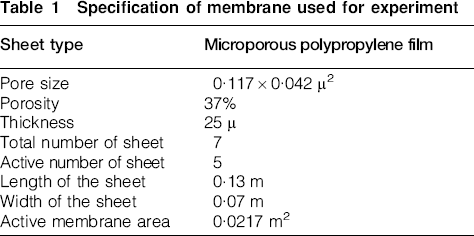
Celgard 2400, a microporous polypropylene film, was used as the solid support for the liquid membrane. Hoechest Inc. (Charlotte, NC, USA) supplied the film. The specification for the solid support film is shown in Table 1.
Specification of membrane used for experiment
The membranes were prepared by absorbing the organic phase (prepared by diluting the required volume of D2HEPA in the distilled kerosene) in the microporous polypropylene support for at least 24 h.
Experimental procedures
Equilibrium study
For equilibrium studies, 10 mL of the aqueous phase containing the metal ions solution was equilibrated with an equal volume of organic phase containing solution of D2EHPA in a separating funnel for 10 min. After complete phase disengagement, the aqueous phase was separated and was analysed for Zn2+, Fe3+ and Pb2+ concentrations. The concentrations of the metals in the organic phase were calculated from the difference between the metal ion concentrations in the aqueous phase before and after extraction.
Removal of iron from solution
The precipitation of iron was carried out with 10% lime at pH of 2·50; the solution was heated to 90°C, allowing cooling and thereafter filtering off (David, 2000). Under these conditions, negligible amounts of zinc and lead were precipitating out.
Liquid membrane experiment
A plate and a frame type of cell with an effective membrane area (geometrical membrane area×porosity) of 0·0217 m2 were used for the liquid membrane experiments. The length, width and depth of the channels of both the feed and the strip solutions were 13, 7 and 0·1 cm respectively (Sarangi and Das, 2004). The volumes of the strip solution and the feed solution used were 200 mL each. Solution of nitric acid and sodium hydroxide was used to adjust the pH in the studied range. The feed and strip solutions were circulated through the module with the help of a peristaltic pump (Watson Marlow 501 S). The feed solution was kept under agitation by using a mechanical stirrer. Equal volumes of samples (1 mL) were withdrawn from both solutions at the desired time interval. The samples were analysed for Zn2+ and Pb2+ concentrations using an atomic absorption spectrophotometer (model AAnalyst 200; Perkin Elmer).
Results and Discussion
Equilibrium studies
The effect of pH (1·5–3·5) on the extraction of metal ions from aqueous solution containing 29·38 mol m−3 Zn2+, 3·8 mol m−3 Pb2+ and 12·52 mol m−3 Fe3+ using 25 mol m−3 D2EHPA with 5%TBP as modifier in kerosene was investigated. The percentage extraction of metals was found to increase with increasing equilibrium pH (Fig. 1). The percentage extraction of zinc increased from 32·24 to 75·44 with an increase in equilibrium pH from 1·46 to 1·8, while percentage extraction of lead increases from 10·02 to 21·16 within the same equilibrium pH range. The percentage extraction of iron was much more than any of the two metals; it increases from 35·65 to 98·76 with increase in equilibrium pH from 1·46 to 1·75.
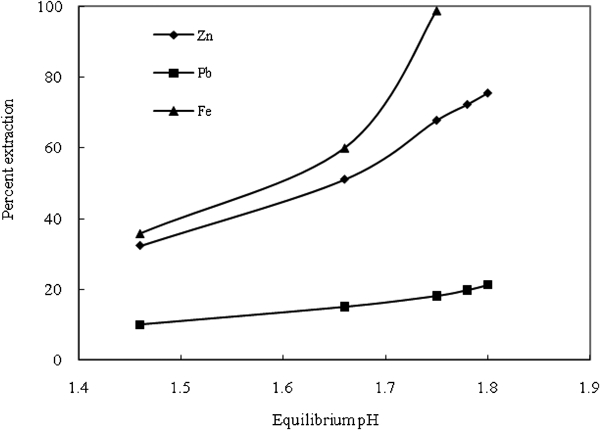
Equilibrium pH against percentage extraction
The effect of D2EHPA concentration in the range of 10–100 mol m−3 on the extraction of metal ions from the aqueous solution was carried out at pH 2·5. It was observed that percentage extraction of the metal ions increased with increasing extractant concentration as shown in Fig. 2. The percentage extractions of Zn and Pb increased from 41·84 to 98·18 and 4·3 to 37·78 respectively with increase in D2EHPA concentration from 10 to 100 mol m−3. The iron extraction was 78·99% with 10 mol m−3 D2EHPA and it reached 100% with 50 mol m−3 D2EHPA.
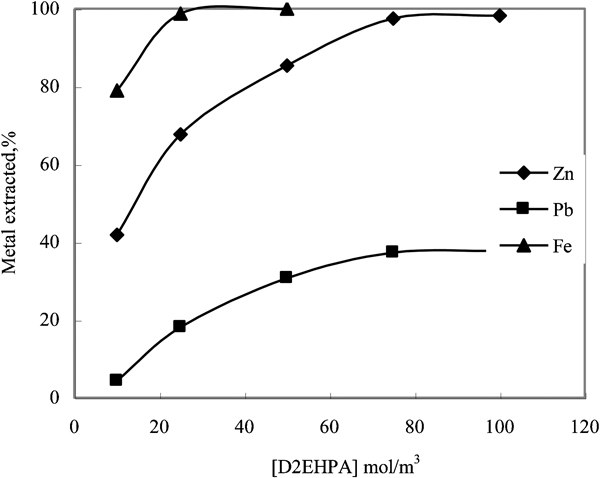
Effect of [D2EHPA] on extraction of metal ions
Removal of interfering iron for SLM
It was observed from the equilibrium studies that percentage extraction of iron was higher than those of zinc and lead, therefore iron was removed from the liquor by precipitation. The iron was completely removed by this precipitation method. Then zinc and lead in the solution were separated using supported liquid membrane with D2EHPA as carrier.
Separation of lead and zinc with SLM
The reaction by which a metal ion is extracted from an aqueous phase using D2EHPA at the feed solution membrane interface can be written as


It was observed that the metal ion concentration decreases in the feed compartment linearly with time and increases with time in the strip compartment at the same rate as it decreases in feed solution. (V/A)d[M] was plotted against dt for each experiment (figure not shown), and from the slope of the initial straight line, flux of the metal ion JM was calculated, where V is the volume of solution on each side of the membrane (m3), A is effective membrane area (m2) and t is time (s).
The permeability coefficient of the membrane P is defined as


Effect of feed solution pH on flux of metals
Several experiments were carried out by varying the pH of the feed solution in a range between 1·5 and 3·5. The adjustment of pH was done by the controlled addition of sodium hydroxide and nitric acid solution appropriately. After removal of iron, the leach liquor contained 29·38 mol m−3 Zn2+ and 3·8 mol m−3 Pb2+. The flowrate, concentration of stripping solution and the concentration of D2EHPA in membrane phase were kept constant. In Fig. 3, the fluxes of metal ions were plotted against pH of the feed solution.

Effect of pH on flux of Zn and Pb across membrane
As the pH was increased from 1·5 to 3·0, the flux for zinc was observed to increase from 2·14×105 to 4·20×10−5 mol m−2 s−1 and then it decreased to 3·25×10−5 mol m−2 s−1 as pH increased to 3·5. It can be seen from Fig. 3 that there was negligible copermeation of lead with zinc. The separation factors were calculated by using equation (3) and the values are given in Table 2. The separation factor increases with pH of the feed solution up to 181·1 at the 2·5 and thereafter decreases to 35·1 at the pH of 3·5.
Separation factors for zinc and lead at different pH values
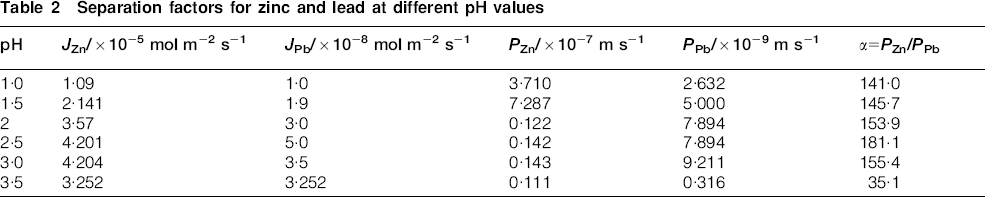
Because of the highest separation factor achieved at pH 2·5, further experiments were carried out at this pH to avoid precipitation of lead.
Effect of D2EHPA concentration in membrane phase
A set of experiments were performed to investigate the influence of the carrier concentration in the membrane phase. In all the experiments, the feed solution pH was kept constant at pH 2·5. Figure 4 shows the relationship of JZn and JPb with concentration of D2EHPA in the membrane phase.
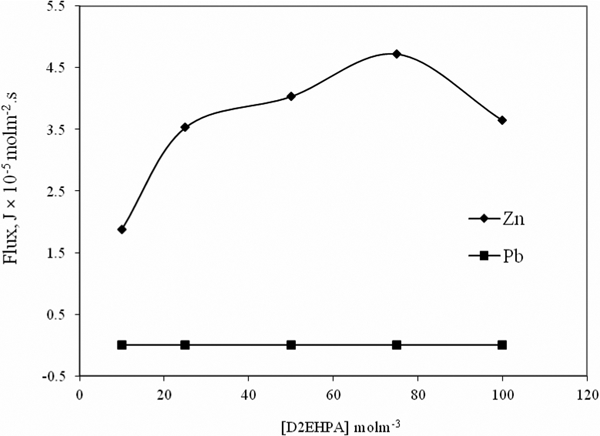
Effect of concentration of D2EHPA on flux of metal ions
With increasing D2EHPA concentration from 10 to 75 mol m−3, the zinc flux increased from 1·85×105 to 4·71×105 mol m−2 s−1 and with further increase in D2EHPA concentration to 100 mol m−3, the zinc flux decreased to 3·64×105 mol m−2 s−1. In accordance with equation (1), with an increase in D2EHPA concentration, the formation of Zn(II)– D2EHPA complex increased at the feed side/membrane interface, and, since at a lower extractant concentration, the same interface was not saturated by the extractant, the flux increased with an increase in the extractant concentration. With a further increase in D2EHPA concentration, viscosity of the membrane phase increased, which decreased the metal ion flux (Kumar, 1994). The separation factors were calculated at different D2EHPA concentrations and are given in Table 3.
Separation factors for zinc and lead at different DEHPA concentrations

It was observed that the separation factor increased from 102 to 181 with an increase in D2EHPA concentration from 10 to 75 mol m−3 and thereafter decreased.
Effect of sulphuric acid concentration in stripping solution
The stripping reaction at the membrane–strip solution side plays a vital role in the transfer of metal ion from feed side to strip side. So the stripping kinetics was studied with different concentrations of sulphuric acid (190, 380, 570, 760 and 1425 mol m−3). All other parameters were kept constant. Figure 5 shows the plot of flux J against the concentration of H2SO4 in the strip solution.
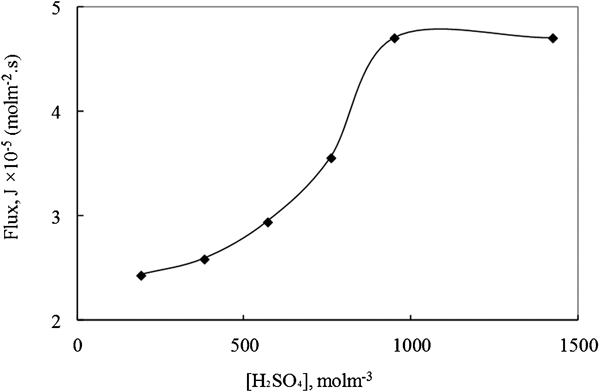
Effect of acid concentration in strip on flux of metal
The plot indicates that flux increased from 2·43×105 to 4·71×105 with increasing acid concentration from 190 to 950 mol m−3 beyond which zinc flux did not change appreciably.
Effect of volumetric flowrate
In order to achieve effective transport of zinc in the SLM system, it is necessary to explore the effect of volumetric flowrate on transport. The flowrates of the source and the receiving phases were carried out from 20 to 150 mL min−1 (Fig. 6). It was observed that the zinc flux increased in the system in the range from 20 to 120 mL min−1. It indicates that transport of the metal through SLM increased with increasing flowrate. However, flux remains constant in the range from 120 to 150 mL min−1 for the system. It can be inferred that the aqueous film thickness attained minimum thickness with 120 mL min−1.
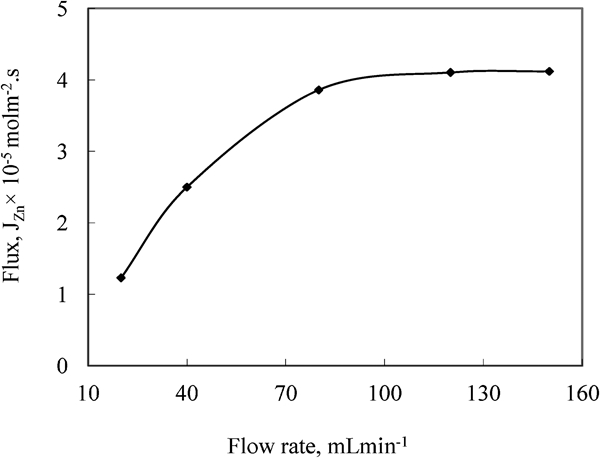
Effect of volumetric flowrate on flux of zinc
The flowrate is an important hydrodynamic factor in the separation of metal ions by the SLM because it affects the aqueous film boundary layer and the residence time of Zn2+ ion at the feed solution/membrane interface.
The aqueous film boundary layer decreased with the increasing flowrate and as a result, the zinc flux increased with the increasing flowrate up to 120 mL min−1. Thus, the thickness of aqueous film boundary layer at this point was the least. At very low flowrate, the flow of the liquid is laminar, but at high flowrate, some turbulence gets associated with the flow of fluid for which the aqueous boundary layer is reduced.
Conclusion
Separation of zinc and lead was carried out by an SLM technique by using D2EHPA as mobile carrier. In addition, equilibrium studies with a shake flask were carried out. The following conclusions were drawn from the studies. The equilibrium studies show that the order of extraction of metals involved is Fe>Zn>Pb with extractant, D2EHPA. In the membrane separation, zinc flux increased with an increase in pH from 1·0 to 3·0, and zinc flux decreased from 3·0 to 3·5. The extraction of lead was negligible at this pH ranges. In addition, JZn increased with an increase in the extractant concentration up to 75 mol m−3 and then decreased. It was observed that the maximum separation factor of 181 was obtained at pH of 2·5. The best separation of lead and zinc is obtained at pH 2·5, 75 mol m−3 of DEHPA and 950 mol m−3 of H2SO4 in the strip solution.
Footnotes
Acknowledgements
The authors wish to thank Professor B. K. Mishra, Director, Institute of Minerals and Materials Technology, Bhubaneswar and Dr R. K. Paramguru, HOD, Hydro & Electrometallurgy Department for their kind permission to publish this paper. One of the authors is grateful to CSIR, Government of India and the Academy of Science for the Developing Countries (TWAS) for CSIR–TWAS Postgraduate Fellowship award leading to this paper.