







Abstract
The solvent extraction of gadolinium (III) from hydrochloric acid solutions with cationic extractants D2EHPA and Ionquest 801 dissolved in Exxsol D100 was investigated. The study was carried out with concentrated solutions in order to better reproduce industrial process conditions. The following operational variables were investigated: initial concentration of gadolinium (16–40 g L−1, i.e., 0·104–0·255 mol L−1), initial concentration of extractant (0·5–1·5 mol L−1), initial pH of the aqueous phase (1–5) and aqueous/organic volumetric ratio (0·5–2·0). Data fitting including the statistical analysis of the estimated equilibrium parameters indicated that gadolinium (III) is extracted from hydrochloric acid solutions with D2EHPA and Ionquest 801 according to the overall reaction Gd3++3(HX)2⇆GdX3(HX)3+3H+. The apparent equilibrium constant at 298±1 K was found to be 1·9±0·3 for the system Gd(III)–D2EHPA and 0·028±0·003 for the system Gd(III)–Ionquest 801.
Introduction
Gadolinium is a rare earth element largely used in the fields of nuclear energy and medicine. It is used in cancer therapy for neutron-capture and as an alternative contrast agent for sialography in patients with iodine sensitivity. In addition, to prevent iodinated contrast medium-induced nephrotoxicity, gadolinium has been used increasingly for magnetic resonance angiography or conventional digital subtraction angiography to visualize arterial anatomy in patients undergoing vascular surgery who are considered at high risk because of chronic renal insufficiency (Riella et al., 1991; Watanabe et al., 2002; Williams et al., 2003; Fatin-Rouge et al., 2004).
The separation of rare earth elements is normally carried out into groups of light rare earths (La, Ce, Pr, Nd), middle rare earths (Sm, Eu, Gd) and heavy rare earths (Tb, Dy, Ho, Er, Tm, Yb, Lu, Sc, Y) (Morais and Ciminelli, 2004). In the group of middle rare earths, Eu can be removed by reduction of Eu3+ to Eu2+ followed by precipitation as EuSO4 (Morais and Ciminelli, 1998, 2001, 2002), while the remaining elements (Sm and Gd) are separated by solvent extraction (Benedeto et al., 1993; Miranda and Zinner, 1997).
A number of complex species have been proposed in the literature to describe the solvent extraction of rare earth elements, but studies are normally carried out using very dilute solutions (Sato, 1989; Miranda and Zinner, 1997; Morais and Ciminelli, 2002; Wu et al., 2004). Therefore, the goal of the present work is to evaluate the equilibrium extraction of gadolinium (III) using concentrated solutions in order to better reproduce industrial process conditions. The study was carried out using D2EHPA (di-2-ethylhexyl phosphoric acid) and Ionquest 801® (2-ethylhexyl phosphonic acid mono-2-ethylhexyl ester) as extractants. Singh et al. (2008) successfully used these cationic extractants to obtain nuclear grade Dy2O3 (recovery>98%) from a crude concentrate containing other rare earths like yttrium and terbium. In the present work, data fitting including statistical analysis of the equilibrium parameters was also performed in order to identify the stoichiometry of gadolinium (III) extraction with both cationic extractants investigated.
Experimental
Reagents
Aqueous solutions of gadolinium chloride GdCl3 were prepared at room temperature (298±1 K) by dissolving a gadolinium carbonate supplied by INB (Indústrias Nucleares do Brasil S.A.) in a hydrochloric acid solution (Vetec, 37%) prepared with distilled water. The chemical composition of the gadolinium carbonate used in this study was (in wt-%): 47·0 Gd3+, 0·01 Eu3+, <0·005 Sm3+, <0·005 Tb3+, 43·3 CO32−, 2·3 Cl− and 7·4 H2O. For the organic solutions, the extractants D2EHPA (Merck, di-2-ethylhexyl phosphoric acid, 98 wt-% purity) and Ionquest 801® (Albright & Wilson, 2-ethylhexyl phosphonic acid mono-2-ethylhexyl ester, 96·5 wt-% purity) were used without further purification. The extractants were diluted at a given concentration in Exxsol® D100 (Exxson), a commercial aliphatic diluent similar to kerosene. The presence of europium in the gadolinium solutions was neglected due to its low concentration in the aqueous phase and also due to the well-known similarity extraction distribution coefficient of Eu3+ and Gd3+ with acid organophosphorous extractants (Sato, 1989).
Solvent extraction tests and analyses
The equilibrium experiments were carried out by mixing suitable volumes of the aqueous and the organic phases in a 250 mL cylindrical jacket glass reactor equipped with a mechanical agitator using a glass marine-type impeller for 10 minutes. This time was found enough to reach chemical equilibrium as verified in preliminary tests (around 3 minutes for the operational conditions investigated). Experiments were performed at constant temperature (298±1 K) and without pH control. In fact, pH was measured only at the beginning and at the end of each test. Neither a third phase nor a significant change in the volume of phases was observed in all tests. The gadolinium chloride solutions were prepared at the following concentrations and respective pH values: 0·255 mol L−1 (pH 5·0, 3·2, 2·2 and 1·1), 0·202 mol L−1 (pH 5·0), 0·154 mol L−1 (pH 5·0, 2·9, 1·8 and 1·0) and 0·104 mol L−1 (pH 5·2). Experiments were carried out at various concentrations of extractants D2EHPA or Ionquest 801 (0·50, 0·75, 1·00, 1·22 and 1·50 mol L−1), and aqueous to organic (A/O) volumetric ratios (0·5, 1 and 2). After extraction, both phases were allowed to settle using a separation funnel.
Chemical analyses
The concentration of gadolinium in the aqueous phase was determined by an atomic emission spectrometer with inductively coupled plasma (ICP/AES). For the organic phase, the concentration of gadolinium was determined by mass balance. The pH of the aqueous solutions was measured using a glass pH electrode attached to a Digimed pH-meter (model DM 20).
Results and Discussion
Effect of the initial concentrations of metal and extractants
Figure 1a and b shows the extraction behaviour of Gd(III) with D2EHPA and Ionquest 801, respectively, according to the initial concentration of metal in the aqueous phase and also to the initial concentration of extractant in the organic phase. As expected, a lower metal extraction percentage was obtained when more concentrated aqueous solutions were contacted for a given initial concentration of extractant in the organic phase; on the contrary, a higher metal extraction percentage was found when more concentrated organic solutions were contacted for a given initial concentration of metal in the aqueous solution. Both effects are related to the relative initial quantities of metal and extractant in the liquid–liquid system. Also according to such results, D2EHPA was found to be more efficient than Ionquest 801 for the extraction of gadolinium (III) from hydrochloric aqueous solutions. When both extractants are compared at similar operational conditions, a relatively higher extraction percentage of Gd(III) was obtained with D2EHPA. According to Morais and Ciminelli (2004), such behaviour is explained based on the ‘soft’ and ‘hard’ acid/base theory and also by the relatively higher hydrophilic nature of the phosphate group of D2EHPA as compared to the phosphonic group of Ionquest 801.
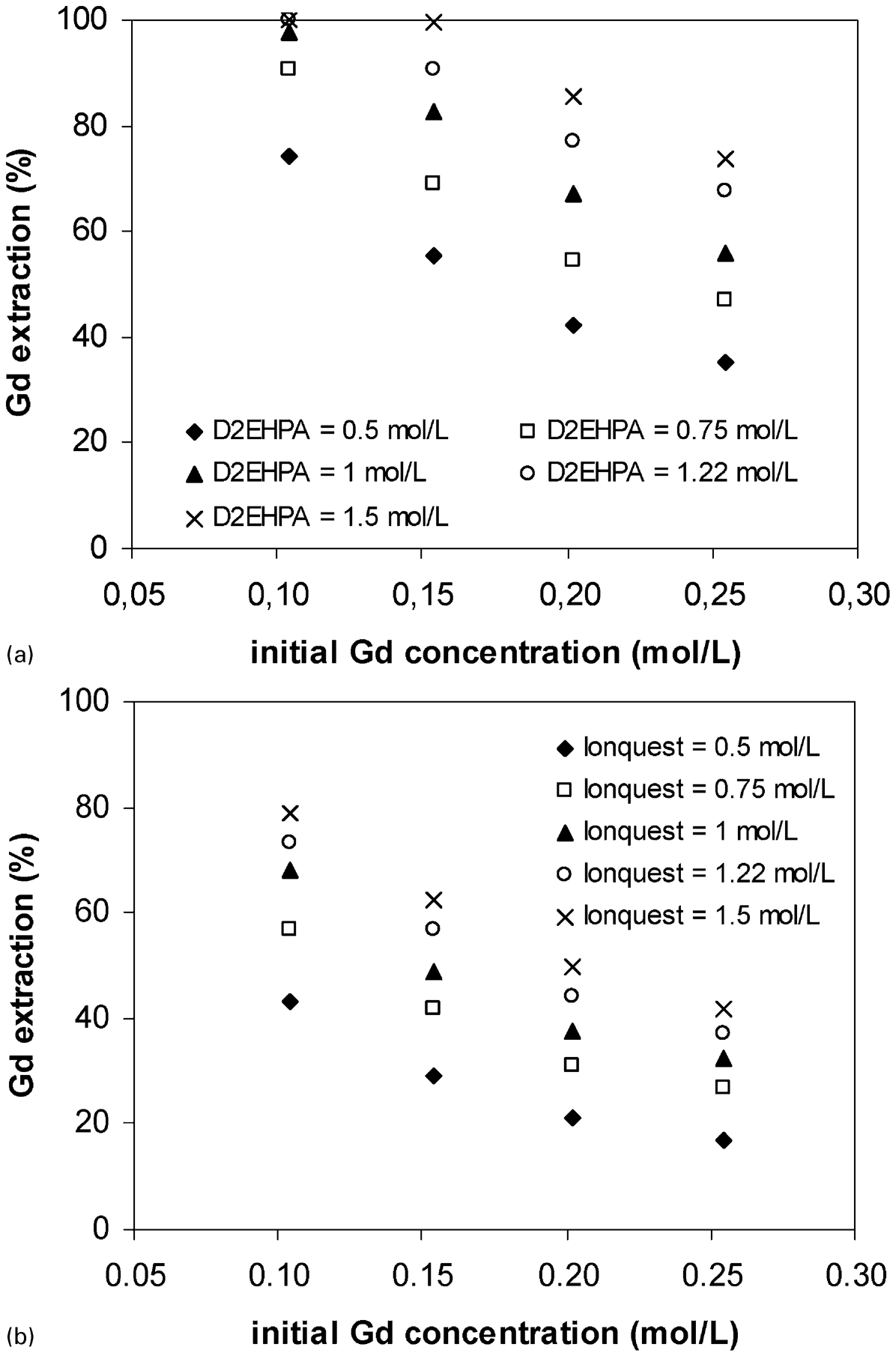
Effect of the initial concentrations of Gd(III) and extractant on the extraction of Gd(III) with a D2EHPA and b Ionquest 801 (A/O = 1, initial pH = 5, T = 298±1 K)
Effect of the initial pH
In this study, experiments were carried out without pH control, so no acid or base was added to the mixed system in order to neutralise the protons released by the chemical reaction between the Gd(III) ions and the extractant molecules. Consequently, in comparison to experiments carried out at constant pH, a relatively lower metal extraction is expected because metal extraction will cease when the equilibrium pH is reached. Actually, in the experiments carried out in this study, the variation between the initial and the final (or equilibrium) pH was measured. This methodology has shown to be easier to handle at laboratory scale because there is no error introduced due to the addition of reagents to control the pH (i.e., variation of volumes and presence of other species that may interfere on the equilibrium). Figure 2a and b shows the equilibrium pH obtained in the experiments presented in Fig. 1a and b, respectively. As expected, higher Gd(III) extraction levels result in higher pH differences (between the initial and the final pH) because more protons are released to the aqueous phase. Therefore, the same conclusions as in the “Effect of the initial concentrations of metal and extractants” section (based on the initial concentrations of metal and extractants) can be drawn here by analyzing the equilibrium pH responses, because higher metal extraction levels lead to lower equilibrium pH values.
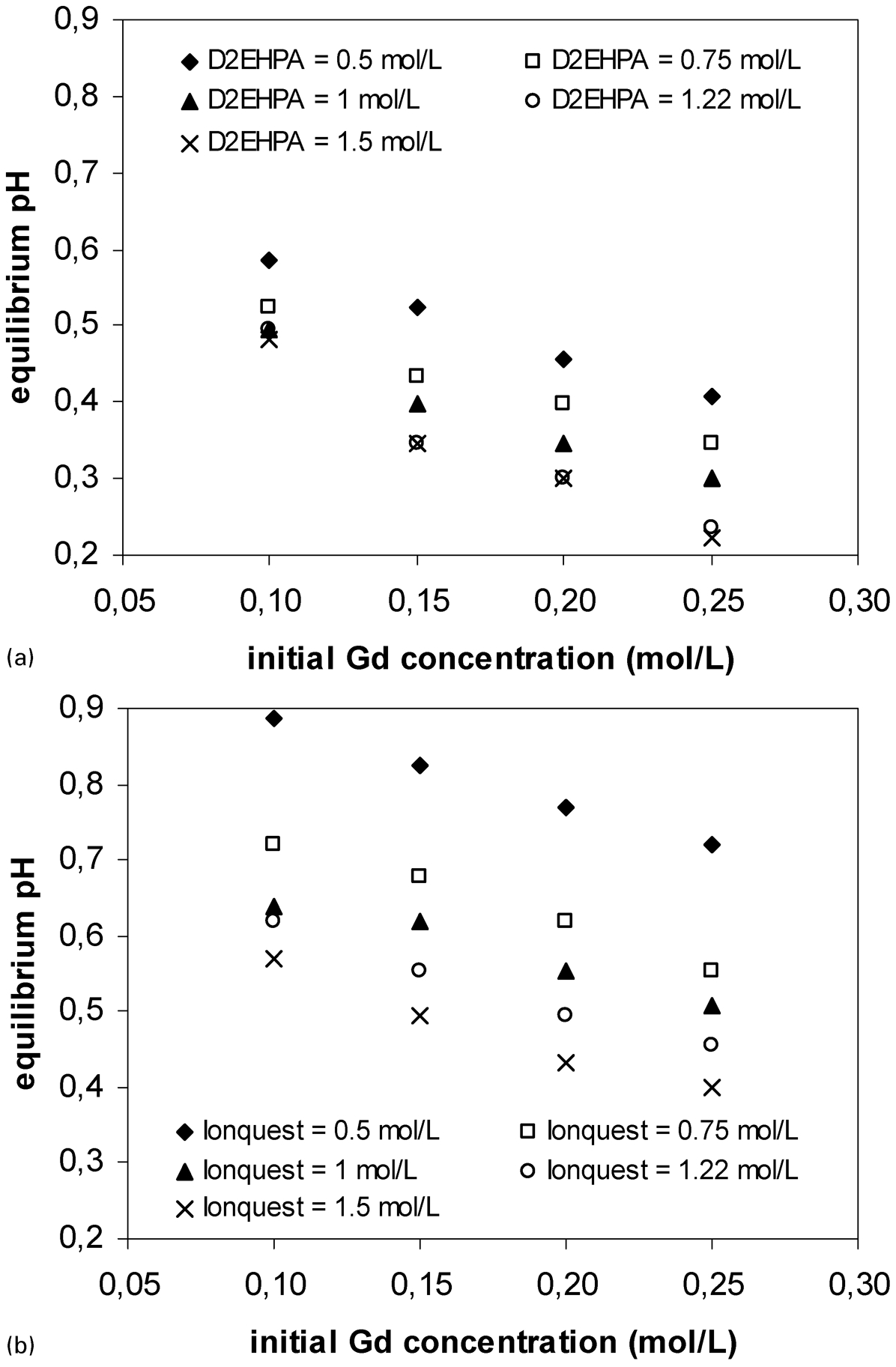
Effect of initial concentrations of Gd(III) and extractant on the equilibrium pH with a D2EHPA and b Ionquest 801 (A/O = 1, initial pH = 5, T = 298±1 K)
Modelling of the equilibrium extraction of Gd(III) with D2EHPA and Ionquest 801
Assuming that Gd(III) is fully dissociated in the aqueous media and that chloride ions do not participate in the extraction reaction, the equilibrium extraction of Gd(III) by cationic organophosphorous extractants such as D2EHPA and Ionquest 801 can be described by the following equation (Peppard et al., 1958; Mansur et al., 2002):

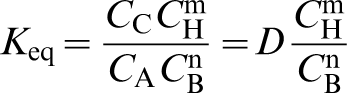
A two-step procedure was performed in order to determine the unknown equilibrium constants for the solvent extraction of gadolinium (III) with extractants D2EHPA and Ionquest 801. Firstly, the stoichiometric constant m was determined by data fitting using mass balance of protons as given by the following equation:

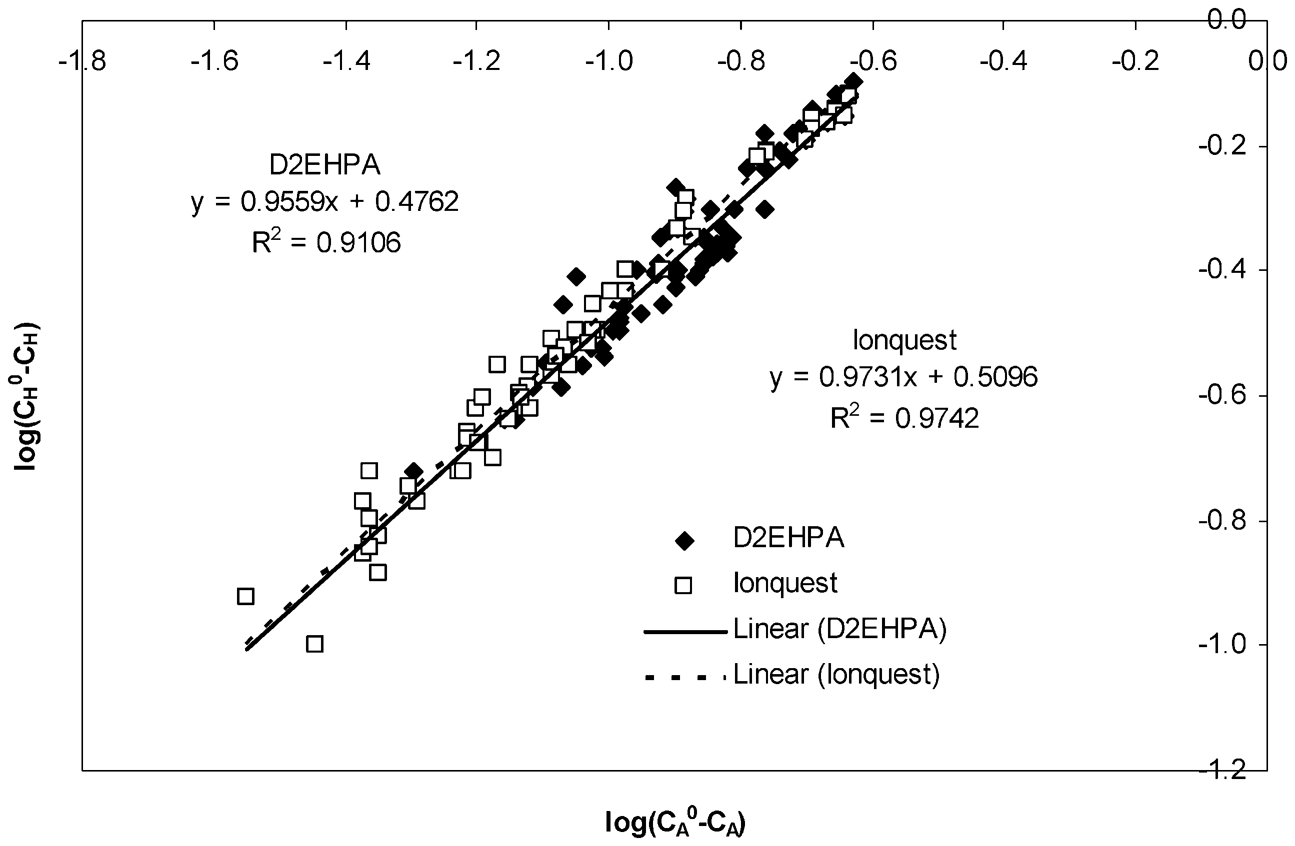
Data fitting in the mass balance equation of protons for the extraction of Gd(III) with D2EHPA and Ionquest 801 (T = 298±1 K)
Once determined the constant m, the logarithm form of equation (2) was used in order to obtain the remaining equilibrium parameters (n and Keq):


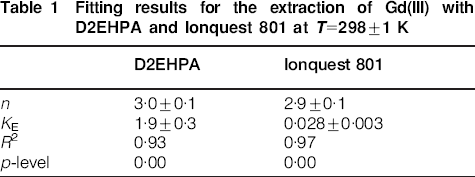
As shown in Fig. 4, the proposed mechanism explains satisfactorily the solvent extraction of gadolinium (III) with D2EHPA and Ionquest 801. The estimated values of n and Keq are shown in Table 1 including 95% of confidence interval for the mean and statistical parameters such as R2 and p-level. A quite satisfactory fit was found for both extractants (R2≥0·93) and no correlation between the estimated parameters was verified (p-level = 0). Therefore, it seems that the assumption of dimer molecules in the organic phase is plausible for D2EHPA – as expected – and Ionquest 801 as well. In addition, a higher Keq was obtained for D2EHPA in comparison to Ionquest 801, thus corroborating the experimental behaviour shown in Figs. 1 and 2. Finally, substituting m = 3 and n = 3 in equation (1), one concludes that the extraction of Gd(III) with D2EHPA and Ionquest 801 is described by the following equation for concentrated solutions:

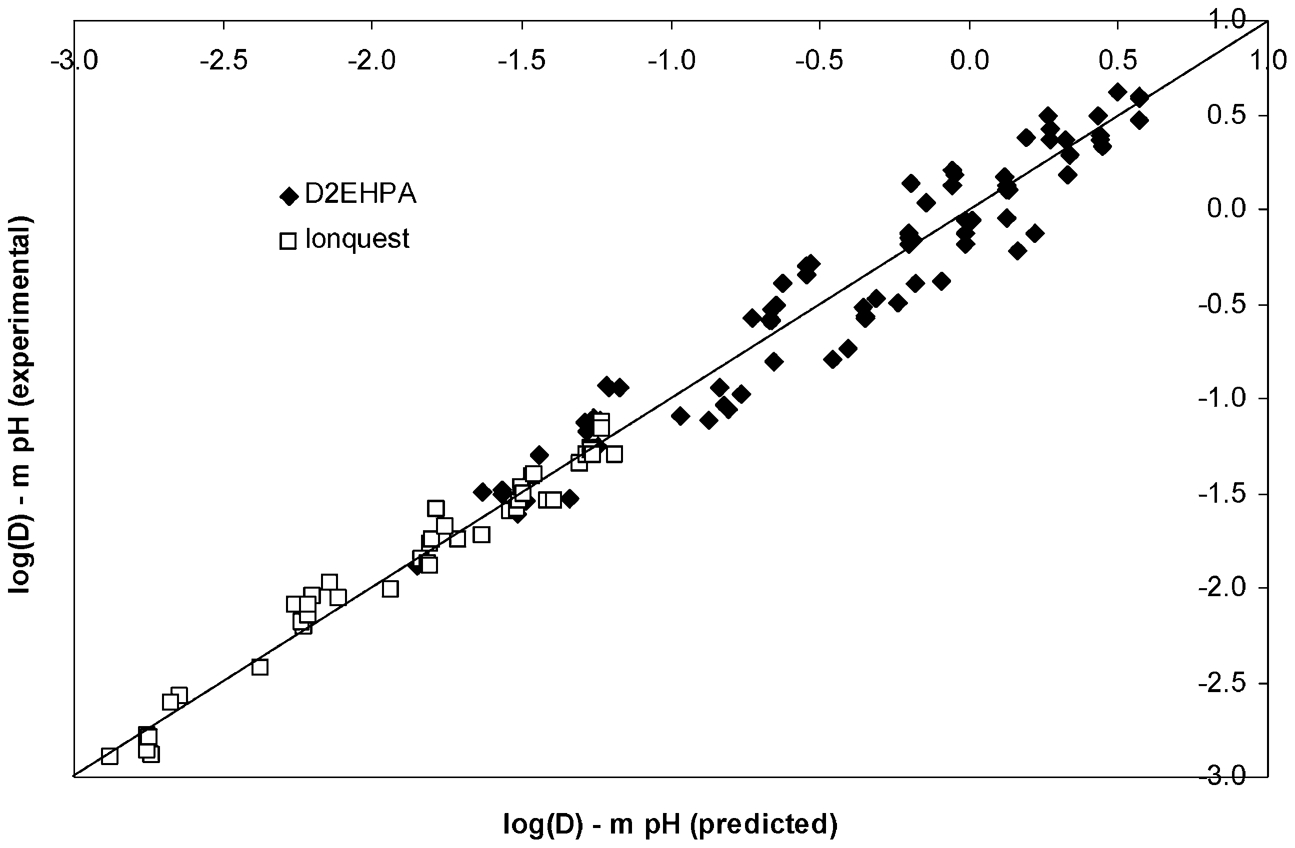
Comparison between the experimental and the predicted left size term of Eq. (5) for the extraction of Gd(III) with D2EHPA or Ionquest 801 (T = 298±1 K)
Fitting results for the extraction of Gd(III) with D2EHPA and Ionquest 801 at T = 298±1 K
Comparing these findings with other works found in the literature, a relatively lower value of Keq was obtained in this study [log(Keq) = 0·28 for D2EHPA and log(Keq) = −1·55 for Ionquest 801] possibly due to the high concentration of gadolinium (III) used in the tests and also because no activity coefficient was considered in the equilibrium model. Working with diluted solutions (10−4 mol L−1 of gadolinium and 0·002 mol L−1 of D2EHPA), Masuda and Zahir (1995) found log(Keq) = 2·70±0·03. In this case, experiments were carried out at pH = 3·5 using succinic acid as buffer and sodium perchlorate to control the ionic strength. On the other hand, Sanchez et al. (1999) have mentioned that log(Keq) for the extraction of neodymium (III) with D2EHPA decreases as the concentration of extractant increases. According to these authors, log(Keq) decreases from 1·13 to 0·38 as the concentration of D2EHPA increases from 0·04 to 0·60 mol L−1 for the system Nd/Cl/D2EHPA/n-heptane. In the present work, the concentration of both extractants varied from 0·5 to 1·5 mol L−1. In addition, as the extraction distribution coefficient for lanthanides increases from lanthanum to lutetium with cationic extractants such as D2EHPA and Ionquest 801 (Sato, 1989; Morais and Ciminelli, 2004), the apparent equilibrium constant for gadolinium (III) is expected to be relatively higher than that for neodymium for the same system when these extractants are used.
Conclusion
The solvent extraction equilibrium of gadolinium (III) from hydrochloric acid solutions with cationic extractants D2EHPA and Ionquest 801 at 298±1 K was investigated. Tests were carried out without pH control and results were evaluated using the slope analysis method and numerical methods. Statistical analysis of the estimated parameters was done in order to assure that equilibrium parameters are not correlated. The following main conclusions can be drawn based on the obtained results:
The extraction of gadolinium (III) with D2EHPA and Ionquest 801 dissolved in Exxsol D100 at concentrated conditions is described by a single reaction. Data fitting indicates GdX3(HX)3 as the extracted species.
The apparent equilibrium coefficient (Keq) obtained for concentrated conditions was relatively smaller than that one found in previous studies using dilute conditions [log(Keq) = 0·28 for D2EHPA and log(Keq) = −1·55 for Ionquest 801]. This can be related to the non incorporation of activity coefficients into the model. The model satisfactorily reproduced the experimental data for the extraction of Gd(III) with D2EHPA and Ionquest 801 for the operational conditions range investigated in this work (R2 = 0·93 for D2EHPA and R2 = 0·97 for Ionquest 801).
Footnotes
Acknowledgements
The authors acknowledge the financial support received from FAPEMIG (Edital PRONEM 16/2010, APQ-04026-10), CNPq and CAPES.