







Abstract
The Archimedean single bob technique was employed to secure density data in the range of 1350–1710°C for selected molten slag compositions in the CaO–SiO2, CaO–SiO2–MgO, CaO–SiO2–Al2O3, and CaO–SiO2–MgO–CaF2 systems. In each system, the measurements typically revealed minor to negligible density variations across the temperature range. In cases where density variations were apparent, density was observed to slightly decrease as temperature was lowered. The density variations between the different slag systems are significant, with lower densities generally associated with the more acidic (higher per cent silica) compositions.
Introduction
Reliable density data for calcium silicate slag systems at temperatures 1600°C and higher than this are generally unavailable. Obtaining density data at such temperatures is not a trivial exercise and the challenges are compounded by complicated phase equilibria among the major slag components, by the effects of minor slag constituents, and by interactions between the molten phase, the containment vessel and the measuring device.
Several techniques exist for determining the densities of liquid samples, including the single- and double-bob Archimedean, bubble pressure, and levitation/sessile drop methods as well as pycnometry and manometry. However, not all methods are suitable for high-temperature measurements. The single-bob Archimedean method was selected for this study.
Archimedes principle states ‘the magnitude of the buoyant force on an object always equals the weight of the fluid displaced by the object’ (Serway and Jewett, 2008). This principle can be applied to determine the slag density by means of the following equation
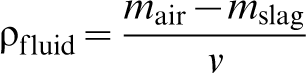
ρfluid = density of the melt at the given temperature (g cm−3)
mair = mass of the bob when suspended in air (g)
mslag = mass of the bob when suspended in slag medium (g)
v = volume of displaced melt (cm3).
Methods
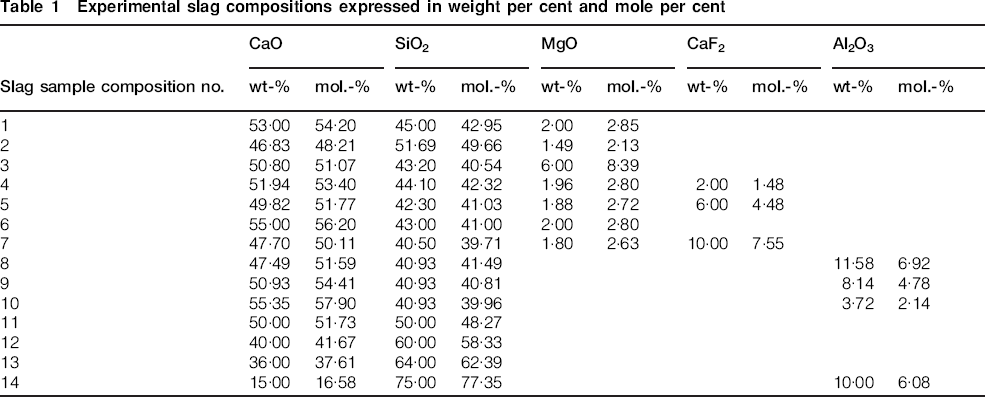
Densities of selected slag compositions in the CaO–SiO2, CaO–SiO2–MgO, CaO–SiO2–Al2O3 and CaO–SiO2–MgO–CaF2 systems were measured via the Archimedean single bob technique. The compositions selected for this study have industrial significance and several were determined to exhibit favourable viscosity characteristics in a concurrent study (Schumacher, 2010). The baseline composition was 53% calcium oxide (CaO), 45% silica (SiO2), and 2% magnesium oxide (MgO). Deviations from the baseline composition were made by (1) modestly increasing the relative proportion of magnesium oxide in the slag, (2) adding calcium fluoride (CaF2), and (3) adding aluminium oxide (Al2O3). The experimental slag compositions are listed in Table 1.
Experimental slag compositions expressed in weight per cent and mole per cent
Density measurements were obtained at 10°C increments as the melt temperature was gradually lowered from a maximum in the range of 1700–1750°C to the liquidus temperature, which was approximately 1450°C for most of the slag compositions. As a quality control measure, liquid samples with known densities were measured in experimental apparatus; the differences between the measured and the actual densities ranged from 0·14 to 1·75%.
Experimental apparatus and procedure
The experiments were performed with an Applied Test Systems (ATS) Series 3310 vertical tube furnace. A Denver Pinnacle Series PI-214 balance was positioned on a platform directly above the furnace on a heat shield composed of metal and ceramic components. The balance was placed on a ceramic and metal heat shield and equipped with a weigh below hook that suspended the molybdenum bob into the melt with molybdenum extension wires, as shown in Fig. 1a.
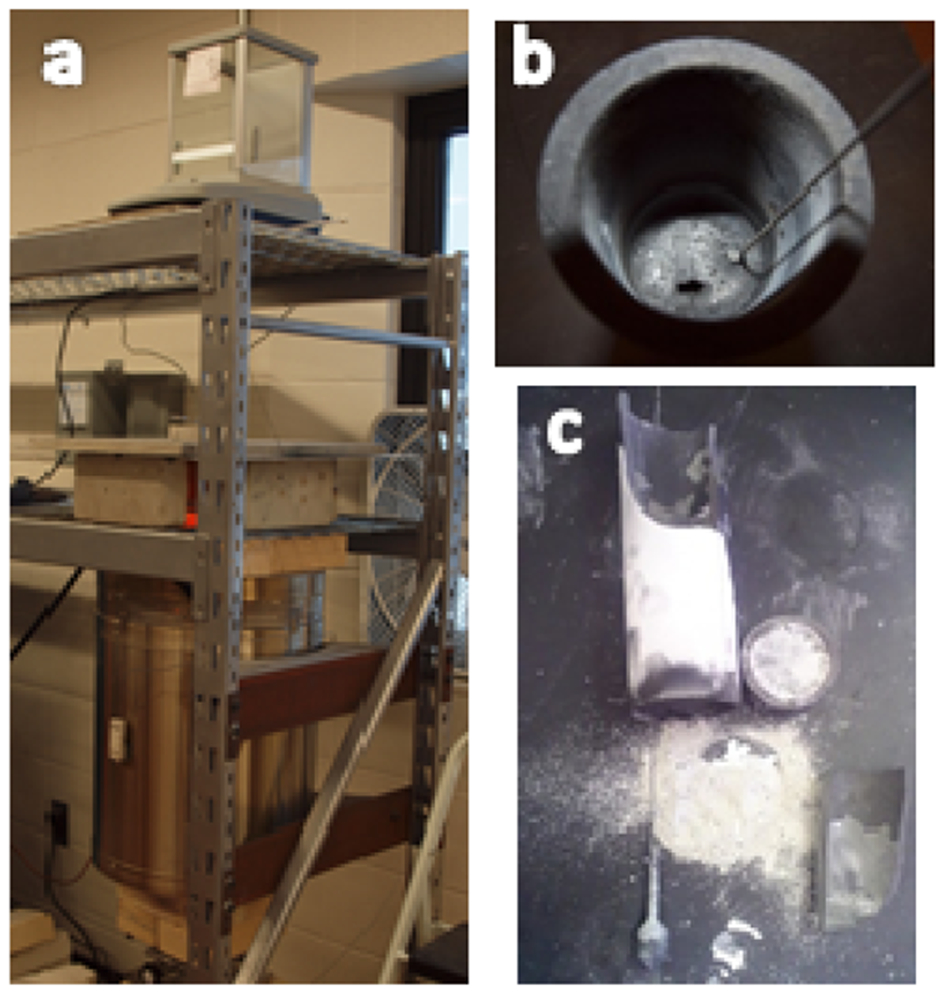
a Experimental apparatus, b bob in solidified melt, and c broken crucible causing a failed test allows further investigation of corrosion on the bob
Slag forming materials were blended in the designated proportions and then gently packed into a graphite crucible. Straight-wall crucibles with dimensions of 4·5 cm internal diameter by 15·2 cm high and 5·7 cm by 22·9 cm were used. The crucibles were coated with boron nitride aerosol and allowed to dry before use. To ensure reagent purity, some of the slag formers were calcined to remove chemically bound moisture, volatile constituents and organics. Calcium oxide was calcined for 1 hat 1000°C, while both calcium fluoride and magnesium oxide were calcined for 1 h at 725°C. Silica was not treated because it was determined that calcination produced no measurable weight changes and the alumina was pre-calcined by the chemical manufacturer. The packed crucible was centred vertically and horizontally in the furnace atop a ceramic support pedestal.
Each experiment was commenced by initiating the argon purge and elevating the furnace temperature at a rate of 300°C h−1 to a final (maximum) temperature between 1700 and 1750°C. Adequate argon addition to the system was imperative as insufficient levels would result in oxidation of the suspended bob apparatus, graphite crucibles and of the melt itself. The effect was evident in the evaluation of broken wires and crucibles, and in the formation of fibrous SiO. At the desired temperature, the bob was lowered into the slag and allowed to soak for at least 1 h or until stable mass measurements were obtained. Thereafter, temperature was gradually lowered and masses were recorded at 10°C intervals until slag solidification forced termination of the experiment. The mass measurement was recorded after mass remained stable for several minutes at each temperature. Following the experiment, the displacement volume was verified by the corrosion on the bob, as seen in Fig. 1b and c.
Results and Discussion
Experimental density data for the four calcium silicate subsystems were examined for density trends as functions of temperature and composition.
The CaO–SiO2 system
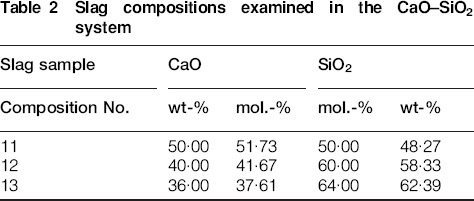
The compositions evaluated in the CaO–SiO2 system are listed in Table 2. Compositions in this system are the most acidic compositions considered in this study.
Slag compositions examined in the CaO–SiO2 system
As shown in Fig. 2, density of the CaO–SiO2 system significantly varies according to the CaO:SiO2 ratio. Composition 11 (second most acidic in the study, CaO:SiO2 ratio of 1·0) exhibited one of the highest density v temperature profiles in the study, while Composition 13 (most acidic in the study, CaO:SiO2 ratio of 0·56) produced the lowest density profile in the 1450–1650°C range. Figure 3 compares experimental data acquired in this test work (given in open circles) to data presented in the Slag Atlas (Keene and Mills, 2008).
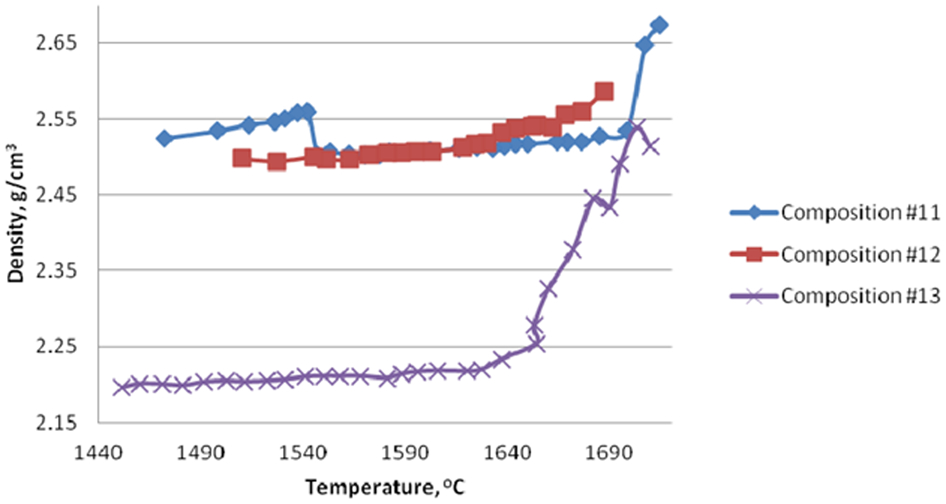
Density as a function of temperature for synthetic slags in the CaO–SiO2 system
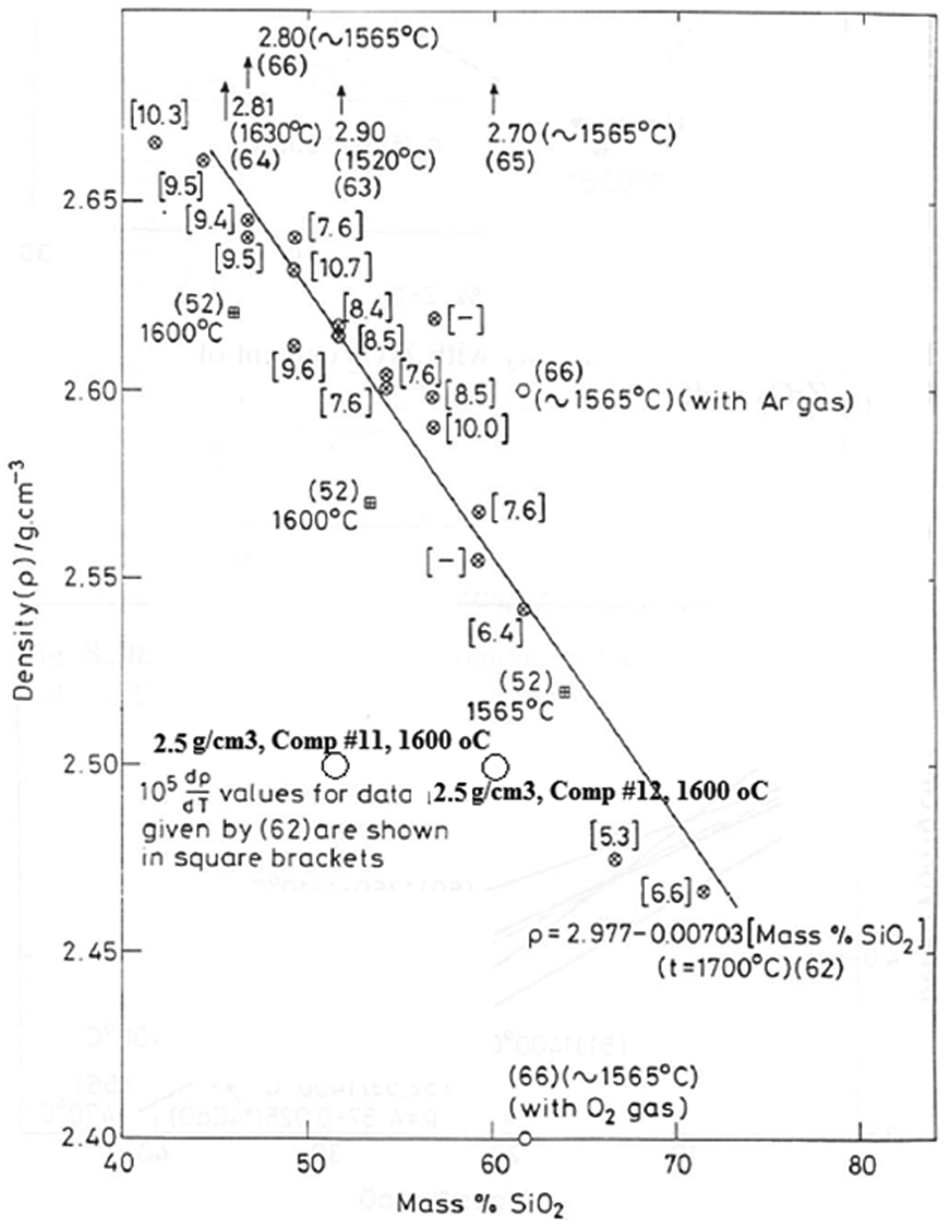
Slag densities in the CaO–SiO2 system, adapted from Slag Atlas (Keene and Mills, 2008)
While the experimental data of Compositions 11 and 12 (13 was too low to register in the density range shown) are lower than the values reported in Fig. 3 adapted from Slag Atlas (Keene and Mills, 2008), the results generally conform to the data published for the CaO–SiO2 system (Keene and Mills, 2008) that were used to produce Equation (2) for estimating slag density in this system at 1700°C.

Equation (2) was used to predict densities of the CaO–SiO2 system measured in this study. The predicted and measured density values for Compositions 11–13 are compared in Table 3 and are in excellent agreement for each composition. Notice the actual temperature for the reported measured density is given in the parentheses. The actual temperatures vary from the target of 1700°C because of difficulty in achieving the required dwell time at the exact temperature.
Comparison of measured and predicted CaO–SiO2 system density values

The CaO–SiO2–MgO system
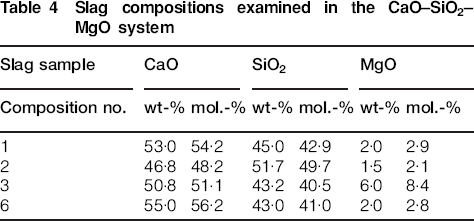
The four compositions evaluated in the CaO–SiO2–MgO system are defined in Table 4. The main purpose of the exercise was to evaluate the effect of altering slag basicity relative to that of the baseline slag composition, which is Composition 1. At 51·7% SiO2, Composition 2 is more acidic than the baseline composition whereas basicity was increased in Compositions 3 and 6 by raising the relative percentages of magnesium oxide and calcium oxide, respectively.
Slag compositions examined in the CaO–SiO2–MgO system
The CaO–SiO2–MgO system density results depicted in Fig. 4 suggest that an inverse relationship exists between slag density and the magnesium oxide content for the compositions studied. With an average density of approximately 2·4 g cm−3, Composition 3 displayed the third lowest overall density of any composition studied across-the entire molten phase. Figure 5, again compares experimental data acquired in this test work (given in open circles) to data presented in the Slag Atlas (Keene and Mills, 2008).
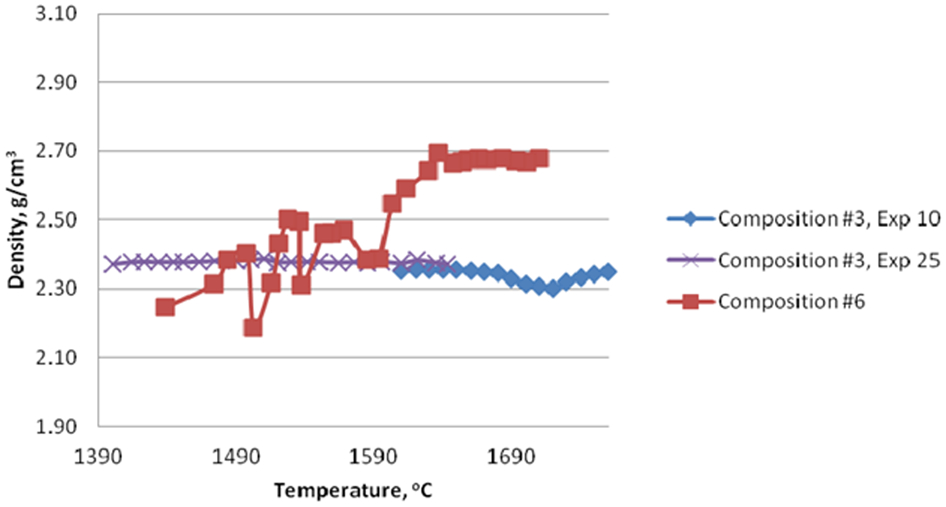
Density as a function of temperature for synthetic slags in the CaO–SiO2–MgO system
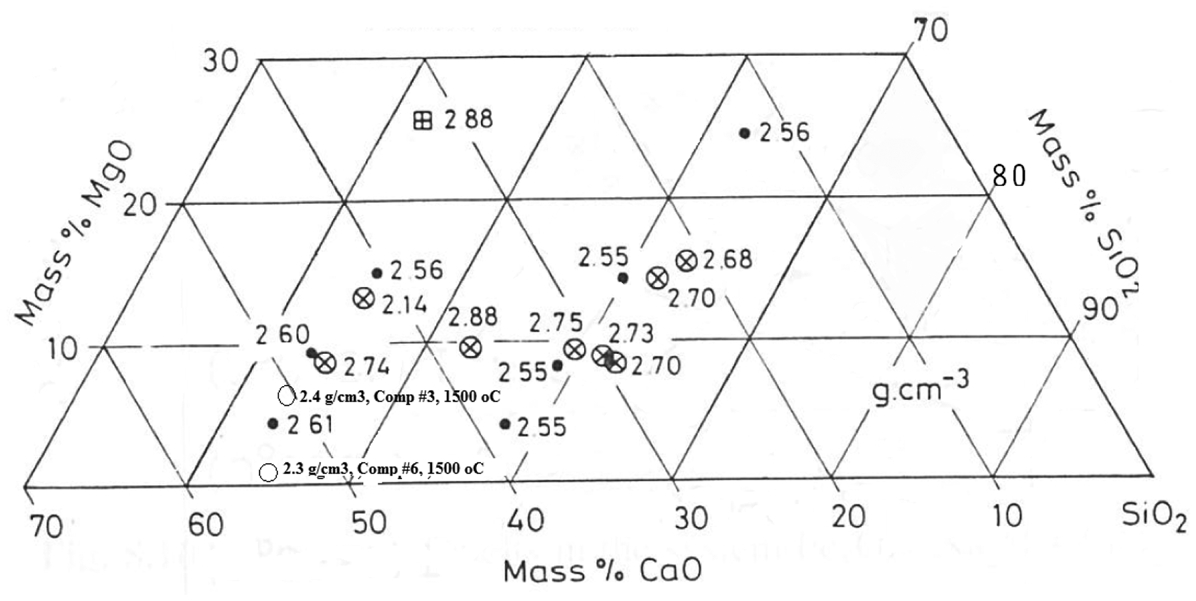
Slag densities in the CaO–SiO2–MgO system, adapted from Slag Atlas (Keene and Mills, 2008)
Just as with the CaO–SiO2 system, the experimental densities recorded in this test work were lower than the values reported in Slag Atlas (Keene and Mills, 2008) shown in Fig. 5. After 1600°C, the experimental values for Composition 6 increase and are a better fit to the published data (around 1500°C) while the experimental densities for Composition 3 appear to diverge further from the published literature with increased temperature.
The CaO–SiO2–MgO–CaF2 system
Calcium fluoride (CaF2) is sometimes added to industrial slag systems in order to decrease slag viscosity. A series of experiments were conducted to determine the effect of adding calcium fluoride to the baseline slag composition. As shown in Table 5, the calcium fluoride concentrations in Compositions 4, 5, and 7 were 2·0, 6·0 and 10·0%, respectively. The weight per cent of magnesium oxide is relatively constant and, although the percentages of calcium oxide and silica vary, the CaO:SiO2 ratio was held constant.
Experimental matrix for the CaO–SiO2–MgO–CaF2 system

The data in Fig. 6 indicate no significant decrease in density between the 6 and 10% CaF2 composition. Although the density of Composition 5 appears to have sharply decreased at 1500°C it is an artefact of the small scale of changes in density that have been reported. Such a small difference would likely not be of any benefit in an attempt to separate slag from molten silica in a density based separation so consequently, it was deemed insignificant. No direct correlation between the proportion of calcium fluoride in a slag and the measured density is apparent. The two sets of data from Composition 7 have been presented from separate experiments to serve as a measure of repeatability of the experimental method.
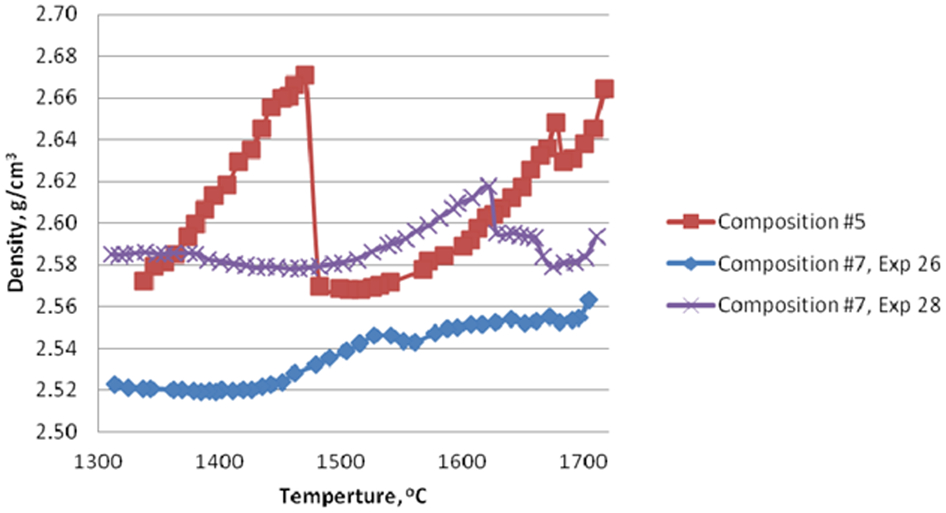
Density as a function of temperature for synthetic slags in the CaO–SiO2–MgO–CaF2 system
The CaO–SiO2–Al2O3 system
The compositions listed in Table 6 were selected to evaluate the effect of adding alumina (Al2O3) to the baseline CaO–SiO2 system.
Experimental matrix for the CaO–SiO2–Al2O3 system
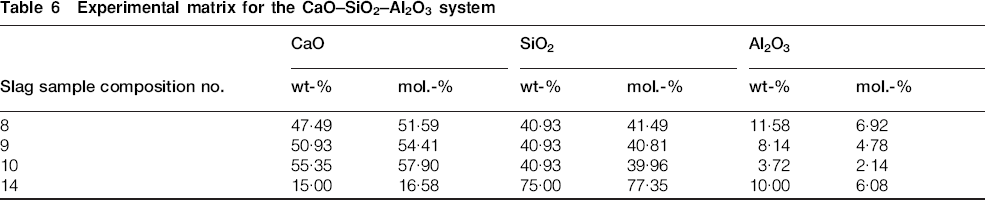
Compositions 8, 9, and 10 have increasing CaO:SiO2 ratios of 1·16, 1·244, and 1·35, respectively. The corresponding percentages of alumina are 11·58, 8·14, and 3·72%. The Compositions 8 and 9 display a slight decrease in density with decrease in alumina, as seen in Fig. 7.
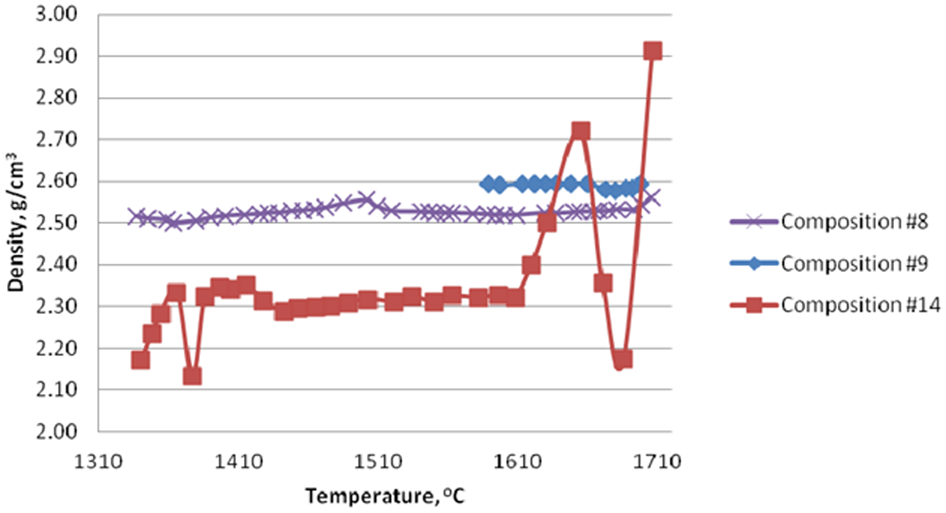
Density as a function of temperature for synthetic slags in the CaO–SiO2–Al2O3 system
Composition 14 with a CaO:SiO2 ratio of 0·2 and 10% Al2O3 demonstrated the second lowest density profile of the compositions studied between 1400 and 1600°C. At 1550°C, the densities measured in this system compare favorably with the densities reported by Tangstad et al. (2009). The last comparison of experimental data acquired in this test work (given in open circles) to the data presented in the Slag Atlas (Keene and Mills, 2008) is given in Fig. 8. Although no similar density data exist for comparison to Composition 14, the experimental densities of Compositions 8 and 9 appear to be in closer agreement with the published data in Slag Atlas (Keene and Mills, 2008).
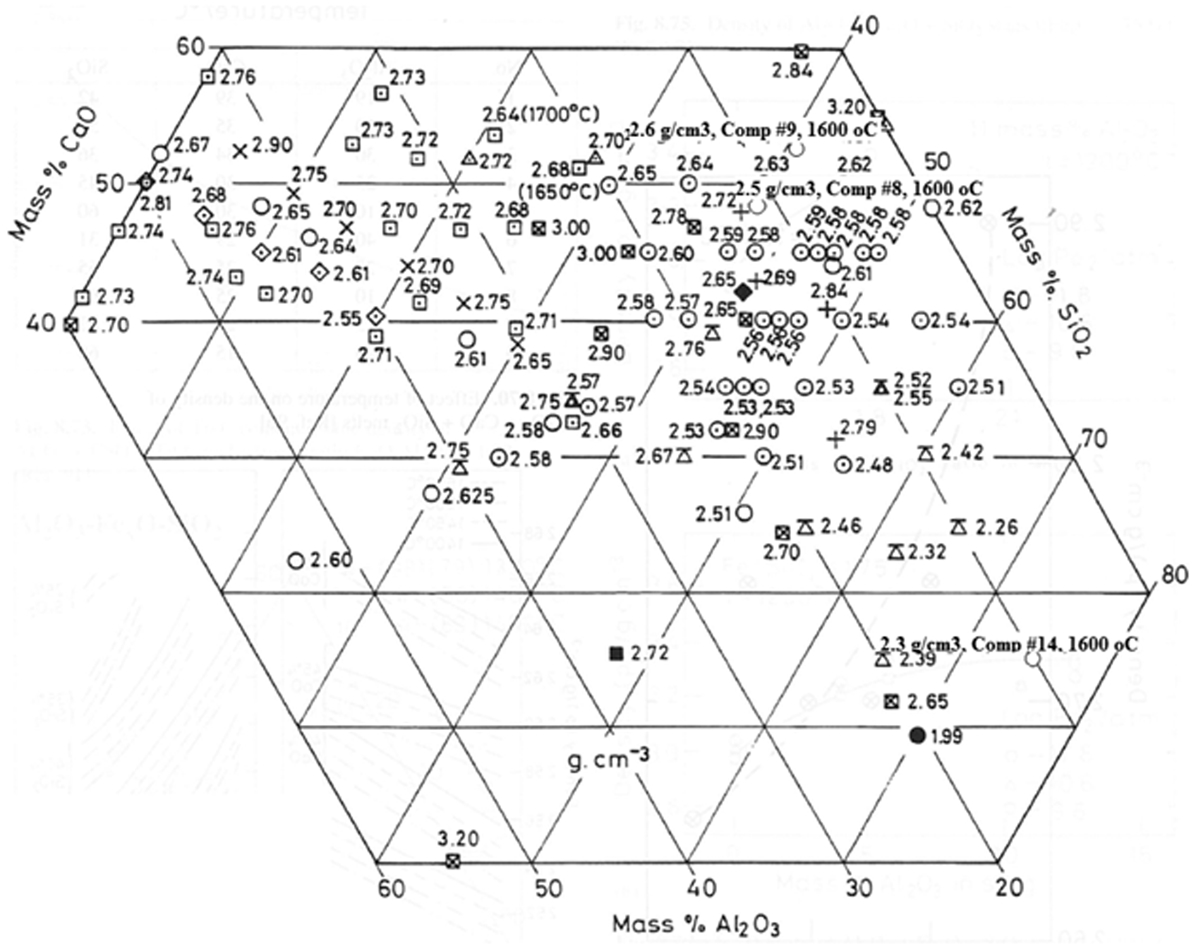
Slag densities in the CaO–SiO2–Al2O3 system, adapted from Slag Atlas (Keene and Mills, 2008)
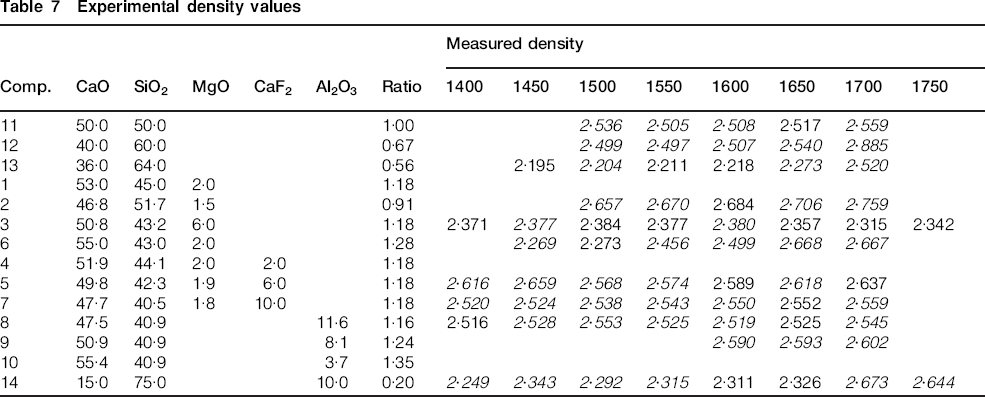
Density data for all systems
Table 7 provides density values cross the temperature ranges tested for all compositions evaluated. The values are given as averages of multiple measurements taken at the specified temperature or, in the case of the italicized number, as values which are proportionally predicted by the averages of the nearest temperature measurements.
Experimental density values
Conclusion
Density data were obtained as a function of temperature for selected slag compositions in the CaO–SiO2, CaO–SiO2–MgO, CaO–SiO2–Al2O3, and CaO–SiO2–MgO–CaF2 systems. The melt density v temperature profile is often nearly linear within this range between 1650 and 1500°C. In most experiments, the melt density decreased as temperature was reduced and the rate of decrease was typically low, about 0·1 g cm−3. In a few instances, the density v temperature profile is practically horizontal, indicating near constant melt density over a wide temperature range. Density measurements became more erratic as the melt temperature approached the liquidus temperature and the density v temperature profile frequently terminated with an abrupt density change. Other findings and observations include the following:
Compositions that contain a high proportion of silica produced relatively low density slags.
Increasing the proportions of basic modifiers such as calcium oxide and calcium fluoride generally increased slag density, while increasing magnesium oxide lowers density.
Compositions that included calcium fluoride consistently produced higher density slags, ranging from 2·5 to 2·65 g cm−3 between 1450 and 1650°C.
Several slag compositions displayed a decrease in density as the temperature decreases. This seemingly counterintuitive behavior was also been noticed in research performed on comparable silicate slag systems by Mills and Keene (1987). Although the methods and compositions are different, it is interesting to note that they reported similar density v temperature trends. Possible reasons for such behavior include the effects of surface tension, slag adhesion to the bob, slag attack on the bob, and/or changes in the volume of the molten slag as it solidifies. For elaboration on the experimental method, data and results, the reader is directed to review “Experimental Determination of Density in Molten Lime Silicate Slags as a Function of Temperature and Composition” (McGrath, 2010).