







Abstract
The response surface methodology (RSM) was employed to study the interactions among different factors (i.e. temperature, liquid to solid ratio, HCl concentration and chlorine gas flowrate) involved in the leaching of Au from copper anode slimes. The interactions such as liquid to solid ratio, chlorine gas flowrate×temperature and HCl concentration×temperature were found to be statistically significant. Under the optimum operational conditions of Cl2 = 1·99 L min−1, 10 000/T = 28·7 K−1, L/S = 12·57 L kg−1, HCl = 2·74 mol L−1 in a semi-pilot 3-L agitated reactor, the maximum recovery achieved for Au was around 93% using the second polynomial equation. This led to a selectivity factor (i.e. the ratio of ‘Au reaction fraction’ to the sum of ‘Se and Cu reaction fractions’) of 86. Process optimisation was carried out based on the maximum selectivity factor achieved. This resulted in the following optimum conditions: Cl2 = 1·26 L min−1, 10 000/T = 30·83 K−1, L/S = 5 L kg−1 and HCl = 2·66 mol L−1, with a separation factor of 112.
Introduction
Au is a strategic/precious metal with special properties and important applications (Dai et al., 2012; Donmez et al., 1999). With the ceaseless consumption of Au worldwide, its reserves are being rapidly depleted. Primary supplies are currently insufficient to meet the global demand for gold. Consequently, secondary sources, such as copper anode slimes, are being inevitably exploited. In the copper electrorefining process, insoluble impurities accumulate at the bottom of cells as anode slimes containing copper, antimony, arsenic, bismuth, gold, lead, nickel, platinum, selenium, silver, and tellurium, with the chemical composition of the slime mainly depending on the purity of the anodes. In the Copper Complex Co. (Sarcheshmeh, Iran), approximately 120 t of copper anode slimes is annually produced. The Au content of these slimes varies between 0·05 and 0·2%; therefore, not only is the recovery of Au from this residue economically effective, but it is also environmentally friendly.
The recovery treatments on the copper anode slimes are generally based on the conventional pyrometallurgical and hydrometallurgical routes (Donmez et al., 1999; Arai et al., 1989; Hait et al., 2009; Akinori and Yoshifumi, 2000). Fernandez et al. (1996) studied the recovery of Se, Te, Ag and Au from copper anode slimes. In their multi-stage treatment (oxidation–leaching, alkaline roasting–leaching and smelting), they obtained a bullion of recovered Ag and Au. Donmez et al. (2001) also developed a chlorination–cementation process for the recovery of Au from decopperized anode slime. Using the chlorine gas in an aqueous medium, they succeeded in dissolving Au and subsequently precipitated the dissolved Au ions using a rotational copper disc. Yavuz and Ziyadanogullari (2000) investigated the extraction of Au from complex anode slimes using thiourea. They reported that the removal of Cu, Se, Te and most of Ag is essential for the effective recovery of Au.
The chlorine/chloride mixture is advantageous for Au dissolution not only because it is environmentally friendly and cost effective, but also because it yields a higher dissolution rate than cyanide salts (Donmez et al., 2001; Puvvada and Murthy, 2000; Arai et al., 1989). On the other hand, the leaching process requires certain considerations if an effective Au recovery is sought. The main problem in using thiourea as a leaching agent, for example, is its sensitivity to basic metals such as Cu, As and Sb (Yavuz and Ziyadanogullari, 2000). Besides, the effectiveness of the leaching process is highly dependent on different factors in the system, which may include the type and concentration of the leaching agent, temperature, solid to liquid ratio and stirring speed (Donmez et al., 2001; Yavuz and Ziyadanogullari, 2000). Maximum yield of Au dissolution would be achieved when these parameters are duly considered and collectively optimised.
Optimisation of the factors involved in leaching operations has traditionally been carried out by considering each factor in isolation and by adopting a ‘one-factor-at-a-time’ approach (Deschenes et al., 2005; Ubaldini et al., 1998). However, this approach cannot be an efficient design strategy while it also fails to identify the region of optimum response of each factor since it fails to reveal the likely interactions among the factors during the process (Montgomery, 2006). A much more suitable experimental approach would be the response surface methodology (RSM), which, with the use of experimental strategies such as central composite design (CCD), is able to consider several factors at different levels simultaneously and to provide a second-order polynomial model for the relationships among the various factors and their responses (Haghshenas et al., 2012). Generally, this experimental design strategy has only rarely been applied to Au recovery processes. Among the few studies adopting this strategy, one can refer to Bard and Sobral (2008) in which a factorial design (at 2 levels) was employed to optimise the factors involved in the extraction of Au, Ag and Cu from copper anode slimes. Donmez et al. (1999) also used the Taguchi method to obtain the optimum conditions for the chlorination of gold in decopperized anode slime with chlorine gas.
This work aims to undertake a fairly complete investigation of the effects of temperature, liquid to solid ratio, HCl concentration and chlorine gas flowrate on the selective recovery of Au from copper anode slimes with the help of RSM. For this purpose, a 3-L agitated reactor is employed for the preliminary optimisation of the factors involved in the leaching process, choosing a half fractional factorial CCD, because it allows reliable identification of first-order interactions among the factors and also provides a second-order polynomial model. Finally, a selectivity factor (SF) is defined as the ratio of ‘Au reaction fraction’ to the sum of ‘Se and Cu reaction fractions’, which is used to evaluate the selective Au recovery.
Experimental procedure
Slime and reagents
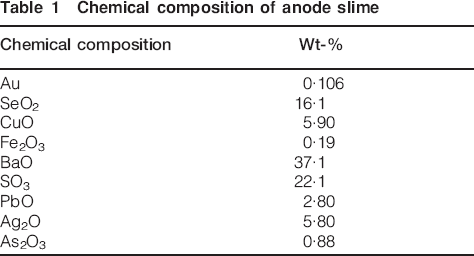
Copper anode slime was obtained from the Copper Complex Co. (Sarcheshmeh, Iran). X-ray diffraction analysis showed that the concentrate was mainly composed of barium sulphate and that the particle size was 120 μm (>80%). The chemical composition of the slime is presented in Table 1.
Chemical composition of anode slime
Commercial sodium carbonate, used in this study, was purchased from Razi Petrochemical Co., Iran. Also, analytical grade sulphuric acid (95–98% Vol) and hydrochloric acid (37% Vol) were used (Baran Chemical Co., Iran). Chlorine gas was produced using industrial grade calcium hypochlorite (Ca(ClO)2), with a minimum available chlorine of 70%, purchased from Sree Rayalaseema Hi-Strength Hypo Company, India.
Methods
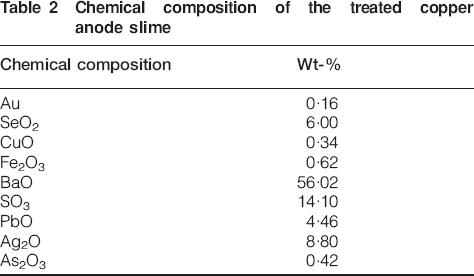
As-received copper anode slime was roasted with 15–20% sodium carbonate at a temperature of about 750°C for 2 hr. The roasted sample was then leached with water at 90°C for effective Se separation (Langner, 1998). The Se-removed slime was dried before leaching with a 100 g L−1 sulphuric acid solution at 90°C for 1 hr in order to dissolve and separate Cu from the slime (Fabian, 1998). The final solid phase (i.e. the copper anode slime remaining after Se and Cu removal) was used for Au leaching studies. The chemical composition of the treated copper anode slime is presented in Table 2.
Chemical composition of the treated copper anode slime
All the Au leaching experiments were carried out in a 3-L mechanically agitated reactor containing 2000 mL of the leaching solution. The reactor was operated at 210 rpm at varying temperatures in the range of 30–75°C. Chlorine gas was produced by chemical reaction of hydrochloric acid with calcium hypochlorite at room temperature according to reaction 1

Following a step of moisture adsorption by sulphuric acid gas washing system, the gas produced was fed into the reactor at different flowrates. The temperature of the reacting mixture in the reactor was monitored and adjusted by a water jacket. To prevent moisture removal by the exhaust gas from the system, the outgoing gas was cooled using a reflux column and the distillated water was recirculated into the reactor. The cooled gas was washed with a scrubbing column of sodium hydroxide. Figure 1 illustrates a schematic view of the reactor employed. The concentrations of Au, Se and Cu were determined using an Atomic Absorption Spectrophotometer (Model Varian AA240).
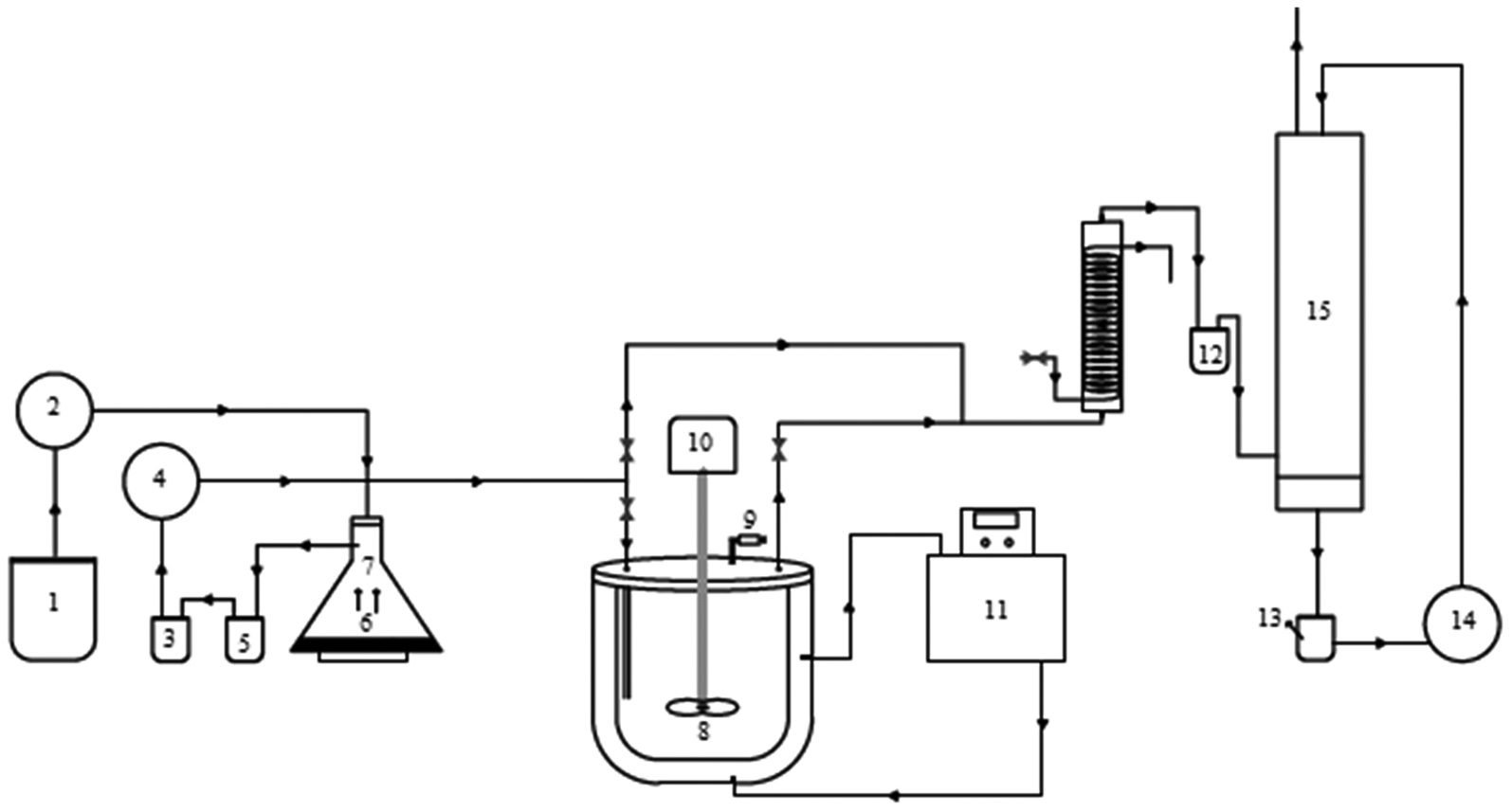
Schematic view of the reactor employed. (1) HCl solution, (2) peristaltic pump, (3) Ca(ClO)2, (4) Cl2 gas, (5) reflux, (6) H2SO4, (7) flow meter, (8) sludge+ HCl, (9) sample, (10) mixer, (11) water bath, (12) water, (13) NaOH, (14) pump and (15) scrubber
Experimental design of RSM
The RSM was employed to investigate the effects of the factors involved in Au recovery. The literature on Au recovery from copper anode slimes revealed that the more important factors include temperature, liquid to solid ratio, HCl concentration and chlorine gas flowrate (L min−1).
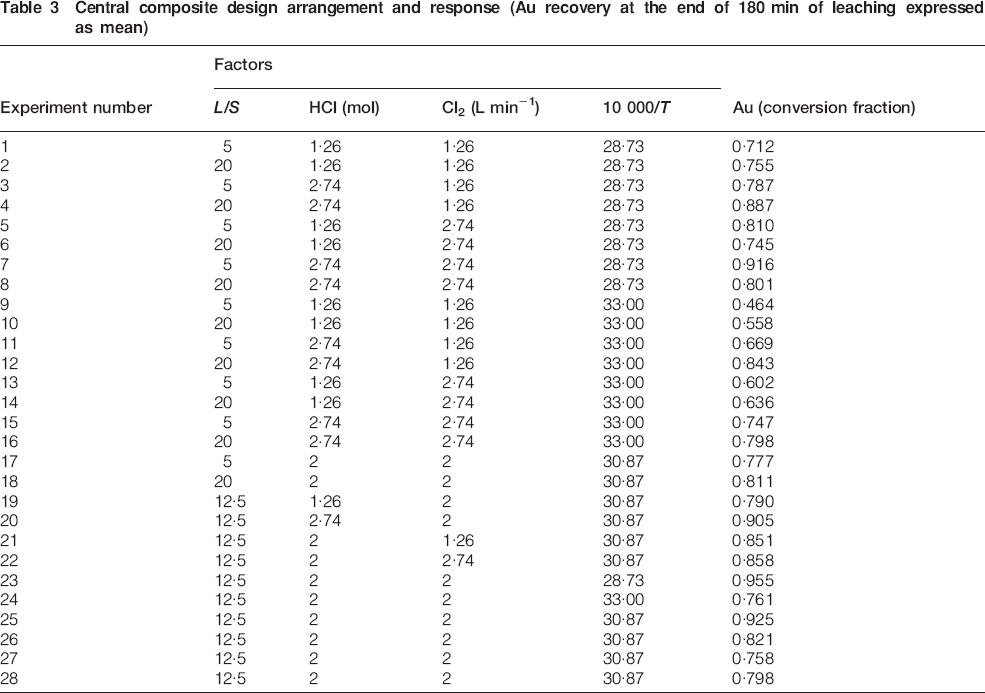
A CCD was adopted in this study to investigate four factors at three levels. Twenty-eight experimental runs consisting of eight star points (star distance is 0) and four centre points were thus generated with four factors and three levels using the principle of RSM in Minitab Release 15. The CCD design matrix included the levels of different factors as presented in Table 3.
Central composite design arrangement and response (Au recovery at the end of 180 min of leaching expressed as mean)
The quadratic polynomial regression model, expression (2), was chosen for predicting the response variable in terms of the four independent variables selected (Montgomery, 2006)

The statistical significance of the full quadratic models predicted was evaluated by analysis of variance (ANOVA). The significance and the magnitude of the effects estimated for each variable and those of all their possible linear and quadratic interactions on the response variables were also determined. Finally, the model was used to predict both the optimum values and the optimum regions of the levels of the four factors resulting in maximum or fairly high Au extraction rates. All the analyses were carried out using Minitab Release 15.
Results and Discussion
Model fitting
Table 3 lists the values of Au recovery (reaction fraction) after 180 min of leaching for each of the 28 combinations of factor levels generated by the principles of RSM with the values ranging from as low as 0·46 to as high as 0·95. The results of ANOVA are presented in Table 4. Clearly, the suitability of the model is indicated by both the low values of P for the regression (P<0·001) and the fact that the lack of fit of the model was not significant (P>0·05).
Results of ANOVA
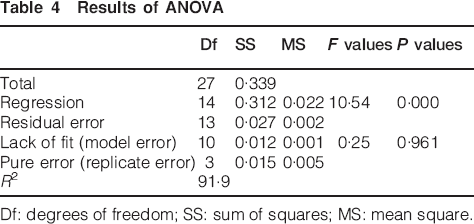
Df: degrees of freedom; SS: sum of squares; MS: mean square.
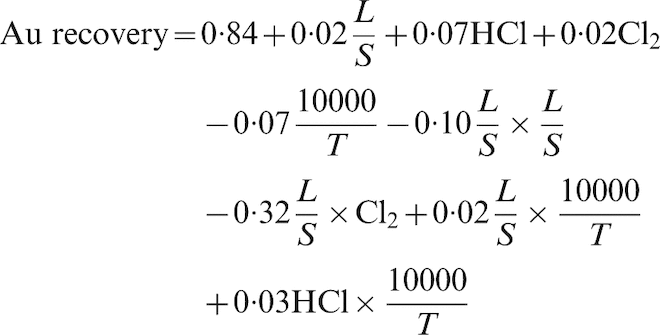
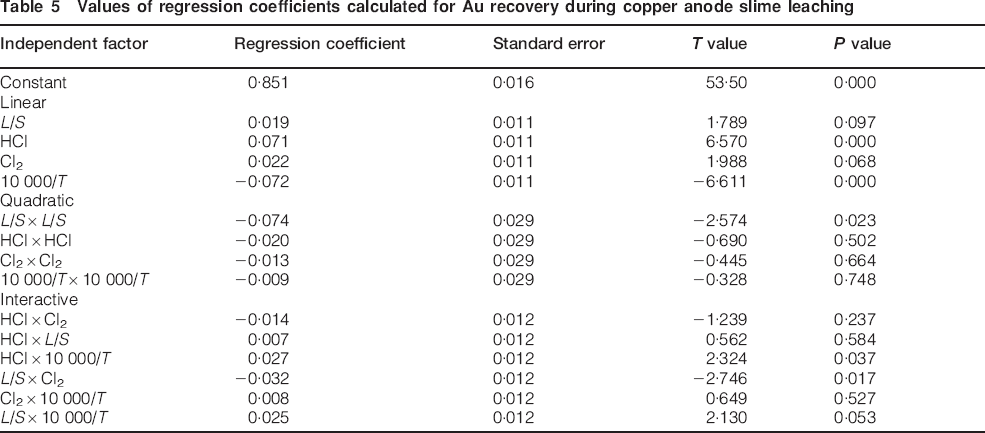
The regression coefficients are presented in Table 5. Obviously, all the linear terms and the second order of L/S are significant, indicating that the data should be represented by a second-order polynomial model. Among the interaction terms, L/S×Cl2, L/S×10 000/T and HCl×10 000/T showed significant effects on the response at 10% significance level. Based on the regression coefficients calculated for the response (Table 5), a polynomial regression model equation that fitted 91·9% of the variation in the data was proposed as follows (coded value):
Values of regression coefficients calculated for Au recovery during copper anode slime leaching
Effects of parameters: Analysis of response surfaces
According to equation (3), increased values of L/S, HCl and Cl2 result in increased Au recovery at the end of 180 min of leaching. However, in the case of 10, 000/T, the increase in the level of the factors in the range employed leads to a decrease in Au recovery.
In cases where the interaction between the factors is statistically significant, surface plots give more complete information regarding the effect of a factor on the response. The curvature of the surface plots presented in Fig. 2 suggests that the two factors in each set of L/S and Cl2, HCl and 10 000/T, and L/S and 10 000/T interact with each other during the leaching process. This is further confirmed by the results presented in Table 5.
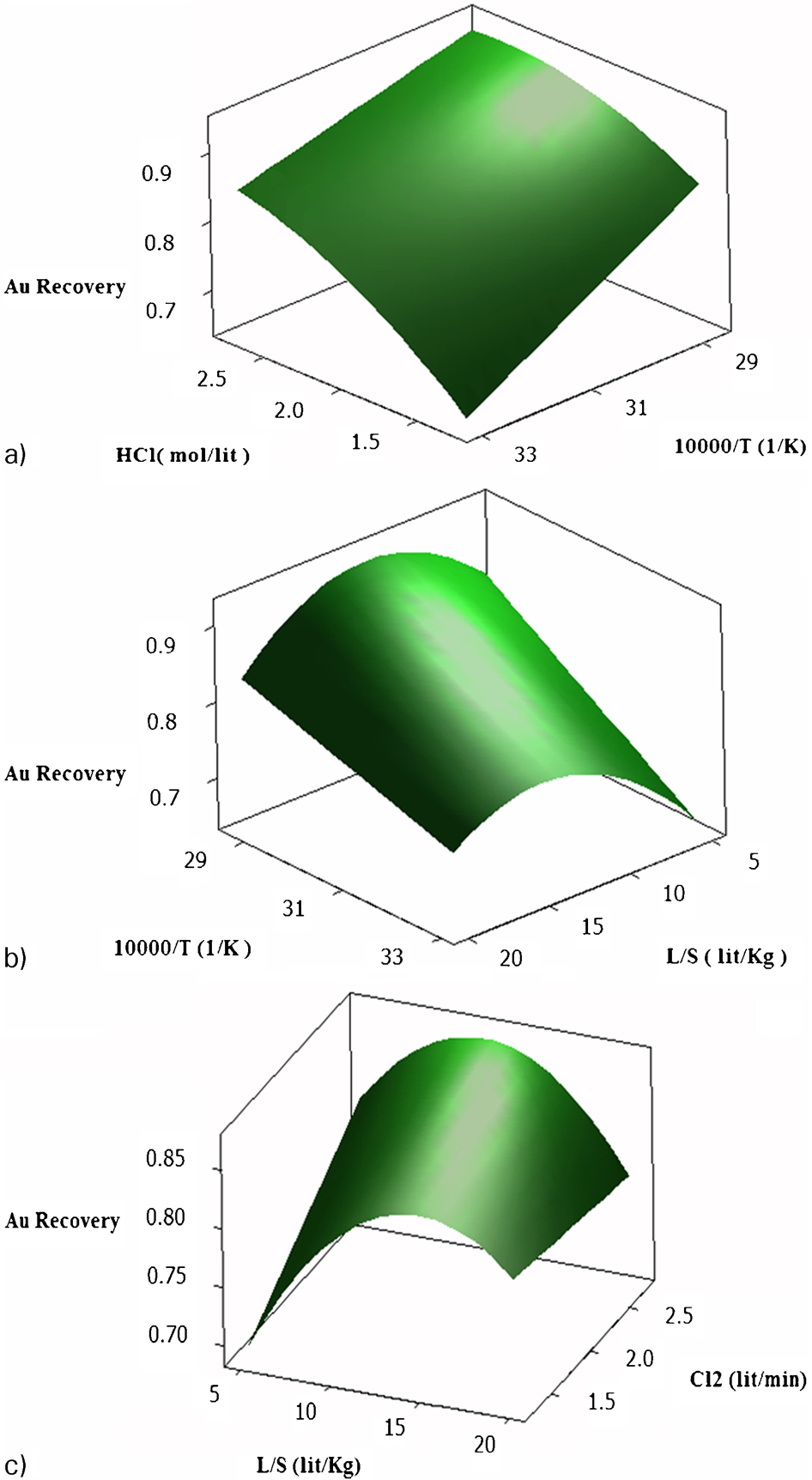
a Surface plots for Au recovery with respect to HCl and 10 000/T (other factors are fixed at their middle values) b Surface plots for Au recovery with respect to L/S and 10 000/T (other factors are fixed at their middle values); c Surface plots for Au recovery with respect to L/S and Cl2 (other factors are fixed at their middle values)
As can be seen in Fig. 2a, the effect of HCl concentration on Au recovery is more significant at lower temperatures. Furthermore, at lower HCl concentrations, the variation in Au recovery with changes in temperature is higher than that observed at higher HCl concentrations. The parabolic change of Au recovery by L/S variation at a fixed level of inverse temperature is clearly seen in Fig. 2b. However, at a given level of L/S, an increase in temperature leads to a slight increase in Au recovery. Moreover, according to Fig. 2c, at low levels of L/S, the variation in Au recovery is intensified because of the change in Cl2, while the same change in Cl2 leads to a minor effect on Au recovery at high levels of L/S.
In order to shed more light on the dissolution mechanisms of Au, the Pourbaix diagram was employed to investigate the electrochemical potential and pH effects. According to the Au–Cl–H2O Pourbaix diagram presented in Fig. 3, Cl− ions together with Cl2 gas play the major role in Au dissolution. The electrochemical potential required for Au dissolution in the Au–Cl–H2O system is around 0·9 V at pH levels lower than 9 (Fig. 3). Under these conditions, the following reactions may take place:



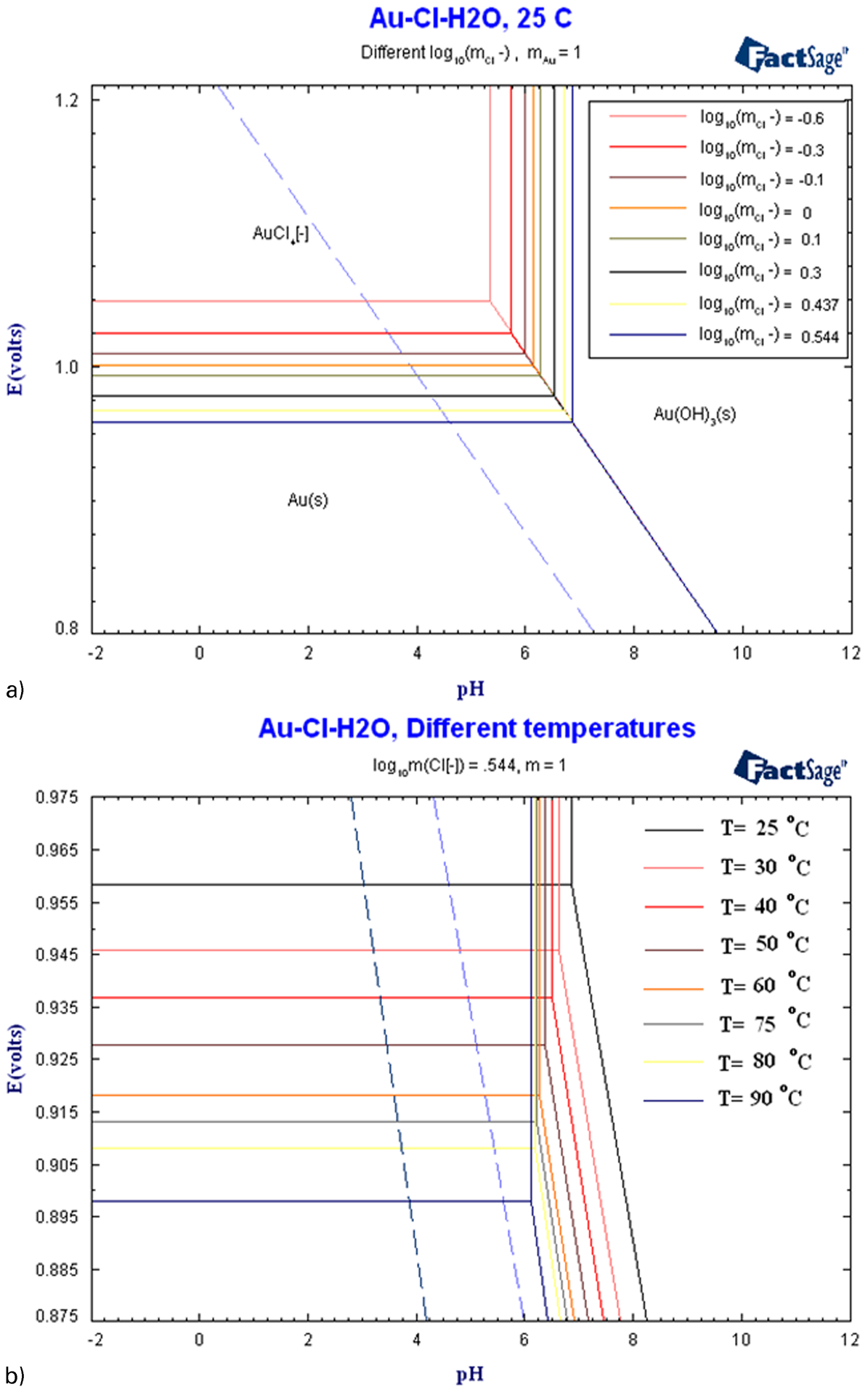
a Pourbaix diagram of Au–Cl–H2O at 25°C with different concentrations of Cl−; b Pourbaix diagram of Au–Cl–H2O at different temperatures
These conditions can be achieved by introducing Cl2 into the system in the presence of HCl. Also, the dissolution reaction can be expressed as follows [8]:

Based on the Pourbaix diagram presented in Fig. 3a, the stability region of
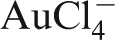 is enhanced at 25°C with increasing Cl− concentration; in other words, at wider ranges of pH and E, Au may also exist in the form of
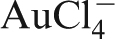 On the other hand, at a given concentration of Cl− (Fig. 3b), the stability region of
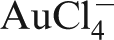 increases at elevated temperatures; this can be attributed to the endothermic nature of the reaction. These results confirm the statistical conclusions (analysis of response surfaces) given above.
Optimisation of Au recovery
Using the proposed second-order polynomial model (equation (3)) to interpolate within the levels of the four factors studied, the maximum recovery of Au that can be achieved in a 3-L reactor running at 210 rpm after 180 min of leaching of copper anode slimes is 0·93 under the following conditions: Cl2 = 1·99 L min−1; 10 000/T = 28·7 K−1; L/S = 12·57 L kg−1; HCl = 2·74 mol L−1.
To confirm the applicability of the model, confirmation runs using the above-mentioned levels of the parameters were carried out in triplicates. The 90% confidence interval for Au recovery after 180 min of leaching under the optimised conditions was obtained as 0·93±0·03. Since the value predicted by the model is within this interval, this can be taken as further confirmation of the suitability of the regression model.
The above optimum combination of the levels of the four factors yields the highest final Au recovery without taking other process aspects into account. An alternative approach to leaching process optimisation would be to aim for a combination of levels of factors which yields a fairly high final Au recovery but at minimised levels of impurities dissolved (the amount of Se and Cu recoveries are around 60 and 48%, respectively, under the above optimised conditions). Developing similar polynomial equations for Se and Cu can be useful for this objective; the three equations can be employed for simultaneous mathematical solution to find a combination of levels of factors which yields a fairly high final Au recovery but with low enough Se and Cu recoveries.
Regarding the 28 combinations of factor levels generated by the principles of RSM (Table 3), the model fitting procedure was applied in the case of Cu and Se under the same conditions (data not shown). Based on the ANOVA, the suitability of the models was confirmed and two polynomial regression model equations were developed (data not shown). Simultaneous mathematical solution for achieving a combination of the levels of the factors that would yield a fairly high Au recovery with minimal Se and Cu recoveries led to the following conditions: Cl2 = 1·26 L min−1; 10 000/T = 30·83 K−1; L/S = 5 L kg−1; HCl = 2·66 mol L−1. Under these conditions, Au, Se and Cu recoveries were 0·75, 0·41 and 0·26, respectively. In order to make a logical comparison between the two strategies proposed, the SF can be introduced as follows

The values of SF are ∼86 and 112 for the first and second strategies, respectively. Thus, the second strategy will perhaps be more suitable from a selective processing viewpoint.
Conclusion
In this study, CCD coupled with RSM was used to study the interactions among the factors involved in Au recovery from copper anode slimes using a 3-L agitated reactor. The following results were obtained:
According to the statistical model developed, an increase in L/S, HCl and Cl2 would result in an increase in Au recovery. Also, it was found that the two factors of L/S and Cl2, HCl and 10 000/T, as well as L/S and 10 000/T in each set have interactions with each other in the Au dissolution process.
The effect of HCl concentration on Au recovery was found to be more significant at lower temperatures. Moreover, a parabolic dependence was observed to hold between Au recovery and L/S variation at a fixed level of inverse temperature. Furthermore, at low levels of L/S, the variation in Au recovery because of the changes in Cl2 was observed to be intensified, while at high levels of L/S, the same change in Cl2 exhibited only minor effects on Au recovery.
The Pourbaix diagrams were used to investigate and clarify the Au dissolution mechanism; it was shown that the following Au dissolution reaction holds under the operating conditions:

Maximum Au recovery achieved after 180 min of leaching of copper anode slime in a 3-L reactor running at 210 rpm was found to be 0·93 under the following conditions: Cl2 = 1·99 L min−1; 10 000/T = 28·7 K−1; L/S = 12·57 L kg−1; HCl = 2·74 mol L−1.
Simultaneous mathematical solution for achieving a combination of levels of factors that would yield a fairly high Au recovery with minimal Se and Cu recoveries resulted in the following conditions: Cl2 = 1·26 L min−1; 10 000/T = 30·83 K−1; L/S = 5 L kg−1; HCl = 2·66 mol L−1. Under these conditions, Au, Se and Cu recoveries were observed to be 0·75, 0·41 and 0·26, respectively.