







Abstract
In order to recover chromium from vanadium slag, the leaching behaviour of chromium during vanadium extraction was studied. The effects of the several parameters that included roasting temperature, roasting time, types of additives as well as addition mass of additives were investigated. The results indicated that chromium can be leached at the same time during vanadium leaching from vanadium slag. In comparison, under the same conditions, the leaching of vanadium is easier than that of chromium. The leaching rate of vanadium and chromium can be beyond 96 and 91%, respectively, under the experimental condition of roasting temperature of 700°C, roasting time of 2 h, 30% (mass fraction) sodium chloride and 20% (mass fraction) sodium carbonate addition to the vanadium slag, leaching temperature of 95°C, and leaching time of 3 h.
Introduction
Vanadium and chromium are important industrial elements, vanadium is used almost exclusively in ferrous and non-ferrous alloys (Moskalyk and Alfantazi, 2003 ; Yang et al., 2010 ), and chromium is mainly used in stainless steel (Erdem and Tumen, 2004 ; Zhang et al., 2012 ). China is rich in mineral resources of vanadium and chromium, and one of the important ores is vanadium–titanium bearing magnetite. Vanadium–titanium bearing magnetite is a complicated ore that contains iron, titanium, vanadium, chromium as well as other valuable elements. The gross reserve of vanadium–titanium bearing magnetite is about 30bn t and mainly distributed in Panzhihua region, in which the amount of resources vanadium and chromium is 17·9m and 18·0m t, respectively (Zheng et al., 2012 ).
In China, vanadium–titanium bearing magnetite is mainly used as the raw materials for ironmaking. After ore dressing, most vanadium and chromium enter iron concentrate, and in blast furnace smelting process, vanadium and chromium are all reduced into molten iron. After selective oxidation, the vanadium as well as chromium is separated from molten iron and generate the slag containing vanadium and chromium, which is commonly referred to as vanadium slag (Du, 1996 ; Li et al., 2013 ). Owing to high value as well as high content of vanadium, and therefore the extraction of vanadium gains more attention, the leaching behaviour of chromium during vanadium extraction from vanadium slag was neglect (Cao et al., 2012).
The motivation for this study was to extract both vanadium and chromium from vanadium slag, because a method of separation and recovery of chromium and vanadium from vanadium-containing chromate solution by ion exchange was found by our group (Fan et al., 2013 ), which provides a possibility for the recovery of chromium. At present, the vanadium extraction technique from vanadium slag is roasting with a source of sodium chloride mixed with sodium carbonate in a rotary kiln, and then vanadium in vanadium slag will be converted to soluble sodium salt, after roasting, the calcine is leached with water (Huang and Chen, 2000 ). The present work investigated the leaching behaviour of chromium during vanadium extraction.
Experimental
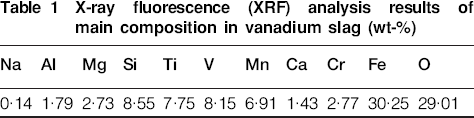
The vanadium slag used in experiment was taken from Panzhihua Iron and Steel Corporation. X-ray fluorescence (XRF) analysis’ result of vanadium slag is listed in Table 1. The X-ray diffraction (XRD) pattern of the vanadium slag was shown in Fig. 1. As can be seen, there are two main crystal mineral phases, namely, spinel ((Mn, Fe)(V, Cr)2O4) and olivine (Fe2SiO4).
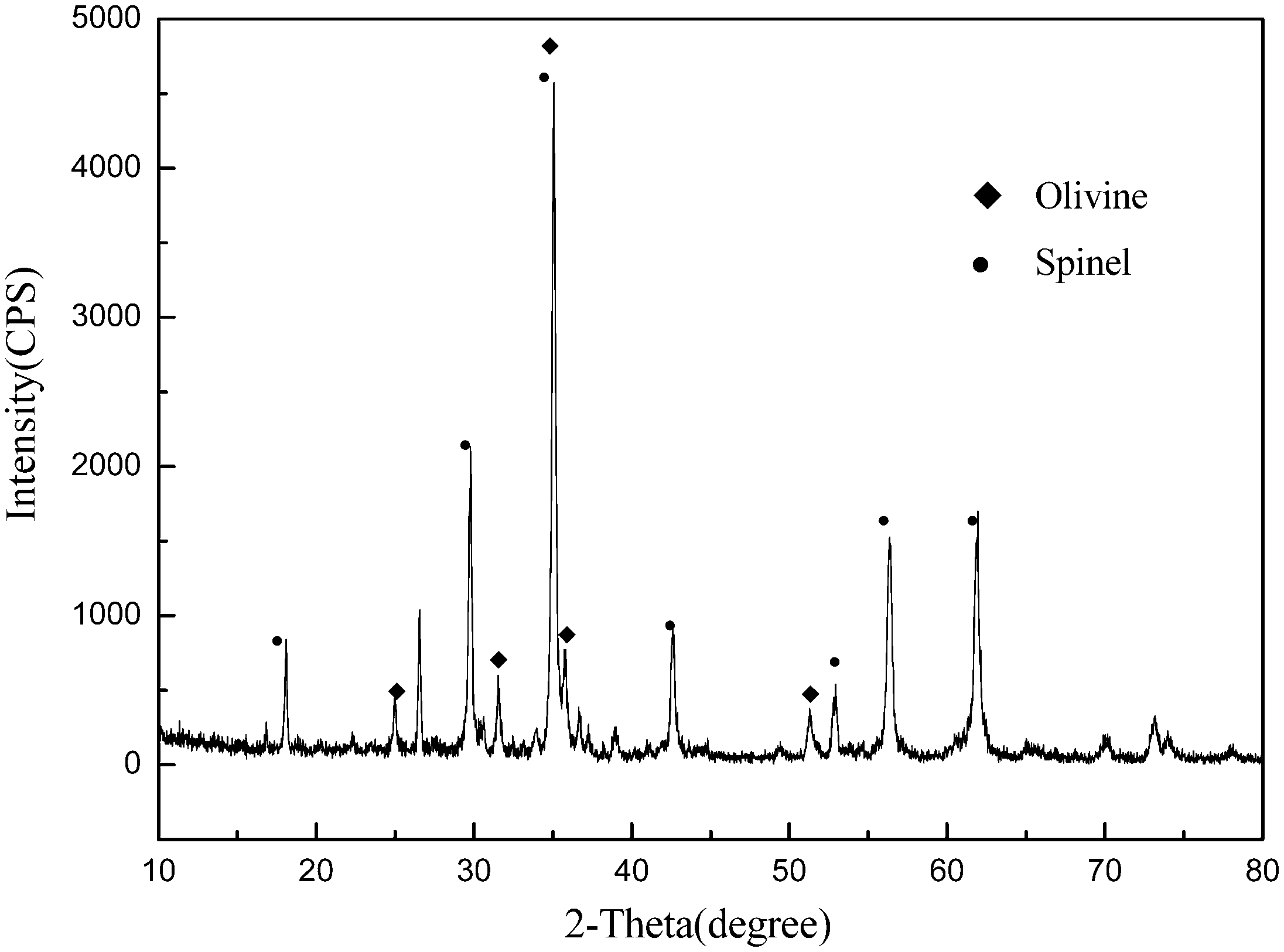
X-ray diffraction (XRD) analysis of vanadium slag
X-ray fluorescence (XRF) analysis results of main composition in vanadium slag (wt-%)
Vanadium and chromium were determined by inductively coupled plasma (ICP) emission spectroscopy with a PS-6 PLASMA SPECTROVAC, BAIRD (USA). The XRD patterns were recorded on a Rigaku Miniflex diffract meter with Cu Kα X-ray radiation at 35 kV and 20 mA.
Experiments were carried out in 100 g vanadium slag scale. The charge was composed of a weighed amount of vanadium slag mixed with sodium carbonate or vanadium slag mixed with sodium chloride and sodium carbonate. This charge was put in a crucible and heated gradually in an electric muffle furnace at a predetermined temperature with the door open. After roasting, the calcine was leached by water in an agitated flask, which was heated by an electric jacket. After leaching 3 h at 95°C with the liquid-to-solid rate of 4 mL g−1, the supernatant was vacuum filtered and the leach residue cake was submitted to successive rinsing with water; lasting up to 10 min, before it was dried and analysed for vanadium and chromium contents.
Results and Discussion
Effect of Na2CO3 addition
To determine the consumption of Na2CO3 in the roasting, a predetermined weight of Na2CO3 was mixed with 100 g vanadium slag and then roasted at 700°C for 2 h. The leaching rate of vanadium and chromium v. Na2CO3 addition was shown in Fig. 2. As can be seen, the leaching of both vanadium and chromium increased with the increase of Na2CO3 addition. The leaching of vanadium and chromium, especially for chromium, all reached the peak value when the addition of Na2CO3 was 50 g per 100 g of vanadium slag. Then the leaching of vanadium and chromium decreased with the increase of Na2CO3 addition.
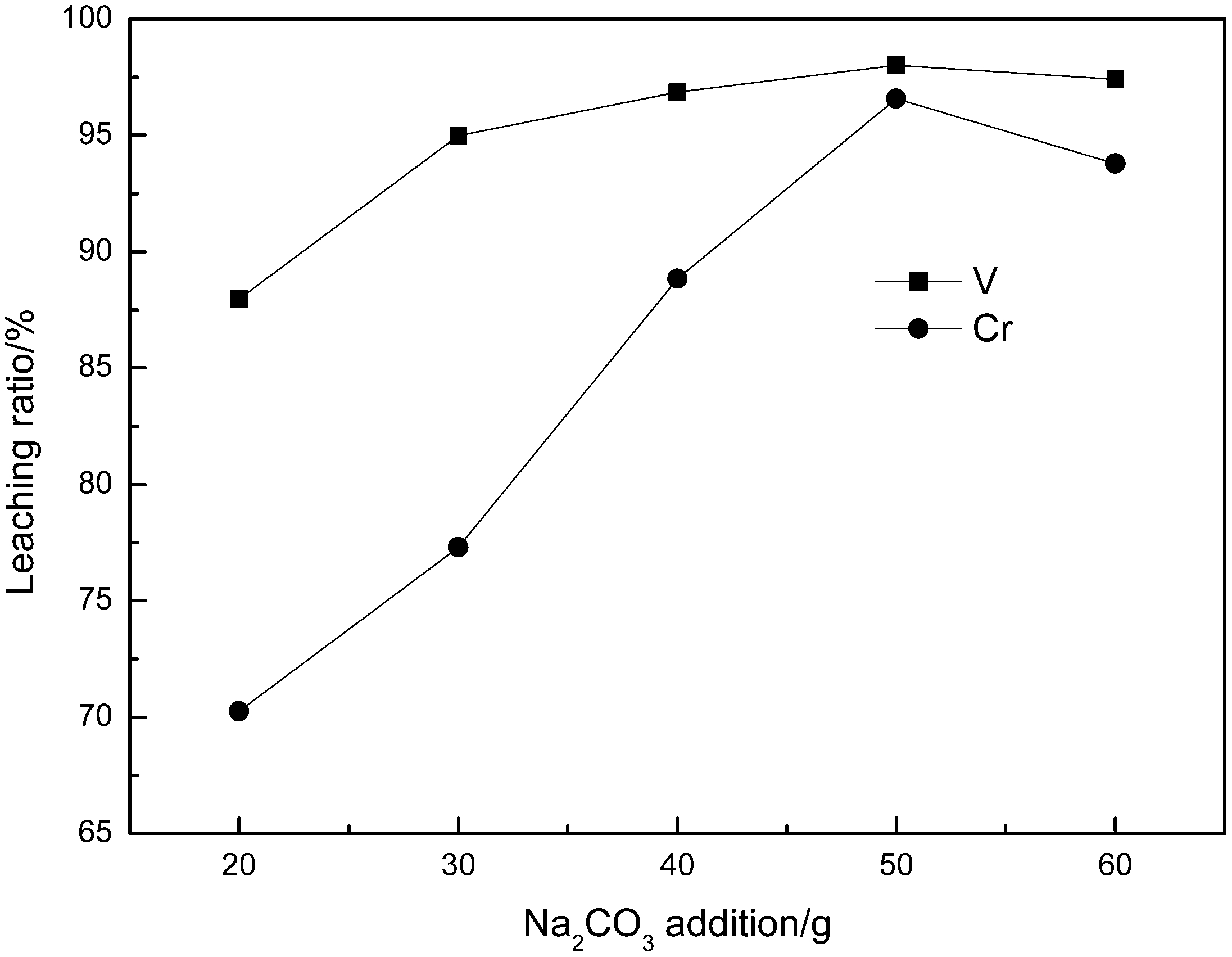
Effect of Na2CO3 addition on vanadium and chromium leaching
The fusing point of the calcinate decreased obviously when the addition of Na2CO3 was over 50 g. If the calcinate was softened, the oxidation of the vanadium slag become difficult as it cannot effectively contact with air during the roasting. Thus, 50 g Na2CO3 per 100 g vanadium slag was the optimum alkali consumption in the roasting.
Effect of roasting temperature
The roasting temperature was varied in the range of 600–800°C, with an interval of 50°C. The roasting time was constant, 2 h, the mass rate of vanadium slag and sodium carbonate was 2:1. The leaching condition was constant, and the results are illustrated in Fig. 3.
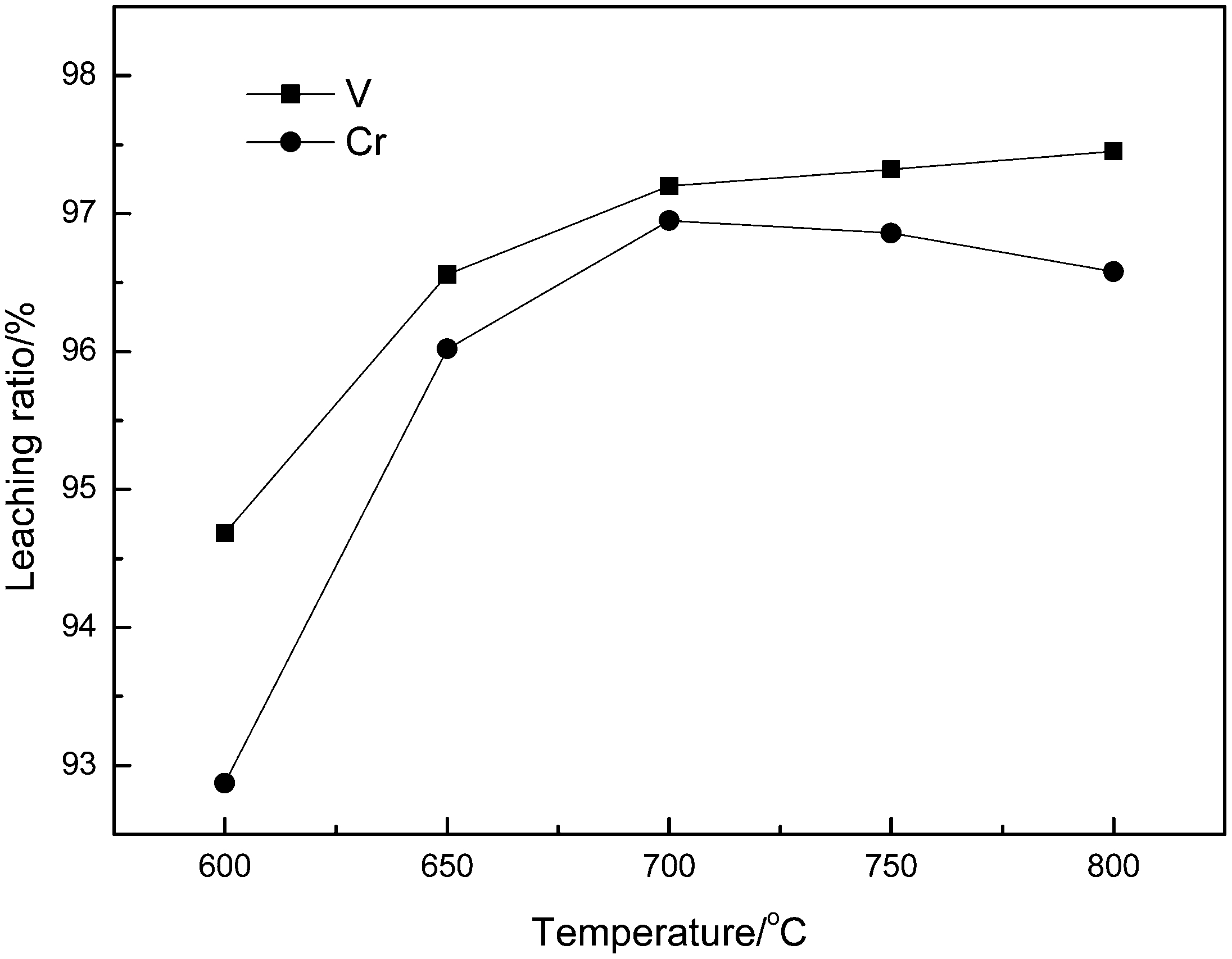
Effect of roasting temperature on vanadium and chromium leaching
It can be seen that, there is a rapid increase in the leaching of both vanadium and chromium with roasting temperature from 600 to 700°C. Above 700°C, the leaching of vanadium did not increase significantly, however, a further increase in temperature leads to decrease in chromium leaching. When the roasting temperature exceeded 700°C, vanadium slag appeared as a sintering phenomenon, which hindered the oxidation of the vanadium slag. Therefore, for subsequent experiments the roasting temperature was kept to 700°C.
Effect of roasting time
In order to study the effect of roasting time on the leaching of vanadium and chromium, the roasting time was varied from 0·5 to 4 h, while keeping sodium carbonate constant. The experimental results, shown in Fig. 4, indicate that a roasting time of 2 h is sufficient.
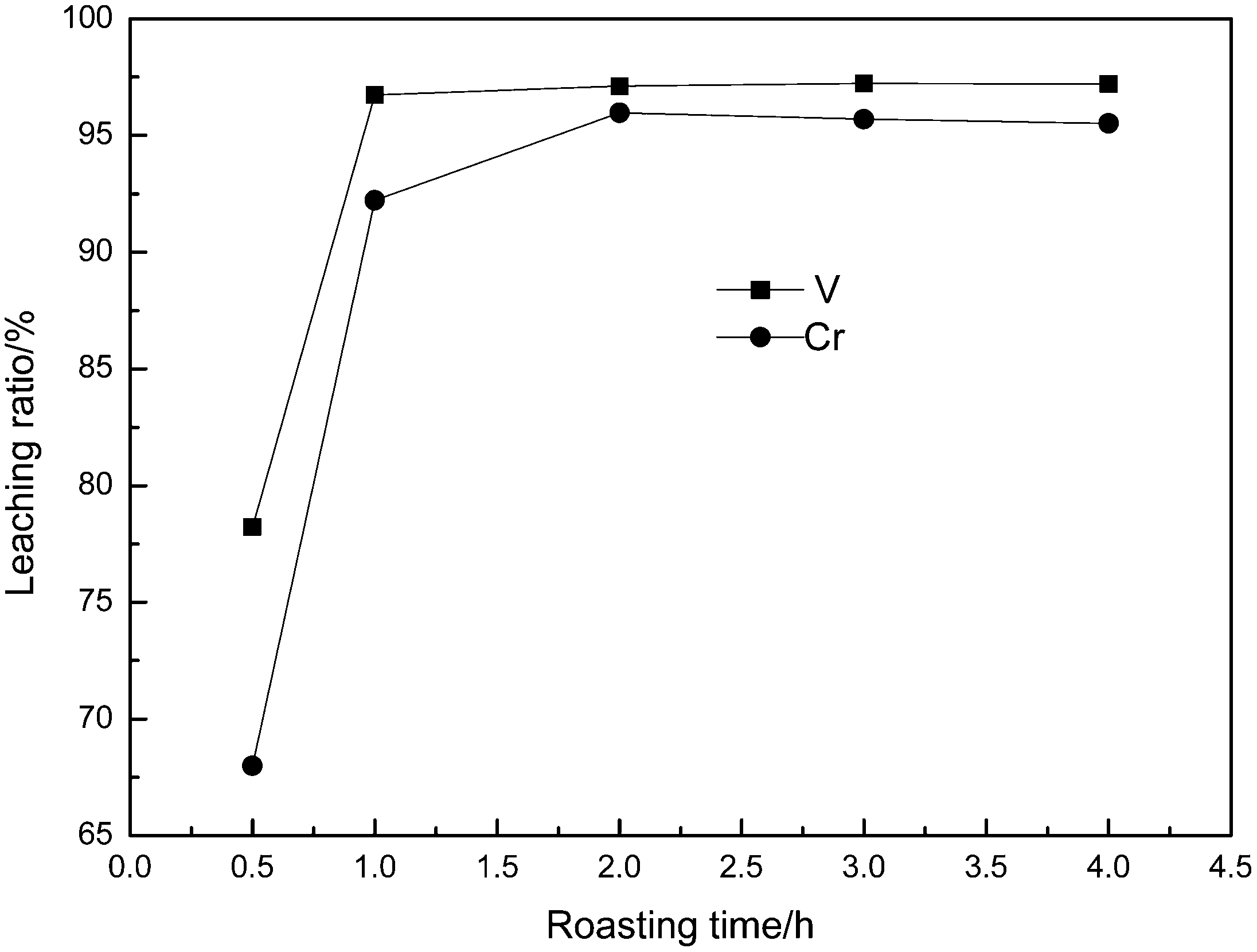
Effect of roasting time on vanadium and chromium leaching
From the above experiments it can be seen that vanadium and chromium in vanadium slag can be leached at the same time by water after roasting with sodium carbonate. As sodium carbonate is more expensive, some of the Na2CO3 was replaced by NaCl in the following roasting experiments.
Effect of NaCl addition
In experimental process, the total mass of added Na2CO3 and NaCl was kept 50 g per 100 g vanadium slag. The roasting temperature was 700°C and roasting time was 2 h. The effect of the mass fraction of NaCl on leaching of vanadium and chromium was shown in Fig. 5. As can be seen, first there is an increase and then decrease in the process of leaching vanadium, and, on the whole, the leaching of vanadium has little change. But for chromium, with increasing in NaCl addition, the leaching rate decreases rapidly.
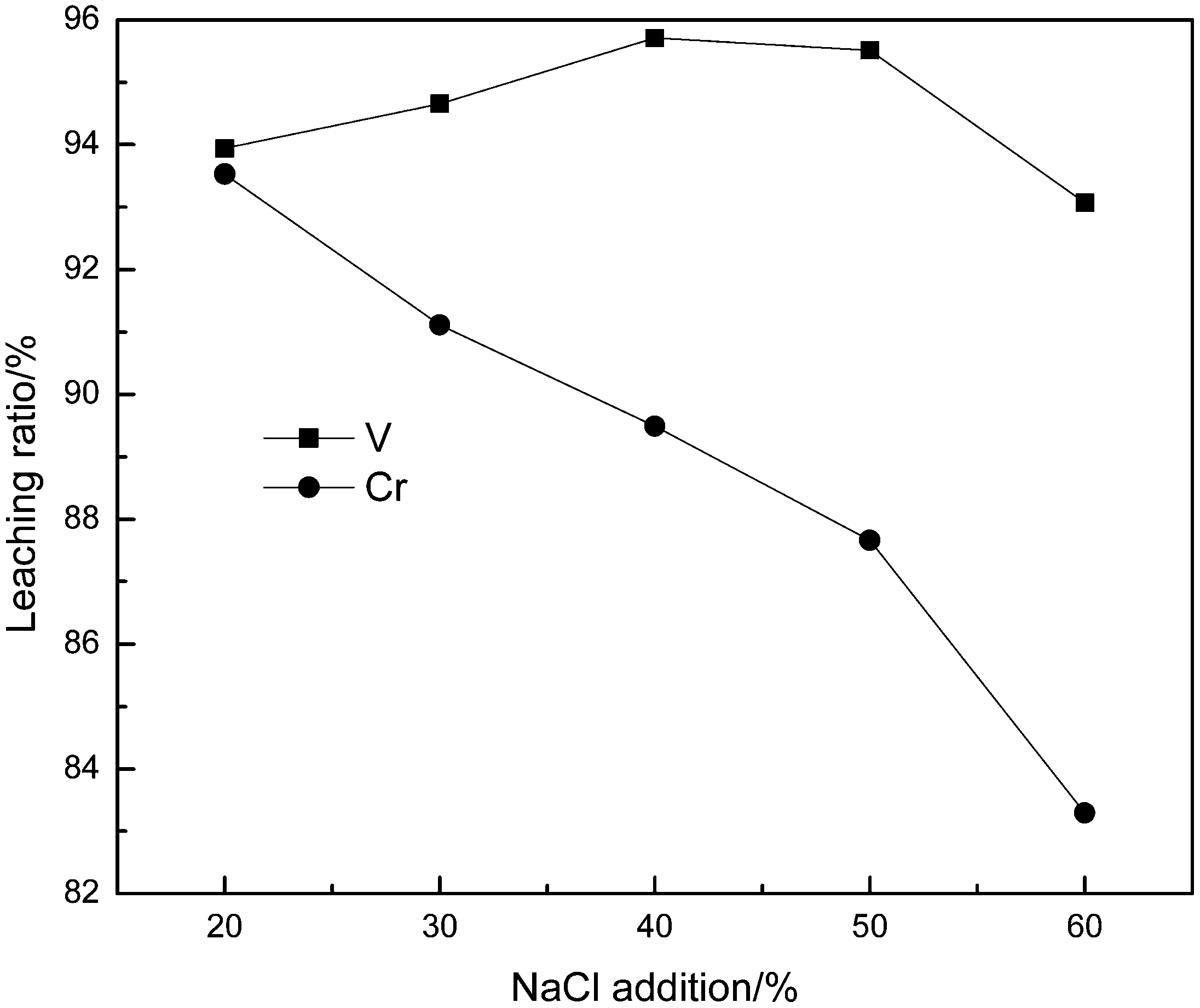
Effect of NaCl addition on vanadium and chromium leaching
Effect of roasting temperature with mixed addition agent
The roasting time was constant, 2 h, and the addition of NaCl was 30%. The leaching condition was constant, and the results are illustrated in Fig. 6. It can be seen that at around 700°C, the vanadium leaching is maximal and a further increase in temperature leads to obvious decrease in vanadium leaching. For the leaching of chromium, there is gradual increase with roasting temperature from 600 to 650°C, and a further increase in roasting temperature does not significantly affect the leaching of chromium.
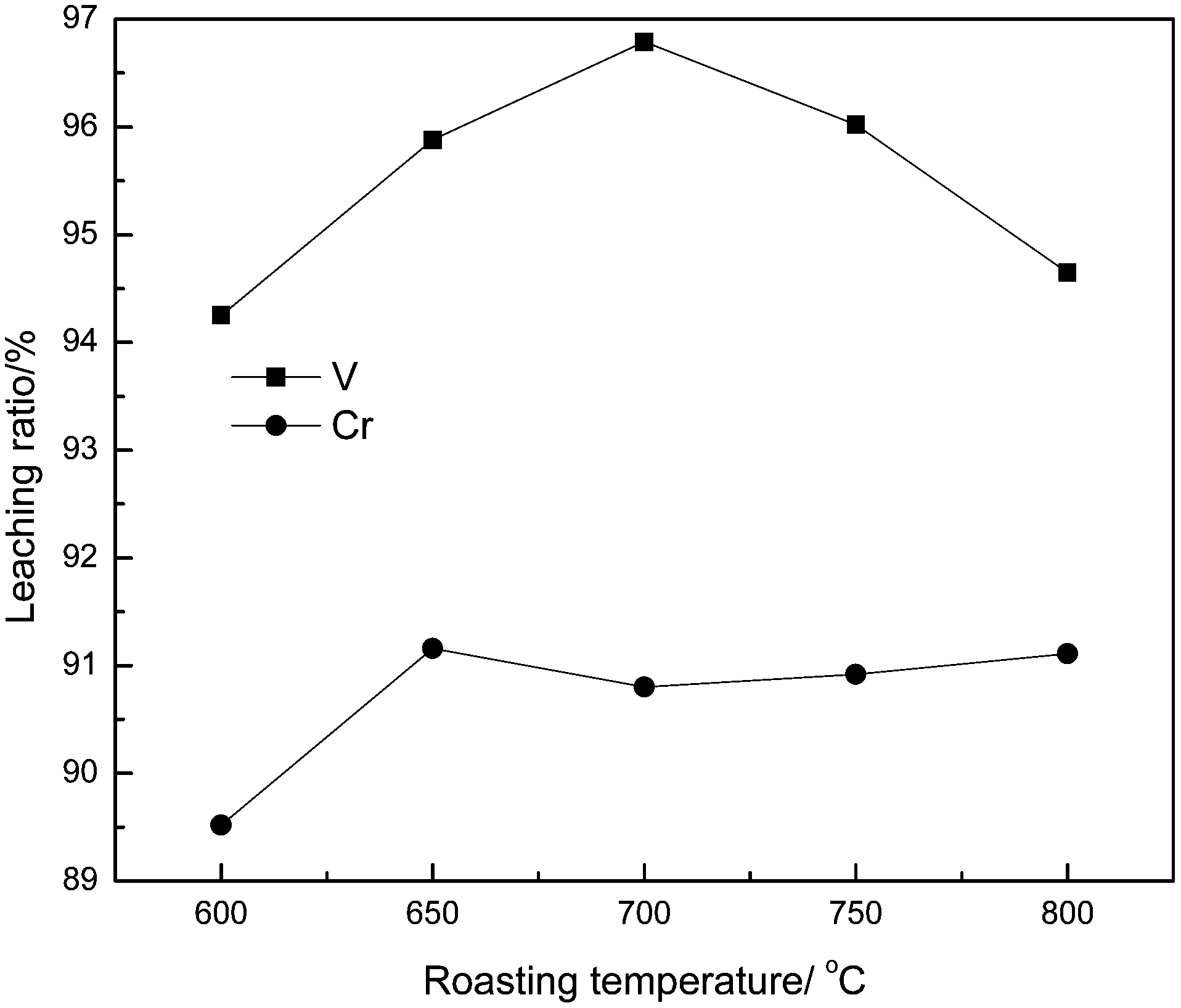
Effect of roasting temperature with mixed addition agent
It is obvious from above experiment that vanadium and chromium all can be leached at the same time after the roasting of vanadium slag with the two kinds of additive agents, and the leaching of vanadium is basically the same. Although Na2CO3 as the additive agent can get higher leaching of chromium than mixed addition agent, the leaching rate is increased only by five percentage points. That is to say, the mixed addition agent is more appropriate.
Figure 7 was the XRD pattern of the leach residue cake, which was got by leaching the calcine of 100 g vanadium mixed with 20 g Na2CO3 and 30 g NaCl roasted at 700°C for 2 h. As seen, after water leaching there are three main crystal mineral phases, haematite (Fe2O3), manganese oxide (Mn3O4) and sodalite (Na8Al6Si6O24Cl2), and there was no crystalized phase containing vanadium and chromium. Comparing Fig. 1 with Fig. 7, it can be seen that the phases of spinel ((Mn, Fe)(V, Cr)2O4) and olivine (Fe2SiO4) disappeared and a new phase haematite (Fe2O3), manganese oxide (Mn3O4) and sodalite (Na8Al6Si6O24Cl2) appeared in the leach residue.
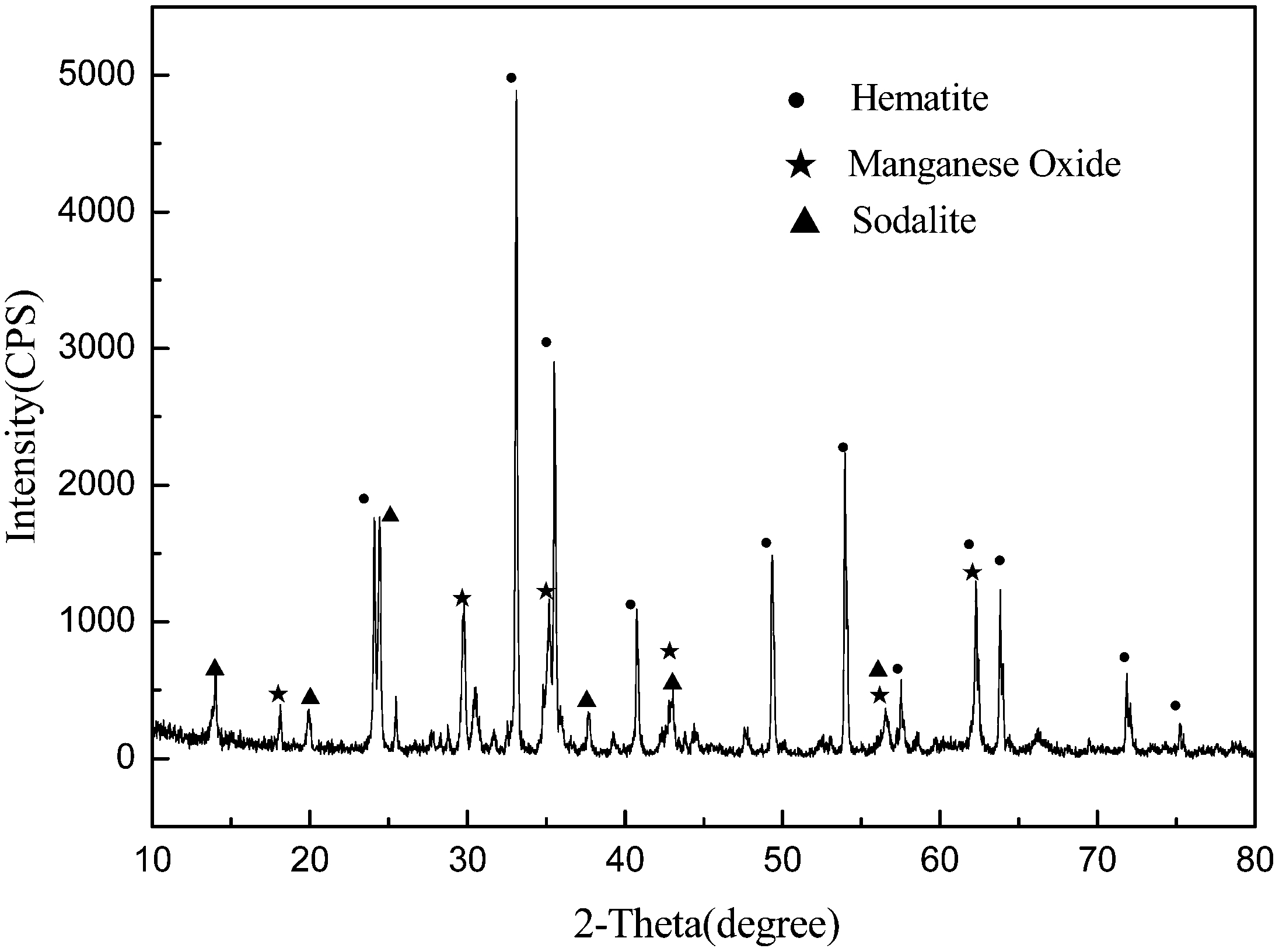
X-ray diffraction (XRD) analysis of leach residue
Conclusion
It is proved from the above experiments that the chromium can be leached during vanadium extraction from vanadium slag. Either sodium carbonate or sodium chloride mixed with sodium carbonate as the roasting addition agent, vanadium can get high leaching ratio. In comparison, under the same conditions, the leaching of vanadium is easier than that of chromium. The leaching rate of vanadium and chromium can be beyond 96 and 91%, respectively, under the experimental condition of roasting temperature of 700°C, roasting time of 2 h, 30% (mass fraction) sodium chloride and 20% (mass fraction) sodium carbonate addition to the vanadium slag, leaching temperature of 95°C, and leaching time of 3 h.
Acknowledgement
This project was financially supported by the National Natural Science Foundation of China (No. 51104186).