







Abstract
Filling the goaf with phosphogypsum can reduce damage to the environment due to phosphate mining. Research was conducted to test the feasibility of using phosphogypsum as a backfill aggregate, concentrating on the mixture ratio of filling materials and the filling process. First, the physical and chemical characteristics of phosphogypsum, fly ash and yellow phosphorus slag were determined. Then, two types of cement strength tests were conducted. One type of cementation was made up of phosphogypsum, cement and fly ash; the other was made up of phosphogypsum, yellow phosphorus slag, alkali activator and composite water reducer. The test results show that by adding fly ash, the characteristics of phosphogypsum change making it usable as a backfill aggregate. In addition, the curing agent of cement can be replaced by the yellow phosphorus slag, and a reasonable mixture ratio for backfill materials can be obtained. The new cemented backfill technology (in which the phosphogypsum is used as the main filling aggregate) was developed and used to fill the goaf of a phosphate mine in YongShaBa (KaiLin Group). Engineering practice has shown that the phosphogypsum filling technology can significantly reduce the environmental damage caused by phosphate mining, and significant economic benefits can be achieved.
Introduction
Phosphogypsum is one of the industrial wastes generated through the wet process of producing phosphoric acid. Usually, 5 t of phosphogypsum will be generated for each tonne of phosphoric acid produced. Phosphogypsum is an acidic material, which is composed of >90% dehydrated gypsum (CaSO4.2H2O). However, it also contains a certain per cent of P2O5 (0·3–1·5%), F (0·1–1·5%) and Ra-226 etc., which are harmful to human health and biological growth. Therefore, phosphogypsum has become a source of pollution (Guo et al., 1999; Qafoku et al., 1999; Torbert et al., 2005). For instance, in Guizhou Province, China, the KaiLin Group factory produces 68 million tonnes of phosphoric acid (100% P2O5) and 1·3 million tonnes of yellow phosphorus every year. During the production process, it generates 3400 thousand tonnes of phosphorus waste, phosphogypsum, and 130 thousand tonnes of yellow phosphorus slag annually. The storage of phosphorus waste on land requires compulsory land purchase, building of dams, and an annual expenditure of ¥12·5/m3 to manage the waste. Currently, the phosphate fertiliser industries generate ∼2000 t of phosphogypsum every year in China, and the rate is increasing annually by 15%. However, the utilisation rate for phosphogypsum is only ∼10% (Chen et al., 2010; Kaziliunas et al., 2006; Villalba et al., 2008). Therefore, the substantial accumulation of phosphogypsum has become a barrier to the sustainable development of the phosphate industry.
The open stope mining method and caving mining method are usually used in phosphate mines, which not only cause high ore dilution and/or loss but also cause geological disasters, such as rockslides, ground subsidence, landslides, and mud–rock flows, etc. (Othman and AlMasri, 2007; Tesfai and Dresher, 2009). For example, for the KaiLin Group in Guizhou Province, the ore recovery rate was only 69% when using caving mining methods to mine the high quality phosphate resources. Furthermore, there were 26 areas of collapse, 13 landslides, 359·9 thousand m3 of potential landslide material, 21 areas of accumulated waste residue in the Yangshui river, 240 thousand m3 of discharged waste rock, 43·02 km2 of soil erosion, and 1558·40 t km−2 a−1 average erosion modulus in mining areas. The damage to the environment was very severe.
Research by Smith (2002), Scoble et al. (1986), Kesimal et al. (2004) and Deng and Bian (2007) shows that backfill technology offers significant advantages in enhancing resource recovery, eliminating the accumulation of waste rock tailings, preventing surface subsidence, and controlling ground stress in the mining area. Using phosphorus waste (e.g. phosphogypsum and yellow phosphorus slag, which are produced in the phosphorous chemical industry) as the fill material, provides the perfect combination of utilisation of phosphorous chemical waste and low ore dilution loss mining. However, phosphogypsum filling technology has many problems, such as the rapid solidification of the filling slurry and difficulty in transportation (Bloomfield, 1984). To address these problems research was conducted into the feasibility of using phosphogypsum for backfill aggregate. Finally, a new backfill technology (which uses phosphogypsum as a backfill aggregate) was established, which could utilise high levels of phosphogypsum waste and lower the cost of phosphate mining. A new means of comprehensive phosphogypsum utilisation was developed.
Feasibility of phosphogypsum as backfill aggregate and proportion testing
Feasibility of phosphogypsum as backfill aggregate
The results of testing the physical and chemical characteristics of phosphogypsum (sampled from the KaiLin Group) and fly ash (sampled from the GuiYang Power Plant) are shown in Tables 1 and 2. Experimental research shows that phosphogypsum is best characterised as ultrafine grained: 93% of its particles have a diameter less than 0·1 mm, and the median diameter is 0·043 mm; both the porosity ratio (1·064–3·415) and the permeability coefficient (0·00294 cm s−1) are small. This type of ultrafine filling aggregate causes rapid solidification and acts against filling dehydration. This is especially so given that phosphogypsum comprises over 90% CaSO4.2H2O, which has the retarding characteristic of inhibiting the early gelation of cemented backfill. In the fly ash, SiO2 and Al2O3 (accounting for 52·42 and 21·84% respectively) have cementation potential and can enhance the strength of the backfill body. The CaO content of fly ash is only 7·32%, and its inner activation performance is low. However, the CaO content of phosphogypsum is 30% and therefore the two materials complement each other. Phosphogypsum is acidic (pH value: 1–3), and fly ash is alkaline (pH value: 9–11) and thus, when the two substances are mixed the product is chemically neutral. As both phosphogypsum and fly ash belong to the homogeneous clay particle size group, when they are combined to produce filling slurry, they have good pumpability, good transportability and low cement eduction. Experimental and research results show that, although phosphogypsum is not an ideal filling aggregate, the filling properties can be changed to meet production requirements by adding fly ash and some other activators.
Physical and mechanical properties of fill materials

Chemical content of fill materials/wt-%

Proportion experiment for fill materials
Some exploratory experiments were conducted before the formal filling test, and the results show that a reasonable concentration of phosphogypsum slurry ranges from 60 to 63%. Table 3 shows the test results for adopting phosphogypsum, no. 425 portland cement, fly ash, rock powder and dolomite block stone in the proportion experiment.
Test results of cemented filling material with different mixture ratios
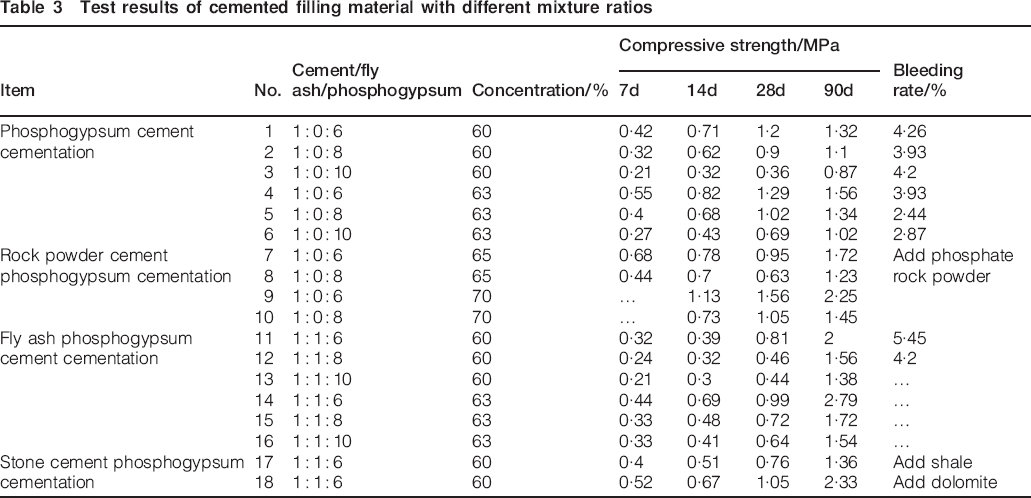
The test results show that:
the uniaxial compressive strengths (90d) of the samples are usually <1·5 MPa when using simple phosphogypsum and cement consolidation. In order to guarantee the filling quality, the ratio between cement and phosphogypsum should be >1∶6 [the consumption of cement (190 kg m−3) is significant]
the strength of the filling body is boosted by increasing the slurry concentration, but a high slurry concentration makes it difficult to transport by pipeline, due to the strong workability and high viscosity of the phosphogypsum filling slurry
in the rock powder cementing body, filling effects are not ideal when the slurry concentrations are <65%, but the compressive strengths (28d) are greater than 1·0 MPa when the slurry concentration reaches 70%. For rock powder cementing backfill of high concentration, it can be used as a cementation surface in stopes for scraper drawing ore, but its transportation performance decreases
the performance of the phosphogypsum cemented body can be boosted and cement consumption can be reduced by adding fly ash to the slurry mixture. Although the strength of the filling body in the early and middle stages cannot be enhanced, its late stage strength (90d) increases noticeably
it is useful to enhance the strength by adding block stones in the fly ash and phosphogypsum slurry
the compressive strengths (90d) of the cemented body can reach up to 1·56–1·72 MPa when using the filling slurry ratio of cement/fly ash/phosphogypsum of 1∶1∶8, where it can meet the requirements of subsequent backfilled stopes.
To sum up, although phosphogypsum is not the best material for use as a cemented filling aggregate, there are advantages after adding fly ash, such as good workability, lack of precipitation, full pipe transportation capability, structural flow characteristics, lack of clogging, and little abrasion, when transported by pipeline. The stress–strain characteristics of the cemented body show elastic–plastic mechanical properties, and it can still maintain a higher residual strength after ultimate failure (shown in Fig. 1), which makes it suitable as a subsequent backfill.
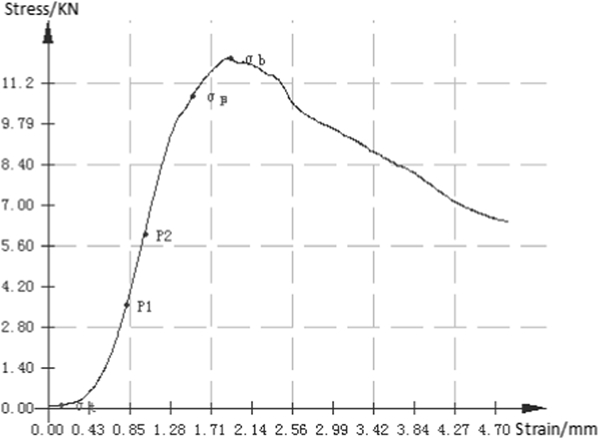
Stress–strain curve of phosphogypsum filling body (cement/fly ash/phosphogypsum is 1∶1∶6, slurry concentration 63%)
Experiment with yellow phosphorus slag replacing cement
Yellow phosphorus slag is another waste product of the phosphate industry, and possesses potential gelation properties (Chen et al., 2010). If yellow phosphorus slag can replace all or part of the cement it can reduce the cost of mining backfill and expand the applicability of the phosphorus wastes. Therefore, research was conducted as follows.
Phosphogypsum, yellow phosphorus slag, self-made alkali activator, and composite water reducer were used as the test materials. Yellow phosphorus slag was dried and ground using a ball crusher, until the specific condition of 2800 cm2 g−1 was reached. The main ingredients of yellow phosphorus slag are 37·60SiO2–51·15CaO–2·16P2O5–0·74K–0·18Fe2O3–2·25Al2O3 (wt-%). The curves of strength (28d) of the filling body versus concentration are shown in Fig. 2, for the yellow phosphorus slag proportions of 10, 20, 30 and 40% respectively. The strength curve versus curing time when a composite water reducer is mixed is shown in Fig. 3. Figure 4 shows the strength curves of the filling body at different curing times for adding 20% yellow phosphorus slag, with and without the water reducer.
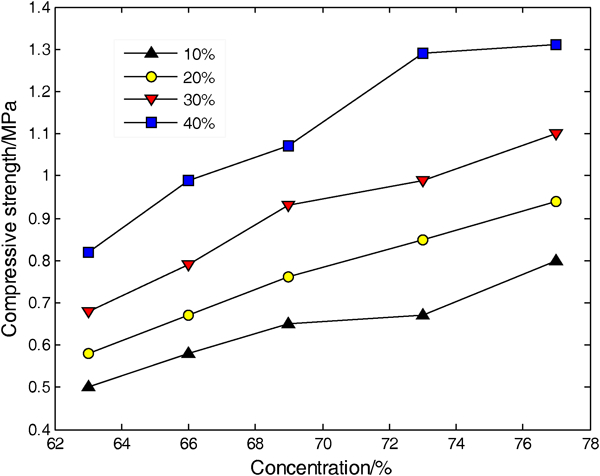
Compressive strength curves at different concentrations (28d)
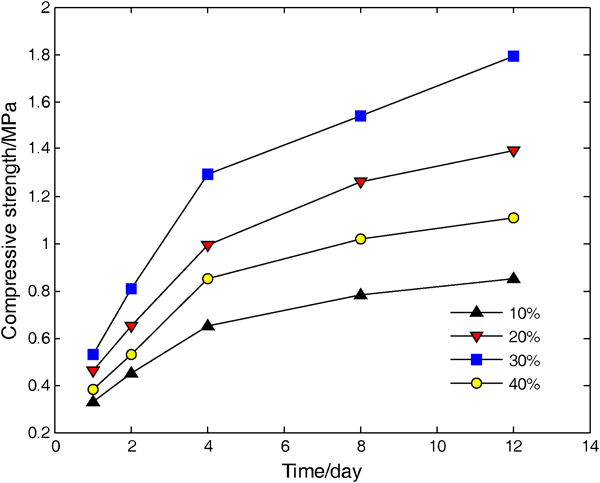
Compressive strength curves and curing time (different contents of yellow phosphorus slag)
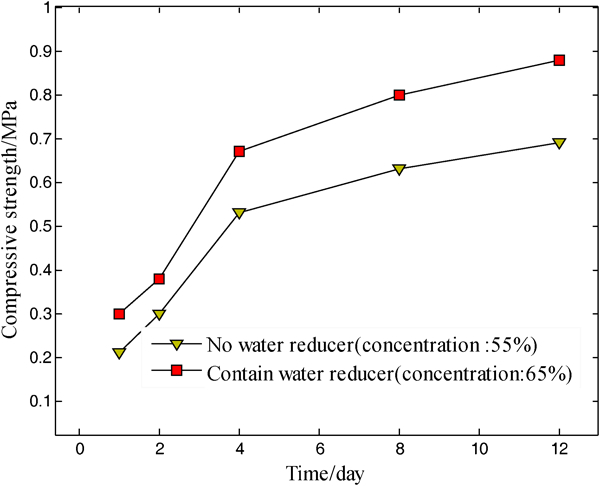
Compressive strength curves and curing time (20% yellow phosphorous slag)
The test results show that:
for each proportion at each curing time, the concentration of filling slurry has a direct influence on the strength, which is enhanced by increasing the slurry concentration, especially in the later stage. When adding the composite water reducer, the strength over different curing times is boosted by increasing the yellow phosphorus slag. With the same concentration, the strength (28d) of the filling body can be enhanced by 30% when the composite water reducer is added
for the condition of a constant concentration of fill slurry, the strength was enhanced by increasing the yellow phosphorus slag content and, under the same conditions, adding the composite water reducer to the filling body leads to a significant enhancement of the strength. Therefore, it is feasible to make yellow phosphorus slag as an alternative for cement cementation material
using a composite water reducer, the workability of the filling slurry can be boosted and the water cement ratio can be reduced.
Recommended proportions
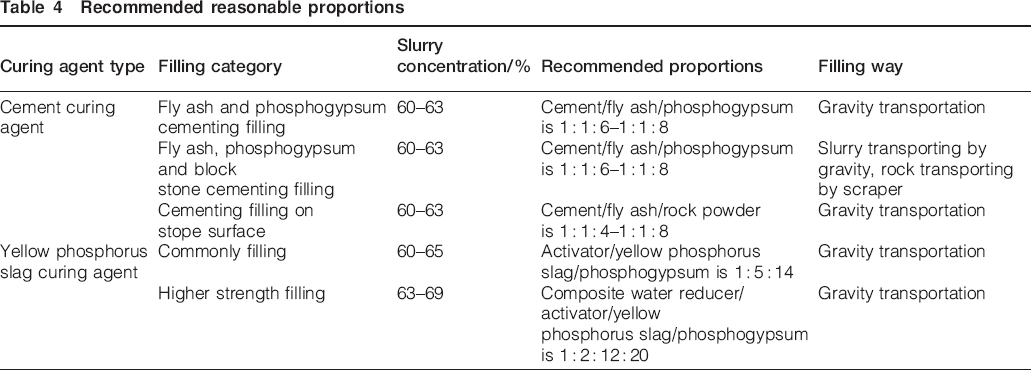
Through a series of comprehensive analyses, the phosphogypsum filling material mixture ratios shown in Table 4 were obtained.
Recommended reasonable proportions
Phosphogypsum filling process and engineering practice
Design process of phosphogypsum filling
Classified or unclassified tailings filling systems and processes are mature technologies used in metal mining (Fall et al., 2005; Fall et al., 2008; Deveci et al., 2009). The corrosion and difficult precipitation characteristics of phosphogypsum lead to extremely complicated preparation processes, making the complexity of the filling technology used for phosphogypsum unprecedented. Based on the characteristics of phosphogypsum materials and combined with contemporary filling technology (Spearing et al., 1998; Rankine and Sivakugan, 2007), the filling slurry preparation, measurement control, and equipment corrosion problems are solved by handling phosphogypsum as a dry type stock, using scraper carry systems, disc feeder, screw conveyor, and impulse flowmeter, with the filling capacity reaching 100–120 m3 h−1.
The filling system is mainly comprised of:
phosphogypsum storehouse. The horizontal phosphogypsum storehouse was built in YongShaBa GuNiuBei at an altitude of +1400 m, and the design was based on the assumption that phosphogypsum was of dry type, and the filling slurry could be transported by gravity flow using the natural difference in elevation
gelling agent storehouse. A steel hermetic storehouse with a vertical cylinder and cone shape was designed. The technical parameters were steel plate thickness 18 mm, cylinder dimension 4 m, cone angle 65·2°, diameter of discharge hole in the bottom of the storehouse 300 mm, total height 80 m, and volume 68·4 m3
a fly ash storehouse using the same design as the phosphogypsum storehouse
a screw conveyer with screw diameter of 300 mm and horizontal transportation length of 5·0 m
discharge funnel which was set in the bottom of the phosphogypsum storehouse. It was welded by steel plate (thickness 5 mm) with a slope angle of 65°
agitation vat of usable volume was 5·6 m3 with a diameter of 2 m and a height 2 m
water supply pool of 10 m diameter, 6 m height and 471 m3 volume, with the base of the water pool at an elevation of +1399·5 m.
The filling preparation station was built in YongShaBa Mine (KaiLin Group), and was mainly for mixing cement, fly ash, water and phosphogypsum to produce a suitable filling slurry. The filling slurry was transported to the stope by borehole and pipeline. The filling preparation station has the function of storing cement, fly ash, phosphogypsum and water, and also has the necessary metering, transport and agitator devices to determine the concentration and mixture ratio of the filling slurry. The process is shown in Fig. 5.
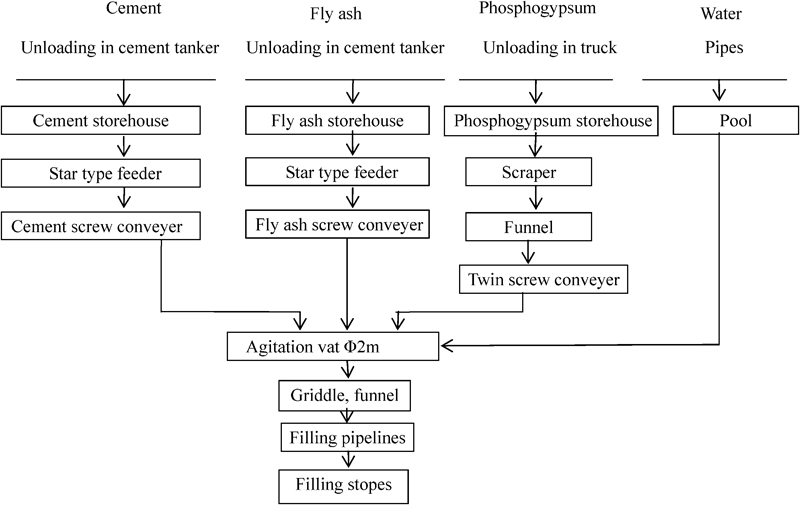
Phosphogypsum cemented filling PFD
Application in KaiLin Group by using phosphogypsum filling process
The KaiLin Group Mine Corporation consists of MaLuPing Mine, YongShaBa Mine and QingCaiChong Mine, all of which mine the same ore vein. The deposit genesis, orientation, mining technology and conditions are the same. The dip of the orebody varies from 10 to 50°, the average thickness of the orebody is 7 m, the length is 15 km and the width is 5 km. The mining recovery was only 68·7% using the caving mining method, and there were 2262 t of ore under the highway, accounting for nearly 50% of the total reserves of the YongShaBa Mine.
From the formulation results for phosphogypsum backfill, when using cement as a curing agent, at the bottom of a stope of ∼2 m height, the filling slurry ratio of cement/fly ash/phosphogypsum is 1∶1∶6 to 1∶1∶8. In the top of the stope, the filling slurry ratio of cement/fly ash/phosphogypsum becomes 1∶1∶6. Both slurry concentrations are in the range of 60–63%, the slurry is transported by gravity flow and rock, such as dolomites and shale, which is included in the fill, is moved by the scraper. When using the yellow phosphorus slag as a curing agent, for the standard filling areas, the filling slurry ratio of activator/phosphorus slag/phosphogypsum is 1∶5∶14, with a concentration of 60–65%. In contrast, for the special filling areas where the filling bodies are required to have a stronger bearing capacity, for instance, under the highway or the village, the filling slurry ratio of composite water reducer/activator/phosphorus slag/phosphogypsum becomes 1∶2∶12∶20, with a concentration of 63–69% with the slurry transported by gravity flow.
In industrial practice, in order to control the influence on the ground surface by phosphogypsum filling mining, there was a displacement observation point along the highway (points of A, B and C) and on the roof of the mining stope (points D, E, F and G) from 2004 to 2007; the measured results are shown in Figs. 6 and 7. The deformation of the highway was monitored by total station, and the roof of the mining stope was measured by multipoint extensometer. The precision of the total station was ±3·5 mm. There was no displacement variation in the precision range of the total station (Fig. 6), and no cracks or fissures in the highway, which proved that the highway was safe. Analysing the terrain deformation of the direct roof of the mining area, the maximal displacement subsidence was only 1·307 mm (Fig. 7), which is very small. Therefore, phosphogypsum filling technology can ensure safe mining under the highway and village, helping to avoid geological disasters.
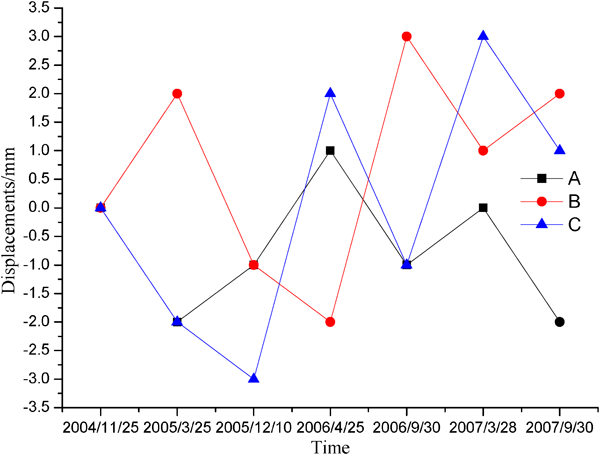
Measurement results of highway subsidence
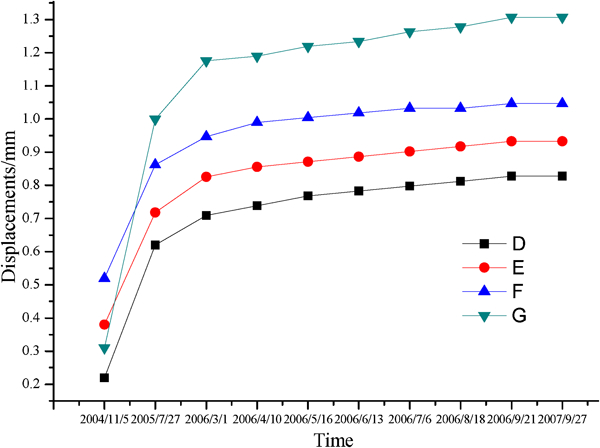
Measurement results of stope direct roof subsidence
The comprehensive application of the phosphogypsum filling technology in the KaiLin Group has reduced the disposal of phosphorus waste by 2044 thousand tonnes and reduced waste rock discharge by 728 thousand tonnes annually. In YongShaBa Mine, 713 thousand tonnes of safety pillars have been mined safely, and the recovery rate has increased from 68·7 to 92·6%, yielding an increase in ¥220·072 million/year in profit. In addition, the application of phosphogypsum filling technology saves an additional ¥5007·8 million/year by reducing the cost of land expropriation, dam building, antiseepage treatment and waste management. The technology has extended the KaiLin Group mines service life by 5 years and the prospects for its use elsewhere are significant.
Conclusions
The problem of disposing of phosphorous industrial wastes during phosphate mining is successfully addressed by the new cemented filling technology proposed in this paper. Specifically, with cement used as the curing agent, the filling slurry ratio of cement/fly ash/phosphogypsum is 1∶1∶6 to 1∶1∶8; while for cementation filling at the bottom of a stope, the filling slurry ratio of cement/fly ash/rock powder is 1∶1∶4 to 1∶1∶8. Both the slurry concentrations are in the range of 60–63%, and thus the slurry can be transported by gravity flow, with the fill rock transported by the scraper.
For standard filling areas, by using yellow phosphorus slag as the curing agent, the filling slurry ratio of activator/phosphorus slag/phosphogypsum is 1∶5∶14, with a concentration of 60–65%. In contrast, for special filling areas where the fill is required to have a stronger bearing capacity, the filling slurry ratio of composite water reducer/activator/phosphorus slag/phosphogypsum becomes 1∶2∶12∶20, with a concentration of 63–69%, with slurry being transported by gravity flow.
The phosphogypsum filling system has been designed and tested in mining operations. The results show that the new filling technology can significantly reduce environmental damage, while achieving a measurable increase in profit. The prospects for its wider use and application are significant.
Footnotes
Acknowledgements
This work was supported by the National Basic Research Programme of China (grant no. 2010CB732004) and joint funding from the National Natural Science Foundation and the Shanghai Baosteel Group Corporation (grant no. 51074177).