







Abstract
To mine coal resources trapped under embankment dams safely and efficiently while, at the same time, disposing of waste rock, solid backfill mining has been proposed as a solution. The extreme value of dam deformation was obtained by analysing geological conditions in the area and structural characteristics of the dam. It was determined that the filling ratio of the working face and the equivalent mining height were the two key factors that control dam deformation. In addition, the extreme values of these two key factors varied with the distance between the working face and the embankment dam in a regular pattern. When mining was completed at the first working face in the pilot area, the maximum sink value of the dam was 42 mm, and the maximum horizontal strain was 0·16 mm m−1. Field demonstrations have shown that solid backfill mining is effective in controlling strata movement and surface deformation.
Introduction
In recent years, the recovery of coal trapped under buildings, railways and water bodies has become a major challenge for sustainable development of the coal mining industry in China. Currently, for large state owned collieries alone, there are as many as 13·79 billion tons of coal still being buried under structures, particularly in East China. In general, these trapped resources account for 10–40% of the recoverable reserve, but the percentage may reach 100% in certain mining areas (Miao and Qian, 2009; Ju, 2008). A large portion of these trapped coal resources is buried under about 125 major bodies of water, including the Huaihe and Sihe rivers, the Beijing–Hangzhou canal, and the Weishan, Tai, Daye, and Pohai Lakes and their dams (Wu et al., 2007; Chen and Li, 2010).
At present, waste rock excavated in the process of underground mining is generally transferred to the surface and piled up, and transportation of this waste is sometimes problematic. Waste rock of more than 900 million tons generated annually fills more than 1600 waste dumps that total 5·5 billion tons, occupying more than 15 000 hectares. These dumps threaten air and groundwater pollution, and are potentially explosive (Bian et al., 2012; Miao et al., 2010a; Huang et al., 2010; Huang et al., 2012).
To improve coal mining safety and efficiency and address environmental pollution issues, domestic and foreign scholars have carried out much research, coupled with new practices. Various backfill mining methods such as pneumatic, hydraulic, cemented paste and high water material have been advanced (Tapsiev et al., 2009; Belem and Benzaazoua, 2008; Seryakov, 2008; Donovan and Karfakis, 2004; Rankine and Sivakugan, 2007; Zhang et al., 2008). A research team from China University of Mining and Technology has developed a set of unique techniques called solid backfilling mining technology (Ju et al., 2009; Miao, 2010b), and successfully solved this technical issue. Using this technique, solid waste such as waste rock, fly ash and loess are backfilled directly to gobs using relevant equipment to support the overlying strata (Zhang et al., 2010a, 2010b). Assuring surface buildings and structures remain undamaged, these trapped coal resources could be recovered in a safe, efficient and productive manner. In addition, waste dumps in mining areas are also disposed of at the same time (Zhang et al., 2010c; Huang et al., 2011a, 2011b). This technique not only increases the recovery ratio of coal resources, but also protects local environments. When coal trapped under embankment dams is being extracted, it is essential to determine the filling ratio, as well as control parameters of dam deformation. This study addresses the issues mentioned above based on the mining and geological conditions of the Jisan Coal Mine, Yanzhou Coal Group Co. Ltd.
Background of pilot area
Mining and geological conditions
The pilot area was a protective coal pillar under Nanyang Lake dam at the no. 6 working face of the Jisan Coal Mine. It was next to the no. 6303 face (recovered) in the east, the no. 6305 face in the west, the gob area of the no. 6304 face (recovered) in the north, and a waste rock discharge roadway of no. 6 district in the south. The face was 548 m long and 250 m wide, with a recoverable reserve of 560 000 tons. The southern part of the pilot face was located beneath the Nanyang Lake dam (Fig. 1).
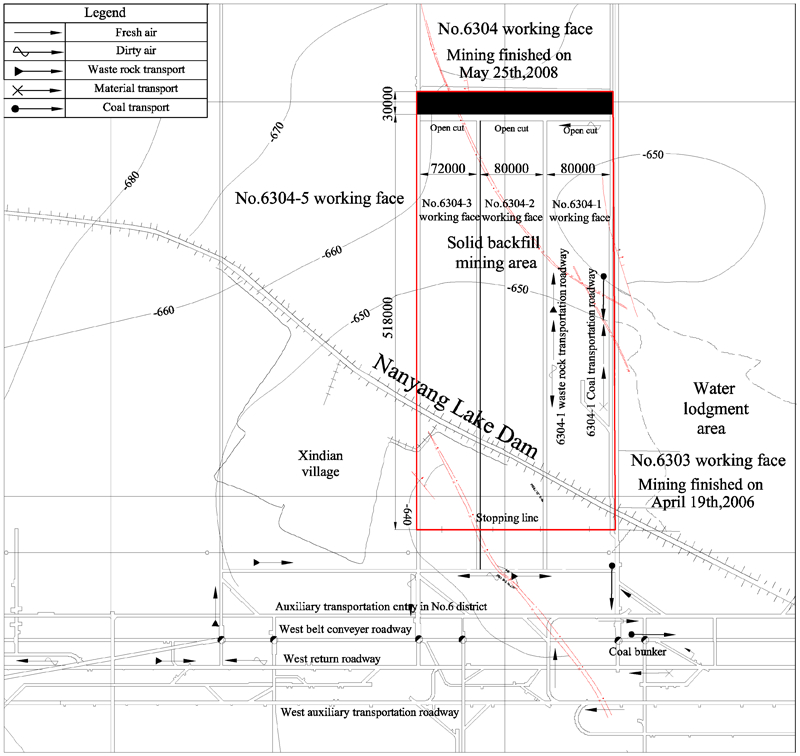
Comparison diagram of surface and underground and production system at first working face
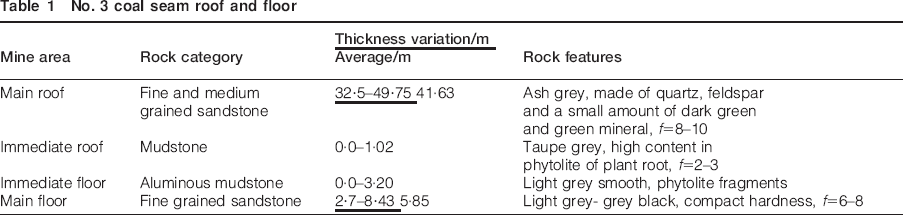
The no. 3 coal's hardness coefficient f is 1–2, and the bulk density is 1·36 t m−3. The coal seam is about 680 m below the surface. Geological features of the roof and floor are shown in Table 1.
No. 3 coal seam roof and floor
General condition of Nanyang Lake dam
Nanyang Lake is located southwest of the Jisan Coal Mine. The Beijing–Hangzhou Canal and Sihe and Xingfu rivers flow into the lake. The water in the middle of the lake is 2 m deep and can reach 4 m during the rainy season. The embankment dam on the north side of Nanyang Lake is above the mining area, and is also a major flood control project.
The river side of this earthen dam is surfaced with stone. The dam is about 8 m high and 5 m wide at the top. The dam is topped with an asphalt highway to aid maintenance and connect nearby villages (Fig. 2).
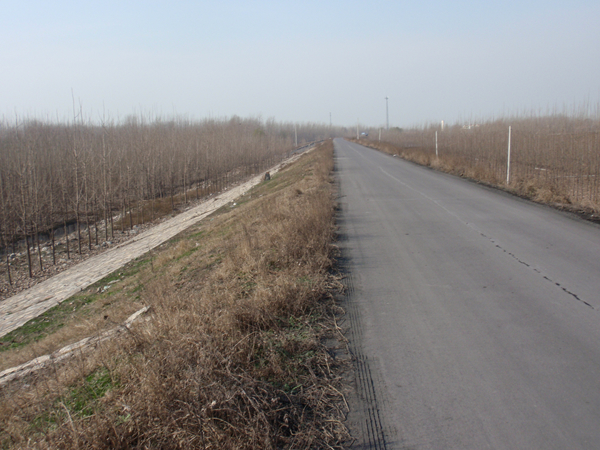
Nanyang Lake embankment dam
System design for solid backfill mining
System layout of working face
Three working faces were planned in the pilot area. In order to maximise the recovery ratio, coal mining proceeded with tail entries retained. The first working face, no. 6304-1 is 80 m wide and 518 m long with a recoverable reserve of 182 000 tons (Fig. 1).
The backfill material was waste rock generated from roadway excavation in the no. 18 district and western parts. The waste would be conveyed to a bunker which located in west area and stored temporarily. When needed, it was screened by a graded sieve (Type WZT-1042) and crushed by a toothed roll crusher (Type 2PLF90/150). After that, the qualified waste rock was transported to the working face and backfilled into gobs using relevant equipment.
Key equipment for solid backfill mining
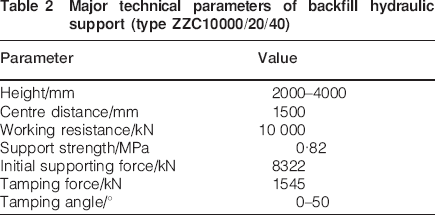
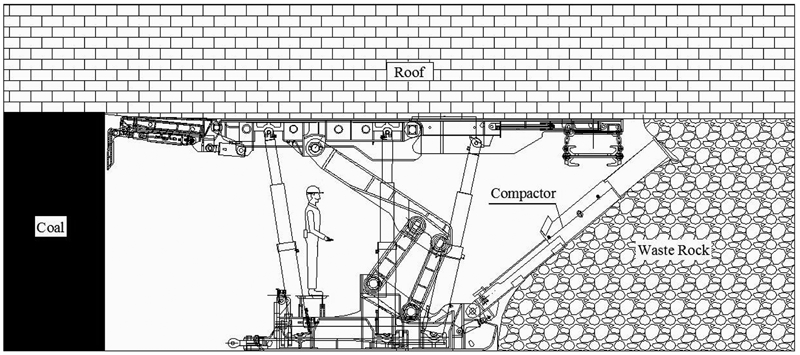
The key equipment for solid backfill mining under embankment dams includes backfill supports, a backfill conveyor and a self-shift loader. The self-designed backfill support used in this example was a Type ZZC10000/20/40, which includes a front top beam, back beam, six columns, four-bar linkage, compactor and support base (Fig. 3 and Table 2). This support maintains the space for backfilling and mining so that backfilling and mining proceed in parallel. The compactor in the rear of the support consolidates waste rock in gob areas.
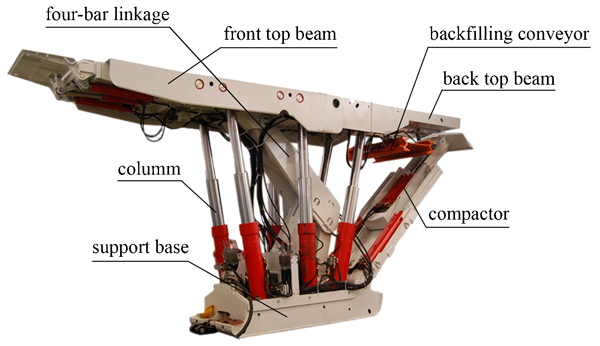
Backfill hydraulic support structure
Major technical parameters of backfill hydraulic support (type ZZC10000/20/40)
The backfill conveyor with unloading holes at the bottom hangs under the back beam of the support and can move along the back beam within a certain range (SGBC764/250). Opening and closing of the holes is controlled by telescopic jacks installed on the side (Fig. 4).
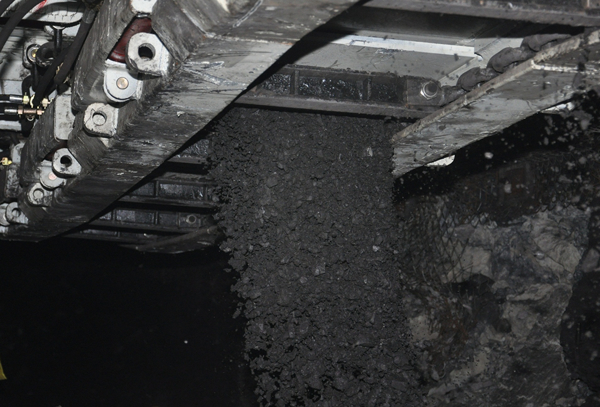
Working state of backfilling conveyor
The self-shift loader transferring waste rock from the belt conveyor to the backfill conveyor is Type GSZZ-800/15. It includes a self-shift tail device, a belt stretching structure, an autonomous elevating structure, and a base sliding structure (Fig. 5).
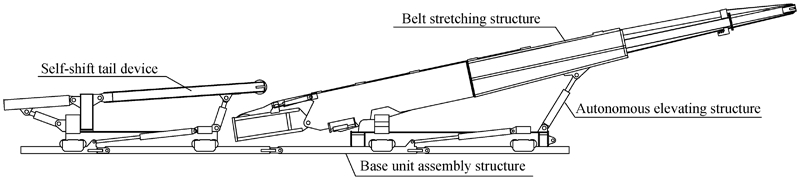
Self-shift loader
Backfill technology
The solid backfill mining technology combines the mining and backfill processes, with the latter following the former. At the beginning, the backfill support advances after the coal is cut, then the backfill conveyor moves backwards along the support back beam. The backfill conveyor, self-shift loader and belt conveyor start in turn, and backfilling begins.
The backfilling process proceeds from the tail to the head of the backfill conveyor. When waste rock dropped from the unloading hole at the bottom of the backfill conveyor reaches a certain height, the next unloading hole is opened, and the compactor of the former support starts to tamp the waste. This process is repeated until the waste has been sufficiently tamped. Generally, two or three cycles are required. This first round of backfilling stops after the face has been fully filled. At this point, the first round of the backfill process is complete, and the backfill conveyor moves forwards along the support back beam.
The compactor functions to push waste rock that remains under the backfill conveyor towards the roof until the waste rock touches the roof and is fully compacted. The last process is to close all the unloading holes to backfill the space occupied by the conveyor's head section. After the first backfill cycle is complete, the backfill conveyor is pushed forwards to prepare for the next backfill process. The final backfilling effect is shown in Fig. 6.
Final backfilling effect
Dam deformation control analysis
Extreme value of dam deformation
Embankment dams are hydraulic structures built on surface soil to control floods. These dams are intended for flood prevention and control, so coal mining under them is likely to cause three problems: the dam could burst from an abrupt slump, cracks in the dam body may grow into pathways for water seepage and dams could be covered by water if they sink.
If a dam sinks, however, it is likely caused by surface subsidence, and development of cracks is due to the strain of horizontal stretching. Sinking and horizontal strain due to coal mining are major reasons for dam damage, thus, deformation resistance of dams determines the influence of mining practices (Liu et al., 2011; Chen et al., 2011).
According to Regulations Regarding Protective Coal Pillar Retaining and Buried Coal Resources Mining around Some Major Roadways and under Buildings, Water Body and Railways and Nanyang Lake dam's geological and physical properties, such as dam type, size, form, materials and its application, the maximum sinking allowed is 250 mm and the maximum horizontal strain is 1·0 mm m−1.
Key factors influencing embankment deformation
Key factors affecting dam deformation
Mining at the working face results in movement of the overlying strata. When movement develops from the lowest strata to the ground surface, deformation of embankment dams occur, which is influenced by many factors, including mining height, working face layout, overlying strata properties and thickness, key strata position, surface soil layer thickness and its physical and mechanical properties. Once a pilot area is designed, all factors, except mining height and working face layout, are inherent and least likely to be changed. In addition, since the working face layout in the Jisan Coal Mine has been set, mining height is the only variable and controllable factor used to control dam surface deformation.
Compared with traditional cave mining methods, roof convergence around the working face with the solid backfilling technique is smaller with the same mining height. This is because the actual mining height is reduced due to backfilling with waste rock. In this study, the concept of equivalent mining height is introduced to estimate the influence between traditional approaches and our newly developed technique.
The equivalent mining height (EMH) is equal to the difference between the actual mining height and the backfill body height after the roof stays stable. EMH is calculated using equation (1)

In order to monitor and measure the backfilling effect in real time, the concept of filling ratio (Φ) was introduced. This ratio is the proportion between stabilized backfill body height and the actual mining height, defined as in equation (2)

Key factor analysis
Based on geological conditions of the pilot area and the dam deformation extreme value, as well as a prediction model of the EMH probability integral method, Me–D and Φ–D curves were obtained using inverse analysis (Fig. 7), among where D is the horizontal distance between the working face and dam.
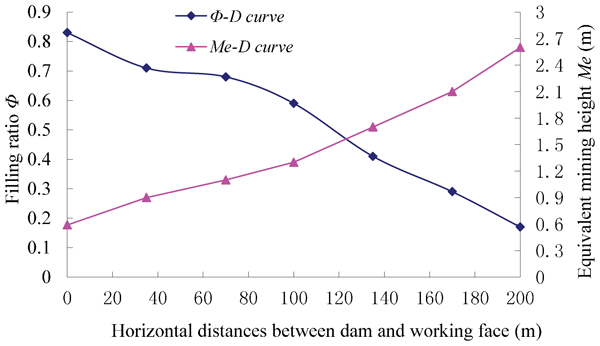
Control parameters of dam deformation curve
As indicated in Fig. 7, the dam would stay undamaged provided that D is 200 m, Φ is no smaller than 17% and Me is no higher than 2·6 m. However, when D declines, the filling ratio should be gradually increased and EMH reduced to lessen the effects of mining practices on the embankment dam. Specifically, when the working face is located right below the dam, Φ reaches at least 83%, and Me should not be more than 595 mm to ensure dam safety.
Dam deformation prediction
Because solid backfill mining was applied in the Yanzhou mining area for the first time, it is of importance to ensure the safety of the Nanyang Lake dam and improve waste rock disposal. In this case, mining height was designed to be no higher than 3·5 m, no larger than 525 mm for the EMH, and no lower than 85% for the filling ratio. Through combining those parameters with geological conditions in this area, dam deformation was predicted using the probability integral method after no. 6304-1 and the recovery of the other three working faces had been completed (Table 3).
Nanyang Lake dam deformation prediction
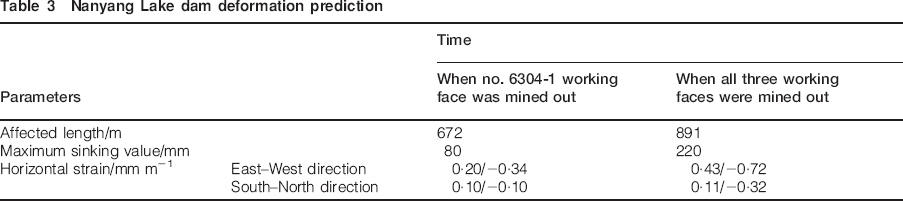
After completion of the extraction work at no. 6304-1 working face, field measurements showed that 672 m of Nanyang Lake dam were affected by mining work, with a maximum sinking of 80 mm and maximum horizontal strain of 0·34 mm m−1, which were all lower than the deformation upper limit (the sinking upper limit was 250 mm and the horizontal strain upper limit was 1·0 mm m−1). When all three working faces were mined out, the length of the dam affected by the mining activity increased to 891 m. The maximum sinking was 220 mm and maximum horizontal strain was 0·72 mm m−1, which were both within the range of the deformation limit.
Application effect
Production at working face
Recovery work at no. 6304-1 working face started on 14 January 2011 and was completed on 20 December 2011. So far, coal resources of 182 000 t have been produced and 237 000 t of waste rock have been backfilled to the pilot area.
Roof convergence monitoring
In order to monitor how the solid backfill activity affects roof sinking, two rows of monitors (type KBU101-200) were installed in the backfill area, which were 10 and 30 m away from the open cut respectively. The result shows that the no. 3 and no. 8 monitors in the middle of each row have the greatest change in sinking values.
As shown in Fig. 8, roof sinking could be divided into three stages: within the range 0–35 m, there is no obvious roof sinking; the roof sinking value increases gradually in the second stage (35–90 m); and the last stage (greater than 90 m) is steady. The maximum sinking value from the no. 3 monitor is smaller than the one from the no. 8 monitor because the former is nearer the open cut. Ten months after mining, the maximum roof sinking value measured was 292 mm (from the no. 3 monitor) and 381 mm (from the no. 8 monitor) respectively. Hence, it is reasonable to take 381 mm as the actual maximum EMH at the workface.
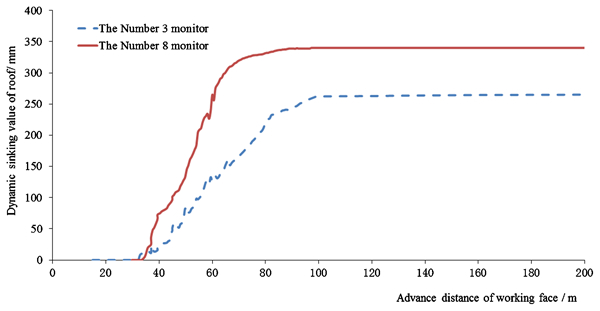
Dynamic sinking values of roof
Deformation monitoring of dam
Meanwhile, in order to monitor deformation of the dam, a mobile monitoring line was deployed along the top of dam, including four fixed points and 30 monitoring points (Table 4).
Comparative analysis of deformation parameters

As shown in Table 4, the filling ratio underground was 89·1%, the EMH was 381 mm, and the real backfill quality was better than the designed value. For the topsoil level, the maximum sinking value monitored was 42 mm and the maximum horizontal strain was 0·16 mm m−1, which were both much lower than the predicted and extreme values. No cracks developed in the dam during the mining process, and it is safe to use without further maintenance.
Economic and social benefits
Based on calculation of the total costs so far to backfill in no. 3 coal mine and income from sale of the coal, coal resources extracted from no. 6304-1 working face brought 125 million yuan of direct economic benefits. More importantly, the technology has provided a feasible solution to extracting coal resources trapped under dams in no. 3 coal mine in Jining and other similar mining areas around China. The recovery ratio was enhanced and the service life of coal mines would also be prolonged.
Conclusions
Surface subsidence and horizontal strain resulting from coal mining are two major reasons for dam damage. Specifically, the maximum sinking value that Nanyang Lake dam can withstand is 250 mm and the maximum horizontal strain value is 1·0 mm m−1.
Filling ratio and equivalent mining height are two key factors affecting dam deformation during coal mining and the solid backfill process. When horizontal distance between the working face and embankment dam is reduced, the filling ratio should gradually increase and EMH diminish for safety concerns. Specifically, when the working face has advanced right below Nanyang Lake dam, the filling ratio is supposed to reach 83% and above, and equivalent mining height should be no more than 595 mm to guarantee the dam's normal use.
After completion of recovery work at no. 6304-1 working face, the monitored maximum sinking value was 42 mm and the maximum horizontal strain was 0·16 mm m−1, which were both much lower than the predicted and extreme values. To sum up, solid backfill mining technology has played an important role in controlling strata movement and surface dam deformation and has contributed to extracting coal resources buried under dams in a safe manner.
Footnotes
Acknowledgements
This work was supported by a project of the National Scientific and Technical Supporting Programs Funded of China (2012BAB13B03), the Program for New Century Excellent Talents in University (NCET-11-0728) and the Research Innovation Program for College Graduates of Jiangsu Province (CXZZ12_0952).