







Abstract
One of the most critical and complicated steps in mine planning is the selection of a suitable layout based on geological, geographical, geotechnical and economical parameters. These parameters influence the choice of different layouts of coal mine workings and normally examined on the basis of experience gained in the coalfields. The wide ranging combinations of geological, geotechnical and mining conditions make the selection of the optimum design and layout for a particular situation a difficult task. Variations in these parameters result in multiple feasible mine layouts; where each layout entails some inherent problems and the optimal layout is the one that offers the least problems. These variations in designs result in complex multi-decision situations that cannot be solved by a simple technique. This study applies the analytical hierarchy process in selection of the most viable panel orientation for a longwall operation. A back analysis of this technique was conducted at a mine located in Central Queensland, Australia. The geological and geotechnical aspects of the mine resulted in variations in the recommended panel orientations. Three different mine layouts with variable geological and geotechnical impacts were evaluated and the optimum mine layout was determined. This study also challenged the viability of the results obtained by performing a consistency check at every critical stage of the project.
Keywords
Introduction
The selection of mine layout is one of the most critical and problematic phase in mine planning stage in coal mining. Subsequent operating factors such as ground support requirements, equipment selection and ventilation are entirely influenced by the mine layout. The ultimate goal of mine layout selection is maximising the company's profit and resource recovery while providing a safe environment for the miners by selecting a suitable layout with the fewest problems among the feasible alternatives. Analytical hierarchy process (AHP) is a multi-criteria decision method that uses hierarchical structures to solve complicated, unstructured decision problems, especially in situations where there are important qualitative aspects that must be considered in conjunction with various measurable quantitative factors (Shahriar et al., 2007). The AHP has been applied extensively in minerals industry in selections of mining layouts, roof supports, equipment and monitoring. It is also used in numerous and diverse fields such as software selection, project selection and measuring business performance; however, it has not been applied widely in the Australian coal mining industry for geotechnical considerations in coal mine layout selection. Unlike the traditional approaches utilised for layout selection, AHP makes it possible to select the best layout in a more scientific, semi-quantitative manner that preserves integrity and objectivity (Ataei et al., 2008) with an ability of detecting inconsistent judgements. The AHP models are transparent and easy to comprehend and apply. The AHP models are unique in their identification of multiple attributes where minimal data is required, and minimal time is consumed (Ataei et al., 2008).
Analytical hierarchy process theory
The AHP methodology was first developed by Saaty (1990). The AHP is a tool that is used to combine qualitative and quantitative factors in the selection of a process. It is based on mathematical framework formed by matrix and vector algebra that can easily be performed in Microsoft Excel. The mathematical framework starts with a pairwise comparison of the relative weight or dominancy of each criterion over another (Musingwini and Minnitt, 2008). To make the comparisons, scaling of numbers is required to indicate the weight and the dominance of a particular element over another element with respect to the criterion to which they are compared. This scale is used to express the evaluator's preference of criterion over another by assigning numbers that ranges from 1 for equally importance to 9 for extreme importance (Yavuz et al., 2007). The relative weight of each pair of criteria, Ci over Cj is denoted by vij such that 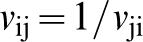 for i≠j and vii = 1, for all i. These weights form a square matrix A, of order n; corresponding to the number of criteria. This matrix is referred to as, reciprocal matrix because of the weight of one criterion over another and is equal to the weight of the second criterion over the first one (Musingwini and Minnitt, 2008). After the construction of the pairwise comparison matrix, Saaty (1990) proposed an eigenvector (priority vector) approach for the estimation of the overall weights of criteria from a matrix of the pairwise comparisons. The eigenvector has an intuitive interpretation in which it is an averaging of all possible ways of thinking about a given set of alternatives (Ekipman, 2003). The eigenvector, w is established such that Aw = λw, where λ is the corresponding eigenvalue of matrix A (Musingwini and Minnitt, 2008).
The final stage of the AHP model is the evaluation of the pairwise comparison matrix for consistency. The matrix is consistent if the relative importance is cardinal and/or ordinal consistent. For example, for a cardinal consistent matrix, if criterion C2 is twice as important as criterion C1 and criterion C3 is three time as important as C2, then it follows that criterion C3 should be six times as important as C1. For a consistent ordinal matrix, if C1 is preferred to C2 and C2 is preferred to C3, then C1 should be preferred to C3 (Musingwini and Minnitt, 2008). However, this consistency is rarely achieved since AHP deals with human judgements which are characteristically inconsistent. Therefore AHP provides a way of measuring the degree of inconsistency in judgements as well as a means for reducing this measure, if it is deemed to be too high (Saaty, 2003).
Identification of main factors related to longwall layout selection
There is large number of geological, geotechnical and coal quality factors that have an impact on longwall layout selection. Large numbers of factors (criteria) are not desirable while conducting a pairwise comparison as they lead to computational difficulties and time-consuming processes which may result in unrealistic outcomes. Therefore, 14 geological, geotechnical and coal quality factors were identified by a team of experts as the main factors for longwall layout selection:
depth of cover
seam inclination
coal quality
gas make
roof and floor strata
geological structures
in situ stress
multiple seam mining
surface restrictions
surface subsidence
access to reserve
reserve losses due to layout
seam thickness
roof cavability.
Construction of AHP model
Pairwise comparison of identified factors
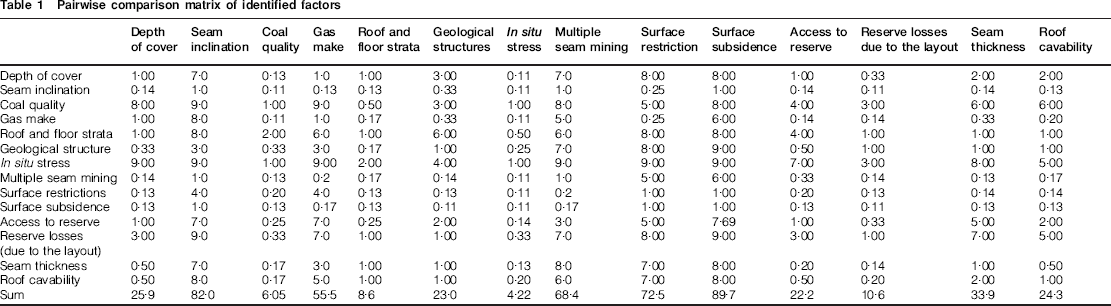
From the identified factors, a 14×14 matrix was constructed using the above critical factors. The number scale proposed by Saaty (1990) was utilised in rating each pair of factors to quantify the dominancy of one factor over another. Therefore, in order to obtain these ratings a workshop was held which involved experts in the longwall mine planning and design process from different functional areas and questionnaire were posed such as; what is the relative importance of factor i (matrix row) as opposed to factor j (matrix column)? The use of verbal scale instead of numerical scale in the AHP model is to enable the decision maker to incorporate subjectivity, experience and knowledge in an intuitive and natural way (Ataei et al., 2008). Owing to the dependency of the assigned rates on the location of the proposed mine, Central Queensland, was selected to be the region of interest and the rates of the pairwise comparisons were assigned accordingly.
As can be seen in Table 1, in situ stress was rated as highly important compared to the other factors, while surface restrictions and surface subsidence were rated as least important due to minimal restrictions on the surface.
Pairwise comparison matrix of identified factors
Relative priorities
The estimation of the relative priorities of the identified factors in the pairwise comparison matrix was achieved through the estimation of the eigenvector (priority vector). There are several methods that are available for estimating eigenvector. The computation of the eigenvector of a matrix can be accurately performed using Matlab software. However this software is not user friendly and requires a competent user. Also, calculated results in Matlab involve risks associated with human errors encountered during data input; therefore errors checking is a difficult task as the data input process is required to be repeated for multiple of times to reduce this risk.
Microsoft Excel was therefore used to estimate the eigenvector by implementing an approximation method based on normalisation (Kardi, 2006). The process of normalisation for a given reciprocal square matrix (n×n) includes the following steps:
summation of each column of the reciprocal matrix
division of each element of the matrix with the sum of its own column, this is called normalisation of relative weight, where the sum of each new column is one (1)
The normalised principal eigenvector can be estimated by averaging across the rows.
The application of this normalisation process on the identified factors’ matrix is shown in Table 2. The eigenvector of the pairwise comparison matrix has also been calculated using Matlab to confirm the validity of the results obtained by the approximation method. The approximation method results were very close to those calculated using Matlab, with only 0–5% deviation. Therefore the use of the approximation method through the normalisation process was considered acceptable.
Normalised matrix of identified factors
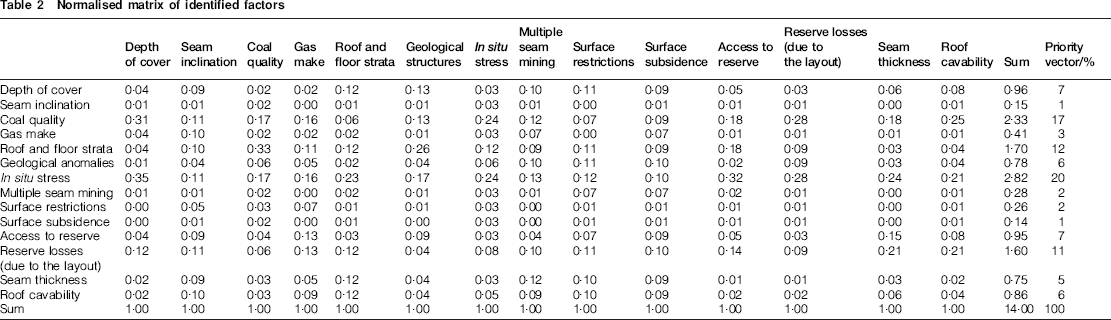
As can be seen in Table 2, in situ stress was calculated to have the highest calculated priority (20%) as it has been considered as highly important against other identified factors in the pairwise comparison. On the other hand, surface restrictions, seam inclination and surface subsidence were calculated to have the lowest priorities (1–2%). These factors were considered with low dominancy or priority due to the fact that the mine under consideration is located in central Queensland, where there are lower restrictions on surface impact compared to other regions. It is highly important to note that the given the rates and the calculated priorities of these factors are subject to alteration if other regions were considered. For example, if a mine in New South Wales was considered, surface restrictions and surface subsidence would be expected to be given higher ranking and hence result in higher priorities.
Consistency measure
When dealing with tangibles the pairwise comparison judgment matrix may be perfectly consistent but irrelevant and off the mark of the true values (Saaty, 2003). Therefore, a small degree of inconsistency may be considered as good practice and forced consistency without the knowledge of the precise values may lead to an undesired outcome. Inconsistency of a matrix indicates a contradiction in preference of a pairwise comparison to another. It is important to note that the AHP does not require decision makers to be consistent but, rather, it provides a measure of inconsistency as well as a means for reducing this measure if it is deemed to be too high (Ekipman, 2003). Saaty (1990) states that AHP estimates consistency by determining the principal (maximum) eigenvalue λmax.
The principal eigenvalue was obtained from the summation of products between each element of the eigenvector (priority vector) and the sum of the columns of the pairwise comparison matrix (Kardi, 2006). The principal eigenvalue of the pairwise comparison matrix for the identified factors was estimated to be 18·13. A consistency Index (CI) was then calculated from λmax to measure the deviation from consistency using the relationship defined by equation (1)
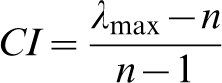
Using equation (1) and the estimated principal eigenvalue, the value of CI was estimated to be 0·32. For a perfectly consistent matrix, λmax = n; where n is the number of identified factors; and hence a CI value of zero is expected. Since the calculated CI value is greater than zero, inconsistency was expected in the pairwise comparison matrix.
In order to measure the level of inconsistency of a matrix, the consistency ratio (CR) was required to be calculated. As a general rule, a CR of 0·10 or less is considered acceptable (Saaty, 1990). The CR is calculated by assessing the value of CI against judgements that are made by experts and completely at random. Saaty (1990) simulated large sample of random matrices of increasing order and calculated their corresponding CIs which are Random Indices (RI). For matrices of order between 1 and 15, Saaty established the corresponding RI. The CR was calculated by dividing the CI (0·32) by its corresponding RI (1·57), to give a value of 0·2. The calculated CR was clearly higher than the acceptable ratio of 0·1, which made the pairwise comparison matrix inconsistent. Therefore, a revision and reconsideration of the subjective judgements was required.
AHP model validation
Methodology
Consistent matrices are essential because when dealing with intangibles, human judgments are usually inconsistent, and if the decision maker is able to improve inconsistency to near consistency, then that can improve the validity of the priorities of a decision (Saaty, 2003). This can be done through the revision of all the data entries in the pairwise comparison matrix and reconsideration of the entries that cause the inconsistency. However, this process can be time consuming as the size of the matrix increases.
Several alternatives, mostly based on various optimisation techniques, have been proposed to help improve consistency. Saaty (2003) proposed a method based on perturbation theory to find the most inconsistent judgment in the matrix. This method could be followed by the determination of the range of values to which that judgment can be changed and whereby the inconsistency could be improved and then asking the decision maker to consider changing the judgment to a plausible value in that range (Benítez et al., 2011). This paper utilised this method in an iterative manner to assist the decision-maker to detect and adjust inconsistencies and to represent more acceptable judgements (Li and Ma, 2007).
The first step in Saaty perturbation theory is the detection of the matrix entry that is causing the inconsistency. Inconsistency detection is based on the fact that
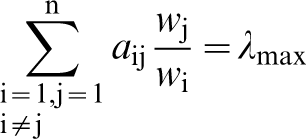
This relationship suggests that examination is required for the entry aij for which aij(wj/wi) is the largest, and determine if this entry can reasonably be made smaller. A reduction of this entry is preferable as such a change will result in a new comparison matrix with smaller eigenvalue and hence more consistency.
The second step in this method is to estimate the most consistent value for the matrix entry. Harker (1987) has shown that the most consistent value for the entry aij can be estimated by
replacing the entries aij and its reciprocal aji, by zeros, and the two corresponding diagonal entries by two
calculating the new eigenvector w′
estimating the new (consistent) value of the entry aij by considering 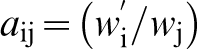 , where aij is the consistent value of entry aij, and wi and wj are the entries of the new calculated eigenvector that correspond to the entry aij.
Results
Implementing Saaty's method, the pair; multiple seam mining and surface restrictions; was identified to have the largest aij(wj/wi) value. Proceeding with Saaty's method, the most consistent value was estimated. However, another workshop was required to validate the estimated value, as simply substituting the most consistent value into the matrix creates a forced consistency situation which is undesirable. The pair had an initial value of 5, but applying Saaty's method; a new value of 1 was estimated for the pair. In order to validate the new estimated value, another workshop was held with the same experts, deciding on a value of 2. From the substitution of the new value of the entry and the estimation of the new priority vector, a new CR of 0·19 was estimated.
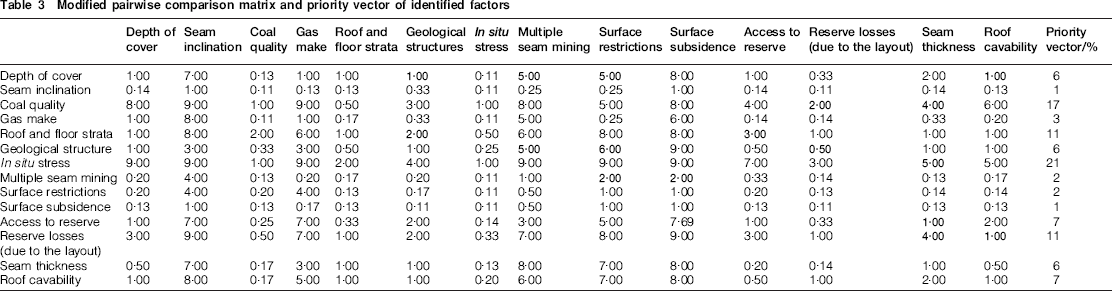
The application of Saaty's method resulted in a 5% reduction of the CR; however, this reduction was considered insufficient to achieve the desired consistency. Therefore, multiple iterations were performed with the subsequent largest inconsistent judgements. The identified new values for the inconsistent pairs were substituted into the original pairwise comparison matrix as highlighted in Table 3 and the new priority vector was estimated. From the modified pairwise comparison matrix and the new estimated priority vector, a new CR was estimated to be 0·13. The estimated value of the CR was still above the acceptable consistency limit (0·1). However, as explained in the section ‘Consistency measure’, this degree of inconsistency is considered to be reasonable as the forced consistency may lead to an undesired outcome without the knowledge of the precise values.
Modified pairwise comparison matrix and priority vector of identified factors
Case study: Mine A
Overview
The second stage of the AHP is the construction of pairwise comparisons between various alternatives (mine layouts) under each criterion (factor). In order to complete this stage, a mine at the feasibility stage, Mine A, located in central Queensland was used as a case study. Longwall mining was selected to be utilised for coal extraction. The geological and geotechnical aspects of the mine resulted in variations in the recommended panel orientations. This work evaluates three different panel orientations with variable geological, geotechnical and coal quality impacts.
Geological and geotechnical conditions
Owing to the sensitivity associated with the data collected from Mine A, only general trends of the geological, geotechnical and coal quality data are provided in this paper.
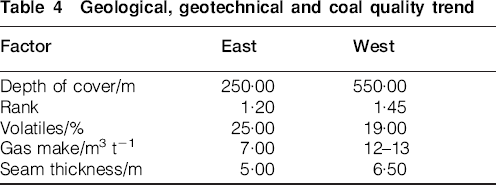
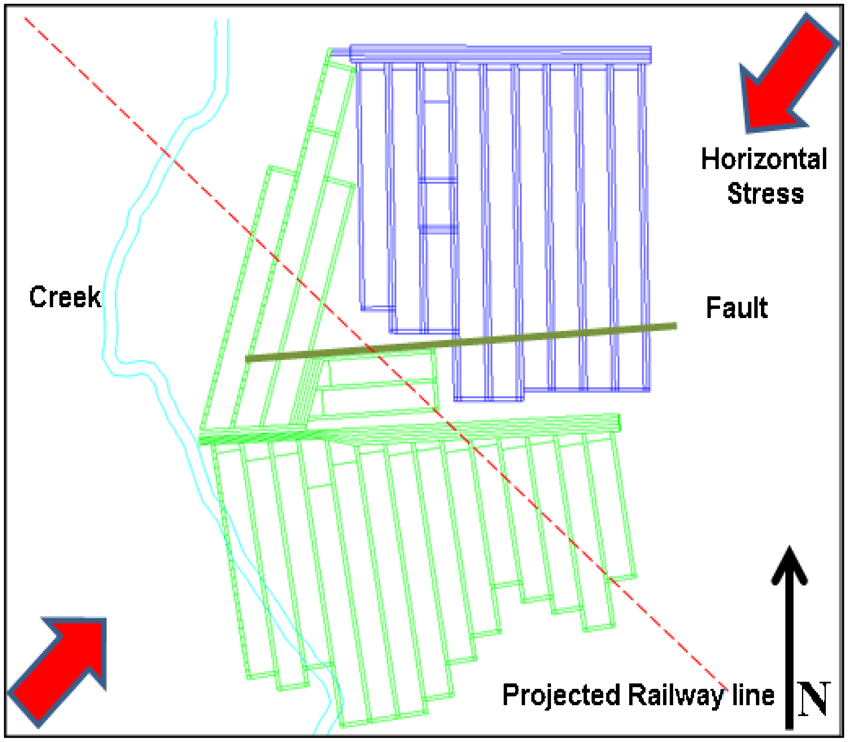
Overall the in situ horizontal stress is oriented at N30E. There is only one major normal fault with a dyke oriented at EW direction. The fault has a throw of 6 m down to the north. Surface restrictions are represented by a projected railway line and a creek running across the expected mining activity area as shown in Fig. 1. Other geological, geotechnical and coal quality aspects varies in the easterly direction, as shown in Table 4.
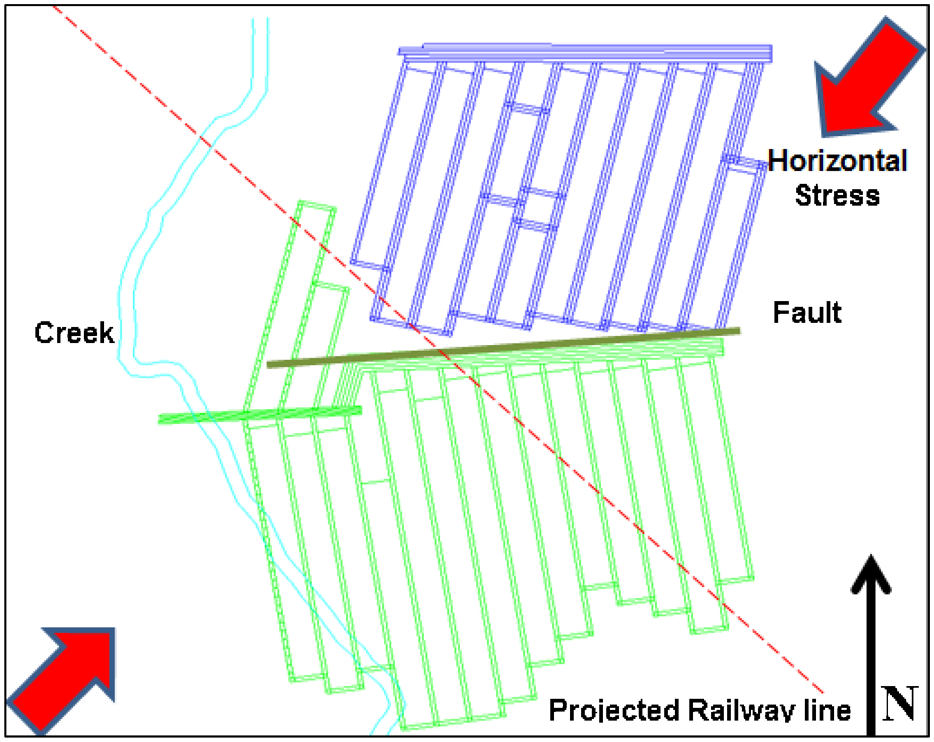
First proposed mine layout
Geological, geotechnical and coal quality trend
Other factors such as multiple seam mining, roof and floor strata and roof cavability were considered to have the same conditions within the active mining areas.
Proposed mine layouts
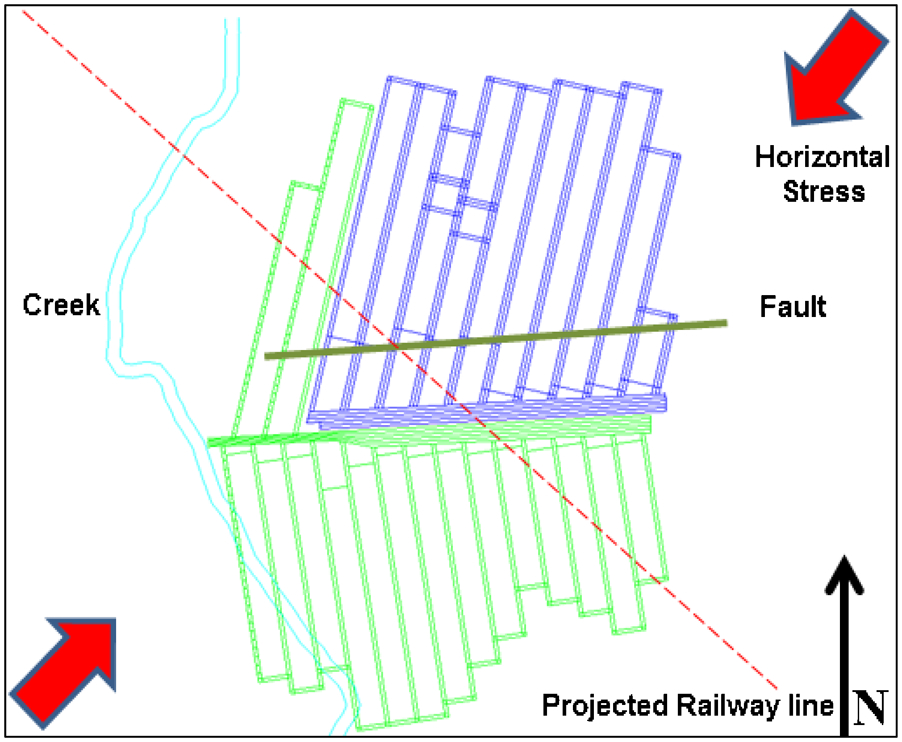
Figures 1–3 represent the three proposed layouts against the horizontal stress, major fault and other surface features.
Second proposed mine layout
Third proposed mine layout
Layouts comparisons
The three proposed different longwall layouts have different mining directions, panel orientations and panel configurations. These variations in layout were expected to have various geological, geotechnical and coal quality impacts, such as:
in terms of coal quality, layout 2 was more preferable than layouts 1 and 3 as it provided a consistent coal quality per panel compared to the other two layouts
considering the longwall panel length of the three layouts, layout 3 has the greatest panel length than other layouts. Therefore, layout 3 would require more complex gas drainage and hence least preferable compared to other layouts but less longwall moves
considering the location of the major fault, layout 1 was strongly more preferable than layouts 2 and 3 as the fault was avoided in layout 1, whereas it cut through the longwall panels in the layouts 2 and 3
all the layouts have different panel orientations to the in situ horizontal stress; therefore, various impacts with respect to stability of the layouts were expected. Layouts 1 and 2 are proposed to retreat from South to North. In this orientation, the stress notch (i.e., increased horizontal stress level about the gateroads during longwall retreat) is minimal and potentially affects only the tailgate that will be supported. On the other hand, layout 3 is proposed to retreat from North to South, in this case there may be a maingate stress notch, which is undesirable as the conveyor belt will be placed in the gateroad. Also layout 1 has potentially lower stress notch on the tailgate than layout 2, since layout 1 is aligned more with the in-situ horizontal stress. Therefore, from the horizontal stress notching point of view layout 1 was considered as most preferable, while layout 2 was more preferable than layout 3
the only surface restrictions are represented by the railway line and the creek. Layout 1 was considered to be more preferable than the other two layouts. This because larger sections of the railway line are above the mining activity area in the other two layouts compared to layout 1
considering the access to reserve, access to layout 3 can be established relatively quickly and at lower cost from the existing workings of the mine. Whereas layouts 1 and 2 will require conveyor drift, man and material vertical shaft. Therefore, layout 3 was considered strongly more preferable than layouts 1 and 2
due to the various panel configurations between all the layouts, layout 3 was considered to have the least reserve losses compared to layout 1 and 2. Also layout 1 has also lower losses than layout 2
impacts with respect to the other factors such as depth of cover, seam inclination, roof and floor strata, multiple seam mining, surface subsidence, seam thickness and roof cavability were considered to be similar for all the layouts. All the layouts were therefore considered equally important with respect to these factors.
Pairwise comparisons of proposed layouts
The second phase of the AHP is the construction of layouts pairwise comparison matrices and the assignation of rates for the alternatives (layouts) with respect to each criterion (factor). This was performed through the construction of a workshop with the same experts where questionnaires were posed to compare alternative i against alternative j with respect to a particular criteria. This comparison was performed using the same number scale proposed by Saaty (1990). The eigenvector (priority vector), the principle eigenvalue (λmax) and the consistency ratio (CR) were calculated in the same manner as the pairwise comparison of the identified factors as shown in Tables 6–13 in Appendix.
The three layouts had an equal importance with respect to factors, including: inclination, roof and floor strata, multiple seam mining, surface subsidence, seam thickness and roof cavability. Therefore, the pairwise comparison matrix and the estimated priority vector for these factors are identical to those for the three layouts with respect to depth of cover as shown in Table 6 in Appendix.
Overall priorities and optimum mine layout
The final stage of the AHP model is the estimation of the overall composite weight of each layout based on the estimated priority vector of both identified factors and layouts. Table 5 shows the priority vector of the identified factors, the priority vector of the layouts with respect to each identified factor and the estimated overall weight of the layouts. The overall weight has been estimated by the summation of the product between the priority value of an identified factor and its corresponding priority value of a particular layout.
Overall priorities and overall composite weight of layouts
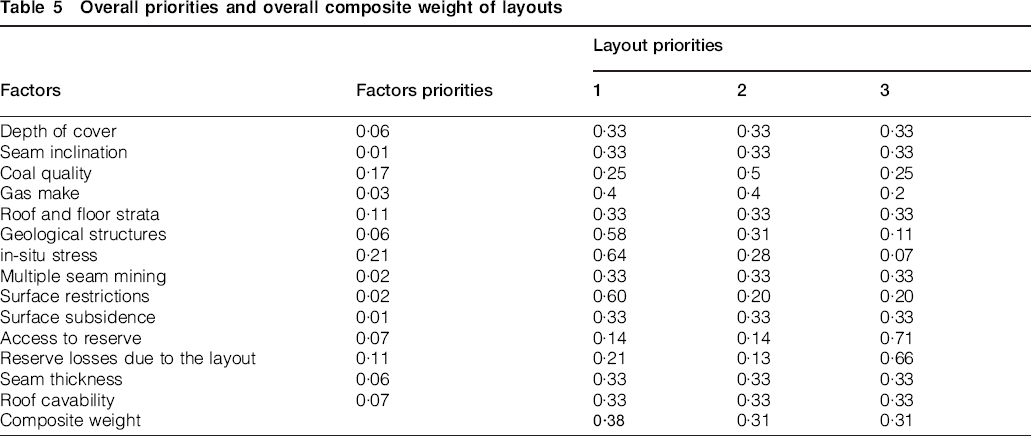
From Table 5, it is evident that layout 1 is the optimum mine layout with a weight of 0·38; followed by layouts 2 and 3 with equal weight of 0·31. These results were expected as layout 1 had higher priority than the other two layouts with respect to in situ stress, which also had the highest priority against other factors.
Overall consistency measure
It is still essential to estimate the overall consistency of the hierarchy as this will give an indication on the validity of the AHP results. The overall consistency of the hierarchy was estimated by dividing the sum of the weighted CI by the sum of the weighted RI. The overall consistency of the AHP has been estimated to be 0·1, which indicates that the results are consistent and valid.
Conclusions
This paper has summarised the development of a method for layout selection using the AHP. Owing to the broadness of the proposed study, the scope was directed to the development of a method for longwall layout selection in the central Queensland region. The geological, geotechnical and the coal quality aspects that influence the selection of panel orientation were identified.
The inter-relationships between the factors and the dependency of each factor on others indicated the necessity of AHP as a decision making tool. From the identified factors, an AHP model has been created. A pairwise comparison matrix was constructed for the identified factors, where in-situ stress was identified as the most important factor with priority of 0·21 for the selection of a longwall layout. Surface subsidence and surface restrictions were identified as the least important as there are limited restrictions on surface in Central Queensland compared to other regions.
A longwall mine at the prefeasibility stage, located in central Queensland, was assessed using the methodology developed. Three proposed layouts were compared with respect to each identified factor and their priorities were calculated. The results from the pairwise comparisons of the identified factors and the layouts were then combined and further evaluated to select the optimum mine layout.
The results of each stage in the AHP model were validated through the estimation of the consistency. For inconsistent matrices, a method has been implemented to improve the consistency of the judgements and transform the inconsistent matrix to a near consistent one.
The results revealed that the AHP model developed in this paper can be used as a basis for implementing longwall layout selection. If new critical factors and hence new criteria emerge to satisfy decision makers need, then they can be included in the AHP model to select the optimum layout. Unlike the traditional approaches to layout selection, the AHP method requires less data and reduces the time consumed in the decision making process.
Footnotes
Appendix
Acknowledgements
The authors wish to thank the following persons for their support and guidance, who have given up their time to aid at every stage of the project: Anna Mills who assisted in the data collection process; Andrew Laws who greatly assisted in providing invaluable geological data for the project; Anglo American Metallurgical Coal for providing access to the data and permission to publish this paper; and last, thanks to Dr Phillip Isaac, lecturer in the School of Mathematics and Physics at the University of Queensland, who also gave up his time to aid with data validation process and provide support and guidance when progress stalled.