







Abstract
Can large-screen visualisation and simulation technology be utilised to depict sustainable mining practices? The system described here provides an opportunity to experience a mine site and the surrounding area via visualisation and simulation. The system presents sustainable mining concepts that must be managed at a mine site surrounded by a national park. The system includes historic and current data and perspectives from mine site, environmental and local personnel. All information must be assessed against an original environmental impact statement and conclusions be drawn upon how the mine has developed. Knowledge gained is transferred to a new site, and issues must be resolved to the satisfaction of all stakeholders. The paper summarises the system and reports outcomes of a trial deployment. The results are encouraging, and the system may prove to be a useful tool for community engagement and mine planning on future projects.
Introduction
Increasing demands on the environment require that mining operations adopt sustainable mining practices. The aim is for mines not to pass on negative impacts to future generations. This concept concurs with definition of sustainability. That is, enable ‘development that meets the needs of the present without compromising the ability of future generations to meet their own needs’ (Bruntland, 1987). This is easy to propose in principle, but in real life is much more problematic. Thus, advanced visualisation tools may assist with comprehension and understanding and enable operators to achieve sustainable mining practices.
Mining by its nature presents technical challenges and results in complex environmental and social impacts. Risk involved in such issues must be managed. Laurence et al. (2011) present a number of handbooks dealing with concepts, case studies and goals that must be addressed and effectively managed to ensure sustainable mining practices are achieved. Such documents are a valuable resource. However, as with much technical literature, information remains mainly text based and it not always easy for people to understand, or place in a real world context. Also, the magnitude of the environmental and social tasks managed by mining companies in order to maintain a ‘social licence to operate’ is not always evident from such text-based information.
Another problem is the massive amount of information presented in environmental impact reports required for the development of a modern mining operation. Data and information contained within such reports requires significant mental effort to build up a mental picture and understand what has, will or may transpire over the life of a mining operation. What is required is a medium that reduces the need for people to mentally interpret and understand many data sets, thus allowing people to focus on what exactly specific data means or infers, by placing data in real life context and in an easy to understand format. Hence, the research question addressed in this paper is, ‘Can large-screen visualisation and simulation technology be utilised to depict sustainable mining practices?’
This paper proposes that a large-screen visualisation system may provide a tool to achieve this and presents encouraging results of a system trial. In this paper, the term visualisation and simulator refers to computer-generated images overlaying digitally recorded video images; however, these could also potentially be real-time video images as in the definition of mixed reality (MR) (Milgram and Kishino, 1994).
Mixed reality
Mixed reality technology is relatively commonplace nowadays. Its power lies within the ability to combine real, digital and computer-generated images, video, environmental data sets and many other types of information and present them in a real world context. Mining MR is an extension of virtual reality (VR) work performed in the mining industry by researchers such as Schofield et al. (1994), Squelch (1997), LeBlanc-Smith et al. (1998) and Foster and Burton (2003).
Because data and information are represented graphically and superimposed over real world images, or in this case, digital images, MR reduces the need to construct a mental picture of data within a person's mind. What a person sees on screen is a ‘real’ representation of some event. The mental model developed of a traditional text based in environmental impact statement for example may actually vary from person to person depending on their previous experiences or opinions. The result of using a visualisation system should be a reduced cognitive load and an improvement in understanding of data and its implication via the use of examples and case studies.
Figure 1 shows that mining simulators can potentially span the entire virtual continuum of Milgram and Kishino (1994). Most mining simulators tend towards the virtual environment end of the continuum, as they are generally 100% computer-generated images as shown in Fig. 2.
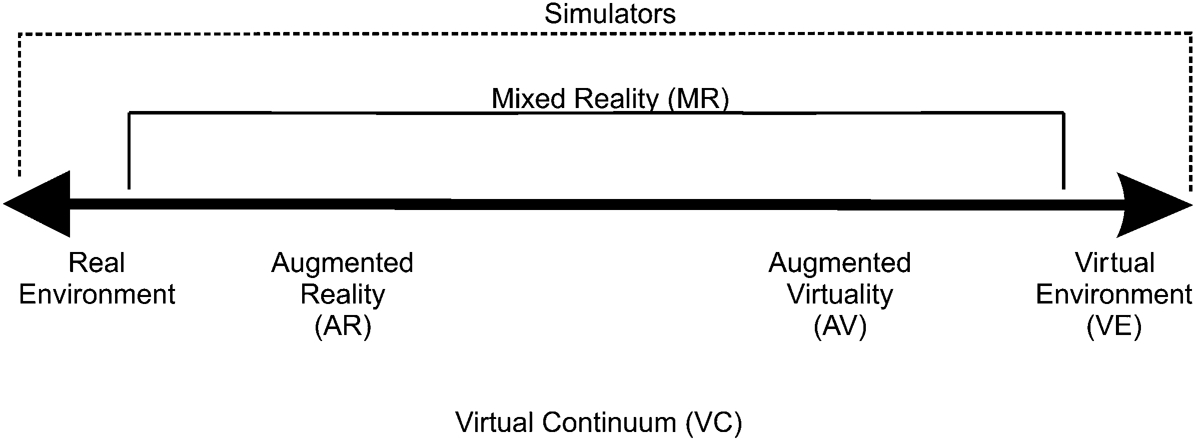
Virtual continuum [modified after Milgram and Kishino (1994)]
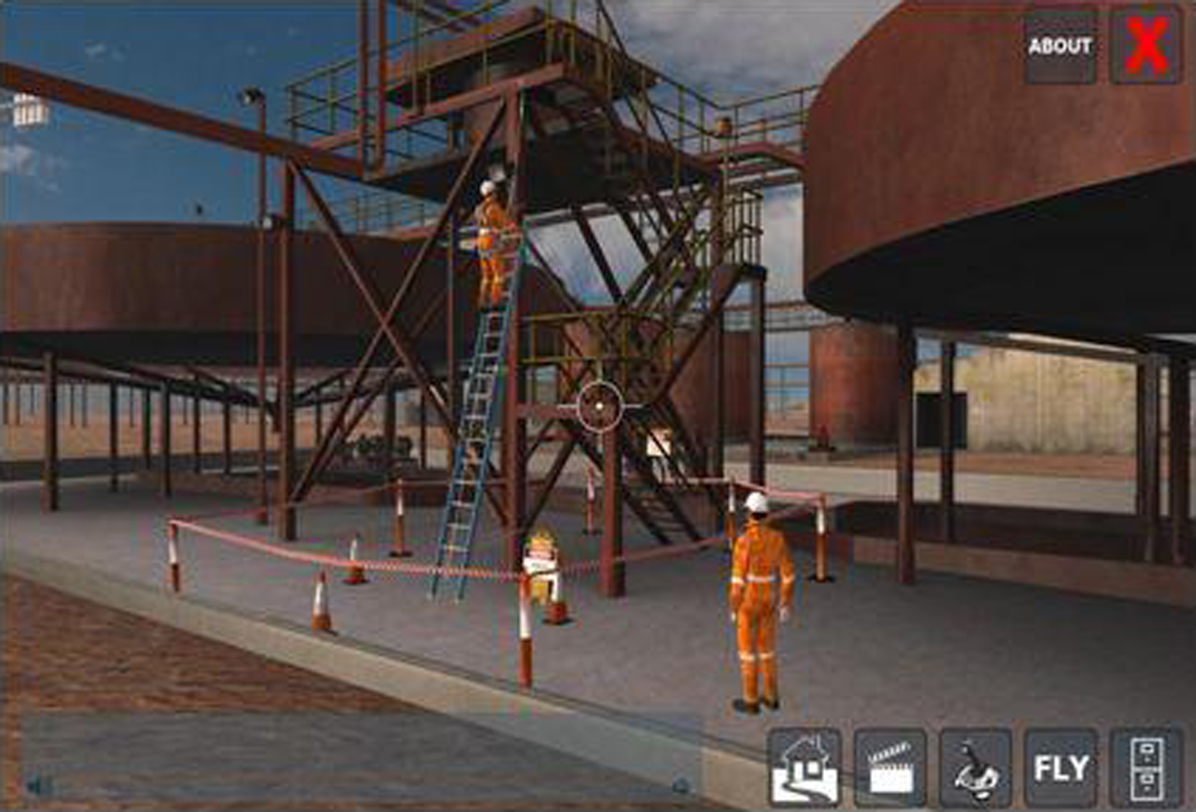
Virtual reality mine simulation
Mine VR simulators
Virtual reality systems applied to mining have been described by many authors (Squelch, 1997; Bise, 1997; Denby et al., 1998; LeBlanc-Smith et al., 1998; Schofield et al., 1994; Kizil et al., 2003; Kizil, 2003; Schmid, 2003; Schmid and Rossmann, 2004; Lucas and Thabet, 2008; Schmid and Winkler, 2008; Orr et al., 2009; Wyk and DeVilliers, 2009; Immersive Technologies, 2013; Thoroughtec, 2013; Tichon and Burgess-Limerick, 2009). In the mining industry, the term simulator is now synonymous with the term VR, and simulators are commonly used in mining for equipment training (CSPL, 2013; CAE Mining, 2013) and induction training (Dowsett, 2011). However, despite much development, simulator use appears immature with respect to application (Stothard and Swadling, 2010).
This issue should be addressed by the mining industry via University research, to bring simulators into broader mining operations. Systems range from small single-screen devices to large-screen immersive environments. An example of this type of collaboration was demonstrated by iCinema and UNSW School of Mining Engineering, who pioneered the introduction of VR simulators into the coal industry in NSW during the period 2000–2010 via the iCASTS and Mining VR projects (iCinema, 2013).
Visualisation and simulation are also commonly used in other industries such as architecture and forestry. An example of advanced interactive visualisation technology developed for the forestry industry by the University of British Columbia's collaborative advanced landscape planning group (CALP, 2014) is an example. This group has developed a professional learning opportunity via integration of cutting-edge technology that supports innovative instruction. CALP researchers present their ideas to instructors, demonstrate state of the art augmented reality and immersion technology being used (CALP, 2014). Another similar example of University collaborative visualisation is the HIVE at Curtin University, where researchers develop visualisation systems and techniques for diverse research groups (HIVE, 2014).
Virtual reality system content can be time consuming to produce and inflexible when the time comes for updating. Proprietary systems can be difficult to manage and innovation can be lacking. That is, systems tend to stall, unless driven by a research organisation or dedicated VR research sponsor.
Practical issues such as ownership, system maintenance and site safety compliance can also present barriers and result in lack of use. Mine sites are busy, and regulated places and the introduction of new technologies to site requires significant planning and engagement of the end user at site to ensure that the system can be correctly integrated into routine operations.
Why use a large-screen immersive visualisation system?
The power of visualisation systems is that real case studies can be shown within a safe and forgiving environment. Case studies allow people to experience situations as they would on-site and acquire and retain knowledge, generate new knowledge and apply that knowledge and associated experience to a new situation. The aim of large-screen visualisation is to provide a team-based site experience.
The ability to learn from the past and transfer that experience and knowledge forward is essential to the pursuit of a sustainable operation under the context of sustainable mining practices. Allowing people to develop knowledge in this way is aligned with the concept of sustainable development by ensuring that people understand that their actions today, if not properly managed, may pass on legacies to future generations.
The range of stakeholders involved in a mining operation is diverse, and its associated locale and environment can be equally very broad. Hence, placing information in an easy to use format for both technical and non-technical people to understand can be challenging. Visualisations presented as MR on a large-screen visualisation system can help address this challenge by taking stakeholders to site as a group when it may not be practicable to do so in real life.
Modern visualisation systems leverage the latest high-technology multimedia methods. For example, in New South Wales, large-screen visualisation systems are in daily use for training (CSPL, 2013). Within mining, visualisation presents an opportunity for historic, current and future mining data and experience to be recorded and interrogated in a visual environment. Nowadays, techniques include digital-photography, photogrammetry, 360° video, web-based communications, satellite imagery, computer graphics and sensor technology, and all provide a valuable resource that can be used to store, interrogate and interpret datasets and information that are generated by mining operations.
An issue that can be overcome via the use of visualisation is that safe and consistent mine site access is often difficult to achieve because of safety issues, staff availability remoteness and so on. This makes site access for education, community and stakeholder engagement very difficult indeed. Also, local site knowledge is often located within individuals, teams or repositories of text-based documents.
Subject matter experts are extremely proficient at dealing and interpreting their own data sets, but unfortunately, when the time comes to present data or work with datasets from other sites or disciplines, or more importantly, present information to non-technical stakeholders, key information can be lost or misinterpreted. This situation can present a major obstacle for forums such as community engagement, where one person's perception of a dataset may not necessarily be the same as another's. Unfortunately in some instances, conflict can be the result.
Ideally, information should be presented so that it can be easily comprehended and understood by all. One person's or a team's experiences or opinions should be easily available for others to learn from and the perception and understanding from one person to the next should be consistent.
Importantly, visualisation allows complex concepts to be presented graphically to any audience, anywhere at any time. An ore body can be visualised in high resolution and fidelity before extraction. This concept was developed by researchers such as by LeBlanc-Smith et al. (1998) for visualising mine data. Many modern mine planning software programmes provide this facility, but do not always provide an immersive ‘on-site’ experience and training in the use of software is often required.
A highly important aspect from the perspective of sustainable mining practices that can be demonstrated relatively easily is the remediation and final restoration of landforms following the cessation of mining. Using visualisation and simulator systems, these issues can be modelled, visualised, assessed, tracked and presented to stakeholders. Via such predictive modelling and visualisation, the impacts of mining can be shown over the short, medium and long terms. Importantly, a starting point can be determined and recorded as a baseline against environmental and social performance and as a tool that can be used for sign off when the time comes to relinquish a mining lease. The system provides transparency to all stakeholders via imagery and photographic record is established that can be used as a baseline for negotiations.
Sustainable mining practices
The term ‘sustainable mining practices’ is a tangible concept and has five dimensions: safety, environment, economy, efficiency and community (Laurence and Scoble, 2009). It implies sustaining the industry, sustaining an individual mining operation as well as providing sustainable benefits for the community and other stakeholders. The five dimensions are as follows:
Safety: Most important is safety of the mine operation. The use of risk management techniques has been universally adopted in Australian mining, and a significant reduction in lost time injuries has resulted.
Socially acceptable: Unless the community is engaged and supportive of a mining operation, opposition and confrontation may ensue. This distracts management from efficient mine operation. Mines maintain their social licence via various initiatives including employment of locals and training in pursuits that endure after mine closure.
Environmental excellence: Adopting leading environmental management practices makes excellent business sense. Unless steps are taken in the planning and operational stages to protect environmental values then long-term liabilities (such as acid mine drainage) may result.
Economic: Mines must be economic to be sustainable. The manager's objective is to generate profit responsibly for as long as possible. This maximises the equitable benefits to all stakeholders who depend on the mine.
Efficiency: Mines must be efficient in the way that a resource is managed and extracted. ‘High grading’ ore bodies is an unsustainable mining practice. During high commodity prices, it is sensible to mine lower grades to extend mine life. There is usually one opportunity to mine a deposit, and it is important to get it right. This efficiency dimension is rarely considered in the literature on mining and sustainable development.
All the above dimensions of sustainability can be demonstrated within AR, the various data and their relationships can be considered visually and may lead to improvements in all of the areas of sustainability. Inter-relationships and complex data can be modelled and expressed and explained to stakeholders.
Application of visualisation to sustainable mining practices
Mining staff may stay on a site for 2–3 years, less if it is a remote site. The result is that local knowledge is often lost and must be relearned. Retaining knowledge is important for long-term mine sustainability because industry wants to learn from past mistakes and not repeat them. Visualisation provides an opportunity for careful consideration of experience and past events, leading to more informed decision-making processes. Innovative ideas can leverage past experience and the issue of the resource sustainability can be assessed to ensure the maximum benefit is gained for all stakeholders.
Mine site access is required for stake-holder engagement when trying to present new ideas or planned mine development. This may prove difficult, because of the risk involved in exposing visitors to a real mine site. Mine production pressures mean that key personnel are not always available, and the time and locations needed to examine and present data in context may simply be impracticable, especially when large numbers of people are involved. Hence, an alternative is required that allows people to take a site tour at their leisure via a low-risk environment.
Presenting environmental issues via a large-screen immersive environment that depicts an existing mine site or potential future mine site offers an opportunity to take people on-site at remote locations without them having to physically leave the safety of the ‘office’ (Figs. 2 and 3). Immersive visualisation systems provide safe and forgiving environments that can be visited multiple times without impacting on remote environments or existing mine operations. When the potential cost impact of lost production is considered along with the risk and logistics associated with a real site visit, multiplied by numerous visits, the potential cost savings and reduction in risk exposure are considerable.
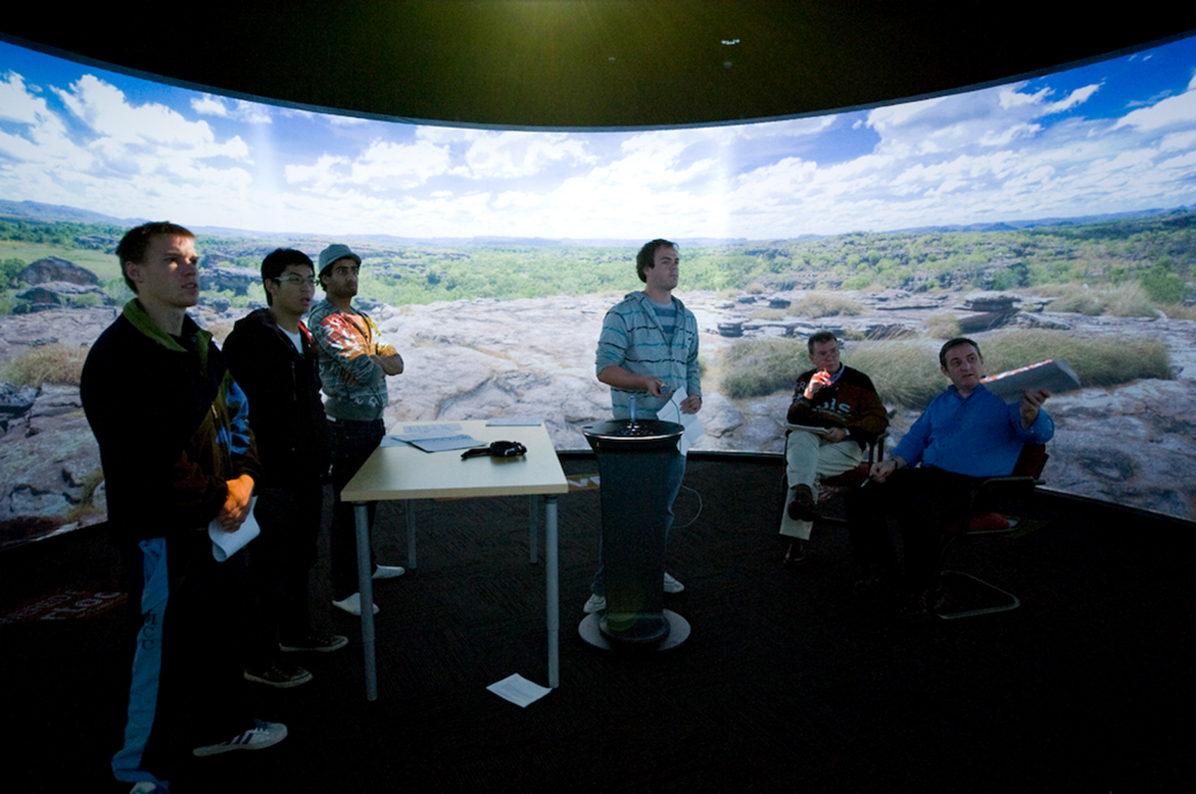
Simulated environmental tour
Figure 4a and b show the concept of a large-screen visualisation system to sustainable mining practices. Via the system and the included material, people can view the site in an immersive environment and learn about the operations. Once an understanding of sustainability issues is reached and methods for ensuring sustainability are developed, stakeholders can then visit the real site with a more accurate opinion and with time, cost and risk minimised. A more efficient use of ‘time on-site’ will be possible. A benefit is that in the simulated environment, as much time as required can be taken to view concepts and perform ‘what if’ scenarios without impacting on the real environment or affecting production issues. A detailed assessment of potential sustainability issues can then be determined.
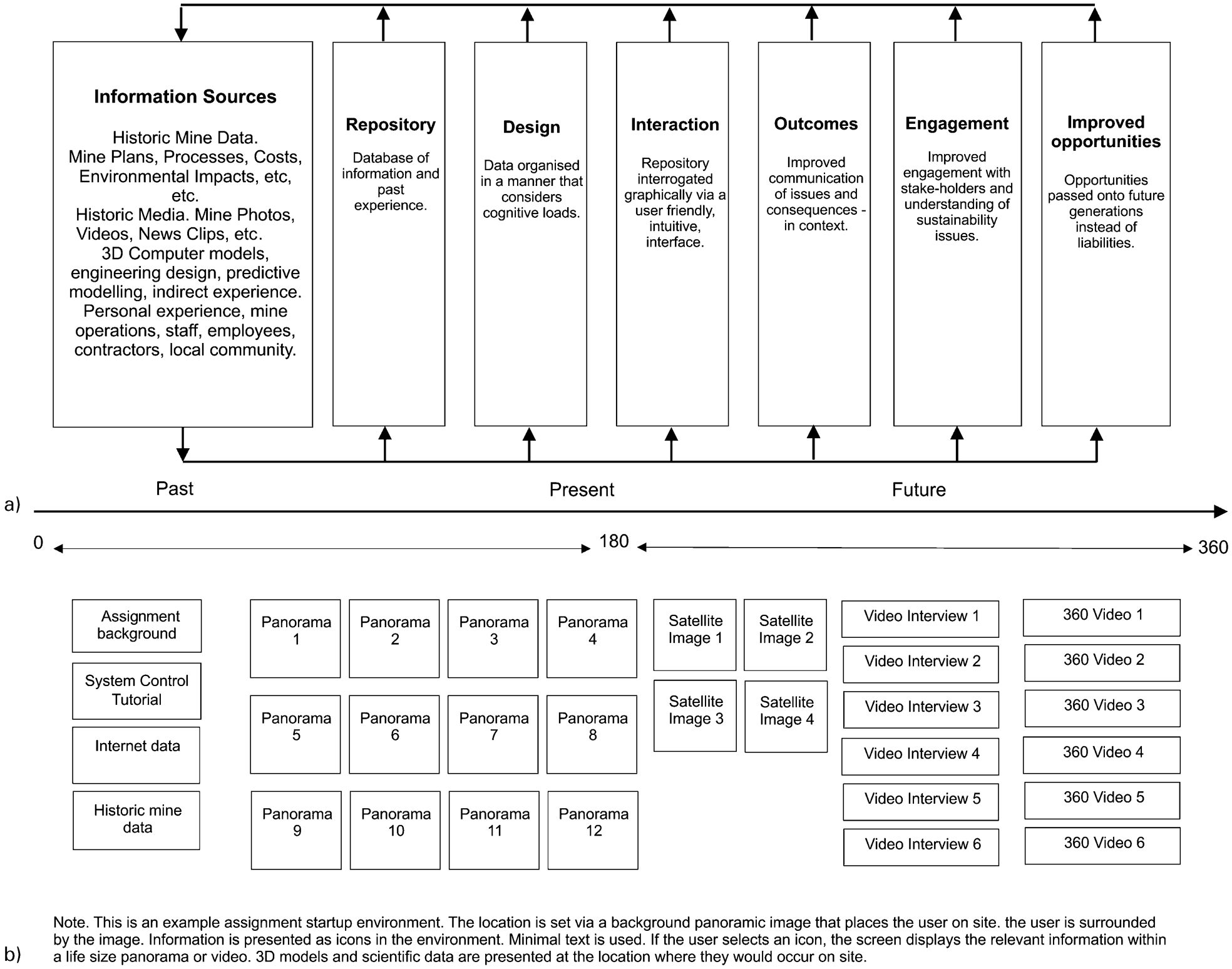
a Concept of the application of a large-screen system to sustainable mining practices. b Presentation of material within the system
Information learned from case studies can be placed into the system and can be reviewed and subsequently be applied to operations. Interaction with the data in this simulated environment provides a mechanism for users to become engaged with material and information graphically and for the interpretation and impacts of mining activities to be evaluated from a sustainable position.
The power of the system is that users can interrogate different datasets, media and scenarios simultaneously and with the aid of modern computer graphics and modern display screen technologies ranging from Class 1 to Class 10 systems (Stothard et al., 2008), almost any type of media can be displayed interactively in real-time to any audience. A large-screen Class 7 system is shown in Figure 5a–c.
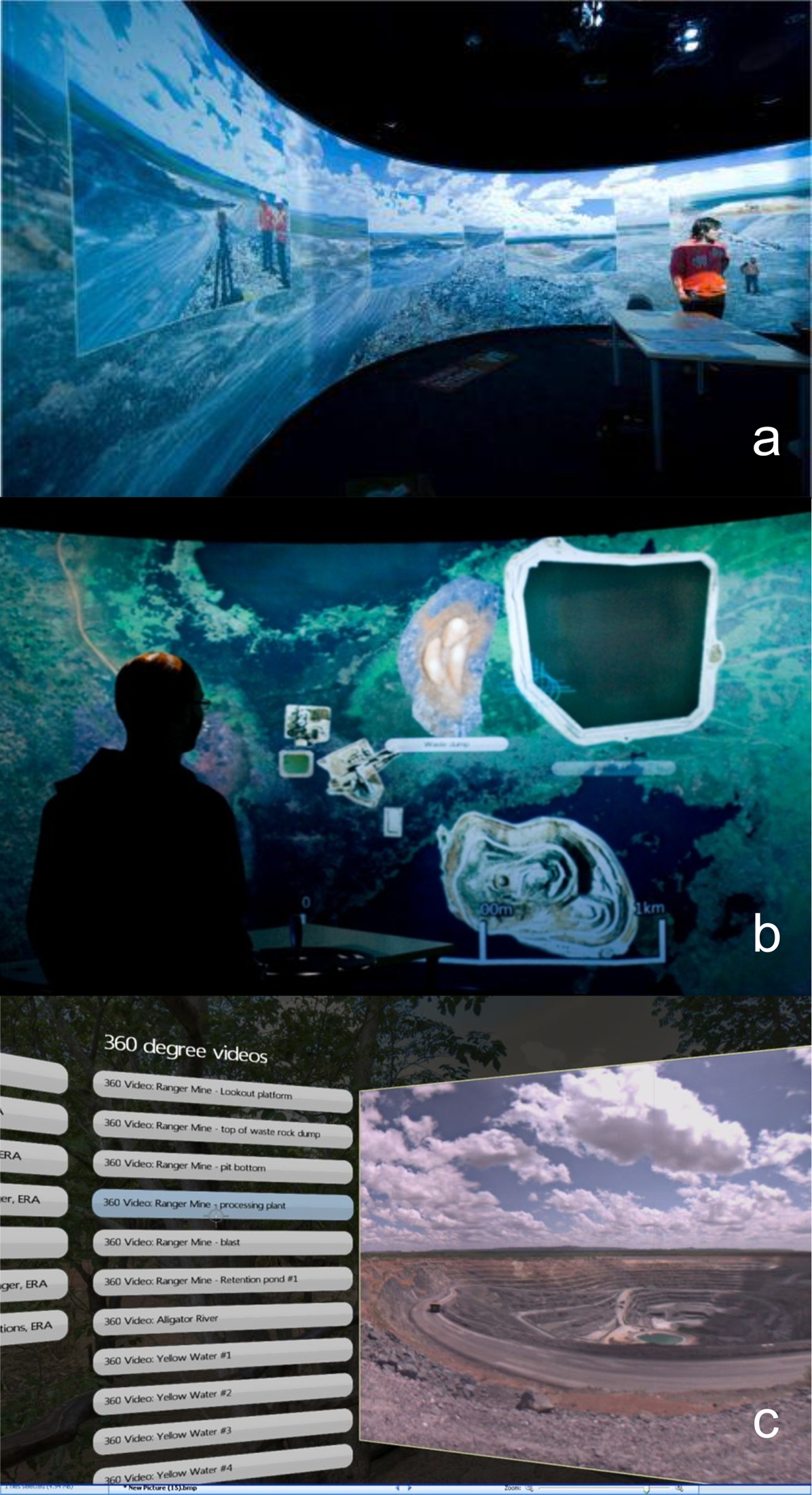
a On-site discussion. b Satellite data and infrastructure modelling. c 360° video and personnel interview
The system utilises, digital 360° panoramas, 360° video, computer-generated 3D models, accesses a database of chemical data, video interviews and other directly related and peripheral information. An advantage of the system is that it is fully scalable. A database of information draws upon past experience, and this knowledge is interrogated by users and subsequently built upon. Information is placed within a repository within the system. The visualisation system was developed by iCinema of UNSW and is installed at many locations around Australia and elsewhere (iCinema, 2013).
Mine site visualisation prototype trial
An UNSW course, ‘mining in a global environment’ provides students with tools necessary to meet the challenges of working as international mining engineers and managers. A highlight is the opportunity to immerse themselves in a virtual mine site over several sessions. A remote mine was chosen because of its complexity of issues. Students required an opportunity to examine information and assimilate it in context to make it meaningful. There are numerous information sources relating to the chosen mine. However, much information is presented abstractly, in text-based format and via two-dimensional drawings. A detailed environmental impact statement (Anon, 1974) exists, but understanding, and relating this information contextually to a modern site is difficult. One reason is that the mine site today is somewhat different to that envisaged in the original report.
A development driver for the visualisation was to provide students with experience of the issues involved in running a mine site within the strict guidelines associated with a mine site surrounded by a national park. What is required is a technique where people can become engaged with the site and its surrounds and through interrogation of information such as environmental impact statements, mine data, mine personnel and so on, in context and ‘on-site’, they can attempt to address and understand the issues of sustainable mining practices relating to the site.
Mining students were placed in small groups, given a one-page outline of the objectives and expectations and how they should proceed. A 10 min demonstration of the innovative controls was given. The students were then left to interrogate the data via a simulated mine tour. Example images are shown in Fig. 5.
The task was to consider sustainability issues surrounding the mining of a new resource located in a highly sensitive area. Their decisions were to be based on experiences gained from interrogation of the visualisation of the real mine site. By acquiring site-based knowledge and experiences they then presented a case for the sustainable development of a new hypothetical resource based on their findings. The objective was to assess the use of visualisation as a tool for students to learn about a situation that cannot be easily replicated in real life. The key was the presentation of facts and imagery in a graphical means that anyone could understand.
Two key elements were requested, a group report and a 30 min group presentation of their findings using the visualisation system to demonstrate their understanding of sustainability issues. The group report required that they consider the issues of sustainable mining practices and how managing the example mine may differ from managing a mining operation elsewhere in Australia or overseas. The original environmental impact assessment and a hypothetical ore body and potential mine site had to be considered. Within the visualisation system, students had to consider, justify and address the sustainability issues of mining operations relating to open cut, processing, waste dump and tailings disposal. They also had to address cultural aspects of mining and explain their design for a green-fields mine site.
Results
Students were surveyed on their experiences (Table 1). Collected data was limited to what the students thought of the system. A more detailed evaluation is planned. Sixteen students were exposed to the visualisation. The data shows that 12 people responded. Most agreed and strongly agreed that the assignment was challenging but useful, that working in a group was useful in this module, learning through the interactive simulator was enjoyable, the simulator was attention grabbing, it was easy to follow what was being taught by the simulator, the course was informative and relevant and the course was enjoyable. The majority who responded disagreed that they prefer standard classroom training. The results shown in Table 1 suggest that on this first exposure to a large-screen visualisation and simulator system for sustainable mining practices, the users viewed the simulator and visualisation favourably.
Questions and responses to the survey about the new sustainable mining course module
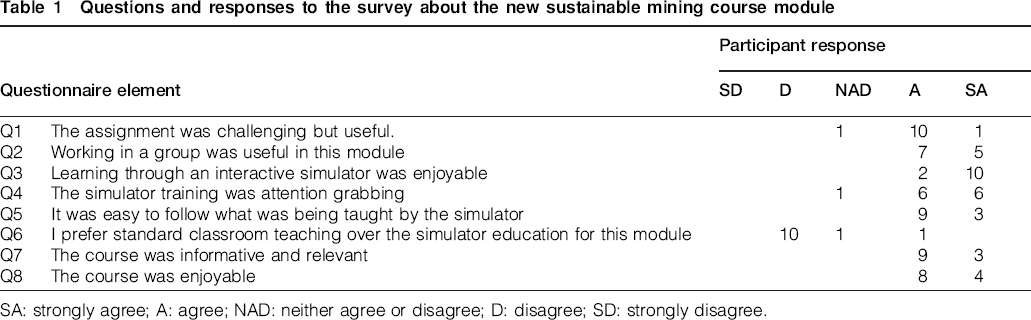
SA: strongly agree; A: agree; NAD: neither agree or disagree; D: disagree; SD: strongly disagree.
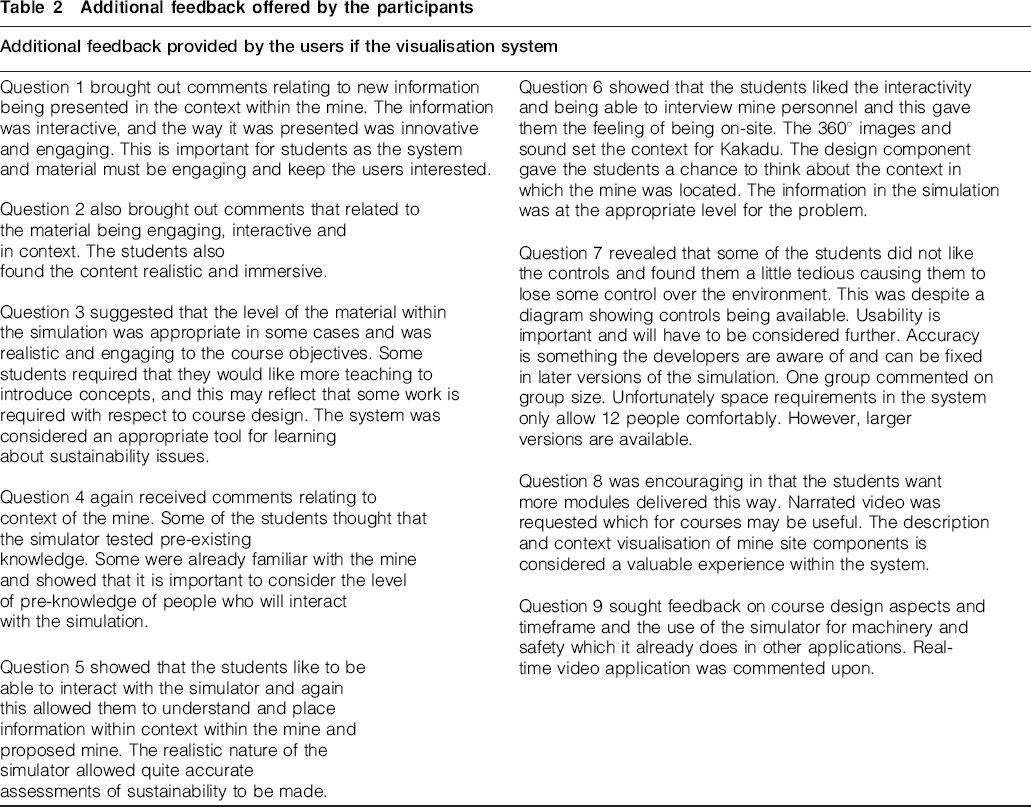
Further questions were asked to ascertain feedback on the simulator and the experience that the students had within it. From the feedback sheet, Table 2, it can be seen that the students enjoyed ‘being on-site’ and interacting with the data in the system. The overriding comments were that material, data and information were viewed in context ‘on-site’ and this helped them make informed decisions. Being able to place mine objects within the simulation and visualisation was also considered valuable as this gave a visual representation of their proposed mine. The realism of the images also seemed popular. The students enjoyed the experience. However, the level of interaction and the complexity of the task would require development to ensure that it is pitched at the correct audience level. As a visual engagement tool for mining sustainability, the simulator allows rapid examination of the impact of mining with respect to historic and future data.
Additional feedback offered by the participants
Conclusions
Sustainable mining practices are an important aspect of mining. Mining activities produce a great amount of data and knowledge that must be captured for later reference. The nature of mining is such that because of high staff turnover, knowledge and experience can be lost.
Visualisation and simulator systems may help retain this knowledge. Knowledge and experience relating to the five pillars of sustainable mining practices have the potential to be recorded and used to improve mine sustainability both in Australia and overseas via visualisation and simulation.
A large-screen visualisation system provides a mechanism to display mining data in context and interactively to groups of experts and non-experts alike via simulation. To demonstrate this concept, a mining in a global environment module was developed as a simulated mine site experience that could be displayed on a scalable visualisation system. The benefit of this was the removal of the need for multiple real life site visits.
Mining students were exposed to an on-site tour and learned about sustainable mining practices via simulation and visualisation. The students enjoyed interacting with the data and found the information easy to understand. The visualisation system, therefore, has a great potential for engaging non-experts with technical data so that an improved understanding of mine sustainability is achieved.
The system may have particular application in community engagement. The visual nature may also potentially improve cross-cultural understanding. However, this requires significant further work.
The research question addressed in this paper was, ‘Can large-screen visualisation and simulation technology be utilised to depict sustainable mining practices?’ In this case, the answer is yes it can; however, significant further work is required to ensure that the system can be used effectively and as a result, should be trialled in an environmental visualisation of a new or proposed mine site. Development and integration of this technology should be done via University collaboration with industrial partners.
Footnotes
Acknowledgements
The support of the ERA Ranger Mine in the development of the teaching module prototype is gratefully acknowledged. UNSW's iCinema (2013) who developed the visual display system on which the module was presented are acknowledged. UNSW's School of Mining VR team, who developed the displayed content are acknowledged.