







Abstract
CdTe nanocrystals have been synthesised with thioglycolic acid as a stabiliser in the aqueous phase. The fluorescence multilayer films of CdTe nanocrystals and cationic copolymers were prepared by layer by layer electrostatic self‐assembly. The multilayer films were characterised using fluorescence spectra, X‐ray photoelectron spectroscopy and atomic force microscopy. The fluorescence intensity of multilayer films was enhanced with the increase in the content of 2‐trimethylammonium ethyl methacrylate chloride in the cationic copolymers. At the same time, a red shift of the corresponding fluorescence emission peak of the multilayer films was suggestive of the increment of the electrostatic force. The surface morphology of the CdTe/cationic polyacrylamide multilayer films was observed by atomic force microscopy. X‐ray photoelectron spectroscopy provided evidence for the presence of CdTe nanocrystals in the multilayer films. A laser diffraction grain size analyser revealed that the size of CdTe nanocrystals increased with the addition of cationic copolymers.
Keywords
Introduction
Fluorescent semiconductor nanocrystals (NCs), also known as quantum dots (QDs), attracted widespread attention in recent years due to their quantum confinement effect1 and unique optical properties. Compared with traditional organic fluorescent dyes, QDs have many excellent optical properties: broad and continuous absorption spectra, tunable fluorescence emission wavelength, narrow half‐peak width, photochemical stability and good biological compatibility. Because of these outstanding properties, semiconductor NCs present a wide range of potential applications in solar cells,2 optoelectronic devices,3 biological markers,4–6 fluorescent probes and biological sensors.7, 8 In addition, the semiconductor NCs containing carboxyl group offer the possibility for the study of self‐assembly and composite with cationic polymers.9, 10
At present, there have been a variety of methods for constructing multilayer films. Among these methods, the layer by layer self‐assembly technique developed by the group of Decher et al.11 and Michel et al.12 is the most versatile technique. Moreover, it does not require specialised equipment, or substrates, and it is easy to operate. Therefore, electrostatic self‐assembly techniques have attracted huge interest in the past few decades.13–15
Layer by layer self‐assembly of multilayer films using II–IV semiconductor NCs and polymers was widely reported.16–18 Mamedov et al.19 first prepared graded CdTe QDs films by employing polyelectrolyte [poly(diallyldimethylammonium chloride] as positively charged polymer by layer by layer self‐assembly. Ma and his co‐workers20 prepared CdTe QDs/polyelectrolyte multilayer films by layer by layer deposition; the multilayer films were successfully used to detect gaseous formaldehyde.
The authors’ group made luminescence ultrathin films using polymers with organic dyes and luminescence material via self‐assembly.21–23 The cationic polyacrylamide (CPAM) is a good water soluble cationic polyelectrolyte and easy to prepare. It can be combined with negatively charged materials, owing to positive charges on molecular chains. So far, no reports were found concerning the assembling and compositing of CdTe QDs with CPAM containing 2‐(trimethylammonium)ethyl methacrylate chloride (TMMAC).
In the present paper, the authors report on the assembling and compositing of water soluble thioglycolic acid (TGA) stabilised CdTe NCs and cationic copolymer (CPAM) via electrostatic force. The characterisation of multilayer film structures was carried out by X‐ray photoelectron spectroscopy (XPS). Meanwhile, the surface morphology was investigated by atomic force microscopy (AFM). Laser diffraction grain size analyser characterised particle size and particle distribution of CdTe NCs and composite.
Experimental
Material
Tellurium powder (99%) was obtained from Shanghai Chemical Reagents Company (Shanghai, China). TGA (90%), CdCl2.2·5H2O (99%), sodium borohydride (NaBH4) (97%), polyacrylamide (PAM) and ammonium per sulphate [(NH4)2S2O8] were obtained from Chengdu Kelong Chemical and Technology Reagents Ltd Co. (Chengdu, China). Acrylamide (AM) was obtained from Beijing East Chemical Industry Factory (Beijing, China). The TMMAC was purchased from Chengdu Sundali Polymer Co. (Chengdu, China).
Characterisation
Fluorescence spectra were recorded on a Hitachi F‐4500 spectrofluorimeter (Hitachi, Tokyo, Japan). Ultraviolet–visible (UV‐vis) adsorption spectra were performed using a TU‐1901 UV‐vis spectrophotometer. The Fourier transform infrared (FTIR) spectra were carried out with a Nicolet 1700SX spectrometer (Nicolet Instruments Inc., Madison, WI, USA). Laser diffraction grain size distribution measurements were performed with a Malvern Mastersizer Micro (MAF 5000) laser diffraction grain size analyser (Malvern Instruments, Ltd, Malvern, UK). XPS was obtained with a Kratos XSAM 800 spectrometer (Kratos Analytical, Manchester, UK). AFM was carried out on an MFP‐3D. All optical measurements were performed at room temperature under ambient conditions.
Preparation of TGA capped CdTe NCs
TGA‐ stabilised CdTe NCs were synthesised following the reported procedure.24 At first, sodium hydrogen telluride (NaHTe) was prepared by reaction of tellurium powder with NaBH4. In brief, 6 mL of ultrapure water was added to a two‐neck flask, followed by deaeration with nitrogen. Then, 80 mg of sodium borohydride (NaBH4) and 127 mg of tellurium powder were transferred into the flask. The reaction mixture was maintained at 0°C in ice bath under the protection of nitrogen. After ∼8 h, the black powder disappeared, and the white sodium tetraborate precipitated out as white solid at the bottom of the flask, providing NaHTe solution in clear supernatant. Meanwhile, 0·112 g of CdCl2.2·5H2O was dissolved in 180 mL of ultrapure water in a three‐necked flask, and 83 μL of TGA was added to the flask, followed by adjusting the pH of the solution to 10·0 with 0·1M NaOH. Freshly prepared NaHTe solution was injected into the solution under vigorous stirring. The molar ratio of Cd2+/Te2−/TGA in the mixture was at 1∶0·5∶2·4. The reaction solution was heated to 100°C and refluxed for 2 h to afford the TGA capped CdTe NCs. The structure of CdTe NCs is shown in Scheme 1.
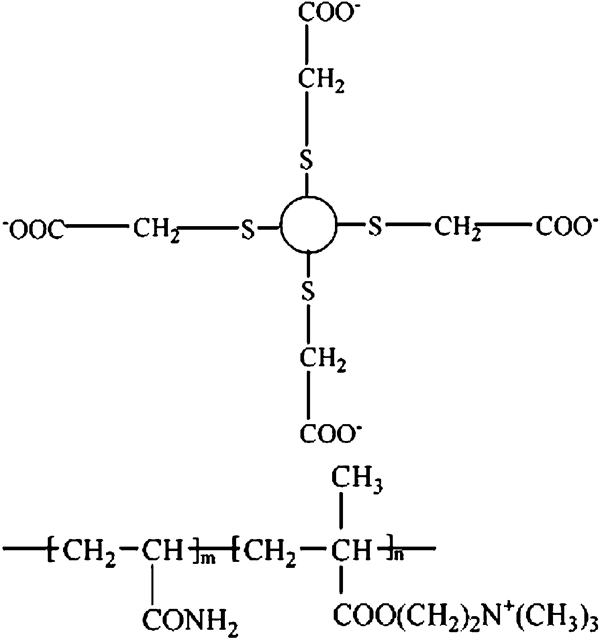
Structures of thioglycolic acid stabilised CdTe nanocrystals and cationic polyacrylamide (CPAM)
Preparation of cationic copolymers
The typical procedure for the preparation of cationic copolymers was described as follows: 0·32 g of AM, and 7·68 g of TMMAC were transferred to a four‐necked flask equipped with a stirrer, and deionised water was added. Then, the pH value of the mixture was adjusted to 6 by dropwise addition of hydrochloric acid. Then, the mixture was heated to 75°C in a water bath in the presence of 0·08 g (NH4)2S2O8 as an initiator. The temperature was maintained at 75°C for 2 h; then, the product was removed from the flask. Afterward, the providing product was washed three times by acetone, followed by drying under vacuum for 24 h. The cationic copolymer samples of different contents of TMMAC (4, 8 and 12%) were prepared following the same procedure. The structure of positively charged CPAM is shown in Scheme 1.
Multilayer fabrication of CdTe/CPAM
Multilayer films of CdTe/CPAM were fabricated by a layer by layer adsorption method as follows. Quartz slides were immersed into a fresh Piranha solution [V(H2SO4)/V(H2O2) = 7∶3] and heated at 70°C until no bubbles overflowed to render net negative surface charges. Then, quartz slides were washed with deionised water three times and dried at 100°C under vacuum for 1·5 h. Sequentially, Quartz slides were dipped alternately into the aqueous solution (2 mg mL−1) of positively charged CPAM and CdTe solution (1×10⁻³M) for 20 min, then rinsed with deionised water and dried under vacuum at 45°C. CdTe/CPAM multilayer films were assembled by repetition of the simple two‐step process in a cyclic fashion until five bilayer films were fabricated, which was based on the electrostatic interaction between negatively charged carboxyl groups of CdTe QDs and positively charged CPAM.
Results and discussion
FTIR spectrum of CPAM
The FTIR spectrum of CPAM was depicted in Fig. 1. The strong band at 3443 cm−1 was due to N–H stretching vibration. The peaks at 2924 and 2849 cm−1 were assigned to stretching vibration of methyl (–CH3) and methylene (–CH2) groups.25 The peak at 1645 cm−1 was attributed to the stretching vibration of carbonyl (C = O). The band appearing at 1455 cm−1 was due to the stretching vibration of methylene group connected to positively charged trimethylamine [–CH2–N+(CH3)3]. Results from FTIR spectroscopy showed that the product was derived from the copolymerisation of AM and TMMAC.
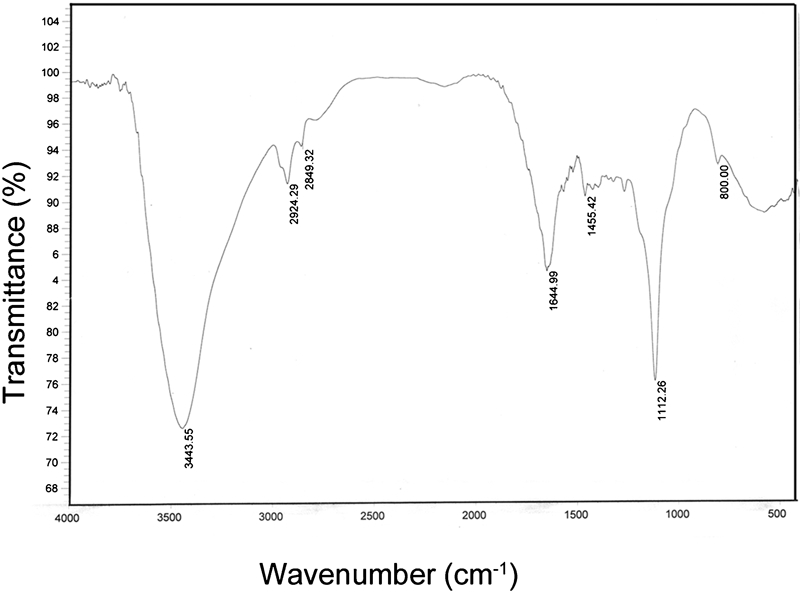
Fourier transform infrared spectrum of cationic PAM
Characterisation of CdTe NCs
The UV‐vis absorption and fluorescence emission spectra of CdTe are shown in Fig. 2. The UV‐vis absorption peak was at ∼525 nm, which was assigned to the first exciton band of CdTe nanoparticles. Photoluminescence (PL) emission peak appearing at 552 nm was symmetrical and full width at half maximum was narrow (25 nm), suggesting that the size of CdTe QDs was uniform.

Photoluminescence emission and absorption spectra of CdTe nanocrystals
Fluorescence spectra of self‐assembly multilayer films
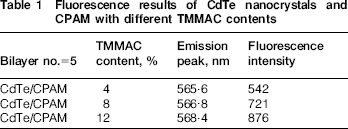
The multilayer films of CdTe NCs showed good PL property, as shown in Fig. 3. The PL intensity of CdTe NCs multilayer films rose when the bilayer number was from 1 to 5. Furthermore, the PL intensity increased with the change of TMMAC content from 4, 8 to 12%, which was due to the increase in the positive charges with elevation of TMMAC content of cationic copolymer. The electrostatic interaction of the cationic copolymer and CdTe NCs was enhanced accordingly. The wavelengths corresponding to the strongest PL intensity of the same layer experienced red shifts with increasing content of TMMAC of the cationic copolymer, as shown in Table 1. This was because the electrostatic interaction of the negatively charged carboxyl group capping CdTe NCs and cationic copolymer was enhanced.
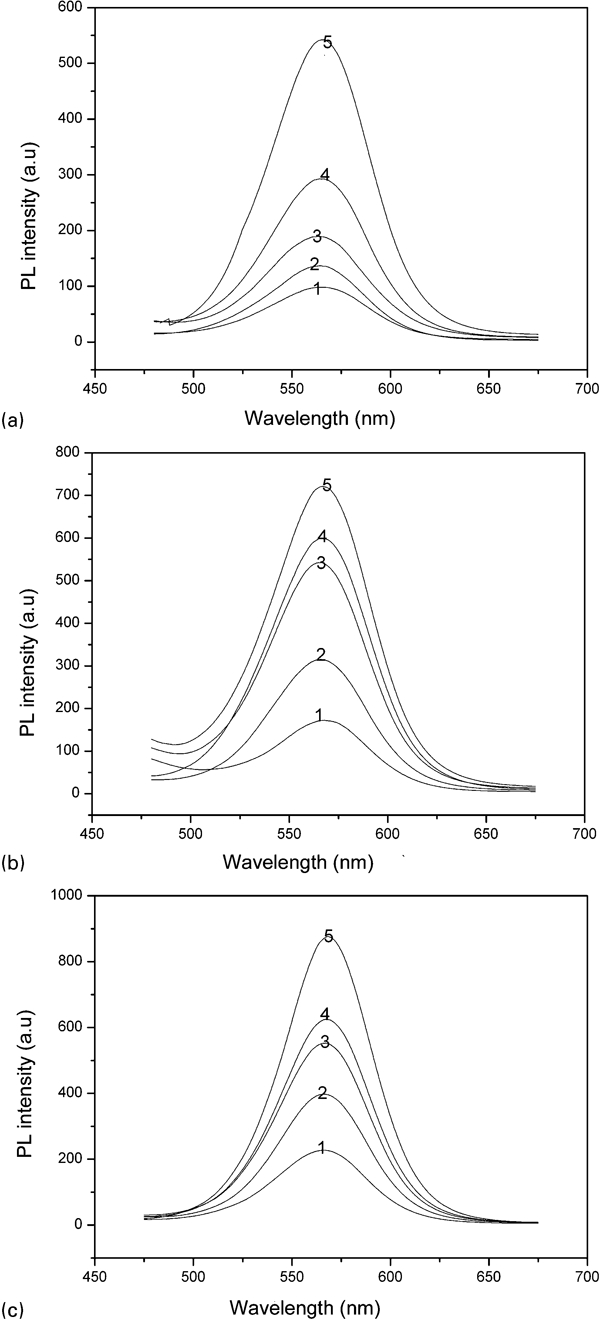
Photoluminescence spectra of multilayer films of a CdTe/CPAM (4%TMMAC), b CdTe/CPAM (8%TMMAC) and c CdTe/CPAM (12%TMMAC) (bilayer no. = 1–5)
Fluorescence results of CdTe nanocrystals and CPAM with different TMMAC contents
X‐ray photoelectron spectroscopy
To provide further evidence of the assembling of CdTe NCs on quartz substrate surface, the XPS was carried out for CdTe NCs electrostatic self‐assembly multilayer films. The results are shown in Fig. 4. Cd 3d5/2 and Cd 3d3/2 characteristic peaks were at 404·8 and 411·6 eV respectively. The characteristic peaks of Te 3d5/2 and Te 3d3/2 were at 572·1 and 583·3 eV. The peak at 162·2 eV was attributed to S 2p of TGA. The characteristic peak of C 1s appeared at 284·8 eV, proving the existence of CPAM. The XPS results indicated that CdTe and CPAM were successfully assembled on the quartz slides via electrostatic force.
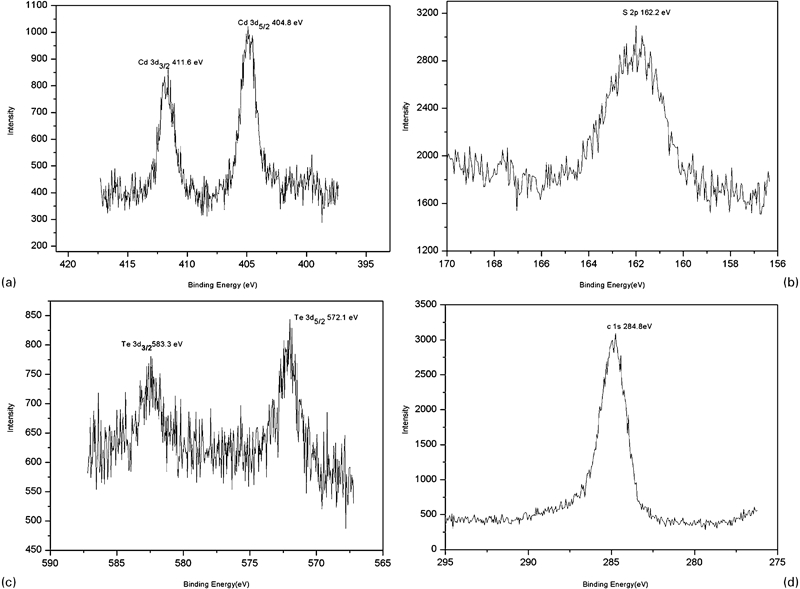
X‐ray photoelectron spectroscopy spectra of CdTe/CPAM
Morphology of self‐assembly thin films
The surface morphology of CdTe/CPAM multilayer films was obtained by AFM. Figure 5 illustrates the typical AFM images of one and 10 bilayer films of the CdTe/CPAM (8%TMMAC). The samples were scanned in the range of 3×3 μm. The surface of the first one bilayer film was obviously coarse and displayed some disfigurements, as shown in Fig. 5a. This may be ascribed to the rough surface of the substrate or the heterogeneous distribution of the surface charge in the adsorption process. When the quartz slide was modified by 10 bilayers of CdTe/CPAM, the modified surface became smoother (Fig. 5b). The results suggested that the disfigurements were repaired gradually in the electrostatic self‐assembly process.
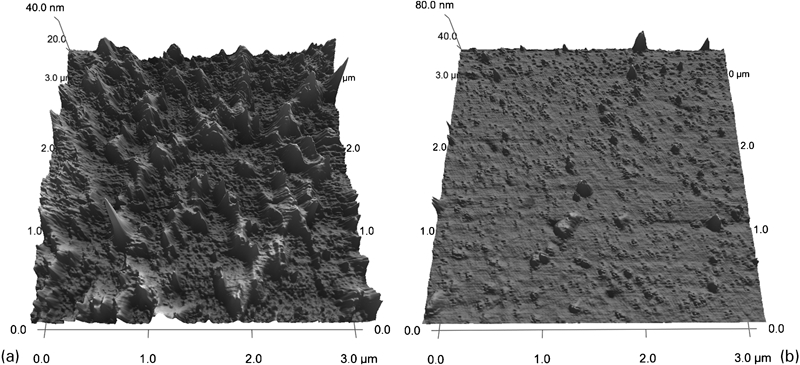
Appearance of assembled films
Fluorescence spectra of composites of CdTe NCs and cationic copolymers
The composites of TGA‐CdTe and CPAM were prepared by incorporating different concentrations of CPAM (8%TMMAC) into an aqueous solution of CdTe NCs, as shown in Fig. 6. It was clear that the PL intensity of composites went up with increasing copolymer concentration, which is an indication of the positive charge increases with elevation of copolymer concentration. PL intensity of composite reaches maximum at the concentration of 0·6 mg mL−1 of the copolymer. In addition, the fluorescence emission wavelength of the composite shifts red, possibly due to the electrostatic interaction of the negatively charged carboxyl group capped CdTe NCs and cationic copolymer. The copolymer played an important role in reflecting dipole–dipole interaction of CdTe NCs.26 Moreover, the electronic interaction became stronger with increasing copolymer concentration.
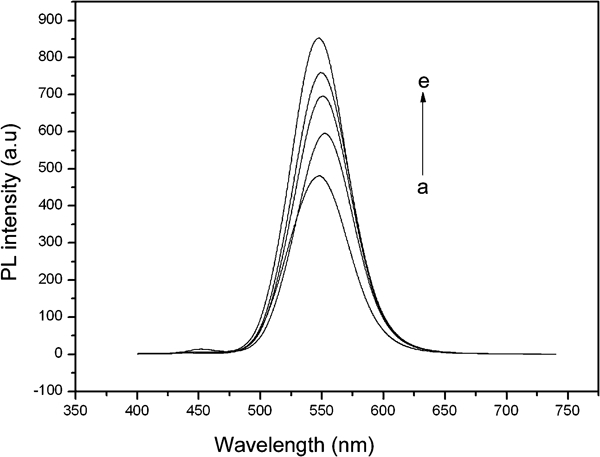
Photoluminescence spectra of composite of CdTe with CPAM (8%TMMAC): CPAM was added to concentrations of a 0 mg mL−1, b 0·1 mg mL−1, c 0·2 mg mL−1, d 0·4 mg mL−1 and e 0·6 mg mL−1
Particle size distribution of CdTe NCs and composites
The particle size distribution of initial CdTe NCs was homogeneous, and the average particle size was 5·0 nm, as shown in Fig. 7a. The average particle size of CdTe NCs with PAM was 5·5 nm (Fig. 7b), and the particle size distribution hardly changed compared with that of initial CdTe NCs. This was explained by the absence of the electrostatic interaction between CdTe NCs and PAM. However, the average particle size of CdTe NCs with cationic copolymer (CPAM) (8%TMMAC) increased from 5·0 to 13·4 nm and presented uniform particle size distribution (Fig. 7c). This may suggest that the CPAM was capped on the surface of CdTe NCs via electrostatic force. The result also indicated that there was the electrostatic interaction between CdTe NCs and cationic copolymer.
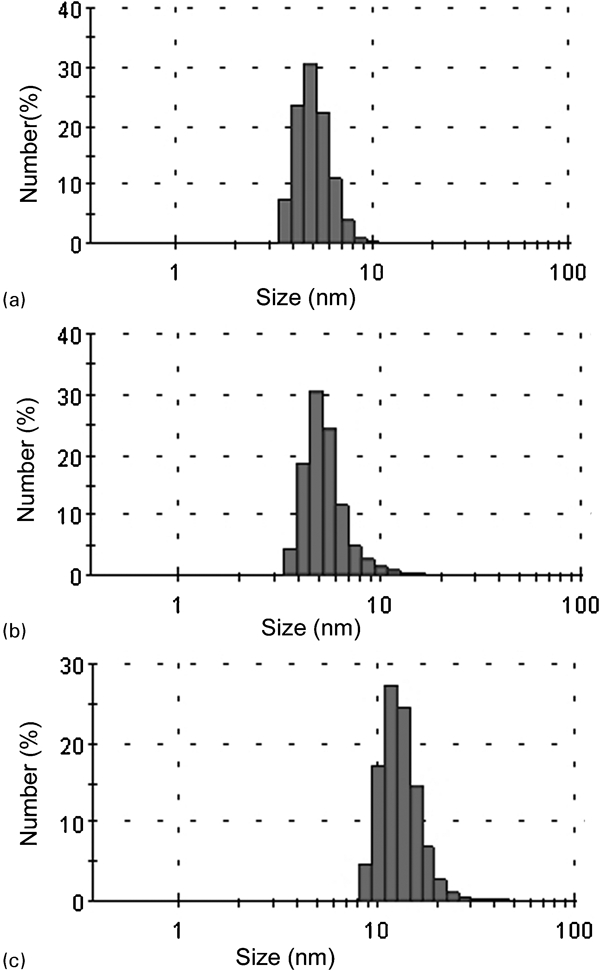
Particle size distribution of different materials
Conclusion
In conclusion, the fluorescence multilayer films have been prepared based on electrostatic interaction between the TGA coated CdTe NCs and CPAM. Furthermore, the multilayer films were studied through PL, XPS and AFM. PL emission spectra intensity of CdTe was enhanced with increasing TMMAC content in the cationic copolymer. XPS measurements confirmed the existence of CdTe and cationic copolymers in the multilayer films. The disfigurements of the films could be repaired automatically in the process of constructing multilayer films by layer by layer electrostatic assembly. These photoluminescent multilayer films may be expected to apply in optoelectronic devices.
Footnotes
Acknowledgements
The work was supported by the National Nature Science Foundation of China (grant no. 50573050). The authors are grateful to Dr M. Z. Chen and J. Lu for their help with XPS and AFM, from Analytic and Testing Center and Engineering Research Center in Biomaterials of Sichuan University respectively.