







Abstract
Composites of poly (lactic acid) (PLA)/wheat starch and PLA/wheat starch/methyldiphenyldiisocyanate, were prepared and characterised in this study. The effects of incorporating different coupling agents on the physical properties and morphology of the composites were studied. Extrusion technology and injection moulding techniques were used to prepare standard tensile and impact test pieces. Tensometry was used to investigate the tensile properties of the composites and impact testing using falling weight technique was used to investigate impact strength. To investigate the thermal behaviour of the composites, differential scanning calorimetry was employed. Water absorption properties of the composites were also investigated. Scanning electron microscopy was used to investigate the morphology of the composites. Starch can be incorporated in a PLA matrix at 10% level without difficulty in processing by extrusion followed by injection moulding to make shaped mouldings in the presence of MDI. With 10% wheat starch and 2% MDI, blends of wheat starch/PLA can reach the tensile strength, elongation, impact strength properties of raw PLA. In the presence of 2% MDI and 10% glycerol, blends of PLA and starch make an entirely flexible material.
Introduction
The use of synthetic polymer based composites in packaging has continuously increased over the last 20 years which has resulted in an increased emission of CO2 and carbon footprinting. It has also resulted in the deposition of large volume of plastic waste either in landfill or municipal waste recovery sites, where sorting and recovery are consuming energy and money. Plastic can be recycled rather than being buried but limitations exist with different types of plastic products. Combining of plastic products with natural systems which would reduce the environmental impact of the plastics would be a promising solution.
There is less use of alternative materials derived from renewable resources as they do not match the performance of commodity polymers and have a higher cost. Incorporation of starch into biodegradable polymers such as poly(lactic acid)(PLA),1–11 poly‐caprolactone12–15 and poly‐hydroxybutyrate16–18 gives composites which have been studied as promising alternatives to petroleum based polymers. Both PLA and starch derived from crops are completely biodegradable, therefore the composites of these polymers can be considered as biodegradable. However, composites of hydrophobic PLA and hydrophilic starch do not have the processing and mechanical properties3–5 that are exhibited by fossil fuel derived polymers. Efforts have been taken to improve mechanical properties of PLA and starch blends by incorporating compatibilizers such as MDI,1, 2, 6 maleic anhydride,9, 10 dioctyl maleate,4 triethyl citrate,3 sorbitol,3 glycerol,3, 10 combination of maleic anhydride and acetyle triethyl citrate11 and aliphatic isocyanates.5 Of them, MDI was the most effective coupling agent and it has considerably improved the strength of the PLA/starch blend at the 0·5% MDI level by hot mixing followed by compression moulding.1 However, processing of PLA/starch composites has not been developed sufficiently for it to be adopted by industry.
In this work, coupling agents and mixtures of these coupling agents have been employed to process the blends with conventional polymer processing equipment to investigate their thermal behaviour and to improve the compatibility between PLA and wheat starch. Wheat starch19 is one of the most utilised starch sources in the UK and its mechanical properties have been reported to be relatively superior to other starches.20 Composites of PLA and wheat starch were prepared with compositions of 90∶10 and 70∶30 (w/w). Coupling agents such as MDI at higher levels, glycerol at lower levels, and stearic acid (SA) have been incorporated and the blends have been extruded and injection moulded for the investigation of the thermal behaviour, mechanical properties, microscopic morphology and water absorption properties of the composites.
Experimental
Materials
Wheat starch (Maritena 200 BA) was purchased from Food Ingredient Technology Ltd, Great Gransden, UK. PLA (LACTY 1012) polymerised mainly from L‐lactic acid was obtained from Shimadzu, Inc., Kyoto, Japan. Methyldiphenyldiisocyanate, a yellowish brown liquid was obtained from Bayer AG, Leverkusen, Germany. Glycerol with 98% purity was obtained from Fisher Scientific, Loughborough, UK as a colourless liquid. General purpose reagent grade SA with 97% purity and a melting point of 67–69°C was obtained as a white powder from BDH Laboratory supplies, England.
Preparation of blends
Wheat starch was dried in an air circulating oven at 130°C for about 2 h. Dried wheat starch and PLA pellets, dried overnight at 60°C, were premixed in an airtight polyethylene (PE) bag at PLA/starch weight ratios (w/w) of 90∶10. The MDI, glycerol and SA were added to the blend as 2 wt‐% based on 100 parts of the starch/PLA blend. All the blends, with and without coupling agents, were then mixed and kept for 2–3 h in an airtight PE bag before extrusion. MDI was added to all the other blends as 2 wt‐% based on 100 parts of dried starch and PLA total weight. According to the material safety data, MDI is harmful by inhalation or through skin and eye contact and therefore the material was handled with suitable safety precautions. A safety glass, face mask and a pair of gloves were worn when handling the material for personal protection and also processing was carried out under adequate ventilation and exhaust system.
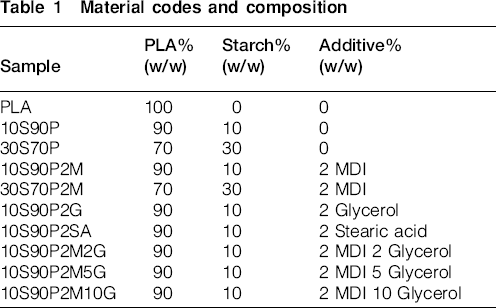
PLA/starch/MDI/glycerol blends were prepared by adding 2, 5 and 10 wt‐% glycerol based on 100 parts of PLA/starch blend. Wheat starch and PLA were premixed at PLA/starch weight ratios (w/w) of 90∶10 and 70: 30 at ambient conditions. MDI was added and the mixtures were well mixed and stored in airtight PE plastic bags for ∼1 h. The blends without MDI were prepared in the same way. Then they were extruded in a lab‐scale co‐rotating twin screw extruder (BTS 30, Betol Machinery Ltd, Luton, UK), which has a screw diameter of 30 mm and length to diameter ratio of 25∶1, through a strand die with a 6 mm diameter at a temperature profile of 150°C (feed inlet) and 185°C for the other zones, including the zone nearest to the die. The screw speed was fixed at 80 rev min−1. The extruded rods were pelletised into small pellets using a Betol pelletiser (1306, Betol Machinery Ltd). Samples were dried and stored in airtight PE bags at ambient temperature until they were analysed. Pure PLA was treated under similar conditions. Blends of PLA/starch/MDI were prepared with weight ratios 90∶10∶2 and 70∶30∶2 and left overnight in airtight PE bags and extruded under the same conditions. Material compositions of the blends and their identification codes are listed in Table 1.
Material codes and composition
Tensile testing
Pure PLA and the blends were dried overnight at 60°C and injection moulded into tensile test bars according to BS EN ISO 527 using a DEMAG injection moulding machine (D60NCIII, DEMAG, Schwaig, Germany). The moulded specimens were then labelled and preconditioned at 50% relative humidity and 23°C at least for 24 h before testing. The tensile strength and elongation at break were determined with a Zwick tensometer (SMART. PRO, Zwick Roell, UK) according to BS EN ISO 527 with a crosshead speed of 5 mm min−1 and a 50 mm gauge length. Five replicates were tested for each treatment.
Impact testing
Dried pure PLA and the blends of prepared composites were injection moulded into plaques according to BS EN ISO 6603 using a DEMAG injection moulding machine (D150 NC III‐K, DEMAG). The moulded specimens were then cut into 60×60 mm squares using a bench saw, labelled and preconditioned at 50% relative humidity and 25°C at least for 24 h before testing. The impact strength was determined by the falling weight technique with a Fractovis Plus impact tester (Model 7520, CEAST, Pianezza, Italy) according to BS EN ISO 6603.
Morphology
The microstructures of the blends were observed with a scanning electron microscope (SEM; Zeiss Supra 35, Carl Zeiss AG, Oberkochen, Germany). Each specimen from a broken tensile test bar was mounted on an aluminium stub, and the fractured surface was coated with gold particles with a sputter coater (Polaron desk sputter coater, Quorum Technologies, East Sussex, UK) before observation.
Thermal properties
Differential scanning calorimetry (DSC) was used to determine the thermal properties. The test was carried out using a DSC Q2000 series instrument (TA Universal analysis, TA instruments Inc., New Castle, DE, USA) according to ASTM Method D 3417‐83. About 4–10 mg of each sample was sealed in an aluminium pan, with an empty sample pan being used as a reference in all cases. The thermal history of a sample was erased by heating it from 20 to 190°C at a rate of 10°C min−1, holding it at 190°C for 10 min, and then cooling it to 20°C at the same rate. The thermal behaviour was recorded by the reheating of the sample from 20 to 190°C at the same rate. The heat of fusion (ΔHm) and heat of crystallisation (ΔHc) were determined. The heat of fusion of 100% PLA was set to 93·6 J g−1 (Ref. 1) and the crystallinity of PLA in the blend was calculated. The DSC test was carried out two times for each sample before calculation of data and reported DSC data were 98% reproducible.
The degradation behaviour of the materials was determined by thermogravimetric analysis (TGA Q500 series, TA Universal analysis, TA Instruments Inc.). A small amount of material was placed in a clean platinum pan and heated from room temperature to 600°C at a heating rate of 10°C min−1.
Water absorption
Injection moulded standard tensile test bars were used for the water absorption test. They were dried at 50°C for 24 h and cooled to room temperature. The dried specimens were immersed in distilled water at ambient temperature for specific intervals, removed from the water, blotted with tissue paper to remove excess surface water, and then weighed. Three replicates from each blend were tested. The water absorption was calculated on a dry basis as follows

Results and discussion
Thermal behaviour
Table 1 shows the prepared blend materials and their material codes and the TGA data are presented in Fig. 1 which shows the degradation pattern of PLA and wheat starch. Figure 2 shows the DSC thermograms exhibiting the thermal behaviour of raw PLA and the blends of wheat starch and PLA with various coupling agents, and the DSC data are summarised in Table 2. The DSC thermograms evidently showed that the glass transition is at about 60°C and an exothermic peak after the glass transition is assigned to cold crystallisation.21, 22 The glass transition temperature (Tg) and the melting temperature (Tm) of PLA and the blends have not been significantly affected by the type of coupling agents but the crystallisation temperature (Tc) differed by approximately 10°C for glycerol and stearic acid. Furthermore, the extent of crystallisation of PLA was affected greatly by starch as well as by the coupling agents. Upon addition of wheat starch to PLA, the crystallinity of PLA was reduced by 12%. Granular starch existing as concentric growth rings23 might have disturbed the continuous PLA phase and its molecular motion1 thus reducing crystallinity. The addition of MDI has slightly increased the degree of crystallinity as a result of interfacial interaction between the starch and PLA in the 10S90P2M blend.
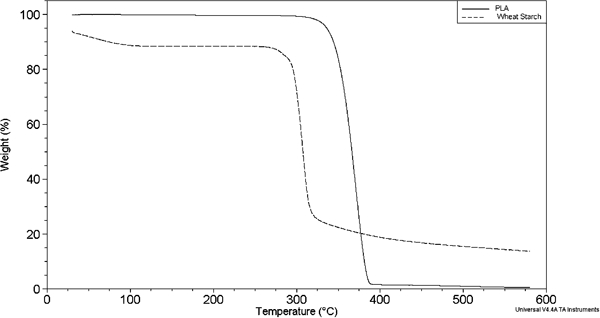
TGA analysis of PLA (solid line) and wheat starch (dashed line)
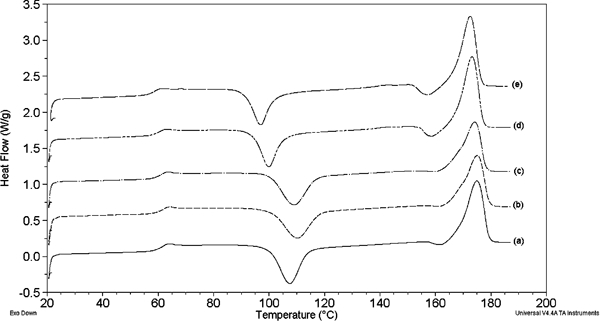
DSC thermograms of PLA and wheat starch/PLA blend with and without different coupling agents
Crystallisation and melting properties of raw PLA and PLA/wheat starch blends with different coupling agents
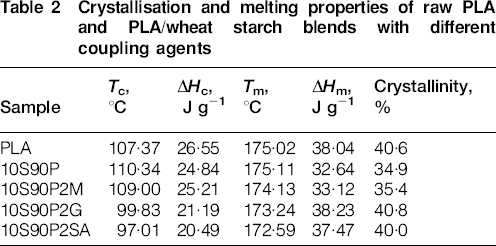
Wheat starch and PLA blends with glycerol and SA coupling agents have lowered the crystallisation temperatures (100 and 97°C respectively) compared to raw PLA (107°C), as can be seen from Table 2. This decrease in Tc suggests that the small, disordered crystals are formed.21 As a result of the effect of glycerol and SA in the blend, chain slipping would have been confined during extrusion thus favouring crystallisation. Furthermore, the extent of the discontinuous phase between PLA and starch might have been reduced in the blend by increasing chain flexibility which would allow molecular motions thus shifting the crystallisation temperature to lower levels. According to Wang and coworkers,1, 2 bonding interactions between starch and PLA restrict the molecular slippage during mechanical shearing and thereby accelerate the crystallisation. Therefore, it is possible that glycerol and SA promoted bonding between starch and PLA.
Such interactions, in the form of hydrogen bonds or ester linkages, would have controlled the slippage of chains at the interface during mechanical shearing and favoured fragmentation of PLA to enhance the number of short chains in the blend. An increased percentage of these short chains consequently supports crystallisation lowering the crystallisation temperature of the blends and giving rise to large melting peaks.
The results demonstrate that wheat starch has decreased the ΔHm and ΔHc of the raw PLA. In the presence of MDI, the heat of fusion and ΔHc exceed those of the starch and PLA blend. However, glycerol and SA have restored the heat of fusion of the blends but further reduced ΔHc.
Cold crystallisation depends on the internal structure present at the time of crystallisation and not on external constraints24 and it is apparent that coupling agents as well as the starch have altered the internal structure of the blend. Incorporation of starch has produced a discontinuous phase in the whole blend and resulted in lower ΔHc, ΔHm and crystallinity. However, blends with MDI having active difunctional groups have decreased the discontinuity by promoting interfacial interaction between starch and PLA. Therefore, the crystallinity of the blend with MDI is higher than that of the blend without MDI. Stearic acid and glycerol3, 23 might have plasticised the starch molecules by leaching out smaller amylose molecules with hindered O–H groups in the wheat starch to the starch granule surface resulting in increased molecular mobility of the chains. As a result of this liberation and exposure of the O–H groups of sugar molecules at the surface, increased interactions with other molecules might have favoured an increase in entanglements. Free ends of such molecules might have better molecular motions. On the other hand, plasticised starch could have been entrapped in the PLA matrix in an ordered pattern or formation of bonds between starch and PLA in the presence of glycerol and SA might have supported molecular fragmentation thus increasing crystallinity as discussed above. It is also noted that re‐crystallisation has taken place in the presence of glycerol and SA. The re‐crystallisation suggests that the small, disordered crystals have eventually changed into more ordered crystals.
Differential scanning calorimetry thermograms of wheat starch/PLA blends with MDI and different glycerol levels are presented in Fig. 3 and the DSC data are summarised in Table 3. According to the data, all three temperatures Tg, Tm and Tc have shifted to lower levels with an increasing percentage of glycerol compared to the blends without glycerol. It is apparent that the ΔHc has decreased but the heat of fusion has increased with increasing glycerol level in the blend. With 10% glycerol, the ΔHc has been reduced more than 60% with respect to the blend without glycerol. The cold crystallisation and heat of crystallisation are very sensitive to chain orientation. In the absence of the molecular orientation, crystallisation is a slow process22 and therefore there is a possibility that the polymer remains in its amorphous state. According to these results, the decrease in the ΔHc with increasing glycerol level is due to the better plasticisation of starch and hence increases the chain flexibility in the blends.
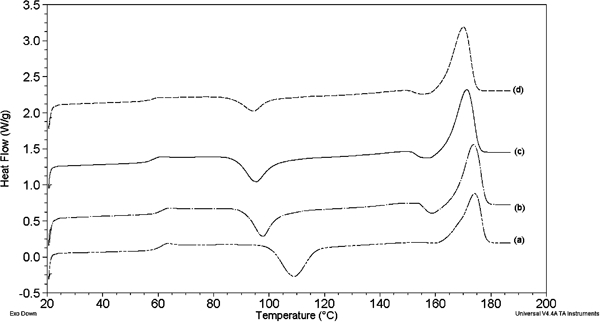
DSC thermograms of wheat starch/PLA/MDI blends with various glycerol levels
Crystallisation and melting properties of wheat starch/PLA/MDI blends with various glycerol levels

Furthermore, an exothermic peak near to the melting peak is observed with glycerol in the blend due to re‐crystallisation taken place in the blend. Increased chain mobility in starch incurred by glycerol and amylose which have been liberated from the granules could have made more stable crystals. Most probably, the glycerol penetrated throughout the granule and randomly packed amorphous amylopectin chains entrapped between crystalline amylopectin chains,23 have increased the free volume increasing the mobility of the amorphous lamellae. This arrangement could have favoured crystallisation. Also, amylopectin double helices within the crystalline lamellae could have taken up favourable crystalline arrangement. However, these peaks get smaller with increasing glycerol content. It is assumed that the decrease in crystallisation has taken place due to the better plasticisation of amylopectin as well as the amylose molecules in starch with higher glycerol19 content in the presence of MDI causing molecular entanglement rather than crystallisation. Therefore, there is no increment in crystallisation observed towards increasing glycerol level from 2 to 10% in the blends.
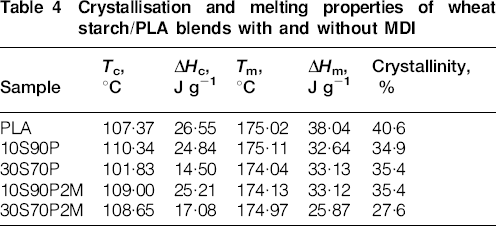
The summarised DSC data of wheat starch/PLA blends with and without MDI are presented in Table 4 and the relevant thermographs are shown in Fig. 4. There is no significant difference in the melting temperatures of the blends and PLA but the crystallisation temperatures are different. The blend 30S70P without MDI shows unusual results having very low Tc and low ΔHc. It is believed that the blend has absorbed moisture and as a result the starch has been plasticised. The resulting molecular orientation might have favoured crystallisation thus reducing Tc. The presence of an exothermic peak (see Fig. 4) near the melting peak is a result of re‐crystallisation. It is well known that in the presence of water, starch molecules undergo re‐crystallisation. Compared to 10S90P blend, MDI in the 10S90P2M blend has increased ΔHc as a result of formation of urethane linkages4, 25 between isocyanate and OH groups. Consequently, chain flexibility is restricted due to the steric hindrance of benzene rings in the MDI.5 Crystallinity of PLA is reduced as expected with increasing starch due to the scattered dispersion of starch in the base matrix.
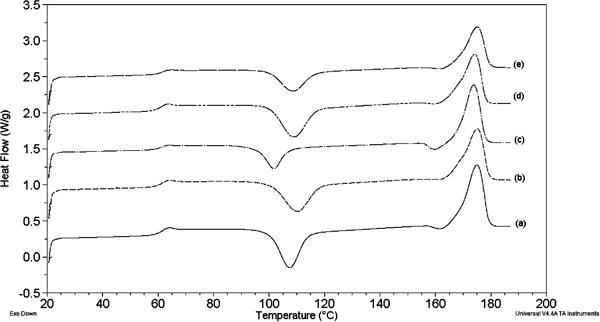
DSC thermograms of wheat starch/PLA blends with and without MDI
Crystallisation and melting properties of wheat starch/PLA blends with and without MDI
Mechanical properties
The appearances of the tensile test bars of only PLA and wheat starch/PLA blends with and without MDI prepared by injection moulding are different from each other. Tensile test specimens of only PLA are transparent but with the inclusion of starch the clarity of the specimen has changed. The blend containing 10% starch has slight opacity but the blend containing 30% starch has much higher opacity. Furthermore, yellowish brown MDI has coloured the dumbell specimens turning them light yellow in the 10S90P2M blend. The appearance of the tensile bars of the blend 30S70P2M is almost dark brown and also seems to be degraded. It is apparent that the clarity of the PLA is reduced with the incorporation of starch and MDI.
Tensile strength and elongation at break of the sample 2 and sample 3 in Fig. 5 under ambient conditions decreased with increasing starch levels compared with those of only PLA. However MDI, in the blend of 10% starch was capable of restoring the strength of raw PLA. Furthermore, elongation which has decreased by almost 38% in the blend 10S90P has been reduced to 30% in the blend 10S90P2M. The Young's modulus was lower than raw PLA and starch/PLA blends indicating lower stiffness in the blend. The 30S70P blends with and without MDI show poorer properties than raw PLA. From its appearance, the 30S70P2M blend seems to be non‐uniform as a consequence of starch overheating during extrusion and degradation due to the difficulty in uniform feeding. The blend 10S90P2M material showed properties similar to those of PLA, except for the Young's modulus.
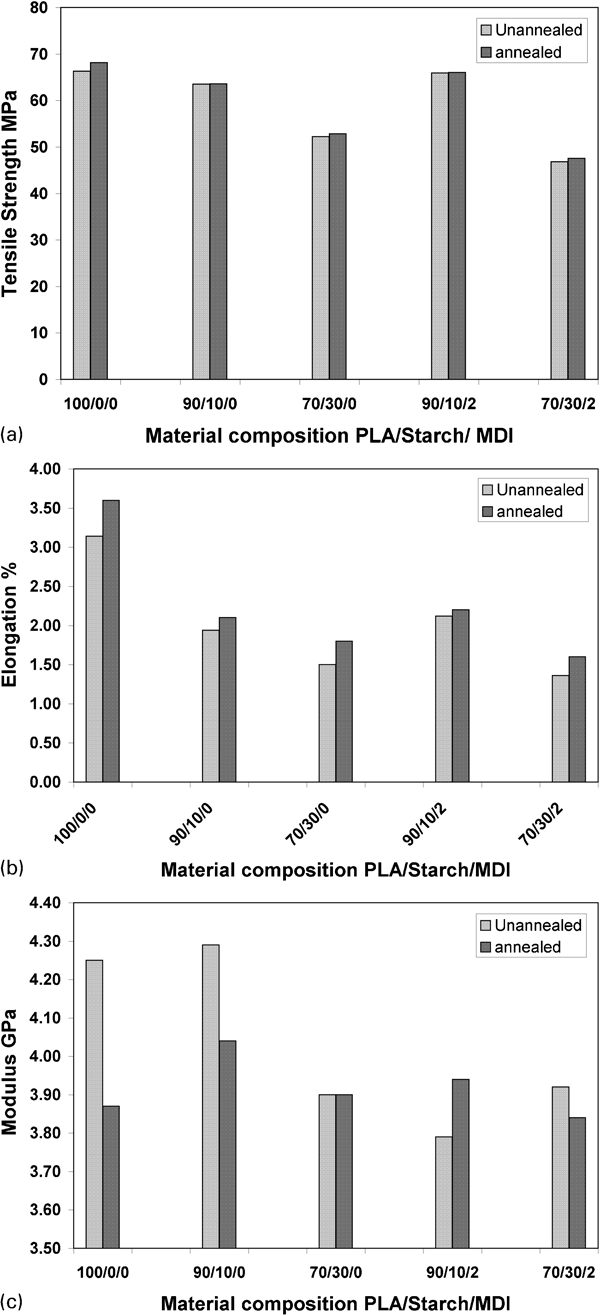
Variation of tensile properties of PLA, wheat starch/PLA blends with and without MDI and with and without heat treatment
Low strength and elongation at break when starch is incorporated into the PLA matrix is due to the distortion of continuous phase of PLA by starch granules. These starch granules might have acted as stress concentrators initiating cracks in the material. When MDI is incorporated into the 10S90P blend, the strength has increased by 4% with respect to the starch PLA blend. It is apparent that the interfacial adhesion between PLA and wheat starch has enhanced the superior properties in the blend. These results are also compatible with the results of compression moulded blends of 0·5% MDI with PLA/starch blends carried out by Wang et al.1 This study shows increased elongation in the 10S90P2M blend but it is less than that of raw PLA. It is well known that the size of the groups in the polymer relate to chain flexibility of the polymer. Therefore two phenyl groups in the MDI as well as starch might have restricted the chain flexibility of the blend resulting in lower elongation than raw PLA.
Figure 5 shows the comparison of tensile properties with respect to annealed and un‐annealed conditions of samples of raw PLA and starch/PLA blends with and without MDI. There is no effect on the tensile strength of the materials upon heat treatment. It is apparent that the enhanced molecular mobility upon heat treatment was not efficient in favouring crystallisation in the blend. However, the elongation at break of the blends has slightly increased in almost all the blend samples and raw PLA. Upon heat treatment, due to energy induced molecular mobility, amorphous orientation might have increased causing the material to deform. The moduli of the blends have decreased apart from that of 10S90P2M. This is consistent with the elongation results upon heat treatment. As a result of annealing, changes in the chain orientations with MDI in the blend might have increased the modulus of the 10S90P2M blend.
According to Fig. 6, the results revealed that leaving the blends overnight before extrusion has reduced the tensile properties compared to the blends processed immediately after preparation. Upon overnight storage, possible weak urethane links formed between PLA and starch might have broken or the PLA chains might have fragmented to short chains resulting in poor mechanical properties. Although the short chains favour crystallisation, they decrease the strength of the material. On the other hand, if the moisture is absorbed by the blend upon prolonged exposure to the environment, this could result in hydrolysis of urethane linkages giving rise to the corresponding amine and carboxylic acid groups and resulting in poor mechanical properties of the blend.
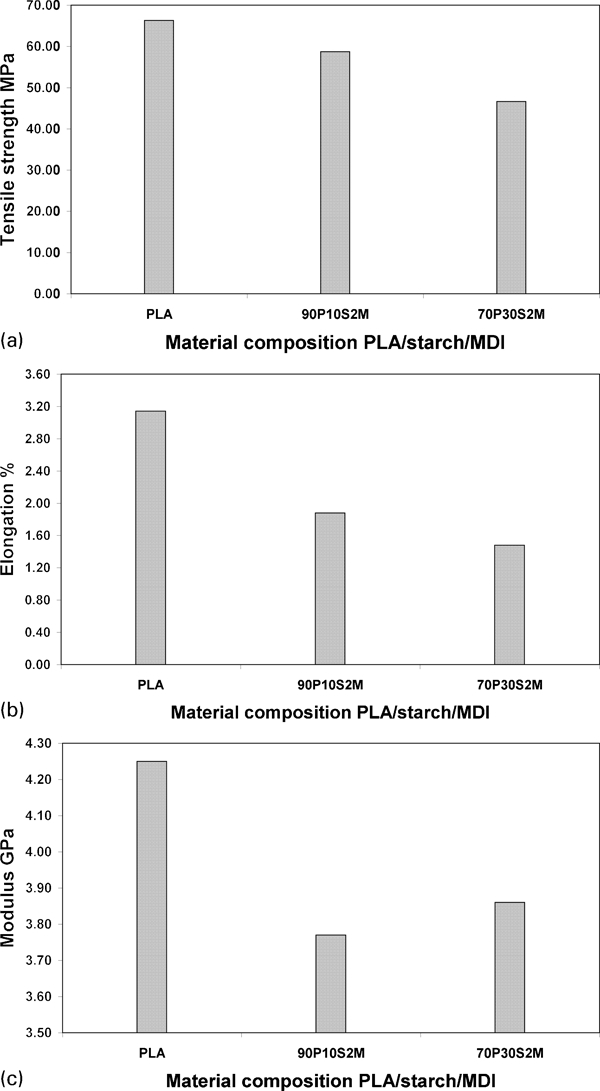
Tensile properties of PLA, wheat starch/PLA blends with MDI blended and left overnight before extrusion
The impact behaviour of the PLA and wheat starch/PLA blends with and without MDI is shown in Fig. 7. With increasing starch levels there is a decrease in the energy absorption in the blends. Because of the nature of the granular starch, it behaves as a stress concentrator rather than dissipator. But the blend 10S70P2M shows energy absorption very similar to raw PLA. The starch and PLA are coupled by interfacial adhesion of MDI. Perhaps the urethane linkages which formed between starch and PLA resulted in long chains. These long chains might have crystalline regions as well as amorphous regions. These amorphous regions in the chains show better toughness behaving as shock absorbers.
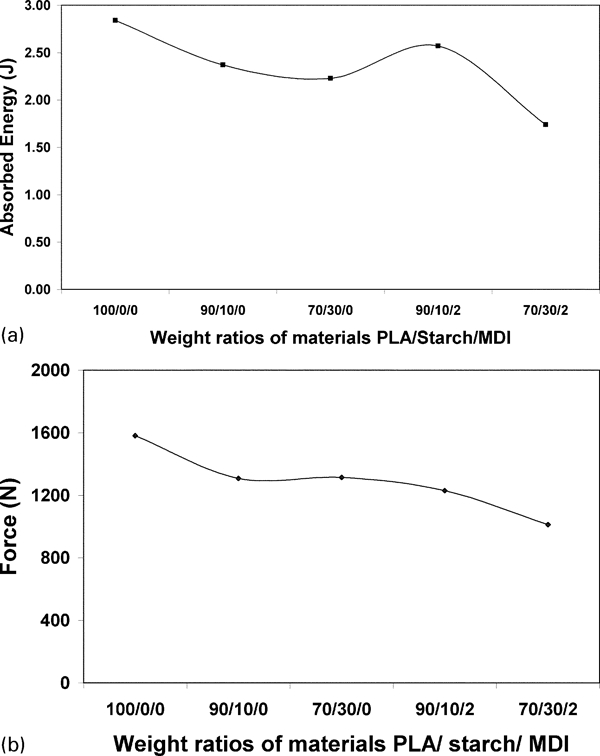
Impact behaviour of PLA and wheat starch/PLA blends with and without MDI
Morphology
Scanning electron micrographs have been obtained of the tensile fracture of PLA (Fig. 8a), wheat starch/PLA blends (Fig. 8b and c) and wheat starch/PLA/MDI (Fig. 8d). Two phases can be clearly seen, starch granules were pulled out and voids have then been created as can be seen in Fig. 8b and c. Better interfacial adhesion of starch and PLA with MDI is observed in Fig. 8d. However, a starch continuous phase is difficult to discern with MDI whereas a starch granular form is still visible.
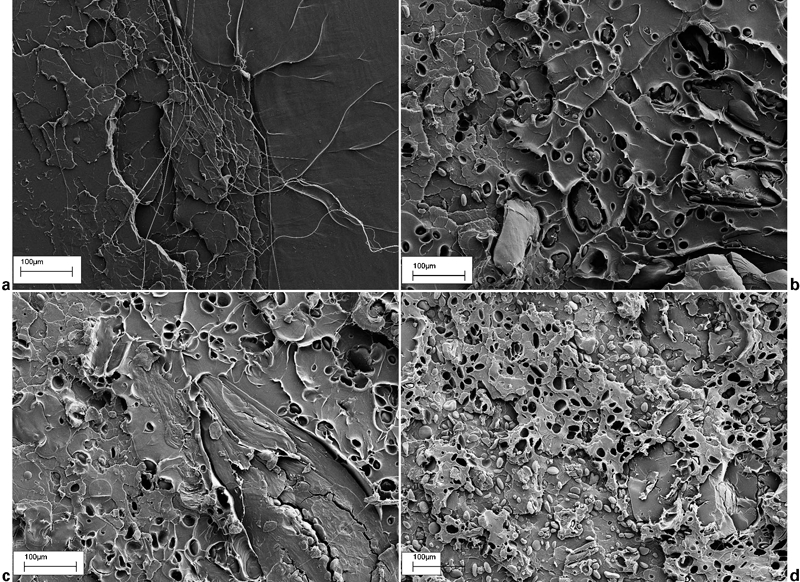
Scanning electron micrographs of PLA, wheat starch/PLA blend with and without MDI
According to the SEM images in Figs. 8 and 9, blends with coupling agents show a better continuous phase between starch and PLA than the blend without coupling agents. It is noticeable that the continuous phase is more prominent with SA and glycerol. The blend with MDI has a continuous phase but the starch granular form is still observed and indicates that MDI does not have the plasticisation ability of starch. It is apparent from the molecular structure that glycerol and SA can plasticise starch better than MDI. However, their coupling effect upon the tensile properties has still to be investigated. Figure 9a and b shows micrographs of blends compounded with 2% glycerol and 2% SA respectively. Stearic acid shows almost the same phase appearance as raw PLA. With glycerol, small starch granules are observed in the SEM graph entrapped in PLA matrix. Both the SA and glycerol coupling agents showed better interfacial adhesion between PLA and starch from their SEM image.
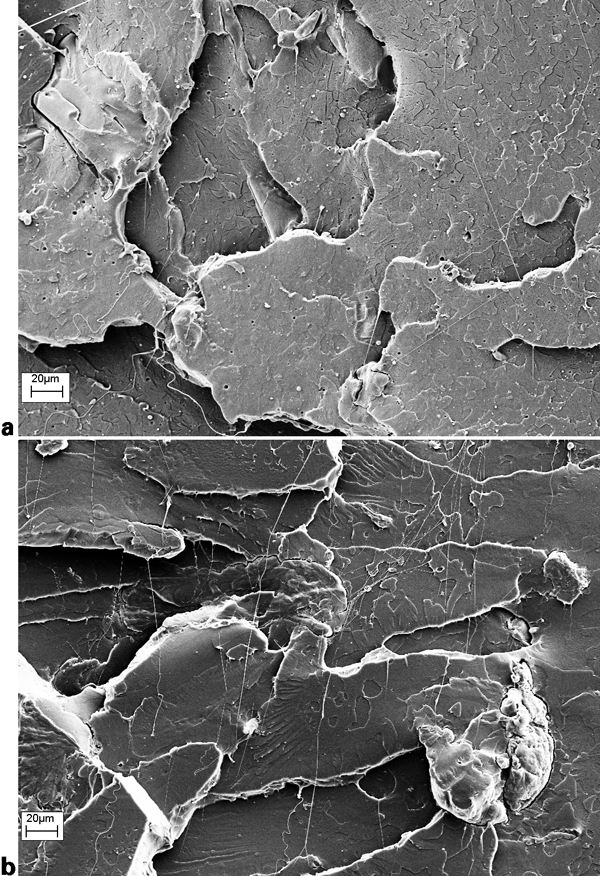
Scanning electron micrographs of PLA/wheat starch blends with different coupling agents
Scanning electron micrographs of blends with MDI and different glycerol levels are shown in Fig. 10. The fracture surface of the blend 10S90P2M10G was more ductile than blends with 2 and 5% glycerol. According to the SEM micrograph and the appearance of the material, with 10% glycerol, most of the starch granules have been plasticised. It is believed that starch granules exist in a form of concentric growth ring with reducing ends more randomly organised and located in the centre of the granule with non reducing ends of amylose and amylopectin pointing outwards allowing the glucose residues to add on to extend the amylopectin chains.23 In the presence of glycerol, amylose chains can leach out to the granular surface from concentric growth ring of the granular starch.23 The small size and nature of the glycerol with high hydrogen bonding density have the ability to penetrate to reach the amorphous region of the granule. It is well understood that glycerol could have infiltrated to amorphous amylose molecular chains arrangements more than the orderly packed amylopectin crystals. A porous structure is observed in the blends in the SEM images with glycerol and the porosity increased with increasing glycerol level. In the presence of glycerol amorphous regions penetrate throughout the granule and on hydration they form continuous gel phase resulting porosity. This result is consistent with the results discussed and reported by Oates.23 The higher glycerol content in the blend shows better plasticisation of starch in Fig. 10c. The fracture surface of the materials showed ductile fracture and the material was flexible at room temperature and upon storage. However, as MDI is a toxic material, further studies will not be carried out on this area with MDI.
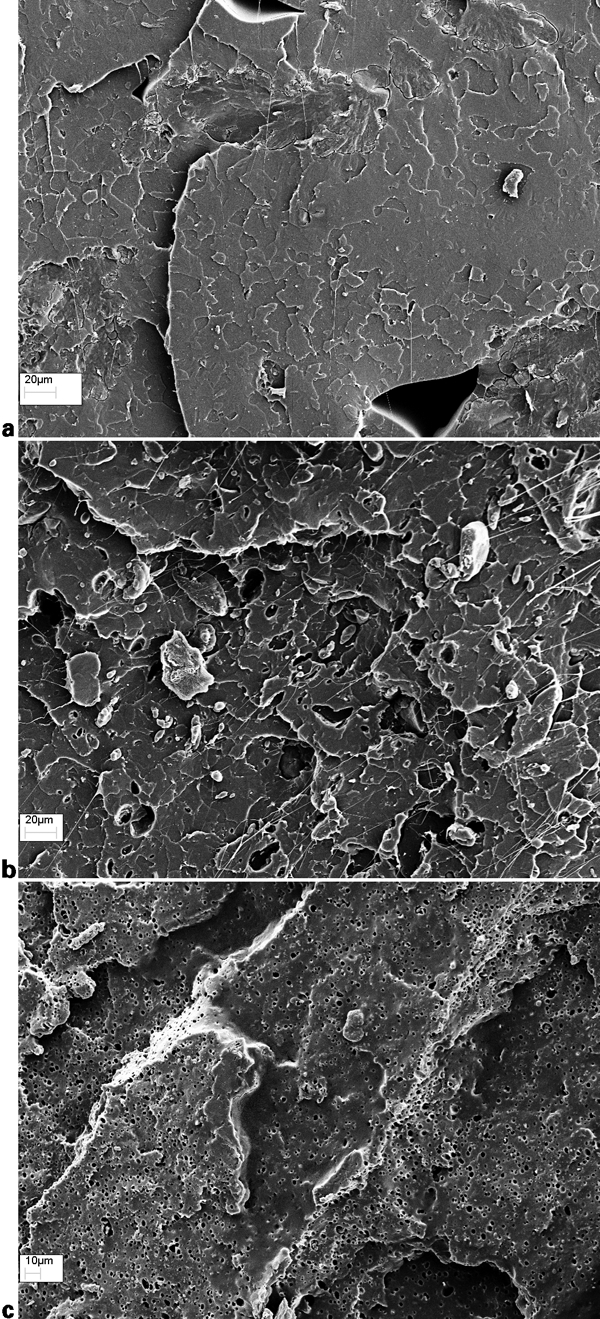
Images (SEM) of PLA/wheat starch blends with different glycerol levels
Water absorption
Starch consists of amylose and amylopectin both having an abundance of hydroxyl groups and shows hydrophilic character. However, PLA is a hydrophobic polymer. Figure 11 shows the water absorption of PLA, wheat starch/PLA blends with and without MDI. All the blends except 30S70P2M show less than 2% water absorption. The blend without MDI having 30% starch shows 3% water absorption. The water absorption for both blends with or without MDI increased during the first two weeks and then levelled off at about 3%. Wang2, 6 and Ke et al.7 have also reported that water absorption gradually increased during the first 15 days before levelling off. No significant difference in water absorption occurred between the blends with and without MDI. The water absorption for raw PLA also had the same tendency as that of the blend with starch but levelled off at about 0·5%. The blend 10S90P2M shows very similar properties to PLA. These results apparently indicate that the starch content in the blend is responsible for the water absorption of the PLA/starch blends.
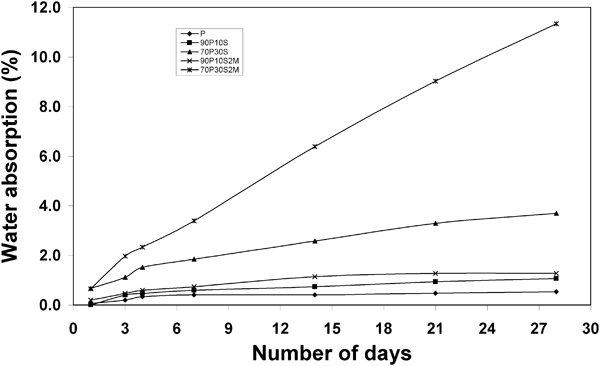
Water absorption of PLA, wheat starch/PLA blends with and without MDI at different time intervals
Conclusions
Starch can be incorporated in a PLA matrix at 10% level without difficulty in processing in the presence of 2% MDI. Pellets can be made followed by extrusion and injection moulding to make shaped mouldings. Starch has induced slightly opaque appearance. With 10% wheat starch and 2% MDI, blends of wheat starch/PLA can restore the tensile strength, elongation, impact strength properties of raw PLA. Furthermore, in the presence of 10% wheat starch, the blend has a lower modulus than raw PLA and water absorption properties similar to raw PLA. Glycerol and SA have the ability to restore crystallinity of PLA and heat of crystallisation better than MDI and hence there could be better physical properties with these two materials. A higher glycerol level in the presence of MDI can better plasticise starch making a ductile material. MDI behaves as a coupling agent and glycerol and SA behave more like plasticisers. The coupling effect will be investigated in future work.