







Abstract
The aim of this work is to study the chemorheology of the phosphorylated novolac epoxy used in flame retardants. The rheological properties are measured by a parallel plate viscometer and are combined with the kinetics of the curing reaction to explore the conversion dependent character of the viscosity. It was found that dynamic viscosity is a unique function of the effective shear rate over a wide range of frequencies and strains after being corrected for temperature. The effective shear rate dependence of the viscosity is described with a power law with an exponent that depends on the conversion. The effect of temperature is described with an Arrhenius type equation with conversion dependent parameters. Differential scanning calorimetry was applied to determine the kinetic equation that is used, in combination with the thermal history, to obtain the conversion during the rheological measurements. Time–cure–temperature modelling was applied to study a variety of factors that had an influence on the chemorheology. It was also found that the Cox–Merz relation can be utilised to correlate the dynamic viscosity data to the shear viscosity data. The Castro–Macosko model is proposed when considering the combination effects of shear thinning viscosity and reaction kinetics.
Keywords
Introduction
Understanding the rheological properties1, 2 of phosphorylated novolac epoxy (PNE)3, 4 has played an increasingly critical role in the successful processing of such materials. Viscosity, the measure of the thickness of a fluid, is a property often dealt with in rheology. Viscoelastic properties are sensitive to macromolecular chain length and to branching. During the curing of epoxy resins, the structure of the polymer undergoes a continuous transformation from being a low molecular weight liquid to being a high molecular weight melt and eventually transforms into a cross‐linked network. Changes in the slopes of the curves defining viscoelastic properties versus reaction time directly reflect such transformations within the material. For mathematical modelling of the processing of reactive materials, an expression is needed, apart from the reaction heat and the kinetics, which relates viscosity to temperature, shear rate and the degree of reaction.
The response of a viscoelastic polymer5 to mechanical deformation involves a series of enormously varied molecular, segmental and conformational adjustments. These are by no means instantaneous. Some are quick, others slow, and the net effect is that the response can spread over a wide and continuous time spectrum of as much as 15 decades. Time–cure–temperature is utilised to understand the full scope of the curing process of PNE with the limited data that are available at this time.
The PNE resin flow is governed by the viscosity history of the resin. In the case of cross‐linking systems like epoxy, the resin viscosity is dependent not only upon the shear rate and the temperature, but also upon the progress of the cross‐linking reaction. Parallel plate geometry was used to determine the shear viscosity of a high performance PNE resin during the curing period. Viscosity profiles were obtained as the temperature rose during the curing period. To determine optimum industrial process conditions, it is essential that the chemorheology of the resin is well understood. The rheology of curing PNE has been recognised as critical to their processing, because of the complications introduced by the chemical reactions during curing. By combining basic rheological and kinetic data, the full spectrum of the curing process for PNE systems is available via a master curve. In recent years, significant research6–10 into phosphate based epoxy resins has focused on their synthesis, their thermal and the characterisation of their flame retardant properties. However, no study of the chemorheology of the PNE can be found in the literature. The work presented here addresses this lack.
Experimental
Materials
Phenolic novolac (PN) resin and o‐cresol novolac epoxy (Ciba‐Geigy Araldite ECN‐1273; epoxy equivalent = 215 g/equiv., number average functionality = 4·8) were supplied by Ciba‐Geigy (Basel, Switzerland). 2‐ethyl‐4‐methyl imidazole and DOPO were purchased from BMD Chemical Co. (Shenyang, China). All solvents [tetrahydrofuran and toluene from Aldrich (Munich, Germany)] were commercial products (LC grade) and used without further purification.
Moreover, epoxy resins with various phosphorus contents which were cured from DOPO‐PN/PN blending curing agents were prepared for evaluating the P content effect. The procedure of polymerisation involves placing the prepared epoxy mixed solution in a vacuum oven at 60°C for 30 min to deaerate and then thermally treating it at 180°C for 2 h. Finally, the temperature was raised to 200°C and maintained at this level for 3 h to achieve full curing.
Characterisation
The viscosity was measured on an MC 100 plate‐and‐plate rheometer (Paar Physica, Stuttgart, Germany), the data accuracy of which was proven by acquiring data on a polystyrene standard and comparing it to data from a capillary rheometer. From the measurable torque reading and angular velocity of the rheometer, viscosity curves were obtained from the attached computer. The size of the gap between the two plates was 1 mm and the shear rate selected was 1·0 s−1.
When the temperature is low, the curing of PNE resin is slow enough for a conventional viscometer to be utilised to characterise its rheology. In fact, the viscosity of PNE at low shear rates and temperatures was determined in the present study by using a rotational parallel plate viscometer. Specifically, our tests focused on the temperature at 80 and 90°C for basic rheology measurement. It was assumed that the PNE would not cure significantly during the time that the experiment was being conducted.
The amplitude of oscillation of the die bottom plate was selected to ensure that the strains imposed on the sample during measurement were within its linear viscoelastic response range while maintaining adequate torque values. Typical measurements on this particular resin system usually started at the 0·5% or 0·005 strain level. Strain values were decreased stepwise down to about 0·001 during the curing cycle due to the increasing rigidity of the sample. Plate oscillatory motion was set at a frequency of ω = 10 rad s−1. The repeatability of the measurements performed at each cure temperature was always checked by selecting various strain values during the curing cycle.
Multiwave time sweeps were used to examine both gelation and cure transition. Multiwave tests allowed the dynamic response to different frequencies to be analysed at the same time, which was essential in the characterisation of the reaction epoxy system.
Results and discussion
Basic rheology
Linear viscoelastic behaviour measurements
Dynamic strain sweep tests were undertaken to isolate the effects of strain γ on the dynamic viscosity η* and to identify the region where the viscosity is independent of strain (linear viscoelastic region). It is clear that there is no clear linear viscoelastic region for this material at the lowest possible strain tested (1%) and that the dynamic properties are highly strain dependent, as can be seen from Fig. 1.
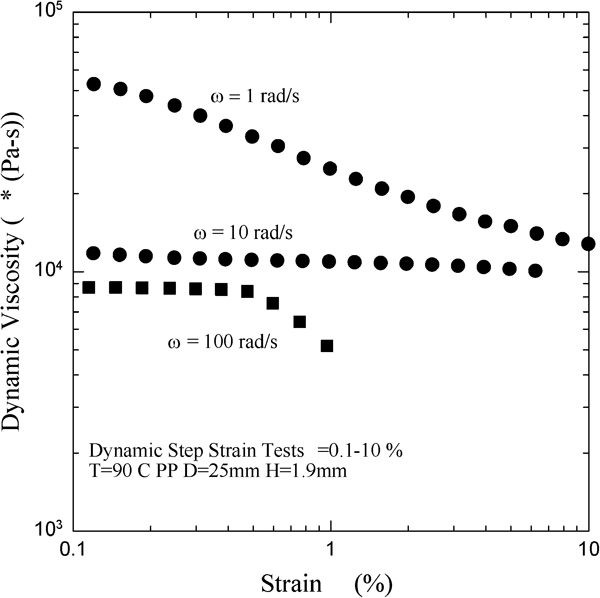
Strain effects on dynamic viscosity as function of frequency for PNE with 5 wt‐%P content
Yield stress and wall slip measurements
The existence of yield stress can be correlated with the strength of a structure formed by the internal interactions. However, in the test shown in Fig. 2, there is no evidence of an infinite viscosity at low shear stresses as the finite value of stress is absent as the rate approaches zero, and thus there is no detectable yield stress for either pure epoxy or 5 wt‐% PNE resin.
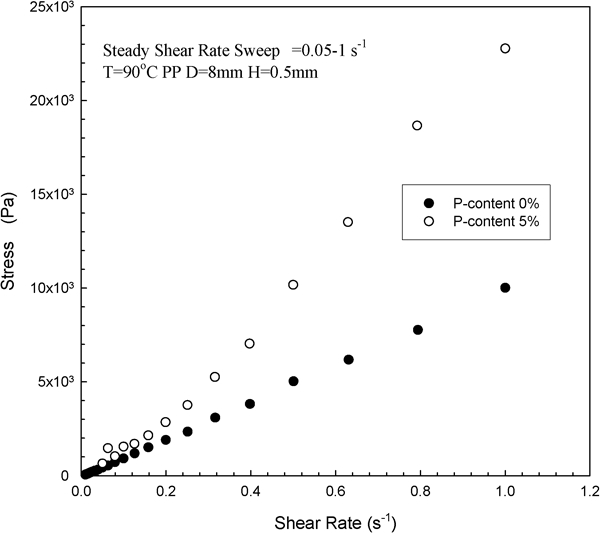
Yield stress determination at different shear rates for PNE with 0 and 5 wt‐% P content
Steady shear sweeps were undertaken to detect the presence of slip. In these tests, slip may be indicated by a gap dependence of steady viscosity (viscosity decreases as the gap increases due to a greater contribution of the slip layer). As shown in Fig. 3, there is no effect of gap (in the range from 0·35, 0·5 to 0·65 mm) on the steady viscosity over the limited number of shear rate conditions tested.
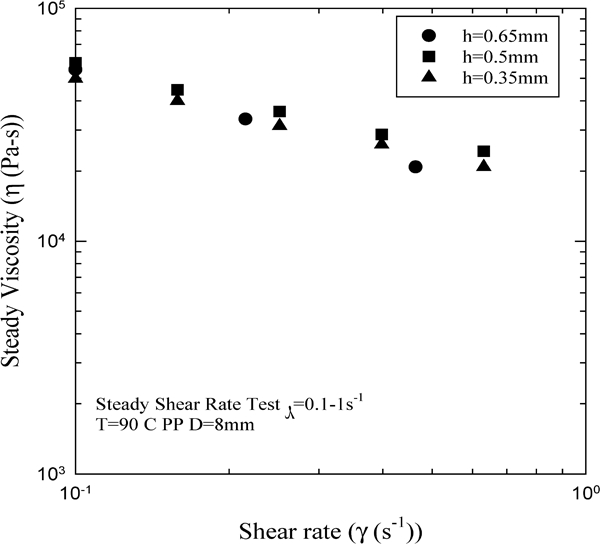
Effect of gap h on steady viscosity at different shear rates for PNE with 5 wt‐% P content
In the tests conducted, temperatures were restricted by shear fracture layering (lower temperatures) and curing effects (higher temperatures). The shear rates were limited by sample pullout (higher rates) and the gaps chosen were limited by unstable flows (both higher and lower gaps). All of the above restrictive conditions may have influenced the results which detected the presence of yield stress and wall slip.
Steady–dynamic shear viscosities relationship
In order to utilise the parallel plate rheometer system for the evaluation of chemoviscosities at realistic shear rates, dynamic shear tests must be used. This is because in the parallel plate system, steady shear rates cannot be used for high viscosity materials because the samples easily fracture. Therefore, a correlation must be made between the dynamic shear viscosity and the steady shear viscosity.
A correspondence between the complex viscosity and the steady shear viscosity has been observed under some circumstances. This relationship, known as the Cox–Merz rule,11 says that, in experimental errors, the complex viscosity is equal to the steady shear viscosity over a range of frequencies and shear rates

 is the shear rate, η* is the dynamic viscosity and ω is the dynamic frequency.
A comparison of steady shear and dynamic shear viscosities using the Cox–Merz correlations is shown in Fig. 4 using a steady shear sweep (
 = 0·05–1 s−1 and T = 90°C) and isothermal multiwave time tests (ω = 0·1–1 rad s−1, γ = 1% and T = 90°C). This proves that the Cox–Merz relationship can be applied in our test range.
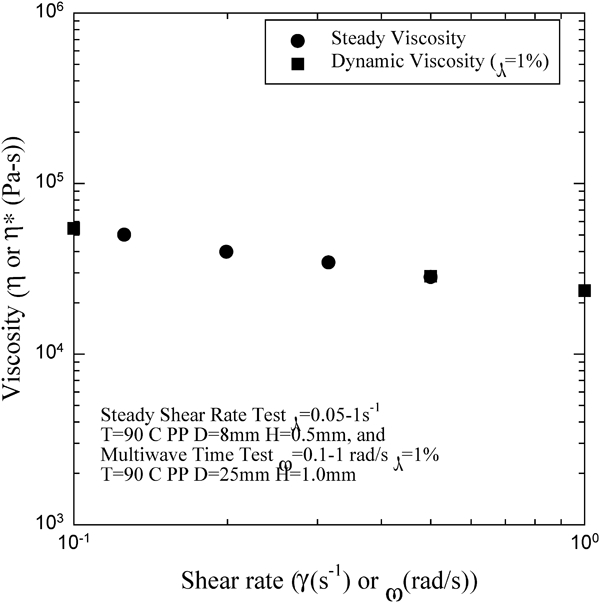
Comparison of steady shear and dynamic shear viscosities for PNE with 5 wt‐% P content
Chemorheology
Isothermal chemoviscosity
Isothermal chemoviscosity tests were conducted using isothermal multiwave tests, with an oscillating frequency from 1 to 100 rad s−1 and a strain of 1%. The temperatures employed are 90, 100, 110 and 120°C. The results of these tests for 5 wt‐% PNE are shown in Fig. 5.
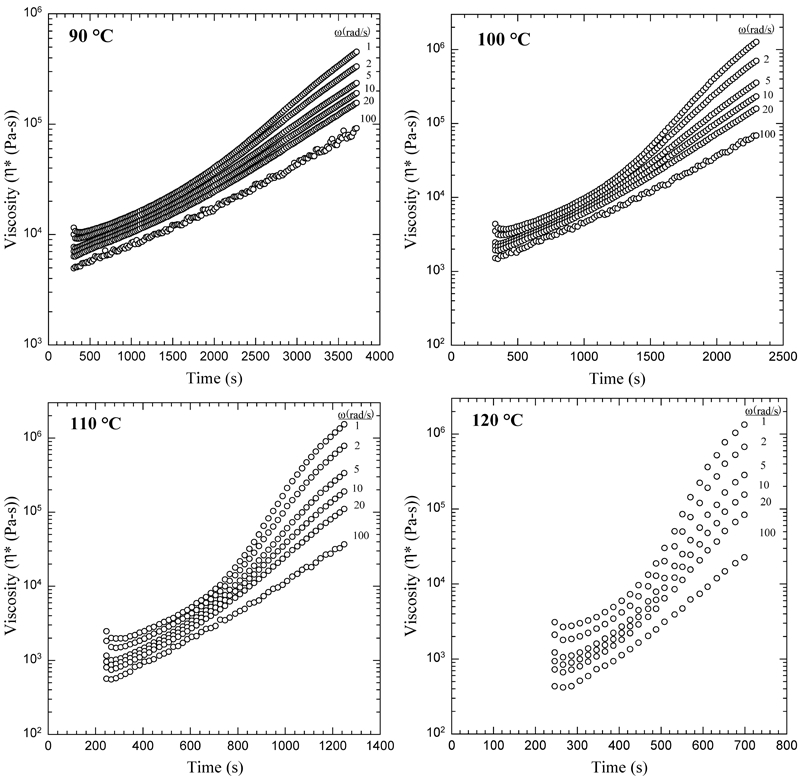
Isothermal chemoviscosity at different oscillating frequencies ω and temperatures
The advantage of isothermal tests is that they may be easily used to separate shear rate γ, thermal T and conversion α effects on the chemoviscosity. These individual effects may be examined in isolation by fitting them to individual models [shear rate: ηsr = ηsr(γ), thermal: ηT = ηT(T) and conversion: ηc = ηc(α)]. These fits then give an indication of the nature of the appropriate overall chemoviscosity model η(γ, T, α) to be used for the material. Usually the overall chemoviscosity model parameters are then determined by a non‐linear regression fit to non‐isothermal data.
Shear rate effect
The effect of shear rate on the chemoviscosity of PNE has been determined by combining the kinetic data and model parameters with the isothermal chemoviscosity data. The viscosity has been fitted to the power law model,12 given in the following equation, for fixed temperatures (T = 90, 100, 110 and 120°C) and levels of conversion (α = 0–0·20)

Power law model fitting parameters for 5 wt‐% PNE
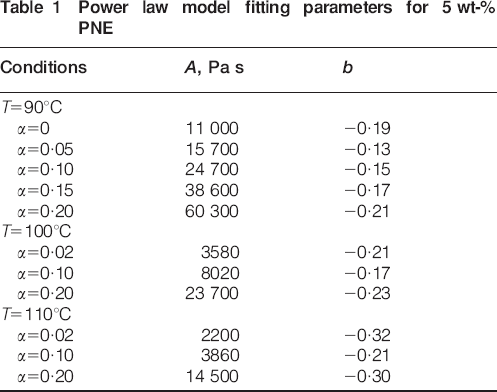
These fitting results verify that the power law model describes the shear rate effects quite well. The power law factor increases with cure level and decreases with temperature, as expected. An Arrhenius style relationship is used to describe the effects of temperature, in which the b coefficient remains reasonably constant with temperature and conversion.
Non‐isothermal chemoviscosity
Non‐isothermal chemoviscosity tests were conducted using non‐isothermal multiwave tests (ω = 1–100 rad s−1, γ = 1%, dT/dt = 2, 10 and 20 K min−1 and T = 80–170°C). The results of these tests for 5 wt‐% PNE via different heating rates are shown in Fig. 6.
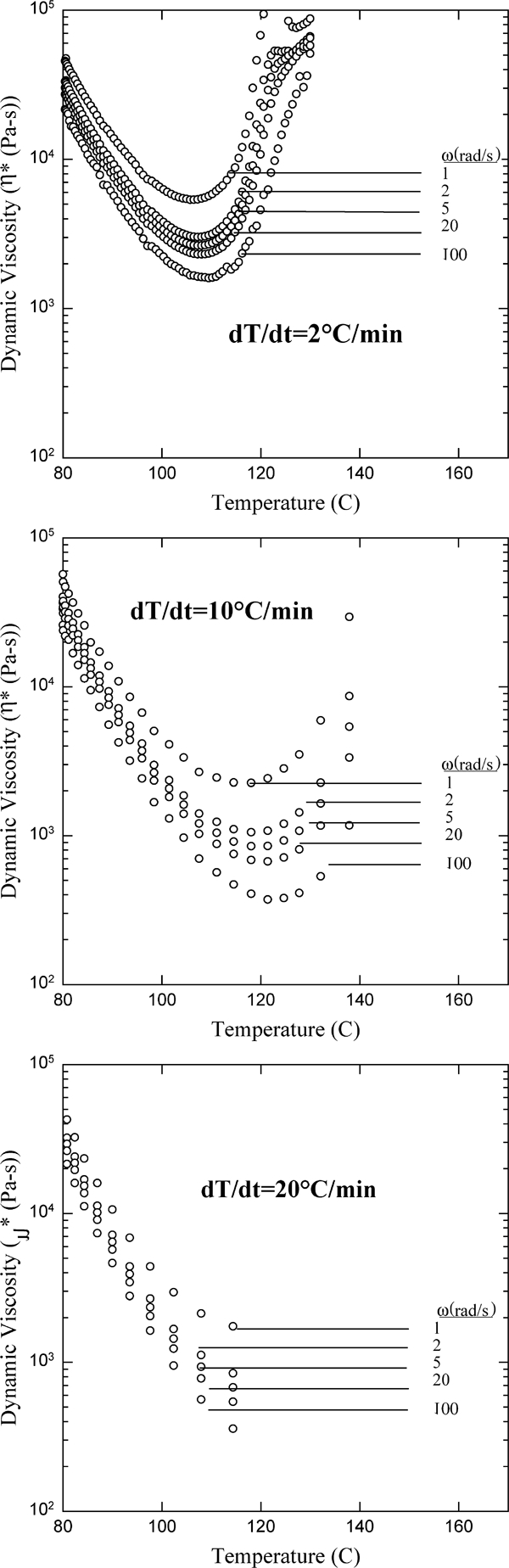
Non‐isothermal chemoviscosity at different oscillating frequencies ω and heating rates dT/dt
The advantages of non‐isothermal testing over isothermal tests are that the temperature profiles are much closer to real processing conditions, higher temperatures can be achieved, and processing information, such as optimal heating rate and optimal minimum viscosity, can be measured. From Figure 5 Figs. 5 and 6, it can be seen that a higher heating rate extends the minimum viscosity to lower values at higher temperatures. Also higher heating rates cause a wider minimum viscosity plateau, as reported in the literature. Optimal heating rates and minimum viscosities may be determined from these figures.
Chemorheology modelling
There have been several attempts recorded in the literature to measure the viscosity of thermosetting polymers. In particular, Castro and Macosko13–15 studied the kinetics and rheology of a polyurethane system and found a relationship between viscosity and degree of cure which is often referred to as Macosko's relation, or the Cross–Arrhenius–Macosko model
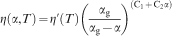

Non‐linear regression of the Macosko model to the non‐isothermal data was undertaken and the fit is shown in Fig. 7. The fit is quite similar to the non‐isothermal fit, although it differs somewhat at the low temperatures that were below the temperatures used in isothermal testing. Although this fitting is based on the dataset of 2 K min−1 heating rate, a similar result was achieved for the 10 K min−1 dataset. However, large variations in terms of fit parameters were observed when the heating rate reached 20 K min−1, which indicates unusual behaviour at the higher heating rate.
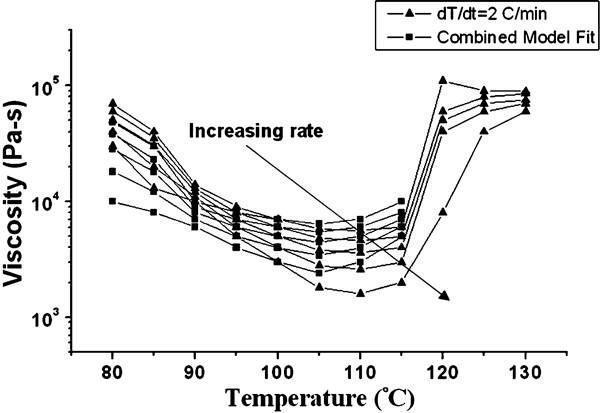
Fitting of Macosko model to non‐isothermal data for 5 wt‐% PNE
Time–cure–temperature superposition
The experimental data presented previously show that PNE melts exhibit both non‐Newtonian viscosity and normal stress effects at large shear stresses, while exhibiting yield values at small strain rates or small shear stresses. Therefore, it is desirable that a three‐dimensional rheological model for PNE melts which is capable of predicting such rheological behaviour, be developed.
For this purpose, the concept of time–temperature superposition is extended and a time–cure–temperature superposition is proposed, in order to predict the viscoelastic properties of the PNE at any stage during complex cure cycles. In the first step, the reaction kinetics of the epoxy system are determined by differential scanning calorimetry and modelled using existing theories. In the second step, its chemorheological properties are measured as a function of isothermal curing temperature and frequency using a torsional parallel plate rheometer. The time–cure–temperature superposition, which is developed following a phenomenological approach, is then applied.
A dynamic rheometer can probe material time, that is, the time required for molecular or segmental motion, separately from laboratory time. Since ω = 1/t, dynamic measurements made at high frequencies provide data corresponding to very short times; and measurements at low frequencies, to long times. The effects of time and temperature are the same for viscoelastic materials throughout certain regions of behaviour. As a result, ‘master curves’ can be generated that can then be used to predict a material's performance outside the range of accessibility of normal instruments.
When a different temperature dataset to plot viscosity versus shear rate as shown in Fig. 8, is added, there is nothing that reflects the extended test range. However, the traditional time–temperature shift factor which is based on the Williams–Landel–Ferry (WLF) equation has been applied as follows:
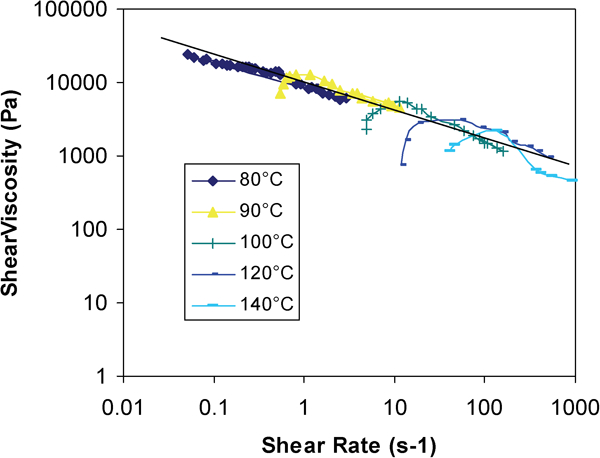
Viscosity versus shear rate using datasets at extended temperatures
For temperature shift factor αs based on WLF equation16

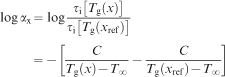
Combining these equations gives the overall shift factor αT,x
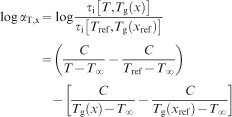
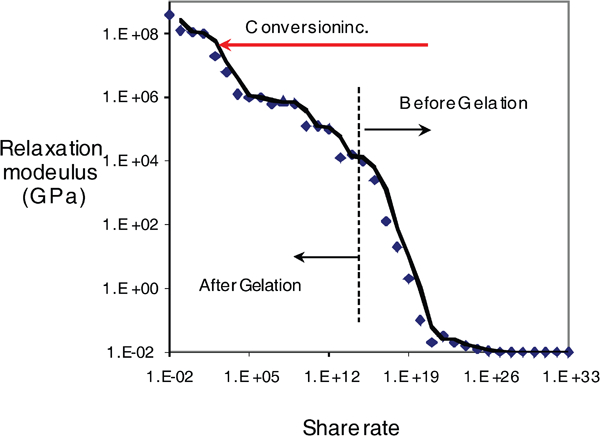
Time–cure–temperature superposition fitting curve for 5 wt‐% PNE
In industrial practice, however, complex cure cycles, including dynamic heating and cooling as well as multiple isothermal steps, are often used. In order to be able to predict the evolution of the internal stress levels and the resulting residual stress after such cure cycles, both the instantaneous conversion and viscoelastic properties need to be modelled using numerical methods.
Conclusions
In this work, the chemorheology of PNE used in flame retardants has been explored. The results of isothermal versus non‐isothermal measurements, steady versus dynamic test and the effects of shear rate were obtained from experiments. The non‐isothermal dynamic test is clearly one of the best methods for characterising the rheological properties of reactive PNE systems.
A procedure is proposed for finding an expression relating the viscosity of a complex epoxy compound during curing to the temperature, shear rate and degree of reaction. It appears that at a constant value of the effective shear rate (i.e. the product of frequency and strain), the dynamic viscosity is identical over a wide range of frequencies, strains and temperatures. The effective shear rate dependence of the viscosity is described by using a power law with an exponent that depends on the conversion.
From this combined numerical/experimental study, it can be seen that the material behaved with time–cure–temperature superposition. The key elements are that the dynamic frequency of oscillation provides a direct link between material time and laboratory time (the time scale t in seconds is the reciprocal of the frequency ω), and dynamic data can be directly related to through the Cox–Merz relation. Furthermore, by employing the Boltzmann principle, which holds that when strain varies linearly with stress, the aggregate effect of applying a series of stresses is the same as the sum of the effects of applying each stress separately together with time–temperature superposition, data can be obtained to predict behaviour that is outside the range of conventional rheometer measurement.