






Abstract
The motion of particles through a system of permeable fibre bundles is considered. The system is discretisised with Voronoi diagrams and the dissipation rate of energy is minimised with respect to the stream function in a system with periodic boundary conditions. The flow of the particles is in the transversal direction to the fibre bundles and the particles are hindered to move out of the plane allowing for two‐dimensional calculations. The motion of particles is assumed to be slow with respect to the flowrate so that particles are driven by the Stokesian force for stationary particles. In this case, the flow distribution is essentially dependent on the particle configuration and strictly follows the motion of particles. When testing different sizes of the particles, it is shown that there is a qualitative agreement between model and experiments previously performed. In particular, stationary flow leads to particle depositions in front of the fibre bundles and small particles move into the fibre bundles while large ones are stuck at the border.
Introduction
When manufacturing fibre reinforced composites by liquid composite moulding techniques such as resin transfer moulding and vacuum infusion, liquid resin is injected into a dry fabric.1–4 During this process air/fibre interfaces are replaced by resin/fibre interfaces, a process very much dependent on the detailed geometry of the fabric. Fabrics used in modern composite materials for high end applications often have dual scale porosity. Common to these types of fabrics are that their pore structure consists of two geometrical scales, <10 μm inside the fibre bundles and >100 μm between the bundles. This bimodal porosity has been reported in the literature to be the cause of several issues occurring during the impregnation stage of composite manufacturing. The detailed geometry of the dual scale porosity is, for instance, of importance for applications when the resin is doped with particles to create multifunctional composites.5–7 The added particles can, for example, enhance the fire resistance, toughen the material, and introduce electrical conductivity and shielding properties to the material.8–14 In order to achieve satisfactory properties of these functional materials, it is vital to have a known spatial distribution of the functionality throughout the material and it is of great interest to develop methods to control the distribution of particles during manufacturing. With a controlled particle distribution the functionality sought for can be optimised without sacrificing other properties. Bimodal porosity is also one of the main reasons for void formation15–17 and the succeeding transport of the bubbles formed.18–20
One way to obtain a desired particle distribution is to control the flow during impregnation. It is then essential to consider the flow on the micro‐ and mesoscales.21 The flow characteristics on these scales differ at the wetting flow front and in the bulk. This is caused by capillary action at the flow front often promoting the flow on small scales and by large differences in permeability.22 A consequence is that the shape of the flow front varies significantly as a function of the flowrate.23 This may lead to more or less filtration of the filler particles as the liquid moves between low and high porosity. Such filtration may also take place in the bulk for flow perpendicular to bundles of fibres. Experimental results for relatively large particles have shown that transient effects lead to particle deposition around fibre bundles while the stationary flow in the bulk results in particle deposition in front of fibre bundles.7 It is also shown that smaller particles deposit inside the fibre bundles.
In this work the authors extend a model developed for studying the formation and transport of bubbles in fabrics with dual scale porosity to include the motion of functional particles during impregnation.17, 24 The model is compared with experimental results in Refs. 6, 7 and 23. The accuracy of the results is discussed and means to improve the model are suggested.
Theory
Flow perpendicular to two‐dimensional systems of fibres is considered. Since the fibres themselves are impermeable, the stream function for the surface of each fibre is constant ψ = ψi, where i = 1…n is the index of the fibres. The difference in stream function between any two fibres is determined by the flowrate in the gap between the two fibres in question. To derive the distribution of flow, the system is thus divided into n parts, so that each part contains one fibre. A modified version of Voronoi diagrams is used for that purpose implying that straight lines are applied also when the fibres have unequal size, see Ref. 25 where the theory is outlined in detail. The fibres are assumed to be stationary with respect to the stream and non‐slip boundary conditions can be applied. At the crossing between the centre and centrelines of fibres i and j with the Voronoi lines, the value of the stream function and the vorticity
 are denoted ψij0 and ωij0 respectively (see Fig. 1). Using this definition the quadratic average of vorticity in an area Sij at the fibre i adjacent to the fibre j may be written as
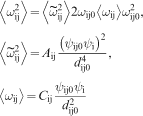

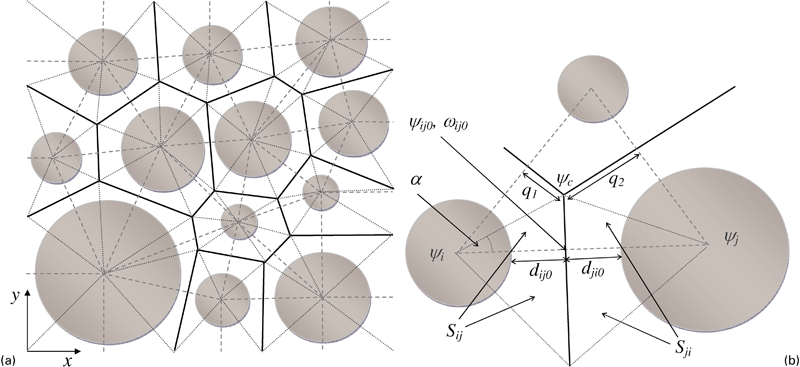
Schematic view of discretisation of system
The total force on each fibre can be expressed by knowledge of the vorticity near the fibres and by accounting for the viscous and normal forces according to
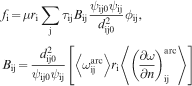

Motion of particles
In the present model the authors assume that the fibres are stiff and thus unaffected by the flow as if the flow occurs only through a particular cross‐section along the length of the bundle. The particles, in their turn, move with the fluid and redistribute with the flow field. Quasi‐stationary redistribution of the particles in the flow is considered. It implies that the fluid flow and the corresponding Stokes drag force are calculated assuming that the particles at that moment are stationary and inertial effects are negligible. This differs from a majority of studies where the particles just follow the fluid flow and does not have a major influence on the flow field (see Ref. 27). Afterwards in the authors’ studies, the particles take new positions depending on the Stokesian drag force on the individual particles. The movement of one particle into another or into a fibre is prohibited. This, however, creates a contact force to another particle or to a fibre. By using the Monte Carlo Metropolis algorithm for relaxation of stresses, the contact force between two neighbouring bodies relaxes to equilibrium. Friction between bodies (particle–particle and particle–fibre) is not included because the bodies are always assumed to be separated by a tiny layer of fluid, hence only viscous drag between the bodies is considered.
Notice that the authors assume that the particles represent a fully two‐dimensional case, and therefore there is very little flow between two closely packed particles or between particles being located close to fibres. This differs from a three‐dimensional set of spherical particles where the flow often can, more easily, go through the system of closely packed particles. Therefore, the fluid flow is more dependent on the fibre distribution in a two‐dimensional case. A previous study on two and three‐dimensional systems shows that the dimension influences the actual permeability level of random systems as well as the controlled distribution of local permeabilities.16 The same study also revealed that main trends of three‐dimensional systems can be captured using a two‐dimensional approach. The additional dimension makes it easier for the fluid to move around the particles, possibly providing a smoother result.
Numerical set‐up
A geometry mimicking three fibre bundles is constructed by randomising positions of fibres within imaginary ellipses (see the larger circles in Fig. 2a). The bundles are placed in a stationary liquid resin and assumed to be fully impregnated with this resin. Now some of the resin is doped with particles being the smaller circles in Fig. 2a, and the resin is subjected to a pressure gradient driving it from the top of the figure to its bottom. The size of the particles is randomised within certain limits to account for the variability of particle diameter. Three size distributions of the particles are considered a medium one with the largest particle size approximately half the average spacing between fibres in the bundles, a second one with twice as large particles as this set and a third distribution with half as large particles as the medium set of particles.
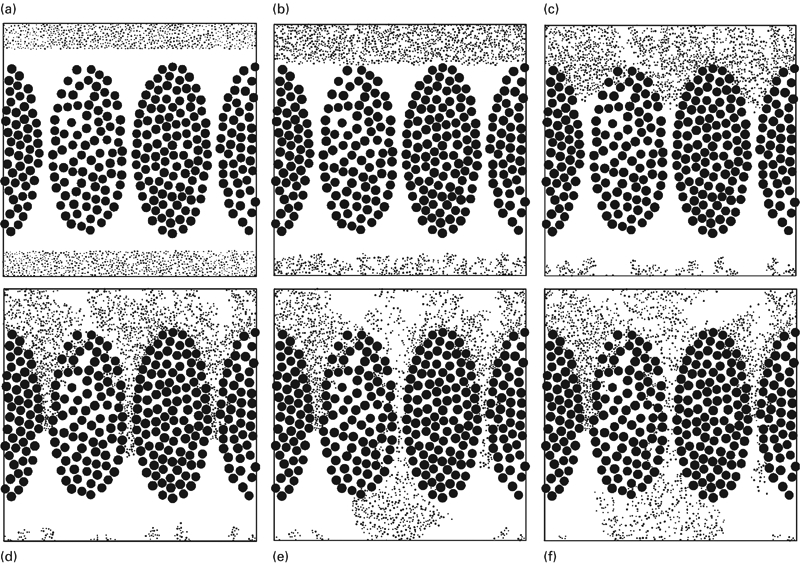
a–f a series of images showing snap shots of motion of medium sized particles through system of fibres bundles: flow is from top of images to bottom of them
Results and discussion
Let us start to discuss the case for medium sized particles. As the resin begins to move the particles follow (see Fig. 2b). When the particle doped resin arrives to the bundles (Fig. 2b and c), some of the particles continue to follow the resin into the bundles from the side of the bundle facing the flow while others are trapped at this border (see Fig. 2d). A third alternative is that the particles follow the resin into the interbundle channels. They may then enter the bundles also from the side of the bundle being mainly directed along the flow (see Fig. 2e). Still some of the particles follow the flow and for two of the three interbundle channels studied the particles eventually form a bridge stopping the flow of particles in the interbundle channels while the resin is free to flow in the third channel, the middle channel in Fig. 2f. The bridging leads to a densification since the resin seeps out between the particles. If we now compare these results with those obtained in Ref. 7, experiments yielded that the wetting flow leads to particle depositions around the fibre bundles; the simulations with the medium sized particles indicate that this may also happen during stationary flow although less pronounced. There are at least two reasons to this: non‐homogenous distribution of the fibres in the bundles and a curved interface of the bundles. The experiments also yielded that the stationary flow leads to large particle depositions in front of the fibre bundles. This effect can also be found in the simulation although not as distinct as in the experiments. The smaller deposition in the model might be due to that the real particles become mechanically or chemically bound to each other when they are close enough. This mechanism was not accounted for in the model. Another reason is that the flowrate through the bundle in the simulations ceases due to early entrapments. Such a reduction in flow will be less in three‐dimensional reality.
If the authors now double the size of the particles the overall clogging increases. To start with more channels is blocked as demonstrated in Fig. 3 where the particles form bridges in all channels. This, in turn, builds up a pressure gradient that pumps particles into the larger openings inside the bundle. As a result an interphase is formed with particles and fibres at the border of the bundles. In overall the densification of particles becomes more significant than that for the medium sized particles. For the case with the smallest particles there is no bridging within the interbundle channels in the simulations performed as illustrated in Fig. 4. There are also a larger number of particles that move into the bundles as compared to the other two cases. Still a majority of the particles are arrested at the border of the bundles. This result is in qualitative agreement with those in Ref. 7 where it is observed that small particles move into the fibre bundles while the large ones are stuck at the border.
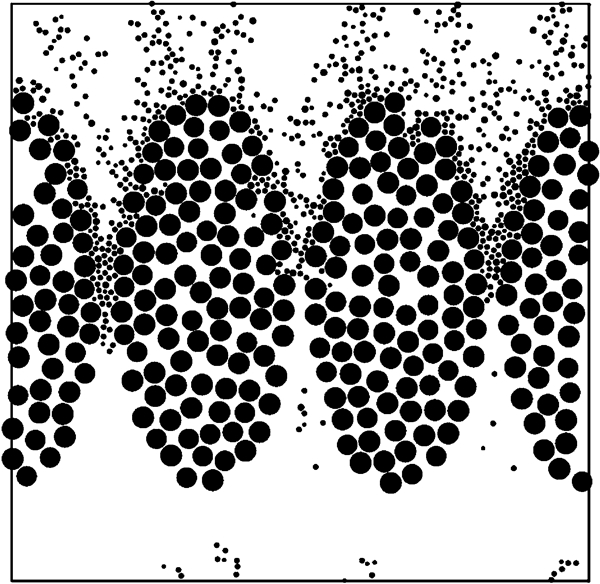
Snap shot of motion of large particles through system of fibre bundles: flow is from top to bottom of image
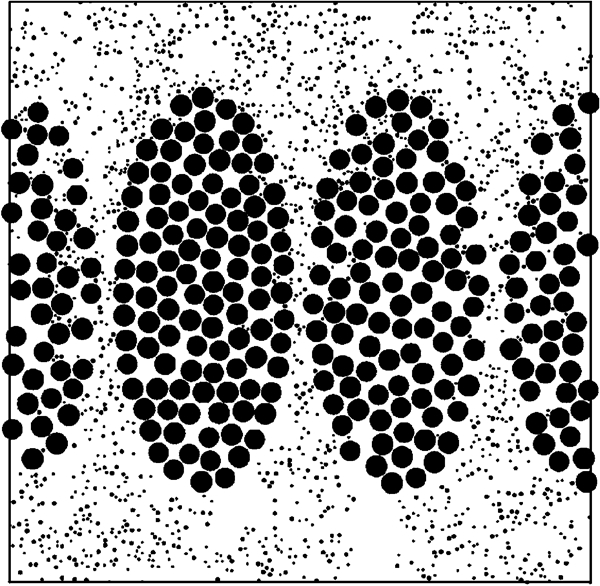
Snap shot of motion of small particles through system of fibre bundles: flow is from top of image to bottom of it
If the system gets blocked in some of the gaps between the bundles, the flow has to go either through the remaining gaps or through the interior of bundles. This can be seen in Fig. 5 where the centre and right gaps are closed and nearly all the fluid goes through the left gap.
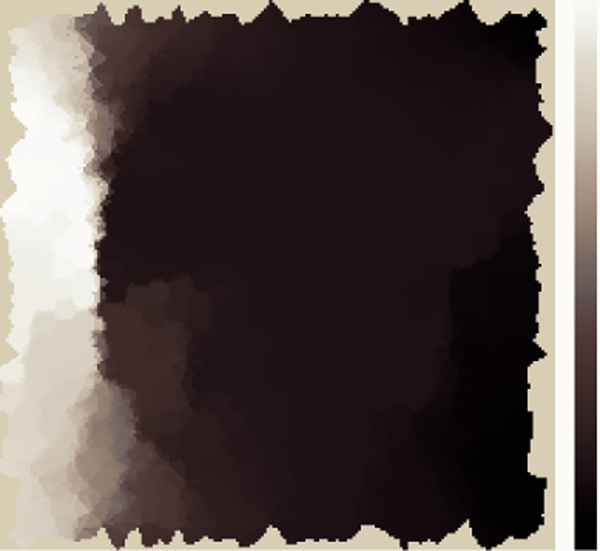
Distribution of stream function when nearly all fluid goes through left gap
Accuracy of results
The values for A, B and C are obtained by CFD calculations for regular particle distributions either rectangular or hexagonal, but the values differ somewhat for these characteristic packing at the same shape of areas Sij in Fig. 1b. Therefore, the system is analysed locally by the nearest three particle configuration (see Fig. 1b) to see which packing is most representative.25 If the particles are located close together, there is a need for asymptotic relationships for A, B and C. These asymptotic relationships25 correspond well with expressions derived by a theory similar to that in Refs. 28 and 29, which is also analogous to that proposed in Ref. 26, where the shape of the particles is approximated as parabolic near the closest distance between neighbouring particles and it is assumed that significant vorticity only exists in close proximity to that area. Without the correction terms, the asymptotic expressions are only valid for higher packing than that at porosity equal to 30% with an accuracy greater than 5%; the numerical correction obtained by CFD allows the range to be extended up to porosities of 50%.25
Conclusions
Voronoi discretisation together with minimisation of the dissipation rate of energy can be effectively used to study fluid flow driven motion of particles through a system where the particles themselves cardinally influence the fluid flow pattern. This was exemplified by studying two‐dimensional particle flow through arrays of fibre bundles. The simulations suggest that blockage is promoted if a space is narrower than the doubled diameter of the largest particles. Particles enter into spaces of the bundle until they get trapped and further motion of particles at that location is prohibited. Experimental observations showed a slightly higher accumulation of particles at the front of the bundle as compared to the model. The model, however, predicts the particle flow between the bundles and deposition of particles within the bundle.
Footnotes
This paper is part of a special issue on manufacturing and design of composites