







Abstract
Procedures for qualifying fibreglass pipes are discussed here in relation to industry needs. The ultimate elastic wall stress (UEWS) test appears to provide an efficient means of rating pressure pipe, and indeed vessels, for the case where weepage failure occurs resulting from the accumulation of matrix cracks. The principle behind the UEWS test is to identify, from the pressure–strain response, a pressure level below which damage growth is either negligible or at least sufficiently low to avoid failure within the design life. The version of the UEWS test most often used involves the application of groups of 10 one‐minute pressure cycles at increasing pressure values, recording the hoop or axial strain. The onset of non‐linearity in the pressure–strain relationship can be accurately determined and enables a safe long term pressure level to be identified. The UEWS test appears to provide a desirable alternative to the currently used procedure laid down in ISO 14692, which involves an expensive series of long term constant pressure tests, as described in ASTM 2992, running for a period in excess of 10 000 h. It is shown here that the UEWS test reflects the cyclic fatigue behaviour of fibreglass pipe, but further work on the relationship between cyclic and static behaviour would be desirable. It has been shown that a Miner's law approach is effective in modelling damage due to combined static and cyclic effects, and that damage can be directly related to matrix crack growth. This approach could form the basis of a future procedure for describing lifetime behaviour of glass reinforced epoxy pipes under any required combination of static, fatigue, hydrostatic and non‐hydrostatic (multiaxial) loading.
Introduction
This work is part of a continuing project to clarify issues relating to the qualification of fibreglass pipe. The research is being carried out against a background of a review of qualification procedures described in ISO 14692. Fibreglass pipe, notably glass reinforced epoxy (GRE) pipe, is used in the energy industries where corrosion resistance is required.1 The pipes referred to here are manufactured by filament winding, which produces a multilayer laminate with plies aligned at ±55° to the axial direction. The principal failure mode is ‘weepage’ of fluid through the pipe wall, due to the growth of cracks in the epoxy matrix parallel to the fibres2 as shown in Fig. 1. The cracks form due to the combined effect of transverse tensile and shear stresses in the composite plies. Cracking is driven by both repeated pressure (cyclic fatigue) and the effect of long term static pressure (static fatigue). Weepage occurs when the concentration or density of cracks reaches a level where a fluid path is possible through the pipe wall. Users of GRE pipe should note that the weepage pressure is much lower than the pressure required to fracture the fibreglass, so weepage can be regarded as a benign failure mode, giving desirable leak before break characteristics.
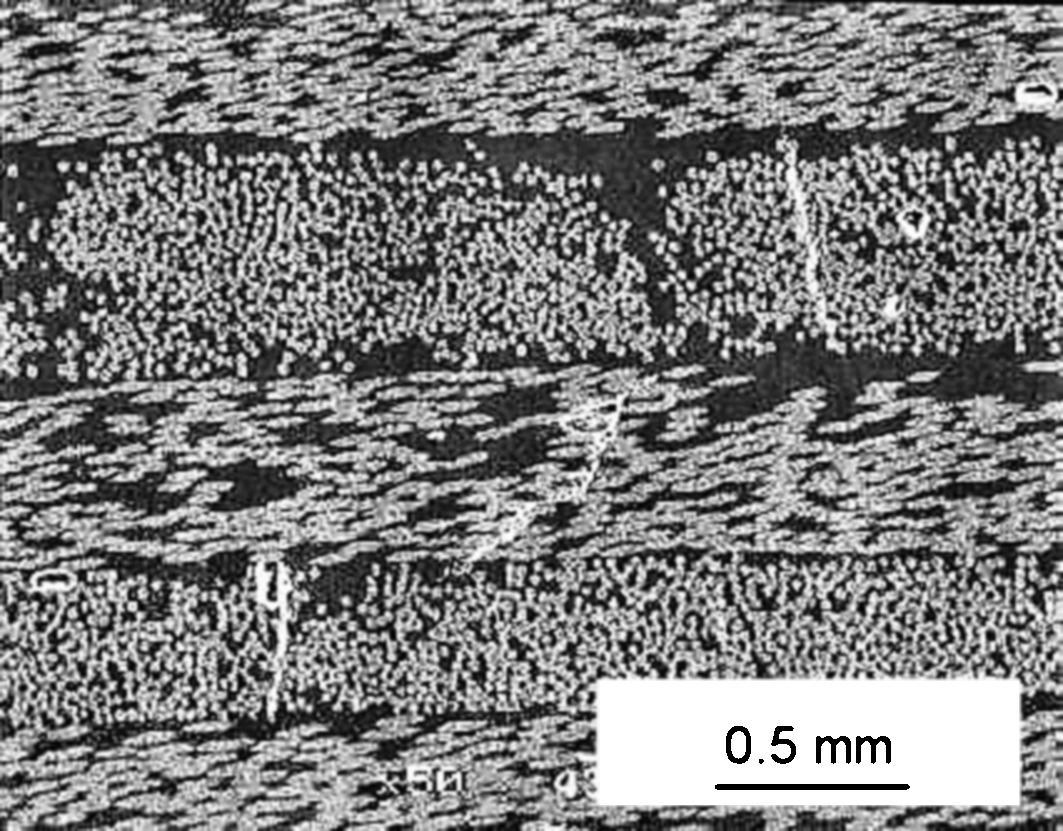
Matrix microcracks in filament wound ±55° angle ply glass epoxy tube2
Qualification and testing procedures
The qualification standard for fibreglass pipe, ISO 14692, is currently being revised. The procedure by which GRE pipes are rated in the standard, ASTM 2992, covers both cyclic and static pressure loading. Weepage is the only failure mode permitted. End users should note that there are other classes of fibre reinforced pipe where weepage is suppressed by means of a ductile liner, so fibre failure occurs. These pipes are covered by different norms, such as API RP15S. The discussion here relates solely to GRE pipes that fail by weepage.
The ASTM 2992 procedure involves hydrostatic pressurisation tests under either cyclic or long term static loading, depending on the loading condition of interest. In each case the method of treating failure data is the same, as summarised in Fig. 2. Both the cyclic and static failure processes can be described respectively by empirical power law expressions


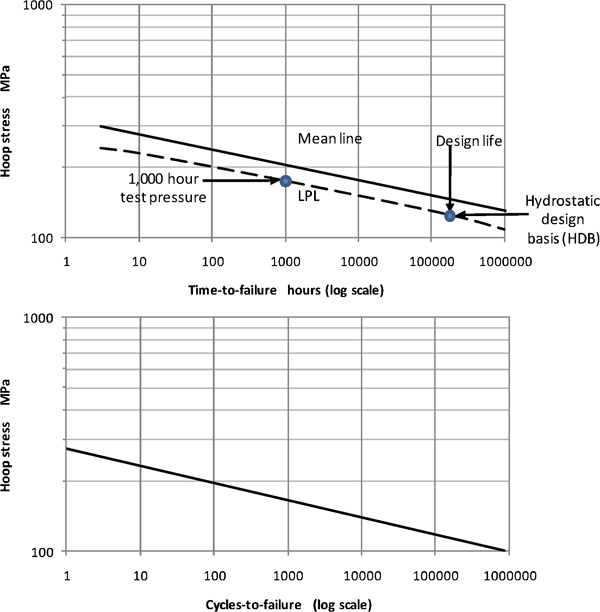
Static (upper) and cyclic (lower) future pipe test results at 65°C from ISO 14692 and ASTM 2992: upper figure shows 97·5% LPL and procedure for determining HDB
As well as giving the pressure rating, it is also necessary for a qualification standard to provide methods of deciding whether changes to the materials or manufacturing process have affected the product. This is necessary since it would be expensive to repeat the full qualification procedure every time a small product change was made. The solution offered to this problem is the procedure for ‘reconfirmation of the HDB’. This is a survival test which involves holding samples under hydrostatic pressure at the 1000 h LPL value for 1000 h. As per the standard, survival in this test indicates that the samples tested are at least as good as those originally qualified.
Ultimate elastic wall stress test
While acknowledging the benefits of a qualification system based on regression analysis, manufacturers, driven by the need for a rapid and effective method of monitoring changes in product quality, have examined various alternative types of shorter term test. The UEWS test has proved to be one of the most effective of these. Frost and Cervenka1 observed that damage involving matrix cracking in composite materials is associated with observable non‐linearities in elastic behaviour. Procedures have been described and reported to a limited extent in the public domain for use with vinyl ester based pipe3 as well as polyvinyl chloride.4
The purpose of the UEWS test is to identify, by studying the stress–strain response, a stress level below which damage growth is either negligible or at least sufficiently low to avoid long term failure at the design life. The UEWS test used by Future Pipe Industries involves the application of groups of 10 one‐minute hydrostatic pressure cycles at increasing values of pressure, as shown in Fig. 3. During the procedure, either hoop or axial strain is measured using gauges. The strain at the end of the first and the last cycle of each 10 cycle group is measured and these values are plotted against pressure (or hoop stress) as shown in Fig. 3. If zero or negligible damage occurs at a particular pressure level, then a linear relationship is observed between strain and hoop stress, and the strain after the tenth cycle in the group is the same as that after the first. This can be clearly seen in the early cycles. As the UEWS is approached, however, a deviation in strain can be seen between the first and the last cycle, and the relationship begins to become non‐linear. The pressure increments are chosen to enable ∼10 sets of measurements to be achieved before the UEWS being reached. It is necessary to take at least two measurements beyond the UEWS, to assist in determining the point of deviation from linearity. The UEWS value is determined by the intersection of two best fit lines, as shown.
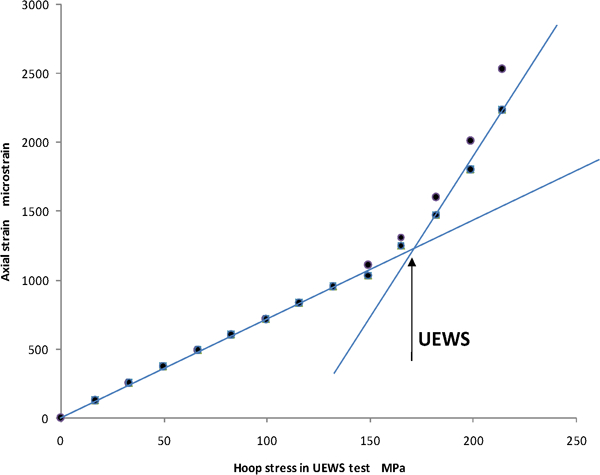
Ultimate elastic wall stress (UEWS) test results showing strain response: squares: first cycle strain; circles: tenth cycle strain; UEWS construction is shown
The main advantage of UEWS is that the test takes only a few hours per sample to perform, compared with the 1000 h HDB reconfirmation procedure. The UEWS has been found to be sensitive to changes in key manufacturing and raw material parameters such as the quality of the ‘size’ on the fibreglass, which influences the bond with the resin. These effects are not easily picked up in the ASTM 2992 tests: indeed the HDB reconfirmation procedure provides no product information other than a yes/no outcome. The sensitivity of the test to material and quality parameters has also been found to be superior to tests such as interlaminar shear and through‐thickness strength.
In practice, the UEWS has been found to correlate well to the long term LPL value obtained from regression tests. The main criticism of the UEWS concept is that the exact significance of the measured quantity is not fully defined. This will be discussed and clarified later.
Comparison between procedures
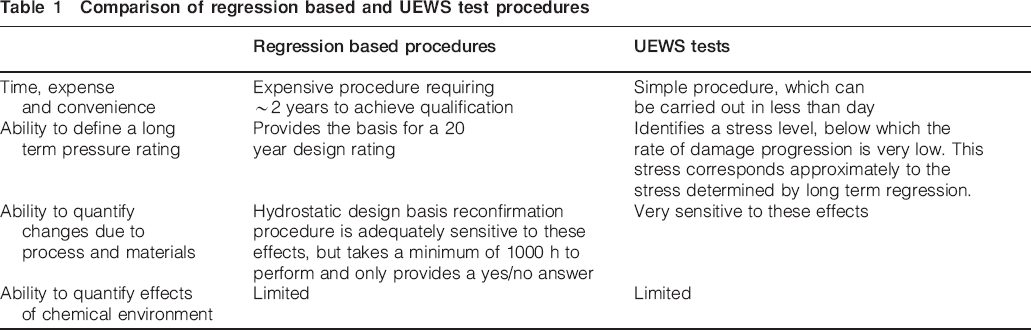
Table 1 discusses the differences between the regression based ISO 14692 and the UEWS procedure. The main advantage claimed for procedures based on cyclic and static fatigue is that they provide a realistic statistical approach to establishing a long term pressure rating when there is a slow deterioration of properties. This makes them attractive in connection with statistically based design. However, there are significant practical issues involved in running experiments for a long period, and the aging processes operating in the test procedure may differ from those that apply in the field. The most significant drawback of the long term tests is the time needed to achieve full qualification of new products. The ASTM 2992b procedure requires static fatigue data at times in excess of 10 000 h (∼14 months). For new piping products, where the regression line slope is not identifiable in advance, this requires significant trial and error to determine the pressures to be used, which often results in a qualification period that exceeds 2 years. Although it is generally agreed that proof of long term durability is desirable, long term static fatigue measurements may not be the best method of achieving this.
Comparison of regression based and UEWS test procedures
Miner's law interpretation of UEWS test
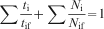
Miner's law, an empirical law, was originally proposed to describe the development of cyclic fatigue damage in metals. It provides a method of summing the damage produced by fatigue cycles of different magnitudes, and can be extended to model and sum the effects of other types of damage. When cycles of different magnitudes are present, end of life is reached when


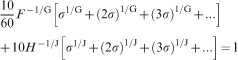
Little work has been carried out for the case where both static and cyclic fatigue effects are present at the same time. Often, it is sufficient simply to compare the Miner's law sums for the two cases, when one will usually be seen to dominate. It has also been proposed1 that the sums of the two effects simply be added, so that failure is predicted to occur when

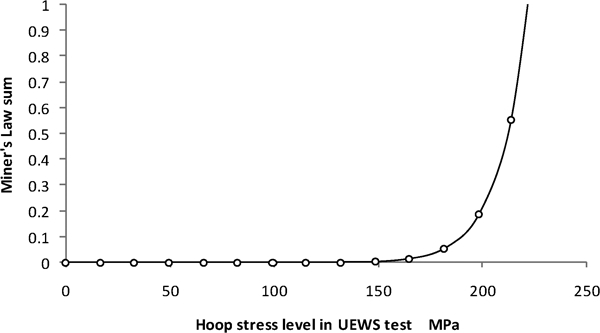
Miner's law sum at each hoop stress level in UEWS test
Effects of crack density on properties
An improved method of looking at pressure rating and lifetime modelling for GRE will probably require considerations of the crack density and the way it affects measurable quantities such as the elastic constants of the pipe and possibly acoustic emission. Furthermore, a damage growth law is required to relate the change in properties with the loading history. The parameter normally used to describe the damage state is the crack density ρ measured in the ply transverse direction. ρ is dimensionless, being defined as the ply thickness divided by the average distance between the cracks. This provides a means of taking into account the well known effect of ply thickness on crack growth. It will be assumed that weepage occurs at a critical value of crack density ρweepage, and that this value is the same regardless of how the weepage state is reached (i.e. by different combinations of static and cyclic loading or different combinations of internal pressure and axial load).
A number of workers have published papers on the effects of cracking and damage growth in laminates.6–9 Talreja6 introduced the concept of damage mechanics and, recently, Varna et al.7 and Quaresamin et al.8 suggested methods by which the power law relationship, equation (1), might be modified to account for the effects of multiaxial loading. The work of Gudmundson and Zhang9 is also relevant, as they modelled the changes in elastic properties due to matrix cracks. Some results are shown in Fig. 5, with the model results normalised by dividing each elastic constant by its initial non‐cracked value. It can be seen that the axial Young's modulus declines most rapidly with increasing crack density, while the hoop modulus declines just a little less. The in‐plane shear modulus, which might be expected to be less influenced by the presence of cracks, declines less, while the Poisson's ratio varies only a little. Weepage probably occurs at a relatively low crack density value in pipe laminates, compared with the maximum possible level, in the range of 0·3–0·5.
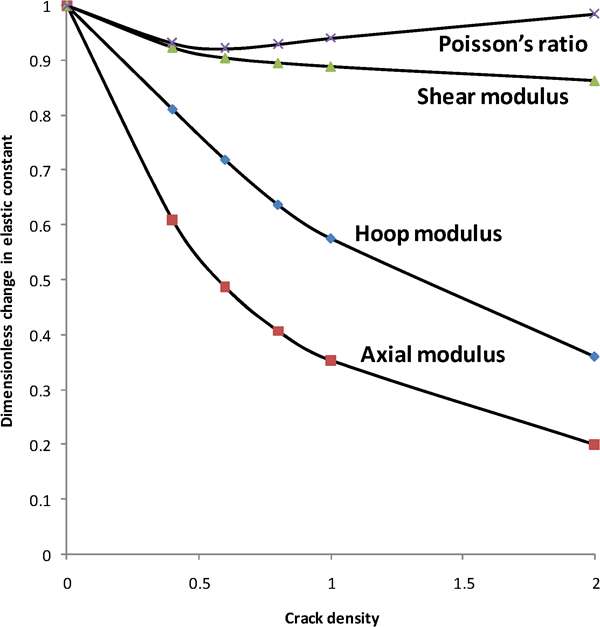
Dimensionless change in elastic constants versus crack density for angle ply pipe laminate, calculated from model of Gudmundson and Zhang9
As there is relatively little crack growth resistance in the fibre direction, the cracks, once initiated, grow rapidly in this direction. The rate determining process in damage propagation, therefore, is crack initiation, rather than growth. Frost and Cervenka1 proposed a damage growth model for GRE pipe using a relationship similar to the Paris' law for crack growth in metals. The modified Paris' law describes the rate of change of crack density, rather than the growth of a single crack so, for the case of cyclic fatigue


Provided that the crack density is less than ∼0·4, the changes in the elastic constants in Fig. 5 can be described by linear approximations. It should therefore be possible to use the Miner's law sum to deduce the variation in elastic constants during the design life or indeed during an UEWS test. Work is continuing in this area at present and the results appear very promising. Figure 6, for instance, shows the predicted change in elastic response during the UEWS test using this approach. This can be seen to agree well with the measured results of Fig. 3.
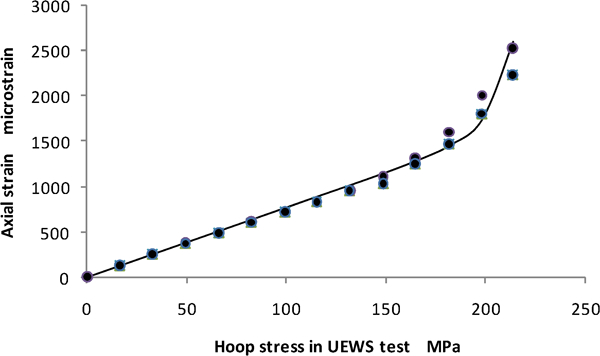
Miner's law based simulation of strain response in UEWS test
General lifetime damage model for gre pipe
Since each ply is constrained by plies of different orientations above and below it, as in Fig. 1, cracks only spread, at least initially, within each ply. The initiation of these cracks is governed by the stress (or strain) state in the ply. The crack initiation process is driven by an interactive combination of stresses on the ply which is probably best described by a ‘polynomial’ expression, similar to the widely used polynomial failure criteria, which takes into account these stresses and their interactions

The stresses in equation (10) can be expressed in terms of the pipe wall stresses. This enables the damaging effects of all stresses to be expressed in a single relationship.
Since equation (10) takes into account the effect of all the stresses acting on the ply, it can be used to model lifetime behaviour under a range of different stress conditions, including those involving axial loads on the pipe, in addition to hydrostatic ones. Figure 7, for instance, shows ‘failure envelopes’ produced by applying this model to measured UEWS data at different stress ratios.
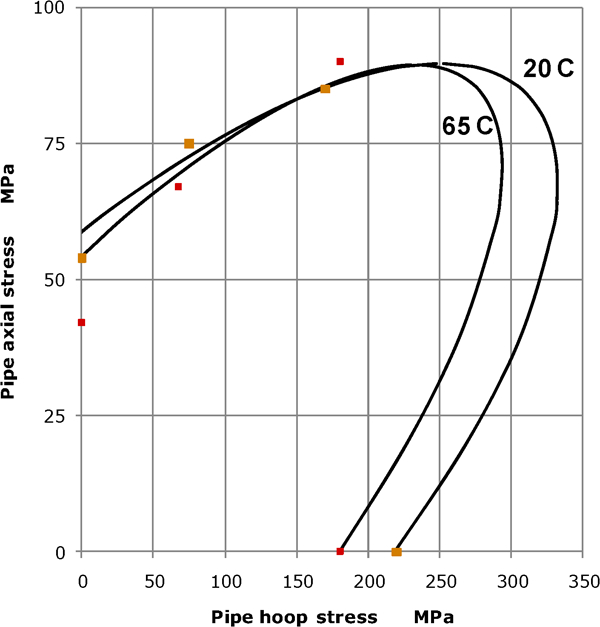
Glass reinforced epoxy pipe failure envelopes, at 20 and 65°C, based on UEWS and interactive stress criterion of equation (10)
Conclusions
Procedures for qualifying and reconfirming the qualification of fibreglass pipes have been discussed. The UEWS test provides an attractive alternative to the current 1000 h survival test for detecting manufacturing changes and reconfirming the design basis of pipes. It is also possible that, after further investigations, the UEWS procedure could form the basis for a full qualification procedure, provided that the UEWS value can be quantitatively interpreted in terms of damage progression and related to the statistically determined HDB. The study to date shows that the UEWS test reflects cyclic fatigue behaviour, so it is necessary to further study the relationship between cyclic and static behaviour of fibreglass pipe. It has also been shown that Miner's law is effective in modelling damage due to combined static and cyclic effects, which can be directly related to matrix crack generation leading to weepage.
Finally, this modelling approach can be extended to give useful predictions of behaviour under stress states involving combinations of internal pressure and axial load on the pipe. The models proposed here are being further studied and refined.
Footnotes
This paper is part of a special issue on manufacturing and design of composites