







Abstract
Advanced fibre reinforced composites are already extensively used in modern aircraft, due to advantages offered for weight reduction, durability, mechanical performance, etc. However, composite structures in aerospace are usually not associated with low costs. Traditional design methods are very time consuming, materials and production processes very expensive as well as labour intensive. To make full use of the potential of composites, a complete redesign of aircraft structures is necessary. Owing to qualification and certification procedures the introduction of low cost materials or low cost production processes is hindered. The current paper describes the results of a collaborative research project aimed at achieving significant cost reductions in the manufacturing of advanced composites for aerospace applications. A highly integrated redesign of a generic wingbox section was made and a low cost, room temperature, open mould (non‐autoclave) resin infusion production process was developed using a room temperature curing resin system for the production of the demonstrator.
Introduction
Advanced polymer composite materials are already extensively used in modern aircraft and spacecraft projects, due to advantages offered in terms of weight reduction, durability, mechanical performance, etc. In general aviation, wet fibre hand lay‐up is the most common production technology, but this process reaches its production limit for the complexity of general aviation airplanes. Furthermore, due to the labour intensive nature of the hand lay‐up, the quality of the part is highly dependent on the craftsmanship of the employee. Therefore, laminates show a high scatter in material properties, especially in the fibre volume content and the void content. Although these properties can be improved by vacuum bagging, this additional production step increases the cycle time and costs. For larger aircraft, another composite production technique is used: autoclave prepregging.1, 2 Although the resulting products show a high fibre volume content and a low void content, on the down side, the degree of integration which can be achieved is limited and the costs are tremendous. Disadvantages of hand lay‐up with or without subsequent vacuum bagging and autoclave moulding are essential in terms of efficiency: long cycle times, low level of integration, poor working conditions, high scatter in material quality (for wet lay‐up) and expensive tooling (for autoclave prepregging).
During the last decade large aircraft manufacturers and material suppliers have focused on pressure injection in stiff moulds commonly referred to as resin transfer moulding or resin transfer moulding (RTM). Composite parts have been produced and already certified for this pressure injection process.3 Although good product quality can be achieved, this process is very expensive due to a double sided mould system, big clamping devices and the use of well defined preforms. Furthermore, it is inflexible for design changes and only limited part sizes are possible. For small and medium sized companies, however, these processes are inherently much too expensive. Therefore, these processes will only be found in large aerospace companies.
Recent developments have focused on cost reduction by switching from pressure injection to vacuum infusion. This low cost liquid resin process is already used in the non‐aerospace market as an alternative for open mould processing techniques such as spray‐up and hand lay‐up for reasons of environmental legislation, improving working conditions and product quality.4, 5 Vacuum infusion would greatly reduce the mould costs since only one mould halve is needed, and as the resin flow is forced by vacuum and not high pressures, the clamping system of RTM moulds becomes obsolete. Besides, part sizes are virtually unlimited, thus enabling the manufacture of large composite structures.6 However, for aerospace applications, still the conventional, expensive resin systems are used which require infusions at elevated temperatures. This implies that the mould geometry needs to be compensated for thermal expansion mismatches and that a heating system needs to be installed in, on or around the mould, increasing the complexity and thus the costs of the mould. Another important reason why the implementation of the vacuum infusion process is hindered is the enormous costs for qualification and certification, not only for just the process but also for the different materials (fibres and resins), product designs, process consumables and equipment.
Methods
Design
As part of the cost reduction objectives of the project, an innovative knowledge based engineering approach was followed during the preliminary design and analysis of the wingbox structure. In order to develop a realistic demonstrator, an analysis of an aerodynamically loaded full generic wingbox structure of a business jet type of aircraft was performed. The sizing of the ribs, front spar and rear spar as well as upper and lower skin panels were determined by means of different load cases as described in Ref. 7. Further on, an optimisation of the wingbox with respect to its weight was performed by using a standard structural concept which is sizing based on the feasilisation methodology.8 The essence of feasilisation is a simplification of the geometry and a simplification of requirements such that an optimisation algorithm can be used to solve the problem, using analytical equations. Therefore, the final geometry, dimensions and material lay‐up of the component were full defined.
Materials
Reasons to opt for the vacuum infusion process can be explained by several advantages over other composite manufacturing processes. During infusion the mould is only under an atmospheric pressure and can therefore be made of relatively lightweight and low cost materials. Moulds for the vacuum infusion process do not need any geometrical compensation for mismatches in thermal expansion and are not limited by the size of a composite part. The room temperature process makes shorter cycle times, higher production rates and the use of low cost materials possible. Furthermore, an autoclave, mould presses as well as additional expensive tooling and special material storage are obsolete.
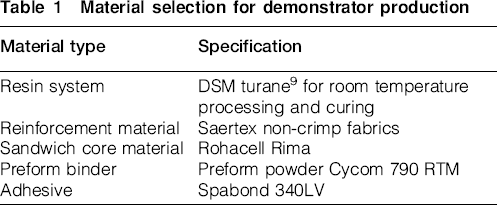
The material selection was determined by a combination of structural requirements: the objective of following a room temperature manufacturing process and the results of a continuing material screening programme. The selected materials used for the demonstrator are listed in Table 1. The specified composite constituents were characterised physically and rheologically as towards their suitability for the vacuum infusion process. In order to perform flow simulations and to define the injection strategy, rheological tests of the resin system and permeability tests of the chosen fabric were performed. The final laminate thicknesses and lay‐ups were additionally verified by a finite element (FE) analysis.
Material selection for demonstrator production
Testing and simulation
Introduction
The introduction of new low cost materials or new low cost production processes for aerospace applications is hindered by the traditional ‘building block certification approach’, as depicted in Fig. 1.10 Furthermore a full scale test under the most extreme conditions would have to show the design meets the airworthiness requirements. This time and cost consuming product control step could be replaced by single stage testing for composite structures or omitted if a proper process control system is implemented. A certification approach of building and testing structures in combination with process control, rather than the traditional building block approach would drastically reduce the introduction time and costs of new materials and processes.
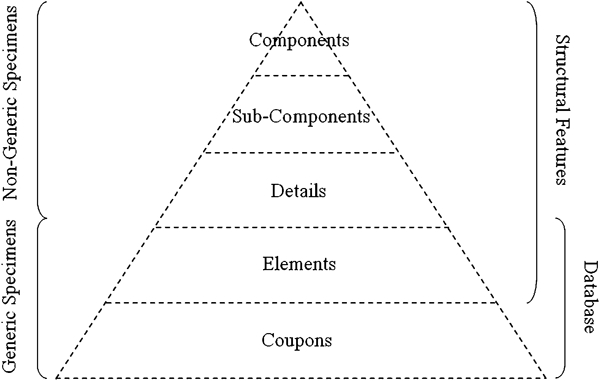
Pyramid of tests according to building block approach10
Hence, the development of the wingbox structure was following the building block approach, but the substantiation of its design route was based on following steps. In the first instance the constituents are tested to evaluate the properties of fabric and matrix. To characterise the mechanical response of the composite material, a comprehensive laminate testing programme is conducted. Subsequently, tests of structural elements are carried out to evaluate the material ability to tolerate laminate discontinuities, for instance, ‘compression after impact tests’, as well as tests of structural subcomponents to evaluate the behaviour and failure modes of more complex structural elements. The experimental analyses are accompanied by FE analyses of structural subcomponents and the final component. The development of the manufacturing process is repeatedly controlled by test infusions. In the last instance a component test under the internal pressure is performed as the wingbox also acts as a fuel tank.
Experimental analysis
The traditional building block certification approach involves an enormous amount of tests on the coupon scale. In this case, the specified materials were mechanically characterised with a tough testing programme as well. Coupons were manufactured out of infused laminate plates via the final route and characterised on a static Zwick 250 kN testing machine, including tension according to EN2561, compression according to EN2850, in‐plane shear according to AITM 1‐0002 as well as interlaminar shear strength (ILSS) according to EN2563. All tests were carried out under three different conditions: room temperature (or ambient), at −50°C and at +70°C/85% relative humidity. The interlaminar shear strength tests were additionally performed at +120°C. Furthermore bearing strength tests were carried out according to the pin loading method, standard AITM 1‐0009, and a typical laminate was also tested for thermal properties with the dynamic mechanical analysis by the resin supplier. Compression after impact tests was performed according to AITM 1‐0010. The selected resin system was additionally compared to RTM6, taken as a well established aerospace benchmark.
As testing on the coupon scale will rarely give insight in the failure mechanisms of the complete composite structure, the mechanical performance and failure modes of the more complex structural elements, the adhesively bonded joints, were evaluated with additional mechanical tests. Therefore, a manufactured skin section with an adhesively bonded rib section, as depicted in Fig. 2a, was cut into 30 mm wide and 250 mm long strips (see Fig. 2b). Before testing, carbon fibre tabs were bonded to the top end of the spar/rib panels, and 10 mm holes were drilled for the loading pin.
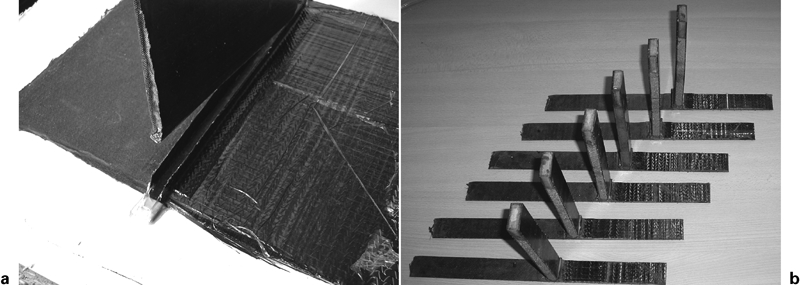
Skin with integrated joint section and rib as well as adhesively bonded test coupons
The testing set‐up, as seen schematically in Fig. 3a and the actual test in Fig. 3b, simulated fuel pressure loading on the spar/rib to skin connection. The skin span was 185 mm. The tests were performed on a Zwick 25 ton test machine with a speed of 2 mm min−1. All specimens were tested until the final pull‐off.
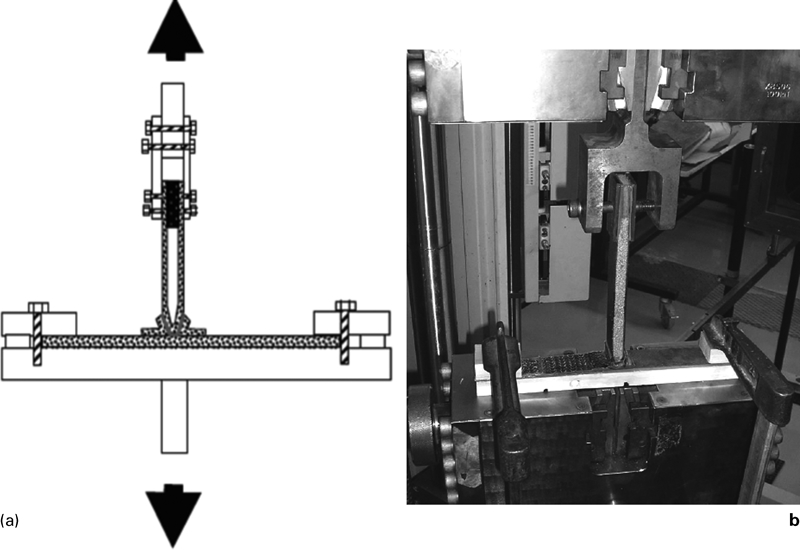
Test set‐up adhesively bonded joint
Numerical analysis
The adhesively bonded joint was also numerically analysed aiming at a realistic prediction of occurring failure modes. The created FE model of the single joint was subsequently used for the FE analysis of the complete wingbox section to examine the performance under the internal pressure and to predict the maximum endurable pressure value without damages.
A further analysis, using the RTM‐Worx11 flow simulation software, was performed to optimise the infusion strategy with respect to the infusion time and to determine the best locations for resin inlets and outlets and to ensure that the chosen strategy will not result in dry spots.
Manufacturing
For the production of the demonstrator, a low cost, non‐autoclave, room temperature process had to be developed. This development work did not only involve just the development of the actual vacuum infusion process but also the development dedicated to new tooling to obtain cost reductions in advanced composites.
Evaluation
The manufactured wingbox demonstrator was finally tested under the internal pressure. The pressure was created with compressed air up to the examined value, determined in the FE simulation, which can be withstood without damages. Two fittings were integrated in the ribs, a nipple in the inboard rib to apply the pressure and a flange with a hole in the centre rib to connect the created wingbox chambers.
Results and discussion
Design
Based on the preliminary design of the generic business jet wingbox structure, the demonstrator was determined as to be a 1 m long full scale centre section of the tip, indicated with a rectangle in Fig. 4.
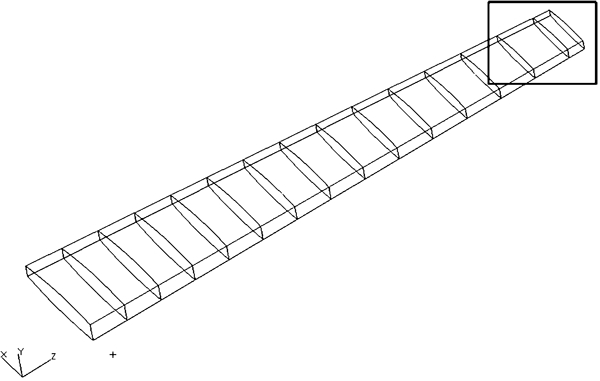
Wingbox structure with indicated demonstrator
Since one objective was to demonstrate the high level of integration which can be achieved with the vacuum infusion process, it was decided to aim at the use of only one subdivision of the redesigned wingbox section. Hence the wingbox consisted of only two parts:
one skin with integrated front and rear spar made of a foam core sandwich laminate as well as preformed joints (see Fig. 5a)
one skin with three integrated foam core sandwich ribs (see Fig. 5b)

a upper and b lower wingbox skin
For further simplicity the leading and trailing edges are not part of this demonstrator. Local hat shaped stiffeners made of foam core material are additionally integrated in the skins.
The selected subdivision option features two equally complex skins with integrated features that would be infused in one shot and consequently assembled by adhesive bonding. Bonding always requires an adequate pressure on the bond line during curing of the adhesive. As the design solution had inaccessible joining areas, an alternative joint design between the top of the rib or spar and the other skin was used, as depicted in Fig. 6. Such a tapered joint design ensures a pressure on joining area, with only a vertical assembly load. To guarantee a proper fit all bond line surfaces need to be defined by additional tooling. Further wing box design details can be found in Ref. 12.
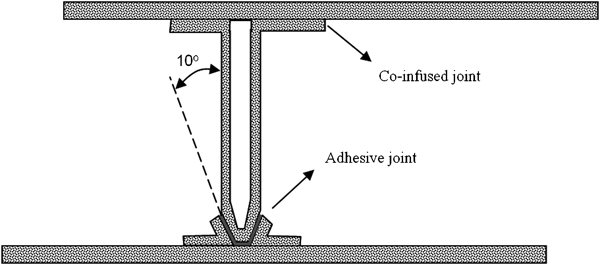
Joint design and its tooling surfaces
Materials
The results of the rheological test for the selected DSM turane vinylester resin system can be seen in Table 2.
Results of rheology tests for DSM turane vinylester resin
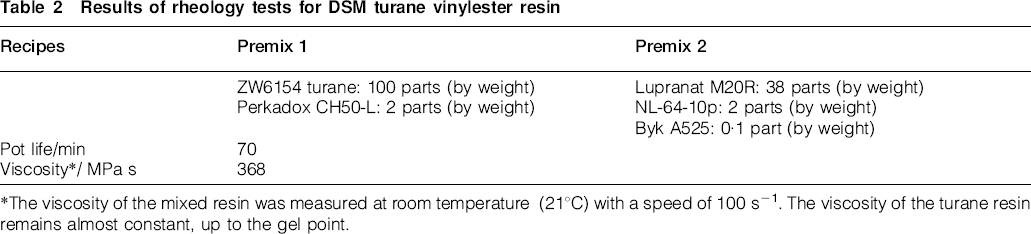
*The viscosity of the mixed resin was measured at room temperature (21°C) with a speed of 100 s−1. The viscosity of the turane resin remains almost constant, up to the gel point.
The selected reinforcement is a bidirectional carbon fabric with a total areal weight of 556 g m−2 and 263 g m−2 in the 0° direction and 267 g m−2 in the 90° direction. Since the material is not perfectly balanced the fabric was tested both in 0 and 90° direction, using eight layer fabric. Assuming a fibre volume content of 56%, the resulting permeabilities were K0 = 4·6906×10−10 m2 and K90 = 5·1906×10−10 m2. These values hold for undeformed and unsheared materials. Since the demonstrator parts will be single curved, there will hardly be any deformation in plane influencing the permeability values.
Simulation and testing
Experimental analysis
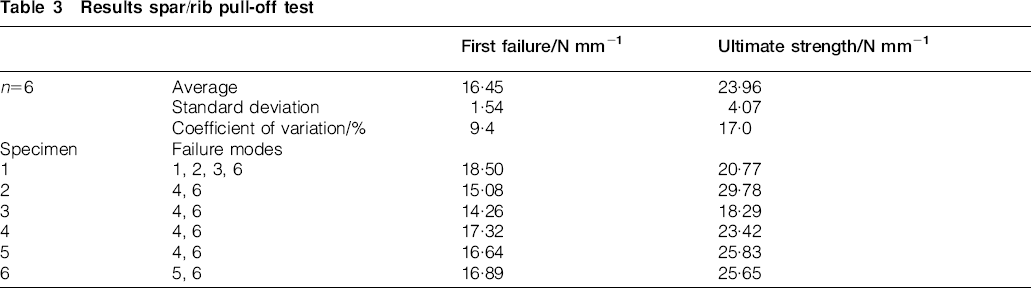
All specimens were tested until the final pull‐off between rib and wing skin. All occurring failure modes were caused by delaminations between the preformed coupling piece and the upper skin. Therefore, the experimental results validated the chosen solution of an adhesively bonded joint design as no failure occurred in the bonding. Table 3 and Fig. 7 show the results of the pull‐off tests.
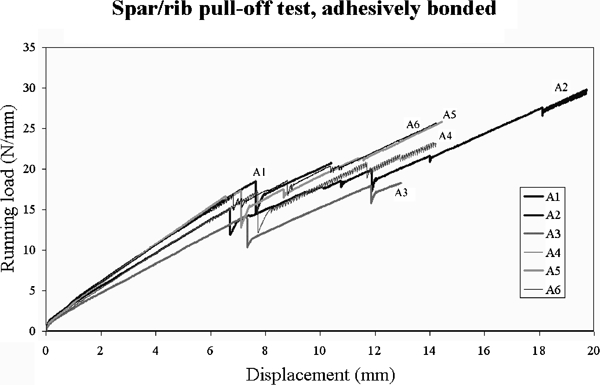
Test curves spar/rib pull‐off test
Results spar/rib pull‐off test
Various failure modes occurred in the adhesively bonded joint, as sketched in Fig. 8. Table 4 shows all delaminations between the coupling piece and the skin explained.
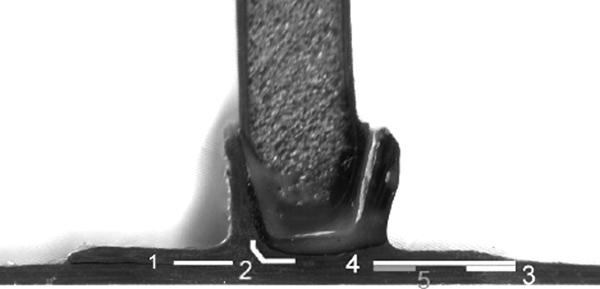
Failure modes of adhesively bonded joint
Occurring failure modes

Numerical analysis
The detected failure in the mechanically tested joints occurred also in the FE modelled joints. The single joint simulation showed maximal stresses in the uppermost layer of the skin, underneath the flange, at the beginning of the preform (see location A in Fig. 9a), similar to failure mode 4 observed in the mechanical tests. The maximum stress in the coupling piece, which is taking up the rib, occurred in the lowest skin touching layer at the beginning of the chamfer on the clamp side, as shown in location B in Fig. 9b, similar to failure mode 1 in the mechanical experiments.
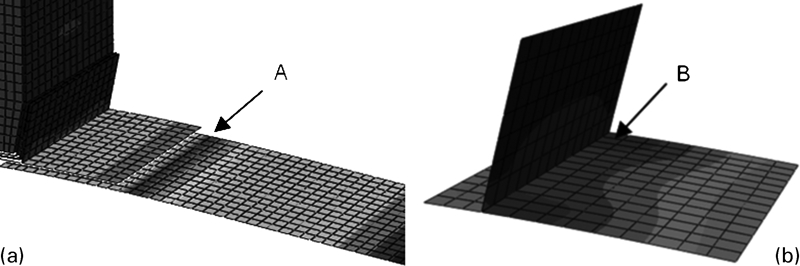
Failure in FE model of adhesively bonded joint
Failure mode 4 delaminations could be traced back to the free edge delamination phenomenon. Occurring delaminations within the laminate, such as failure mode 1, could be explained by interfibre fracture in an unidirectional layer based on matrix cracks. As the loading of the joint is in the vertical direction the loading was perpendicular to the fibre direction of the skin and the lower preform skins. A matrix crack represents a free edge within the laminate and furthermore a discontinuity thus leading to a stress redirection. As a non‐crimp fabric with 0/90° lay‐up was used, the matrix crack can turn in a boundary layer between two layers and initiate delamination.13 The growth of delaminations can be divided into two different phases: an initiation and a propagation phase.14 As the FE analyses of the laminates showed that normal stresses and shear stresses in the joint section were relatively high and small respectively, delaminations could be traced back at the initiation stage to high interlaminar normal stresses in horizontal and vertical direction of the joint. Hence the growth of these delaminations could be additionally propagated by occurring shear stresses.
The FE simulation of the wingbox under the internal pressure showed that an internal pressure up to 0·4 bar should be withstood safely, without causing initial damage. The maximal stress in the wingbox occurred in the wing skin underneath the beginning of the preform chamfer, similar to the maximal stresses in the single joint simulation and similar to failure modes 1 and 4 in the experimental testing. Therefore, a qualitative prediction of occurring failure in the wingbox could be obtained with experimental and numerical analyses of the structural subcomponent.
To minimise the infusion time a centre feed line for the resin was selected. The simulations with RTM‐Worx indicated that this infusion strategy was feasible; an example for the upper skin with spars is shown in Fig. 10.
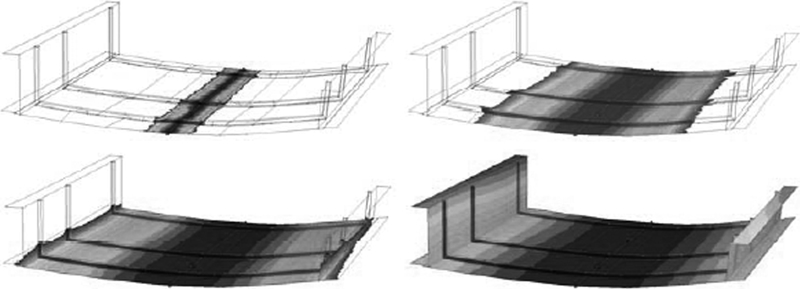
RTM‐Worx flow simulations
Manufacturing
Based on the generated wingbox dimensions, its structural design of the necessary tooling concept was designed. The tooling concepts do not allow the use of resin distribution material at the location where tooling is present. Only the undisturbed wing skin laminate and the webs of the spars can be covered with a resin flow net. At locations of the joints and underneath the tooling block for the spars, the resin feed is disturbed. However, practical issues such as fibre bridging might have a serious impact on the overall infusion. Furthermore, the top and bottom flanges of the spars will have to feature good tolerances on the outer sides, in order to provide a good interface with the leading and trailing edge. This implies that tooling is required on the outside. For the positioning and fitting of preformed spars, and for reasons of infusion and assembly, tooling blocks on the inside of the spar laminates are preferred. Therefore locally, laminate needs to be fitted between tooling surfaces. Since the edges of the flanges are extreme points for the infusion, vacuum outlets need to be fitted here.
To validate whether an infusion of the designed mould details is feasible, whether for example air can be extracted from underneath the tooling surfaces, practical infusion experiments for the upper skin with the joint detail as well as for the skin with the spars were conducted (see Fig. 11). The infusions were performed in simplified tooling, no aerodynamic skins, with representative dimensions and fibre lay‐ups. The resin distribution material was only applied on free skin areas. Simultaneously the actual infusion length without resin distribution material was determined.
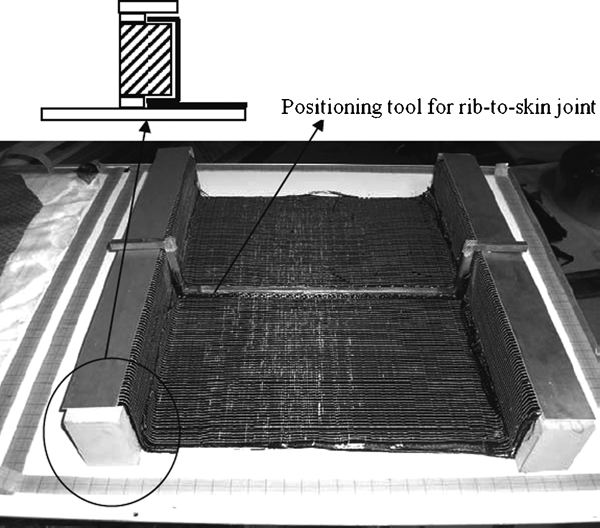
Tooling set‐up for validating infusion strategy
The infusions did not present any problems, with respect to fill‐time, impregnation and resulting laminate quality. Visual inspections during infusion and after demoulding revealed a proper impregnation even in the critical areas. No voids, pinholes or other problem areas could be detected. The design of the joint detail was feasible from a process point of view and the chosen production strategy was validated. The result of the spar infusion experiment gave further confidence to proceed with the finalisation of the design and manufacturing of the actual infusion tools.
The surfaces of the final mould which define the outer skins as well as the front and rear spars were produced out of a high density polyurethane tooling block material. As for assembly and tolerance reasons, all joining surfaces needed to be determined by tooling, and these tools were made of aluminium as shown in Fig. 12.
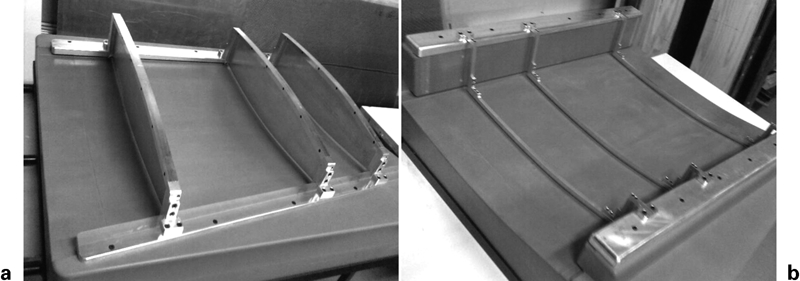
Mould for a lower and b upper skin
The demonstrator was subsequently manufactured, combining all of the routes developed in this project. Features such as spars were preformed, using binding powder between the fabric layers to give the required consistency for shaping into the preform. The preforms were trimmed and placed over and in the tooling which was then positioned on the skin moulds. After that a lower skin with three integrated foam core sandwich ribs and an upper skin with integrated front and rear spars made of a foam core sandwich laminate as well as preformed joints were infused in one shot, cured and post‐cured.
The resulting two parts were demoulded, edges trimmed, bonding areas prepared and assembled, resulting in a closed wing box section (see Fig. 13). During the production of the demonstrator no major obstacles were encountered. The production of the parts and the assembly showed to be a straightforward procedure.
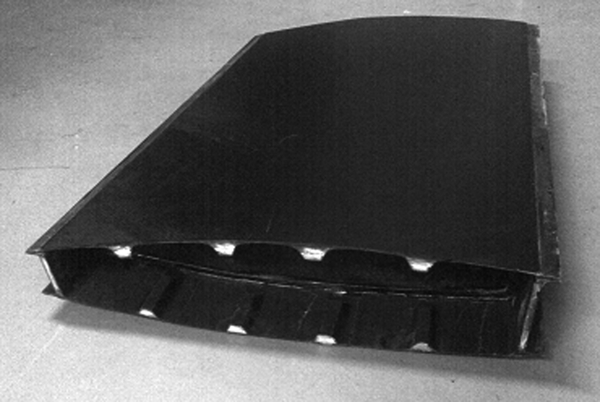
Final manufactured wingbox section
Final testing
The final internal pressure test of the wingbox section showed that the proposed design endures pressures up to (at least) 0·5 bar without acoustically and visually detectable damages in agreement with the conclusions drawn from the FE simulations, thus validating the developed manufacturing route.
A comparison of the estimated weight of the wingbox section based on the design and the experimentally determined weight of the manufactured wingbox section, showed just a 4% increase in weight over the theoretical estimate, which was assumed as a good indicator of the production quality of the manufactured demonstrator.
Conclusions
This paper describes a novel, cost effective design approach to produce a wingbox section with respect to assembly as well as the consequent production process and tooling issues. The developed routes to obtain cost reductions in advanced composites were validated by the successful production of a highly integrated 1 m long demonstrator, to be representative for a wingbox design of a business jet type of aircraft. The wingbox section was manufactured using low cost materials such as multiaxial reinforcements, room temperature curing resins and a low cost out of autoclave resin infusion process. Testing of the demonstrator showed weight and performance under the internal pressure in agreement with predicted results. The evaluation regarding manufacturing as well as physical, rheological and mechanical characterisation of the demonstrator showed the potential of the followed route for the cost effective production of composite parts with increased repeatability and a high degree of integration.
Footnotes
This paper is part of a special issue on manufacturing and design of composites