







Abstract
Processing of unidirectional (UD) carbon fibre reinforced thermoplastic composites using a laboratory scale modular composite line was investigated. Thin continuous tapes were manufactured from a 12k carbon fibre tow via wet impregnation impregnated using a slurry based polymer suspension. Hardware design as well as processing parameters influencing the tape quality and the fibre volume content of the resulting tapes, is discussed. Two different grades of polyetheretherketone were used for in‐house manufacturing of UD carbon fibre reinforced composite tapes. Laminates were prepared from the manufactured tapes via compression moulding and tested. Results from short beam strength, flexural and compression tests show that the properties of the manufactured composites match the properties of commercially available aromatic polymer composites (APC2). The flexibility of the process is demonstrated, showing that it is also possible to manufacture unidirectional carbon fibre reinforced polyvinylidene fluoride composites.
Introduction
Carbon fibres are frequently used as reinforcement for polymeric matrices. Thermoset resins account for over 90% of the polymeric composite market share whereas thermoplastic matrices occupy only 10% of resins used in advanced composites.1 This is primarily because thermoset systems, epoxy in particular, have relatively low viscosities and can be processed and handled easily. However, epoxy systems suffer from their intrinsic properties such as brittleness, chemical instability, short workable pot life and they are difficult to recycle.2 Thermoplastic matrices are a good alternative for advanced structural composite systems because of their intrinsic characteristics such as improved toughness, low moisture absorption, rapid production, unrestricted shelf life and moreover thermoplastic composites can be reprocessed, thermoformed and welded.1
Uniform impregnation of reinforcing fibres with the matrix during processing is critical as it ensures that all fibres are wetted out and homogeneously distributed. This can avoid defect sites within the composite, such as fibres in contact, fibre misalignment, fibre waviness and voids, etc.3 Manufacturing of fibre reinforced thermoplastic composites began in the mid 1970s using processes such as film stacking/hot compaction, melt pultrusion, wet and dry powder impregnation, etc.4 Film stacking has been a standard process for making fibre reinforced thermoplastic composites for several decades. The process requires the reinforcing fibres being laminated between layers of thermoplastic films, this stack is then fused together under heat and pressure (in excess of 10 bar) over a period of time (typically 1 h)2 to form a prepreg. Issues often encountered with film stacking are for example the wet‐out (impregnation) of the fibres by the matrix, which is correlated with the viscosity of the resin. Furthermore, damage to the reinforcing fibres is also known to occur.5 Nevertheless, film stacking has remained the most widely used technology for manufacturing small quantities of fibre reinforced thermoplastic composites. Fabrication of unidirectional (UD) fibre reinforced tapes via the pultrusion,5, 6 dry7 and wet3 powder impregnation routes are fairly similar; all three processes involve a continuous fibre tow being pulled through a medium (a thermoplastic melt in pultrusion, a dry powder bed in dry impregnation or a polymer powder suspension in wet powder impregnation) to impregnate the fibre with the thermoplastic matrix. Dry and wet processing require in‐line post heat treatment to melt the polymer and consolidate the tapes with the wet powder impregnation process requiring extra heat treatment to remove the liquid in which the polymer powder is suspended. The melt pultrusion process faces similar problems as film stacking, i.e. impregnation of fibres is dependent on the viscosity of the thermoplastic melt, and the stability of the polymer melt for an extended period in air. It follows that dry and, therefore, dry powder impregnation technique should be a better route to manufacture thermoplastic tapes. However, impregnating a dry fibre tow with a dry polymer powder has its disadvantages. Friction between fibres and die is high and causes fibre and tapes to fracture. Furthermore impregnation relies on electrostatic forces which do not guarantee good process control due to the fact that polymer powder may be lost after impregnation and prior to polymer melting and, therefore, it is difficult to make tapes with consistent fibre volume fraction. On the contrary, the wet impregnation process relies mainly on surface tension, capillary forces, powder size and its size distribution and is easy to operate providing that a suitable liquid medium is available.8 The liquid phase present in this process not only reduces the frictional force between the fibre tow and the impregnation pins, minimising fibre damage, but also helps in interlocking the polymer powder within the fibre tow when exiting the impregnation bath due to capillary actions.
Advanced composite materials such as carbon fibre reinforced polyetheretherketone (PEEK) and polyphenylene sulphide manufactured via melt pultrusion are used in load‐bearing and structural applications because of their high strength, high modulus, and low density. Hence the interest in developing a modular flexible and compact system to investigate the potential to manufacture unique carbon fibre reinforced thermoplastic (and other matrices) composites as well as the impact of in‐line modification of carbon fibres on composite performance. Carbon fibre reinforced polyvinylidene fluoride (PVDF) could be an ideal material for the oil and gas industry because PVDF is extremely corrosion resistant while thermally stable, has a low permeability to gases and liquids, resistance to creep at elevated temperatures and is readily melt processable.9, 10 In this paper, a processing route to manufacture UD carbon fibre reinforced thermoplastic composites using a wet powder/slurry route is presented. Processing impact, including polymer powder bath concentration, speed, tension and temperature is discussed. As produced CF/PEEK tapes were compared against commercially available aromatic polymer composites (APC2) to examine the quality of the produced materials. The flexible module was also used to manufacture carbon fibre/PVDF tapes, the quality of fabricated composites was assessed by measuring the macromechanical properties.
Materials and methods
Materials
The carbon fibres used in this study were high strength and strain, unsized but industrially carbonised and oxidised continuous PAN‐based carbon fibres kindly supplied by Hexcel Corporation (Hextow AS4 12k, Cambridge, UK). Two different grades of PEEK (Tm≈334–344°C), Vicote 704 (in powder form) and Vicote 804 (39 wt‐% of PEEK dispersed in a water suspension) from Victrex (Lancashire, UK) were used. In addition, PVDF Kynar 711 (Tm≈165–170°C) powder from Arkema (Serquigny, France) was used. Aerosol OT 75%E (AOT) (kindly supplied by Cytec Engineering Materials, Wrexham, UK) and Cremophor A 25 (BASF Ludwigshafen, Germany) were used as a surfactant to disperse the Vicote 704 PEEK and PVDF Kynar 711 polymer powder in water respectively. As control, commercially available continuous fibre reinforced PEEK composites APC‐2 was used (kindly supplied by Cytec Engineering Material, Wrexham, UK).
Preparation of slurry based polymer suspension for wet impregnation
An aqueous PEEK slurry based polymer suspension for wet impregnation was prepared by dissolving 0·4 g of AOT (1 wt‐% with respect to the polymer) in 2 L of deionised water before 40 g of Vicote 704 PEEK powder was added (2 wt‐% with respect to the mass of water). The suspension was then left to stir at room temperature using a magnetic stirrer for a minimum of 3 h to ensure that a homogenous PEEK slurry was obtained. A 2 L Vicote 804 PEEK slurry was prepared by adding 1·9 L of deionised water to 102 g of as received Vicote 804 PEEK stock suspension giving a polymer loading of 2 wt‐%.
Similarly an aqueous PVDF slurry was prepared by dissolving 3·6 g of Cremophor A 25 surfactant (2 wt‐% with respect to the polymer) in 2 L of deionsed water before 180 g of Kynar 711 PVDF powder was added (9 wt‐% with respect to the mass of water). The suspension was then left to be stirred at room temperature using a magnetic stirrer overnight to ensure that a homogenous PVDF slurry was obtained.
Particle size analysis
The particle size of polymer slurry suspensions used for wet impregnation was measured using a Mastersizer 2000 particle size analyser (Malvern, Worcestershire, UK). The measurements were performed directly on the 2 wt‐% of Vicote 704 and Vicote 804 PEEK slurry based polymer suspension. A 2 wt‐% of PVDF slurry was made by diluting the 9 wt‐% aqueous PVDF based powder suspension using deionised water. All measurements were repeated 3 times per condition. The mean diameter of the maximum volume of the particles in the suspension is represented as d50.
Modular laboratory scale composite production line
A modular laboratory scale composite line11 (CL) incorporating the wet powder impregnation technique was built enabling the production of continuous UD carbon fibre reinforced thin thermoplastic composite tapes. The CL consists of 9 units (Fig. 1), which can be arranged to form a continuous composite manufacturing line. Units 1 and 2 together form a creel with close loop tension control (Izumi International, Greenville, SC, USA), which can hold two spools of carbon fibres in an isometric frame. Up to 10 N of tension on individual fibre tows can be generated and controlled. The wet slurry impregnation bath (Unit 3) can hold up to 3 L of the impregnation medium in which up to 13 removable pins are fitted (Fig. 2). The position of individual pins can be adjusted by up to 10 mm from the neutral axis, which allows for different wrap angles to influence fibre spreading. This provides greater flexibility to control the impregnation process which is governed by the number of filaments in the fibre tow, the particle size of polymer powder as well as the powder concentration in the bath. Given that a water based slurry impregnation route is used, the water must be removed. Unit 4 is a 1 m long drying oven, which houses two infrared heaters. These medium wave infrared heaters (Model B, fast response medium wave emitters, Heraeus, Kleinostheim, Germany) emit up to 150 kW m−2 of power and are extremely efficient for drying water in a very short period of time. The melting oven (Unit 5) is identical to Unit 4 only the temperature setting is higher in order to melt the polymer. The power output for both Unit 4 and 5 are controlled independently using programmable logic controllers (3508 Eurotherm PID temperature controllers, UK). Unit 6 consists of three heated pins, which are arranged 30 mm apart and can be adjusted up to 25 mm horizontally (Fig. 3). This evens out the spreading of the polymer which gives a smooth finish to the composite tape. The tension generated from the wrap angle of the heated pins also spreads the fibres further, driving the polymer into the tow and eliminating voids. Any fibre ‘fuzzes’ that are produced during manufacturing can also be collected here. Unit 7 is a water‐cooled rolling die (15 mm width) which is used to consolidate the hot, smooth carbon fibre polymer melt tow into a thin tape. The pressure exerted onto the tapes while passing through Unit 7 can be adjusted by adding additional weights onto the upper roller to maximise the effect. The haul off device (Unit 8) is a belt‐drive pulling unit (Model 110‐3; RDN Manufacturing Co., Bloomingdale, IL, USA) which controls the whole processing speed. Finally the as produced continuous UD carbon fibre reinforced thermoplastic composite tape is wound up onto a spool using a VEXTA Gear Head Drive (GFB5G2000, Oriental Motor Co, Ltd, Tokyo, Japan).
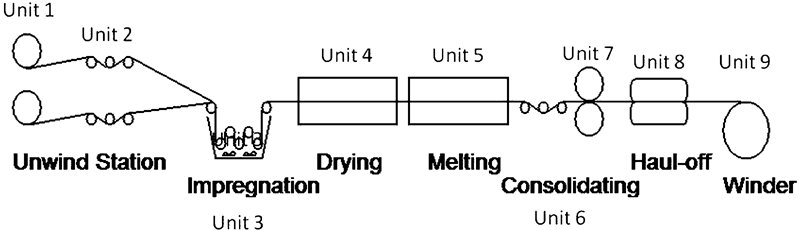
Schematic of modular laboratory scale composite production line based on wet powder impregnation
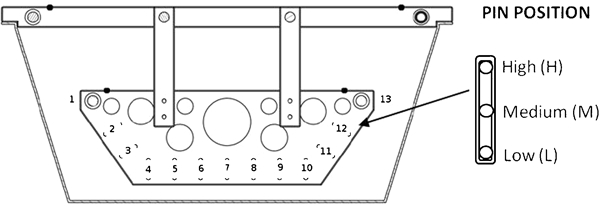
Schematic of impregnation pins used to spread fibre tows inside impregnation bath

Schematic diagram of heated shear pins used to spread molten polymer on carbon fibre tow
Manufacturing of UD carbon fibre reinforced thermoplastic composite tapes
Continuous UD carbon fibre reinforced thermoplastic composite tapes (10·5 mm wide and 0·1 mm thick) were manufactured using our CL described above. A 12k carbon fibre roving was fixed into the creel and a pre‐tension of 1·5 N was applied. The fibre tows were then passed through the impregnation bath containing the powder slurry, which was agitated using two 60 mm magnetic stirring bars. The wet polymer impregnated fibre tow was then passed into the drying oven set to 130°C. The fibres were dried completely before melting to ensure no water is entrapped within the composite. Once the water was removed, the tow then entered the second (melting) oven. This oven was set to operate at 390°C for manufacturing carbon fibre reinforced PEEK composites (CF/PEEK) and 220°C for fibre reinforced PVDF composites (CF/PVDF) in order to melt the polymer. The tape coming out from the melting oven was passed over the shear impregnation pins operated at 390°C for the CF/PEEK and 220°C for the CF/PVDF. The melt impregnated tape was passed through the water‐cooled consolidation unit to consolidate the tape. The tape was pulled through the line by the haul‐off at 1 m min−1 and wound up onto a spool. During manufacturing, the width and the thickness, as determined by the spreading of the fibres, of the composite tape, produced was monitored using a calliper (Series 500, Mitutoyo, Hampshire, UK; accuracy = 0·02 mm). The fibre volume content (Vf) of the as produced composite tape was measured.
Effects of processing conditions
Determination of optimum bath concentration for consistent resin content of carbon fibre/PEEK composite tape
Initial bath concentrations of 2, 3 and 4 wt‐% were used to identify the optimum concentration for consistent carbon fibre/PEKK composite tapes with a resin of 0·60 to be produced. The time required to reach steady state; a continuous composite tape of at least 15 m measuring a uniform Vf, for each experimental run using different bath concentrations was recorded. The Vf was determined by cutting 1 m long samples of UD carbon fibre reinforced thermoplastic composite tapes and weighing them using an analytical balance (HR‐120‐EC, A&D Instruments, Oxford, UK). Vf was calculated using the following equation
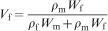
During manufacturing, the Vf of the manufactured composite tape changes as a function of processing time because the PEEK powder from the impregnation bath is consumed. This causes the Vf of the produced composite tape to increase. Therefore, for a consistent carbon fibre/PEEK composite with a resin of 0·60 to be produced, the concentration of PEEK powder in the impregnation bath must be maintained as constant as possible. Different bath concentrations throughout the manufacturing process were confirmed by extracting 5 mL of the polymer slurry from the bath during steady state and evaporating off the water using a hot plate.
Pin configurations within impregnation bath
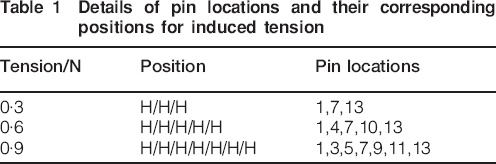
The tension applied on the fibre tow directly influences the spreading of the fibre and, therefore, the polymer powder pick up rate. Tensions of 3, 6 and 9 N were induced by adjusting the pins located inside the impregnation bath (Fig. 2), details of individual configurations can be found in Table 1. The tow tension was logged throughout individual experimental runs while the as produced tapes were visually monitored and the width, thickness and Vf were measured.
Details of pin locations and their corresponding positions for induced tension
Variation of manufacturing speed
The effect of the manufacturing speed on the quality of carbon fibre reinforced PEEK tapes manufactured was evaluated. As produced tapes must be of uniform Vf all the water from the wet impregnation process must be removed and the polymer must be sufficiently melted. However, since the CL is a laboratory scale module and is constrained by the length of the ovens, in order to determine the optimum productivity three different speeds of 1, 2 and 3 m min−1 were chosen for this study. The processing speeds were monitored using a digital tachometer (DT‐2235B Lutron, Taiwan).
Preparation of composite test specimen
UD carbon fibre reinforced thermoplastic composite laminates (both PEEK and PVDF) were prepared by cutting the as produced composite tape into 15 or 20 cm long sections. For flexural, short beam shear and compression specimens, 34 layers of the cut composite tapes were stacked and tightly wrapped using a release film (Upilex 25S, UBE Industries Ltd, Tokyo, Japan) before placing them into a stainless steel mould (200×12 mm). The mould containing the stacked composite tapes was then heated for 10 min in a hot press (George E. Moore and Son, Birmingham, UK) at 390°C for carbon fibre/PEEK and 190°C for carbon fibre/PVDF followed by a slow increase in pressure to 2 MPa, which was held for 2 min before transferring the mould to another hot press (P319, Moore, Birmingham, UK) operated at 120°C for carbon fibre/PEEK and 80°C for carbon fibre/PVDF and held for 10 min at 2 MPa. The specimen was then removed from the mould after it was cooled to ambient temperature. A diamond blade cutter (Diadisc 4200, Mutronic GmbH & Co, Rieden am Forggensee, Germany) was used to cut test specimens to the required dimensions (please see below) for mechanical testing. The edges of the test specimens were smoothed by grinding using P60 grit sandpaper.
Microscopic analysis of composite test specimens
Transverse sections of compression moulded specimens were embedded into a polyester resin (Kleer Set, MetPrep, Coventry, UK). The resin was cured at room temperature for 24 h before being polished using resin bonded diamond grinding discs (ApexDGD 60 μm Buehler Ltd, IL, USA). Specimens were ground first using a water medium for 2·5 min at a pressure of 0·2 MPa and a speed of 220 rpm. This was followed by a diamond suspension (MetaDi 6 μm, Buehler) for 2 min. In order to obtain a scratch and void free surface finish of the cross‐section of composites for distinctive optical analysis, specimens were further polished using a 3 and 1 μm diamond suspension respectively, for 5 min at a pressure of 0·27 MPa and a speed of 150 rev min−1. Processed specimens were then examined under an optical microscope (BH2, Olympus, Tokyo, Japan).
Crystallinity of composite test specimens
The melting and crystallisation profiles of mechanically tested specimens were determined using dynamic differential scanning calorimetry in a nitrogen atmosphere at a heating rate of 10°C min−1 over the range from −50 to 390°C for carbon fibre/PEEK and −100 to 220°C for carbon fibre/PVDF. Samples (typically 10 mg) were sealed in a Tezro‐aluminium pan. An empty sealed pan was used as reference. The melting temperature (Tm) and heat of melting (ΔHm) were determined from the heat flow curves. The degree of crystallinity (Xc) was calculated as follows

 is the heat of fusion of 100% crystalline PEEK (130 J g−1)16 and PVDF (104·5 J g−1).17
Short beam strength testing
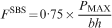
The short beam strength test was chosen as a screening/ranking test to characterise the interlaminar shear characteristics of the manufactured composites because it is one of the simplest and most commonly used test methods.18 It should be noted that the ASTM 234419 states that although the dominant failure during the test is purely shear, the internal stresses are complex and various failure modes can occur. Thus the results of this test are termed ‘apparent’ short beam strength. Test specimens of carbon fibre/PEEK and carbon fibre/PVDF laminates with dimensions of 20×10×2 mm were loaded under three‐point bending using a jig with a 10 mm span (i.e. span to thickness ratio S/h of 5∶1). Such recommended S/h allows for interlaminar shear failure to be induced. The test was carried out with an Instron equipped with 1 kN load cell (model 4466, Instron, Buckinghamshire, UK). The loading rate was set at 1 mm min−1 and the test was carried out following ASTM D2344.19 The apparent short beam strength was calculated using the following equation
Flexural testing
Flexural moduli and flexural strengths are of importance in engineering practice because composites are often subjected to bending load. Individual test specimens with dimensions of 95×10×2 mm were prepared. The specimens were loaded into a three‐point bending rig (span to thickness ratio of 32∶1) equipped with a 5 kN load cell (model 4466, Instron, Buckinghamshire, UK). The test was carried out according to the ASTM D790‐03 standard20 with a crosshead speed of 1 mm min−1 until failure. The flexural strength σf and flexural modulus Ef was calculated using the following equations


Compression tests
The compression moulded test specimens were cut to a dimension of 90×9·8×2 mm. A 10 mm gauge section in the centre of each bar was protected using masking tape. The ends of the bars were grit blasted to roughen the surface. Fibre glass composite end tabs, with a 45° chamfer toward the gauge section, were attached to the ends of the bars using industrial grade cyanoacrylate glue (Kwik Fix superglue, Chemence, Inc., Corby, UK). The masking tape was then removed and two strain gauges (FLA‐2‐11, Tokyo Sokki Kenkyujo Co., Tokyo, Japan) were attached to the each face of the bar. Compression testing was performed according to the Imperial College Method for Testing Composite Materials in Compression using the Imperial College Compression jig21 and tested at 1 mm min−1.
Results and discussion
Particle size distribution of slurry polymer for wet impregnation
The particle size in slurry based polymer suspension during wet impregnation process in the production of unidirectional carbon fibre reinforced thermoplastic composite laminates (both PEEK and PVDF) is crucial.22 Different particle sizes behave differently during wet impregnation of the carbon fibre tow. Polymer powders with small particle size may be filtered through the spread carbon fibre tow inside the impregnation bath and polymer powder with larger particle size may rest on the surface of the tow which leads to an uneven resin rich layer of the produced tape. Such partial or imperfect, i.e. impregnation due to resin rich regions or fibre contacts will result in mechanical weak points in the fabricated composites.3 The average particle size d50 of the Vicote 704 (10 μm) was found to be relatively similar to that of Vicote 804 (11 μm) as shown in Fig. 4. This indicates both PEEK grades should behave the same during the wet impregnation process. On the other hand, the average particle size d50 of PVDF (Kynar 711) was measured to be 5 μm (Fig. 5) and it is likely that the polymer powder would be filtered through, as compared to PEEK, given that the degree of spreading on the fibre tow remains constant. Therefore higher polymer powder concentration is required (9 wt‐%) for the manufacturing of carbon fibre/PVDF tapes as compared to carbon fibre/PEEK tapes (2 wt‐%).
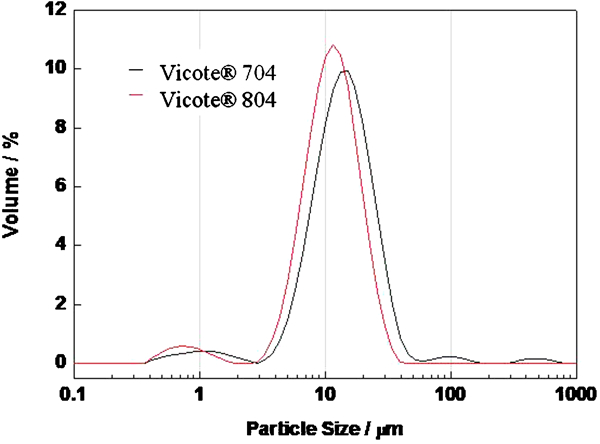
Particle size distribution of Vicote 704 powder suspended in water and as received
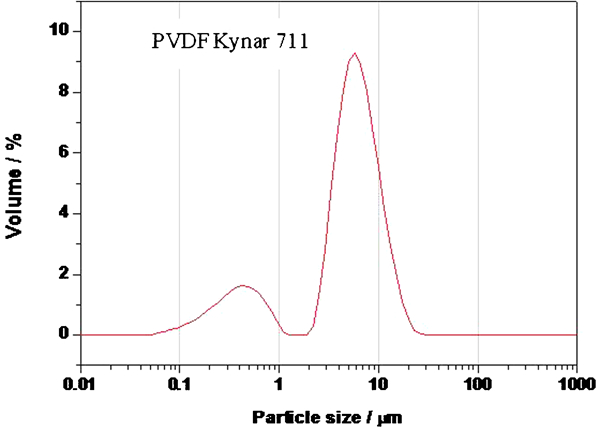
Particle size distribution of PVDF Kynar 711 powder suspended in water
Influence of processing parameters
The effect of the initial polymer bath concentrations (2, 3 and 4 wt‐%) on polymer pick up (impregnation) during manufacturing was studied. A preliminary run with 4 wt‐% of PEEK bath concentration was carried out. However, it was realised that 4 wt‐% is not the desired bath concentration required to manufacture carbon fibre reinforced PEEK with Vf of 0·60. Bath concentration (4 wt‐%) gave significantly higher Vf (in the range of 0·70+) as compared to the desired aim. Therefore, a lower bath concentration of 3 wt‐% was selected but it was found that the Vf of the as produced composite tapes was again too high (∼0·65). Finally, 2 wt‐% bath concentration resulted in consistent Vf of 0·60 with minimal top up frequency. It was established that a top up of 50 mL of concentrated polymer suspension containing 30 wt‐% of polymer suspension was added periodically to the impregnation bath and the Vf of the as produced composite tape was measured every 5 min. This bath concentration enabled steady state to be maintained after 10 min of stabilisation time. Composite tapes manufactured with 0·3 N tension caused by the friction between the tow and impregnation pins located inside the powder impregnation bath had a poor quality of impregnation. The width of the composite fluctuated constantly. Furthermore, when such composite tapes were flexed by hand, it could be observed that the inner part of the fibre tow consisted of dry fibres. The quality of composite tapes manufactured with 0·9 N tension induced by the tow/impregnation pin friction was found to vary as a function of time. Steady state was not achievable even after 60 min of manufacturing time. The Vf of the composite tapes manufactured fluctuated throughout the duration of the experiment, which made it difficult to identify the corresponding bath concentration required to give a consistent Vf of 0·60 Carbon fibre reinforced PEEK tapes manufactured with 0·6 N of induced tension resulted in much better composite tapes as compared to those manufactured with 0·3 and 0·9 N induced tension. The Vf as well as the width of fabricated composite tapes was consistent throughout and could easily be controlled.
The manufacturing speed was varied from 1, 2 and 3 m min−1. It was observed that at a processing speed of 3 m min−1, the PEEK powder could not be sufficiently melted, as could be seen by the white powder situated within the fibre tow exiting the melting oven. This is governed by the residence time of the impregnated tow inside the oven, which was too short. At 2 m min−1 manufacturing speed, patches of dry polymer powder and melted polymer were observed on the impregnated tape at random intervals. This indicated that a lower processing speed would be optimal and at 1 m min−1, good quality composite tapes with consistent Vf over time were produced.
Quality of UD carbon fibre reinforced thermoplastic composites
All investigated composites possessed a uniform fibre volume fraction of 0·58–0·62 (Table 2) confirming that both carbon fibre/PEEK and carbon fibre/PVDF manufactured using the CL was of consistent quality and comparable to APC2.23, 24 It can be seen from Table 2 that the crystallinity Xc of the carbon fibre/PEEK composites laminates manufactured in‐house was 0·34 compared to 0·22 for APC2 despite being moulded under the same condition. This can be attributed to the fact that commercially available APC2 are manufactured at much higher processing speed and the cooling effect of the PEEK polymer is different as compared to in‐house manufactured carbon fibre/PEEK composites. It should also be noted that neither the in‐house manufactured carbon fibre/PEEK composites nor the APC2 were annealed. Xc is highly relevant in this study because semi‐crystalline thermoplastics were used as matrices and the Xc of the polymer matrix can influence mechanical (higher Xc means stiffer matrix) as well as thermal properties since re‐processing the composite tape into laminates requires melting and consolidation.
Properties of investigated unidirectional carbon fibre reinforced thermoplastic composites

The cross‐sectional view of the composite laminates (Fig. 6) gives an insight into the quality of the produced composite tapes which is governed by controlling the processing parameters such as the number and the positioning of the impregnation pins, drying and melting oven temperatures, the wrap angle as well as the temperature of the shear pins and processing speed. Cross‐sectional images (Fig. 6) of APC2 are comparable to the in‐house manufactured carbon fibre/PEEK which reveals that the reinforcing fibres were evenly distributed within the matrix with minimal voids. Figure 7
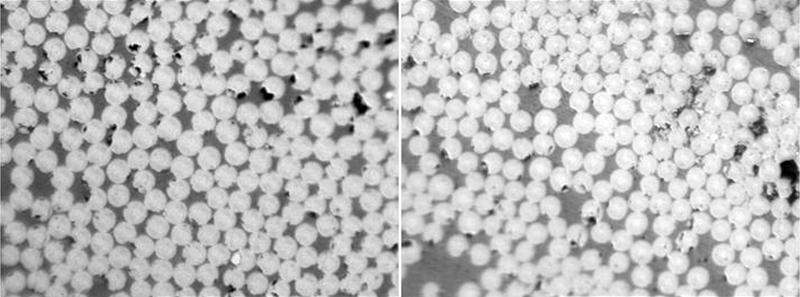
Polished cross‐section (×50) of as received APC2 (left) and in‐house manufactured CF/PEEK (right)
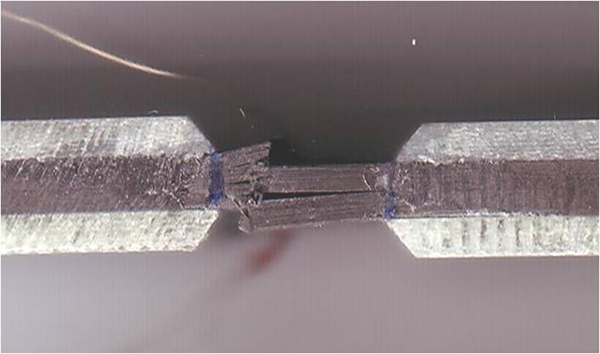
Typical bulk compressive failure of CF/PVDF
Mechanical properties of carbon fibre reinforced PEEK and carbon fibre reinforced PVDF composites
The mechanical properties of all manufactured composites as well as APC2 (used as control specimen) are presented in Table 3. It can be seen that the measured short beam strength (SBS) for carbon fibre/PEEK and APC2 are virtually equivalent.24 The data exhibit very little scatter which verifies that the quality of the manufactured tape is comparable to commercially available APC2 grade. The manufactured carbon fibre/PEEK has a measured flexural modulus of 123·5±0·9 and 120·5±0·8 GPa for the composites made using Vicote 704 and Vicote 804 PEEK respectively, which is comparable to the flexural modulus of APC2,24 121·5±1·1 GPa. The flexural strength of the manufactured carbon fibre/PEEK Vicote 704 is slightly higher, up to 200 MPa (7·9%), as compared to APC2 and carbon fibre/Vicote 804 PEEK. This may be explained by the fact that diphenyl sulphone (DPS) used during manufacturing of APC2 is still present in the as received formulation of Vicote 804 PEEK suspension. It has been reported that residuals of DPS acts as plasticiser for PEEK and could affect its mechanical properties.25 It can be assumed that since DPS, being a plasticiser, was not present in the slurry based polymer suspension for manufacturing carbon fibre/Vicote 704 PEEK, a slightly higher flexural strength was measured.
Mechanical properties of investigated unidirectional carbon fibre reinforced thermoplastic composites

The compression strengths of the manufactured carbon fibre/Vicote 704 PEEK and carbon fibre/Vicote 804 PEEK were very similar, 852±26 and 896±14 MPa respectively. The values are within the compressive strength range (800–1350 MPa) quoted in the literature.26 However, when compared to APC2 (998±30 MPa), a significant lower compression strength was measured. This may be due to the fact that twists are present in carbon fibre tows. Industrial scale manufacturing of APC2 involves tens of tows of carbon fibres to produce 15 cm wide tapes, therefore, the presence of twists can be compensated for when multi‐tows are used and overlap among each other. However, only one carbon fibre tow was used to manufacture composites using the CL and hence, the effect of twists present within the fibre tow is more likely to magnify and influence the alignment of the fibres compromising the compression strength. When compared to flexural properties, compression strength and modulus are much more sensitive to defects such as fibre misalignment.27 Fibre misalignment is the dominating factor for failure when carbon fibre/PEEK is loaded under axial compression as compared to flexural where specimens are loaded under three point bending mode in which the predominant failure mode is at 90° to the fibre axis. The compression moduli of both the manufactured carbon fibre/Vicote 704 PEEK and carbon fibre/Vicote 804 PEEK were also found to be very similar, 114±2·6 and 113±2·0 GPa respectively. When compared to APC2 (122±1·2 GPa), the compressive moduli were 7% lower but again within the range reported in the literature.26 Therefore to summarise, mechanical data for APC specimens tested here are in good agreement with those reported in the literature. This indicates that the quality of our manufactured carbon fibre/PEEK composites matches that of commercial grade (APC‐2) composites which confirms that the laboratory scale modular CL is capable of fabricating consistent UD carbon fibre reinforced thermoplastic composite tapes.
To demonstrate the flexibility of the laboratory scale modular CL, UD carbon fibre reinforced PVDF composites were manufactured and the mechanical performance data are presented in Table 3; however, no baseline data exist for comparison purposes. It should be noted that the mechanical performance should not be compared to that of carbon fibre reinforced PEEK because PEEK is the highest performing thermoplastic polymer matrix, with the tensile strength and modulus of 89·6–140·0 MPa and 2·7–18·3 GPa (Ref. 28) compared to the tensile strength and modulus of PVDF of 11·7–141·0 MPa and 0·2–7·0 GPa (Ref. 29) respectively. Nevertheless, carbon fibre/PVDF is of interest for use in oil and gas applications because of its chemical inertness.30 Due to this intrinsic property of PVDF together with its superior melt processing characteristics compared to other inert fluoropolymers such as polytetraflurorethane, carbon fibre/PVDF can be employed in a range of potential applications. Research on enhancing the interfacial compatibility between carbon fibres and PVDF by modifying the fibres and matrix has been carried out over the past decade. In particulr, it has been shown that introduction of fluorine moieties onto the carbon fibre surface using atmospheric plasma led to improved interfacial adhesion for single fibre model composites.31 Furthermore, it has been shown that using a blend of PVDF containing maleic anhydride functional groups grafted to the polymer chain improved the interfacial shear strength from 15 to 40 MPa.32 This optimisation is attributed to the changes in surface energy components of both the fibre and the matrix, i.e. improving the wetting behaviour of the fibres by the non‐polar PVDF melt. It would be ideal if such improvements can be translated for scaling‐up the model into continuous carbon fibre reinforced PVDF.
Conclusions
A laboratory scale modular composite line for manufacturing continuous UD carbon fibre reinforced thermoplastic composite tapes was developed, tested and validated. The process uses a wet impregnation route for polymer impregnation to produce tapes (10·5 mm wide and 0·1 mm thick) with fibre volume content between 0·58 and 0·62. However, this can be tailored by controlling the polymer powder concentration in the impregnation bath and manufacturing speed.
Data from macro‐mechanical tests carried out on the composites show that the quality of the UD carbon fibre reinforced PEEK composites manufactured is largely comparable to commercially available APC2 composites. This shows that our laboratory scale composite production line is capable to produce high quality composite tapes.
Manufacturing other thermoplastic composites is also possible provided that polymer powder is available or can be produced by cryogenic grinding of polymer pellets. For example, in this manuscript, carbon fibre reinforced PVDF tapes were produced using the same setup only by adjusting processing parameters such as concentration of slurry based polymer powder suspension and temperature. However, more research is required to fully optimise the mechanical properties of CF/PVDF composites in order to utilise the advantages this composite has to offer.
Footnotes
Acknowledgements
The authors would like to thank the following organisations (in alphabetic order) for their financial support: (i) (MQT) Arkema and Total, S.A. Group, (ii) (KKCH) Engineering and Physical Science Research Council (EPSRC), UK (Grant No. GR/S75673/01), (iii) (SL) EPSRC and Defence Science and Technology Laboratory (DSTL) (Grant No. GR/T24029/01), (iv) (SR and AJ) University of Engineering and Technology Lahore, Pakistan and (v) (SRS) Ministry of Higher Education, Malaysia. We are very grateful to Dr John Hodgkinson for his help and advice on macroscopic composite testing and his suggestions to improve this manuscript.
This paper is part of a special issue on manufacturing and design of composites