







Abstract
A new process for the production of carbon black master batches with enhanced mechanical properties has been developed. The unit operations in the process are the preparation of carbon black slurry in the presence of a suitable surfactant, addition of the slurry to the fresh natural rubber (NR) latex under stirring, coagulation of the mixture by the addition of acid, dewatering of the coagulum and drying to obtain carbon black incorporated NR. The competence of the new technique was established by comparing the characteristics of the carbon black incorporated NR by mill mixing process (control). The mechanical properties of the vulcanisates obtained from the latex stage and the dry rubber incorporated mixes were evaluated. The effect of aging on the mechanical properties was also discussed. The carbon black filled mixes prepared by the new process showed better cure characteristics as compared to the dry rubber incorporated mix. The mechanical properties, like tensile strength, modulus, tear strength and hardness, were superior for the vulcanisates prepared by the new method. Comparatively better aging resistance was also recorded by these vulcanisates. The improvement shown by the vulcanisates prepared by the new process was attributed to the better filler dispersion evidenced from the result of filler dispersion data and the scanning electron micrograph studies along with the attainment of a higher level of vulcanisation.
Introduction
The level of dispersion of carbon black in a rubber matrix is an important issue in a large variety of rubber products.1 Filler dispersion is generally influenced by the point of incorporation of filler along with other factors like the nature of rubber and the presence of plasticisers.2 In the case of carbon black, there are issues such as air pollution and higher energy consumption when incorporated in dry rubber. The production of a rubber latex–carbon black master batch by the addition of carbon black as a slurry has been suggested as one of the methods to avoid some of these problems.3, 4 One of the approaches for the production of a carbon black master batch was to mix natural rubber (NR) latex with carbon black slurry and then coagulate the mixture chemically. With this process, the coagulation and mixing times were higher.5 In another process named Cabot elastomer composite process, the carbon black slurry was injected into a mixer at very high speed and mixed continuously with NR latex stream.3 Under high energetic and turbulent conditions, the mixing and coagulation of the polymer with the filler were completed mechanically at room temperature in <0·1 s without the aid of chemicals. Generally, a high Mooney viscosity is recorded by the carbon black master batches, which can be reduced by the addition of chemical additives during the master batching process. It has been reported that the coagulation time of the latex is reduced due to the presence of suitable surfactants.6 When the carbon black incorporated latex is coagulated quickly by the addition of acids, it is expected that the carbon black is uniformly distributed in the rubber matrix as compared to the conventional coagulation methods, where the coagulation time is high, and there is no loss of carbon black. There has been no systematic study on the production of carbon black master batches from fresh NR latex through a quick coagulation process. In this paper, an attempt is made to prepare latex–carbon black master batch from fresh NR latex by a modified coagulation process.
Experimental
The fresh NR latex used in the study was obtained from the Rubber Research Institute of India, Kottayam. Fluffy carbon black samples, high abrasion furnace black (N330), were obtained from M/s Phillips Carbon Black Ltd, Kochi, India. The other ingredients used were rubber grade chemicals. The surfactant used was based on alkali salts of fatty acid.
Preparation of carbon black master batches by quick coagulation method
A slurry of fluffy carbon black was prepared by finely dispersing carbon black in water mechanically in the presence of a suitable surfactant (alkali salts of fatty acids consisting mainly of ammonium laurate). The slurry was added slowly into fresh NR latex under stirring and coagulated by the addition of acid to produce a latex–carbon black master batch (Scheme 1). In this new method, the carbon black–latex mixture is coagulated chemically almost immediately after the addition of acids. Here, the latex is sensitised for quick coagulation by the presence of fatty acid soap based surfactants in the carbon black slurry.
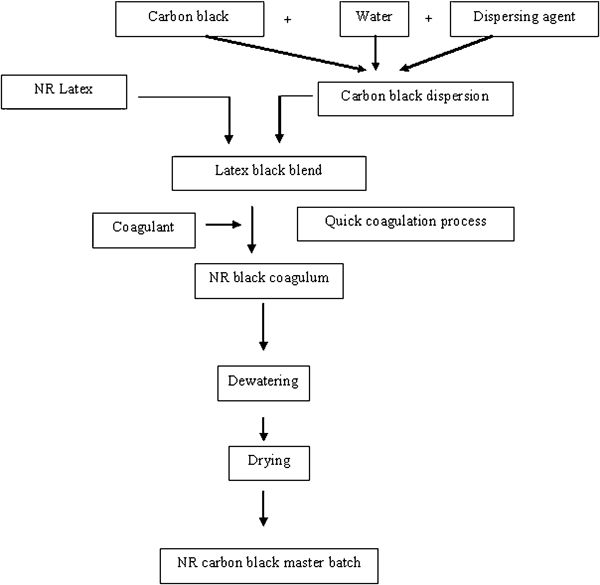
Flowchart showing preparation of latex–carbon black
The coagulum was washed well to remove the acid and dried in an air oven maintained at 70°C. Carbon black was incorporated in the latex so as to have levels of 30–40 parts per hundred parts of dry rubber (phr). The dried rubber was mixed as per the formulation given in Table 1 and vulcanised by conventional methods. A control mix with loadings of 30 and 40 phr carbon black added by conventional mill mixing process was also prepared.
Formulation of mixes
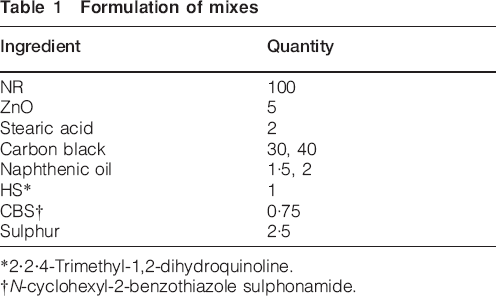
*2·2·4-Trimethyl-1,2-dihydroquinoline.
†N-cyclohexyl-2-benzothiazole sulphonamide.
Vulcanisation characteristics, particle size measurement, filler dispersion analysis, mechanical properties and SEM evaluation
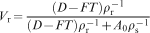
The cure behaviour was determined using a moving die rheometer (Monsanto MDR 2000) at 150°C. The volume fraction of rubber in the swollen gel was determined using the following equation7
The particle size of the carbon black slurry and the latex was determined based on the dynamic light scattering technique using a Malvern nanosizer (UK). Filler dispersion was studied on vulcanised films using a dispersion analyser from Tech Pro USA. The mechanical properties were determined from relevant ASTM standards (tensile properties, ASTM D412-92; heat build-up, ASTM D623-93; abrasion resistance, ASTM D5963-96; hardness, ASTM D2240-95; compression set, ASTM D395-89; resilience, ASTM D2632-92; and tear strength, ASTM D624-98). The aging tests were carried out according to ASTM D573 after aging at 100°C for 3 days. The SEM study was conducted using a Hitachi SEM (model 2400). The tensile fracture surface of the vulcanisates was coated with gold to carry out the SEM study.
Results and discussion
Coagulation characteristics
The particle size distribution of the carbon black slurry and the latex–carbon black slurry mixture is shown in Fig. 1. The slurry contains carbon black particles that have comparatively lower size (average of 100 nm). The carbon black used is the fluffy form and obtained before the pelletisation process and is made of comparatively nanosized particles (Scheme 2). The particle size of the fresh NR latex–carbon black slurry mixture varies from 90 to 2000 nm. Hence, it is expected that there is a uniform mixing of the carbon black in the latex stage.
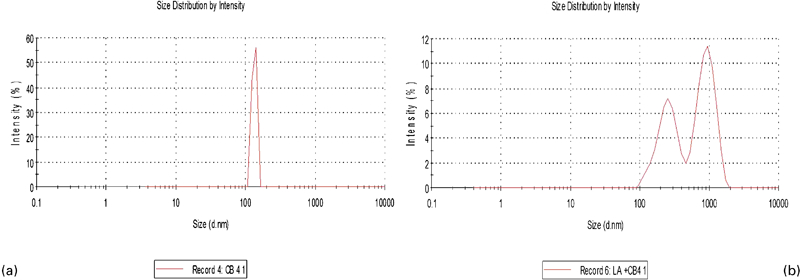
Particle size of a carbon black in carbon black slurry and b rubber particles and carbon black in latex–carbon black slurry mixture
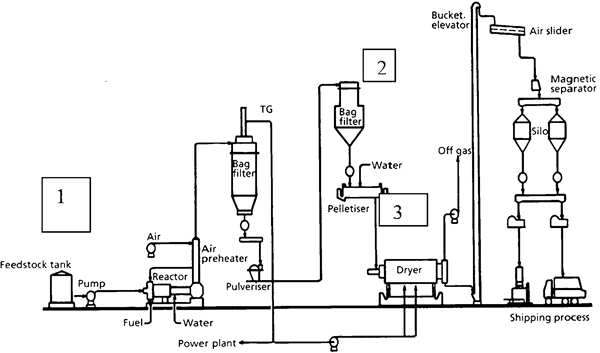
Furnace black production plant
The carbon black slurry–fresh latex mixture coagulated immediately on the addition of acid, leaving a clear serum (Fig. 2). On the addition of surfactants (alkali salts of fatty acids) to the latex, they cause displacement of the protein and get strongly adsorbed on the rubber particles. In this way, the protein stabilised latex gets transformed into a surfactant stabilised system. On the addition of acids to the surfactant containing latex, the adsorbed anions react with the acid to form an undissociated surfactant and deprive the latex particles of stabilisers. As a consequence, latex coagulates immediately.6, 8, 9 Owing to the quick coagulation, it is expected that the uniformly mixed carbon black remains unaggregated during coagulation and further processing. The change in viscosity after the incorporation of carbon black is not very high, as shown in Fig. 3, and is attributed to the presence of fatty acids obtained during the coagulation of the latex–carbon black slurry mixture.
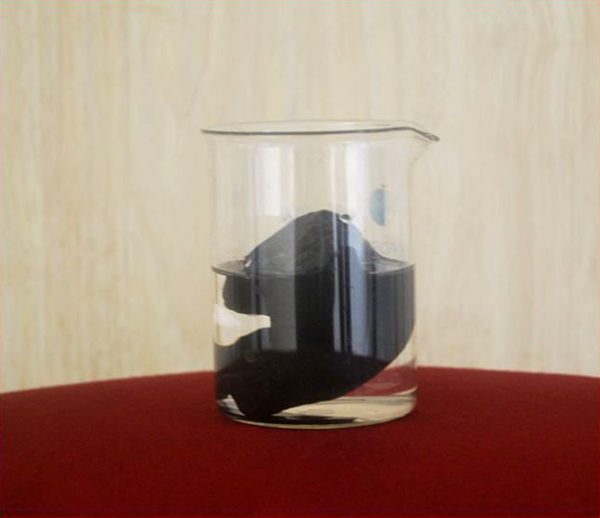
Image of coagulum and clear serum
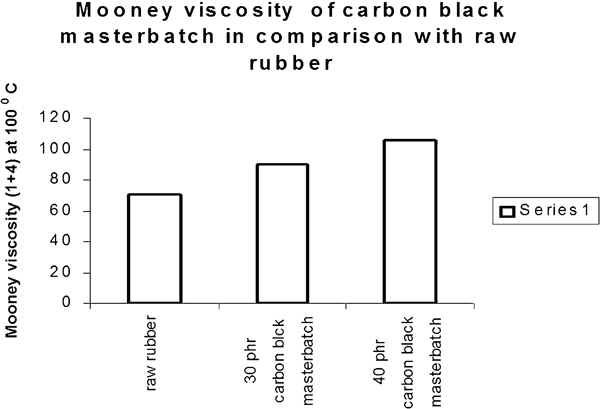
Mooney viscosity of carbon black master batch
Vulcanisation characteristics
The carbon black master batch of 30 phr concentration recorded a higher rheometric torque and a lower cure time as compared to the dry rubber mixed one. However, when the concentration of carbon black was higher (40 parts), both the cure time and the rheometric torque recorded were higher as compared to the dry mixed one (Table 2). When the surfactant (fatty acid soap) is added to the latex, it disperses uniformly in the latex due to adsorption on the rubber particles. During the coagulation, the surfactant gets converted into the corresponding fatty acid. This helps in the better vulcanisation characterising of rubber as the fatty acids are activators of vulcanisation.10 Consequently, higher Vr values are also recorded by the carbon black master batch based compounds. When the cross-link density is higher, the swelling in solvent is less, and consequently, the volume fraction of rubber in the swollen gel is higher. A higher rheometric torque at the same filler loading can be attributed to the higher level of cross-linking.
Cure characteristics

Mechanical properties
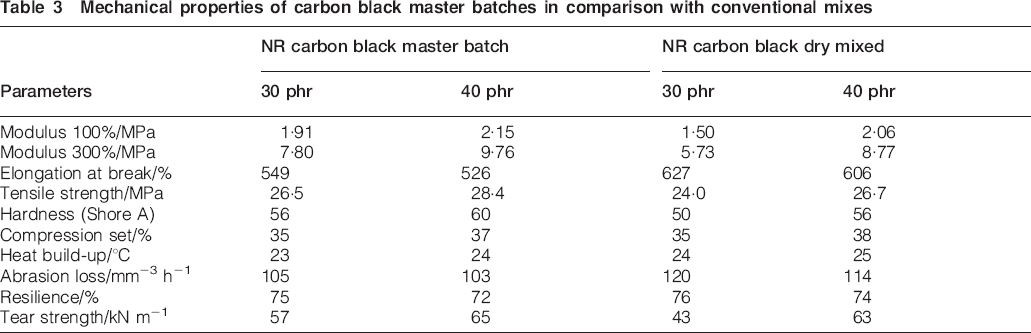
The vulcanisates prepared from carbon black master batches by the new method showed higher tensile strength and higher modulus, along with higher hardness, resilience and tear strength. The compression set, the abrasion loss and the heat build-up were found to be lower (Table 3). The improvement in mechanical properties is attributed to the better filler dispersion and the higher level of vulcanisation. The filler dispersion characteristics are presented in Fig. 4 and Table 4. Comparatively better dispersion and lower aggregation are shown by the latex stage incorporated mixes as compared to those mixed in the dry condition. The mixing is more uniform at lower concentration (30 phr) than that observed at higher concentration (40 phr) for both latex and dry rubber stage mixed vulcanisates. This is also evident from the SEM studies described later.
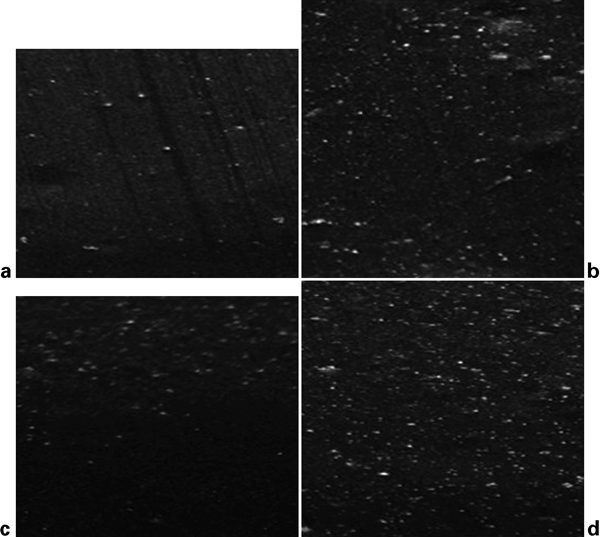
Images of carbon black dispersion as per rating in Table 4
Mechanical properties of carbon black master batches in comparison with conventional mixes
Results of carbon black dispersion*

*Scale is from 1 to 10 (1 = poorest, 10 = best, Y = 10 represent no agglomerate). Any particle >23 μm is considered as agglomerate.
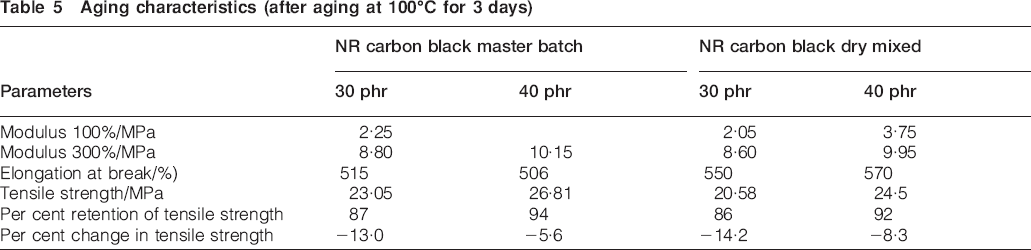
The mechanical properties obtained after aging the samples at 100°C for 3 days are given in Table 5. The carbon black filled mixes showed higher tensile strength and modulus values as compared to conventional mixes. A higher retention and a lower variation in tensile strength during aging are observed for vulcanisates based on the carbon black master batch. The enhancement in mechanical properties and aging behaviour is attributed to the better filler dispersion along with the higher level of cross-linking.11
Aging characteristics (after aging at 100°C for 3 days)
Scanning electron micrograph image studies
The SEM is being widely used to characterise the filler distribution and dispersion characteristics.12–14 More information on the filler dispersion is obtained from the SEM images of the tensile fracture surface, as shown in Fig. 5. The vulcanisates obtained using the new method (sample B) have more uniform surface and, hence, exhibit better distribution as compared to vulcanisates prepared by the conventional method (sample C). For comparison, an SEM image of the NR prepared by surfactant assisted coagulation of NR followed by incorporation of carbon black by dry rubber mixing (sample A) was also taken. Material removal is more evident in sample C in comparison with the other two mixes. It is expected that the fatty acid obtained from the surfactant acts as a plasticiser and helps in better filler dispersion.15
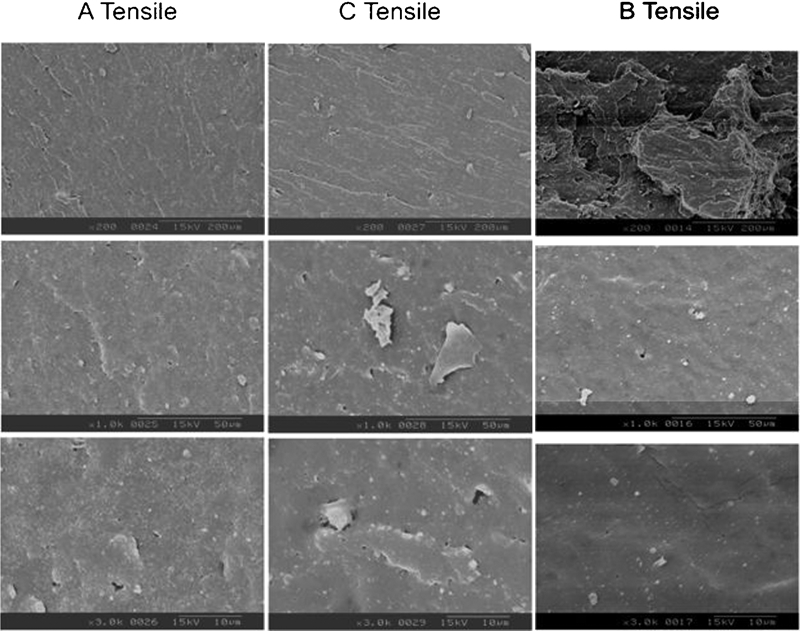
Images (SEM) of tensile fracture surface vulcanisates with carbon black added on mixing mill (sample A, rubber coagulated in presence of surfactant; sample C, rubber coagulated by conventional method; sample B, rubber coagulated with carbon black slurry containing surfactant)
Conclusions
A uniformly mixed carbon black slurry and latex in the presence of a suitable surfactant coagulates quickly with the addition of acids. The carbon black master batch prepared by this new method shows enhanced cure characteristic, filler dispersion and superior mechanical properties as compared to conventionally prepared carbon black mixes.
This is a simpler and cheaper method of master batch preparation as compared to the earlier methods. Furthermore, the Mooney viscosity is not very high due to the fact that there are in situ formed fatty acids that act as plasticisers and cure activators.