







Abstract
Rubbers and elastomers will change their material properties due to environmental influences such as temperature, oxygen, radiation and similar conditions. The reason for this material change is the modification of the polymer network. In the case of sulphur cured natural rubber it can result in hardening of the material and pronounced surface hardening for thick walled products. This is known as the diffusion limited oxidation effect when oxidation is the key environmental influence. This paper describes a model which is designed to calculate the change in network density caused by thermo-oxidative aging and the required measurements for the parameterisation. The model is validated by simulating the intermediate stress relaxation experiments and showed good correlation with the experimental data.
Keywords
Introduction
Lifetime prediction of elastomeric parts plays an important role in product development. For seals, for example, it is important to know the relaxation and compression set behaviour to predict the point of time when leakage will occur. For rubber parts such as in suspensions, it is important to know how much the material is going to harden or soften to predict the time of failure or the set behaviour. Although the point of interest is different for each industrial application, the cause of this material behaviour is the same, namely, the change of the elastomeric network. Chain scission and cross-linking due to environmental influences such as temperature, oxygen and radiation thus determine the material behaviour. Over the past years different simulation models were developed which partially give answers to the previously mentioned issues.1–3
For larger rubber parts such as in the car industry an additional problem occurs, namely, the diffusion limited oxidation (DLO) aging effect where the consequences can be seen in Fig. 1.
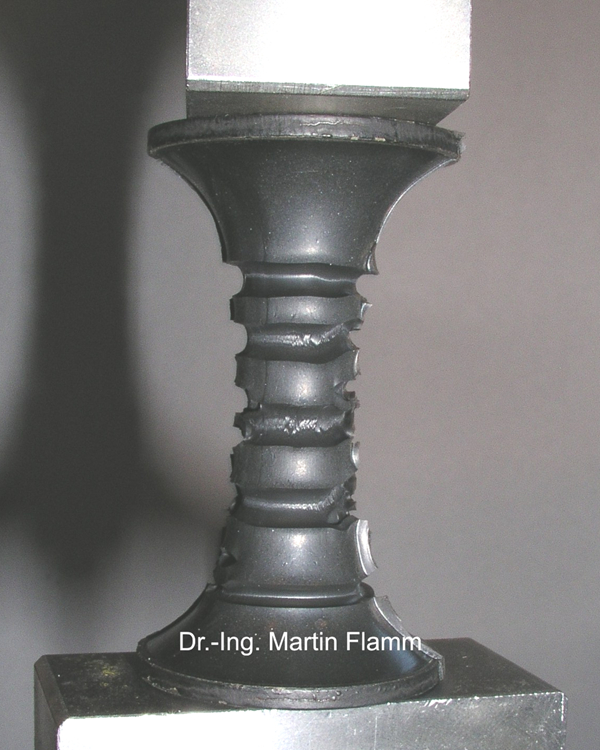
Stressed dumbbell specimen aged for 100 h at 130°C
The dumbbell specimen was aged for 100 h at 130°C and then stressed at room temperature. Owing to the DLO effect the elastomeric network changed mainly in the surface area and the damage will first occur in this area while the inner part of the specimen will still be intact.
Although much work has been accomplished in this area both on the experimental and the simulation aspect,4–6 the direct link between these two types of models concerning the influence of aging and DLO on material parameters for hyperelastic models such as Neo-Hooke is still missing. This paper provides a contribution to the missing link between the degradation chemistry part which describes the DLO effect and the mechanical part modelling the change in network density which is referred to as the material parameter of the Neo-Hooke model.
Modelling and experiments
The concept of the aging model is pictured in Fig. 2. It consists of a chemical part which determines the oxygen concentration and the consumed oxygen within the material. The mechanical model calculates the amount of chain scission and cross-linking based on a homogeneous aging approach at which both processes are controlled by the functions f1(t) and f2(t). While for a homogenous aging condition the time of the functions is determined by the real aging time, and the time for a heterogeneous case is also dependent on the amount of oxygen present.
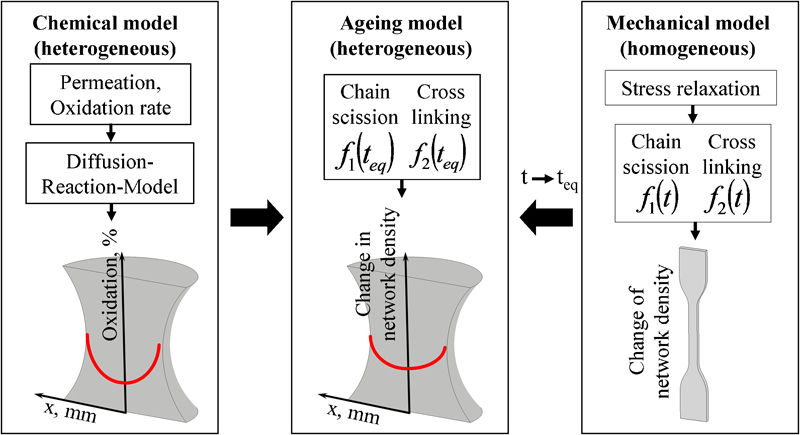
Concept of aging model
That means that the lower the amount of oxygen present at one point within the material the less material degradation will occur. For example, if within the material the amount of oxygen is lower than that on the surface, considering a time step it means that the consumption of oxygen within the material takes less time until the oxygen is totally consumed.
The model includes the following assumptions:
the consumption of oxygen is of first order kinetics, which is for model simplification purposes only but also not expected to be a significant issue. The true behaviour is likely more complex4
the oxidation rate is independent from the partial pressure
the Mullins effect is neglected.
Chemical model (heterogeneous)
The oxygen concentration within the material over time can be described by Fick's second law with the chemical reaction (equation (1))

The diffusion coefficient was measured with the induction time technique.7, 8 To identify the influence of network change on the diffusion coefficient, a permeation measurement was conducted for unaged samples and aged samples for different temperatures. If the aging condition would influence the diffusion coefficient, this would only be due to an increase in the network density. Figure 3 shows that the diffusion coefficient changes little over the aging time despite the network density increasing as shown in Fig. 4. This means that for these aging conditions the degraded network still has enough free volume for the oxygen to diffuse through the elastomer.
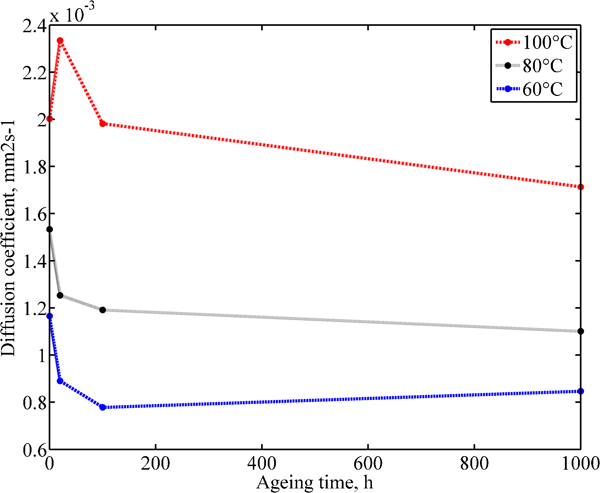
Diffusion coefficients for different aging times and temperatures
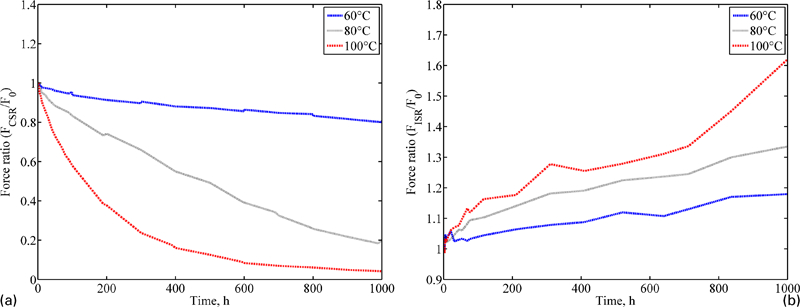
a continuous and b intermediate stress relaxation
The oxygen consumption rate r can be measured with a respirometer.9 For the measurement a specific amount of polymer, small enough to neglect the diffusion process of oxygen, was sealed in a chamber with a known amount of air and thus oxygen. The chamber was put in an oven for a certain time. To avoid that solubility and thermal equilibrium effects are influencing the measurement, the chamber was opened after a short time to equilibrate the pressure. After sufficient thermal exposure the air inside the chamber was measured with the respirometer and referenced to standard air conditions. The oxygen consumption rate can be calculated with the know amount of polymer, the aging time and the measured oxygen difference.
Figure 5 shows the oxygen consumption rates for different aging times and temperatures. The oxygen consumption rate is decreasing slightly with increasing aging time.
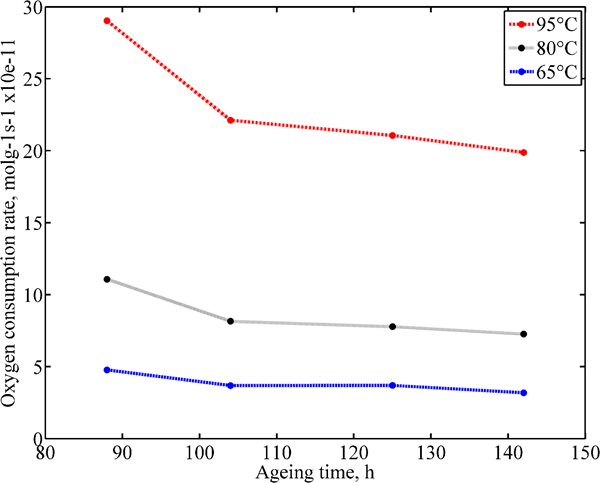
Oxygen consumption rate r for different aging times and temperatures
The surface concentration as boundary condition for the solution of equation (1) can be calculated by Henry's law

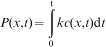
The consumed oxygen and accordingly the oxidation of the material P(x, t) can be calculated by integrating the reaction term over time (equation (3))
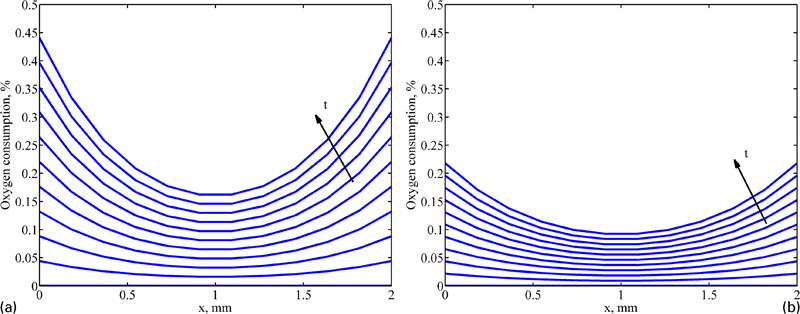
Calculated oxygen consumption for a 80°C and b 60°C for aging interval of 100 h
It clearly shows the dependence of the reaction on the diffusion conditions. The oxidation at the surface is considerably higher than that within the material due to the higher oxygen concentration within the surface layer. This effect becomes more pronounced with increasing temperature, time and material thickness.
Mechanical model (homogeneous)
The mechanical model describes the chain scission and cross-linking based on stress relaxation experiments which were carried out with the dog bone specimen as shown in Fig. 2 (mechanical model homogeneous) with a thickness of 2 mm. Tobolsky and co-workers10–12 developed this technique to estimate the chain scission and cross-linking reaction.
For the so called continuous stress relaxation a specimen is kept under constant elongation and the constant temperature and the force is measured over time. For the intermediate stress relaxation the specimen is aged in an undilated state under the constant temperature and stretched to a particular elongation at room temperature for specific time intervals. The force is then measured at each time interval at a specific point of elongation.
The experiments were carried out for temperatures at 60, 80 and 100°C for an aging time up to 1000 h and an elongation of 30%. Figure 4 shows the continuous and intermediate relaxation data. While the continuous relaxation is measuring the amount of chain scission, the intermediate measures the chain scission and cross-linking at the same time. To estimate the amount of cross-linking it is necessary to subtract the continuous data from the intermediate data. The results are shown in Fig. 7.Fig. 8
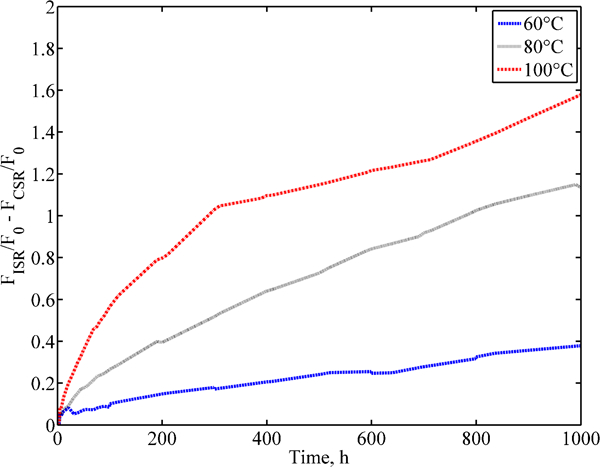
Superposed relaxation data
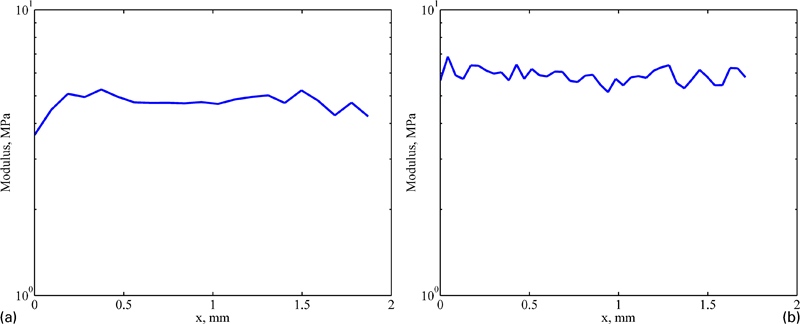
Modulus profiles at a 80°C, 500 h and b 80°C, 1000 h aged samples
Using this process, we can determine the functions for chain scission f1(t) and cross-linking f2(t). The functions were generally considered to follow a rate equation of first order.1, 3 For the continuous data a rate equation of first order is acceptable (equation (4)) but for the intermediate data it is not. This indicates that cross-linking is not a rate equation of first order. For a first validation of the model a power function was fitted to the data (equation (5))


Both functions are supposed to be valid for every point within the material. To assure that this assumption can be made, both functions had to be estimated from data where the DLO effect is insignificant. In order to verify that these samples were aged homogeneously and that the estimated functions correspond to homogeneously aging functions, modulus profiling on aged samples was performed (Fig. 8). Modulus profiling was developed by Gillen and Clough13 to obtain aging profiles of polymer samples by mapping a mechanical property with a high resolution. The mechanical parameter, the tensile compliance, is closely related to the commonly measured tensile modulus. The following figures show the results from modulus profiling of two aged samples.
The shape of the profiles clearly shows that the network within the samples ages homogeneously and that the modulus does not change much with a higher aging time. Therefore, it is valid to use such specimen for stress relaxation analysis.
Mechanical model (heterogeneous)
The determination of the change of the mechanical parameter due to the oxygen consumption is accomplished in two steps. The first step is to transfer the oxidation of the material into an equivalent aging time teq by dividing the oxygen consumption by the oxygen consumption rate (equation (6))

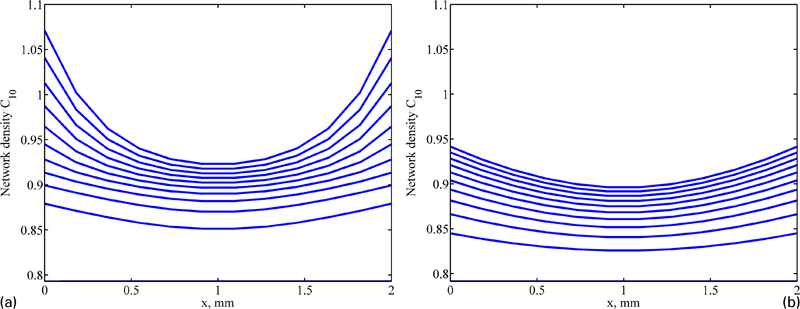
Calculated network densities for a 80°C and b 60°C with sample size of 2 mm and aging time from 0 to 1000 h
Results and discussion
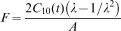
As validation of the model the intermediate stress relaxation (Fig. 4) was simulated for 60 and 80°C with the measured material parameters. The elongation for the intermediate stress relaxation was 30%. To calculate the tensile force at 30% elongation for the simulated samples the Neo-Hooke model was used (equation (7))
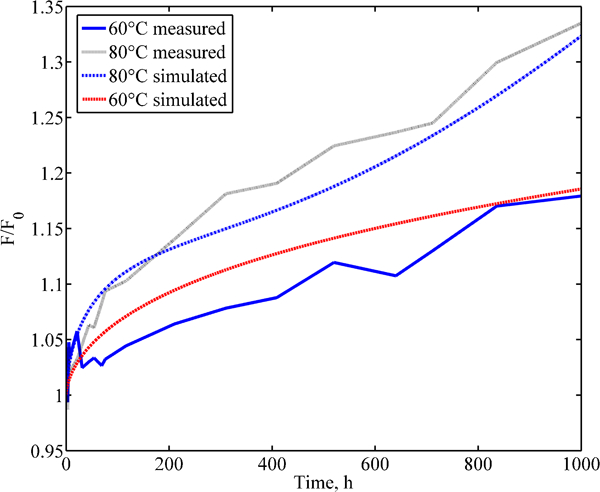
Simulated and measured intermediate stress relaxation
The simulated data fit the measured data reasonably well considering the assumptions made for this model. The oxidation rate, for example, will depend on the effective oxygen partial pressure condition within the material, which was neglected here but should be investigated. This will likely result in a slower oxidation rate within the material where lower partial pressures apply, and thus a lower amount of oxidised material.
The Mullins effect was neglected which if taken into account would lead to a softer material because of the damaging of the network due to mechanical loads.
Another problem occurs for the simulated heterogeneous network density. The characteristics of the modulus profiles (Fig. 4) show a homogeneous aging state, whereas the simulated change in network density is heterogeneous (Fig. 9).
One explanation may be the calculated oxygen concentration. The results from the diffusion reaction equation (equation (1)) and thus the oxidation of the material were estimated only by a one-dimensional simulation. The oxygen diffusion in the second dimension was neglected which actually has to be taken into account for a more realistic oxidation of the material. A higher oxygen concentration within the material as a result of a two-dimensional diffusion would result in a higher oxidised material and accordingly in a higher network density within the material.
Another explanation may be that the modulus at least for low oxidation levels is not particularly sensitive to oxidation or the associated network changes. Even at the sample edges total oxidation levels at the conditions investigated are only between 0·2 and 0·4%. At higher oxidation levels a much better correlation between oxidation profiles and modulus profiles would be expected.
Conclusions
An aging model is presented which links the DLO effect with the changes of the network density described by chain scission and cross-linking functions. These functions were linked to the material parameter of the Neo-Hooke model which is equivalent to the network density of the material. The simulation model parameters were determined by stress relaxation, permeation and oxygen consumption experiments. The first results of the model fit the measured intermediate stress relaxation data reasonably well. For further investigations the comments mentioned above have to be embraced.