






Abstract
Following an eco-design approach we have investigated the possible formulation of conductive polymer composite (CPC) from recycled poly(carbonate) (PC) and crushed rubber microparticles (CR) for tribological applications. Particularly, the abrasive wear behaviour of CPC has been studied as a function of smooth surface treatments applied to rubber fillers to improve their adhesion with the PC matrix. The effects of normal load, sliding velocity and treatments applied to CR on the wear rate and kinetics were investigated. Pin-on-disc tests carried out under water lubrication show that the wear rate increases with the increase in load and sliding velocity. Moreover, among all surface treatments, the most effective to improve the interface quality and thus wear resistance was a stripping of rubber microparticles with methanol whereas flaming was assumed to degrade filler surface and dichloromethane to swell the matrix. Additionally wear experiments proved to be effective in evaluating the quality of PC/CR interface.
Introduction
Owing to environmental issues it is a main concern to use plastics and composites having the lowest impact on nature as possible according to eco-design rules.1 In fact, analysing the life cycle of such materials evidences that the use of recycled polymers in composite formulations allows us to get rid of one of the most impacting step, i.e. polymerisation. Nevertheless, recycled polymers often have degraded properties compared to their virgin homologues as their first processing quite systematically causes macromolecular chains breakage and consequently molar mass decrease.2 Thus, two different strategies can be envisaged to reuse such engineering polymer wastes: target the same kind of application but this requires regeneration by addition of a coupling agent or a chain extender to enhance mechanical properties, or find a new application that will be less exigent from this point of view.3–6 Electrically conductive polymer composites (CPCs) obtained by blending an insulating polymer matrix with conductive fillers like carbon nanoparticles,7–13 carbon micro and nanofibres11,14–17 or metal micro and nanoparticles 18 , 19 give a good example of applications which do not need exceptional mechanical properties; on the other hand, these materials have been studied by many groups for their smart functionalities. 9 18 20 9,18,20,21 In fact, they exhibit several interesting features due to their resistivity variation with thermal,22–24 mechanical 12 , 25 or chemical solicitations. 23 24 26 23,24,26,27 This versatility of CPC is used for ‘intelligent’ applications such as self-regulated heating applications such as shielding, 28 , 29 switching 11 19 11,19,23 or vapour sensors. 14 18 26 14,18,26,27
Some of the last evolutions in the CPC field concern the use of exclusion volumes to decrease the percolation threshold and control conductive pathways structuring.30–34 In a recent study, it was shown that CPC obtained by dispersing crushed tire rubber microparticles into recycled poly(carbonate) matrix (PC/CR) had very attractive properties for smart applications24 owing to their sensitivity to environmental changes like temperature and vapour atmosphere. Nevertheless, it was also found that the development of these composites required taking care of the quality of PC/CR interface to prevent any deterioration of their mechanical properties both at micro35 and macro36 scales. Among all different strategies experimented to improve adhesion between rubber fillers and PC matrix solvent washing appeared to better than flaming and coupling agents.37 This was explained by a double effect of solvent: first a removal of oil and dust from particles surface, and second a desorption of low molar mass elastomer molecules from the reticulated network which could act as compatibilising agent. To go further into interface characterisation and understanding of adhesion between filler and matrix, we have investigated wear properties of PC/CR eco-composites.
In fact, abrasive wear behaviour of polymer composites has attracted lots of scientists due to its simple approach and ability to study surface characteristics in severe friction conditions in relation with the different mechanical characteristics of the material.38–42 Many models, which attempted to relate the abrasive wear resistance of polymers to other mechanical properties, have been examined43–45 and it was shown that the wear behaviour 14 , 46 differed depending upon the polymer type.
Numerous studies have been carried out to investigate the influence of test conditions on wear properties.47–58 Some authors observed a decrease in wear rate with increasing load in a number of materials and it was associated to the formation of ridges within the wear scar.46 Others showed that its value will increase when the load increases to the limit load value because of the critical surface energy of the polymer.59 The effect of sliding speed and load, on the friction and wear of glass-fibre-reinforced poly(ether imide), (20%) composite has been studied,38 it was reported that no unique trend between wear rate and speed can be expected. The same authors showed that the friction coefficient of unfilled PEI and PEI/PTFE composite decreased with increasing load; however, in the case of glass-fibre-reinforced PEI, the effect of load on wear differed with counterface roughness and no clear trend emerged. Liu et al.41 reported that load is the most important factor in the wear of unfilled UHMWPE specimens; however, for the wear of filler reinforced UHMWPE composites, the role of the load abates and the role of abrasive particle size increases with the increase in filler particle size. On the other hand, sliding speed seems to have little effect on the total wear volume. Abrasive wear studies60 of poly(aryl ether ketone) PAEK and their composites, against silicon carbide (SiC) abrasive paper, showed that wear volume increases with the increase in load and sliding distance. Liu et al.61 observed that wear loss of PA and UHMWPE blend is higher under dry-sliding conditions than lubricated test conditions, and increases with load increase. Li and Bell,62 showed that the mechanical properties and wear resistance of UHMWPE can be improved by surface treatment with the active screen plasma nitriding technique. Zhang et al.63 reported that tribological behaviour of plasma-treated PEEK and its composites was improved. Indumathi et al.64 found that comparison of wear rates of treated and untreated samples under various loads revealed that cryo-treatment technique has potential to increase the wear resistance of some polymers and their composites. Finally, Blanchet and Peng65 reported that wear resistance of fluorinated ethylene propylene can be increased through electron irradiation treatment.
The present paper investigates the ability of tribological experiments to discriminate between different treatments applied to crushed rubber microparticles to improve their adhesion with a poly(carbonate) matrix. Additionally, it is of interest to produce information on wear behaviour, under variable normal load and sliding velocity, of such new polymer composites having low impact on environment which proved to be suitable for smart applications.
Experimental
Materials
The material used in this study is a blend of poly(carbonate) engineering wastes (rPC) from signalisation panel cuttings by Self-Signal company (derived from Makrolon 3103 commercial grade of Bayer company) and of crushed tire rubber particles (CRs) from Delta-Gom company. PC wastes were just ground at room temperature to obtain millimetric pellets without any additional treatment whereas rubber millimetric particles were milled in liquid nitrogen to reduce their diameter range down to 140 μm<φ<315 μm after sieving. The fine micrometric CR particles were then melt-mixed with millimetric PC crushed pellets. The density of CR measured with a pycnometre was d = 0·840. Two types of surface treatments were carried out:
firstly, a flame treatment proceeded to oxidise the CR surface and obtain satisfactory level of adhesion with poly(carbonate). This treatment was performed with a propane blowtorch. The flame temperature was about 800°C and particles were flamed during 1 min at a distance of 20 cm.
Second, a solvent washing with dichloromethane or methanol was done to eliminate oil residues. Particles were dispersed in solution under sonication and stirred at room temperature for 25 min. Then the particles were filtered and dried under vacuum at 40°C for 30 min to remove remaining solvent.
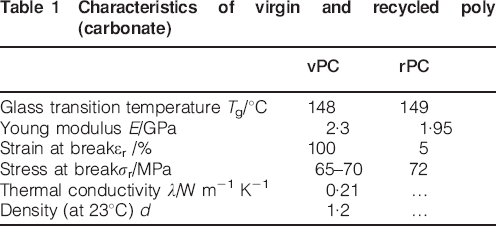
Main properties of PC can be found in Table 1, additional data concerning recycled polymers are given elsewhere. 1 24 35 1,24,35,36
Characteristics of virgin and recycled poly(carbonate)
Blend processing
PC/CR blends were melt-mixed in a BRABENDER 50 EHT internal mixer with contra rotating blades driven by WINMIX software. Polymers were dried under vacuum for 24 h at 90°C before processing. PC matrix and CR particles were mixed with a rotor speed of Ω = 40 rev min−1 at a temperature of T = 240°C for 10 min. These optimised blending conditions allowed a good dispersion of CR into PC. Just after mixing, blends were hot pressed Tmould. = 240°C, pmould. = 50 bar, tmould. = 5 min to provide 4 mm thick plates which were cooled down to room temperature in approximately 15 min. Normalised samples of 10×10 mm were cut out of plates with a small numerical milling machine. The formulations used in this study were composed of 80% PC/20% untreated CR, 80% PC/20% flame treated CR, 80% rPC/20% solvent treated CR.
Wear tests
Abrasion tests were conducted by the use of a METKON Instruments machine that simulates a pin-on-disc configuration. The schematic illustration of the wear test apparatus is shown in Fig. 1 and described elsewhere.
61
60
61,60,66 During abrasion experiments, polymer samples with dimensions of 10×10×4 mm were abraded against waterproof (grit grade 600) SiC paper, fixed on the rotating disc surface. The tests were carried out at ambient temperature under water lubricating condition. A constant lubricant flow was used in order to avoid rip of the abrasive paper especially in the beginning of the wear test. Samples were brought into contact with abrasive paper under constant normal load. The abrasive paper was changed before each test. Wear rate, computed from weight loss of sample and averaged on three separate tests, was measured at different times by stopping the test. The wear rate (%) is calculated by equation (1)

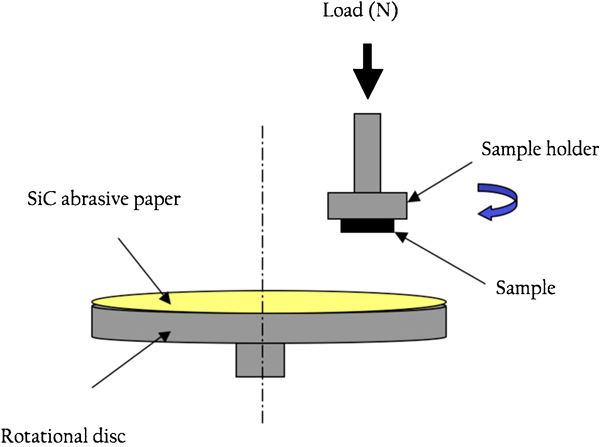
Pin-on-disc wear test configuration
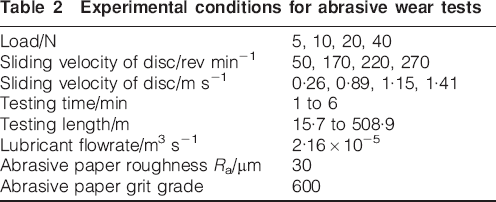
An electronic scale with an accuracy of 10−3 g was used to weigh samples. The abrasive wear test conditions are detailed in Table 2.
Experimental conditions for abrasive wear tests
Microstructure characterisation
Microstructures of worn surfaces, for the various CPCs, were observed with different microscopes. Scanning electronic microscopy observations were performed with a JEOL JSM-6031 after fracture of samples in liquid nitrogen and spray deposition onto the surface of a thin gold layer. A LEICA DMLP optical microscope with LIDA software in episcopy mode and non-polarised light was used to observe worn surfaces of both paper and composite.
Results and discussion
Effect of test conditions on wear properties
The effect of normal load on wear rate of a CPC with untreated CR is shown in Fig. 2. It can be seen that the wear rate increases linearly with sliding time (proportional to sliding distance through equation (2)). These results are in agreement with those found by Shipway and Ngao46 for poly(methyl methacrylate) samples

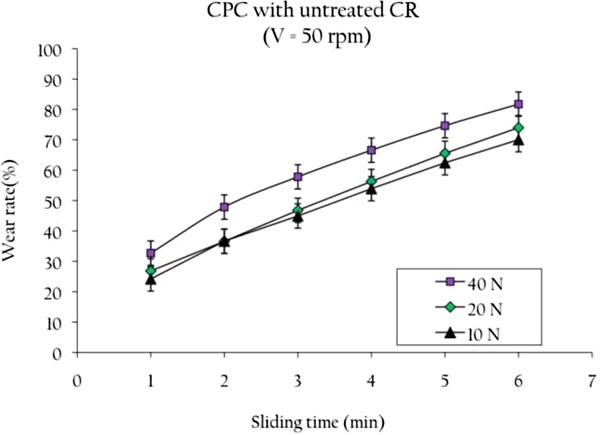
Evolution of wear rate with normal load
The application of a normal load of 40 N generates a significant increase in the wear rate compared to a loading of 20 and 10 N; this evolution can be explained by the heavy damage of PC matrix by ploughing and cutting action of abrasive particles at higher load. It was noticed that curves do not start from zero, then two slopes are distinguished: the one with higher value, indicating a maximum speed of wear, located in the interval of time (0–1 min) and the other lower value (thus a low wear speed) spread out over the remaining wear time. This phenomenon can be explained by the fact that the first contact of the material with virgin abrasive paper (Fig. 3a) will generate necessarily a maximum tearing off of the material during the first minute, then the active surface of the paper will be covered by an adherent layer (formed by wear debris, the area outlined in Fig. 3b) whose thickness increases with wear time. Moreover, most grains lose their sharpness by crushing, some of them being torn off. This supports the reduction of wear speed and explains the decrease in wear kinetics with wear time, whatever the loading.
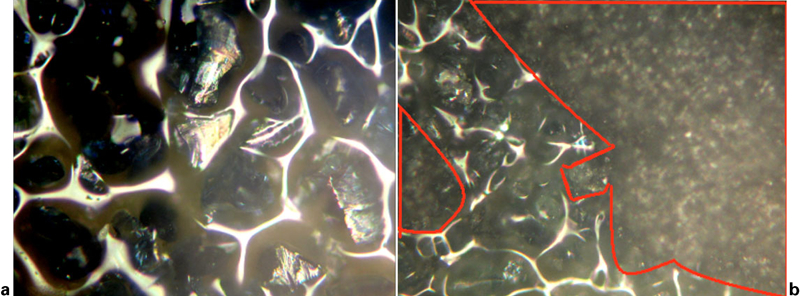
a non-worn and b worn surface of abrasive paper (200×)
Figure 4 illustrates the effect of sliding velocity on the wear rate of CPC with untreated CR. It shows a linear increase in wear rate with the increase in sliding velocity and a decrease in the kinetics of wear is noticed, in the course of the wear time, for all speeds. It should be noted that the heat accumulated in the wear process causes thermal softening of the polymer, and repeated sliding causes massive tearing and rupture of the surface layer. Indeed, the variation of the wear rate is more marked for high sliding velocity values (220 or 270 rev min−1), which is in agreement with the results found by Wang and Sliding54 describing the effect of sliding velocity on wear loss.
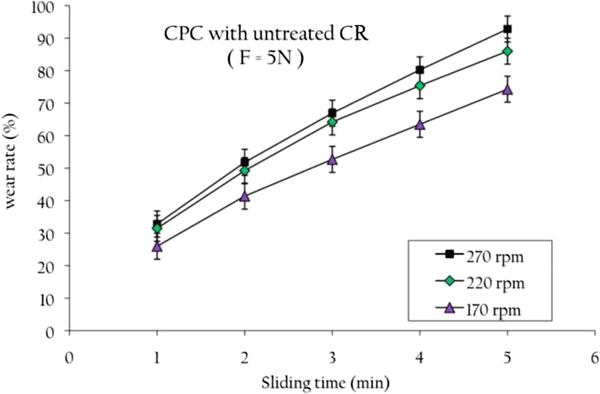
Wear rate as a function of sliding velocity of abrasive disc
Effect of CR treatment on CPC wear behaviour
Preliminary tests were carried out under 5 N and 50 rev min−1 (mild conditions) for four CPC only differing by CR particles treatment.
As shown in Fig. 5, the CPC with CR washed by CH2Cl2 wears very quickly (wear rate equals to 100% at the end of less than 2 min) and it presents the highest kinetics of wear. This fast degradation of the material can be explained by the absence of the adherent layer formed by wear debris on the counter face, unlike other CPCs, which leads to the specimen being directly in contact with a clean abrasive surface; then the mechanism of wear changes and the wear loss increases significantly. Moreover, it is likely the dichloromethane washing has partially swollen PC matrix changing surface roughness and probably also degrading it. The fast degradation of the CPC with CR washed by CH2Cl2 makes the study reserved exclusively for the CPC that showed an abrasion resistance (CPC with CR flamed and washed with methanol).
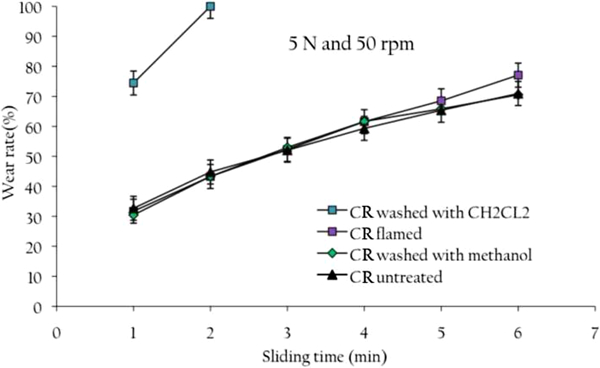
Wear rate of CPC as a function of type of applied treatment
It should be noted that the results found for the evolution of wear properties with test conditions in the case of the CPC with CR flamed or washed by methanol are similar to those found for CPC with untreated CR. Thus it can be concluded that 5 N load only makes it possible to evidence the effect of washing solvent but not to compare the influence of other treatments.
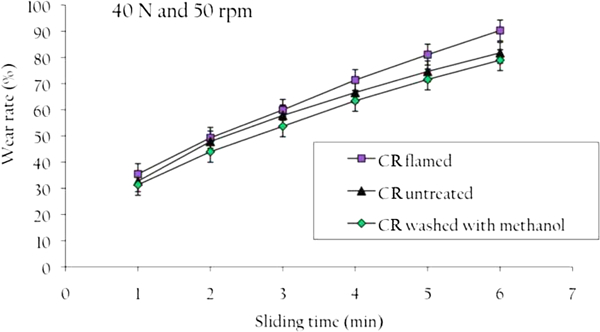
Figure 6 Figures 6 and 7 show that the CPC with flamed CR has the lowest resistance to abrasive wear. However, the CPC with CR washed with methanol has always the lowest wear rate. It should be noted that washing with methanol eliminates the residues of grease and any trace of moisture being able to generate chains breakage by hydrolysis for example or appearance of air bubbles in the composite. This treatment was also found to improve adhesion between PC and CR in another study,36 in the same way flaming contributes although less importantly to the improvement of the interface quality. Scanning electron and optical micrographs of abraded surfaces under 10 N load and 50 rev min−1 sliding velocity ( Figure 8 Figs. 8 and 9) show the presence of porosities or internal cavities due probably to the imprisonment of air bubbles in the mixture and the presence of a phenomenon of wrenching of CR particles which proves that treatments have no significant influence on the reduction of these phenomena. In addition, deep furrows in the abrading direction due to the ploughing action by sharp abrasive particles are illustrated. It is pointed out that the furrows appear only under severe tribological conditions and they are characteristics of abrasive wear.
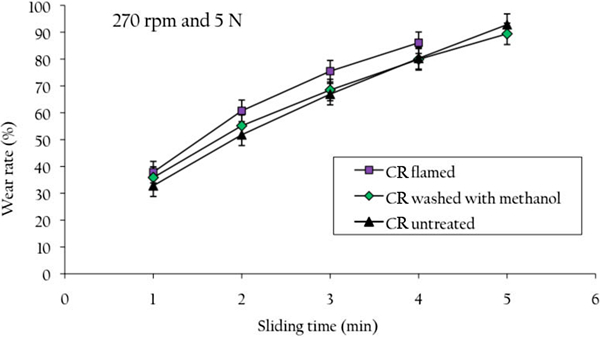
Wear rate of CPC as a function of applied treatment under high speed
Wear rate of CPC as a function of applied treatment under high load
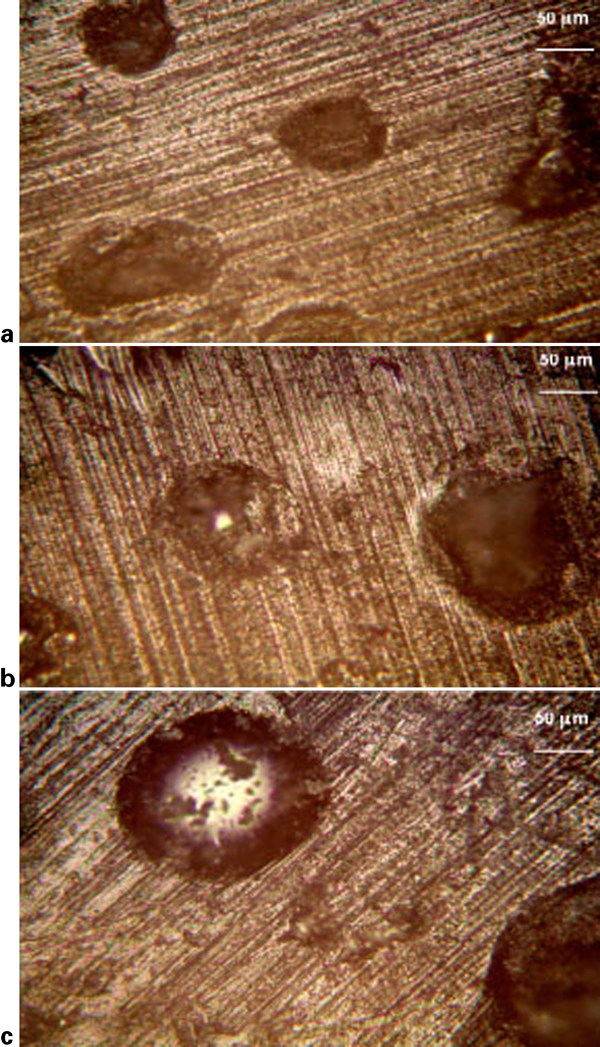
Optical micrograph of surfaces of wear after wear test under 10 N load and 50 rev min−1 sliding velocity (×200)
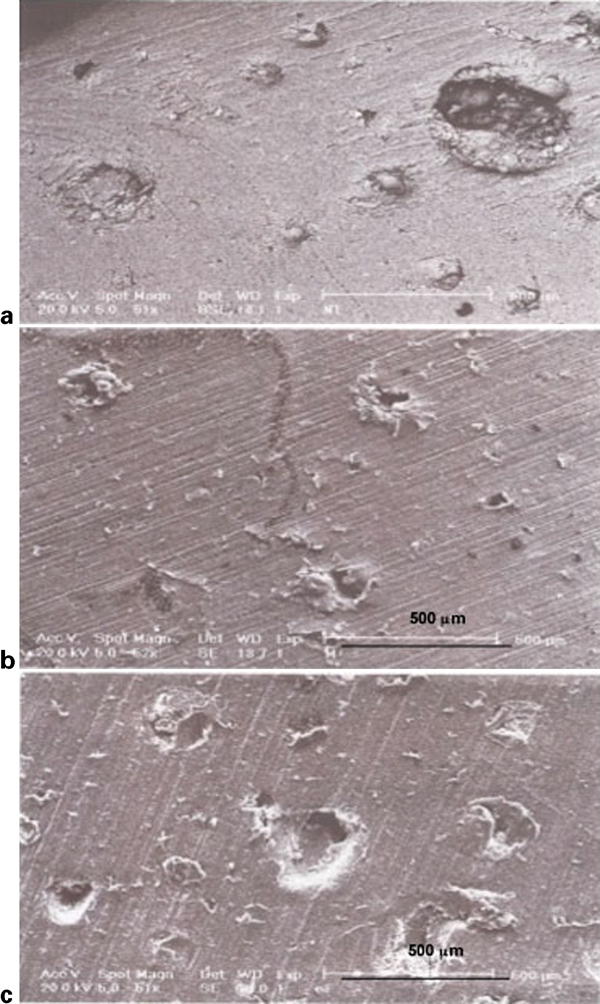
Scanning electron micrograph of surfaces of wear after wear test under 10 N load and 50 rev min−1 sliding velocity (×200)
Figure 10 represents the evolution of the wear rate as a function of the applied loading for wear duration of 6 min. It is noted that the wear rate of various materials makes a remarkable jump at a loading of 40 N and more particularly the wear rate of CPC with flamed CR increased more than those of others. Moreover, the curves of kinetics of wear for the various materials (Fig. 11) show an abrupt increase in the kinetics of wear of the CPC with flamed CR while passing to a loading of 40 N. The low wear resistance of flamed CR filled CPC is thought to result from its higher rigidity, i.e. Young modulus determined by tensile tests.36 In fact, heterogeneous materials with high rigidity can less easily accommodate slip, which will weaken their wear resistance. Additionally nanoindentation tests have shown that CPC filled with flamed CR presented the lowest hardness and the weakest resistance to diamond indenter depression, which can be compared to the action of silica grains on paper surface during wear tests.35 As the abrasive wear resistance is an increasing linear function of the material's hardness,67 the wear rate increase was considered to be acceptable for flamed CR CPC, and then mechanical and wear rate results are in good agreement.
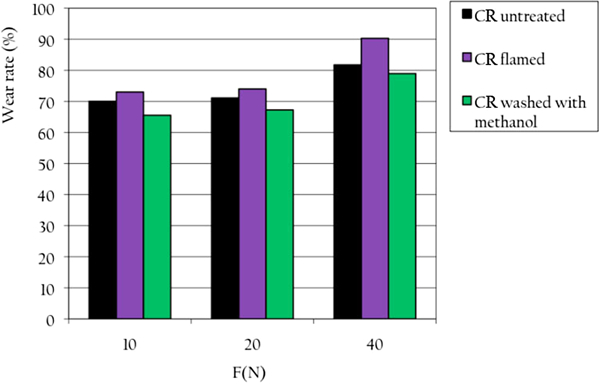
Wear rate of CPC as a function of applied treatment for t = 6 min (V = 50 rev min−1)
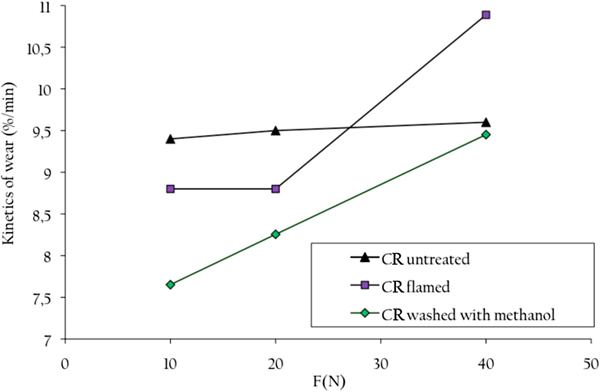
kinetics of wear as a function of normal load for V = 50 rev min−1
Conclusion
In this study, wear experiments have been carried out (with a pin-on-disc test under water lubrication) to investigate the tribological behaviour of CPC obtained by the dispersion of crushed CRs into a recycled PC matrix. In an eco-design approach, these plastic wastes could be valued as smart materials for sensing24 but their further development could be limited by insufficient mechanical properties35 due to a poor interface between CR and PC.36 Tribological tests appear to be a good (and cheap) alternative to qualify PC/CR interface as it was able to discriminate between all surface treatments applied to CR. As expected wear rate increases with load and sliding velocity whatever the type of treatment applied for rubber microparticles. The CH2Cl2 treatment led to very bad wear resistance, probably due to the swelling of CR low mass macromolecules whereas the flaming treatment was found to decrease CPC wear properties certainly because of surface damage. Methanol treatment of CR provided the best compromise between surface activation/degradation allowing us to develop CPC with the best wear resistance for all loading and sliding velocities. It is also noticed that the kinetics of wear depends primarily on the nature of the treatment applied to the CR particles. The examination of micrographies showed that all CPC present almost identical wear scars characterised by the presence of internal cavities, wear furrows and CR particles wrenching.