







Abstract
New composites of poly(ϵ-caprolactone) containing Zn/Al hydrotalcites [layer double hydroxide (LDH)] and ‘active’ antimicrobial anions (benzoate, dichlorobenzoate, o-hydroxybenzoate and p-hydroxybenzoate) prepared with two different techniques have been characterised through differential scanning calorimetry and dynamic mechanical analysis. The method of preparation of the samples has a strong influence on the dispersion of the nanolayers within the polymeric matrix, and, in turn, on the crystallisation kinetics: in fact, the samples prepared by high energy ball milling crystallise much faster than those prepared by casting. The different ‘active’ anions strongly affect the value of the LDH interlamellar distance, which, in turn, affects their capacity of dispersion in the polymer. As a consequence of the different kinds of dispersion, the sample containing benzoate LDH or dichlorobenzoate LDH crystallises faster than that containing p-hydroxybenzoate LDH. Such results are of great importance in the definition of processing and use conditions of such materials of potential interest in food ‘active’ packaging.
Introduction
In the last years, great attention has been focused on the possibility of designing new materials through manipulation on the nanometre scale.1–4 Much attention has been devoted to hybrid organic–inorganic systems, in particular those in which layered silicates are dispersed at a nanometric level in a polymeric matrix,1 which show specific properties and which are not attainable from only one of the two components.
Although layered silicates are the most used nanofillers,5–7 recently attention has turned to layer double hydroxides (LDHs), also known as hydrotalcite-like compounds,8–17 with the general formula
 where MII is a divalent cation such as Mg, Ni, Zn, Cu or Co, MIII is a trivalent cation such as Al, Cr, Fe or Ga and An− is an anion of charge n. The possibility of replacing these anions by simple ion exchange procedures makes LDH a unique class of layered solids to be used as hosts of polymer bearing a negative charge or polymers copolymerised with a small quantity of a negatively charged monomer.
11
, 14
where MII is a divalent cation such as Mg, Ni, Zn, Cu or Co, MIII is a trivalent cation such as Al, Cr, Fe or Ga and An− is an anion of charge n. The possibility of replacing these anions by simple ion exchange procedures makes LDH a unique class of layered solids to be used as hosts of polymer bearing a negative charge or polymers copolymerised with a small quantity of a negatively charged monomer.
11
, 14
In general, modified LDH can be prepared with simple procedures, at high level of purity, which are cheap and ecocompatible and can be organically modified with a variety of organic anions, generally much more numerous than organic cations. The added anions not only can increase the compatibility with LDHs with a variety of polymeric matrices, but can also be released with a controlled kinetics (Ref. 18 and Refs. 2–8, 11 therein).
On the other hand, great attention has been devoted in the last years to biodegradable materials that can be used as renewable resources for plastic applications to reduce wastes.19 In fact, despite the not-overvaluable benefits produced by plastics on nowadays life, their environmental impact is increasing and the development of biodegradable, friendly to the ambient, materials becomes urgent. This is particularly important in short term packaging and disposable applications as well as in medical applications such as resorbable sutures, tissue culture and controlled release systems for topical applications.
Aliphatic polyesters are among the most promising materials for the production of high performance environment friendly biodegradable plastics. Biodegradation of aliphatic polyesters is well known, in that some living organisms degrade them by producing enzymes that attack the polymer. 19 , 20 One of the most interesting aliphatic polyesters is poly(ϵ-caprolactone) (PCL), which is readily obtainable from ϵ-caprolactone ring opening polymerisation, and is used for a series of applications, such as disposable food service items, food packaging, health care products and agricultural films. Nevertheless, despite its attractive degradation characteristics, poly(ϵ-caprolactone), as well as most biodegradable synthetic polymers, shows a poor structural and functional stability, which prevents their widespread commercial impact. In particular, thermal stability, barrier properties and so forth need to be improved. A good way to significantly improve these properties, without hindering the biodegradability, is the obtainment of suitable nanohybrids between the biodegradable polymer and a nanolayer silicate.1–7,21–24 In contrast, few papers have been published up to now 15 , 17 on anionic layered inorganics of hydrotalcite type, even if they are favourable compared with natural clays in terms of purity, control of crystallinity, particle size and wider possibility of functionalisation.
Recently, new composites based on poly(ϵ-caprolactone) and LDH modified with antimicrobial species have been prepared.18 In particular, LDHs have been intercalated with benzoate (Bz) and its derivatives as 2,4-dichlorobenzoate (DCB), p-hydroxybenzoate (p-BzOH) and o-hydroxybenzoate (o-BzOH) and dispersed into PCL. The obtained composites have been shown, through X-ray diffraction and scanning electron microscopy, to have different dispersions of the filler in the polymeric matrix: when exfoliated nanocomposites are formed, the guest anions not only improve the compatibility of LDHs with the polymer, increasing its mechanical and barrier properties, but also confer to it their typical biological activity.18 Therefore, the obtained materials are of potential interest in the ‘active packaging’, in particular in the food packaging, since, containing antimicrobial agents that can control undesirable growth of microorganisms, they would allow to increase the durability of food and to hold its freshness and conservation for the period necessary to its commercialisation and consume.
The development of new materials involves the need of knowledge of a series of properties, in particular physical, mechanical and thermal. In the case of polymer based composites, the knowledge of the thermal behaviour and the crystallisation kinetics of the polymer and of the influence induced by the nanolayers and their distribution in the polymer matrix is of fundamental importance, from either a scientific or a technological point of view, since it allows to define the conditions of processing and use of the material.
Therefore, in the present paper, the thermal behaviours of a series of nanohybrids based on PCL and different LDHs modified with antimicrobial species have been investigated. The nanohybrids have been prepared with two different techniques, casting and high energy ball milling (HEBM). The thermal properties have been studied in order to evaluate the influence of the dispersion, the kind of antimicrobial agent and the technique of preparation of the nanohybrids.
Experimental
Materials
Poly(ϵ-caprolactone) (Capa 6501,
 = 50 000) was kindly supplied in powder form by Solvay. Modified LDHs and nanohybrids investigated throughout this work have been prepared by the group of Professor V. Vittoria at the University of Salerno and kindly furnished.
The nanofillers used were Zn/Al LDHs with the empirical formula
 , where through ionic exchange reaction, the substitution of
 with Bz, DCB, o-BzOH or p-BzOH has been obtained. The method of the sample preparation is reported in Ref. 18.
The composites were prepared using two techniques, casting and HEBM.
In the first case, a tetrahydrofuran suspension containing LDH has been added to a tetrahydrofuran suspension containing PCL; the mixture has been hold under agitation for 3 h, and then the solvent has been evaporated in a Petri capsula.
In the second case, powders of PCL and modified LDH were milled in a cylindrical steel jar of 50 cm3 with five steel balls of 10 mm diameter. The rotation speed used was 580 rev min−1 and the milling time was fixed at 60 min.
In all cases, films were obtained by moulding in a hot press (Carver Inc.) at 100°C and 250±50 μm thick films were formed, which were rapidly quenched in a water ice bath (0°C).
All the examined samples together with their codes and compositions are reported in Table 1.
Samples examined throughout work

Methods of investigation
Thermal analysis was performed by the differential scanning calorimetry (DSC 7; PerkinElmer). Runs were performed on 5±0·5 mg samples in a helium atmosphere. The apparatus was calibrated using the melting temperature of indium (156·6°C) and its heat of fusion. Before each run, the baseline was optimised in the suitable temperature range and then subtracted from the corresponding DSC curve. Transition temperatures were taken as the appropriate peak temperatures in the DSC curve and are reproducible to ±0·3°C. All the experiments were performed after taking the samples to 80°C at 10°C min−1 and holding them at this temperature for 10 min, in order to cancel any thermal history. The crystallisation curves have been obtained by cooling the sample from the melt to room temperature at 10°C min−1 and the melting ones on reheating it to 80°C at the same scanning rate. For isothermal crystallisations, the samples were cooled from the melt to the selected crystallisation temperature Tc and taken at the same temperature for the time necessary to the completion of the crystallisation of PCL. In order to avoid crystallisation on cooling, liquid nitrogen was used as a coolant, which allows the sample to reach the selected crystallisation temperature at 200°C min−1. The heats of transition were calculated from the peak areas using Pyris software running on a Windows NT 5·0 based Pentium III PC with a precision of at least ±0·1%. The heats of crystallisation at suitable interval times were calculated by the method of partial areas.
The dynamic mechanical thermal analyses (DMTA) have been performed using a DMA Q800 analyser (Rheometrics) and the data were analysed through the TA5000 Advantage Software Suite. The measurements have been carried out using liquid nitrogen as a coolant to allow scans from −150 to 40°C. The scanning rate is 5°C min−1, during the application of forced oscillations with the frequency of 1 Hz, in the tensile mode.
The dynamic mechanical analysis measures the response of a given material to a periodic, here sinusoidal, deformation as a function of temperature. The three main parameters which express the dynamic mechanical results are the storage modulus E′, the modulus elastic component, the loss modulus E″, the modulus dissipative component and tan δ, the loss factor, i.e. the E″/E′ ratio, which is used since it clearly shows the occurrence of molecular transitions in the sample.
Results and discussion
In Figs. 1 and 2, the curves of the isothermal crystallisation at Tc = 42°C and those of the subsequent melting are reported respectively for the samples PCLDCB3, PCLDCB5 and PCLDCB10, obtained by HEBM. The curves for the other samples are not reported, due to their strict similarity. All the samples show well evident crystallisation and melting peaks, indicating that the presence of the nanoparticles does not hinder the PCL phase transitions.
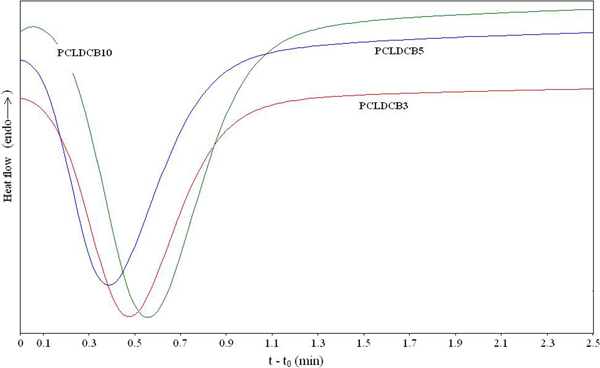
Differential scanning calorimetry curves of isothermal crystallisation at Tc = 42°C as function of t–t0, where t0 is induction time of crystallisation
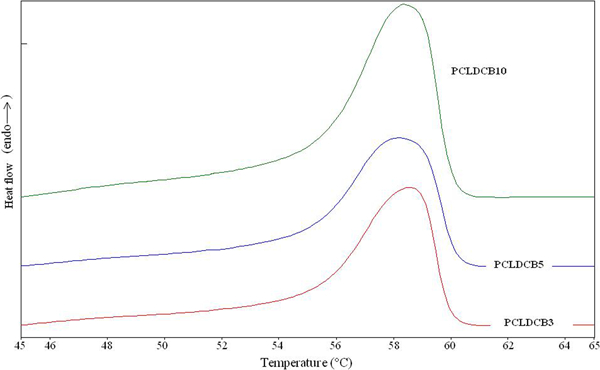
Differential scanning calorimetry melting curves recorded at 10°C min−1 after isothermal crystallisation at Tc = 42°C
Let us examine, in detail, the kinetics of the isothermal crystallisation. From the curves such as that of Fig. 1, the relative crystallinity χ(t) has been calculated, obtained as
 , where ΔHt is the enthalpy of crystallisation evaluated at time t and ΔHTOT is the total enthalpy of crystallisation at the given crystallisation temperature Tc. χ(t) is reported in Fig. 3 as a function of t–t0, where t0 is the induction time of crystallisation, evaluated as the time at which the curves begin to deviate from the baseline. As an exemplum, the case of the sample PCLDCB5 is reported at Tc = 42°C.
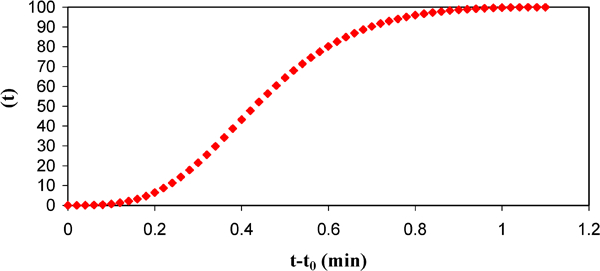
Data of relative crystallinity χ(t) as function of t−t0 (sample PCLDCB5, prepared through HEBM, at Tc = 42°C, is reported)
The data of crystallinity are analysed through the Avrami method,25 by reporting log {−ln [1− χ(t)]} as a function of log (t−t0) (Fig. 4).
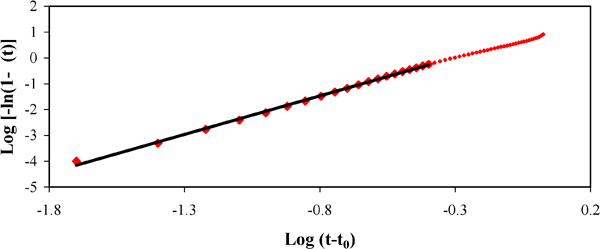
Data of relative crystallinity expressed as log {−ln [1−χ(t)]} as function of log (t−t0) for sample PCLDCB5, prepared by HEBM, at Tc = 42°C: linear fitting of data is represented
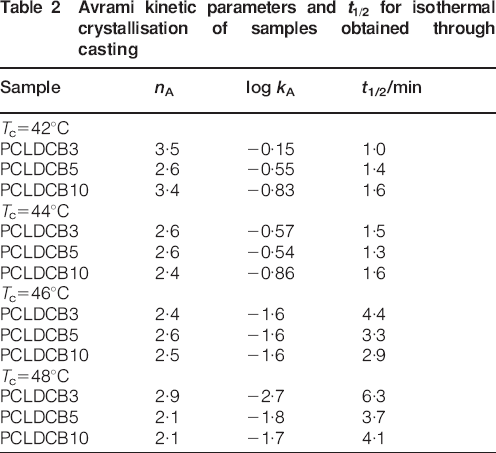
By the linear fitting of the data (up to the deviation from the linearity), it is possible to calculate log nA (the slope), where nA is the Avrami coefficient, related to the kind of nucleation and the shape of the crystallites, and log kA (the intercept) that is the global crystallisation kinetic constant. In Tables 2 and 3, the kinetic parameters are reported for the samples obtained by casting and HEBM respectively. The half time of crystallisation t1/2, i.e. the time necessary to the crystallinity to reach 50% of its final value, is also reported.
Avrami kinetic parameters and t1/2 for isothermal crystallisation of samples obtained through casting
Avrami kinetic parameters and t1/2 for isothermal crystallisation of samples obtained through HEBM
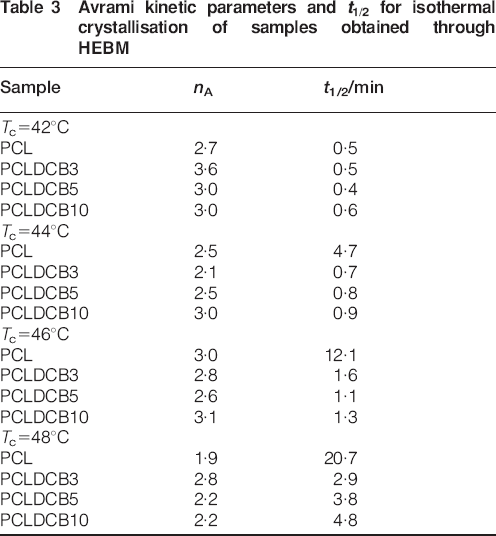
For all the samples, the Avrami coefficient nA shows values in the range 2–3, which indicates heterogeneous nucleation and spherulitic morphology. Therefore, the typical morphology of melt crystallised PCL is hold in the composites. As far as the kinetic constants kA are concerned, it can be noted that they are always higher (and, as a consequence, the t1/2 is lower) for the samples obtained by HEBM, compared with those obtained by casting, indicating a major effect of the nanoparticles on the crystallisation of the ‘milled’ samples, which, in turn, may be ascribed to a more efficient dispersion within the polymeric matrix, obtained through HEBM compared with casting.
The samples obtained by HEBM are also compared with the milled neat polymer. It can be noted that on increasing the crystallisation temperature, the crystallisation becomes faster and faster for the composites compared with neat PCL. This behaviour can be attributed to the effect exerted by the LDH nanoparticles on the crystallisation: in fact, they act essentially on the nucleation process; therefore they have a major influence on the crystallisation kinetics at the higher temperatures, where the crystallisation rate determining step is nucleation.
Let us compare more in depth some samples prepared by HEBM, containing the same content of nanofiller (3 wt-%) but different anions (Bz, DCB, p-BzOH and o-BzOH), crystallised at Tc = 46°C. The corresponding kinetic parameters are reported in Table 4.
Avrami kinetic parameters and t1/2 for isothermal crystallisation at Tc = 46°C of samples containing 3 wt-% of nanofiller obtained through HEBM
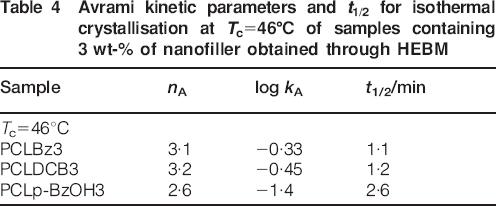
The values of nA are always in the range 2–3, indicating heterogeneous crystallisation and spherulitic morphology.
As far as the crystallisation rate is concerned, the sample PCLp-BzOH shows values of kA much lower (and t1/2 much higher) than the other two samples PCLBz and PCLDCB. This trend may be ascribed to a major nucleating effect obtained when the nanoparticles are better distributed within the polymeric matrix. In fact, for such samples, it has been shown by X-ray diffraction18 that the filler is exfoliated in PCLDCB3, intercalated (partially exfoliated) in PCLBz3, where phase separation takes place, and then a microcomposite is formed for PCLp-BzOH3. The kind of dispersion has been explained through models taking into account the more probable arrangements of the anions between the LDH layers.18 In particular for p-BzOH, it is likely that the H bond network between the anion OH groups and those of LDH, through the hydration waters, holds closer the nanolayers, preventing the polymer intercalation.
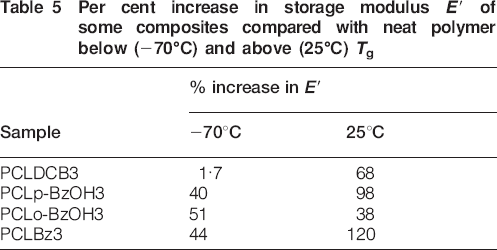
In Fig. 5, the dynamic mechanical curves for the above composites (prepared by HEBM and containing 3 wt-% of nanofiller) are reported. The trend of the storage modulus as a function of temperature is the same for all the samples; in all cases the typical trend, corresponding to the PCL glass transition, is observed at about −40°C. At room temperature (∼25°C), i.e. in the use conditions, the neat polymer shows the lowest E′ value, which indicates the reinforcement effect of LDH on PCL. Table 5 shows the per cent increase in the modulus at −70°C (T<Tg) and at 25°C (T>Tg) for the composites compared with PCL. Such an increment is higher for T>Tg. This behaviour is typical for nanocomposites and is an indication of a major reinforcement effect of the nanoparticles when the material becomes ‘soft’, as the chain motions are restricted by the nanofiller.
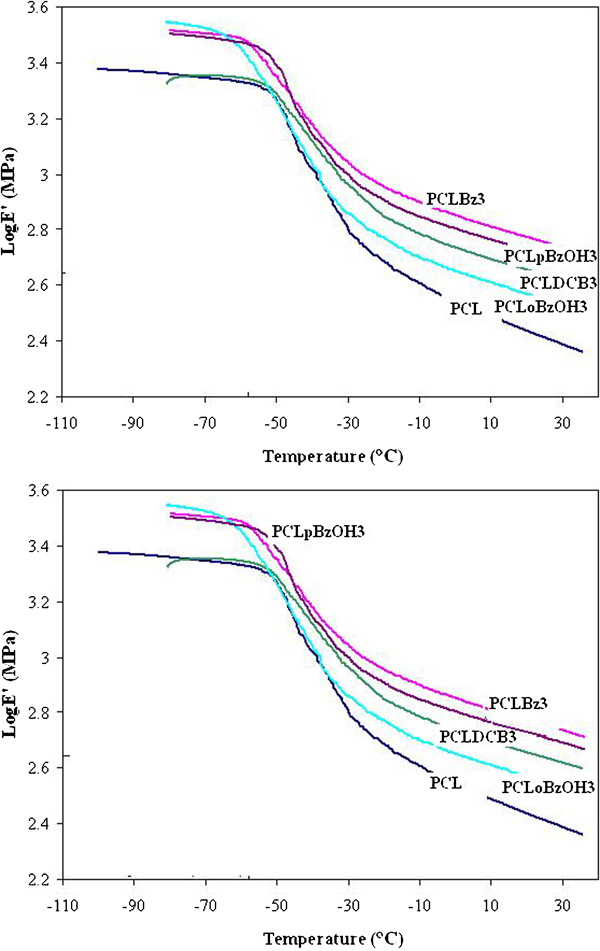
Logarithm of storage modulus E′ (top) and tan δ (bottom) as function of temperature in range from −100 to 40°C
Per cent increase in storage modulus E′ of some composites compared with neat polymer below (−70°C) and above (25°C) Tg
Conclusions
The isothermal crystallisation kinetics has been investigated for nanohybrids of PCL containing LDH modified with bioactive anions. The samples have been prepared either by casting or by HEBM. The samples prepared by HEBM, given the crystallisation temperature, the LDH content and the anion type, crystallise faster than those prepared by casting. This behaviour is a clear indication of a better dispersion of the LDH nanolayers within the polymeric matrix: in fact, it is well known that exfoliated nanolayers are more able to nucleate polymer crystallisation than intercalated or phase separated ones.
If the crystallisation kinetics of samples prepared by HEBM was compared, containing the same LDH content (3 wt-%) but different ‘active’ anions, the strong influence exerted by the anions on PCL crystallisation kinetics was observed, due, in turn, to the different degrees of separation promoted by them on the LDH nanolayer. Therefore, the sample containing BzLDH or DCBLDH crystallises faster than that containing p-BzOHLDH, which, due to the formation of H bonds, holds closer the nanolayers, preventing the polymer intercalation.
Footnotes
Acknowledgements
Professor V. Vittoria and her group at University of Salerno are gratefully acknowledged for the kind gift of the samples used throughout this work.