







Abstract
For industrial applications of engineering polymers such as polyurethane, polyamides and polyesters, the addition of suitable reinforcing inorganic fillers is a practical and convenient method to achieve the desirable mechanical and chemical properties. In this study, the mechanical, chemical and morphological properties of cast polyurethane samples containing barium sulphate, calcium carbonate, kaolin and quartz fillers were investigated. In the formulation of these samples, the ranges of inorganic filler were 0–40 phr. The results of mechanical property tests, such as tear resistance, tensile strength, elongation at break, Young's modulus, hardness and abrasion resistance, were evaluated. The chemical resistance of the samples was determined against xylene and methyl ethyl ketone. The chemical resistance of the filled cast polyurethane was determined by the solubility parameters of polymer/solvent. Finally, the experimental results and SEM images showed that samples containing 30 phr calcium carbonate produced the best results.
Introduction
Polyurethane cast elastomers have the most diverse range of polymers because of different raw materials that can be used for their production.1 They are used in a variety of critical applications, including electrical encapsulates, abrasion resistance linings for pumps, chutes and conveyor belts, rollers, wiper blades, seals and gaskets and wheels for casters. Polyurethanes are being used in graphic rolls, offset printing rolls and in paper mill rolls.2, 3 They also have wide applications in other industries such as paints, varnishes,4, 5 foams, nanocomposite foams6, 7 and medical implants.8 Polyurethanes are also used for nanoparticle filled composites.9 These varieties in the applications of polyurethanes have led to a widespread choice of raw materials for their production. The majority of polyurethane elastomers are based on diisocyanates, polyesters or polyethers long chains and bifunctional alcohols with short chains as chain extenders. In recent years, studies on polyurethanes and their derivatives have become an important research field. Polyurethanes derived from different polyols, diisocyanates and their characterisation have interested many researchers.10–14 On the other hand, castable polyurethanes are considered as an important part of polyurethane industries. These polymers are generally produced by mixing two to five ingredients in a suitable mould at ∼100°C, and the curing process is completed inside the mould after 6–18 h. For castable polyurethane products, it is essential to control the following parameters:15
the fillers used in polyurethane samples must be completely dry in order to prevent the formation of carbon dioxide and gas bubbles during the two-roll mill mixing process
complete mixing of the filler particles and their breakdown in polyurethane matrix prevents the blooming process (a visible exudation or efflorescence on the surface of materials) and avoids sharkskin phenomenon as a surface defect in polymer melts
a suitable filling of the mould is necessary in order to prevent viscous resin leakages and polyurethane shrinkage in the cast moulding process.
The purpose of adding mineral fillers to polymers has been primarily for cost reduction. In recent years, however, the fillers are more often used to fulfil a functional role, such as increasing the stiffness or improving the dimension stability of the polymers.16 For instance, the addition of zinc ferrite17 improves magnetic and dielectric properties, whereas the addition of calcium carbonate (CaCO3),18 aluminium hydroxide,19 kaolin,20 titanium dioxide, zinc oxide21 and silica22 reinforces mechanical properties. Furthermore, the use of metallic fillers increases acoustic properties in polyurethanes.23
For polyurethane filled samples, an improvement in surface hardness, tensile strength (TS) and tensile modulus values was noticed by Roopa and Siddaramaiah.24 They used different amounts of metakaolin in castable polyurethane, and investigated the physicomechanical properties and chemical resistance of filled chain extended polyurethane. Their results showed that with increasing the filler content in polyurethane matrix, the TS and chemical resistance of the samples against different solvents such as toluene and methyl ethyl ketone (MEK) were increased.
Gao et al.25, 26 have investigated the preparation and characterisation of well dispersed waterborne polyurethane/CaCO3 nanocomposites. It was found that well dispersion was obtained up to 6 wt-% of the surface treated CaCO3 loading for polyurethane/CaCO3 nanocomposite. Compared with the pure polyurethane, a significant improvement in thermal stability was observed with the addition of 6 wt-% of the surface treated CaCO3. The experimental results suggested that the properties of nanocomposites were correlated with the dispersion of nano-CaCO3 in polyurethane and the interfacial interactions between nano-CaCO3 and polymer matrix.
In this work, a systematic study on cast polyurethanes containing different inorganic fillers was carried out. Four types of fillers [barium sulphate (BaSO4), CaCO3, kaolin and quartz (0–40 phr)] were added to polyurethane samples, and their mechanical, chemical and morphological properties were evaluated. On the basis of the experimental results, the optimum choice for the filler type and its percentage was determined. In addition, the chemical resistance of the samples against solvents such as xylene and MEK were determined from weight loss measurements of the samples. Finally, SEM images showed the extent of filler dispersion in the polyurethane matrices.
Materials and methods
Materials
Polyurethane prepolymer (TB 636) containing poly (glycol adipate) and toluene diisocyanate (with 3·6% free isocyanate), chain extender [a mixture of three methyl propane and three isopropanol amine (TMP/TIPA)] and the plasticiser (trade name, V03) were all polyurethane purchased from Baule Co. (France). The polyurethane prepolymer had a viscosity of 3·2 Pa s at the process temperature of 80°C and a solid state at 20°C. In addition, TMP/TIPA was solid at room temperature and had a viscosity of 0·075 Pa s at the process temperature of 80°C. The inorganic fillers BaSO4, CaCO3 and kaolin were supplied by Soft Powder Sepahan Co. (Iran). Quartz filler was provided from Iranian Mineral Production and Supplying Co. (Iran). The physical characteristics of these mineral fillers are given in Table 1.
Technical data for different inorganic filler properties used in cast polyurethane samples

*Specific surface area.
Samples preparation
The above fillers were dried at 100°C for 24 h in an oven. A mixture of 10–40 phr filler and 15 phr plasticiser (V03) was added to 100 phr polyurethane prepolymer (TB 636). The mixture was then agitated in a mixer for 3 h at 50 rev min–1. After vacuum evacuation of the gases from the mixture, 3·9 phr chain extender (TMP/TIPA) was added. After the mixing process was complete, the mixture was heated at 70°C for 12 h. It was then poured into a mould and heated at 110°C for 6 h. Finally, the moulded polyurethane samples were cured at 110°C for 16 h.
Samples characterisation
Mechanical tests
The TS of the samples was determined using a universal tensile tester (model 4505, Instron Co.) according to the standard test method ASTM D412. Furthermore, tear resistance was measured according to the standard test method ASTM D624 using die (C) (CCSi UltraLife specimen cutting dies, Ohio, USA), and the hardness (shore A) was evaluated according to ASTM D2240 using a durometer hardness tester (Zwick Co., Germany). The abrasion resistance of the samples was determined using a Hampden Northampton abrasion tester (UK) according to the standard test method DIN 53516. Cylindrical samples of 8 mm thickness and 16 mm diameter were prepared, and their weight loss on the volume basis (mm3) was recorded. In all these measurements, the results had a standard deviation <5%.
Chemical resistance tests
Solvent resistance of the polyurethane samples was evaluated according to standard test method ASTM D474, in xylene and MEK at room temperature for 72 h. Using equation (1), the weight loss was determined

Scanning electron microscopy
Cast polyurethane samples were cut into small pieces, and after 10 min, their gold sputtering operation was carried out using a Bio-Rad automatic sputter coater (model E-5200, UK). Then, SEM images of the specimens obtained using CamScan (model MV-2300, Cambridge, UK), with 25 kV high voltage and 500× magnification.
Results and discussion
The reinforced mechanical properties of cast polyurethane samples, such as tear and abrasion resistances, TS and chemical resistance, are important factors for the selection of the most suitable filler in cast polyurethane samples.
Mechanical properties of samples
Tear resistance
Figure 1 shows the tear resistance variations of cast polyurethane samples containing 0–40 phr BaSO4, CaCO3, kaolin and quartz. The tear resistance is increased by an increase in filler content. For samples containing CaCO3 and quartz, the increase in tear resistance was more than that in the other two fillers. For 30 phr filler content, the samples have similar tear resistance ∼61 kN m–1. One of the most important factors in the reinforcement of the tear resistance and toughness of the samples are the type and shape of the filler particles and also the value of Brunauer–Emmett–Teller (BET), which is directly related to the specific surface area of the filler particles.27
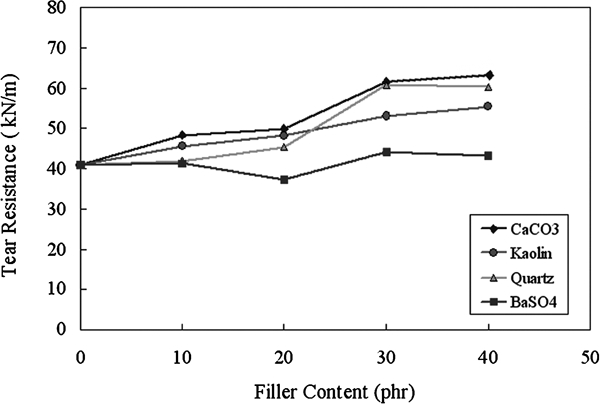
Variations of tear resistance against different amounts of fillers (0–40 phr) BaSO4, CaCO3, kaolin and quartz in cast polyurethane samples
Previous studies show that CaCO3, as a neutral filler, is very effective in reinforcing toughness property of polymers.28 The micromechanism consists of three stages:
stress concentration: the modifier particles act as concentrator because they have different elastic properties compared with the matrix polymer
debonding: stress concentration gives rise to build-up of triaxial stress around the filler particles, and this leads to debonding at the particle/polymer interface
shear yielding: the voids caused by debonding alter the stress state in the host matrix polymer surrounding the voids, which reduces the sensitivity towards crazing since the volume strain is released.
The experimental results also show that the highest tear resistance of the samples belongs to those containing CaCO3 filler.
On the other hand, for semireinforcing fillers such as silica (quartz) and silica clay (kaolin) for lower values of BET, the surface area of the filler particles is smoother, and the interactions between filler particles and polymer chains increase.29 Therefore, the highest values of tear resistance for these samples belong to CaCO3, quartz, kaolin and BaSO4 for an optimum 30 phr filler content respectively.
Usually, low particle size and high surface activity of a filler increases the viscosity of polyurethane, which makes mixing and processing difficult. In this work, filler particles with similar dimensions were used.
Tensile strength, elongation at break and modulus
Table 2 shows TS, elongation at break (EB) and Young's modulus for 300% elongation. Our previous work27 shows that SiO2 has a suitable compatibility with polymer structures containing Si such as silicone rubber. However, in this study, the TS measurements for polyurethane samples show completely different results. Samples with quartz, kaolin, BaSO4 and CaCO3 fillers containing SiO2 percentages 98·7, 68·8, 6·13 and 0·15% respectively, have an increase in their TS values. For instance, at 30 phr filler content, the extent of TS increases for these fillers is ∼29%. On the other hand, when CaCO3 content in the samples varies from 0 to 40 phr in the formulations, the TS increases ∼142%. The tear resistance increase for samples from 30 to 40 phr CaCO3 is not remarkable.
Tensile strength, elongation at break and modulus at 300% elongation for samples containing 0–40 phr fillers BaSO4, CaCO3, kaolin and quartz

According to physical and mechanical properties of polymers,30 when TS increases, EB is reduced. It was observed that by the addition of a filler to polyurethane samples, the EB relative to pure samples is increased. This behaviour can be explained in terms of increases in elastic property and the formation of junctions in polymeric chains. In polyurethane polymer chains, an increase in the degree of cross-linking leads to an increase in EB. As the amount of filler is increased in the samples, they become harder, and a reduction in EB is observed. Usually, the main purpose from the addition of a filler to a polymer is twofold:
an increase in modulus
cost reduction in the final products.
Therefore, an increase in filler content results to an increase in modulus, which leads to higher values of hardness in the samples. The role of CaCO3 and BaSO4 compared with the other two fillers is more significant for increases in the modulus.
Hardness and abrasion resistance evaluations of samples
The results from hardness (shore A) and abrasion resistance measurements are important for coating the surface of two-roll mill by cast polyurethane samples. Therefore, high values of hardness and abrasion resistance are considered as advantages of adding a suitable filler in the samples. Figure 2a shows the highest values of hardness for the samples containing kaolin, CaCO3, BaSO4 and quartz respectively. For lower values of SiO2 in a filler, the surface of filler particles has higher interactions with elastic polyurethane chains, and therefore, the modulus and hardness of the samples are increased for higher values of the filler. On the other hand, the abrasion resistance of the samples is related to their hardness. Therefore, an increase in the hardness of the samples corresponds to a reduction in their abrasion volume loss. As can be seen in Fig. 2b, polyurethane cast sample containing quartz (30 phr) has the highest volume loss ∼130 mm3, and samples containing BaSO4, kaolin and CaCO3 have the lowest abrasion values.
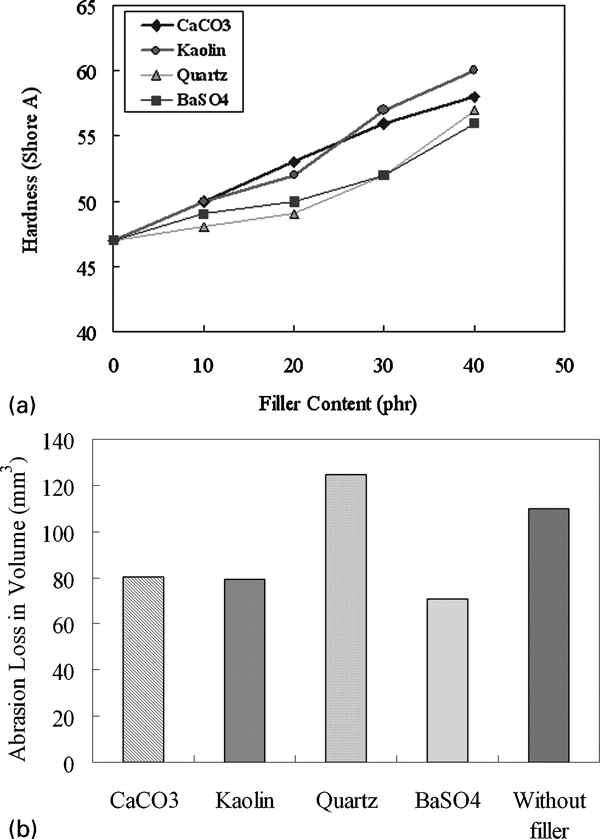
a variations of hardness (shore A) and b abrasion resistance against different amounts of fillers (0–40 phr) BaSO4, CaCO3, kaolin and quartz in cast polyurethane samples
Chemical resistance evaluations of samples
Figure 3 shows weight reduction values of cast polyurethane samples containing CaCO3, kaolin, quartz and BaSO4 for 10–40 phr. The effects of xylene and MEK solvents in the weight losses of the samples have a direct relation to the solubility parameter of solvent and polymer. As the solubility parameters of the solvent and polymer get closer together, the solubility of the polymer in the solvent increases.31 From the literature,31, 32 solubility parameters are 18 and 19·3 MPa1/2 for xylene and MEK respectively and are 18·3–19·3 MPa1/2 for polyurethane samples, which are dependent on polyol and diisocyanate and their molecular weights. Considering the samples without a filler (Fig. 3) in xylene and MEK solvents, weight reduction values were ∼25 and 90% respectively. It can be concluded that the solubility parameter for the samples without a filler is very close to the solubility parameter of MEK. The solubility parameters for the fillers used in the samples exist in the literature,3 which has a direct relation on the lowering of weight reduction of the samples and their resistance against xylene and MEK. Considering this characteristic, Fig. 3 shows an increase in chemical resistance of the samples by the addition of a filler and increasing its content. This behaviour for CaCO3 and quartz is more than the other two fillers, which show the higher solubility differences between the filler and the solvent.
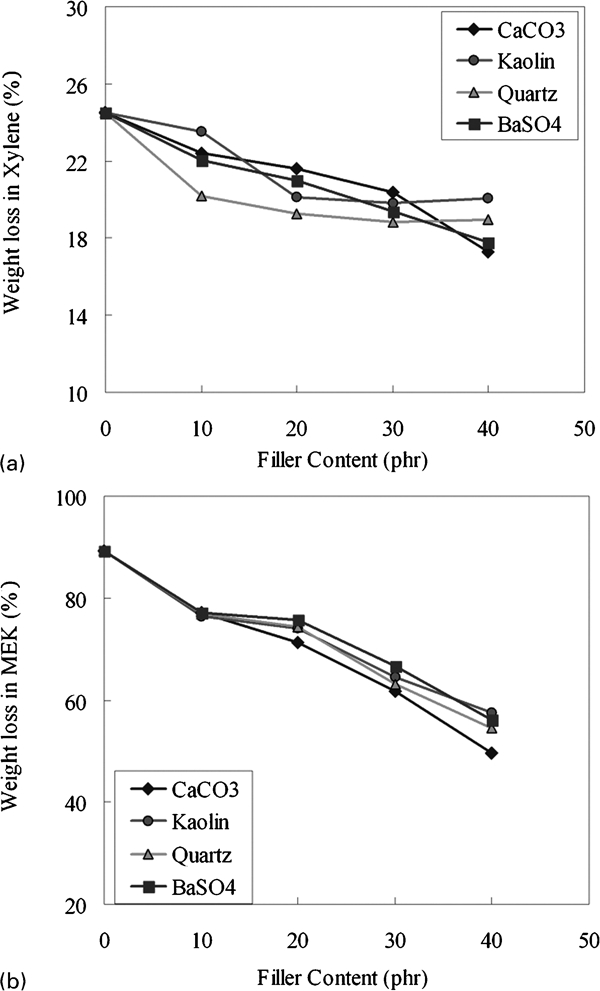
Chemical resistance of cast polyurethane samples versus filler content (0–40 phr) BaSO4, CaCO3, kaolin and quartz in two solvents
Morphology analysis of samples
From the previous results, especially tear resistance, hardness, abrasion and chemical resistance of the samples, CaCO3 is the preferred filler compared with the other three selected fillers, and its most suitable percentage was 30 phr. Figure 4 shows SEM images of the samples without fillers (Fig. 4a) and containing 30 phr BaSO4, kaolin, CaCO3 and quartz (Fig. 4b–e respectively). Furthermore, in mechanical property improvements such as tear and abrasion resistances, parameters such as suitable mixing properties of the filler in the polymer matrix, filler distribution and also the extent of filler migration to the surface of the polyurethane samples play a key role. As can be seen in Fig. 4, samples containing quartz (Fig. 4e), CaCO3 (Fig. 4d), BaSO4 (Fig. 4b) and kaolin (Fig. 4c) have the best distribution of filler particles on the surface of the polymer matrix respectively. However, considering the high percentage of SiO2 in quartz and kaolin fillers and because of incompatibility of the surface of the filler particle with rubbery chains, the filler migration to the surface is observed in the images as brighter points in Fig. 4e and c. Therefore, the surface of the samples becomes rougher and also results to a reduction of the abrasion resistance. Consequently, the samples containing 30 phr CaCO3 were selected as the best ones.
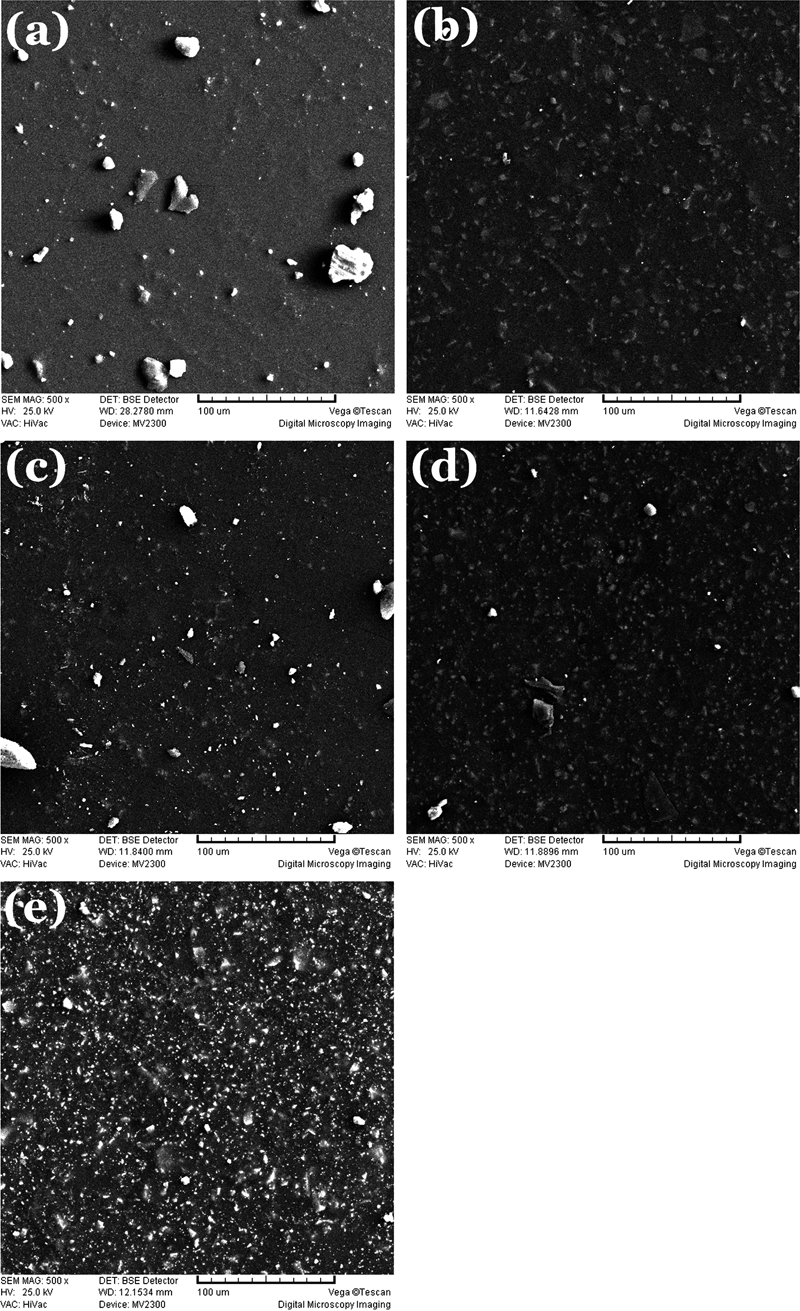
Images (SEM) of cast polyurethane samples surface a without filler and with 30 phr different fillers b BaSO4, c kaolin, d CaCO3 and e quartz
For samples without a filler, in order to recognise bright points, numbered 1, 2 and 3 in Fig. 5, energy dispersive X-ray (EDX) images were taken from the surface of the sample. It was found that these points were holes containing carbon and oxygen elements which exist in the backbone of polyurethane chains. They may also be possibly due to Au from gold coating which has been gathered on the surface of the samples. Therefore, the results obtained from SEM images show darker and brighter points which represent the filler used in the samples, and EDX images also confirm these observations.
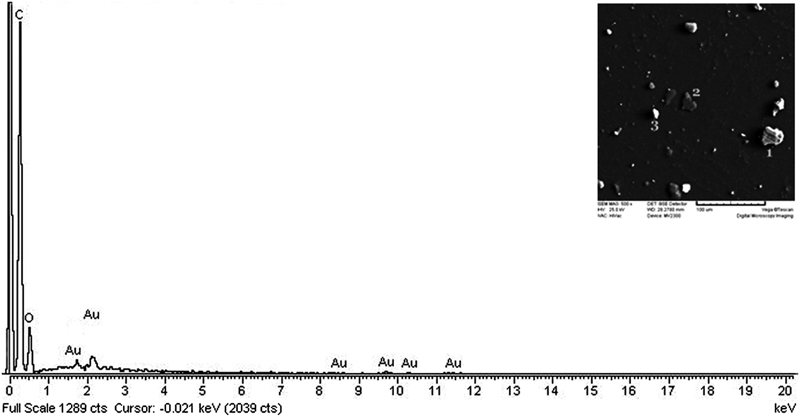
Energy dispersive X-ray spectrum and mapping of cast polyurethane samples in absence of filler
Conclusions
In this study, cast polyurethane samples containing BaSO4, CaCO3, quartz and kaolin fillers in the range of 0–40 phr were prepared, and their mechanical, chemical and morphological properties were investigated. The tear resistance examinations of these samples showed that the shape and topology of the fillers and also their specific surface area (BET) are the most effective parameters in reinforcing these properties, and 30 phr CaCO3 samples showed the best results. In addition, mechanical test results including TS, EB and modulus indicate that different percentages of SiO2 can be an important parameter in the variation of these properties. On the other hand, the evaluation of the samples’ hardness and their abrasion resistance showed that a relative increase in hardness and abrasion resistance is observed. Finally, SEM and EDX images of the samples containing 30 phr CaCO3 can be the best choice for coating the stainless steel surfaces of the two-roll mills.