







Abstract
This paper presents an overview of the research performed to date by a Swedish interdisciplinary team of scientists striving to develop multifunctional composite materials for storage of electric energy in mechanical load paths. To realise structural batteries from polymer composites, research pursued on carbon fibres for use as negative electrode in the battery as well as on polymer electrolytes for use as polymer matrix in the composite is reported. The work on carbon fibres comprises characterisation of the electrochemical capacity of commercial carbon fibre grades and how this is affected by mechanical load. Co-polymers are studied for their multifunctional performance with respect to lithium ion conductivity and stiffness. Also, rational processing of these polymer electrolytes and the effect of processing on their properties are addressed.
Keywords
Introduction
Weight reduction is currently a top priority for many applications in the transport industry. Use of lightweight materials has been identified as key for successful electrification of future road transport.1 Reduced vehicle weight is required for increased range and energy efficiency of future electric cars.2 In addition, reduced vehicle weight will allow reductions in battery volume and mass. Introduction of carbon fibre composites in electric vehicles is already taking place, e.g. BMW Mega city electric vehicle and Toyota Prius X/1.
The versatility of polymer composite materials offers an ideal opportunity to develop novel multifunctional materials for use in future cars. In 2009 an interdisciplinary team of Swedish researchers, lead by the author, launched a research campaign to develop structural batteries from polymer composite materials, i.e. a material which can simultaneously store electrical energy, while meeting the demands of the mechanical loading.3 The idea behind the project was to employ carbon fibres for mechanical performance and as negative electrode in the structural battery material, and to use a lithium ion conductive polymer electrolyte as matrix material for mechanical load transfer between fibres and lithium ion transport. Carbon fibres are particularly attractive as they are commonly used as both electrodes and high performance structural reinforcement, but usually the forms of carbon are different. Work in the USA,4, 5 UK6 and at Swerea SICOMP7 has already demonstrated that such multifunctional materials can be synthesised. The structural batteries are developed with the ambition to further reduce system weight. Traditional batteries do not contribute to the structural performance of a car. Components, which do not contribute to the load carrying capability, are structurally parasitic. The multifunctional capability provided by the structural batteries is expected to offer significant savings in system level mass and volume. The design approach, however, is relatively new and faces significant engineering, design, material and application challenges. This paper addressed two of these: use of commercial carbon fibres as the negative electrode and use of solid polymer electrolytes as composite matrix material.
Different types of graphitised carbons have been used as the negative electrode in secondary, i.e. rechargeable, lithium ion batteries.8 The advantage of using carbon is its ability to intercalate lithium ions at a very low electrode potential, close to that of the metallic lithium electrode (−3·045 V versus standard hydrogen electrodes).9 Since its introduction, extensive research has been conducted on graphite electrodes for improved battery life, capacity and safety.10 Snyder et al.11 performed the first in depth evaluation on commercial carbon fibres for use in structural battery electrodes. In the study by Snyder et al., 11 the electrochemical capacities of carbon fibre electrodes from high and intermediate modulus polyacrylonitril (PAN) based fibres were identified to provide the best compromise for specific capacity and tensile strength.
The electrolyte is essential in a lithium ion battery. Its function is to transport lithium ions at a certain rate to produce a current. During discharge lithium ions are transported from the negative to the positive electrode. This transport is restricted if the electrolyte is a solid polymer electrolyte. The challenge is thus to allow sufficient mobility of the lithium ions while retaining mechanical performance of the structural battery. Current solid polymer electrolytes hold conductivities up to 10−5 S cm−1, whereas contemporary liquid electrolytes exhibit conductivities as high as 10−2 S cm−1.12 However, the liquid electrolyte cannot carry any mechanical load. Consequently, in the structural battery application one has to accept the lower lithium ion conductivity. The relationship between lithium ion conductivity and stiffness is schematically illustrated in Fig. 1. In the figure a shaded area has been included to indicate desired properties of the polymer electrolytes for realisation of structural battery composite materials.
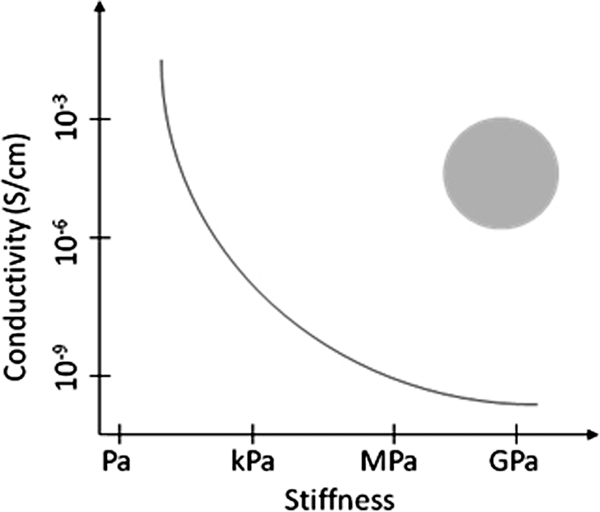
Schematic of lithium ion conductivity versus stiffness for solid polymer electrolytes
One route to create solid electrolytes is to employ polymers containing ethylene oxide (EO) groups.13 The polymer EO chains can be formulated to cross-link in order to form a polymer network. The cross-linking density in relation to EO groups will decide the stiffness to conductivity ratio, and hence the multifunctionality, of the structural polymer electrolyte. Snyder et al.12, 14 were first to try to improve the multifunctional behaviour of structural electrolytes by co-polymerisation of cross-linking and conductive monomers. By this approach they tried to move the performance of the structural electrolyte into the grey area in Fig. 1. Indeed, the co-polymers synthesised by Snyder and co-workers12, 14 consistently exhibited improved electrochemical–mechanical multifunctionality with respect to the analogous homopolymers.
The objective of this paper is to present an overview of the current status of research performed to facilitate structural batteries within the Swedish research project ‘Lightweight structural energy storage materials’.3 The research comprises evaluation of commercial fibres capability to intercalate lithium ions and to work as negative electrodes in structural batteries.10 This research comprises studies of the effect of mechanical loading on lithiation and delithiation of carbon fibres.15 The research also addresses development of co-polymerised polymer electrolytes, in the spirit of Snyder et al.12 and Wysocki et al.16 and by photo polymerisation.17
Carbon fibre electrodes
Carbon fibres are analysed at the Royal Institute of Technology (KTH), Stockholm, Sweden, for their potential use as negative electrodes in structural batteries.10, 15 This work is lead by Professors G. Lindbergh and D. Zenkert. The research is based on the assumption that a battery with good mechanical properties can be achieved by employing continuous carbon fibre yarns acting as the negative electrode. Carbon fibres have reasonably good electrical conductivity in the axial direction of the fibre. Values up to 2×10⁴ 1/Ω cm have been reported for carbon fibres.18 For this reason, the negative electrode in a structural battery may be designed in a manner that no current collectors or conductive additives are needed. Kjell et al.10 recently published a study of the electrochemical properties of several different grades of commercially available PAN based fibres. PAN based fibres were selected as they are cheaper, less brittle and exhibits higher strength than pitch based fibres. The study addresses effects of sizing, lithiation rates and number of fibres per yarn on electrochemical capacity. The main findings from the study by Kjell et al.10 are presented in the following section.
Electrochemical capacity of commercial carbon fibres
In the study by Kjell et al., 10 pouch cell batteries with a carbon fibre tow electrode and lithium foil counter electrode separated by a glass fibre separator were designed and employed. Electrochemical capacity was measured on seven grades of carbon fibre using galvanostatic cycling between 0·002 and 1·5 V versus Li/Li+ for 10 cycles with a current corresponding to 100 mA g−1, resulting in a lithiation rate of ∼0·25 C. T800 and IMS65 fibres by Toray and Toho Tenax respectively, were tested at different rates ranging from 0·1 to 1 C. Figure 2 shows lithiation/delithiation curves from the tests on the best performing fibre type, the unsized IMS65 fibres. A summary of some key results are presented in Table 1.
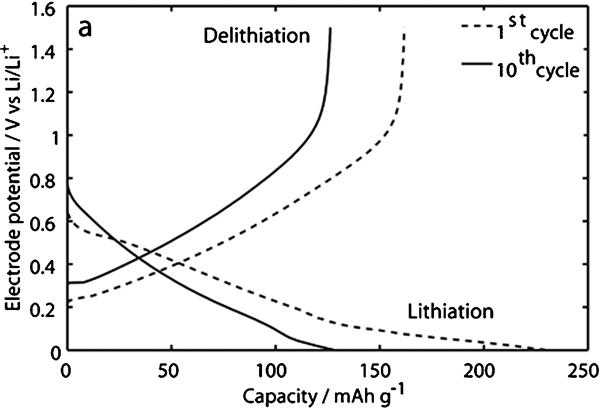
Lithiation/delithiation curves for unsized IMS65 fibres10
Measured electrochemical capacity for first and tenth cycle10
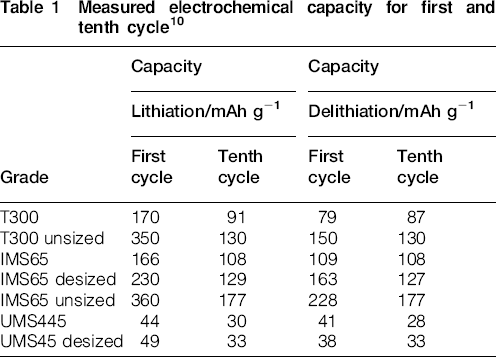
The electrochemical capacity dropped to a stable reversible capacity after the first lithiation/delithiation cycle for all fibre grades. However, the electrochemical capacity for different grades of fibres varied considerably, as indicated in Table 1. A general effect of sizing was noticed for all fibre grades. For the desized fibres the sizing had been removed using acetone.10 As the sizing was removed, the capacity was improved by few percentages up to >100%. The negative effect of sizing was evident from the results for unsized T300 and IMS65 fibres (Table 1). In contrast to the desized fibres these fibres had been supplied unsized by Soficar and Toho Tenax. The capacity of the unsized fibres was remarkably high, close to the theoretical capacity for graphite (372 mAh g−1) during the first lithiation. The stable capacity for the unsized T300 and IMS65 fibres was 50 and 64% higher than that for the sized fibres respectively. In Table 1, data for the high modulus UMS45 fibre are included. UMS45 has a stiffness of 430 GPa according to the manufacturer. The measured capacity for UMS45 is very low (<20% of that of the best performing fibre grade, IMS65, which has a reported stiffness of 290 GPa). This is unexpected as high modulus fibres are extensively graphitisied, more so than intermediate modulus fibres.18 Similar observations were made for other high modulus fibres (M40 and M46), which were all out performed by the tested intermediate modulus fibres. Consequently, the structure of the graphite must be important for the lithiation processes in carbon fibres. This calls for further study.
Kjell et al.10 also studied the effect of charging rate. They observed that as the charging rate was reduced from 1 to 0·1 C, the reversible capacity increased by 100%. Consequently, the reversible capacity of the unsized IMS65 fibre was ∼350 mAh g−1 at 0·1 C.
Effect of mechanical loading on electrochemical capacity of commercial carbon fibre electrodes
The graphite structure deforms when an external mechanical load is applied. Therefore, mechanical loading may affect the lithium ion intercalation in the graphite structure of the carbon fibre. Jacques et al.15 have investigated the effect of mechanical loading on the electrochemical capacity of a T800 fibre electrode. Tensile strain was applied on pouch cell batteries with a T800 carbon fibre negative electrode before, during and after electrical charging cycles. The same charging conditions used by Kjell et al.10 were employed. A reversible capacity of ∼140 mAh g−1 was measured. The capacity did not change once the mechanical loading was released, implying that the amount of lithium ions intercalated in the graphite structure of the carbon fibre was unaffected by the mechanical loading. Lithiation and delithiation curves for the loaded and unloaded T800 electrode are presented in Fig. 3.
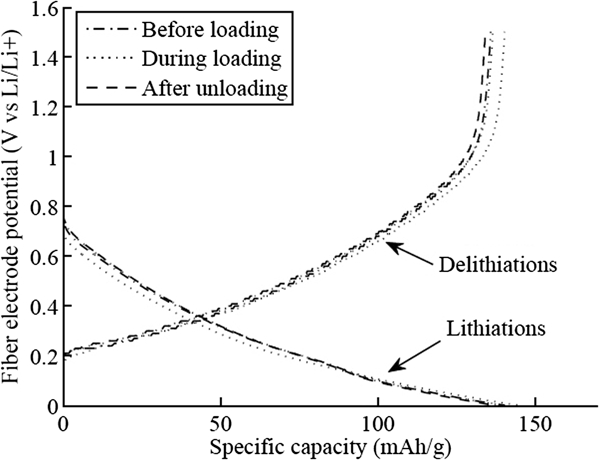
Lithiation and delithiation curves for T800 fibre electrode, before and during loading and after unloading15
The static tensile test set-up employed by Jacques et al.15 allowed measurements of axial swelling and shrinkage during the electric charge cycle by observation of a resulting increase or decrease in load for the applied strain level. By this approach, an axial swelling of 0·33% for lithiation and axial shrinkage of 0·28% at delithiation were recorded for the T800 fibre electrode. As concluded by Jacques et al., 15 these results are very encouraging for the continuing development of energy storage composite materials.
Structural electrolytes for use as composite matrix material
Solid polymer electrolytes were made by co-polymerisation of two types of monomers for multifunctionality. The first monomer is a highly lithium ion conductive monomer, containing long chains of EO. The second monomer is a difunctional methacrylate, which provides the cross-linked network. By mixing these monomers in different mixing ratios, a variation in cross-linking density and chain mobility can be achieved. This is the starting point for this research. Two different approaches have been taken. In a first study Wysocki et al.16 employed thermal curing of co-polymerised methacrylate monomers to investigate influence of mixing ratios on the multifunctionality of polymer electrolytes. In a second approach, Willgert et al.17, 19 employed UV induced polymerisation of similar monomers and investigated the influence of cross-linking and lithium salt content on the multifunctionality of the polymer electrolytes.
Multifunctional performance of thermally cured co-polymer electrolytes
Inspired by the findings of Snyder et al., 5, 12 Wysocki et al.16 co-polymerised polymer electrolytes from methacrylate monomer mixtures to identify candidate polymer electrolytes for use as matrix material in structural batteries. Two monomer systems were employed to generate variations in cross-linking density. In principle, the idea is to graft highly conductive chains on to a structural, three-dimensional polymer network. The highly conductive monomer used in this study was methoxy polyethylene glycol (550) monomethacrylate, CD552, from Sartomer. High lithium ion conductivity is expected due to the long chains of EO in the monomer. Tetraethylene glycol dimethacrylate, SR209, also from Sartomer, was used as a cross-linker for its high mechanical properties. The monomers are presented in Fig. 4.
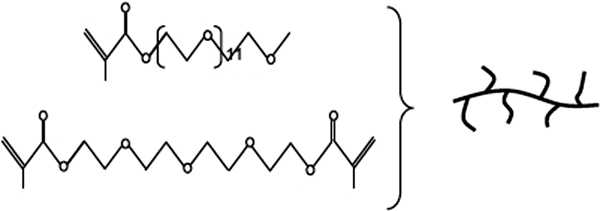
Co-polymerisation of polyethylene glycol (200) dimethacrylate and methoxy polyethylene glycol (550) monomethacrylate20
In total six monomer mixing ratios were investigated (see Table 2). Salt (lithium triflate) was added to the monomer solution at a ratio of 12% by weight per EO. After addition of initiator/accelerator the monomer blend was infused into a matched die tool for curing. The polymer electrolytes were cured at 80°C for 12 h and subsequently post-cured for 1 h at 110°C. All operations were carried out inside a glovebox to maintain dry conditions.
Ionic conductivity and storage modulus at different mixing ratios16
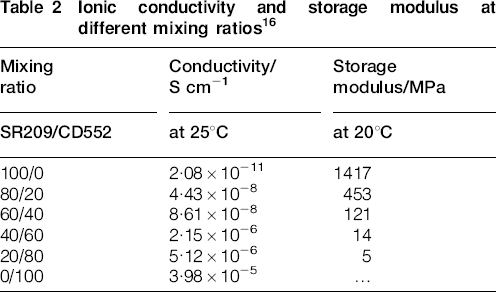
Lithium ion conductivity and storage modulus were measured by impedance spectroscopy (IS) and dynamic mechanical thermal analysis (DMTA) respectively. Results from IS and DMTA tests are summarised in Table 2. The achieved results are consistent with results achieved for the same monomer system by Snyder et al., 12 as illustrated in Fig. 5.
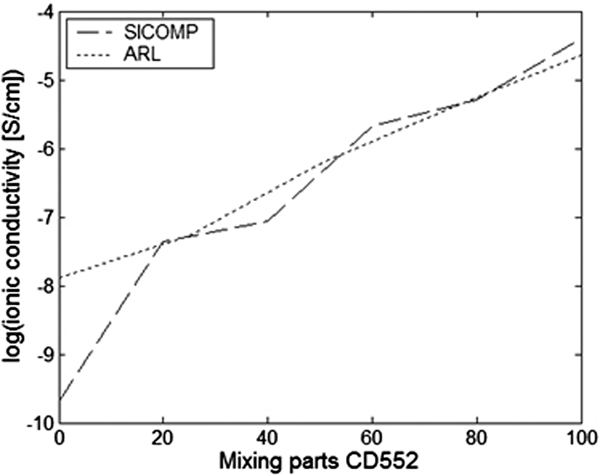
Ionic conductivity from impedance spectroscopy, compared with results from Snyder et al.12
The effect of monomer mixing ratios on the polymer electrolyte multifunctional performance is plotted in Fig. 6. In summary, all co-polymers show enhanced multifunctional behaviour relative to the baseline, represented by the linear fit of the performances of the homopolymers.
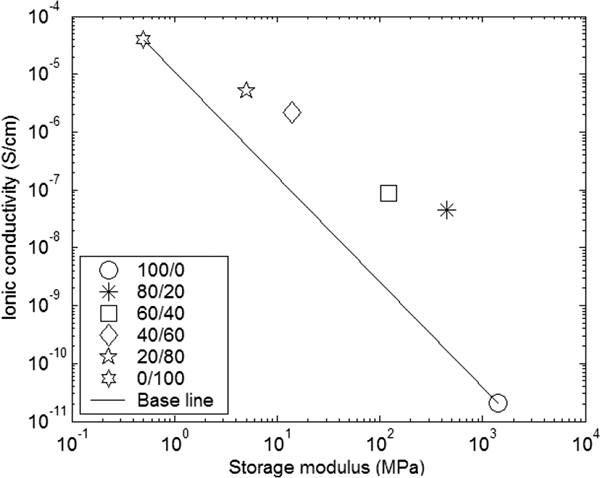
Ionic conductivity versus storage modulus at room temperature for different mixing ratios of SR209/CD55217
Multifunctional performance of UV cured co-polymer electrolytes
Professor Mats Johansson and his colleagues at the Royal Institute of Technology (KTH) have pursued an alternative route for processing of polymer electrolytes.17, 19 Thermal curing of polymer electrolytes is slow and does not allow much flexibility. Also, the mechanical properties of the thermocured bulk polymer electrolytes may be improved by a room temperature cure procedure. That is, during thermocuring significant thermal load is imposed on the network. Furthermore, gases emitted at the elevated temperature are expected to produce voids in the polymer, lowering its performance. Ultraviolet curing provides means to overcome these problems and at the same time offers a fast and flexible process for the polymer electrolytes. In recent research works Willgert et al.17, 19 applies UV curing to similar monomer systems as used in the study by Wysocki et al.16 However, the lithium ion conductive monomer, CD552, was replaced by the similar monomer, SR550, which is available at Sartomer, Europe. The number of EO groups in the SR550 is six compared to 11 in CD552. The reactive groups of the monomers are identical. A photo initiator was solved in the monomer mixture to trigger the curing upon UV irradiation. Details of the procedures are presented by Willgert et al.17, 19 The employed UV irradiation process was found to produce smooth, homogeneous specimens.
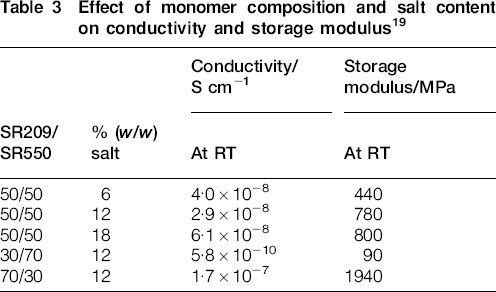
In the works by Willgert et al., 17, 19 effects of salt content as well as monomer mix ratios were studied. Data from IS and DMTA experiments are presented in Table 3. Presence of salt was found not to impair curing. For all salt concentrations the polymer electrolytes were fully cured after receiving a UV dose of 48 J cm−2. Data on the conductivity of the UV cured polymer electrolytes are presented in Table 3. From these data, no significant effect of salt content on conductivity is found. This indicates that ion transport is mainly restricted by the polymer network and not by the ion concentration in the electrolyte. In Table 3, there is a noticeable effect on storage modulus of salt concentration. However, tensile test results presented in Ref. 19 reveals only small changes in stiffness from varied lithium ion content.
Effect of monomer composition and salt content on conductivity and storage modulus19
Multifunctional performance of the thermocured (open symbols) and UV cured (filled symbols) polymer electrolytes is presented in Fig. 7. In the figure measurements of conductivity and storage modulus are presented for the two processes. It should be noted that different lithium ion conductive monomers were used in the two studies. This may explain the observed lower lithium ion conductivity of the UV cured polymer electrolytes. In contrast, a general improvement in stiffness is observed for the UV cured systems. Stiffness is controlled by the cross-linking monomer, the difunctional SR209, which was the same in both studies.
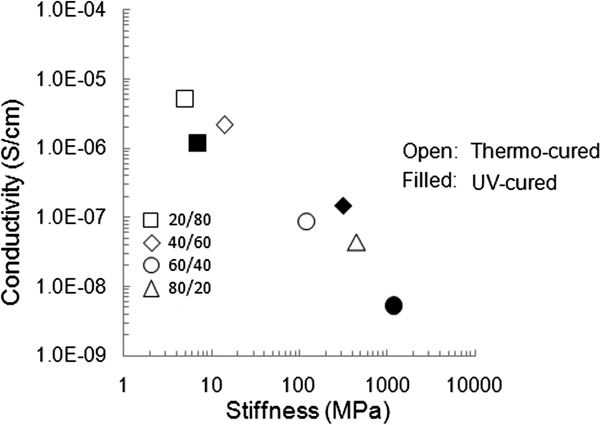
Multifunctional performance of thermocured and UV cured polymer electrolytes (mixing ratios: SR209/CD552 and SR209/SR550):16, 19 open symbols (□◊○Δ) and filled symbols (▪♦•) refer to thermocured and UV cured polymer electrolytes respectively; symbol type indicates mixing ratio structural/conductive monomer
Conclusions
This paper presents an overview of the current status of research performed to facilitate structural batteries within the Swedish research project ‘Lightweight structural energy storage materials’. Realisation of structural batteries from polymer composites relies on solutions to a number of engineering challenges. Two of these challenges are addressed in this paper: applicability of commercial grades of carbon fibre as negative electrode in a battery and use of solid polymer electrolytes as composite matrix material.
Carbon fibres are developed to sustain high mechanical loads when employed in a composite. Consequently, they are solely designed for stiffness or strength. If they are to be employed as negative electrodes in a structural battery, or any battery for that matter, they must be also able to intercalate lithium ions. In this paper, research demonstrating the applicability of commercial intermediate modulus fibres from two manufacturers in structural batteries is presented. Significant effects of sizing on electrochemical capacity are found. Electrochemical capacity measured for unsized carbon fibres is in some case double of that of the corresponding sized fibres. Use of unsized carbon fibres in composites is problematic, not least from a manufacturing point of view, and calls for further study.
The electrochemical capacity of T800 electrodes is found unaffected by mechanical loading. Measurement of responding load levels in constant strain tests allowed calculation of axial swelling and shrinkage of the carbon fibre during an electrochemical charge cycle. Swelling and shrinkage in the order of 0·3% are reported. These results, obtained for a commercially available carbon fibre, are important if used as the electrode in a structural battery as both dimensional stability during charge/discharge as well as electrochemical stability during mechanical loading/unloading are required.
For a polymer electrolyte to work as matrix material in a composite material structural battery, it has to provide at least two functions. First, the polymer must conduct lithium ions to act as electrolyte. Second, it has to be sufficiently stiff and strong to transfer mechanical loads between fibres to provide mechanical performance, in particular for transverse and shear loads. Here two methods for processing of such multifunctional polymers are described: thermal and UV irradiation assisted curing. The polymers are co-polymerised methacrylates containing long EO chains. The synthesised systems demonstrate enhanced multifunctional performance compared to homopolymers, confirming results previously presented by Snyder et al.5, 12 Polymerisation in presence of lithium salt has been found feasible for both processes, with no or limited effects on the performance of the polymer electrolytes.
Footnotes
Acknowledgements
Funding by the Swedish Foundation for Strategic Research (SSF, grant no. RMA08-0002) is gratefully acknowledged. All partners within the SSF programme are gratefully acknowledged for valuable discussions.
This paper is part of a special issue on 22nd Annual International SICOMP Conference