





Abstract
A family of random co-poly(amic acid)s containing 4,4′-oxydianiline (ODA) moiety were synthesised in N, N′-dimethylacetamide. The co-poly(amic acid) solutions were used as spinning dope for dry jet wet spinning process into as spun poly(amic acid) (PAA) fibres. The polyimide (PI) fibres were obtained from PAA fibres after being imidised and drawn in furnace. The processability and mechanical properties of the fibres were notably improved by incorporating ODA into 3,3′,4,4′-biphenyltetracarboxylic dianhydride/p-phenylenediamine (BPDA/PPD) backbone. The best strength and modulus of BPDA/PPD/ODA PI fibre (diamine mole ratio of PPD/ODA = 85∶15) attained 2·25 and 96·5 GPa respectively, which were approximately three times the tenacity of the BPDA/PPD PI fibre. The SEM image showed that the cross-section of each stage fibres was round and void free. In addition, ‘skin–core’ and microfibrillar structure were not observed. The thermal properties of PI fibres were also investigated. The results showed that the PI fibres have excellent thermal stability; moreover, the dimensional stability and structural homogeneity of the fibres were significantly improved by heat drawn stage. Tg was found to be ∼290°C by thermomechanical and dynamic mechanical analyses. The X-ray (wide angle X-ray diffraction and small angle X-ray scattering) experiments indicated that the ordering degree of longitudinal and lateral stacks, as well as the molecular orientation of PI fibre, was improved in the preparation process of fibres. Furthermore, the mechanical properties of fibres are profoundly affected by the heat drawn conditions.
Keywords
Introduction
High performance fibres with high strength and modulus and excellent chemical and heat resistances have been widely applied to many fields of national economy. Their significant developments have been achieved since the 1960s. Some high performance fibres such as carbon fibre,1–3 poly(p-phenyleneterephthalamide) (Kevlar or Twaron),4–6 poly(p-phenylenebenzobisthia-zole),7, 8 poly(p-phenylene benzobisoxazole),9–11 poly(p-phenylenebenzobisimidazole),12, 13 poly{2,6-diimidazo[4,5-b:4′,5′-e]-pyridinyl-ene-1,4(2,5-dihydroxy)phenylene} (PIPD) (M5)14, 15 and ultrahigh molecular weight polyethylene fibre16, 17 have been thoroughly investigated by many researchers. Aromatic polyimides (PIs) are well known for their excellent thermal, mechanical and electrical properties, chemical resistance and outstanding light stability. The combination of these properties makes PIs highly potential candidates for high performance fibrous materials.18–26 Among the reported PI systems, 3,3′,4,4′-biphenyltetracarboxylic dianhydride/p-phenylenediamine (BPDA/PPD) is one of the most important systems due to its low cost and high performance. In fact, this material has been successfully used as PI film with the trade name Upilex-S.27 Unfortunately, the PI fibre of this system has not been successfully used because of the inferior mechanical properties. This is attributed to the poor stretchability of the PI fibre in the heat drawn process due to the inherent chain rigidity and consequently leading to the high content of defects of fibre. Therefore, it is very important to improve the processability and mechanical properties of BPDA/PPD based PI fibre by appropriate modification. One approach to overcome this drawback is the introduction of flexible chains into PI backbone to enhance the molecular mobility. Diamine 4,4′-oxydianiline (ODA) is an ideal choice for achieving this goal.
In this context, we got BPDA/PPD/ODA PI fibres by dry jet wet spinning with a two-step process. The processability of fibres was notably improved by incorporating ODA into the BPDA/PPD backbone due to the moderate reduction in chain rigidity. The experiment results showed that introducing cheap ODA obviously enhanced the mechanical properties of the fibres. Characterisations of the co-PI fibres, such as morphology, thermal properties, structural parameters and homogeneity, were investigated. Moreover, the effects of heat drawn conditions on the mechanical properties of fibres were also discussed.
Experimental
Materials
p-Phenylenediamine was obtained from Adamas Reagent Co., Ltd. 4,4′-Oxydianiline was obtained from Bengbu Zuguang Fine-Chemical Co., Ltd. 3,3′,4,4′-Biphenyltetracarboxylic dianhydride (s-BPDA) was obtained from Shijiazhuang Haili Fine-Chemical Co., Ltd. N, N′-Dimethylacetamide (DMAc) was obtained from Tianji Tiantai Reagent Co., Ltd and was distilled over CaH2 under reduced pressure before use.
Preparation of PI fibres
All poly(amic acid) (PAA) spinning solutions were synthesised in DMAc, and the reaction process is shown in Scheme 1. First, distilled DMAc, PPD and ODA were charged into a three-necked flask equipped with a mechanical stirrer. After the diamine was dissolved, calculated amounts of dianhydride were added gradually; the solid concentration and inherent viscosity were controlled to 15 wt-% and 1·80–3·0 dL g−1 respectively.

Synthetic route of PI fibre (m/n = 95∶5, 90∶10, 85∶15 and 80∶20)
The PAA solutions were filtered and degassed before use. The PAA fibres were spun by dry jet wet spinning. The PAA dopes were extruded through a spinneret (34 holes with 0·12 mm in diameter) into an air gap and then into a coagulation bath. The solidified filament entered into the second washing bath and then clustered at the third spool. The fibres were dried and then imidised and drawn in a furnace over 400°C.
Characterisation
Inherent viscosities ηinh were obtained on 0·5 g dL−1 concentration with an Ubbelohde viscometer in DMAc at 30°C. The mechanical properties were measured with a Donghua XQ-1 instrument; the gauge length and crosshead speed for the tensile test were 20 mm and 10 mm min−1 respectively. Thermogravimetric analyses (TGAs) were conducted with a PerkinElmer TGA7 at a heating rate of 10°C min−1 in a flowing nitrogen. The linear coefficients of thermal expansion (CTEs) of fibres were performed on a TMA/SDTA841e/190 (Mettler Toledo) with a heating rate of 10°C min−1 scanning between 25 and 520°C in atmosphere. A bundle of filaments (34 filaments) were clamped into the sample holder under different forces applied. Tg values were measured with a dynamic mechanical analyser (DMTA V; Rheometric Scientific) for samples of ∼10 mm length using the tensile mode at a constant frequency of 1 Hz and a heating rate of 10°C min−1 scanning from 25 to 450°C in atmosphere. The fibres were embedded in Spurr's epoxide resin, and the morphology of the fibres was observed with an XL30 environmental scanning electron microscope field emission gun scanning electron microscope (FEI Company). The two-dimensional (2D) wide angle X-ray diffraction (WAXD) patterns were conducted with a Bruker Discovery general area detector diffraction system (40 kV and 30 mA) equipped with a Hi-star charge coupled device detector and diffracted beam graphite monochromator, and the diameter of pinhole collimator was 0·1 mm. The one-dimensional (1D) WAXD patterns were conducted with a Rigaku D/MAX 2550 installation (50 kV and 200 mA). Small angle X-ray scattering (SAXS) experiments were performed using a NanoSTAR-U (40 kV and 650 μA; Bruker AXS Inc.) with a Hi-star detector. The distance between the sample and the detector was LSD = 1074 mm. The effective scattering vector
Results and discussion
Mechanical properties of fibres
The mechanical properties of the co-polyamic acid fibres and thermal imidised (collectively as imidised) and heat drawn co-PI fibres are listed in Tables 1–3. As could be seen in the tables, the as spun PAA fibres had generally low strength and modulus, ranging from 0·20 to 0·31 and 5·8 to 8·1 GPa respectively, while the as imidised fibres had displayed a far more increased strength and modulus, ranging from 0·66 to 0·96 and 23·1 to 29·4 GPa respectively. For heat drawn fibres, the strength and modulus of the fibres ranged from 1·10 to 2·25 and 65·0 to 96·5 GPa respectively. The strength and modulus of the BPDA/PPD PI fibres produced with the same process were 0·75 and 70 GPa respectively, which were obviously lower than all co-PI fibres containing ODA. From Table 3, it could be seen that the tensile strength of PI3 fibre was approximately three times that of BPDA/PPD PI fibre, and the modulus was also higher. It indicated that the use of ODA improved efficiently the mechanical properties of BPDA/PPD PI fibres. The best strength and modulus were observed when the ratio of ODA was 15%, and a further increase in ODA component led to decreased mechanical properties. The introduction of ODA largely improved the flexibility of the polymer chain. As the content of ODA increased, the polymer chains could obtain bigger drawing ratio in the heat treatment stage, which reduced the influence of voids in the fibre and thus promoted the mechanical properties of PI fibres. However, the internal rotation of molecular chains was easier to happen with the increase in ODA content, which impaired the mechanical properties of fibres. Once the unfavourable factors were dominant, it was inevitable to reduce the mechanical properties of fibres.
Mechanical properties of as spun PAA3 fibres

Mechanical properties of as imidised PI3 fibres

Mechanical properties of heat drawn PI3 fibres

Thermal and dynamic mechanical properties of PI fibre
The thermal behaviours of PI fibres were characterised by TGA, thermomechanical analysis (TMA) and dynamic mechanical analysis (DMA). The TGA curves of PI fibres displayed excellent thermal stability (Fig. 1). All samples showed similar degradation patterns in N2 atmosphere. There was almost no weight loss until 480°C, and a rapid weight loss occurred at >530°C because of the thermal decomposition of the polymer backbone. The T5% of PI-1, PI-2, PI-3 and PI-4 were 540, 535, 530 and 522°C respectively, and the T5% of BPDA/PPD PI fibres produced by us was 557°C. The 40–55% of the original mass was retained even after heating to 800°C, which was a reasonable carbon yield for this material. Incorporating 6,4′-diamino-2-phenylbenzimidazole in polymer chains significantly enhanced the mechanical properties without sacrificing the thermal properties.
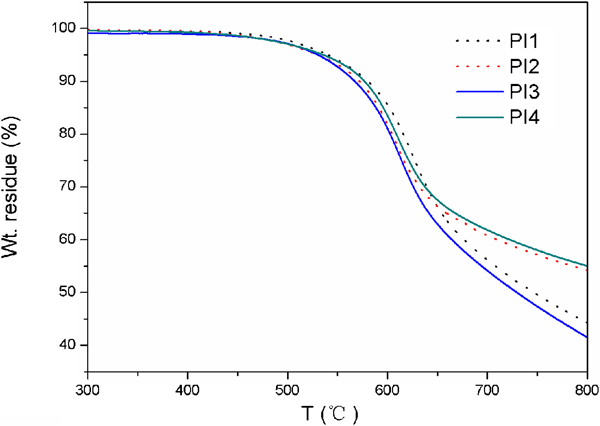
Thermogravimetric analysis curves of PI fibres
Figure 2a shows the CTE data for the as imidised and heat drawn PI3 fibres at 0·1 N force applied during the TMA measurements. The CTEs of two kinds of fibres exhibited slightly negative values (−7·3×10−8°C−1) between 25 and 300°C, but large difference >300°C due to the internal stress frozen into fibre during the preparation process. When the force applied overcame the internal stress, the higher CTE was observed. Furthermore, the CTE data of fibres exhibited a drastic change at ∼290°C, which was an indication of the glass transition temperature Tg.
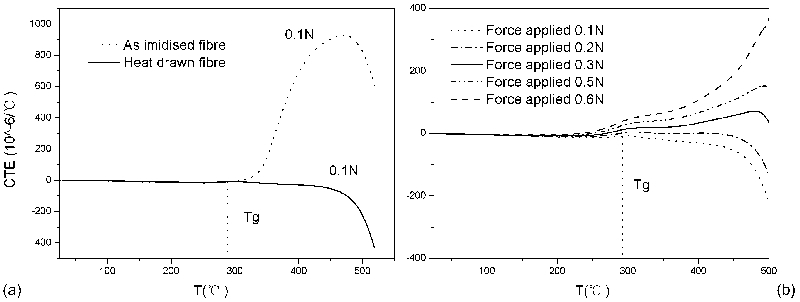
a as imidised and heat drawn fibres at 0·1 N force applied; b heat drawn fibres at 0·1–0·6 N force applied
Figure 2b represents the CTE data for the heat drawn PI3 fibres at different force levels. Generally, a negative CTE could be found at a low force applied level and then gradually increased with force applied for overcoming the internal stress. As shown in Fig. 2, the change in absolute CTE values of heat drawn fibres was smaller than that of as imidised fibres, indicating that the dimensional stability of fibres was obviously enhanced by the heat drawn process.
The DMA spectra of as imidised and heat drawn PI3 fibres were investigated from room temperature up to 450°C and presented in Fig. 3. A clear transition of E′ curves was seen at ∼270°C, generally defined as the onset of glass transition in the polymer. The storage modulus E′ of the heat drawn fibres exhibited better retention than the as imidised fibres at >300°C due to the structural improvement of fibre at the heat drawn stage.

Dynamic mechanical analysis curves of as imidised (AI) and heat drawn (HD) PI3 fibres
Two major transitions were easily seen in the loss modulus E″ curves, and the as imidised and heat drawn fibres show a similar trend all over the temperature ranges. The first transition at ∼150°C displayed β relaxation, which was related to the subglass transition.28–31 At the higher temperature of ∼290°C, the second transitions (α relaxation) of two kinds of fibres were observed, which were generally regarded as the maximum of glass transition in the polymer and bigger than that of the E′ curve. The Tg value of the E″ curve was identical with the Tg value decided by TMA.
Below the glass transition temperature, tan δ values were very close for both as imidised and heat drawn fibres. Tan δ represents the energy consumption of the segmental movement, which is related to the structural homogeneity of the polymer. A smaller tan δ value above Tg and a lower α relaxation temperature in the heat drawn fibre indicated that the structural homogeneity was evidently improved by the heat drawn process.
Morphology of PAA and PI fibre
The morphology of the fibres was studied by scanning electron microscopy (SEM) and shown in Fig. 4. As for PAA3 fibre in Fig. 4a, the cross-section of the fibre was round and void free, and yet the ‘skin–core’ structure was not obvious. These meant that the coagulation conditions were very beneficial to form a homogeneous and dense fibrous structure. Generally, the soluble PAAs are spun into coagulation to prepare PAA fibres and then subsequently converted to PI fibres by thermal imidisation. However, voids in PI fibres can be caused due to the extrusion of volatile molecular such as water during thermal imidisation, leading to the difficulty to prepare PI fibres with dense interior structure in a two-step process.32 In our experiment, PI fibres were prepared by keeping PAA fibres in a furnace of >300°C and then were subsequently drawn in a temperature higher than Tg under N2 atmosphere. The voids could be removed during thermal imidisation, and then the molecular chains could be further rearranged and oriented along the fibre axis to form a compact structure in the heat drawn stage. As shown in Fig. 4b–c, the cross-section of the as imidised and heat drawn PI3 fibre displayed lack of voids and distinct ‘skin–core’ structure.

a–c cross-section of PAA3, as imidised and heat drawn PI3 fibre, which was embedded in Spurr's epoxide resin, and d directly fractured cross-section of heat drawn PI3 fibre
An alternative method of examining the structure of the heat drawn PI2 fibres was also investigated by fracturing fibres. Figure 4d shows the directly fractured cross-section of heat drawn fibres in liquid nitrogen, indicating the lack of a well defined fibrillar structure. It was a large difference from the two sorts of PI fibres, which were prepared by Goel et al.32 and Li et al., 33 and in the latter two PI fibres, there existed a highly fibrillated structure.
Wide angle X-ray diffraction of PI fibres
Fibre diagrams were recorded for parallel bundles of fibres (34 monofilaments in a bundle); both as imidised and heat drawn PI3 fibres are shown in Figs. 5 and 6. The structural parameters including the crystal size, crystal d-spacing and molecular chain orientation were measured with WAXD and can be calculated by equations (1)–(3).

Two-dimensional WAXD for as imidised (top) and heat drawn (bottom) PI3 fibre: herein, a, e, c and g were diffraction patterns in meridional and equatorial directions, in which beamstop was 0° retrospectively, while b, f, d and h were diffraction patterns in meridional and equatorial directions, in which beamstop was 18° retrospectively

One-dimensional WAXD for as imidised and heat drawn PI3 fibre in a meridional and b equatorial directions respectively
The apparent crystallite size (ACS) is estimated using the Scherrer equation

The crystal interplane d-spacing is calculated with the Bragg reflection equation


The 2D WAXD patterns are shown Fig. 5. The as imidised and heat drawn PI3 fibres exhibited clear diffraction streaks along the meridian, indicating that polymer chains formed highly ordered structures in the fibre axial direction. On the equator, as shown in Fig. 5d with h, the equatorial arcs originated from the lateral packing were obscure, especially to as imidised fibres, which were so called ‘amorphous halos’. It meant the low ordering degree of the lateral stack. Comparing Fig. 5b with f and Fig. 5d with h, the breadths of the meridional steaks and the equatorial arcs along the azimuthal direction became narrower by heat drawn process, meaning that the orientation of molecular chains was enhanced through the heat drawn stage. The azimuth curves of two kinds of fibres are shown in Fig. 7, and the molecular orientations were calculated with equation (3) as fAI = 0·79 and fHD = 0·90 respectively. The absence of off-axis peak was observed in Fig. 5; this indicated that a translationally disordered form of the as imidised and heat drawn fibre was present. A similar situation also existed in the poly(p-phenylene benzobisoxazole) structure.35, 36

Two-dimensional SAXS for a PAA3, b as imidised and c heat drawn PI3 fibres respectively (horizontal direction is meridian of fibres)

Azimuth curves of a as imidised and b heat drawn PI3 fibre respectively
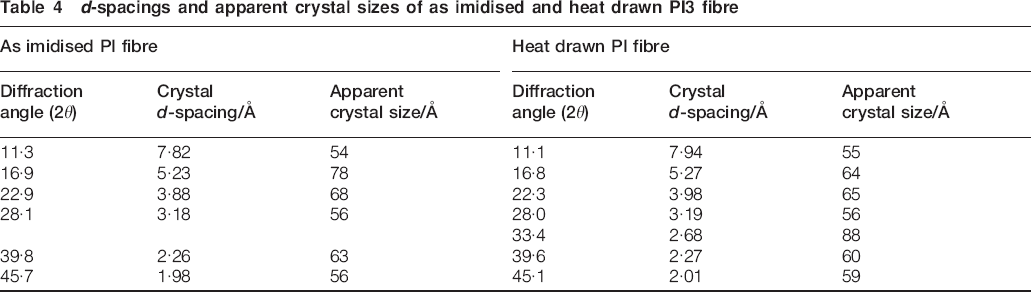
The 1D WAXD patterns along the meridional and equatorial scans of two sorts of PI3 fibres are shown in Fig. 6. In Fig. 6a, the intensity of meridional diffraction became bigger through heat drawn stage, especially the first diffraction peak, indicating that the degree of crystalline perfection of the basic segments (BPDA-PPD) was evidently improved in the fibre axis direction. Moreover, there appeared a very weak crystal peak at the angle of ∼33·4° in the heat drawn fibre. In Fig. 6b, the equatorial diffraction of heat drawn fibres emerged two obvious crystallite peaks, meaning that the lateral stack of fibres was notably improved by the heat drawn process. The ACS and crystal d-spacings of two kinds of fibres were calculated with equations (1) and (2) respectively and listed in Table 4. It could be seen from Table 4 that the crystal d-spacings slightly increased, except for the first and third diffraction peaks, and the longitudinal crystal sizes were only of subtle difference except for the second diffraction peak after heat drawn process.
d-spacings and apparent crystal sizes of as imidised and heat drawn PI3 fibre
Above all, the molecular orientation, the ordering degree of longitudinal and the lateral stack were markedly improved by the heat drawn process. It was easily understood that the mechanical properties could be enhanced with heat treatment stage.
Small angle X-ray scattering of PI fibres
The scattering from microvoids typically accounts for 97–99% of the overall scattering in semicrystalline polymers37, 38 because the SAXS intensity is proportional to the square of the electron density difference between adjacent domains. Therefore, SAXS is an ideal tool to characterise nanoscale microvoids in the polymer system.39 In this section, the PI3 fibres at each stage of the manufacturing process were adopted to investigate the evolution law of microvoids within fibres by SAXS due to the adverse influences on the mechanical properties of fibres.
As shown in Fig. 8, the 2D SAXS patterns of fibres from as spun to heat drawn processes were obtained. The common feature seen in these patterns was that there were intense scatterings nearby the beamstop along the equatorial direction yet no detection along the meridional direction. These indicated that fibres existed large size needle-like microvoids, which oriented with their long axes in the fibre axis direction. The microvoid systems with preferred orientation were also known to be present in cellulose fibres40, 41 and in carbon fibres.42–44 From Fig. 8, the scattering width of fibres along the meridional direction obviously decreased (Wa>Wb, where W is the width of scattering peaks) in as spun and as imidised process, meaning that the orientation of fibres was significantly enhanced in the as imidised process due to the reciprocal law of SAXS. Comparing with Fig. 8b, there existed lots of new scattering dots along both sides of the equatorial direction in Fig. 8c, which came from the better lateral crystallites in the heat drawn fibre. This phenomenon could be confirmed with Fig. 6b. The results indicated that the higher orientation and the stack ordering of polymer chain were important factors that improved the mechanical properties of fibres.
Figure 9 shows the 1D SAXS patterns along the meridional and equatorial directions of fibres at each preparation stage. The common tendency in two patterns was that the scattering intensity decreased from as spun to as imidised process, indicating that the structure of the fibres became more homogeneous, mostly ascribing to the elimination of microvoids in the two processes. However, the scattering intensity of the heat drawn fibres remained unchanged and enlarged with respect to that of as imidised fibres in the meridional and equatorial directions respectively. The possible reason for the results was that the misorientation of microvoids reduced; meanwhile, the amount of microvoids slightly increased due to the excessive stretching in the heat drawn process.

One-dimensional SAXS for PAA3, as imidised and heat drawn PI3 fibres along a meridional and b equatorial directions respectively
The fractal dimension Ds can be a measure of the internal surface roughness in a microvoid material, which follows a power law I(q)∝q−α. For mass fractals, α = Dm and 1<α<3. In contrast, we have α = 6−Ds for surface fractals and 3<α≤4. If Ds = 2, we obtain the well known Porod's law I(q)∝q−4 for non-fractal structures with smooth interfaces.45–47 The bigger the Ds value, the larger the surface roughness of the microvoid. As shown in Fig. 10b, the slopes of ln I(q) versus ln q curves in the linear region were calculated, with linear regression analysis, as −3·47, −3·86 and −3·81, corresponding to fractal dimensions of 2·53, 2·14 and 2·19 for PAA3, as imidised and heat drawn PI3 fibres respectively. The results indicated that the surface roughness of microvoids obviously decreased in as imidised process and then slightly increased in heat drawn process.

a, b LnI(q) versus Lnq relationships of PAA3, as imidised and heat drawn PI3 fibres along equatorial direction respectively
Effects of heat treatment on mechanical properties of PI fibres
Methods for improving the strength of fibres usually involve increasing the degree of crystallinity and the molecular orientation, decreasing the content of voids and the structural homogeneity or some combination of these factors.48, 49 In this section, PI3 fibres were treated under variously thermal conditions; the effects of temperature, time and drawing ratios on the mechanical properties of fibres were discussed. There was only a variable that can be changed among three heat treatment conditions in one experiment.
As shown in Fig. 11a, the tenacity and modulus of PI3 fibres increased with drawing ratios until ∼1·8 (temperature and time remained 540°C and 11 s respectively) and then decreased. The orientation of molecular chains was first developed with the increase in drawing ratios to the critical point, yet meaning that the mechanical properties of fibres was enhanced at this stage. However, once exceeding the critical point, a few molecular chains with high orientation on the early stage began to be broken and led to the residual molecular chains in the fibres to be seriously disrupted. As a result, the mechanical properties of the fibres started to descend.

a–c effects of heat drawn process parameters on mechanical properties of PI3 fibres
In Fig. 11b, it could be seen that the preferable mechanical properties were obtained at ∼540°C (drawing ratio and time remained 1·8 and 11 s respectively). Commonly, the flowability and rearrangement of molecular chains became easier as the temperature increased, which made fibres have better mechanical properties due to the higher orientation and less defects. Nevertheless, the degradation and misorientation of molecular chains started to play an important role when the temperature further increased. Once the adverse effect dominated the structure evolution, the mechanical properties inevitably declined.
As shown in Fig. 11c, the mechanical properties gradually increased with heat treatment time. The structural heterogeneity was the main restricted factor to the mechanical properties of fibres when the heat treatment time was short (temperature and drawing ratio remained 540°C and 1·8 respectively). As the heat treatment time prolonged, the mechanical properties could be enhanced by eliminating microvoids of fibres.
Conclusions
A series of co-PI fibres containing ODA moiety were prepared by dry jet wet spinning with two-step process. The processability and mechanical properties of fibres were notably improved by incorporating ODA into the BPDA/PPD backbone. The best strength and modulus of the PI3 fibre were obtained as 2·25 and 96·5 GPa, which were considerably higher than the BPDA/PPD PI fibre. All of the PI fibres displayed excellent thermal stability in TGA pattern. Moreover, TMA and DMA measurements indicated that the dimensional stability and structural homogeneity of the fibre were improved by heat drawn stage. Tg was found to be ∼290°C by TMA and DMA. The SEM image showed that the cross-section of each stage fibre was round and void free. In addition, the ‘skin–core’ and microfibrillar structure were not observed.
The structure and orientation of as imidised and heat drawn PI3 fibres were determined by WAXD. The molecular orientation of the fibres was enhanced after heat drawn processes fAI = 0·79 and fHD = 0·90. Furthermore, the ordering of longitudinal and lateral stacks was obviously improved by the heat drawn process. Meanwhile, the crystal d-spacing increases slightly, and the longitudinal crystal sizes have only a subtle difference.
Small angle X-ray scattering experiments indicated that there existed large size needle-like microvoids along the fibre axial direction. The molecular orientation was enhanced noticeably from the as spun to as imidised process. Moreover, the structural homogeneity was also improved, mostly ascribing to the elimination of microvoids in two stages. However, the amount of microvoids slightly increased due to the excessive stretching in the heat drawn process. The surface fractal dimension Ds values indicated that the surface roughness of microvoids markedly decreased in the as imidised process and then slightly increased in the heat drawn process. Furthermore, the mechanical properties of fibres are profoundly affected by heat drawn conditions. Only under the optimal heat treatment conditions could the best mechanical properties be obtained.