







Abstract
This study investigates the influence of two plasticisers, polyethylene glycol (PEG) and tributyl citrate (TbC), on the thermomechanical properties and fracture behaviour of nanosized calcium carbonate blended poly(lactic acid). Various compositions of nanocomposites were compounded and processed using co-rotating twin screw extrusion and compression moulding. DMA analysis shows that adding nano-CaCO3 reduced the storage modulus (E′) of the nanocomposite while the glass transition temperature (Tg) of the samples was not affected. Furthermore, plasticised poly(lactic acid) (PLA) showed an improvement in elongation at break in all samples, and the impact resistance of the nanocomposites was also improved by 1·6 times with the addition of 20 phr PEG plasticiser and by 1·4 times with the addition of 20 phr TbC plasticiser. Morphological study reveals that the fracture behaviour of PLA-CaCO3 nanocomposites changed from brittle to ductile after plasticisers were incorporated.
Keywords
Introduction
Aliphatic polyesters such as poly(lactic acid) (PLA) nowadays play an important role in various applications due to their biodegradable and biocompatible characters.1–5 PLA, typically polymerised through the fermentation products of starch and sugar,4 offers a potential alternative to petrochemical based plastics in many applications such as biomedical applications and food packaging.1, 6, 7PLA, however, is comparatively brittle and stiff at room temperature,4, 8so modification of PLA is needed for applications that require flexibility such as food packaging.
Adding fillers to plastics is usually done to improve their mechanical properties. Recently, there have been extensive efforts to improve polymeric materials’ properties with nanosized inorganic fillers such as ZnO, SiO2, clay, precipitated calcium carbonate surface modified with rare earth elements and noble metals.9, 10 Properties of filler filled composites are closely related to the dispersion of particles in the polymer matrix. Since PLA is well known for its difficulty in crystallisation, adding CaCO3 could have an impact on its properties as well as potential applications replacing petrochemical based plastics.11, 12
Moreover, previous researches have shown that addition of plasticisers such as polyethylene glycol (PEG), glucosemonoesters, and partial fatty acid esters successfully improves the brittleness and widens PLA's applications.8, 13Thus, in the present contribution, the effect of two plasticisers, PEG and tributyl citrate (TbC), on thermomechanical properties and fracture behaviour of PLA–CaCO3 nanocomposites was investigated.
Experimental
Materials
Poly(lactic acid) (Natureworks2002D, NatureWorks LLC, USA), Calcium carbonate (NPCC 101, Behn Meyer Chemical), Poly(ethylene glycol) (PEG, Mw ∼400, Fluka), and Tributyl citrate (TbC, Mw ∼360, Fluka) were used as received.
Preparation of plasticised PLA–CaCO3 nanocomposites
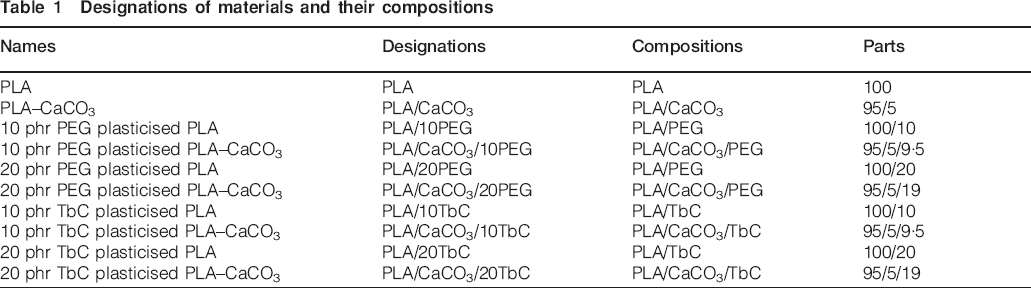
Prior to compounding, PLA and CaCO3 were dried overnight at 60°C in order to remove structural water. The EN MACH SHJ-25 co-rotating twin screw extruder was used to compound the nanocomposites (Table 1). PLA and CaCO3 blends were prepared by weight percentage while PEG and TbC were added as parts per hundred (phr) into the blends. The barrel temperature profile adopted during blending ranged from 150°C in the feed zone to 170°C in metering zone at a fixed screw speed of 130 rev min−1. The extruded materials were then compression moulded into standard tensile and impact specimens using LabTech compression moulding with mould temperature of 170°C and mould pressure of 20 000 psi for 5 min.
Designations of materials and their compositions
Thermal analysis
The storage modulus (E′) of the PLA, and PLA nanocomposites as a function of temperature was determined by dynamic mechanical analysis method using DMA, GABO EPLEXOR QC25. DMA spectra were taken in the tension mode at a frequency of 1 Hz, in a temperature range of 25–160°C at a heating rate of 2°C min−1.
The melting and crystallisation behaviour of the nanocomposites were studied by a differential scanning calorimeter (DSC) (Mettler Toledo DSC822e) under nitrogen atmosphere. The temperature was raised from 20 to 180°C at a heating ramp of 10°C min−1.
Mechanical analysis
Tensile tests were carried out according to ASTM D638 type V using a universal testing machine (LR50K, Lloyd Instruments, UK) under ambient conditions with crosshead speeds of 10 mm min−1. Izod impact tests, according to ASTM D256, were done on notched impact specimens, by using an instrument impact tester (Radmana Model ITR2000).
Morphological study
The morphology of nanocomposite was investigated by scanning electron microscopy (SEM). The fracture surfaces of samples were sputtered with platinum and then the morphology was observed in an SEM instrument (Hitachi Model S3400N).
Results and discussion
Thermal analysis
Figure 1 shows the dynamic mechanical analysis results of plasticised PLA–CaCO3 nanocomposites over a temperature range of 25–160°C. From Fig. 1a, showing the E′ of the nanocomposites as a function of temperature, it can be seen that the E′ of samples was rather stable as the temperature increased from 25 to 50°C. Subsequently, the E′ dropped rapidly at about the temperature designated as their Tg, and then increased slightly again at temperatures above Tg because of the cold crystallisation of PLA matrix.14, 15 Additionally, from Fig. 1a, the incorporation of CaCO3 nanoparticles in the composites resulted in the reduction of the E′, but did not affect Tg of PLA. This was due to the lubricating effect of sizing agents from fatty acids used to treat the CaCO3 surface in order to prevent it from agglomeration.16 Furthermore, the spherulitic structure is destroyed because of the nucleating effect of the CaCO3 nanoparticles. A reduction in the spherulite size and crystallinity decreases the modulus of polymer, because large spherulites are believed to have a much higher load bearing capability.17, 18
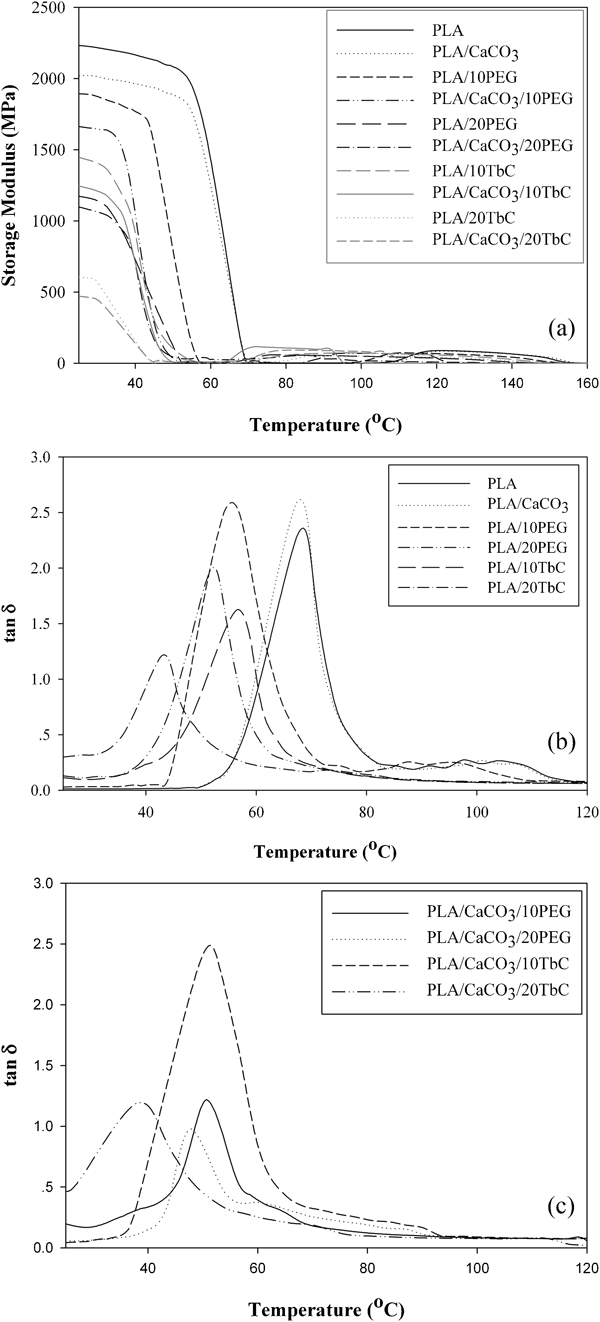
a storage modulus, and b, c tan δ as a function of temperature of PLA/CaCO3/plasticisers nanocomposites
Figure 1b and c shows tan δ of the nanocomposites as a function of temperature. Clearly, both of these figures show the effect of plasticisers on the viscoelastic properties of the PLA nanocomposites. When PEG or TbC was blended into PLA, the Tg of all samples dropped significantly in line with the amount of plasticisers added. This implies that the plasticiser enhances the mobility of PLA polymer chains at low temperature.13, 15 Moreover, the incorporation of CaCO3 nanoparticles and plasticisers tends to reduce Tg of PLA more than using plasticiser alone, indicating a synergistic plasticising effect between sizing agents and plasticiser.
DSC analysis was conducted to study effect of adding of CaCO3 and PEG or TbC on composite thermal properties. The glass transition temperature (Tg), melting temperature (Tm), and crystallisation temperature (Tc) of the nanocomposites are summarised in Table 2. It is interesting to note that the Tc peak for PLA appeared during cooling only in PEG plasticised PLA–CaCO3 nanocomposites. It is believed that the main reason for this occurrence was due to a very slow crystallisation rate of PLA during cooling.13 Furthermore, PLA crystallisation temperature decreases strongly with PEG addition. This indicates a higher mobility of PLA macromolecules. This enhancement of the PLA molecular mobility is claimed to be the major factor acting on the crystallisation kinetic of this polymer.19
DSC of PLA, PLA nanocomposite and plasticised PLA nanocomposites
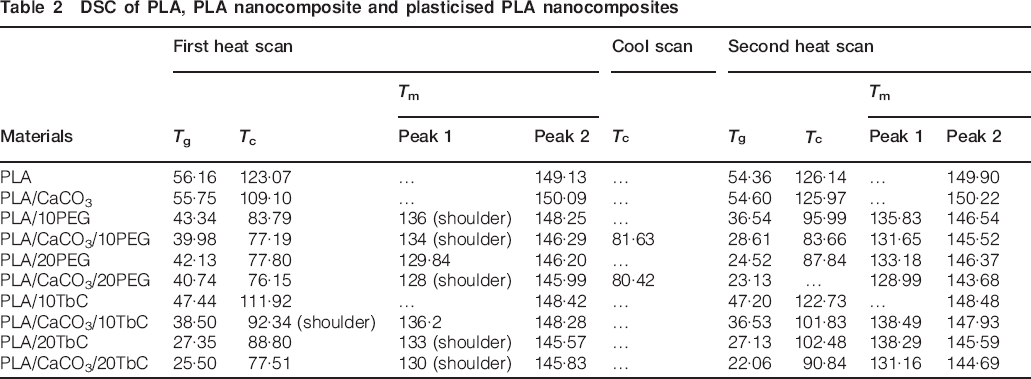
In addition, it can be observed from Table 2 that the Tg of the nanocomposites shows the same trend as in the DMA results, where the Tg of PLA drops with an increasing amount of plasticisers. Moreover, increasing loading of plasticiser resulted in the shift of Tc to lower temperatures. This was due to better mobility of PLA molecules that were plasticised by PEG and TbC. Comparing the effect of these plasticisers, it is found that the lowest Tg of the nanocomposite was obtained at the content of 20 phr of TbC.
Mechanical analysis
The mechanical properties of the nanocomposites were examined by tensile test according to the ASTM D638 standard. Figure 2 reveals the tensile properties of nanocomposites incorporating various contents and types of plasticisers. It shows that elastic modulus of PLA–CaCO3 nanocomposites was slightly lower than those of neat PLA, similar to the reduction in storage modulus. Adding plasticisers further decreased the elastic modulus of PLA, and plasticising with TbC decreased elastic modulus of PLA dramatically. In the presence of CaCO3, the decrease in percentage elongation at break of PLA demonstrates that fillers induce a definite decrease in elongation20 because CaCO3 acted as stress concentrator to promote crack initiation. After plasticising, percentage elongation at break of neat PLA and PLA composites were higher. Adding plasticisers increased percentage elongation at break by 40 times when compared to neat PLA and unplasticised PLA nanocomposites.
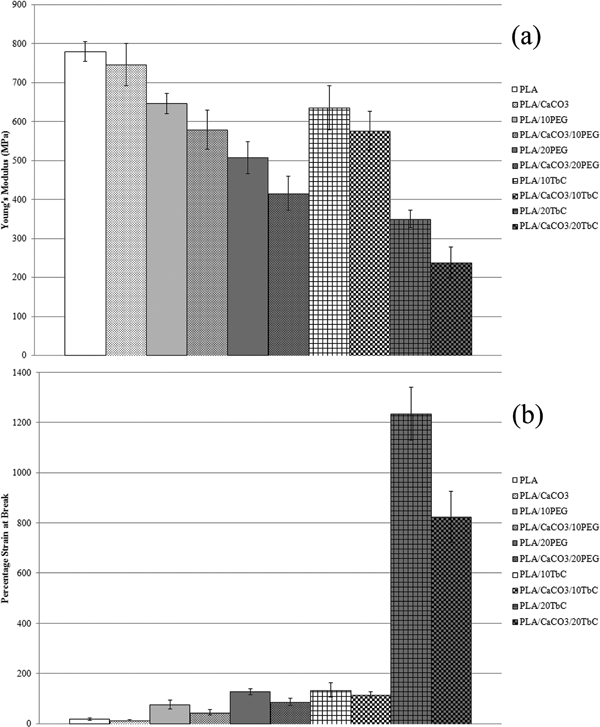
Mechanical properties of PLA/CaCO3/plasticisers nanocomposites: a Young's modulus and b percentage elongation at break of the samples
Figure 3 presents the notched impact strengths of the nanocomposites. From the results, it can be seen that CaCO3 reduced the impact strength of PLA. This might be resulted by coarse morphologies of smaller particle sizes (<0·7 μm) lowering the toughening efficiency.21On the other hand, the impact resistance of the samples was improved by 1·6 times with the addition of 20 phr PEG plasticiser and by 1·4 times with the addition of 20 phr TbC plasticiser.
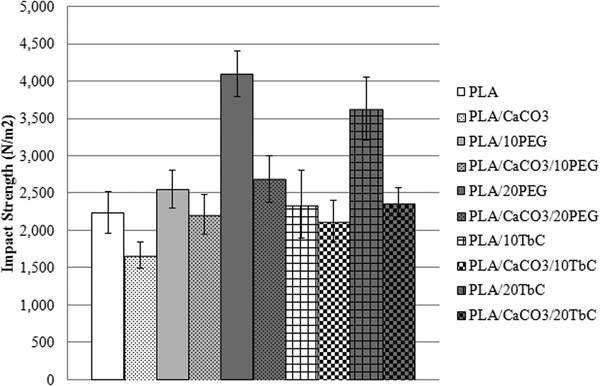
Dependence of impact strength on composition of prepared nanocomposites
Morphological study
Figure 4 is the SEM image showing that the fracture behaviour of PLA–CaCO3 nanocomposites changed from brittle to ductile after plasticisers were incorporated. The fracture surface of neat PLA was smooth with local ductile breaking as craze and crack propagation occurred during the fast breaking. When CaCO3 was added into the polymer matrix, it behaved as stress concentrators, promoting crack initiation and reducing local ductile breaking. When plasticisers were blended into PLA, nanocomposites were tougher and ductile failure was dominant. Stripes of local extension in the polymer matrix were present in the fracture surface of 10 phr plasticised PEG nanocomposite, and these stripes became more randomly distributed when PEG was 20 phr. Meanwhile, TbC plasticised PLA nanocomposites broke mainly in ductile failure, even when CaCO3 nanoparticles were added.
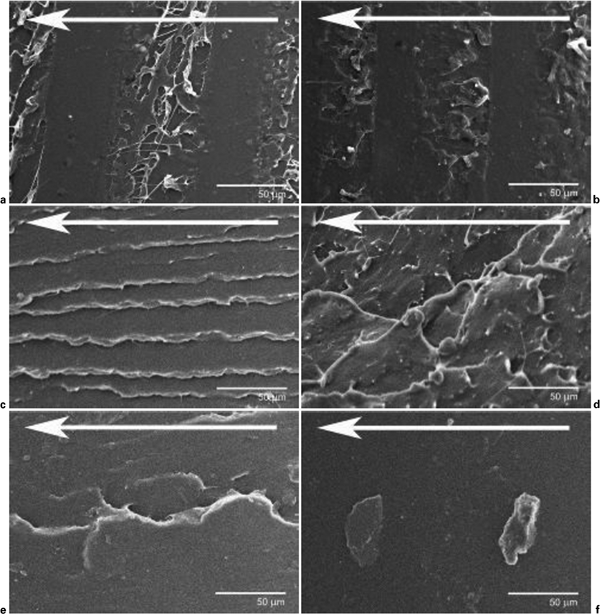
Images (SEM) of impact fractured specimen of PLA/CaCO3/plasticisers nanocomposites (White arrow indicates stress direction in impact test)
Conclusions
In this study, plasticised PLA–CaCO3 nanocomposites were prepared using twin screw extruder and compression moulding. The elongation of all samples was improved with increasing loadings of plasticisers. DMA and DSC results reveal that the incorporation of plasticisers can improve the thermal properties of PLA, particularly in reduction in Tc and Tm. Finally, morphological study reveals that the fracture behaviour of PLA–CaCO3 nanocomposites changed from brittle to ductile after plasticisers were incorporated.
Footnotes
Acknowledgements
The authors would like to thank Department of Materials Science and Engineering, Faculty of Engineering and Industrial Technology, Silpakorn University and the Center of Excellence for Petroleum, Petrochemicals and Advanced Materials for financial support.
This paper is part of a special issue on Deformation and fracture of polymers and their composites