







Abstract
The properties of asphalt modified by styrene–butadiene–styrene, polyvinyl acetate and waste crumb rubber separately in a wide range of polymer loadings were studied in this paper. In analysing the relationship between polymer loading and modified asphalt properties, we found that the ductility of polymer modified asphalt measured at 5°C exhibited a percolation phenomenon, that is, as the loading of polymer exceeded a critical value, the ductility of modified asphalt changed abruptly. Furthermore, a percolation threshold differential existed. A rubber processing analyser, an optical microscope and a fluorescence microscope were used to characterise the microstructure of polymer modified asphalt and validate the occurrence of a polymer network in modified asphalt as a function of polymer loading. The percolation phenomenon of polymer modified asphalt was found to be associated with the polymer network in modified asphalt and can be well explained by the percolation mechanism of rubber toughened plastics.
Introduction
The development of modern society has put forward more and more requirements for the utilisations of materials, and the traditional asphalt pavement cannot satisfy the conditions needed for road transport. Asphalt modified by polymer, with its excellent pavement properties, is a good solution to address this issue.1 In fact, asphalt modification using waste crumb rubber can date back to the year 1843,2 although polymer modified asphalt did not become widely commercialised until the 1980s. Currently, polymer modified asphalts can be categorised into three main types: styrene–butadiene–styrene (SBS)/styrene–butadiene rubber modified asphalt, polyvinyl acetate (EVA)/polyethylene (PE) modified asphalt and asphalt modified with waste crumb rubber.3 The interaction between polymer and asphalt is very complicated because of the special chemical components of asphalt, and thus different polymers have different effects on the properties of asphalt. The swelling theory of polymer modified asphalt has generally been accepted by researchers. According to this theory, polymer chains will adsorb light components, such as saturates and aromatics, when being immersed in asphalt. The total volume after swelling can reach 4–10 times the original volume for SB and EVA, but much smaller for PE.4 The introduction of polymer makes the structure of asphalt more complicated, resulting in different properties of modified asphalt. Styrene–butadiene–styrene modified asphalt is widely used for its excellent properties. As an asphalt modifier, waste crumb rubber is very significant because of the reuse of waste resources. Different polymers have different interactions with asphalt, and fully understanding the microstructure of polymer modified asphalt is valuable for scientific research and industrial application.
The percolation phenomenon of rubber toughened plastic was discovered in 1985 by Wu.5 By studying rubber toughened nylon composites, the notch impact strength of rubber toughened nylon composites was found to increase abruptly when the loading of the rubbery particles reached a certain critical volume. Meanwhile, similar percolation phenomena were found by Zhang and Wang for rubber strengthened with carbon black and nano zinc oxide.6
In this work, the properties and microstructure of asphalt modified by different polymers in a wide range of polymer loadings were studied. The relationship between the microstructure of polymer modified asphalt and the percolation phenomenon found during the process of asphalt modification was also investigated, and the mechanism of percolation phenomenon was finally explained.
Experimental
Main materials
The petroleum pitch (AH-70) was provided by Qinhuangdao Refinery of China National Petroleum Corporation. Styrene–butadiene–styrene 1401 was provided by Yanshan Petrochemical Corporation of Sinopec. Waste crumb rubber (80 meshes) was made in Puyang, Henan Province. Polyvinyl acetate 265 was provided by Du Pont Company.
Method
Polymer modified asphalts were prepared in open containers. First, asphalt was mixed with polymer at different loadings (1, 3, 5, 7, 10, 15, 20, 25 and 30) at 160°C for 15 min at a speed of 600 rev min−1. Then, the mixture was sheared using a FLUKO high shear emulsifier device (Germany) for 40 min at a speed of 95 000 rev min−1. The temperature of the blends was controlled between 170 and 180°C.
The softening point, penetration and ductility tests were carried out respectively with the instruments PKA-2, PNR-10 and DDAA3-150 provided by Petrotest Company (Germany). The viscosity testing was carried out with a Brookfield viscometer (VD-2+PRO; Nirun Technology Company, Shanghai) according to Chinese standard JTJ052-2000: ‘Standard test methods of bitumen and bituminous for highway engineering’.
A fluorescence microscope made by Chongqing Optical Electronic Instrument Co., Ltd, was used for the observation of modified asphalt samples. A sample was heated until it can flow freely. A drop of sample was set on a glass slide, covered with a thin cover slide and flattened by the pressing of the cover slide.
An optical microscope made by Chongqing Optical Electronic Instrument Co., Ltd, was used for the observation of the asphalt samples modified with waste crumb rubber. A sample was heated until it can flow freely. A drop of sample was set on a glass slide, covered with a thin cover slide and flattened by the pressing of the cover slide. Both ends of the slide were fastened, and the sample was cooled for 3 h. The fastened slide was immersed in toluene for 48 h in order to make the asphalt in the sample dissolve well and then was baked out.
A rubber processing analyser (RPA-2000) produced by Alpha Company (USA) was used to measure the dynamic mechanical properties of the samples. About 5 g of sample was taken at room temperature for stress–strain scanning at 40°C and 60 cpm in the strain range of 1–400%.
Results and discussion
Effect of polymer loading on asphalt properties
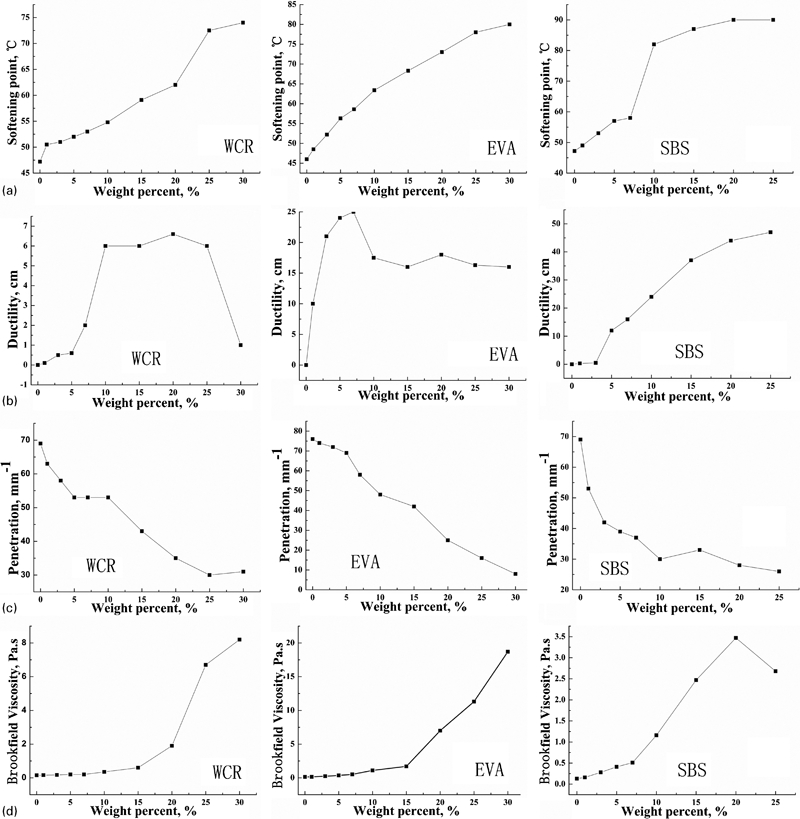
The effect of polymer loading on asphalt properties was studied, and the results are shown in Fig. 1.
Relationships between properties of modified asphalt and polymer loading
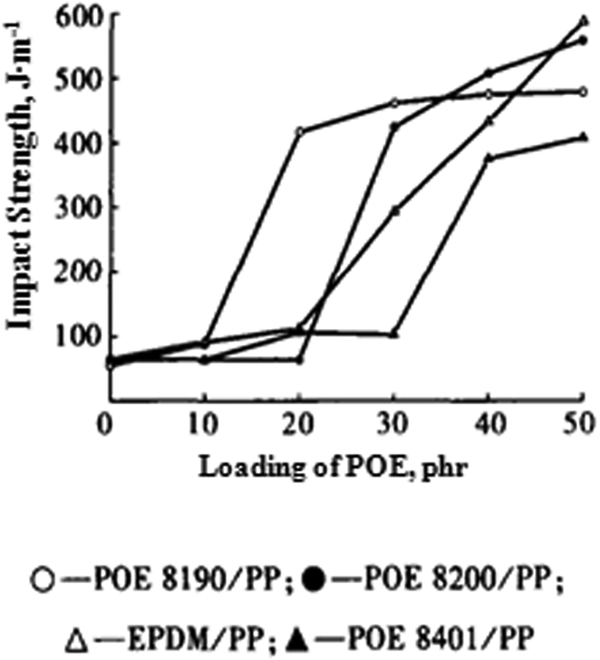
It can be seen from Fig. 1 that the softening point, Brookfield viscosity and penetration of asphalts modified by SBS, EVA and waste rubber powder all exhibit similar trends. The softening point and Brookfield viscosity increase, but the penetration decreases with the increase in polymer content, but the property values are different for asphalts modified by different polymers. For instance, at a polymer loading of 25%, the softening point is higher than 90°C for the asphalt modified by SBS but lower than 80°C for the asphalt modified by EVA or waste rubber powder. In addition, the Brookfield viscosity is higher than 17 Pa s for the asphalt modified by EVA but lower than 4 Pa s for the asphalt modified by SBS. At the same time, the ductility exhibits something special at low temperature. As the loading of polymer reaches a critical value, the ductility increases abruptly, similar to the percolation phenomenon for the notch impact strength of rubber toughened plastic (shown in Fig. 2) discovered by Feng et al.7 Moreover, the trends of ductility are different for asphalts modified by different polymers. With increasing polymer loading, the ductility keeps on increasing for the asphalt modified by SBS but decreases for the asphalt modified by waste rubber powder and remains steady for the asphalt modified by EVA.
Percolation behaviour in rubber toughened plastic
According to the swelling theory of polymer modified asphalt, when a polymer is added into asphalt, the light components of the asphalt will immerse into the polymer, and the structure of the asphalt will change from a sol structure to a gel structure, resulting in the increase in softening point and Brookfield viscosity but the decrease in penetration. As the loading of polymer keeps increasing, the amount of light components will keep decreasing, the softening point and Brookfield viscosity will keep increasing and the penetration will keep decreasing. The ductility of asphalt at low temperature is improved by the addition of the polymer. In essence, the properties measured above are determined by the structure of the polymer modified asphalt and the interaction between the polymer and the asphalt. The differences in the properties of the asphalts modified by different polymers shown in Fig. 1 suggest that different polymers have different interactions with asphalt, resulting in differences in the microstructure of polymer modified asphalt. The ductility index was selected to study the relationship between microstructure and property and to explain the percolation phenomenon.
Dispersion state of polymer in asphalt
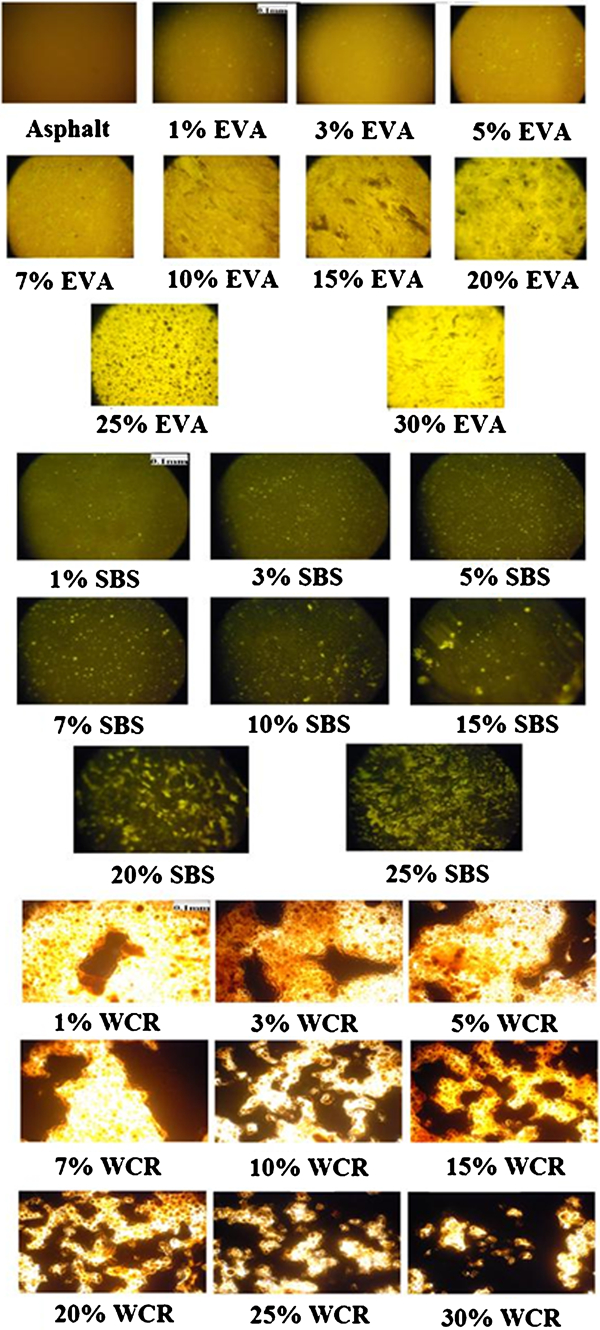
An optical microscope was used to characterise the dispersion state of EVA, SBS and waste crumb rubber in asphalt, and the results are shown in Fig. 3.
Microscope observations of polymer particle features in asphalt
It can be seen that with the increase in polymer loading, the distance between polymer particles becomes smaller and smaller. Finally, the particles aggregate with further increases in polymer loading, resulting in the transfer of continuous phase from the asphalt to the polymer. It also can be seen that the waste crumb rubber remains as particles under stirring and shearing, and the particle size is much larger than that of SBS and EVA. Optical microscopy can generally show the dispersion of polymer particles but cannot clearly show the features of an individual particle.
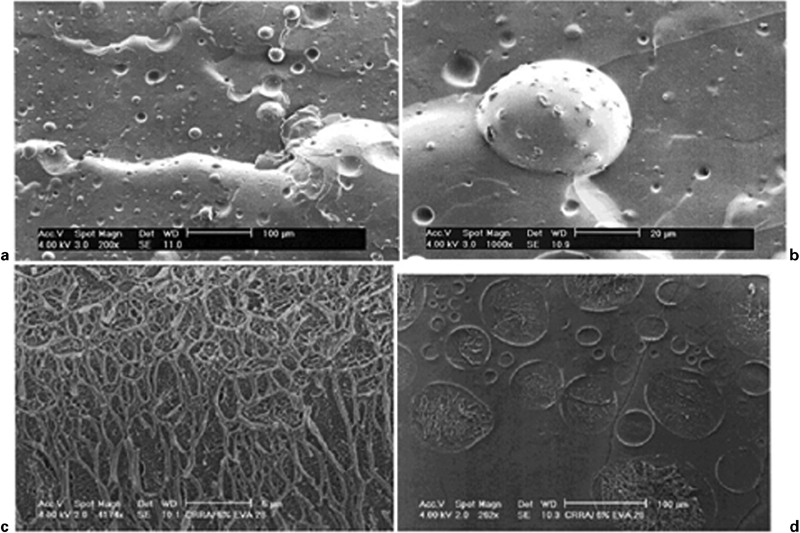
In fact, many researchers have carried out a lot of work on the observation of polymer modified asphalt. A new method called cryo-SEM used for the observation was developed by Wilson and Champion-Lapalu.8 The dispersion state and particle features of polymer in asphalt were observed, which are shown in Fig. 4.
Cryo-SEM photographs of polymer modified asphalt
Figure 4 shows that the SBS particles tens of micrometres in diameter were disperse in the asphalt. The EVA particles have a similar diameter, but with a fibroid surface. At the same time, the fracture surface of the EVA binder exhibits particle pullout with a slight plastic deformation. In polymer modified asphalt, the polymer hinders the crack bypasses, so the fracture mainly occurs at the interface between the two phases. The asphalt will fracture rapidly when being stretched at low temperatures, so the polymers play a role in preventing the fracture cracks from propagating and thus improve the performance of the asphalt. Figure 5 shows a schematic of the deformation of the polymer modified asphalt under stress.
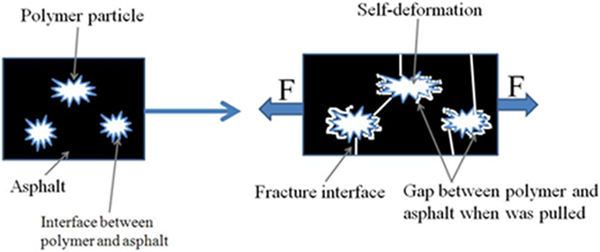
Schematic of deformation of polymer modified asphalt under stress
The closer the indices such as solubility parameter, dielectric parameter and polarity are, the stronger the interaction between polymer and asphalt is. At the same time, the larger the diameter of the polymer particle is, the higher the stress concentration of the polymer particles in the asphalt phase is and the easier the polymer particles can be pulled out from the asphalt phase. In other words, smaller particles will be more fully immersed in asphalt, the relative contact area will be larger and the interaction between polymer and asphalt will be stronger. The interfacial strength is higher between EVA and asphalt than between SBS and asphalt or waste rubber powder and asphalt for the following reasons: EVA is as polar as asphalt is because of the acetate moiety, while SBS and rubber powder are non-polar, and the surface of EVA particles in asphalt is fibroid, so the relative contact area is higher in EVA than in waste rubber powder or SBS. The ductility of water based chlorinated rubber (WCR) modified asphalt is the worst (WCR modified asphalt cannot be extended for >10 cm). However, the ductility of EVA modified asphalt is worse than that of SBS modified asphalt, mainly because the tensile strength of EVA is higher than that of SBS at the same strain and temperature, as shown in Fig. 6.
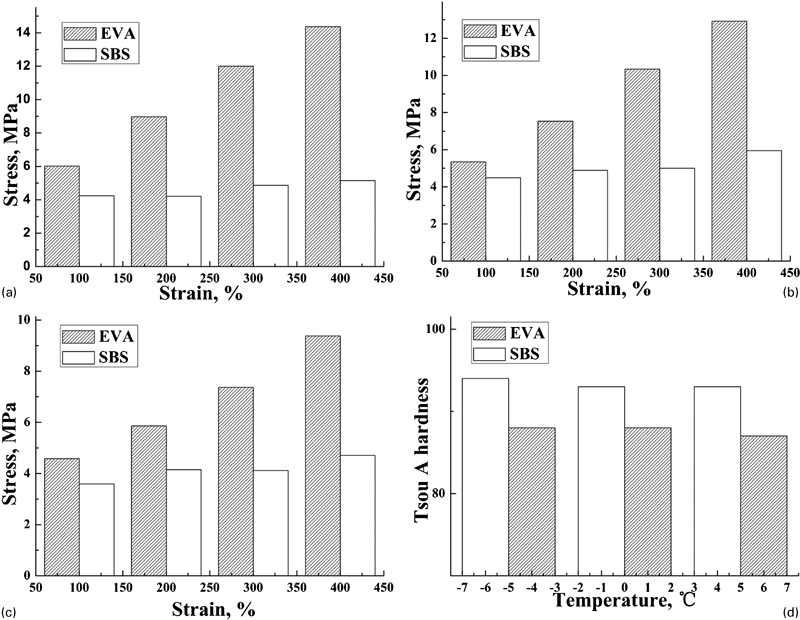
Tensile strength and hardness of EVA and SBS at different temperatures
It can be seen from Fig. 6 that the lower the temperature is, the higher the difference in tensile strength between EVA and SBS is. That is, a higher stress is needed for the same deformation in EVA than in SBS. Thus, the interfacial strength between EVA and asphalt is higher than that between SBS and asphalt, but the EVA particles could be pulled out more easily than the SBS particles, resulting in a better ductility at low temperature of asphalt modified by EVA than of asphalt modified by SBS.
In addition, when the loading of linear polymers such as EVA in asphalt reaches a certain level, the particles will aggregate to form a continuous phase. For polymers such as rubber powder with a network structure, the particles can aggregate and form a continuous phase but cannot transfer into one phase. As a result, the ductility decreases for WCR modified asphalt but remains steady for EVA modified asphalt as the polymer loading exceeds a certain value. At the same time, for segmented copolymers such as SBS, the particles can self-assemble to form a new network structure or linear structure. As a result, the ductility of asphalt modified by SBS keeps on increasing with the increase in polymer loading. A schematic diagram of the self-assembly process of SBS is shown in Fig. 7.
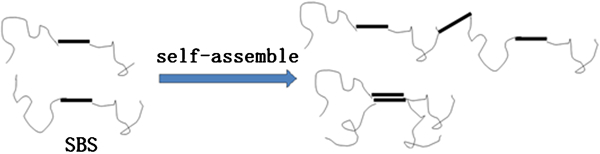
Schematic diagram of self-assembly process of SBS
Network structure of polymer modified asphalt
An RPA is a very common instrument for rubber dynamic property testing, and it can also be used for the characterisation of the dispersion and network structure of particle fillers in rubber. Asphalt is a composite material with an average molecular weight of about 600–1500 (Ref. 9) but is composed of many high molecular weight components. Polymer modified asphalt shares much in common with rubber modified by particle fillers. On the basis of this similarity, we, for the first time ever, used an RPA to characterise the dispersion of polymer particles in asphalt. The results are shown in Fig. 8.

Strain–stress curves of different polymer modified asphalts
It can be seen from Fig. 8 that with the increase in polymer loading, there occurs a plateau area in the stress–strain curve, a phenomenon known as the Payne effect.10 The Payne effect is usually used for examining the dispersion state and the network structure of fillers such as carbon black in rubber. The smoother the plateau is, the more uniform the filler dispersion is. The longer the plateau is, the more stable the network structure is. Figure 8 shows that with the increase in polymer loading, the network structure is formed gradually, and the network became more and more stable until the loading of polymer reached a critical value. The Payne effect, which indicates the formation of a polymer network in asphalt, appears when the loading of SBS or EVA reaches 5% or when the loading of WCR reaches 10%. As shown in Fig. 1, the ductility percolation threshold of polymer modified asphalt was 5% for asphalt modified with SBS or EVA and 10% for WCR modified asphalt, consistent with the results shown in Fig. 8. The percolation threshold is just the critical polymer loading for polymer particles to form a network structure in asphalt. It also can be seen that the change in the plateau with increasing polymer loading and the change in ductility with increasing polymer loading follow the same trend.
Thus, the RPA results support the existence of a polymer network in asphalt. The polymer network plays an important role in asphalt enhancement. The loading of polymer particles must reach a critical value for the polymer network to form, and this critical value is the percolation threshold. The polymer network formed in asphalt is directly related to the properties of the modified asphalt and is the main reason for the percolation phenomenon.
Percolation mechanism
The percolation phenomenon was discovered in 1985 by Wu and Margolina11, 12 for rubber toughened plastics, and a percolation theory called the substrate layer thickness theory or brittle–ductile transition (BDT) percolation model was also proposed to analyse the effect of particle diameter and interparticle distance on the percolation behaviour of rubber toughened plastics. According to the theory, when rubbery particles are dispersed in plastics, a rubbery particle (with diameter d) and the surrounding matrix spherical shell (with thickness τc/2) form a plane stress ball, as shown in Fig. 9. When the distance between rubber particles τ is larger than τc (the distance between the centres of two stress balls L = d+τ), the stress balls are interspersed and not interferential. When the distance τ is smaller than or equal to τc, the stress balls come to interact with each other. The number of stress balls that get interacted will increase with the growth of volume fraction Фs, [Фs = (s/d)3Ф]. Finally, the stress balls will form a percolation group. When the volume fraction Фs reaches the percolation threshold Фsc, the shear stress superposition of particles will be higher than the shear yield stress at the state of matrix plane stress, a percolation channel that penetrates the whole shear yield area will come up, and the BDT of the blend system will take place.
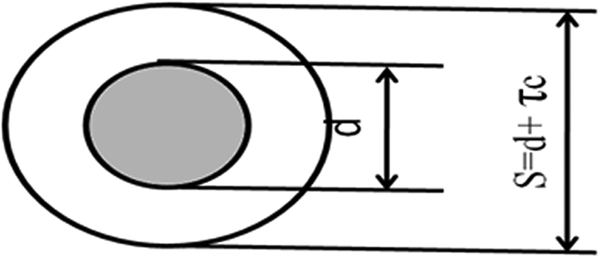
Brittle–ductile transition percolation model
The main relationship of BDT of impact strength and volume fraction was obtained by Li et al. Through researching the non-polar polypropylene/ethylene propylene diene monomer blend system,13 the corresponding percolation model was developed. The factors such as weight per cent and diameter dispersion degree and interfacial strength were discussed to analyse the effects on the percolation threshold, and the percolation threshold of BDT and the critical matrix thickness were obtained independently.
There is currently no percolation theory for polymer modified asphalt. We concluded that the mechanism of percolation phenomenon during the process of polymer modification of asphalt can be explained by the BDT model, and the process can be regarded as similar to that of rubber toughened plastic. At low temperatures, asphalt is hard and brittle (as indicated by the results shown in Fig. 10), characteristic of plastics, and the polymers used for asphalt enhancement were elastomeric, the glass transition temperatures of SBS, EVA and WCR being −80, −30 and −60°C respectively, all lower than that of asphalt. The addition of a polymer to asphalt played a role in enhancing and plasticising asphalt, so the BDT model can be used to explain the percolation behaviour of the ductility of polymer modified asphalt. The mechanism is as follows: with the increase in the loading of rubbery particles, the distance between the rubbery particles will decrease to a threshold value. In this case, the occurrence of crazing or shear bands under external stresses will be restrained, reducing the extent of destruction and substantially improving the ductility and other properties of asphalt.
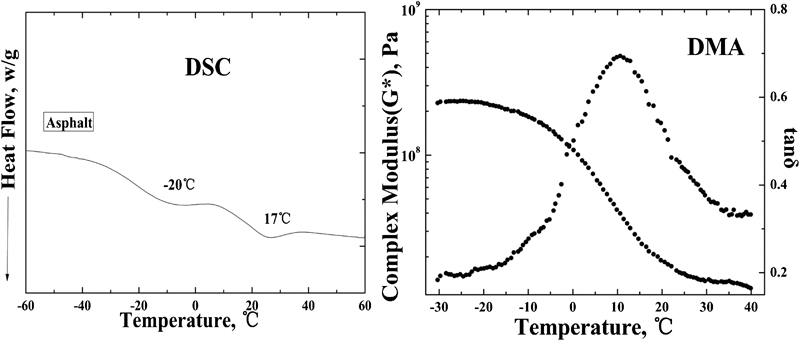
Differential scanning calorimetry and dynamic mechanical analysis curves of neat asphalt
According to the BDT model and the results of Li et al., we concluded that the performance of polymer modified asphalt depended on the following conditions:
a good dispersion of polymer particles in asphalt, an essential condition for the formation of a steady network of polymer particles in asphalt
good compatibility between the polymer and the asphalt, so that when the modified asphalt is under strain, the interface strength will be strong enough to prevent fracture and the polymer can give full play to the plastic deformation ability of the modified asphalt
a critical volume fraction of polymer in the asphalt, an essential condition for the polymer particles to be close enough to form a network structure and reach the percolation threshold
an optimum diameter of polymer particles
the properties of the polymer itself.
A mechanism on the percolation phenomena of the properties of polymer modified asphalt is very helpful to the mechanism research on polymer modified asphalt. The mechanism can be used to explain why a minimum loading of polymer is needed for asphalt enhancement and why there are differences in performance of asphalts modified by different polymers.
Conclusions
The properties of asphalt modified by different polymers follow similar trends in a wide range of polymer loadings, and the percolation phenomenon was found with each polymer.
The polymer network structure in asphalt is gradually formed when the polymer loading increases, and the steadier the network is, the better the performance of polymer modified asphalt is.
The percolation phenomenon was directly related to the network structure of polymer particles formed in asphalt, and the percolation threshold is just the minimum loading of polymer to form a network structure in asphalt.
The percolation phenomenon can be well explained by the percolation mechanism of rubber toughened plastics, and five factors that affect the performance of modified asphalt can be obtained.