







Abstract
A novel water swellable rubber (WSR) has been prepared by blending nitrile rubber (NBR), carbon black and other additives with cross-linked sodium polyacrylate (CSP), which was modified by interpenetrating polymer network technology with cross-linked P(AA-co-BA). The structure of WSR was characterised by SEM. The mechanical properties, water swelling ratio by mass and the percentage loss of CSP in the WSR were investigated. The results showed that the modified CSP grains can be dispersed well in the NBR and that it resulted in increase of mechanical properties and water swelling ratio and in decrease of percentage loss of CSP compared with the unmodified one. When the percentage content of cross-linked P(AA-co-BA) used to modify CSP reached 30%, the tensile strength, elongation at break and water swelling ratio of WSR exhibited a maximum value, and percentage loss of CSP exhibited a minimum value. When the content of CSP in WSR was 30 phr, the tensile strength, elongation at break, water swelling ratio and percentage loss of CSP of the WSR containing CSP modified were 11·3 MPa, 1943%, 532% and 5·8% respectively.
Introduction
Cross-linked rubber articles are swollen by a good solvent, and the swelling phenomenon is used to measure the cross-link density of a cured rubber.1–4 Swelling behaviour of a rubber vulcanisate is a diffusion process. The amount of a given solvent that will diffuse into rubber until it reaches equilibrium swelling depends on not only the degree of compatibility between the rubber and the solvent but also the state of a rubber vulcanisate. Rubber composites containing water absorbent resin can swell water. Water swellable rubber (WSR) has applications for sealing to prevent water leakage from pipe or block connections.
For blend systems, the mechanical behaviour depends critically on two demanding structural parameters, a proper interfacial tension leading to a phase size small enough to allow the material to be considered as macroscopically homogeneous, and an interface adhesion strong enough to assimilate stresses and strains without disruption for the established morphology. This can be achieved by different ways. One way is to modify one of the phases so as to increase the interfacial area, so that the components will be able to transfer the applied stress effectively, despite having high interfacial tension. Techniques of blending have been used successfully in some blend systems to form interpenetrating continuous network phases. Such systems have improved mechanical properties because of the interpenetrating polymer networks (IPNs), which allows direct load sharing between the components without the need for stress transfer across the phase boundaries.
It is now well established that the phase morphology of immiscible polymer blends can be controlled by IPNs, which act as interfacial agents. The modified polymer added to an immiscible binary blend should (1) reduce the interfacial energy between the phases; (2) permit finer dispersion during blending; and (3) result in improved interfacial adhesion. Several experimental investigations have been reported on the compatibilising action of added block and graft co-polymers in heterogeneous polymer blends. In recent years, more attention has been focused on compatibilisation of immiscible polymer blends modified by IPN technology.5–8 Polymer modified by IPN technology, as compatibilisers reduced the interfacial tension and increased the adhesion between the phases, thereby presented a finer dispersion and a more stable morphology.
As a novel functional material, WSR can stop water not only by means of elastic sealing but also by means of swelling in water. The general methods used to prepare WSR are mechanical mixing. Hydrophilic super water absorbent resin cannot disperse well in hydrophobic rubber, so that it can break off from the rubber network easily. This will weaken water swelling abilities, mechanical properties, long term water retention and repeated usage. These problems of polymer–polymer incompatibility can often be mitigated by modification of one phase by IPN technology. The compatibility of hydrophilic dispersion phase and hydrophobic continuous phase is expected to be improved greatly and the loss of super water absorbent resin from the rubber matrix to be reduced. In such a way, the water swellable properties may be enhanced, but work using this method has seldom been reported.
Nitrile rubber (NBR) has a great potential in industry because of its excellent resistance to oil, fuel and grease. Nitrile rubber is generally used for gaskets and O rings in fuel systems. Nitrile rubber grade is determined with the acrylonitrile content. Cross-linked sodium polyacrylate (CSP) used as a super water absorbent resin has high water retention abilities, stable structure and a low price. It does not decompose and denaturalise below 300°C.
In this research, NBR and CSP were chosen as chief materials, and the technique of IPNs was used to modify CSP. Modified CSP was obtained first by swelling network with acrylic acid, and then it was copolymerised with butyl acrylate. The effects of the content of modified polymer on mechanical properties and water–swelling behaviour were investigated. The effect of CSP content on water–swelling behaviour was studied. The morphological structure of the fractured surface of WSR was characterised by SEM.
Experimental
Materials
Nitrile rubber with an acrylonitrile content of 33% was supplied by Lanzhou Chemical Industry Corporation, Gansu Province, China. Cross-linked sodium polyacrylate was prepared by our laboratory (water swelling ratio, 500 g/g). Acrylic acid, butyl acrylate, benzoyl peroxide and dimethylaniline were obtained from Bodi, Tianjin, China. Potassium persulphite and a cross-linking agent (N, N-methylene-bisacrylamide) were obtained from Shanghai Chemical Reagent Factory, China. Reactive clay (particle size, below 200 mesh) was obtained from Xiangfan Chemical (Xiangfan, China). Zinc oxide and magnesium oxide were all chemical grade.
Preparation of CSP modified with P(AA-co-BA)
An amount of CSP was swelled by acrylic acid and an amount of cross-linking agent, which was dissolved completely in acrylic acid at ambient temperature. After 30 min, butyl acrylate (the compositions of butyl acrylate and acrylic acid were 85∶15) and benzoyl peroxide and dimethylaniline initiators (1·5% by mass to monomer respectively) were added. The mixture was dispersed well under stirring, and then the reaction was carried out at 30°C for 4 h. The product was dried in a vacuum oven at 60°C.
Preparation of WSR
At room temperature, NBR rubber was masticated on an open mill for 2 min and then modified or unmodified CSP, stearic acid, zinc oxide, N, N-methylene-bisacrylamide, reactive clay and magnesium oxide were fed into the mill in proper order and mixed continuously until the mixture reached apparent homogeneity. After blending, the batch was laid up on a dry and clean place at room temperature for >2 h and then remilled and passed through the open mill seven times. A mixed compound with better dispersion was obtained. The mixed compound was put in a 160×120×2 mm mould, preheated for 3 min and cured for 15 min at 150°C in a 16 ton press for vulcanisation. After that, the mould was taken out and cooled to room temperature.
Characterisation
Infrared (IR) spectra of the pure CSP and the modified CSP coated on KBr pellet were recorded on a Nicolet Magna-IR750 Fourier transform IR (FTIR) spectrometer.
The accurately weighed CSP (∼1 g) was immersed in 800 g of distilled water and allowed to soak for 1 day. The swollen gel was then separated from unabsorbed water by screening through a 300 mesh sieve, and the sieve was then weighed to determine the weight of the water swollen gel. The water swelling ratio Q (g/g) was calculated using the following equation

Tensile strength and elongation at break testing of dumbbell shaped specimens were performed using a WDW-20 electronic universal tester (Shenzhen Kaiqiangli Testing Instruments) at room temperature at crosshead speeds of 500 mm min−1.
The dried samples were cut ∼3 g, weighted accurately and soaked in distilled water or solution with different pH values at room temperature. At regular intervals, the swollen sample was removed from the distilled water or bath of different pH values, superficial moisture was removed, the weight of the sample was measured immediately and the sample was placed in the same bath. After the swelling test, the samples were dried at 50°C until a constant weight was reached. The first water swelling ratio by mass and the first percentage loss by mass were calculated as follows


The secondary water swelling ratio was measured by the same method used for the first one, using the dried sample, which was swelled with water in the measurement similar to the first water swelling ratio by mass.
Scanning electron microscopy of the WSR was performed on a Hitachi S-530 SEM. Samples were first cryogenically fractured in liquid nitrogen, mounted on a sample holder, gold sputtered and finally observed under the microscope.
Results and discussion
FTIR spectra of CSP modified and unmodified
The FTIR spectra of CSP (Fig. 1a) and CSP modified with P(AA-co-BA) (Fig. 1b), which is purified by IPN technology, are given in Fig. 1. The characteristic bands of C = O group at 1730 cm−1 in the FTIR spectra of modified CSP confirmed that there was a PBA chain in the modified CSP.
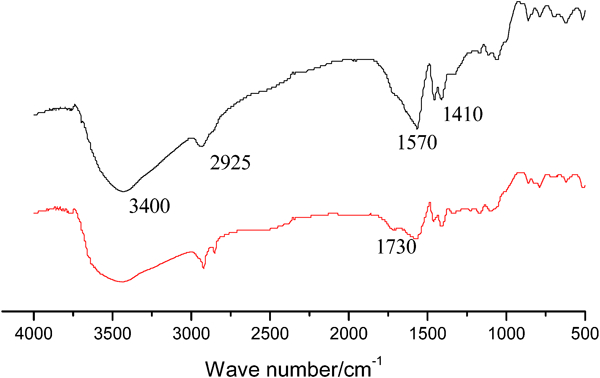
FTIR spectra of a CSP and b CSP modified with P(AA-co-BA)
Effect of P(AA-co-BA) content on water/swelling ratio of CSP
The effect of cross-linked P(AA-co-BA) content on water swelling ratio of CSP is shown in Fig. 2. Compared with that of unmodified CSP, water swelling ratio of CSP modified by cross-linked P(AA-co-BA) decreased slightly. This indicated that the effect of the introduction of cross-linked P(AA-co-BA) on the water swelling ratio was smaller.
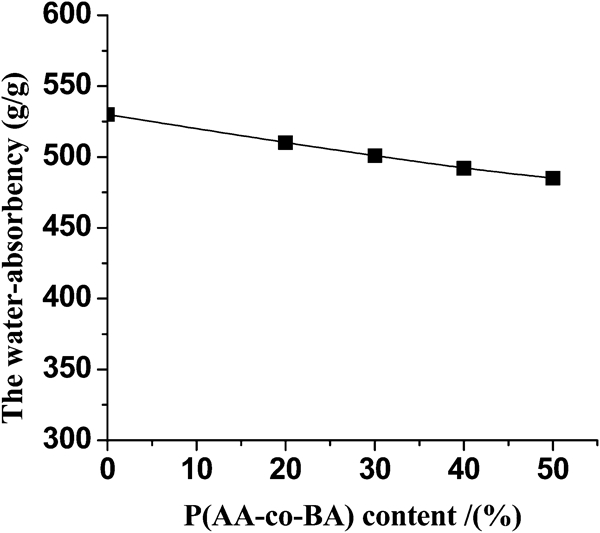
Effect of cross-linked P(AA-co-BA) content on water swelling ratio of CSP (soak temperature: 25°C)
Effect of P(AA-co-BA) content on mechanical properties of WSR
The effect of cross-linked P(AA-co-BA) content used to modify CSP on the mechanical properties of WSR is shown in Table 1. From Table 1, the tensile strength and elongation at break of WSR, unswelled and swelled with water, changed with cross-linked P(AA-co-BA) content. The maximum values occurred when P(AA-co-BA) content was 30 wt-%. They increased with an increase in P(AA-co-BA) content, when P(AA-co-BA) content is <30 wt-%. But when cross-linked P(AA-co-BA) content is >30 wt-%, they decreased. The tensile strength of WSR unswelled was better than that of WSR swelled with water, whereas elongation at break of the former was lesser than that of the latter.
Effect of modified polymer content used to modify CSP on mechanical properties of WSR
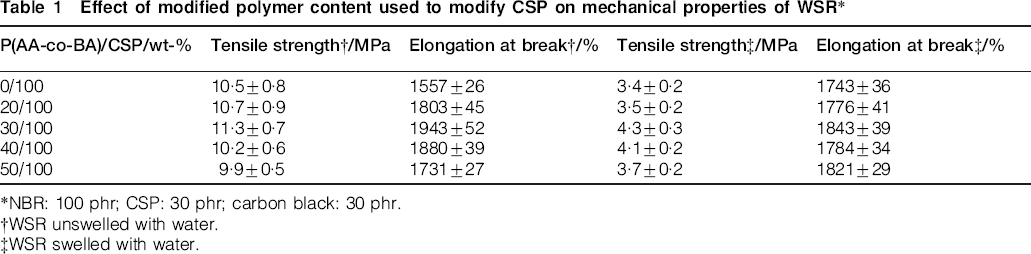
NBR: 100 phr; CSP: 30 phr; carbon black: 30 phr.
WSR unswelled with water.
WSR swelled with water.
Hydrophilic super water absorbent resin cannot disperse well in hydrophobic rubber, so that it results in the decrease in mechanical properties. The compatibility of hydrophilic dispersion phase and hydrophobic continuous phase is expected to be improved greatly, when hydrophilic CSP was modified by IPN technology with hydrophobic P(AA-co-BA). CSP dispersed well in the NBR and resulted in the increase of tensile strength and elongation at break of WSR, unswelled and swelled with water, but when the P(AA-co-BA) content used for modifying CSP was too much, the tensile strength and elongation at break of WSR, unswelled and swelled with water, decreased and that could be because the mechanical properties of P(AA-co-BA) were smaller than those of NBR. Its tensile strength decreased and its elongation at break increased because of the plastication of water, when WSR was swelled with water.
Effect of P(AA-co-BA) content on water swelling ratio of WSR
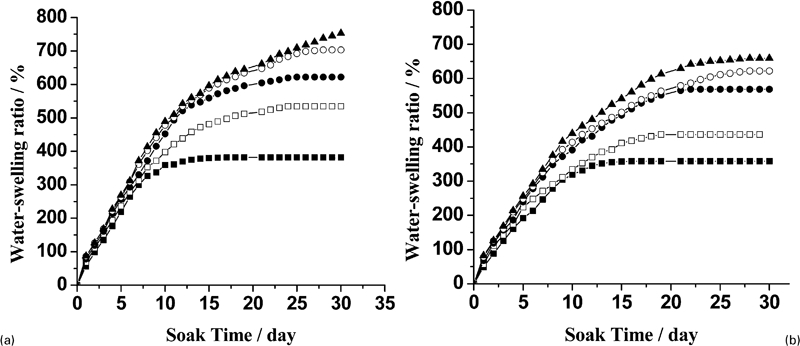
Figure 3 shows the effect of soak time on the water swelling ratio of WSR in which the CSP was modified with different contents of P(AA-co-BA). For initial swelling in deionised water, from Fig. 3a, it can be seen that the water swelling ratio of WSR increased with the soak time increase, but the speed of water absorption for the WSR in which the CSP was modified with different contents of P(AA-co-BA) was different. There is a relationship between the amount of P(AA-co-BA) used for modification and the speed of water absorption and water swelling ratio in the equipment of WSR. The maximum speed of water absorption and water/swelling ratio in the equilibrium of WSR occurred when the mass ratio of P(AA-co-BA) and CSP was 30%. The speed of water absorption and water swelling ratio in the equilibrium of WSR increased with an increase in P(AA-co-BA) content, when the amount of P(AA-co-BA) used is <30%. But when the amount of P(AA-co-BA) used is >30%, they decrease with an increase in P(AA-co-BA) content.
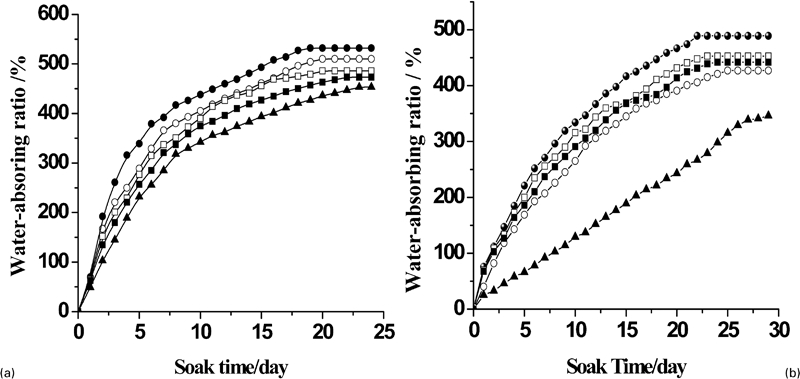
a initial swelling in deionised water; b secondary swelling in deionised water
Water swelling ratio in the equilibrium and the speed of water absorption of WSR are dependent on the amount and distribution of CSP in WSR. The water swelling ratio in the equilibrium and the speed of water absorption of WSR increase with the amount of the CSP when the distribution of CSP in WSR is certain. In other words, when there was a certain amount of CSP in the WSR, water absorbent resin dispersed well in rubber and also results in the increase of the water swelling ratio in the equilibrium and the speed of water absorption of WSR. Figure 3a shows that when CSP was modified by IPN technology with P(AA-co-BA) up to 30%, the CSP dispersed well in the NBR and resulted in maximum water swelling ratio in the equilibrium and the speed of water absorption of WSR. When the P(AA-co-BA) content used for modifying CSP was too much, the water swelling ratio in the equilibrium and the speed of water absorption of WSR decreased because of the hindrance of PBA shell, which hinders water from a thin layer of continuous paste passing well through and reaching the CSP.
To investigate secondary water swelling properties of WSR in deionised water, the WSR, which has absorbed a large amount of water and reached water absorbing equilibrium, was dried and then put into the water, and the changes of water swelling ratio with soak time were recorded in Fig. 3b. It can be seen that the water swelling ratio of WSR increased also with the soak time increase. The maximum speed of water swelling and water swelling ratio in the equilibrium of WSR occurred also when mass ratio of P(AA-co-BA) and CSP was 30%. The change of the speed of water swelling and water swelling ratio in the equilibrium of WSR with an increase of P(AA-co-BA) content was also similar to Fig. 3a, but when compared with Fig. 3a, the speed of water swelling and water swelling ratio in the equilibrium of WSR, which was swelled with water and then dried, decreased. The change of first and secondary water swelling ratio in the equilibrium of WSR and their difference with P(AA-co-BA) content are shown in Table 2. From Table 2, it can be seen that the difference of the first and the secondary water swelling ratio in the equilibrium exhibited a minimum value, when mass ratio of P(AA-co-BA) and water absorbent resin was 30%, and it was only 43%, but it was 107% when CSP was not modified. In WSR consisting of unmodified CSP, the loss of CSP was the main reason for the decrease in the secondary water swelling ratio in the equilibrium. But in the WSR consisting of CSP modified with P(AA-co-BA) for CSP, the decrease in the secondary water swelling ratio in the equilibrium was due to the little decrease in CSP.
Effect of P(AA-co-BA) used to modify CSP on water/swelling ratio at equilibrium of WSR
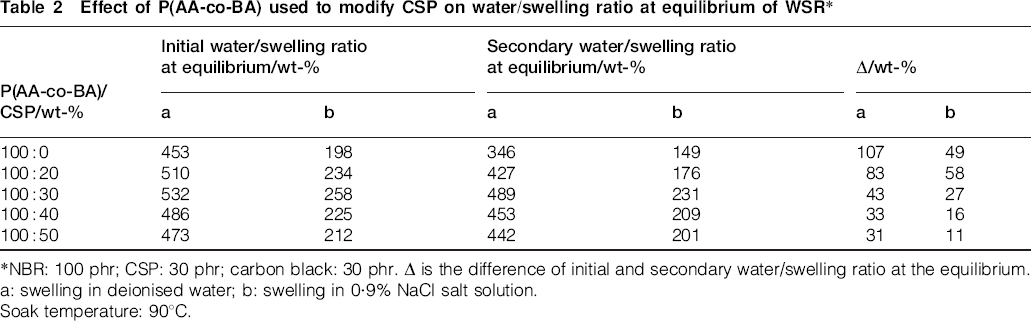
NBR: 100 phr; CSP: 30 phr; carbon black: 30 phr. Δ is the difference of initial and secondary water/swelling ratio at the equilibrium.
a: swelling in deionised water; b: swelling in 0·9% NaCl salt solution.
Soak temperature: 90°C.
Effect of P(AA-co-BA) content on percentage loss by mass of CSP in WSR
The effect of P(AA-co-BA) content, used to modify water absorbent resin, on percentage loss by mass of water absorbent resin in WSR is shown in Fig. 4. From this figure, it can be seen that in WSR, consisting of unmodified CSP, loss of CSP in deionised water reached 11·2 wt-%, but in WSR, consisting of modified CSP, loss of CSP in deionised water decreased obviously and it reached 4·2 wt-%. At the same amount of CSP, the percentage loss by mass of WSR in deionised water is higher than that in 0·9% NaCl salt solution. This is because the modified polymer is located at the CSP interface and a thin shell of polymer is formed around the dispersed phase. This leads to a broad, stable and less mobile interface that can resist coalescence. CSP grains could not be dropped out of cross-linked network as a whole from NBR.
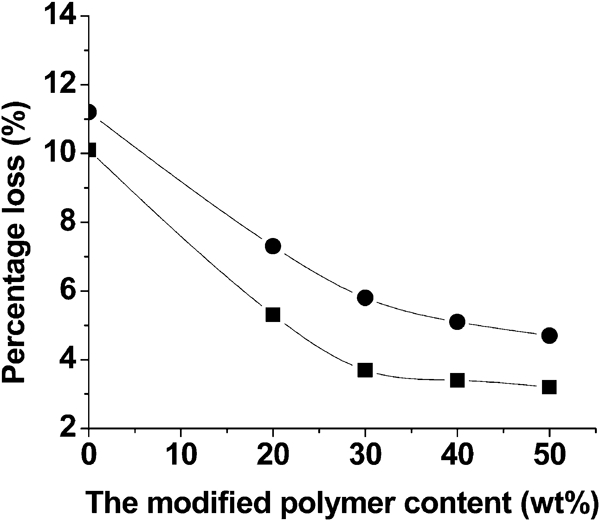
Effect of P(AA-co-BA) content used to modify CSP on percentage loss by mass of CSP in WSR: •: water swelling in deionised water; ▪: water swelling in 0·9% NaCl salt solution; other materials: NBR, 100 phr; CSP, 30 phr; carbon black, 30 phr)
Effect of pH value on water swelling ratio by mass
Figure 5 shows the effect of value of pH on water swelling ratio by mass of WSR. From Fig. 5, it is can seen that when pH value was <7, the water swelling ratio by mass increased with its increase. When the pH value was equal to 7, it reached the maximum value. But when the pH value further increased, water swelling ratio by mass decreased. When the pH value was <7, the carboxylate in water absorbing resin becomes carboxylic acid as it reacts with acid; ionisation of carboxylic acid was weaker than that of carboxylate in water solution; and the water swelling ability of water absorbing resin depends on the amount of carboxylation in CSP net, and repulsion between chains in water absorbing resin decreased with the decreased carboxylate ion amount of chains. When the pH value was >7, the cation formed from the alkali ionisation in the water solution hindered the ionisation of carboxylate. From Fig. 5, it can be seen that the water swelling ratio of WSR containing modified CSP was more than that containing unmodified CSP in different pH values, and their difference increased with decrease or increase (pH 7) of pH value in the system. When hydrophilic CSP was unmodified, the CSP grains could not disperse well in the NBR. As a result, some CSP grains in WSR were not used well to absorb water and swell the rubber because the resin grains were apart from each other. The smaller (or larger) the pH value in water solution, the smaller the water swelling ratio of the resin grains. When the water swelling ratio of the resin grains is less, the movement of water from one water absorbent resin grain to the other is difficult because they are apart from each other.
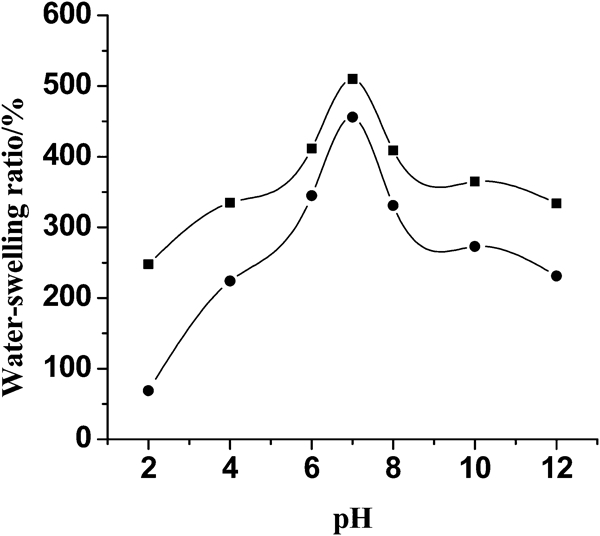
Effect of value of pH on water swelling ratio by mass of WSR: NBR, 100 phr; carbon black, 30 phr; CSP, 30 phr; modified polymer/CSP, •, 0 wt-%; ▪, 30 wt-%
Effect of amount of CSP on water swelling ratio of WSR
Figure 6 shows the effect of the amount of modified CSP on the water/swelling ratio of WSR. From this figure, it can be seen, for all WSR, that the water/swelling ratio increased with the increase of soaking time and that it stopped to increase after reaching the maximum value, but the speed of water swelling increased with the increase of CSP amount. That is because, in the WSR, the distance between CSP grains decreased with the increase in CSP amount, and the time, which was needed for the water to be carried from one CSP grain to the other, decreased with decrease in distance between the grains.
a initial swelling in deionised water; b secondary swelling in deionised water
Figure 6 shows the effect of the amount of modified CSP on secondary water swelling ratio of WSR. From this figure, it can be seen that, for all WSR, change of the secondary water swelling ratio with the increase in soaking time is similar to that of the first shown in Fig. 6. Compared with the first water swelling ratio, the secondary water swelling ratio at the equilibrium of the WSR declined slightly, which is due to the loss of CSP.
Effect of amount of CSP modified on percentage loss by mass
The effect of the amount of the modified CSP on percentage loss by mass of WSR is shown in Fig. 7. From this figure, it can be seen that the percentage loss by mass was <10% for the different content of modified CSP. The percentage loss by mass of WSR increases with increasing of the amount of CSP modified. At the same amount of CSP, the percentage loss by mass of WSR in deionised water is higher than that in 0·9% NaCl salt solution.
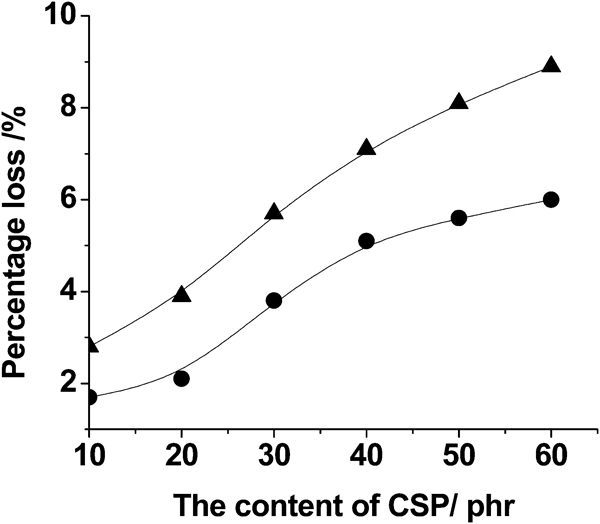
Effect of content of modified CSP on percentage loss by weight: ▴: water swelling in deionised water; •: water swelling in 0·9% NaCl salt solution; NBR, 100 phr; carbon black, 30 phr; modified polymer/CSP, 30 wt-%; soak temperature, 90°C
Images (SEM) of fracture surface for WSR
Figure 8 shows the SEM images of the fracture surface for the WSR. Figure 8a shows that the fracture surfaces are distinct. But in Fig. 8b, fracture surfaces are very blurry. It indicates that compatibility of rubber and modified CSP is better than that of rubber and unmodified CSP.
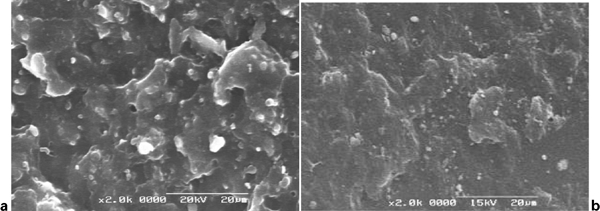
a CSP was not modified in WSR; b CSP was modified with 30%P(AA-co-BA)
Conclusions
A novel WSR has been prepared by blending NBR, reactive clay and other additives with CSP, which was modified by IPN technology with cross-linked P(AA-co-BA). The compatibility of CSP and NBR was improved greatly, when CSP was modified by IPN technology with cross-linked P(AA-co-BA). It resulted in better properties of WSR. When the content of CSP in modified WSR was 30 phr, and the content of cross-linked P(AA-co-BA) in the modified CSP was 30%, tensile strength, elongation at break, water/swelling ratio and percentage loss of the WSR were 11·3 MPa, 1943%, 532% and 5·8% respectively.
Footnotes
Acknowledgements
The authors would like to thank the support from the projects for the Excellent Youth Scholars of Educational Commission of Hubei Province of China (grant no. Q20101505) and Hubei Provincial Natural Science Foundation of China (grant no. 2011CDB220).