







Abstract
In this study, polypropylene (PP)/sisal fibre (SF)/carboxyl terminated hyperbranched polymer (CTHP) composites were prepared by using short SF as the reinforcement, PP as the matrix and CTHP as a compatiliser. The impact fracture surface of PP/SF composites and the interfacial compatibility between PP and SF were analysed. Experimental results showed that the impact strength and flexural strength of PP/SF composites modified with the CTHP (2 wt-% of SF) were 21·5 and 9·7% higher than that of unmodified systems respectively. The SEM photomicrographs of the fracture surfaces have also shown that PP was highly bonded to the SF in the CTHP treated composites; wide angle X-ray diffraction (WAXD) measurement indicated that the CTHP did not change the crystal structure of PP and was still a-type crystal. Moreover, the addition of a small amount of the CTHP was helpful to improve water resistance of SF/LGF/PP composites.
Introduction
The application of natural fibres such as jute, kenaf, sisal, flax and industrial hemp, etc., reinforced composites are increasing in the automobile industry and used as building materials since they come from renewable materials and are easily recycled and reasonably strong and light.1–3 Compared with traditional synthetic fibres reinforced thermoplastic polymers, composites based on cellulosic fibres offer a number of advantages such as high stiffness and strength, desirable fibre aspect ratio, flexibility during processing with no harm to the equipment, low cost per unit volume, low specific mass and good mechanical properties.4, 5
Sisal fibres (SFs) are extracted from sisal plant leafs in the form of long fibre bundles have been used extensively as ropes and twines.6 Owing to their high breaking strength, SFs are excellent reinforcing elements for the preparation of polymer composite materials. The incorporation of SF into plastics and elastomers to obtain cost reduction and reinforcement has been reported by various workers. Silva et al.7 had recently used long SF to reinforce durable cement composites. These composites exhibited better tensile strengths comparable to those of polypropylene (PP), polyethylene and glass fabric reinforced cement composites.8 Silva et al.9 investigated the stress versus cycles fatigue behaviour of single SF. SFs were subjected to tensile fatigue loading with maximum stresses ranging from 80 to 400 MPa at a frequency of 2 Hz. The fatigue tests were stopped either at 106 cycles. Young's modulus was improved with increasing fatigue stress. However, the disadvantages of the use of SFs as a reinforcement in thermoplastics are the result of a lack of a good interfacial adhesion and a poor resistance to humidity absorption, since SFs are of hydrophilic nature and thermoplastics are of hydrophobic nature.10 Many studies have been performed to improve the adhesion between the fibre and matrix by modification of the fibre and/or polymer matrix using physical and chemical methods. The use of coupling agents, pretreatment of fibres, grafting and coating with suitable chemicals were reported to improve the interfacial adhesion between cellulosic fibres and thermoplastic matrices.11 Besides, a good compatiliser could also provide stronger adhesion between the natural fibres and the polymer, and form entanglements and/or segmental crystallisation with the polymeric matrix. It has a significant effect on the polymer properties. Prasad et al.12 had studied the effect of alkali treatment on the physical and mechanical properties of coir-polyester composites. Kokta and co-workers13 had reported that coupling agents like silanes and isocyanates could improve the mechanical properties and dimensional stability of cellulosic fibre/polyethylene composites. Joseph and Thomas14 investigated that the cardanol derivative of toluene diisocyanate treatment reduced the hydrophilic nature of the SF and thereby exhibited superior mechanical properties of the SF/low density polyethylene (LDPE) composites. Pavithran et al.15 reported the impact properties of unidirectionally oriented SF composites. Maria et al.16 reported the composites of PP reinforced with SFs treated with sodium hydroxide solutions. Maleic anhydride grafted PP was used as coupling agent. The mechanical properties (tensile, flexural and impact strength) of the PP/SF composites were studied as a function of reinforcement and fibre treatment. Nhlapo and Luyt17 reported the thermal properties and mechanical properties of LDPE/SF composites using maleic anhydride grafted hard paraffin wax and oxidised hard paraffin wax as a compatiliser, and the properties of LDPE/SF composites showed a more significant improvement.
In this paper, we investigate short SF reinforced PP composites using carboxyl terminated hyperbranched polymer (CTHP) as a compatiliser, which was synthesised by Bolton H20, toluene diisocyanate and 12-hydroxy stearic acid. The molecular structure of the CTHP containing anchoring groups of carboxyl terminated and the surfaces of SF have many hydroxyl groups that can be utilised for chemical modification. So the CTHP can anchor on the surfaces of SF and the functional SF can improve interfacial adhesion between the PP matrix and SF and may improve the mechanical properties (flexural and impact strength) and thermal properties of the PP/SF composites. Additionally, scanning electron microscopy (SEM) was performed to evaluate the reinforcement matrix adhesion and the fibre dispersion.
Experimental
Materials and measurements
Bolton H20 (abbreviated as H20) was provided by Perstorp AB Company (Sweden) and used directly. Toluene diisocyanate (TDI) (80∶20) was purified by distillation under vacuum. The PP was purchased from Yangzi Petrochemical (China) and MFI 1·2 g/10 min (at 190°C, 10 kg); 12-hydroxy stearic acid was supplied by Tonghua Castor Chemical Co. Ltd, China. SFs were obtained from Guangxi Sisal Company, China.
Preparation of CTHP
H20 of 5·36 g (3·07 mmol) dissolved in the proper amount of acetone was added into a three necked round bottomed flask equipped with a mechanical stirrer, a N2 inlet–outlet and a cooler. The mixture of 7·0 mL TDI and 10 mL acetone was then dropped into the flask within 1 h. The solution was stirred for an additional 20 h at 30°C, and a yellow solution was obtained. The terminal of the reaction was confirmed by titration of the isocyanate group content. Then 16·14 g (49·12 mmol) 12-hydroxy stearic acid and 30 mL acetone mixture were then dropped into the above solution within 2 h and stirred at 60°C for additional 10 h. The acetone was distilled under vacuum at 50°C to get the CTHP. The synthetic routes for the CTHP are shown in Fig. 1.
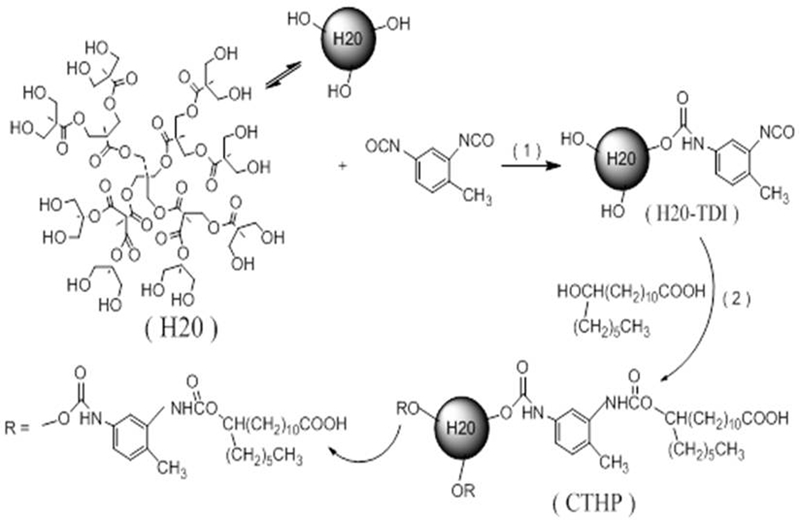
Step reactions for preparing of CTHP
SF treatment
The SFs were chopped to a length of 5–8 mm, preliminarily soaked in 10 wt-% NaOH at 30°C for 4 h and then the treated fibres were thoroughly washed with cold water until complete removing all of the sodium hydroxide, controlled by monitoring the pH of the washing water. Finally, the fibres were dried at 90°C for 10 h. For each treatment, the yield was determined by comparing the weight before and after the treatment.
Preparation of PP/SF composites
The PP/SF composites were prepared in a laboratory two-roll mill. The nip gap, mill roll, speed ratio and the number of passes were kept the same in all the mixes. In the melt mixing method, the SF and compatiliser were added to a melt of PP and the mixing was performed in a Haake Rheocord Mixer. When a homogeneous mixture of PP, SF, calcium carbonate power and compatiliser was obtained, the mixture was put into the mould at 180°C for about 10 min under mild pressure followed by 5–15 MPa for about 4 min and cooled to room temperature under the pressure to obtain the final composite plaques for testing. Flexural and impact specimens were prepared by using universal system prototype according to Chinese national standards.
Characterisation
Fourier transformed infrared spectroscopy (FTIR) was recorded between 4000 and 450 cm−1 on a PerkinElmer 1710 spectrophotometer using KBr pellets at room temperature.
Mechanical properties of the PP/SF composites were evaluated by impact and flexural measurements. Mechanical data presented in this study were the average of at least five parallels. Izod impact strength was performed on the PP/SF composites according to GB 1043–1993. Flexural tests were performed according to WDW-20 (Shenzhen Jun Red Instrument Equipment Co., Ltd, China) using a three-point bending mode of the universal testing machine with a crosshead speed of 10 mm min−1. The conditions of the tests and the specimens conformed to GB1449-2005.
The wide angle X-ray diffraction (WAXD) analysis was performed using a type/Bruker-AXS D8ADVANCE X-ray diffractometer equipped with a computer controller. The measuring conditions were: wavelength, 1·540 A; start angle, 5°; stop angel, 50°; and scanning speed, 4° min−1.
Thermomechanical properties, modulus and glass transition temperature were determined using a linear rheometer (Q 800 dynamic mechanical analyser, made with a TA instruments) in a single cantilever bending mode, at a frequency of 1·0 Hz from 40 to 250°C at a heating rate of 3°C min−1. The storage modulus E′ and tan δ were measured for each sample in this temperature range.
The differential scanning calorimetry (DSC) test was carried out with a Netzsch differential scanning calorimeter (model DSC-204) at heating and cooling rates of 10°C min−1 under flowing nitrogen within the temperature range of 40–200°C. The degree of crystallinity Xc (%) for each sample was calculated by Xc = (ΔHm/ΔHm−100%) ×100%, where ΔHm−100% is the melting enthalpy of perfect crystals and ΔHm is the melting enthalpy of the samples. Here, the values of ΔHm−100% for PP were selected as 209 J g−1).18
Thermogravimetric analysis (TGA) was made by a NETZSCH STA 449C at a heating rate of 20°C min−1 from 50 to 600°C.
SEM (JSM-6380LV) studies were conducted to analyse the impact fracture surfaces of the composites. The samples were previously coated with carbon.
Results and discussion
Characterization of CTHP
As mentioned in the section on ‘Experimental’, the preparation of the CTHP included two steps. The possible reactions are shown in Fig. 1. Step 1 is a hydrogen shift reaction between TDI and H20, resulting in producing the endcapped H20 (H20-TDI). Since the molar ratio of TDI/H20 was 16∶1, basically only one of the −NCO groups on TDI could participate in this reaction and all of the −OH groups on H20 was endcapped. Step 2 is a coupling reaction of 12-hydroxy stearic acid with the endcapped H20. In this step, the –OH groups of 12-hydroxy stearic acid reacted with the –NCO groups of the H20-TDI, forming carbamido linkage CTHP, which contains –NH groups. Figure 2 shows the FTIR spectra of H20 (Fig. 2a), H20-TDI (Fig. 2b) and CTHP (Fig. 2c). In Fig. 2a, a distinct absorption peak at 1100 cm−1 is in the region of –C–O–C stretching for ether groups and the peak at 3404 cm−1 belongs to –OH group. In Fig. 2b, the peak at 2274 cm−1 confirms the existence of –NCO groups, the with characteristic urethane peaks at 3317 cm−1 for –NH and 1720 cm−1 for –C = O stretching vibration. The spectrum of the CTHP shows that the peaks at 2274 cm−1 disappears, indicating that the –NCO groups have completely reacted with the –OH groups of 12-hydroxy stearic acid. Meanwhile, H20, H20-TDI and CTHP respectively had two distinctive characteristic peaks around 2850–2950 cm−1 due to C–H stretching.
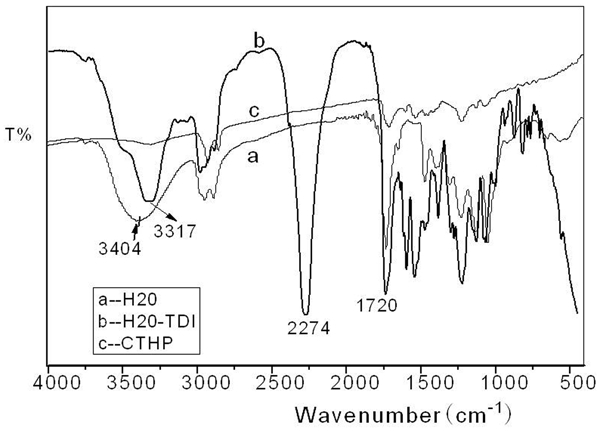
FTIR spectra of a H20, b H20-TDI and c CTHP
Mechanical properties of SF/PP composites
Table 1 shows the results of mechanical properties and different CTHP contents of the PP/SF composites. It is observed from the results that the CTHP compatiliser shows mechanical properties improved with increasing CTHP content. From the table, it can be seen that the impact strength increased at first and then declined with increasing CTHP content. It reached the maximum when the CTHP content was about 2 wt-%. A similar trend for the flexural strength and modulus was observed. In comparison with the blank sample, the impact and flexural strengths of the PP/SF composites increased by 94·8% and 19·3% respectively. This may be due to uniform distribution of SF in the PP matrix when adding the CTHP compatiliser at a low CTHP contents. But with increasing CTHP content, it does not favour the improvement of mechanical performance. As the interface becomes saturated, the compatiliser gets trapped in one of the phases and the system behaves like a ternary blend, and a multimolecular layer is formed on the surface of the SF.
Effect of CTHP content on mechanical properties of composites
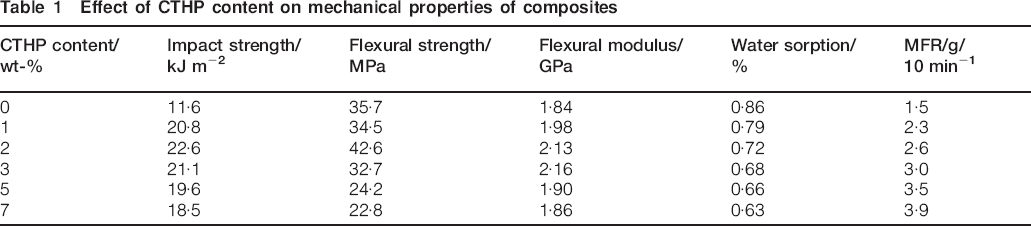
Effect of CTHP contents on water sorption and melt flowrate (MFR) of composites
The CTHP contents can influence on the hydrophilicity of the composites and change the extent of the water sorption of PP/SF composites. Table 1 shows the effect of the CTHP on water absorption characteristic of the PP/SF composites at different CTHP contents. All composites modified with the CTHP reduce the water absorption compared to untreated composite. Since the water absorption rate depends on the nature of the treatment, in the case of the CTHP treatment, there is a reduction in the number of hydroxyl groups and this leads to a reduction in water absorption rate. This may be attributed to the interactions between water molecules and imino groups present in the CHTP.
The MFR) of the PP/SF composites was present in Table 1. It can be seen that the MFR of the compatibiliser systems was two to three times higher than that of the uncompatilising system. This will reduce the hydroxyl number of the SF surface and improve the interfacial compatibility of SF and PP matrix; a lower friction force will be obtained in the various components of the composites at high shearing forces and make the MFR improvement.
Dynamic mechanical analysis
The variation of the storage modulus E’ with temperature is shown in Fig. 3a. It is worth noting that the storage modulus of the polymer and composites decreased with increasing temperature. The reduction of storage modulus with temperature can be attributed to the softening of the polymer due to the increase in the chain mobility of the polymer matrix at high temperatures. As compared to composite without CTHP treatment, the composites with the compatiliser systems obtain higher storage modulus. This result indicates that the compatiliser migrated to the fibre surface and formed a hydrogen bond through carboxyl and imino groups, thereby increasing the stiffness of the matrix, and the hyperbranched framework of the compatiliser, which contained a long flexible chains, became entangled in the PP matrix, resulting in stiffer combination.19
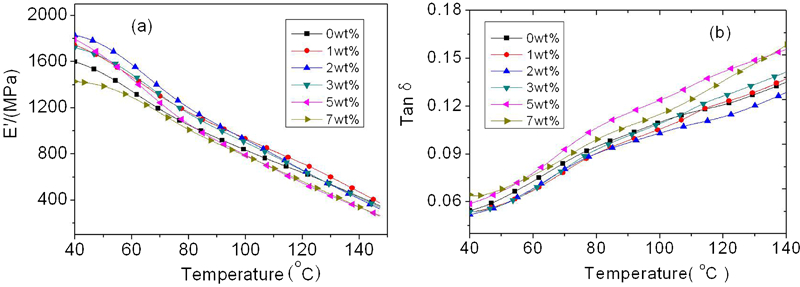
a storage modulus; b tan δ of composites
The tan δ of the PP/SF composites is showed in Fig. 3b. In the tan δ curves, the tan δ peaks are shifted toward higher temperatures when adding 5–7 wt-%CTHP to the compatibiliser. Good interaction between PP matrix and SF can be understood from the increased tan δ peak temperature (often referred as glass transition temperature Tg), and another cause of increase in Tg may be the possibility of secondary bonds that acted as quasi-crosslinks and restricted the motion of long chain molecules and increased peak temperature.20 This may be attributed to be effects such as improved interaction and plasticisation due to the CTHP addition.
WAXD measurement
The WAXD patterns of the PP, PP/SF and PP/SF/CTHP composites are shown in Fig. 4. It shows that the 2θ peaks of all samples at 14·04, 16·90, 18·46 and 21·72° in the curves correspond to the crystal planes (110), (040), (130) and (041) respectively, which are all the characteristics of the typical α-type monoclinic crystal structure of the PP.21 It proves that these samples contain α-type crystal. However, compared with the curve of PP, it can be obviously found that a new peak at 29·41° appears for the PP/SF and PP/SF/CTHP composites. This new peak has been assigned to the calcium carbonate crystal peak which was added to the SF/PP and SF/PP/CTHP composites. But there was no significant effect in the diffraction positions of the composites which added SF and CTHP. The crystalline degree of the three composites was assessed from DSC results.
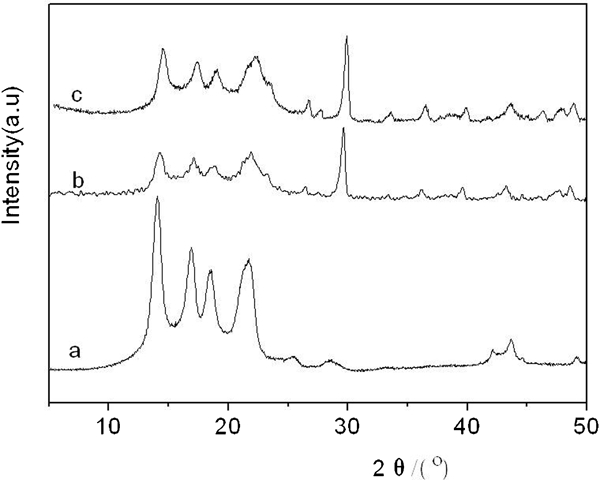
WAXD spectra of a PP, b SF/PP and c SF/PP/CTHP composites
Thermal properties
The crystallisation behaviours of PP/SF and PP/SF/CTHP composites obtained from DSC experiments are summarised in Fig. 5 and Table 2. In the melting curves as shown in Fig. 5A, it can be seen that a peak at about 168°C is attributed to the melting of a-crystals in PP/SF. However, with the addition of the CTHP into PP/SF, the melting point slightly decreases from 168 to 165°C (Fig. 5A-b), 3°C lower than that of the PP/SF composite. This is due to the fact that the non-crystallisable component of the CTHP inhibits the crystal growth of PP, which thus leads to the formation of small and unperfected PP crystals.22 On the other hand, Fig. 5B shows that when cooled at 10°C min−1, the crystallisation temperature of PP/SF composite is about 119°C, while crystallisation in PP/SF/CTHP occurs at 123°C, and the crystallinity calculated from the curve of each corresponding sample is listed in Table 2. Only a slightly decrease in the crystallinity is found when adding the CTHP into PP/SF composite.
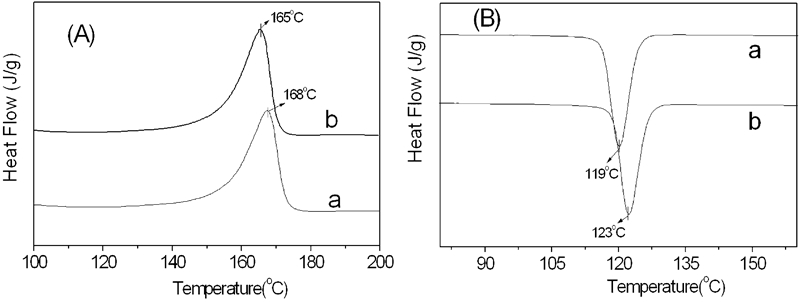
A the heating curve; B the cooling curve
Thermal properties of SF/LGF/PP composites

Figure 6 shows the TGA curves for PP/SF and PP/SF/CTHP composites in the temperature range of 50–550°C. The curves of the two composites exhibit two stages degradation at 267 and at 448°C with 72% weight loss. Similar observations are seen for both PP/SF and PP/SF/CTHP composites. This means that the incorporation of the CTHP into the composite did not improve the thermal stability of a composite.
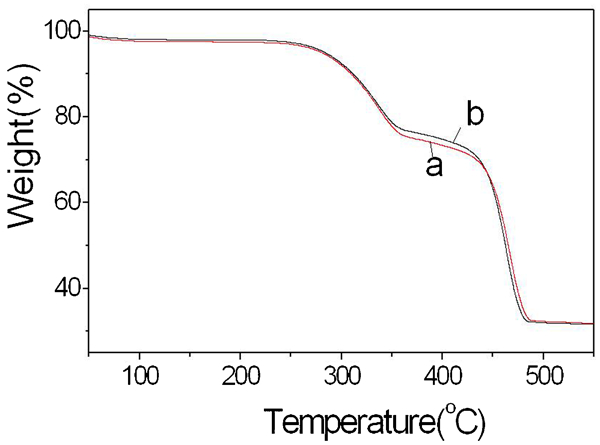
TGA curves of a PP/SF and b PP/SF/CTHP composites
Surface morphology
SEM images of PP composites are shown in Fig. 7. As seen from the micrographs, in the case of SF/PP composite where the adhesion between the fibre and matrix is poor, the fracture occurs by fibre pullout and is indicated by holes and fibre ends (Fig. 7a). When adding 2 wt-%CTHP into SF/PP composite (Fig. 7b), where there is a strong interaction between the fibre and matrix, the failure occurs by fibre breakage, and is clear from the SEM images of the fractured surface of the PP/SF/2 wt-%CTHP composite, which shows fibre breakage rather than fibre pullout, indicating that the CTHP improves the adhesion between PP and the fibres. This result is in agreement with those from mechanical tests.
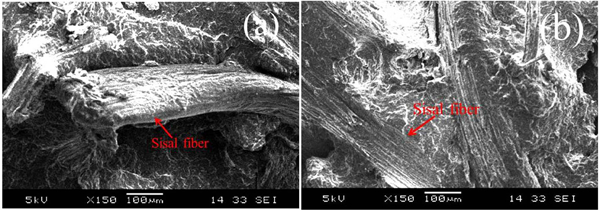
SEM images of composites a PP/SF and b PP/SF/2 wt-%CTHP
Conclusions
In this work, we have investigated the effect of CTHP on the PP/SF composites mechanical properties, MFR, WAXD and morphology. The mechanical properties of PP/SF/CTHP are better than PP/SF because the addition of the CTHP to PP increases the distribution of SF in PP matrix. When the CTHP content is about 2 wt-%, the impact strength of the PP/SF/CTHP composite was 22·6 kJ m−2 and the flexural strength is 42·6 MPa, which is 86·2% and 19·4% higher than that of the PP/SF. The WAXD measurement substantiates the formation of a-type crystal of PP when incorporating the CTHP into the PP matrix. The SEM images also demonstrates that the CTHP can increase the interface adhesion of SF and PP matrix, and decrease the aggregation of SF and thus increase the mechanical property of composites.
Footnotes
Acknowledgements
The authors are grateful for the financial support by the National Natural Science Foundation of China (no.51163004) and the Scientific Research and Technology Development Plan of Guangxi Province of China (nos. 1298025-8 and 0992022-4).