







Abstract
Flame retardant ethylene vinyl acetate (EVA) composites were prepared based on different contents of hollow glass beads (HGBs) and aluminium hydroxide (ATH) in this paper, and the flame retardant properties were studied using limiting oxygen index, UL-94 test and cone calorimeter test respectively. The results showed that EVA-4 with 1·0 wt-%HGBs has the lowest heat release rate, total heat release and smoke production rate among all samples, and HGBs could promote to form a compact char layer on the surface of the sample. It indicates that there is an obvious synergistic flame retardant effect between HGBs and ATH in this composite.
Introduction
Ethylene vinyl acetate (EVA) is a copolymer that can be used as thermal plastics and elastomer depending on the vinyl acetate (VA) content in copolymer. 1 Furthermore, EVA copolymers are widely used in many fields such as insulating materials, hot melt adhesives and biomedical devices due to their good mechanical and physical properties, easy processing as well as good resistance to chemicals.2, 3 However, EVA burns very rapidly due to its chemical constitution, with high smoke emission leaving no char residue, which restricts their applications.3, 4 Thus, preparing flame retardant EVA composites becomes an important requirement for the industry.2, 5–13
It has been reported that the halogenated compounds combined with antimony trioxide are very effective to prepare flame retardant EVA composites.4, 14 However, these compounds release large amount of smoke and toxic gases in fire. Recently, developing halogen free flame retardant system is a new trend in EVA composites. Among the halogen free flame retardants used in EVA, the most are mainly metal hydrates. Magnesium hydroxide and aluminium hydroxide as metal hydroxides are commonly used in flame retardant EVA composites due to their no toxicity and moderate cost.15–17 However, the high loadings (>60 wt-%) required for adequate flame retardant level often lead to difficult processing and a great decrease in the mechanical properties of filled polymer materials. 4 Thus, some synergistic flame retardants, such as phosphorus, zinc borate, silica, montmorillonite and other small molecular additives, are combined with magnesium hydroxide or aluminium hydroxide (ATH) to improve the flame retardant efficiency in EVA compsites. 18 However, few studies have been reported on the synergistic flame retardant effect between hollow glass beads (HGBs) and ATH in the EVA system.
HGBs are silicates, which exhibit excellent mechanical properties and heat resistance without emitting any toxic or noxious components. Compared to the fibres, HGBs have good processing properties due to their spherical shape. At the same time, HGBs have low density compared to most of the fillers because of their hollow form. 19
In this paper, flame retardant EVA composites were prepared based on HGBs as synergism and ATH as flame retardant. The flame retardant properties were studied using limiting oxygen index (LOI), UL-94 test and cone calorimeter test (CCT).
Experimental
Materials
EVA18 (containing 18 wt-%VA) was bought from Beijing Eastern Petrochemical Co., Ltd (China). Hollow glass beads (6020) with average particle size of 18·4 μm and stacking density of 227 kg m−3 were bought from Qing Hong Corporation of Shanghai (China). Aluminium hydroxide, with decomposition temperature of about 220°C and average particle size of about 2 μm, was bought from Jinan Shang Shan fine chemical Co., Ltd (China). Other reagents were standard laboratory reagents and used as received without further purification.
Preparation of flame retardant EVA samples
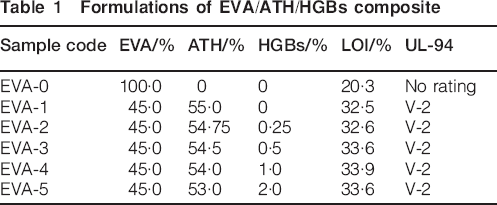
All flame retardant EVA samples were melt compounded with a mixer at 120°C for 10 min. After mixing, the mixtures were then compression moulded at about 120°C into sheets under a pressure of 10 MPa for 10 min. The sheets were cut into specimens with suitable size for fire testing. The formulations are given in Table 1.
Formulations of EVA/ATH/HGBs composite
Measurements
Limiting oxygen index
LOI was measured according to ASTM D2863. The apparatus used was an HC-2 oxygen index meter (Jiangning Analysis Instrument Company, China). The specimens used for the test were of dimensions 100×6·5×3 mm.
UL 94 testing
The vertical test was carried out on a CFZ-2-type instrument (Jiangning Analysis Instrument Company, China) according to the UL 94 test standard. The specimens used were of dimensions 100×13×3 mm.
Cone calorimeter
The CCTs (Stanton Redcroft, UK) were performed according to ISO 5660 standard procedures. Each specimen of dimensions 100×100×3 mm was wrapped in aluminium foil and exposed horizontally to an external heat flux of 50 kW m−2.
Results and discussion
LOI and UL-94 rating
The LOI and UL-94 tests can be commonly used to study flame retardant properties of materials and to screen flame retardant formulations. Table 1 presents the LOI and UL 94 test results of flame retardant EVA composites. It can be seen that the LOI value of pure EVA is the smallest among all samples. It increases to 32·5 from 20·3 (pure EVA) when ATH is incorporated into EVA composites. Furthermore, in the case of the samples with HGBs (EVA-2 to EVA-5), the LOI values gradually increase with the loading of HGBs. The LOI value of EVA-4 increases to 33·9 when the addition of HGBs is raised to 1·0 wt-%, which is the largest LOI value among all samples. It also can be seen that the LOI value from EVA-2 to EVA-5 with both HGBs and ATH is higher than that of EVA-1 with only ATH. Table 1 also presents that pure EVA did not pass the UL 94 test. The EVA-1 with ATH can reach V-2 rating level in the UL-94 test. HGBs cannot further improve the UL 94 rating of the flame retardant EVA composites. These results show that a suitable amount of HGBs can improve the flame retardancy of EVA composites.
Cone calorimeter study
The cone calorimeter based on oxygen consumption principle has been a universal method used to compare and study the flammability characteristics of materials. It remains one of the most useful bench scale tests, which can be used to predict the combustion behaviour of materials in a real fire. Focused by external radiation, the cone calorimeter represents a well defined flaming condition after ignition. The heat release rate (HRR) measured by CCT is a very important parameter as it expresses the intensity of a fire. However, often used to describe the fire hazard behaviours are averaged HRR or peak HRR (PHRR) for actual situation.20, 21 Usually, the value of averaged HRR is low for a highly flame retardant system. The PHRR value is used to express the intensity of a fire.
Heat release rate
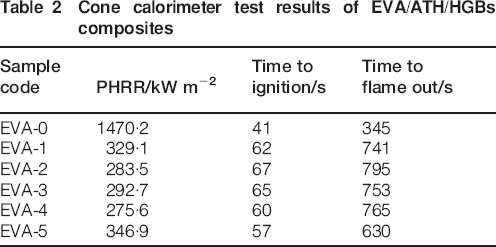
Figure 1 shows the HRR curves of different EVA samples obtained from CCT. It can be found that the pure EVA burns fast after ignition and reaches a sharp peak of HRR with the value of 1470·0 kW m−2. The addition of ATH and HGBs decreases the HRR. It is obviously found that the HRR of EVA composites (EVA-0-EVA-5) shows two separate peaks during combustion. The order of the first PHRR values from all samples is EVA-0>EVA-5>EVA-1>EVA-3>EVA-2>EVA-4 in Table 2. EVA-4 with 1·0 wt-%HGBs has the lowest PHRR value (275·6 kW m−2) among all samples. It can be explained that the flame retardant plays the gas and solid phase flame retardant effect. Furthermore, the addition of HGBs and ATH prolongs the burning time in Table 2. It can be seen that the addition of different contents of ATH and HGBs produces good flame retardant effect. Moderate amount of HGBs has effective synergistic flame retardant effect with ATH in EVA composites.
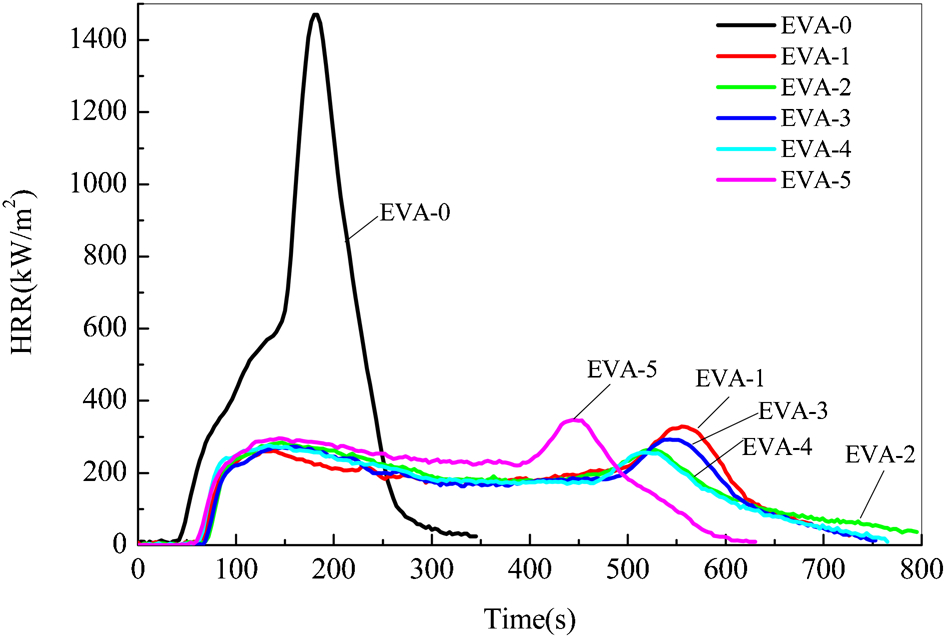
Effect of hollow glass bead content on HRR of EVA/ATH composites
Cone calorimeter test results of EVA/ATH/HGBs composites
For the samples with multi-HRR peaks, the first peak is assigned to the development of the intumescent protective char. 22 After the first peak, the HRR curve forms a plateau in some cases, in which the increase in HRR is suppressed because of the presence of efficient protective char residue layer. The second peak is because of the destruction of the intumescent structure with a lot of combustible gases when the sample is continuously exposed to heat.23, 24 It indicates that EVA-4 with 1·0 wt-%HGBs has the best synergistic effect in flame retardant EVA/ATH system among all samples, which is in agreement with the LOI and UL-94 results.
Total heat release (THR)
Figure 2 presents the THR for all EVA samples. The slope of THR curve can be assumed as representative of fire spread. 24 From Fig. 2, it can be seen that the THR of pure EVA is higher than those with different contents of ATH and HGBs. EVA-4 with 1·0 wt-%HGBs has the lowest THR among all samples, which is in agreement with the HRR result. Pure EVA reaches the maximum value at 250 s. The addition of ATH and HGBs prolongs the combustion time.
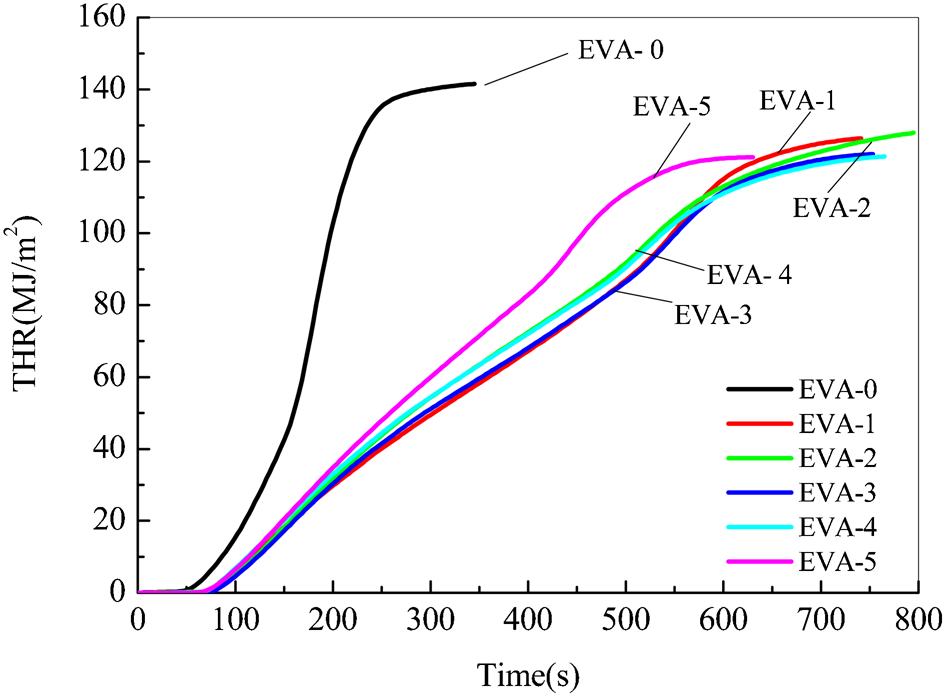
Effect of hollow glass bead content on THR of EVA/ATH composites
Smoke production rate (SPR)
Smoke performance of flame retardant material is a very important parameter in fire safety fields. It has been recognised that the smoke problems are very essential. Therefore SPR is also an important parameter to evaluate the flame retardancy of flame retardant materials.25–28
The SPR values of flame retardant EVA are given in Fig. 3. The peak SPR value of pure EVA is the highest one (0·12 m2 s−1) among all samples. The peak SPR value decreases greatly with the addition of ATH and HGBs. The SPR of EVA-4 with 1·0 wt-%HGBs is the smallest among all samples. Aluminium hydroxide is effective in smoke suppression. It also indicates that EVA-4 with 1·0 wt-%HGBs has the best synergistic smoke suppression effect in the EVA/ATH flame retardant system.
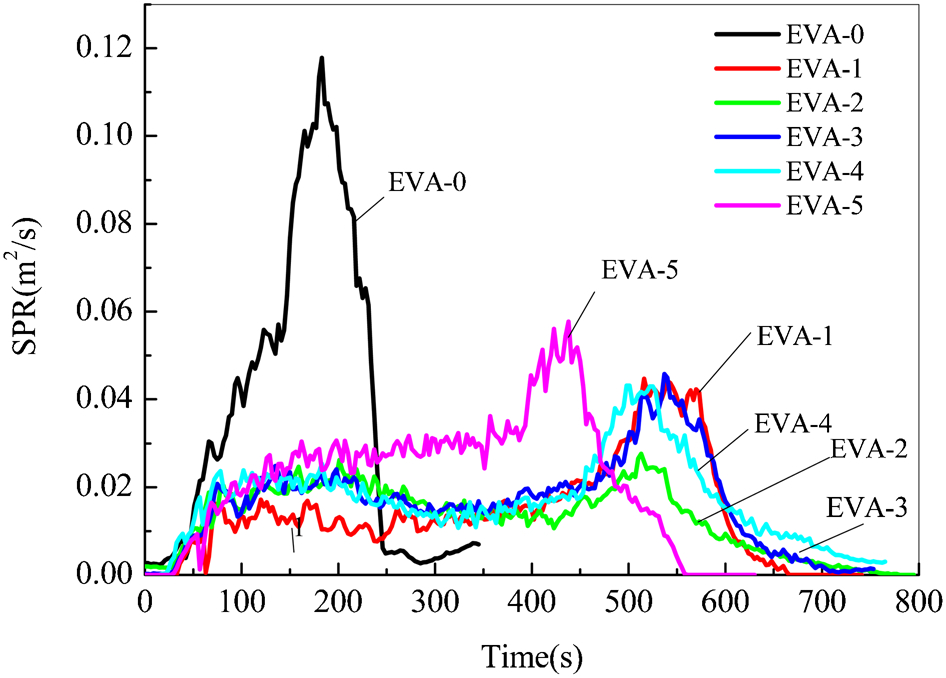
Effect of hollow glass bead content on SPR of EVA/ATH composites
The results imply that a moderate amount of HGBs can produce obvious smoke suppression in flame retardant EVA composites by decreasing the peak SPR value, and delaying time to the peak SPR value. The above smoke suppression phenomena can be explained as follows.
Photographs of residues
Figure 4 are photographs of residues of series of EVA composites. From Fig. 4, it can be seen that a coherent and dense char can be formed with the addition of HGBs and ATH. With the increase in HGBs (EVA-2 to EVA-5), the char layer becomes more and more dense. The EVA-0 without ATH and HGBs almost burns completely. From the char structure, we can explain the combustion phenomenon of the flame retardant EVA composites. The formation of condense char can prevent the heat transfer between the flame zone and the burning substrate, and thus protect the underlying materials from further burning, and retard the pyrolysis of polymers.
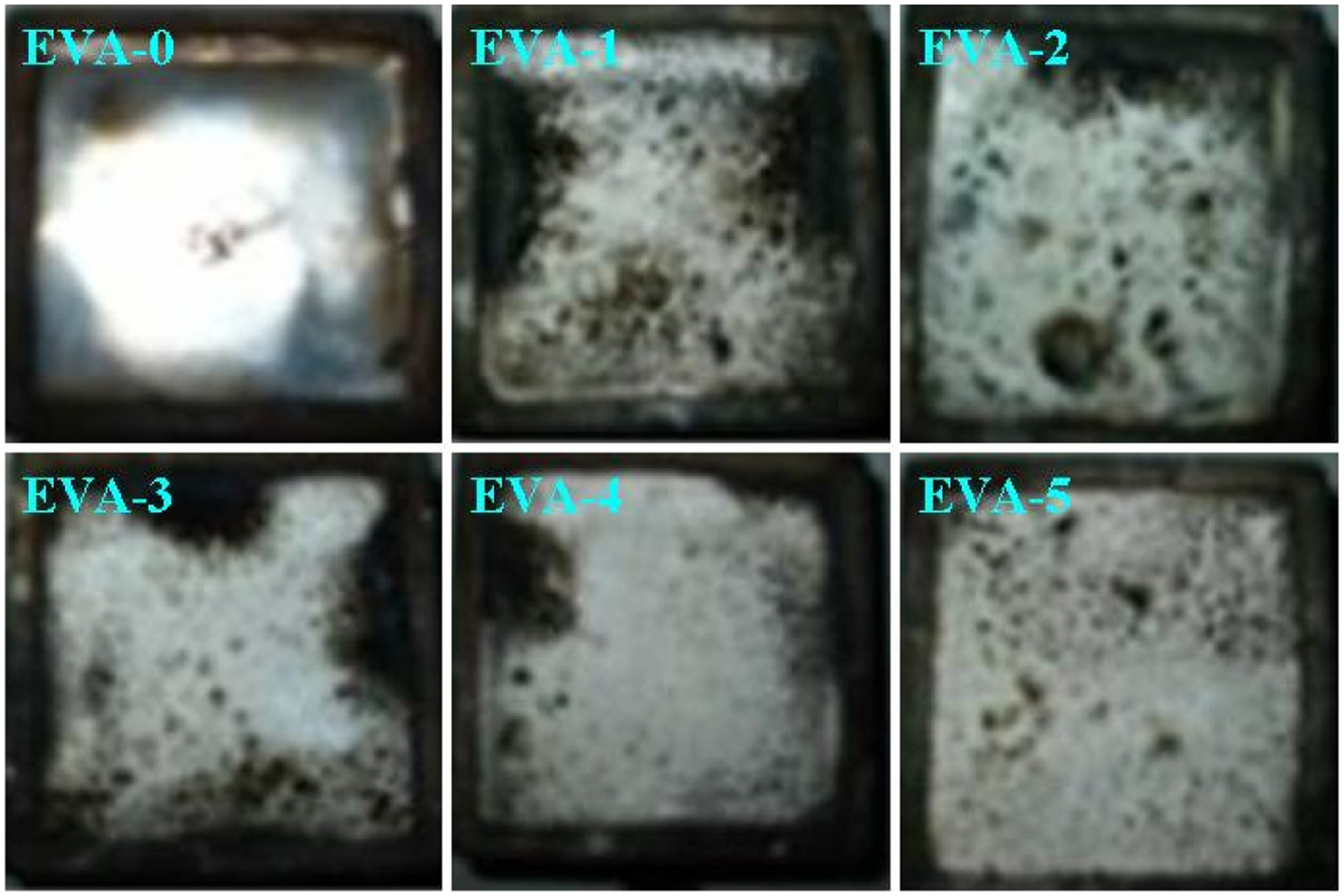
Photographs after cone calorimeter test
Mass
Figure 5 shows the weight of the char residues. It can be seen that the char residues of flame retardant samples are higher than that of pure EVA. Furthermore, the char residues of the samples with different ATHs and HGBs are all higher than that of EVA-0. It should be figured out that the char residue of EVA-4 with 1·0 wt-%HGBs is highest among all samples in Fig. 5. A compact char residue will be formed during combustion on the surface of the burning materials, which could create a physical protective. The physical process of the char would act as a protective barrier, which can limit oxygen diffusion to substrate and combustible gases into flame zone.
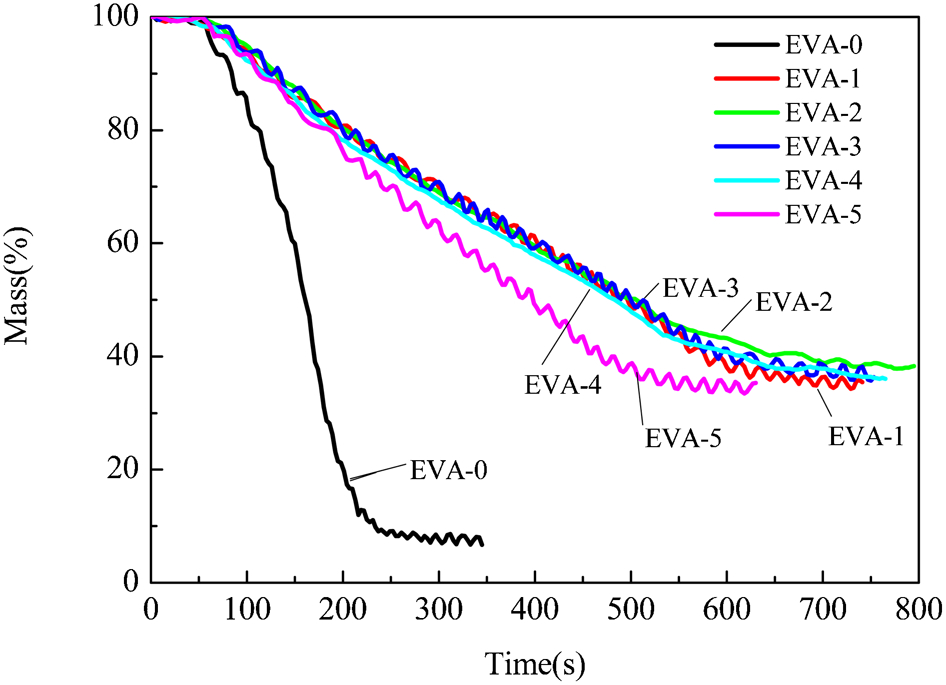
Effect of hollow glass bead content on mass of EVA/ATH composites
Fire performance index (FPI) and fire growth index (FGI)
In order to judge the fire hazard clearly, the FPI and the FGI are calculated after CCT. The FPI (m2 s kW−1) is defined as the ratio of time to ignition to PHRR and the FGI (kW m−2 s−1) is defined as the ratio of peak HRR to time to PHRR respectively. 21 The FPI and FGI are parameters directly calculated from the data measured by CCTs, and reflect the safety rank of samples directly. That is, materials with high fire safety rank should need high FPI and low FGI values.29, 30 Figures 6 and 7 respectively show the FPI and FGI values. We can see that the addition of a suitable amount of HGBs with ATH can increase the FPI value and decrease the FGI value in the EVA system. Furthermore, the EVA-3 sample with 0·5 wt-%HGBs and ATH shows the lowest FGI value, which indicates that there is a synergistic flame retardant effect between ATH and HGBs in the EVA composites.(insert in Fig. 6)
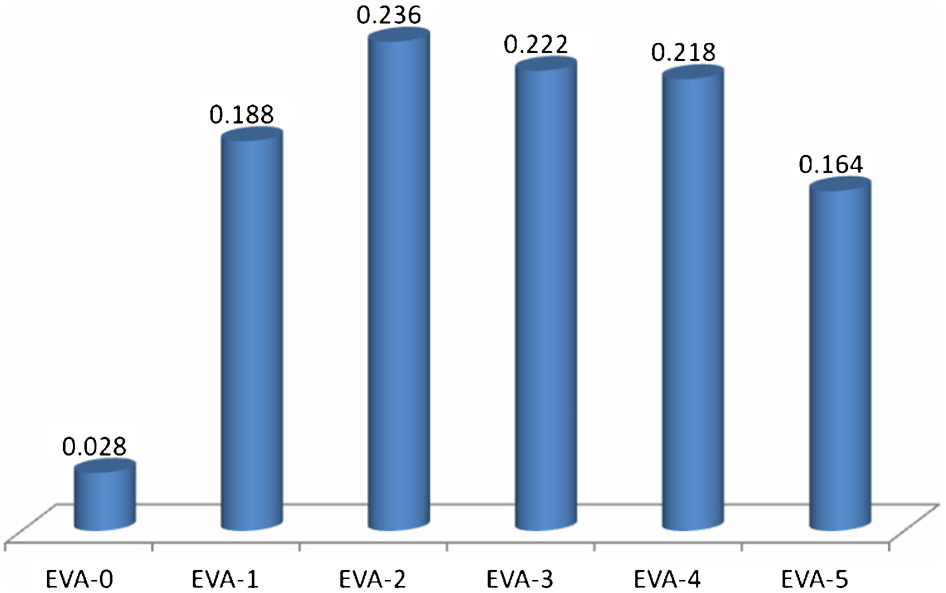
Fire performance index for EVA composites at flux of 50 kW m−2
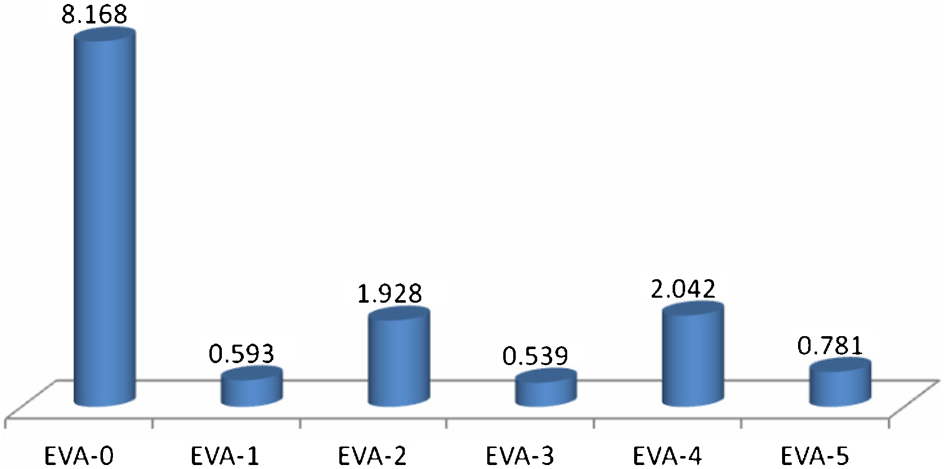
Fire growth index for EVA composites at flux of 50 kW m−2
Conclusions
A series of flame retardant EVA composites based on HGBs and ATH were prepared in this paper. The LOI results indicate that HGBs can improve the LOI value of EVA/ATH composites. The CCT date reveals that values of HRR, THR and SPR apparently decrease with increasing amount of HGBs. EVA-4 with 1·0 wt-%HGBs shows the lowest HRR and SPR and the highest mass among all samples. It proves that the addition of HGBs is capable of initiating a compact and homogeneous char on the surface, which turns out to be of most important for the flame retardant performance. The synergistic flame retardant mechanism of HGBs with ATH in EVA blends is due to its physical effect in condensed phase.
Footnotes
Acknowledgements
The authors gratefully acknowledge the National Natural Science Foundation of China (grant nos. 51106078 and 51206084) and the Outstanding Young Scientist Research Award Fund from Shandong Province (grant no. BS2011CL018).