







Abstract
In this study, different proportions of hollow glass microsphere (HGM) filled thermoplastic polyurethane (TPU) elastomer composites were prepared by normal vane extruder. The phase morphology, rheological properties, mechanical properties and thermal stability of TPU/HGM composites were investigated in detail. It was observed that the incorporation of HGM increased the thermal stability of TPU. With the increase in HGM content from 5 to 20 wt-%, the glass transition temperature, storage modulus and complex viscosity values increased continuously, while the density of the composite monotonously decreased. Moreover, the tensile modulus of the composites increased from 43.5 to 81.3 MPa. The results showed that, although raw HGM was used without any modification, the HGM played an important role in improving the properties of TPU.
Introduction
Polyurethane is a versatile material that can be used in numerous applications ranging from flexible foam in upholstered furniture to rigid foam as insulation in walls and roofs. Other forms of polyurethane products, such as thermoplastic polyurethane (TPU), can be used in medical devices, footwear, coatings, adhesives and sealants. Polyurethane elastomers can also be used on floors and automotive interiors.1–5 A wide range of monomeric materials are commercially available, and desired properties can be obtained by combining monomeric materials.6–8 Conventional TPUs exhibit poor stiffness, low thermal stability and weak barrier properties, which limit their applications. 9 Therefore, modification for TPU is urgent. Significant efforts have been exerted to prepare TPU based composites via a simple, rapid and cheap method; these composites can be used to fabricate materials with properties that are not generally exhibited by single pure materials.10–12
Inorganic fillers have been used to modify polymeric materials. The inorganic fillers are often used to increase the stiffness and improve the dimensional stability of polymer materials.13–16 Increasing interest has been given to the development of inorganic composites based on polymer materials.17–25 Hong et al. 17 prepared multilayer graphene flakes and multiwall carbon nanotubes/poly(butylene succinate) composites with enhanced properties. Liang et al. 19 prepared hollow glass bead filled poly (acrylonitrile–butadiene–styrene) composites and found correlation between impact strength and fracture surface fractal dimension. Suprakas et al. 23 prepared polylactide/layered silicate nanocomposites and investigated their properties. They found that the intercalated nanocomposites exhibit remarkable improved material properties in both solid and melt states compared with that of PLA matrices without clay.
Hollow glass microspheres (HGMs) consist of outer stiff glass and gas inside; HGMs exhibit some desirable properties, such as lightness, low thermal conductivity and low dielectric constant.26–29 Based on these properties, HGMs have been widely used in polymer based composites for different applications. Filling TPU with HGM can be one of the key methods to modify TPU and extend its applications. To the best of our knowledge, TPU based composites reinforced with HGM have not been studied.
Moreover, the aforementioned studies were conducted in a conventional screw extruder or batch mixer governed by conventional shear flow. However, to the best of our knowledge, the elongation flow is more effective than the shear flow in polymer processing. 30 Therefore, various attempts have been performed to generate elongation flow based on converging channels, but most of these elongation flows are local and fixed. 31 In this study, different properties of HGM filled TPU composites were prepared by vane extruder. Polymer vane extruder, which was designed by Professor J. P. Qu in South China University of Technology, is a novel equipment for polymer processing. 32 The plasticising and conveying mechanism of the vane extruder is dominated by elongational flow, which is good for the dispersive and distributed mixing of composites.30, 31, 33 Furthermore, the thermal–mechanical history of the vane extruder is shorter than conventional screw extruder, leading the reduction in the degradation of polymer molecules.34–36 Scanning electron microscopy (SEM), differential scanning calorimetry, thermogravimetric analysis (TGA), dynamic mechanical properties analysis and dynamic rheological measurements were used to investigate the effects of HGM content on the rheological, mechanical and thermal properties of TPU/HGM composites.
Experimental
Raw materials
Thermoplastic polyurethane (grade WHT1195, polyester type) was supplied by Yantai Wanhua Polyurethanes Co., Ltd, and the shore A hardness and density provided by the supplier were 70 A and 1.2 g cm− 3 respectively. Hollow glass microsphere (K85, 0.4 g cm− 3), industrial grade, was supplied by Guangzhou Yanna Trading Co., Ltd, China. The purity is >98%.
Preparation of TPU/HGM composites
Before melt blending, TPU resin and HGM were dried in an oven at 80°C for 6 h. In order to improve the dispersion of HGM into the TPU matrix, the masterbatch method was adopted. The TPU/HGM (50/100) blends were first compounded using a vane extruder, and then the resultant palletised extrusion masterbatch was used to melt blend with different content of TPU. For all samples, the speed was 45 rev min− 1, and the level of temperature was controlled at 180–200°C. All the samples were compression moulded into sheets with a thickness of 1 mm using a Flat Sulfuration Machine (model QLB-25D/Q, China) at 200°C and 15 MPa for 15 min. The sheets were cooled to 30°C.All the bars were conditioned at 50% relative humidity and 25°C for at least 48 h before testing.
Characterisation
Microscopic analysis
The fracture surface was studied using a scanning electronic microscope (SEM, model HITACHI S-3700N, Japan). The specimens (4 mm thick) were submerged in liquid nitrogen for ∼15 min and fractured to expose the internal structure for SEM investigations. Before the SEM test, all surfaces were sputtered with gold to provide enhanced conductivity.
Dynamic mechanical analysis
Dynamic mechanical analysis was performed from − 100 to 100°C under liquid nitrogen atmosphere using a Netzsch DMA (model 242c, Germany). The dimensions of samples were 40 mm × 10 mm × 1 mm in dimension, and the tests were performed in a single cantilever bending mode at a fixed frequency of 2 Hz and a heating rate of 3°C min− 1.
Dynamic rheological measurements
Dynamic rheological measurements were carried out using the MCR302 rheometer (Anton Paar, Austria) in dynamic oscillation mode with a parallel plate geometry (diameter = 25 mm, gap = 1 mm). The frequency sweep tests were performed in the range of 0.01–100 rad s− 1 at the temperature of 200°C. The amplitude of 1% was used in order to maintain the response of materials in the linear viscoelastic regime.
Thermogravimetric analysis
Thermogravimetric analysis was performed on ∼10 mg samples on a thermogravimetic analyser (Netzsch TG209) from 30 to 700°C in an N2 atmosphere (250 mL min− 1) with a 10°C min− 1 heating ramp.
Mechanical test
Tensile test of the pure TPU and TPU/HGM blends was conducted using an Instron universal machine (model 5566, USA) in accordance with ASTM D882-10 standard. INSTRON POE2000 Pendulum impact tester was used in impact test. All the values were determined in an average of five repeats.
Density and hardness measurement
The density of polymer and composites was measured by an Electronic densimeter (DH-300, China) that takes measurements according to Archimedes principle. The hardness of polymer and composites was measured by a Shore rubber scleroscope (LX-A, China).
Thermal conductivity
Thermal conductivity of the TPU control material and TPU/HGM composites was calculated from the thermal diffusivity measured via flash method using commercially available NETZSCH-LFA 447 equipment. Measurements were performed using precisely machined samples in the temperature range of 25–125°C. Before the measurement, the top and bottom surfaces of each specimen were coated with graphite to increase the emission/absorption characteristics of the specimen. The thermal conductivity was determined from the density, thermal diffusivity and heat capacity data using the following expression
 where α is thermal diffusivity, ρ is density and Cp is heat capacity.
Results and discussion
Extrusion device
The description of the operation of the vane extruder can been seen everywhere.37–43 The vane extruder is a type of novel polymer processing equipment that is completely different from the traditional screw extruder in terms of structure. As shown in Fig. 1, the vane extruder is composed of a number of vane plasticising and conveying units (VPCU). The stator, vane, baffle and rotor of the equipment comprise the closed chamber. Given that the stator has an eccentric distance to the rotor, the volume of the closed chamber surrounded by two baffles periodically changes with rotor rotation during processing. A converging channel can be obtained in the circumferential direction, thus generating a dynamic elongated deformation field. The VPCU feeds materials when the volume of the closed chamber increases, but discharge materials when the volume of the closed chamber decreases.37, 43 The main parameters of the vane extruder used in this study are shown in Table 1.
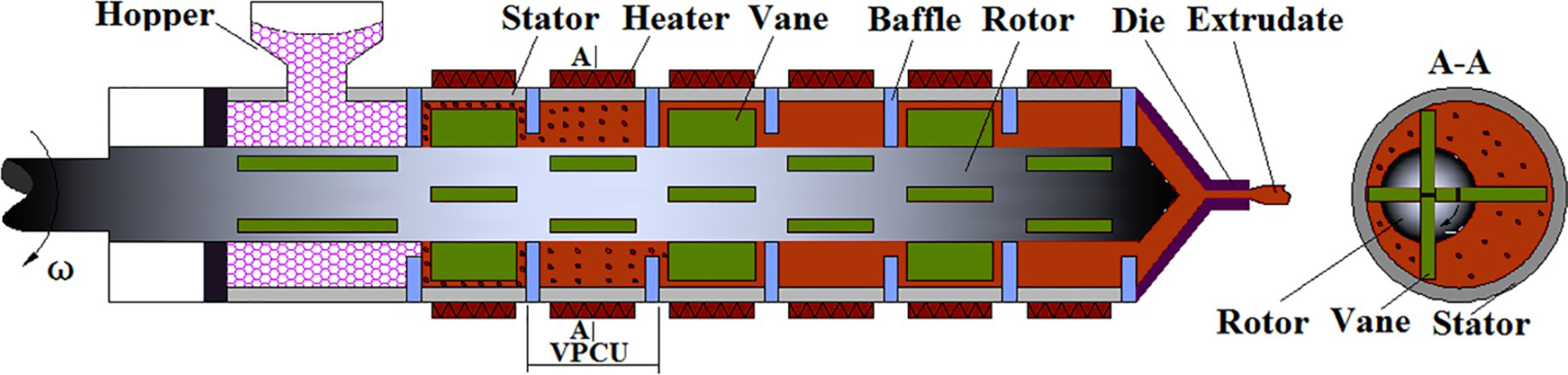
Schematic diagram of the vane extruder
Main parameters of Vane extruder

Morphology
Scanning electron microscopy was used to observe the morphology of the fractured surface to evaluate the distribution of HGM in TPU. The SEM images of the fracture surface for the pure TPU and TPU/HGM composites with different HGM loadings are shown in Fig. 2a–f. The pure TPU shows a singular dispersed phase (Fig. 2a) because the sole component of the sample is TPU. On the other hand, it is seen from Fig. 2b–f that HGMs are exposed on the fracture surface or peeled from the matrix to from holes or embedded in the matrix. The absence of shattered HGM in the fractured surface suggests that the interface between the TPU matrix and the HGM is weak. Moreover, during the fracture process, cracks propagate along the TPU matrix/HGM interface. Similar morphological variations were previously reported for other HGM reinforced polymer composites.29, 44 The SEM images also show that no obvious reunion phenomenon was observed, illustrating that the continuous volume extensional flow generated in the vane extruder had good effects on the dispersion of HGM in the TPU matrix.
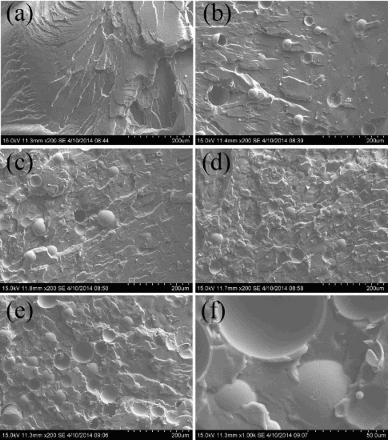
a pure TPU ( × 200); b TPU+5 wt-% HGM ( × 200); c TPU+10 wt-% HGM ( × 200); d TPU+15 wt-% HGM ( × 200); e TPU+20 wt-% HGM; f TPU+20 wt-% HGM ( × 1000)Images (SEM) of fractured surfaces of composites at different formulations
The possible dispersing mechanism of HGM under the elongational flow field is shown in Fig. 3. As we all know, for the steady shear case, the velocity gradient is almost perpendicular to the flow direction. The inorganic particle aggregates were inclined to move in a shear layer and generated the rotation of itself. Thus, the aggregates were difficult to disperse as separated particles in steady shear flow. However, according to recent published works, the inorganic particle aggregates are more efficiently broken under elongational flow than shear flow. 33 In this study, the vane extruder has improved significantly the elongational flow during polymer processing, and it is much stronger than the shear flow in the vertical direction. In addition, it is conductive to the uniform dispersion of HGM in TPU matrix.
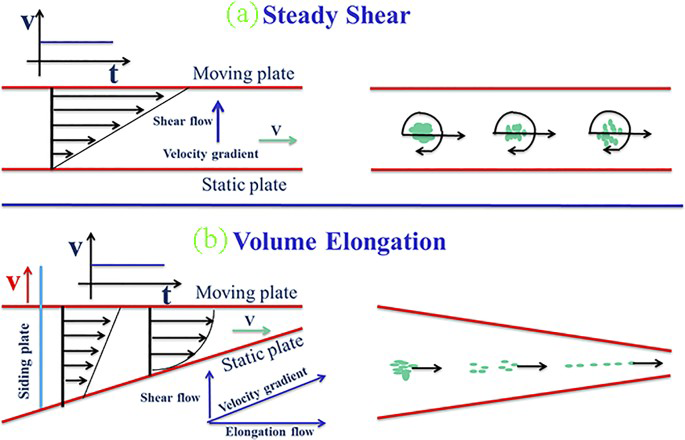
a steady shear flow; b volume elongational flowSchematic diagram of dispersing process for nanoparticles in different flow field
Thermal properties
Previous studies demonstrated that the addition of inorganic fillers may affect the thermal properties of polymers.32, 36 Evaluating the extent to which HGM influences the thermal stability of TPU is necessary. The effect of HGM on the melting behaviour of TPU/HGM composites was studied by TGA. Figure 4a shows the plot of relative weight loss as a function of temperature. To achieve a clear visualisation of the degradation process, the first derivative TGA curves of the composites were plotted as a function of temperature (Fig. 4b). The onset degradation temperature T5 was determined arbitrarily as the temperature at which 5 wt-% degradation occurred; T50, the temperature after 50 wt-% degradation, was obtained from three individual tests per sample, and the average values were plotted as a function of temperature (Table 2). The temperature values at which maximum rate of blend degradation occurred Tmax were also obtained from the three tests, and the average values are plotted as a function of temperature (Table 2).
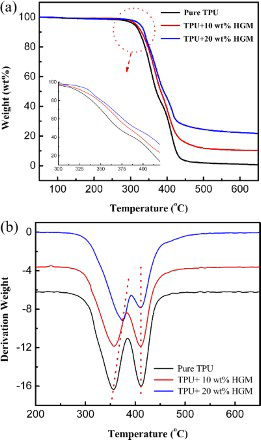
Thermogravimetric analysis and derivative TGA curves of pure TPU and TPU/HGM composites
Thermal stability parameters for TPU and TPU/HGM composites

The TGA curves indicate that the thermal degradation of the pure TPU and TPU/HGM composites consisted of two weight loss between 300 and 450°C, corresponding to the soft segment and hard segment respectively.7, 45 All of the pure TPU and its composites present similar behaviour, and the corresponding results are tabulated in Table 2. The real inorganic content, measured as the residue left at 600°C, is also presented. As shown in Table 2, the T5 of the pure TPU is 310.34°C, which increased to 315.92 and 327.13°C with the addition of 10 and 20 wt-% HGM respectively. The T50 of the pure TPU, TPU/10 wt-% HGM and TPU/20 wt-% HGM were 370.56, 383.42 and 392.56°C respectively. The Tmax1 of the TPU/HGM composites appeared at ∼357.71 and 375.05°C for TPU with 10 and 20 wt-% HGM content, which were ∼2.37 and 19.71°C higher than that of pure TPU respectively. These results indicated that the incorporation of HGM improves the thermal stability of the polymer materials. This behaviour is generally attributed to the physical barrier effect of HGM, which restricts polymer chain mobility and keeps decomposed products out of the polymer composites, resulting in retardation of thermal decomposition in the composites.46–48
Some differences were observed in the examination of the HGM contents. The real HGM content reported in Table 2 (measured as the residue left at 600°C) is different from the designed composition. This difference can be due to the uneven dispersion of HGM in the matrix. Further studies are needed to improve the dispersibility of HGM.
Dynamic mechanical property analysis
Plots of dynamic loss (tanδ) as a function of temperature for the pure TPU and TPU/HGM composites with different HGM loadings are shown in Fig. 5. The pure TPU showed a peak at − 10.3°C, which is associated with the glass transition of the original TPU. When TPU was filled by HGM, the glass transition peak of TPU increased to − 8.7 and − 6.2°C for 10 and 20 wt-% HGM contents respectively. This behaviour may be ascribed to the presence of rigid HGM in the TPU matrix, thereby increasing the glass transition temperature.46, 49
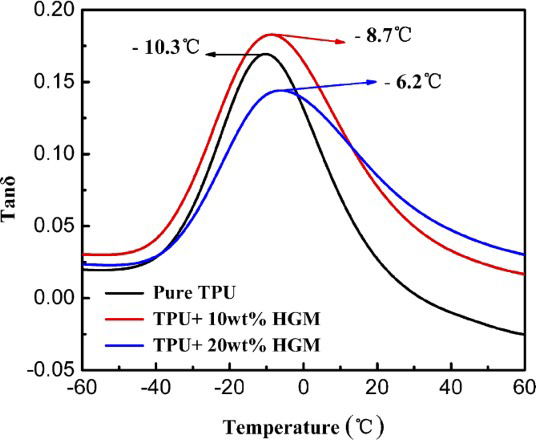
Tanδ versus temperature for pure TPU and TPU/HGM composites
The temperature dependence of the storage modulus E′ of the pure TPU and TPU/HGM composites is illustrated in Fig. 6. In the experimental temperature range, all of the HGM filled TPU composites show higher E′ than that of pure TPU. The HGMs with high modulus are favourable for load transfer across the phase interface between HGM and TPU. As a result, some enhancements of the modulus of the HGM filled TPU are achieved.
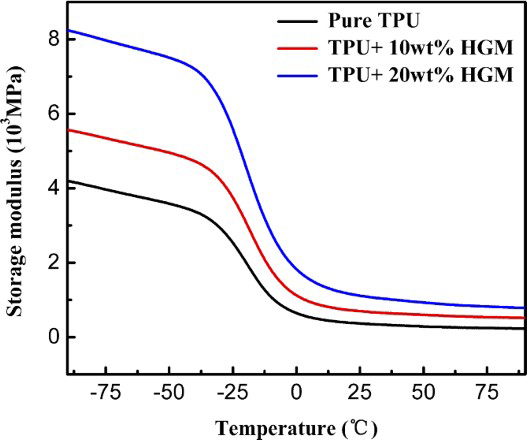
Temperature dependence of E′ for pure TPU and TPU/HGM composites
Dynamic rheological analysis
Dynamic rheological analysis can provide information about the evolution of the polymer materials in the melt state, which can be used to anticipate the internal structures and processing properties of polymer materials.29, 50 Storage modulus G′ represents the elastic response of a material, which relates to the potential energy stored by the material during deformation. Thus, G′ can be used as a comparative estimate of the stiffness of a material. 51 Figure 7 represents the frequency dependence of G′ for the TPU and TPU/HGM composites measured at 200°C. The G′ of the composites increased with the content of HGM. This result has been considered in the literature as indicator of the interactions between particles and polymer chains, which produce a percolated network.29, 51 This result indicates that large scale polymer relaxations are effectively restrained by the presence of HGM. Therefore, the incorporation of HGM improves the stiffness of TPU, which is consistent with the results in other reports.29, 52
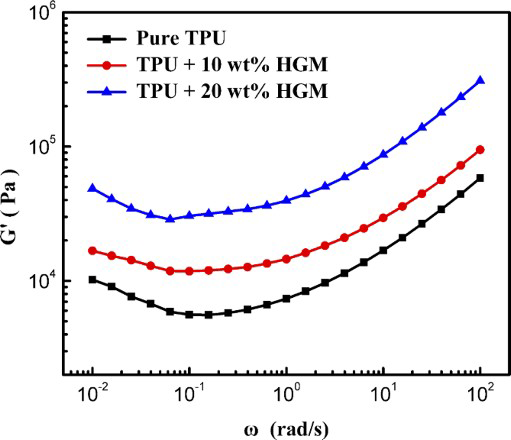
Storage modulus G′ versus angular frequency ω for pure TPU and TPU/HGM composites
The complex viscosity η* values of pure TPU and the composites measured at 200°C as a function of angular frequency ω are shown in Fig. 8. In the shear rate range, the η* of pure TPU and all of the composites show shear thinning effect, which is ascribed to the reduction in entanglement density of TPU chains under high shear stress. Furthermore, the filled samples exhibit a significant increase in viscosity with the increase in HGM content. This phenomenon can be attributed to the interactions established between the polymer melt and the microscopically rough HGM surface. 29 The observed η* values indicate that the incorporation of HGM does not change the shear thinning behaviour of the composites, but affects the extent of viscosity at a given shear rate and specified temperature. Similar results are found in other reports involving polymer based/HGM composites.29, 52
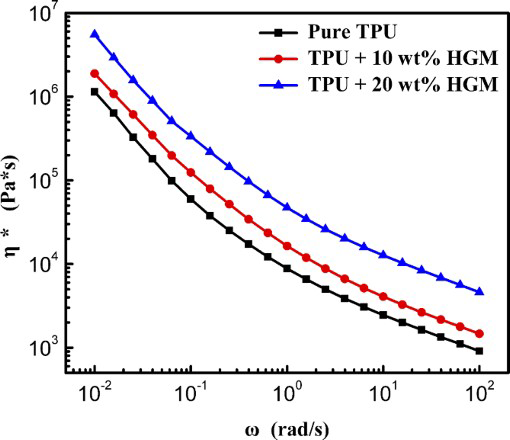
Complex viscosity η* versus angular frequency ω for pure TPU and TPU/HGM composites
Mechanical properties
The tensile stress–strain curves for pure TPU and HGM filled TPU composites are shown in Fig. 9. The elongation at break decreases monotonously with the increase in HGM content. Figure 10 shows the dependence of tensile strength and modulus of TPU/HGM composites as a function of HGM content. With the increase in HGM content, the tensile strength decreases monotonously, whereas the modulus increases continuously. For example, tensile strength decreases to 66.72, 236.52, 33.39 and 27.02 MPa, whereas the converse modulus increases to 49.03, 54.02, 67.50 and 81.29 MPa with the increase in HGM content from 5 to 20 wt-%. The remarkable decrease in tensile strength and elongation at break can be ascribed to the agglomeration of HGMs with the increase in loading, thereby decreasing the effectiveness of HGM reinforcement. 29 The increase in modulus is also caused by the presence of dispersed HGM, which improves the stiffness of the composites. The modulus enhancement corresponds well with the dynamic rheological measurements.
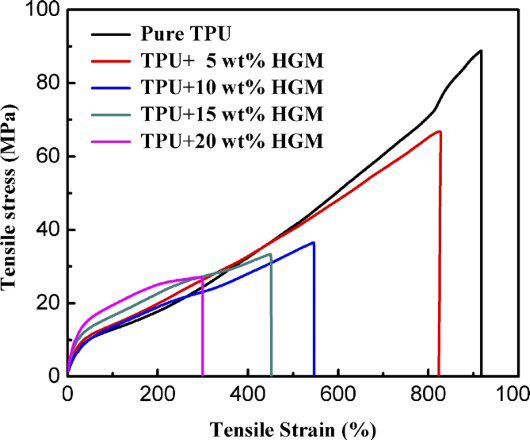
Stress–strain curves for TPU/HGM composites with various HGM contents
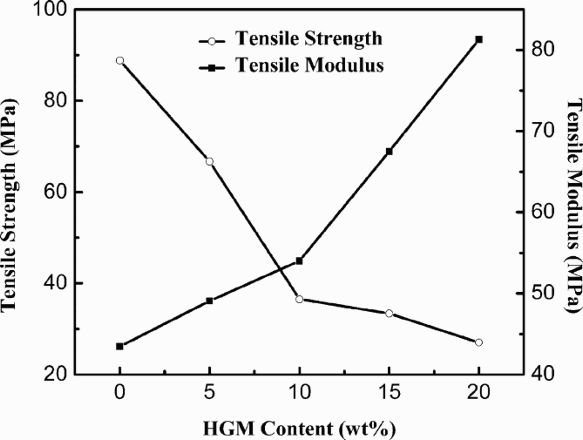
Tensile strength and tensile modulus (right) for TPU/HGM composites with various HGM contents
Density and hardness of composites
The density of pure TPU and TPU/HGM composites was measured by a densimeter and was shown in Fig. 11. It is clear that the density of the composites decreases with the increase in HGM content. The density for TPU/HGM composites with different HGM loadings was 1.201, 1.091, 1.018, 0.928 and 0.867 g cm− 3 for 0, 5.0, 10.0, 15.0 and 20.0 wt-% respectively. Furthermore, the density of the HGM/TPU composites, which blended by vane extruder and screw extruder respectively, was compared to illustrate the processing benefits of vane extruder. As shown in Fig. 11, all the densities of the HGM/TPU composites blended by screw extruder were higher than those of composites blended by vane extruder. The reason may be that there are a lot of microsphere that were broken up by the shear flow. This result indicates that the utilisation of HGM in TPU can lead to lightweight and high performance composites blend by vane extruder.
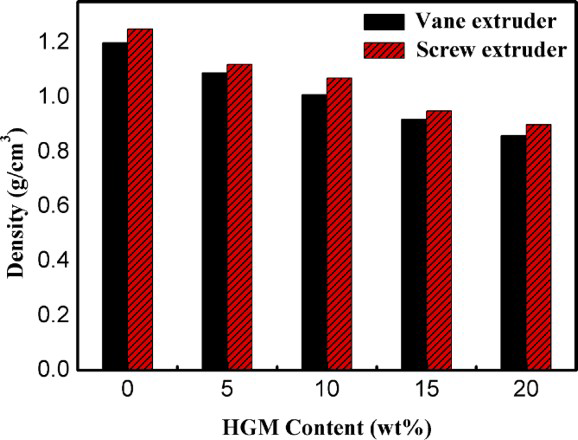
Density for TPU/HGM composites with various HGM contents
The hardness of pure TPU and TPU/HGM composites was measured by a shore rubber scleroscope, which is shown in Fig. 12. The hardness of the composites increases with the increase in HGM content. It was clear that the HGM made the TPU much stiffer, which coincided with the results from tensile tests.
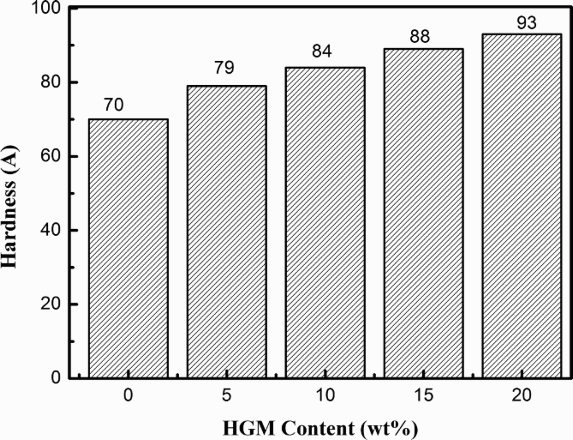
Hardness for TPU/HGM composites with various HGM contents
Thermal conductivity
Figure 13 shows thermal conductivity for TPU control material and TPU/HGM composites. Because of the lower thermal conductivity of HGM, the resultant TPU/HGM composites have significantly lower thermal conductivity, and thermal conductivity is found to decrease with increase in HGM content in the composite.
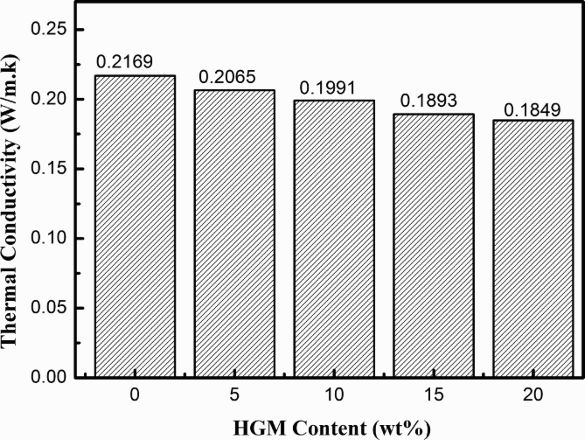
Thermal conductivity for TPU/HGM composites with various HGM contents
Conclusions
In this study, HGM reinforced TPU elastomer composites have been prepared by vane extruder. Testing of morphological, mechanical, rheological and thermal properties revealed that HGM plays an important role as reinforcement for improving stiffness and thermal stability of TPU. Moreover, the addition of HGM significantly decreased the density and thermal conductivity of the composites. The storage modulus, viscosity and hardness of the composites were enhanced with the increase in HGM content. The present results shed some light on improving the properties of TPU and extending its applications by the incorporation of HGM.
Acknowledgements
The authors wish to acknowledge the Specialized Research Fund for the Doctoral Program of Higher Education (no. 20120172130004), National Nature Science Foundation of China (grant nos. 10872071, 50973035 and 50903033), National Natural Science Foundation of China-Guangdong Joint Fundation Project(U1201242), National Key Technology R&D Program of China (grant nos. 2009BAI84B05 and 2009BAI84B06), Program for New Century Excellent Talents in University (no. NCET-11-0152) and Pearl River Talent Fund for Young Sci-Tech Researchers of Guangzhou City (no. 2011J2200058) for the financial supports.