







Abstract
Poly(ethylene glycol-co-1,4-cyclohexanedimethanol terephthalate) (PETG) with 30% 1,4-cyclohexanedimethanol is an amorphous material, which is suitable for use as a transparent matrix. In order to prevent the potential damage caused by direct exposure to the harmful light such as ultraviolet (UV) and high energy visible (HEV) light, PETG/UV absorber/benzidine yellow composite films were prepared by blending PETG resin with functional additives and then compression moulding. Optical properties of the composite films with different UV absorbers or varying benzidine yellow concentrations were investigated via an UV–visible spectrophotometer. The PETG/Tinuvin 326/benzidine yellow composite films show more than 80% optical transparency in the visible light range, 99% shielding efficiency of UV blocking up to 400 nm and absorption of HEV light from 400 to 500 nm. The protection materials could be applied to windows of automobiles and buildings, light emitting screens and sunglasses as visibly transparent, UV opaque and HEV light filtering optical films.
Introduction
With increasing concern for protecting polymer materials,1–4 human skin5, 6 and eyes 7 from ultraviolet (UV), photoprotective materials with high visible transparency as well as UV blocking properties are needed for application as shop windows, product packaging materials and contact lenses. It is well established that high energy visible (HEV) wavelength representing the violet/blue band from 400 to 500 nm in the visible spectrum is harmful to human tissue, including eyes, living epidermis and dermal.8, 9 Some diseases related to eyes, such as age related macular degeneration,10, 11 are strongly associated with HEV light. High energy visible light can also cause the photoaging of polyvinyl butyral. 12 Exposure to HEV light has and will be more frequent in daily life with the increasing development and usage of digital products such as light emitting diodes that are applied to televisions, computer monitors and other screen displays, or cold cathode fluorescent lighting that is applied to neon lamps and discharge tubes. Therefore, it is desirable to develop protection materials that are capable to filter UV and HEV light.
The properties of the composite materials can be functionally designed through judicious selection of additives and polymers. Poly(ethylene terephthalate) (PET) has been used widely in fibrous textile materials 13 and packaging applications 14 because of its excellent thermomechanical and mechanical properties, gas barrier property as well as clarity. Poly(ethylene terephthalate) is a semicrystalline polymer and tends to crystallise to make it opaque and limits its uses in some applications that require optical transparency.13–15 Therefore, poly(ethylene glycol-co-1,4-cyclohexanedimethanol terephthalate) (PETG) as a thermoplastic of the PET family is used to describe PET with 50% or less 1,4-cyclohexanedimethanol (CHDM) modification, which decreases crystallinity and reduces the crystallisation rate by replacing some of the ethylene glycol with secondary glycols. The compositions with various ratios of CHDM exhibit different rates of crystallisation and degrees of crystallinity. 16 In our previous study, 17 the composition of PETG containing a glycol ratio of ∼70% ethylene glycol and 30%CHDM is amorphous, which exhibits superior transmission in the visible range and excellent mechanical properties.
In outdoor applications, polymer materials are frequently exposed to solar radiation. In this case, UV absorbers play a significant role in additives for protecting outdoor polymer materials against UV radiation.4, 18 In most recent literatures, nanoinorganic particles such as ZnO,19, 20 TiO2 21, 22 and CeO2 23 with wide band gap were used to shield UV light in the UV shielding composite materials. However, this method easily gives rise to the aggregation of nanomineral, which would influence the properties of composite materials, especially optical transparency. Organic UV absorbers are colourless or slightly coloured organic substances that are used as additives in order to protect light sensitive materials from photodegradation under irradiance of natural or artificial light. 24 Organic UV absorbers are more suitable for transparent materials because of less impact on visible transmittance and better UV shielding efficiency.
For the mixing of coloured light, a pair of complementary colours, such as yellow and blue, when combined, cancels each other out. Thus, pigment yellow absorbs the blue light, which is the HEV light, minimising risks to human eyes and skin. Appropriate amount of pigment yellow can be functionalised as HEV light absorber to control the HEV light transmittance within a reasonable range.
In the current investigation, the visibly transparent, UV shielding and HEV light filtering optical films were prepared by adding UV absorbers and benzidine yellow (PY 14) to a PETG matrix. The prepared PETG/UV absorber /PY 14 composite films can be easily applied as functional optical materials while exhibiting a tunable absorption band edge.
Experimental
Materials
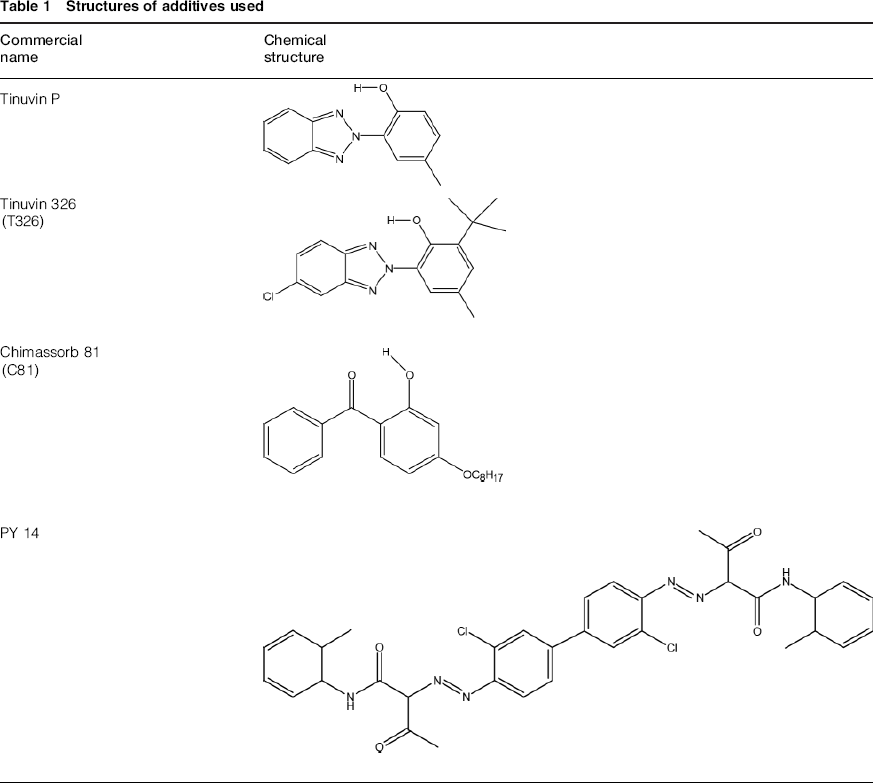
Poly(ethylene glycol-co-1,4-cyclohexanedimethanol terephthalate) (0603) was purchased from Eastman Chemical Co., America. Two benzotriazole type UV absorbers [2-(2-hydroxy-3-tert-butyl-5-methylphenyl)-5-chlorobenzotriazole, Tinuvin 326] and [2-(2-hydroxy-5-methyl-phenyl) benzotriazole, Tinuvin P] and a benzophenone type UV absorber [2-hydroxyl-4-(octyloxy) benzophenone, Chimassorb 81] were all purchased from Ciba Specialty Chemicals (China) Ltd, China. Benzidine yellow {2,2′-[(3,3′-dichloro[1,1′-biphenyl]-4,4′-diyl) bis(azo)]bis[N-(2-methylphenyl)-3-oxobutyramide], PY 14} was kindly supplied by Nanjing Huage Electronics & Automobile Plastic Industry Co. Ltd, China. 1,1,2,2,-Tetrachloroethane was purchased from Shanghai Lingfeng Chemical Reagent Co., Ltd, China. The structures of these additives are shown in Table 1.
Structures of additives used
Preparation of protective films
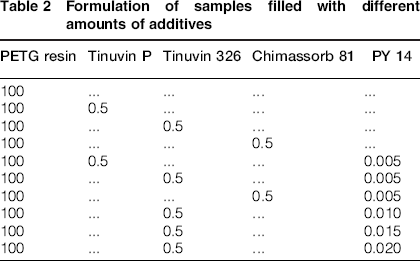
The protection material was developed by modifying transparent PETG resin with a variety of UV absorbers and PY 14. Two benzotriazole type UV absorbers, (Tinuvin P and Tinuvin 326) and a benzophenone type UV absorber (Chimassorb 81) were used. The per hundred ratio (phr) of UV absorber and PY 14 relative to PETG resin is shown in Table 2.
Formulation of samples filled with different amounts of additives
Transparent PETG resin, UV absorber and PY 14 were mixed on a laboratory two-roll mill at 120°C. Then, the compound films of ∼0.2 mm thickness were prepared by hot moulding at 180°C with a pressure of 10 MPa for 10 min.
Spectroscopic measurements
Tinuvin P, Tinuvin 326 and Chimassorb 81 were dissolved in tetrachloroethane with moderate concentration (10− 5 mol mL− 1) respectively. The transmittance and absorbance spectra were acquired via a UV–visible spectrophotometer (UV-3200 Shanghai Mapada Instruments Co., Ltd, China) from 200 to 800 nm wavelength. The prepared PETG composite films were mounted on a solid sample holder, and the UV absorber solution was filled in quartz glass containers for measurements.
The average transmittance can be estimated from the equation below

 is the calculated value of average transmittance,
 is the wavelength of the light and
 is the transmittance measured by a UV–visible spectrophotometer when wavelength of the incident light is
 .
.
 and
and
 are the bounds of the measuring range. The average transmittance of UV (200–400 nm), HEV (400–500 nm) and visible light (400–780 nm) can be estimated from the equation.
Fundamental principle
Figure 1 describes light transmission through the PETG film with and without the additives addition. As shown in Fig. 1a, the neat PETG can block UV light up to 300 nm. This is because the aromatic terephthalic units in PETG absorb UV at a corresponding range. Ultraviolet absorbers used to filter UV radiation and dissipate the energy in the form of heat can be used as UV blocker. Figure 1b schematically illustrates that the UV absorbers play an effective role in dissipating the UV light at a range up to 400 nm and prevent the transmission of UV light through the PETG film.
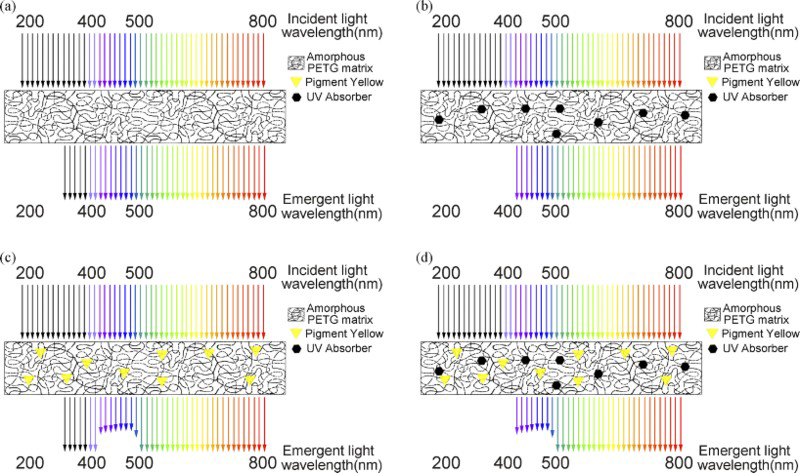
Schematic diagram of ultraviolet shielding, HEV light filtering and high visible light transparency PETG film
According to the theory of complementary colours in the RGB model, the light of two complementary colours, such as yellow and blue, combined at full intensity, will make white light, since two complementary colours contain light with the full range of the spectrum. In Fig. 1c, appropriate amount of pigment yellow can be functionalised as blue light absorber to control the high energy visible light transmittance to a reasonable range. The resultant effect of UV absorber and pigment yellow is shown in Fig. 1d. The PETG composited film demonstrates UV light opacity (∼400 nm), translucence of high energy visible light (400–500 nm) and high transmission of visible light in the range of 500–780 nm wavelength.
Results and discussion
Figure 2a shows the transmittance spectra of PETG/UV absorber (0.5 phr relative to PETG resin) composite films with a thickness of ∼0.2 mm. In the visible range (400–780 nm), the transmittance spectrum of neat PETG film and the PETG/UV absorber composite film shows more than 80% transparency. Addition of UV absorbers into PETG maintained the high optical transparency of PETG in the visible light range. In the UV range (200–400 nm), the neat PETG only blocks UV light up to 300 nm. Addition of UV absorbers (0.5 phr) into PETG leads to a wider UV blocking range.
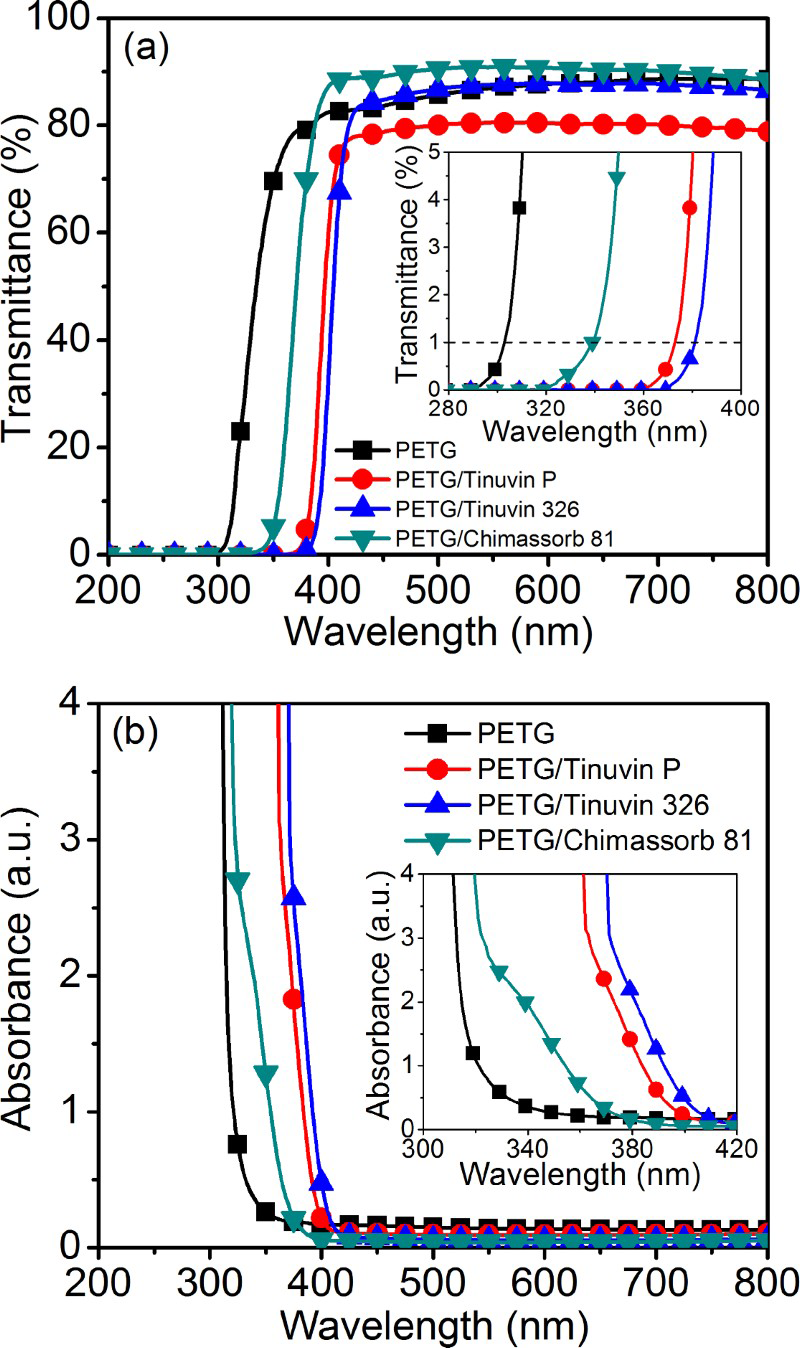
a transmittance and b absorbance spectra of PETG/UV absorber (0.5 phr) composite film with different UV absorber varieties (Tinuvin P, Tinuvin 326 and Chimassorb 81)
As shown in Fig. 2a, PETG/Tinuvin 326, PETG/Tinuvin P and PETG/Chimassorb 81 composite films block 99%UV at a range up to ∼380, 370 and 340 nm respectively. This observation is consistent with the absorption range as shown in Fig. 2b. The UV absorbers used here could shield the UV light. An essential property of UV absorbers is that they possess a mechanism for the rapid dissipation of the absorbed UV radiation via some suitable intramolecular rearrangement.25–27 Correspondingly, the photostabilisation mechanisms are shown in Fig. 3. Tinuvin 326 and Tinuvin P belong to 2-hydroxybenzotriazole derivatives, and Chimassorb 81 belongs to 2-hydroxybenzophenone derivatives. The different molecular structures correspond to different UV absorption ranges. As shown in Fig. 4, the benzotriazole based UV absorber exhibits high absorption over a wider range, relative to the benzophenone based UV absorber. Chimassorb 81 exhibits a maximum peak of the absorbance at ∼290 nm, which is consistent with Fig. 2. Meanwhile, it should be noted that Tinuvin P and Tinuvin 326 respectively absorbed the UV light at a range up to 370 and 400 nm, while their shapes are similar. Therefore, in order to screen the UV at a broader range, Tinuvin 326 is the better candidate.
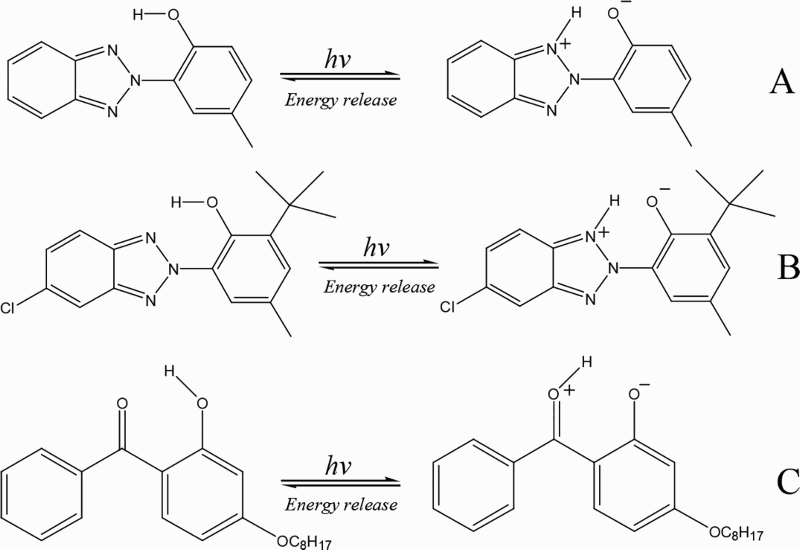
Photostabilisation mechanisms of Tinuvin P (A), Tinuvin 326 (B) and Chimassorb 81 (C)
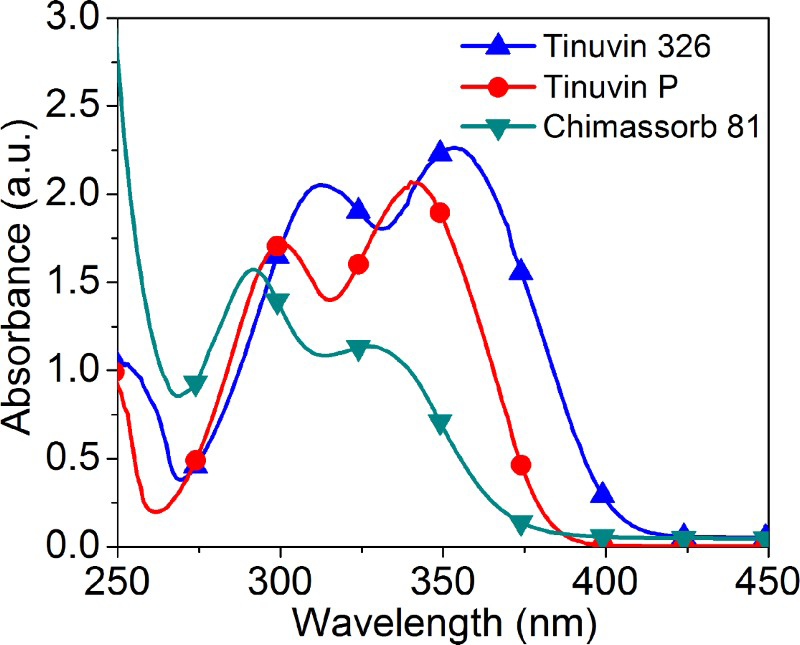
Absorbance spectra of UV absorbers in 1,1,2,2,-tetrachloroethane (10− 5 mol mL− 1), from 250 to 450 nm, with a resolution of 1 nm
Figure 5a shows the transmittance spectra of PETG/UV absorber (0.5 phr)/PY 14 (0.005 phr) composite films with a 0.2 mm thickness. It clearly indicates that the introduction of PY 14 did not affect UV shielding performance. The film reveals a very high transparency in the visible region with a small absorption tail between 400 and 500 nm that is responsible for its slight yellowish coloration. In addition, a little absorption in the range from 400 to 500 nm in Fig. 4b confirmed the above conclusion.
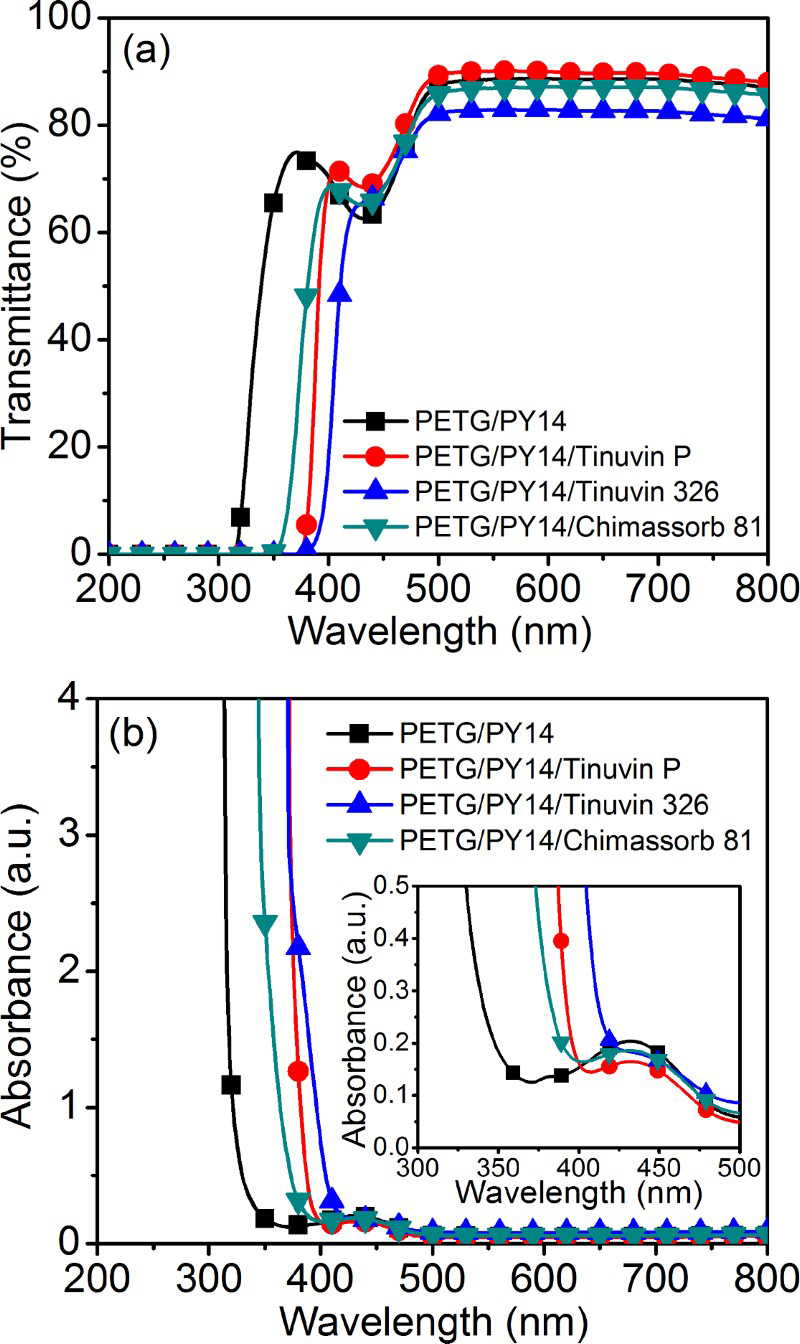
a transmittance and b absorbance spectra of PETG/UV absorber (0.5 phr)/PY 14 (0.005 phr) composite film with different UV absorber varieties (Tinuvin P, Tinuvin 326 and Chimassorb 81)
PY 14 is working as the HEV light absorber to filter part of HEV light. As shown in Table 3, PY 14 at 0.005 phr in the PETG resin showed ∼70% transparency from 400 to 500 nm.
Average transmittance of PETG/UV absorber (0.5 phr)/PY 14 (0.005 phr) composite films in each wave band
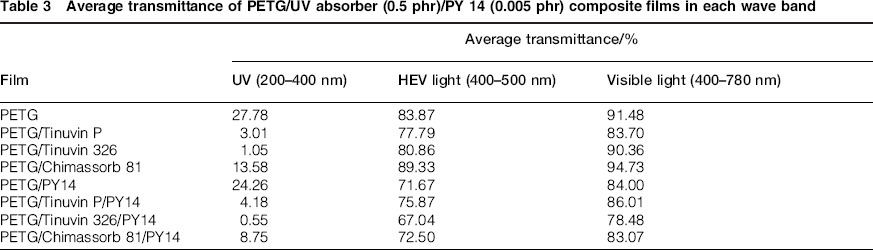
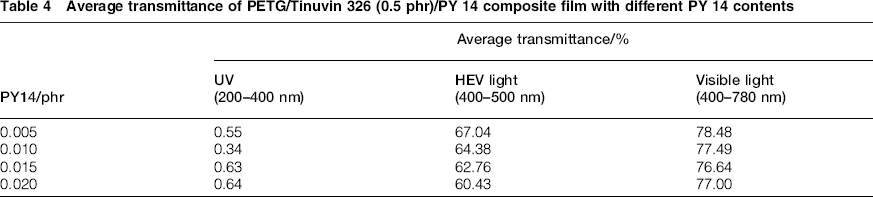
Figure 6 presents the transmittance and absorbance spectra of PETG/Tinuvin 326/PY 14 composite film with different contents of PY 14. As expected, an increase in PY 14 concentration also heightened the HEV light filtering capability. As shown in Table 4, the 0.020 phr PY 14 sample filtered out ∼40% of the HEV light. PY 14 is a pigment that is particularly sensitive to light absorption in the wavelength ranging from 400 to 500 nm. The filtering efficiency of HEV light was primarily determined by the chromophore concentration within the sample. It can be understood that, based on the law of complementary colour, the HEV light transmittance can be controlled by adjusting the content of PY 14.
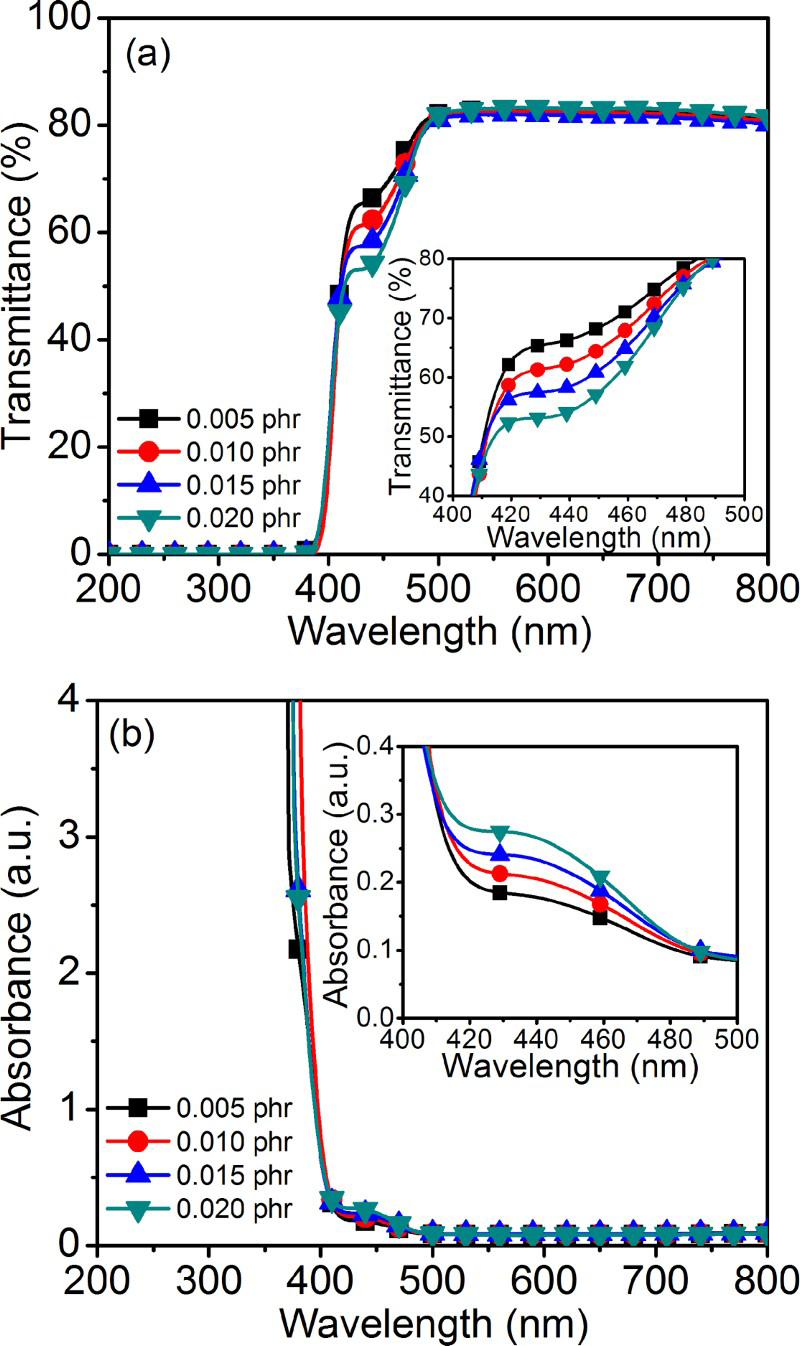
a transmittance and b absorbance spectra of PETG/Tinuvin 326 (0.5 phr)/PY 14 composite film with different PY 14 contents
Average transmittance of PETG/Tinuvin 326 (0.5 phr)/PY 14 composite film with different PY 14 contents
The effect of blue light filtering can be directly observed from the images in Fig. 7. As shown, the composite films are highly transparent with no visible clouding in all of the samples. The only difference observed is that the samples with high PY 14 content appear more yellowish. Meanwhile, the blue logo seems to be black through the high PY 14 content film because blue light has been filtered.
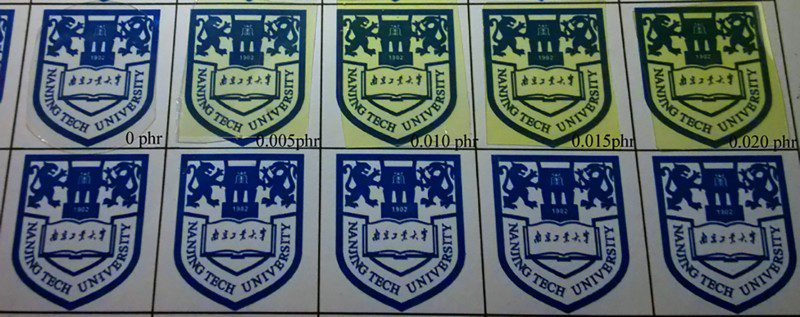
Digital photographs of PETG/Tinuvin 326 (0.5 phr)/PY 14 composite films with different PY 14 contents (0, 0.005, 0.010, 0.015 and 0.020 phr); to aid comparisons with filtering effect of sample, downside pattern background was provided
Conclusions
In this study, three kinds of UV absorber were added separately or in combination with benzidine yellow (PY 14) into PETG to investigate their UV shielding efficiency. Tinuvin 326, the benzotriazole based UV absorber with special molecular structure, is observed to be the suitable one, shielding the UV light up to 400 nm. The PY 14 demonstrates the ability to absorb the HEV light in the wavelength ranging from 400 to 500 nm.
To summarise, excellent synergism is to incorporate UV absorber and benzidine yellow with thin PETG film in a suitable proportion. The prepared PETG/Tinuvin 326 composite films demonstrate more than 90% transparency of visible light and 99% blocking efficiency in the range up to 380 nm. The PETG/Tinuvin 326/PY 14 composite films show low transparency of HEV light, and the increase in the PY 14 concentration leads to higher HEV light filtering efficiency.
Footnotes
Acknowledgement
We would like to express our sincere thanks to the Priority Academic Program Development of Jiangsu Higher Education Institutions.