







Abstract
Ternary carbides of titanium and aluminium were prepared via mechanical alloying and following heat treatment. Effects of the starting materials, milling time and heat treating temperature were investigated. In order to study the structural and morphological evolutions of the ball milled and annealed powders, X-ray diffraction (XRD) and scanning electron microscopy (SEM) were used. Results showed that the ball milling of TiO–Al–C as starting materials was unsuccessful for the synthesis of Ti3AlC2. On the other hand, ball milling of the elemental powders for shorter milling times led to the activation of powders and after longer milling times, Ti–TiC nanocomposite was obtained. Also, during the annealing of the 6 h milled sample, Ti3AlC2–Ti4Al2C2 nanocomposite was synthesised. At the end of milling, a very fine microstructure with narrow size distribution and spheroid particles was procured.
Introduction
Titanium aluminium carbide (Ti3AlC2) is a novel material, which possesses many of the best attributes of both metals and ceramics. It belongs to the so called ‘312’ ternary carbides material group (i.e. Ti3SiC2, Ti3AlC2 and Ti3GeC2).1–6 Like a metal, it is a good electrical and thermal conductor, easily machinable, damage tolerant at room temperature and resistant to thermal shock. Like a ceramic, it is lightweight, elastically stiff, with the Young's modulus of 297 GPa and shear modulus of 124 GPa and it retains its strength at high temperatures.2 Ti3AlC2 has high compressive strength at both room and high temperatures. Its failure below 1000°C is due to shear fracture, while above 1050°C, the deformation is ductile.3 Meanwhile, Ti3AlC2 has excellent oxidation resistance due to the formation of a continuous adhesive Al2O3 layer on the Ti3AlC2 surface at higher temperatures.3
The synthesis of Ti3AlC2 was reported by several researchers after 1994. Pietzka and Schuster synthesised this material for the first time through sintering cold compacted powder mixtures of titanium, TiAl, Al4C3 and graphite at 1300°C in H2 atmosphere for 20 h.7 Ti3AlC2 was synthesised by various methods such as pulse discharge sintering, plasma activating sintering, hot pressing, conventional heating and combustion synthesis.8–15 Elemental Ti, Al and C or other compounds such as TiC, TiAl and Al4C3 were used as starting materials in the studies above.
Recently, the mechanically activated synthesising process, including a combination of the mechanical milling of the mixed powder to a superfine structure (the first step) followed by heat treatment (the second step), has attracted much interest, due to its use in synthesising various homogeneous and nanostructured materials. Mechanical alloying is basically a dry and high energy ball milling process, which has been used to synthesise alloys, oxide dispersion strengthened alloys, amorphous alloys and various intermetallic compounds.16,17 Li et al. obtained Ti3AlC2 single phase after milling the elemental powder with different ball to powder weight ratios (BPR) followed by high temperature sintering (1250–1350°C).18
The aim of this work is the synthesis of Ti3AlC2 via mechanical alloying and heat treatment of two kinds of starting materials. Also the authors tried to reduce the milling time, BPR and heat treatment temperature in order to achieve rapid synthesis of Ti3AlC2.
Experimental
Ti (99·9%, <100 μm), Al (99·8%, <200 μm), graphite (99·9%, <50 μm) and TiO (99%, <300 μm) were used as starting materials. These powders were mixed in the stoichiometric ratio in the following reactions


Phase transformation and crystallite size evolution during milling and heat treatment were determined by X-ray diffraction (XRD) analysis using a Philips diffractometer (30 kV and 25 mA) with Cu Kα radiation (λ = 1·5404 Å). All XRD experiments were performed with a step size of 0·02° and a time per step of 1 s. The morphology of the mechanically alloyed powder samples was examined by a Philips scanning electron microscope (SEM) operating at 20 kV. For the investigation of the thermal behaviour of the milled powders, conventional heating in the atmosphere control tube furnace was used. Heat treatment was performed at temperatures of 700 and 1000°C with heating rate of 15°C min−1 and holding time at the maximum temperature of 2 h.
Results and discussion
TiO reduction
In the first method, the feasibility of TiO reduction to synthesise Ti3AlC2 was investigated. Aluminium was used as the reducing agent. The structural evolutions of the starting materials during milling are shown in Fig. 1. Milling led to the decrease in the integrated intensity of the aluminium and graphite reflections after 3 h and at longer times (6 h), all of the Al and graphite reflections disappeared; meanwhile, no new phases existed at this stage of milling. These results indicate that the disappearance of Al and graphite may be due to the:
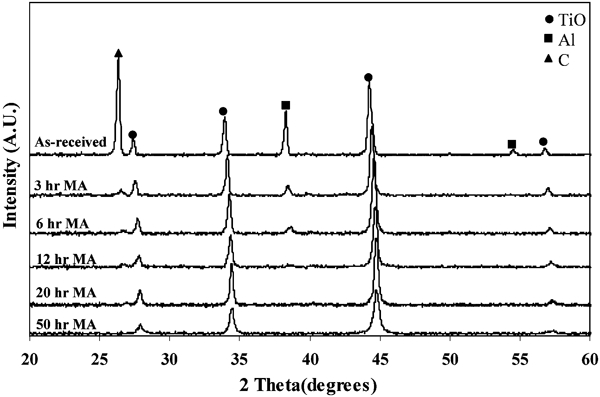
X-ray diffraction patterns of mechanically milled and as received powders
intimate mixing of the starting materials and the absorption of the diffracted X-rays of the light atomic weight atoms by high atomic weight atoms
solid solution formation.
The first possibility can be ignored due to the approximately same mass absorption coefficient of the starting materials (TiO and Al).19 On the other hand, it is correct for the disappearance of graphite reflections. The second possibility can be confirmed by the shift in the solvent phase reflections due to embedding of solute atoms into its lattice. The solute atoms occupy the interstitial or subsituational positions in the solvent lattice, depending on their sizes; solvent reflections may be shifted to smaller or higher angles. It can be seen in Fig. 1 that the TiO reflections, as solvent phase, shift to higher angles, which confirms the formation of TiO (Al) solid solution and the smaller size of aluminium atom. As the milling time increased to 20 h, solid solution formation process progressed (shifting of TiO reflections) and completed at longer milling times (there was no shift in TiO reflections).
At the end of milling, a nanocrystalline solid solution of TiO (Al) was formed with the mean grain size of 19 nm. This measurement is based on XRD profile analysis by Scherrer equation with the details presented in our previous paper.20
For obtaining Ti3AlC2 as a product, mechanically milled powders were annealed at two different temperatures, 700 and 1100°C. To compare the results, two kinds of samples were annealed. In the first 3 h milled sample, solid solution formation process was in the initial stage and in the second 50 h milled sample, this process completed. Figure 2 shows the results of these heat treatments. It can be seen that no new phase appeared in the patterns. All of reflections in the patterns are known as TiO. It can be concluded that the synthesised solid solution was stable during heating. Heat treatment led to the sharpening of TiO reflections, due to the microstructure refinement (grain growth and strain release). On the other hand, the mean grain size of TiO (50 h milled) increased from 19 to 23 nm during annealing. As a result, it is impossible to synthesise Ti3AlC2 by reduction of TiO under these conditions of milling and heat treatment.
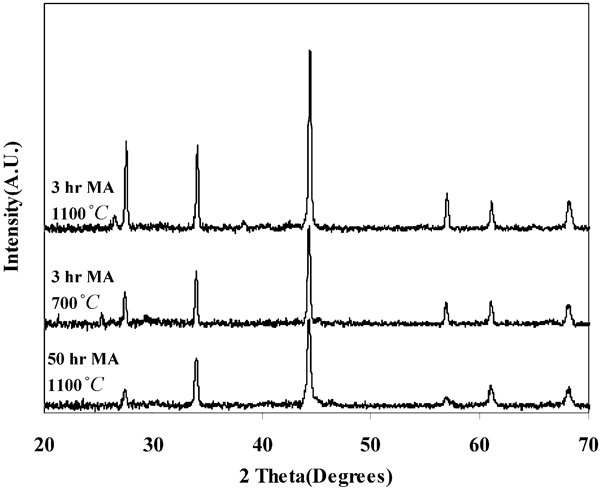
X-ray diffraction patterns of mechanically activated powders after heat treatment at different temperatures: all reflections are known as TiO
In spite of negative Gibbs free energy for reduction of TiO by Al (−1304·9 kcal mol−1)21 at room temperature, it can not be performed at these conditions of milling. It seems that the reaction kinetics may be kinetically unfavourable or the reduction reaction has very large energy barrier. This barrier may be due to the very strong ionic bonds of TiO21 that prevent it from being reduced by Al. Increasing the ball mill energy (rotating speed, BPR, time of milling, etc.) and increasing heating energy (temperature and time of annealing) are possible approaches for overcoming this barrier energy. It can be concluded that the formation of TiO (Al) solid solution is favourable thermodynamically and kinetically.
Direct reaction of elemental powders
Elemental powders of aluminium, graphite and titanium were mixed in the stoichiometry of Ti3AlC2. Figure 3 shows the XRD patterns of these starting materials. This mixture was milled for different periods. The structural evolutions of the milled powders are illustrated in Fig. 4. In the early stage of milling, only the broadening of the Ti reflections and strong decrease in Al and graphite reflections intensities took place. Lack of any shift in the Ti reflection positions leads to the conclusion that no reciprocal solid solution has occurred. It seems that the process of intimate mixing in the early stages of milling is responsible, to a large extent, for the decrease in the intensity of the Al and graphite reflections. In fact, the Al and graphite diffractions were significantly eliminated, due to the high X-ray absorption coefficient of Ti.19
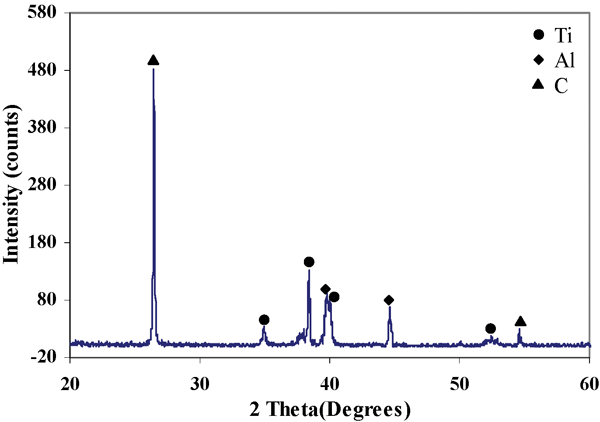
X-ray diffraction pattern of as received sample (mixture of Ti, Al and C)
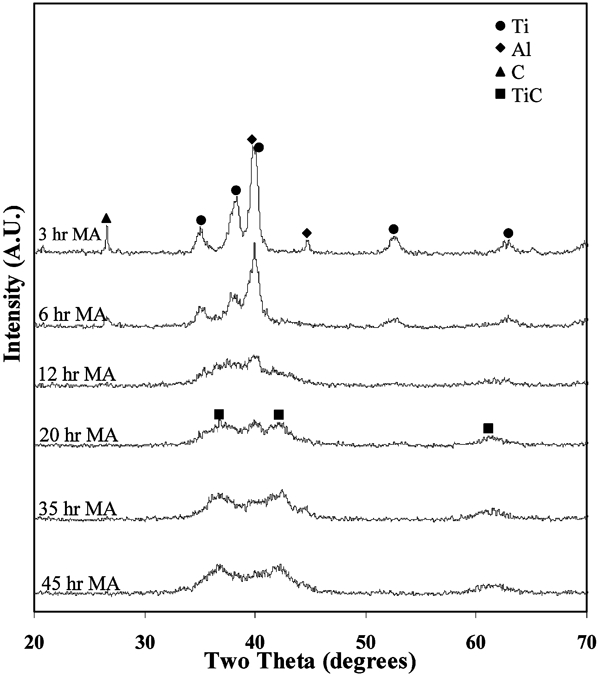
Structural evolutions of mechanically alloyed powders during milling by X-ray diffraction
The initial mixing continued up to 12 h of milling and led to the formation of nanocrystalline amorphous-like structure. This is confirmed by much broadened reflections of Ti after 12 h of milling. As the milling time rose to 20 h, TiC reflections appeared in the pattern. Meanwhile, the Ti reflections with the decreased intensity can still be observed. The formation of TiC instead of Ti3AlC2 implies that the former is thermodynamically and kinetically favourable, i.e. the Gibbs free energy formation of the former is more negative than the latter.21 With further milling to 45 h, the Ti reflections disappeared and the TiC reflections broadened. Disappearance of the Ti reflections was due to the very fine microstructure of the powders that led to elimination of the Ti reflections. On the other hand, Ti exists in the composition, but because of high mass absorption coefficient of TiC rather than Ti, its reflections cannot be observed.
The results of milling showed that the synthesis of Ti3AlC2 via milling only is unfeasible, so the milled powders were annealed at different temperatures, 700 and 1100°C. The milled samples can be categorised into two groups:
the powders that were only mechanically activated and no new phases were synthesised
the powders at longer milling times that included Ti and TiC.
The 6 and 45 h milled samples were selected from each group. The results of the heat treatment are presented in Fig. 5. Annealing of 6 h milled sample led to the appearance two kinds of Al–Ti ternary carbides in trace amount. Also the other effect of the heating is the sharpening of the Ti reflections, due to the grain growth and strain release. In spite of this microstructure refinement, the mean grain size of the Ti increased from 9 to 20 nm. In order to calculate the mean crystalline size, the Sherrer equation was applied to (ijk) peaks.19 As the annealing temperature increased to 1100°C, formation reaction of the Ti3AlC2 and Ti4Al2C2 were completed. Some other phases may be formed in this condition, but they cannot be identified by XRD method due to overlapping and low intensity of these phases.
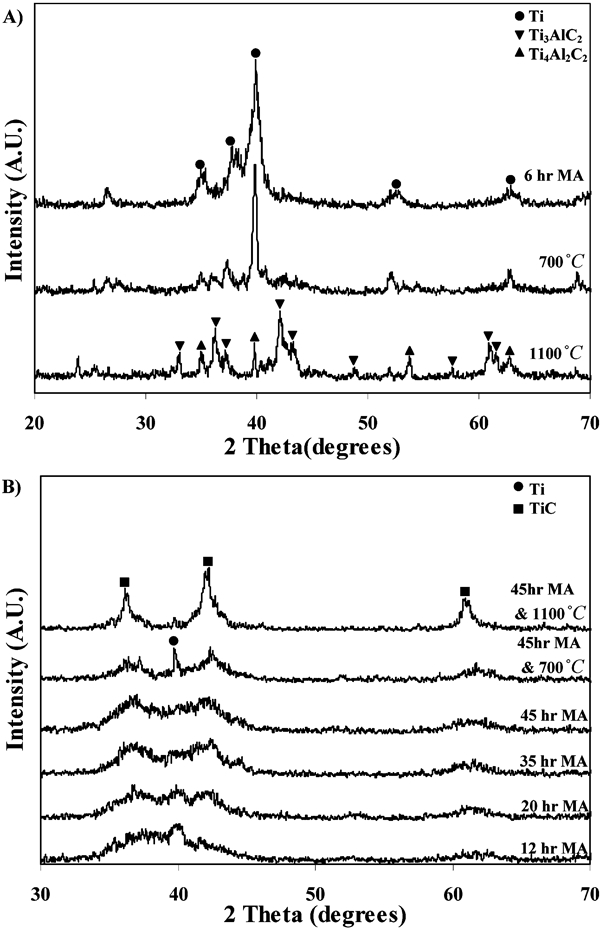
Effect of heat treatment on structural evolutions of milled powders
Heat treatment of 45 h milled powders had no interesting results. It is obvious from Fig. 5B that annealing cannot change the formed mixture during milling. Heating at 700°C led to only sharpening of the Ti and TiC reflections. On the other hand, a nanocomposite of Ti–TiC was obtained under these conditions. Aluminium in the milled (45 h) and annealed powders did not participate in any reaction and its reflections cannot be seen due to the high mass absorption coefficient of TiC.19 Comparison of this sample with the as milled sample shows that the Ti reflections appeared in the annealed sample. Ti reflections waned during milling because of high mass absorption coefficient of TiC.19 These results indicate that the ball milling of the starting materials for much time is unsuitable for synthesizing of Ti3AlC2 ternary carbide because of the high activity of the Ti and C for the formation of TiC.
To investigate the morphological changes during milling, SEM was used. It can be seen in Fig. 6B that the particles had very uneven and irregular shapes and sizes. These differences in the early stage of milling are due to dissimilarity of the starting materials, which were mixed. Ductility of the metallic powders leads to heavy plastic deformation and agglomeration during milling. It is obvious in Fig. 6B that the plastic deformation of the Al and Ti led to adhering and agglomeration of the smaller particles after 6 h of milling. Agglomeration and cold working are the dominating phenomena at this stage of milling. With increasing milling time to 20 h, the role of cold working decreased. Conversely, the effect of workhardening and fracturing increased. As it is observed in Fig. 6C, the cold worked particles in the previous stage fractured and formed the smaller particles and agglomerates.
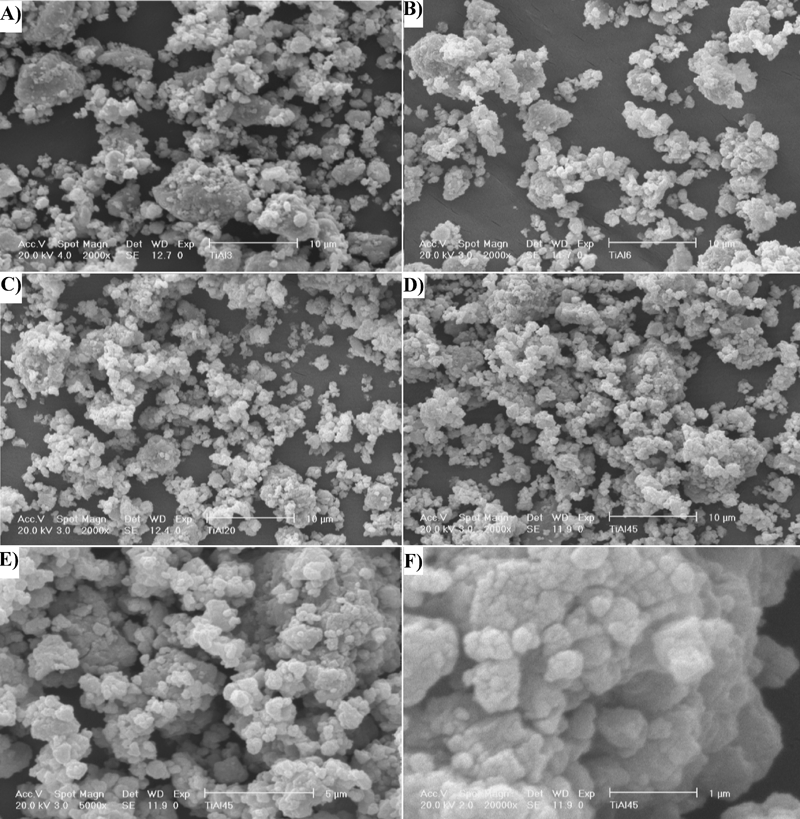
Morphological evolution monitored by scanning electron microscopy of samples milled for A 3 h, B 6 h, C 12 h, D 45 h, E and F 45 h at higher magnification
At longer milling times, there was equilibrium between cold working and workhardening. This equilibrium led to the formation of similar particles with very narrow size distribution and spheroid shape. The other effect of this process is decreasing the average particles size, which is shown in Fig. 6D. Figure 6E shows the spheroid and very small particles and the very fine microstructure that is more obvious at higher magnification in Fig. 6F. It can be seen that the average grain size is in the submicron or nanorange approximately.
Conclusion
The feasibility of Ti3AlC2 synthesis via mechanical alloying and following heat treatment was investigated. Two kinds of starting materials were used. Reduction of TiO as a source of Ti could not be performed during milling and annealing. Direct reaction of elemental powders was impossible during milling. At shorter milling times, the starting materials were only activated and at longer milling times, Ti–TiC nanocomposite was obtained. The heat treatment of the 6 h milled sample led to the formation of Ti3AlC2–Ti4Al2C2 nanocomposite. Additionally, in the 45 h sample, the microstructure refinement took place. The SEM analysis showed a very fine microstructure with narrow size distribution of spheroid particles.