







Abstract
Isotropic NdFeB permanent magnets were prepared by spark plasma sintering. Melt spun NdFeB ribbons with two compositions and four particle size ranges, i.e. 200–400, 100–200, 45–100 and <45 μm, were employed as the starting materials. For the magnets with Nd rich compositions, high density (7·5 g cm−3) and good magnetic properties with remanent magnetic polarisation Jr>0·8 T and maximum energy product (BH)max>100 kJ m−3 were obtained. The influence of particle size on the magnetic properties is not very significant. For single phase NdFeB alloys with stoichiometric 2∶14∶1 composition, because of the deficiency of Nd rich phases, it is relatively difficult to consolidate microsized powders into high density bulk magnet, but generally, a larger particle size is beneficial to achieve better magnetic properties, including higher Jr and (BH)max.
Introduction
NdFeB magnets have been widely used because of its excellent magnetic properties and reasonable cost.1 Nanocrystalline NdFeB powders with enhanced remanence were normally made into isotropic bonded magnets, which generally have low magnetic properties and low thermal stability due to the addition of bonding agent. The conventional densification method for preparing nanocrystalline magnets is still a major concern, since magnetic properties will deteriorate dramatically due to slow heating rate, high sintering temperature and long holding time.
Spark plasma sintering (SPS), as a novel sintering technique, has developed rapidly in recent years.2 It can generate high frequency and momentary local high temperature by joule heating and pulsed energy, which makes it possible to effectively restrain the growth of grains due to high heating rate, short holding time and low sintering temperature. It, therefore, has been employed to prepare nanocrystalline materials,3 composites,4– 6 functionally graded materials,7– 9 etc. The advantages of the SPS method make it suitable for the preparation of bulk materials from melt spun ribbons.10 In our previous work,11 the processing–microstructure–magnetic properties relationships of spark plasma sintered NdFeB based magnets with Nd rich composition have been studied in detail. It was found that two distinct zones with different grain sizes existed in the spark plasma sintered magnets. A large grain size was observed in the area of the particle boundaries, and a fine grain structure was maintained in the interior of the powders. The large grain size and high area ratio of the coarse grain zone and fine grain zone are not beneficial to the magnetic properties. Since the volume ratio of the particle boundary is dependent on the particle size, the influences of particle size on the structure and magnetic properties are in need of research. On the other hand, it is also important to understand the differences in microstructure and property evolution in the spark plasma sintered magnets with and without Nd rich phase. To shed some lights on these subjects, in this work, isotropic NdFeB permanent magnets were prepared by SPS using melt spun NdFeB ribbons with Nd rich and single phase compositions. The influences of particle size on the structure and magnetic properties have been investigated in detail.
Experimental
Commercial melt spun ribbons with nominal compositions of Nd13·5Co6·7Ga0·5Fe73·5B5·6 and Nd11·5Co1·9Fe81·1B5·5 were used as the starting materials. The ribbons were screened to four particle size ranges, i.e. <45, 45–100, 100–200 and 200–400 μm. Roughly 10 g powders were put into the cylindrical graphite die for SPS in vacuum using the facility of SPS-825 (Sojitz Machinery Co.). The spark plasma sintered samples are of diameters equal to 20 mm and a height of about 4–6 mm. The inset in Fig. 1 shows the sample shape of the spark plasma sintered magnet. The sintering conditions included the SPS temperature TSPS of 600–900°C, the SPS pressure PSPS of 50 MPa and the SPS holding time tSPS of 3–5 min. The density for the magnets was measured based on the Archimedes principle. X-ray diffraction patterns were obtained with an X-ray diffractometer (Philip X'Pert) using Cu Kα radiation. To characterise the microstructure, the spark plasma sintered magnets were carefully broken intentionally, and the fracture was examined by SEM (Nano430; FEI Co.). The maximum magnetic field with 8 T was used to obtain the magnetic hysteresis loops for all samples by a physical property measurement system (PPMS-9 Quantum Design; USA) equipped with a 9 T vibrating sample magnetometer.
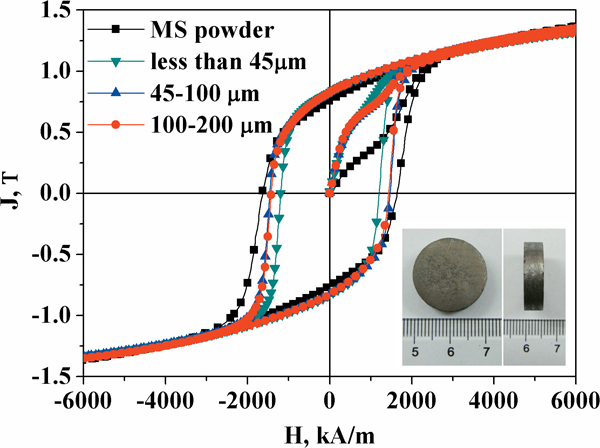
Magnetic hysteresis loops for starting powder and NdFeB magnets spark plasma sintered with three different particle size ranges (TSPS = 700°C, PSPS = 50 MPa and tSPS = 5 min): inset; pictures of the sample
Results and discussion
NdFeB magnets spark plasma sintered from melt spun powders with Nd rich composition
Two distinct zones with different grain sizes were noticed in the spark plasma sintered NdFeB magnets in our previous work.11 Spark plasma sintering temperature and pressure had important effects on the widths of coarse and fine grain zones and the grain sizes in both zones. The changes in grain structure led to the variation in the magnetic properties. Here, powders with three different particle sizes, i.e. <45, 45–100 and 100–200 μm, were employed for SPS using the optimised SPS parameters obtained previously (TSPS = 700°C, tSPS = 5 min and PSPS = 50 MPa).11 Table 1 lists the magnetic properties and density for the as prepared magnets. The density increases from 7·33 g cm−3 for the magnets spark plasma sintered with powders having particle size of <45 μm to 7·50 g cm−3 for the magnets prepared with powders in the size range of 100–200 μm. Figure 1 shows the magnetic hysteresis loops for the starting powder and spark plasma sintered magnets. For the starting powders, the magnetic properties are Jr = 0·78 T, jHc = 1624 kA m−1 and (BH)max = 103 kJ m−3. One should note that these values were obtained without considering the demagnetisation factor for powders. Good shape of the demagnetisation curve was obtained for all spark plasma sintered magnets. With increasing initial particle size, the magnet density increases. The magnet prepared with powders <45 μm has the minimum value of intrinsic coercivity jHc. The remanence Jr and the maximum energy product (BH)max change slightly with varied particle size. The magnets spark plasma sintered at 700°C/50 MPa/5 min have good magnetic properties with Jr = 0·83 T, (BH)max = 117 kJ m−3 and jHc = 1202 kA m−1. Since there are no heavy rare earth elements, such as Dy or Tb, the obtained magnetic properties with (BH)max>110 kJ m−3 are indeed very promising. The magnetic properties are also slightly better than the previous report on a similar composition.12
Magnetic properties and density for Nd rich NdFeB magnets spark plasma sintered with three different ranges of particle size (TSPS = 700°C, PSPS = 50 MPa and tSPS = 5 min)
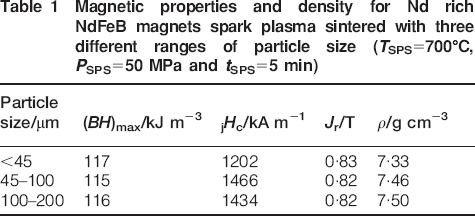
Figure 2 shows the microstructure of the magnets spark plasma sintered using three types of powders. Two distinguished zones with different grain sizes were noticed again for the magnets spark plasma sintered from the particles in the size ranges of 45–100 and 100–200 μm. This phenomenon is attributed to the mechanism of SPS.11 Local high temperature zone was generated by pulsed energy that existed between particle contacting surfaces. The temperature at the centre of the particle was lower than that in the particle boundaries. Song et al. 13 reported that the temperature in the particle contacting surface is nearly 3000 K higher than that at the particle centre during SPS, and the temperature decreased sharply from the particle contacting surface towards the centre. In this study, the high temperature at the particle boundaries led to excessive grain growth, as shown in Fig. 2c–f. The grains located in the interior of the particle have a less growth trend due to the low temperature, resulting in the fine grain zone. However, interestingly, for the magnets spark plasma sintered with the particle size of <45 μm, only a very small amount of coarse grain zones were observed (not shown here), and the grain size was almost uniformly distributed, as shown in Fig. 2a and b. The mean grain size for this sample is almost similar to that in the fine grain zones for the magnet spark plasma sintered with larger particle sizes. The uniform size for the magnets spark plasma sintered with the particle size of <45 μm can be explained as follows. During SPS, momentary electric currents flow through the particle contacting surface. In the spark plasma sintered billet, the volume fraction of particle boundaries for powders with small sizes is higher than those with large particle sizes of 45–100 and 100–200 μm, resulting in weak current intensity in the former. Yanagisawa et al. 14 reported that spark phenomenon can only occur at large current and low pressure. Therefore, it is possible that there is no or little plasma that existed between the particles with particle size of <45 μm due to the weak current intensity. The grain could not grow due to the deficiency of enough temperature produced by spark plasma. This leads to the disappearance of coarse grain zone in the magnet spark plasma sintered with the particle size of <45 μm. On the other hand, low current intensity and low temperature in the particle boundaries may be not beneficial to the densification of the magnets, which explains the low density of the magnets spark plasma sintered by powders <45 μm, as listed in Table 1.
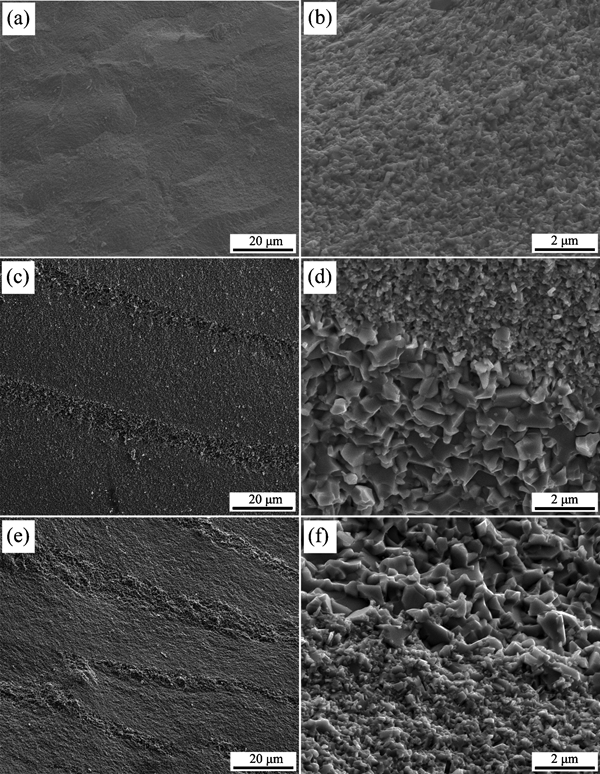
Images (SEM) for Nd rich NdFeB magnets spark plasma sintered with three different particle size ranges by TSPS = 700°C, tSPS = 5 min and PSPS = 50 MPa
The spark plasma sintered magnets with nanocrystallites generally show exchange coupling between grains. Henkel plots15– 17 can be used to analyse the exchange interactions between the grains based on the relationship δM(H) = Md(H)–[1–2Mr(H)], where Mr(H) and Md(H) are defined as the remanent magnetisation after applying a field H on a thermally demagnetised sample and a reverse field on a previous saturated sample. According to the Stoner–Wohlfarth theory,18 for an assembly of small non-interacting particles, δM = 0. A positive value of δM indicates that the exchange coupling was enhanced, while a negative value of δM was interpreted as magnetostatic interaction dominating when magnetisation reversal occurs.15,19 Figure 3 shows the Henkel plots for spark plasma sintered magnets prepared from various powders. Large positive values of δM verify the strong exchange coupling interaction due to the nanostructure in the magnets. For the spark plasma sintered magnets prepared from small powders (<45 μm), the largest positive value of δM was obtained, which indicated that exchange coupling in the magnet spark plasma sintered from small powders is stronger than that from large powders. This can be manifested by the disappeared coarse grain zone in magnets prepared from smaller powders, as discussed earlier. Meanwhile, a relatively sharp peak obtained in the δM plot indicates a uniform grain size distribution,19 which can be verified by SEM images, as shown in Fig. 2a and b. For the spark plasma sintered magnet prepared from the particle size of <45 μm, possible deficiency of spark plasma and stronger exchange coupling due to the uniform distribution of nanostructure grain size are the main reasons for the reduction in coercivity. In contrast, the high jHc of 1466 and 1434 kA m−1 obtained in the spark plasma sintered magnets from large particles (Table 1) possibly resulted from the weak exchange coupling in the magnets. Meanwhile, the uniform distribution of the Nd rich phase due to the activated powder surface by interparticle discharge plasma in the process of SPS is also contributed to the high jHc.
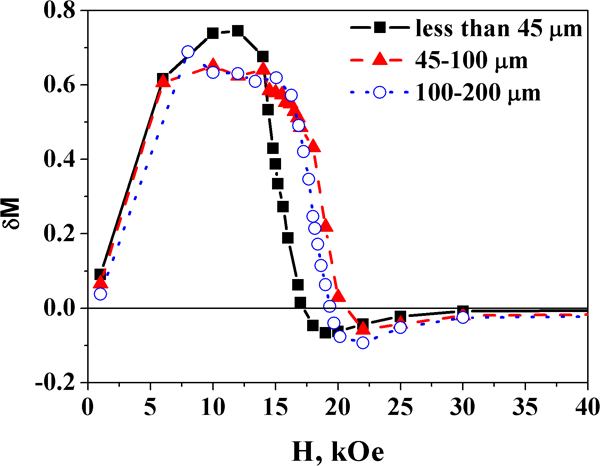
Henkel plots of Nd rich NdFeB magnets prepared by SPS with different powder size ranges by TSPS = 700°C, tSPS = 5 min and PSPS = 50 MPa
NdFeB magnets spark plasma sintered from melt spun powders with single phase composition
For comparison, isotropic magnets with single phase composition of Nd11·5Co1·9Fe81·1B5·5 were also prepared by SPS using melt spun powders with four different particle sizes, i.e.<45, 45–100, 100–200 and 200–400 μm. Figure 4 shows the magnetic properties and density for the magnets spark plasma sintered with particles of <45 μm. With the increase in TSPS, the density increases and jHc decreases. The Jr increases with increasing TSPS until 750°C and decreases afterwards. The different dependences of jHc and Jr on the temperature lead to a maximum of (BH)max at 750°C. The best combination of magnetic properties is Jr = 0·70 T, jHc = 435 kA m−1 and (BH)max = 65·0 kJ m−3. It is also noted that the density of the spark plasma sintered magnet ρ = 6·68 g cm−3 is much lower than that with Nd rich composition. The low density has been contributed to the deficiency of the Nd rich phase. In addition, as discussed above, the Nd rich phase has an important effect on the jHc. For these samples, due to the deficiency of the Nd rich phase, jHc decreases monotonically with increasing temperature.
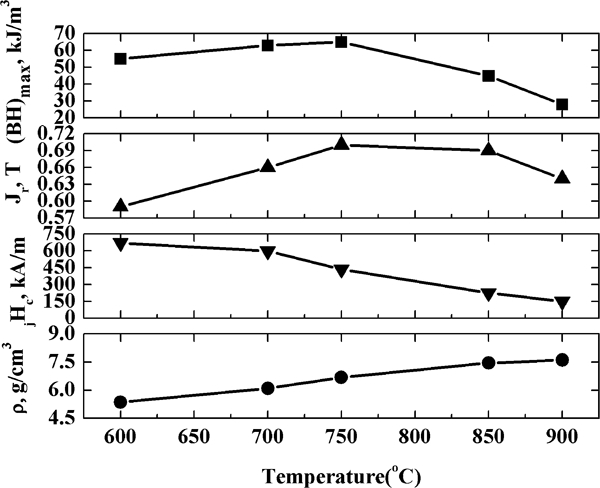
Magnetic properties and density for single phase NdFeB magnets spark plasma sintered with particle size range of <45 μm as function of sintering temperature (PSPS = 50 MPa and tSPS = 3 min)
Figure 5 shows the X-ray diffraction patterns of NdFeB magnets spark plasma sintered with particles of <45 μm. With the increase in temperature, the diffraction peaks become strong and narrow, which indicated the growth of grain size. It is also found that there existed an undefined phase in the magnets prepared at 850 and 900°C. This undefined phase possibly resulted in the reduction in Jr after 850°C. All the other peaks in all the patterns are attributed to the tetragonal hard magnetic Nd2(FeCo)14B phase.
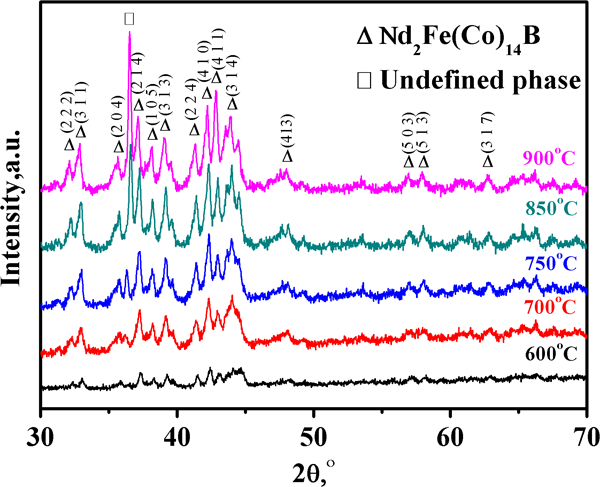
X-ray diffraction patterns for single phase NdFeB magnets spark plasma sintered with particle size of <45 μm at different temperatures (PSPS = 50 MPa and tSPS = 3 min)
Figure 6 shows SEM images of magnets spark plasma sintered with particles of <45 μm. With increasing TSPS, the porosity reduces, and thus, the density increases. Similar to the Nd rich composition, at the vicinity of particle boundaries, coarse grain zones also formed, as shown in Fig. 6d. Similar results on the variations in magnetic properties and density were obtained for other spark plasma sintered magnets prepared from powders with size ranges of 45–100, 100–200 and 200–400 μm.
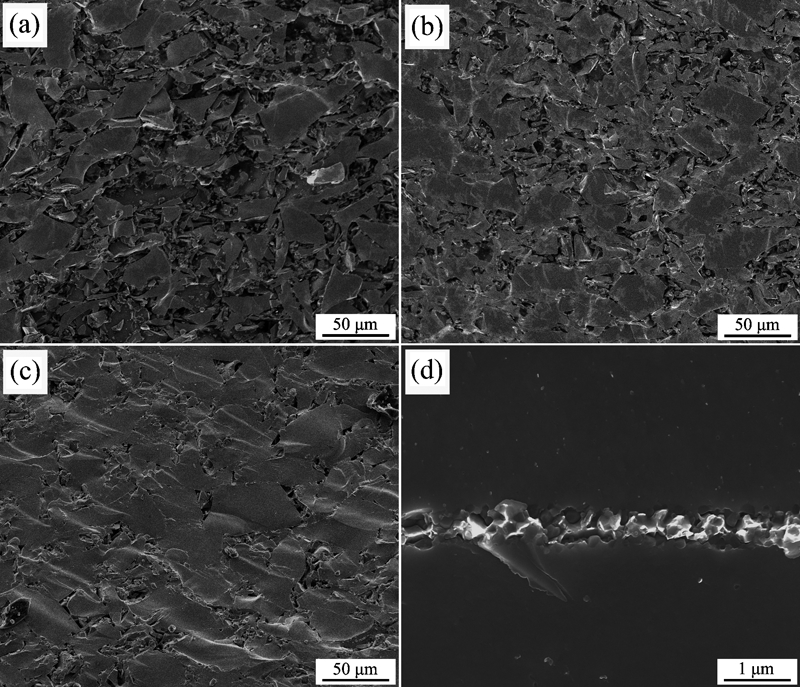
Images (SEM) for single phase NdFeB magnets spark plasma sintered from powders with particle size of <45 μm at different temperatures (tSPS = 3 min and PSPS = 50 MPa)
Table 2 lists the density and optimal magnetic properties for magnets spark plasma sintered from powders with four different sizes under the optimal sintering conditions. The low densities of the spark plasma sintered magnets indicate that it is relatively difficult to consolidate microsized melt spun powders into high density bulk magnet for single phase NdFeB ribbons due to the deficiency of the Nd rich phase. The best magnetic properties with Jr = 0·73 T, jHc = 604 kA m−1 and (BH) max = 81 kJ m−3 in the magnet spark plasma sintered from powders with size of 200–400 μm are noticed. The (BH)max for the spark plasma sintered magnet increases monotonically with increasing particle size under the optimal sintering conditions, as listed in Table 2.
Optimal magnetic properties and density for single phase magnets spark plasma sintered from powders with four different particle size ranges under optimal sintering conditions

Figure 7 shows the dependences of magnetic properties on TSPS for NdFeB magnets spark plasma sintered with different powders. It is found that TSPS has important effects on the magnetic properties. Good combination of properties has been obtained in the TSPS range of 700–800°C. At temperatures higher than 800°C, low jHc and Jr result from the grain growth and the existing undefined second phase. At low temperatures, low Jr due to low density is the main reason of the bad combination of magnetic properties. Comparing the magnets prepared from various powders, generally, a larger particle size is beneficial to achieve better magnetic properties under the same sintering condition, including higher Jr and (BH)max. This is also attributed to the sintering mechanism of SPS. For larger particle size, the volume fraction of coarse grain zone in the spark plasma sintered magnet is less than that for the smaller particle size due to less particle boundaries.
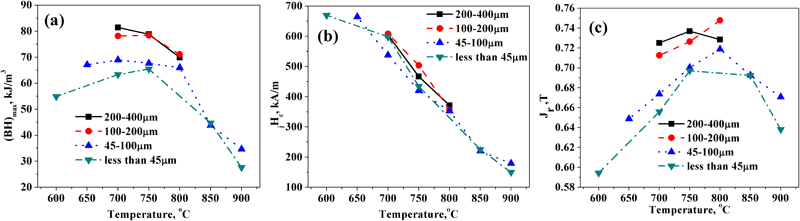
a energy product, b coercivity and c remanent magnetic polarisation for single phase NdFeB magnets spark plasma sintered with different powder sizes as function of sintering temperature (PSPS = 50 MPa and tSPS = 3 min)
Table 2 and Fig. 7 indicate that, for the single phase spark plasma sintered NdFeB magnets, the particle size of the starting melt spun powders has a significant effect on the magnetic properties. However, for the Nd rich magnets, as listed in Table 1, the magnetic properties of magnets spark plasma sintered from the starting particles with sizes of 45–100 and 100–200 μm change only slightly. The latter can be possibly attributed to the fact that both Nd rich powders with sizes of 45–100 and 100–200 μm are crushed into almost the same size due to the high brittleness of the Nd rich composition. The results in this work imply that, to achieve good properties in spark plasma sintered magnets, the powder particle size has to be considered and selected accordingly.
Conclusions
Isotropic Nd rich and single phase NdFeB based magnets were prepared by SPS using melt spun powders as starting materials. For the spark plasma sintered magnets prepared from Nd rich compositions, high density and good magnetic properties have been obtained. The particle size has an important effect on jHc, but the effects on Jr and (BH)max are not very significant. Unlike the magnets spark plasma sintered from powders with larger particle size, only a very small amount of coarse grain zones were observed in the spark plasma sintered magnets consolidated from powders with size of <45 μm. The deficiency of spark plasma and the stronger exchange coupling due to the uniform distribution of nanostructured grains are the main reasons for the reduction in jHc. For single phase alloys, it is relatively difficult to consolidate the powders into high density magnets. A larger particle size of starting powder is beneficial to achieve better magnetic properties, including higher Jr and (BH)max, due to the less volume fraction of coarse grain zone in the spark plasma sintered magnets. Overall, the spark plasma sintered Nd rich magnets have better properties than single phase magnets.
Footnotes
Acknowledgements
This work is financially supported by the Guangdong Provincial Science and Technology Program (Grant Nos. 2008B010600005, 2009B090300273, 2010A090200060, and 2010A090200042), the Guangdong Natural Science Foundation (Grant No. 8151064101000084), and the State Key Laboratory for Advanced Metals and Materials (Grant No. 2011-ZD05).