







Abstract

Purpose
Recently, a report has been published by Ebrahimi Kahrizsangi and co-workers about fabricating Fe–ZrC composite using mechanically activated combustion synthesis route.
1
In this article, the authors investigated the effect of mechanical activation on the combustion synthesis of ZrC and Fe–ZrC composite with different concentrations of ZrC synthesized base on the following reaction

Besides, after the reaction, they performed acid leaching to remove magnesium oxide from the products and the formation of Fe–ZrC composites. In combustion synthesis, adiabatic temperature (the maximum theoretical temperature that the products can reach) is a criterion that is used to show if a reaction can propagate spontaneously or not. According to the literature, in a reaction if adiabatic temperature is higher than 1800 K, it will release enough heat to propagate in the self-sustaining mode (Merzhanov criterion).
2
The adiabatic temperature can be calculated using thermodynamic data by the following reaction
1
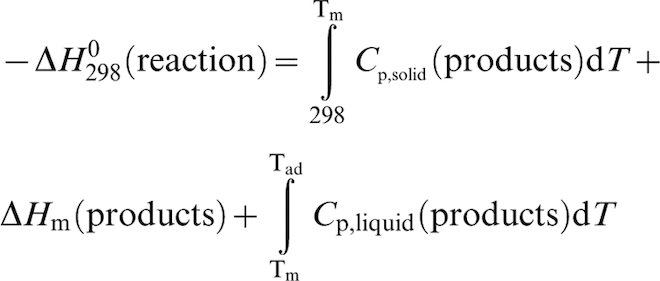
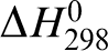 is enthalpy of the reaction, Tm is melting point, Cp is heat capacity and Tad is adiabatic temperature. If some diluents like Fe are added to the reaction, its heat capacity should be considered in the product.
In the cited article, there is a graph (Fig. 5) showing the effect of diluents content on the adiabatic temperature of the reaction (1). This graph was created based on the theoretical data. In this figure, the calculated adiabatic temperatures were reported as 2867 and 1800 K for 0 and 43·98 wt-%Fe respectively. There is a considerable difference between these values and adiabatic temperature that calculated by Li et al. (2235 K). 3 Usually, small differences between calculated adiabatic temperatures in different literatures can be observed because of different thermodynamic data. But, this strong disagreement is so much that could not be considered due to these different data. Moreover, based on this graph, the maximum Fe which could be added to the reaction to remain in the self propagating mode is about 44 wt-%. So, we recalculated the adiabatic temperature of this reaction with different concentrations of Fe as diluents and compared the results with Refs. 1 and 3.
Calculation of adiabatic temperature
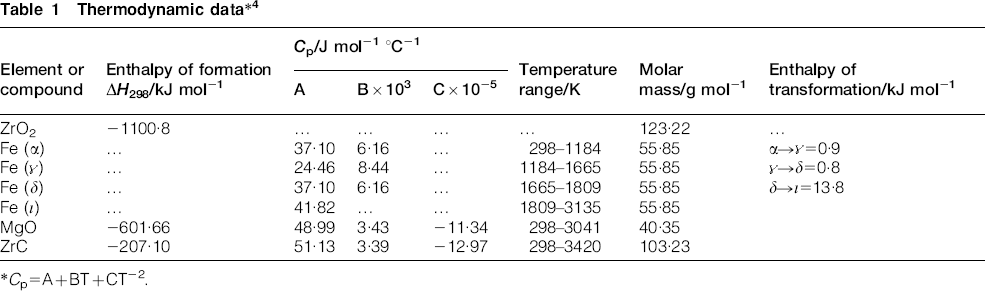
The thermodynamic data used to calculate the adiabatic temperature are listed in Table 1.
Thermodynamic data* 4
*Cp = A+BT+CT−2.
Considering data values in the Table 1, the enthalpy of the reaction is calculated as −309·62 kJ mol−1 (ZrO2). So the adiabatic temperature can be calculated as follows
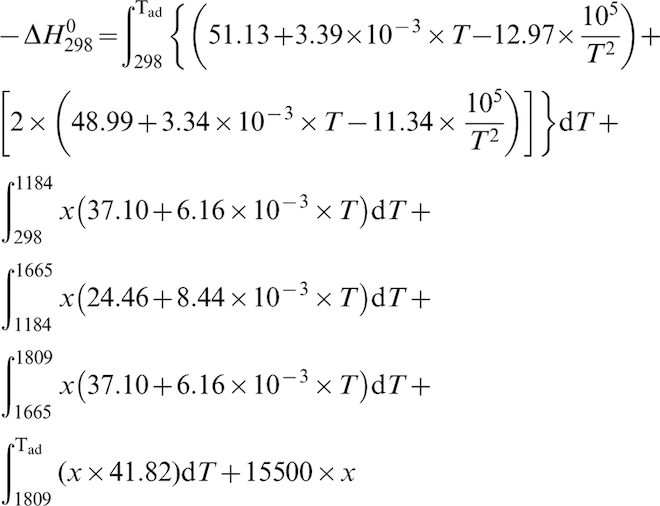
And finally
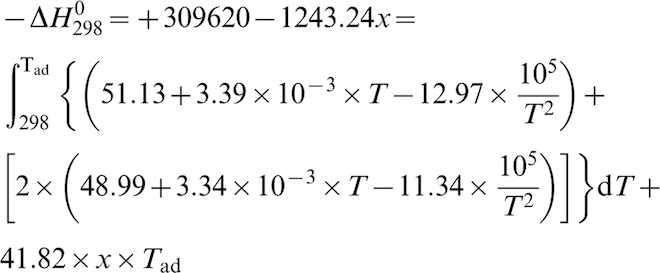

Figure 1 shows the adiabatic temperature as a function of Fe concentration in the reactants. It can be seen that the adiabatic temperature at 0 wt-%Fe is 2270 K, which is in agreement with the value that reported by Li et al. 3
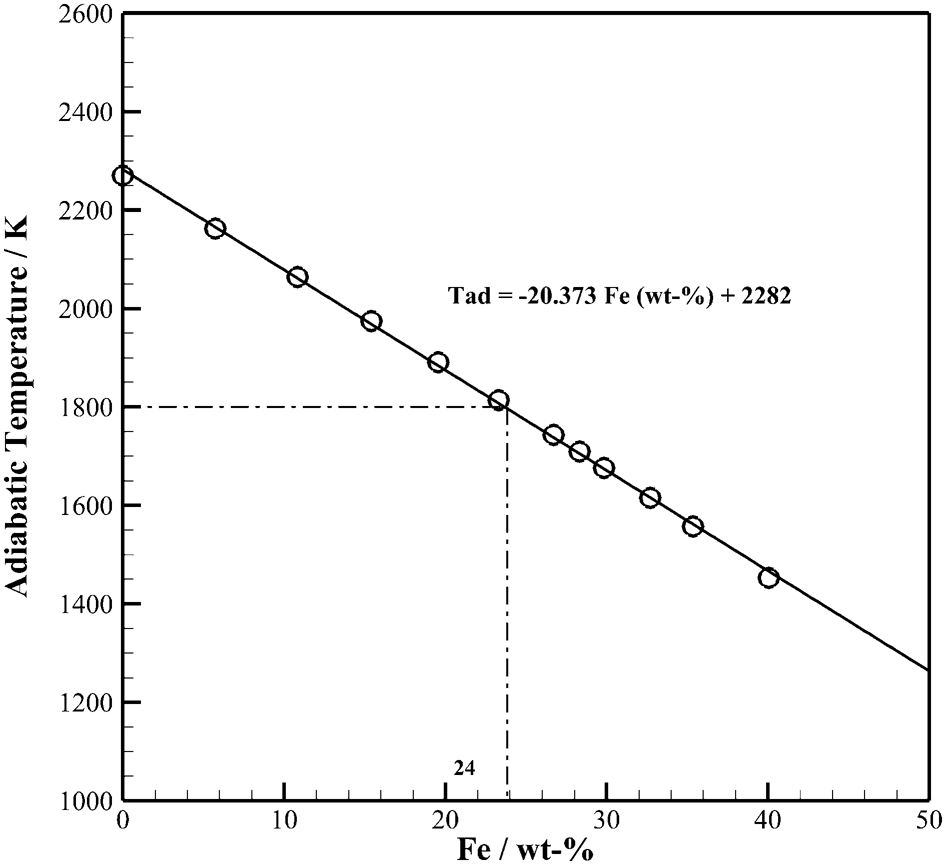
Effect of iron content on adiabatic temperature
Also according to Fig. 1, the maximum concentration of Fe which could be added to the main reactants and reaction remains self-sustaining is 24 wt-%. This value was estimated by Ebrahimi et al. about 44 wt-%. These authors performed some valuable experimental works to confirm their estimations, but the most concentration of Fe which was added to the main reactants was 20 wt-%. This value is much lower than the theoretical value estimated by them (44 wt-%). The addition of higher concentrations of diluents to the reactants than 20 wt-% has not performed by these researchers. This may because of the two following reasons:
they did not decide to produce a Fe–ZrC composite with higher concentrations of Fe than 30·8 wt-% (remember that if 20 wt-%Fe be added to the reactants and all MgO be removed from the products after leaching with no Fe losses, the concentration of Fe in the final product will be 30·8 wt-%)
They might add higher amount of Fe than 20 wt-%, but they did not observe a self-sustaining reaction between the reactants and so they did not report the results. However, our calculations show that the adiabatic temperature of the reaction (1) for 20 wt-%Fe diluents is about 1850 K which is close to the Merzhanov criterion and so the addition of higher diluents prevents from propagation of the reaction in the self-sustaining mode. So, Fig. 5 in the Ref. 1 should be replaced with the Fig. 1 of this comment.