







Abstract
R&D efforts at CSIRO, Australia, into the production of ‘lower cost’ titanium powders are complemented by a strong, downstream PM programme. One of these efforts has focused on the direct powder rolling of commercially pure (cp) titanium powder with a view to the continuous production of fully dense strip. Considerable research is also being undertaken to produce titanium alloy strip, initially from the Ti–6Al–4V alloy, using this process. An experimental design approach has been employed to establish key parameters, maximise the process window and meet property specifications. Demonstration of a proof-of-system at pilot scale is well advanced and the focus is now shifting to seeking industrial engagement with a view to collaboration, technology transfer and commercialisation of the technology. The current status of the technology is surveyed including aspects of the associated market trends and commercial feasibility.
The drive to lower the cost of components made from titanium and titanium alloys has led to the development of innovative processes for the production of powders;1– 3 examples of these activities include the CSIRO TiRO™ process and the ITP-Armstrong process. In addition, this has stimulated the development of alternative downstream technologies for the manufacture of semi-finished flat products based on PM techniques.4– 6 The overall approach is to eliminate process steps to reduce the cost of both materials and subsequent processing (Fig. 1).
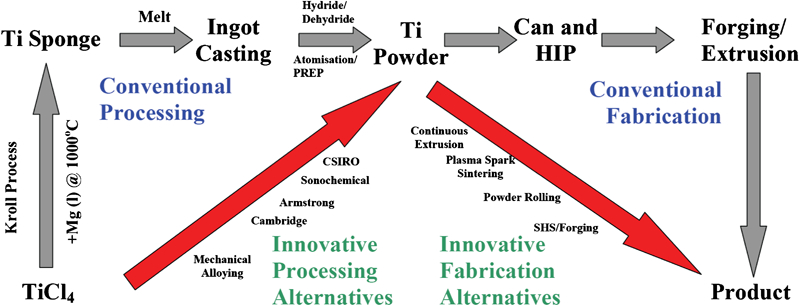
Current R&D trend is to replace conventional processes in production of titanium with innovative processes to reduce production costs (after Ref. 7)
CSIRO is working on the development of a continuous process for the manufacture of titanium and titanium alloy strip by a PM route.4 In this process powders are compacted by cold rolling to form a green strip; this strip is fed to a preheating station where it is rapidly heated in an argon atmosphere for up to a few minutes then transferred in a continuous manner to a hot rolling station (Fig. 2). The strip exits from the rolls directly into a cooling chamber which is also purged with argon to minimise the pick-up of atmospheric gases. This technique is capable of producing strip from cp titanium powders, pre-alloyed powders, and blended elemental powders. Below, the terms direct powder rolling (DPR) and hot roll densification (HRD) are used to describe the green rolling and hot rolling stages of the process respectively.
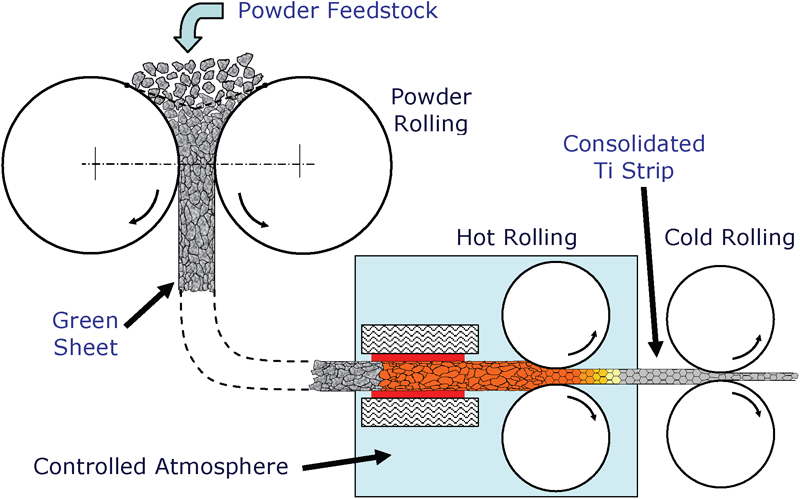
Schematic diagram of CSIRO process for continuous production of cp Ti strip
A significant aspect of the combination of DPR and HRD is the short preheating time prior to hot rolling,4 which directly impacts on productivity. Another important advantage is that both cp grade and titanium alloy strip can be manufactured to thin gauges (<1 mm) in one or two hot rolling passes,4 which significantly reduces material waste, especially the yield losses resulting from surface removal treatments.
The intensification of effort in this project has resulted in a recent up-scaling of the facilities including the installation and commissioning of a new pilot scale hot roll mill during 2010. This facility consists of a four-high roll system, which will significantly increase the capacity of the process, and is designed for the production of 400 mm wide and nominally 0·5–3·0 mm thick strip. CSIRO is actively seeking industry engagement to expand the process from its current pilot plant status to a production operation.
A flow diagram of the process is shown in Fig. 3. The stages within the combined DPR and HRD sections are highlighted.
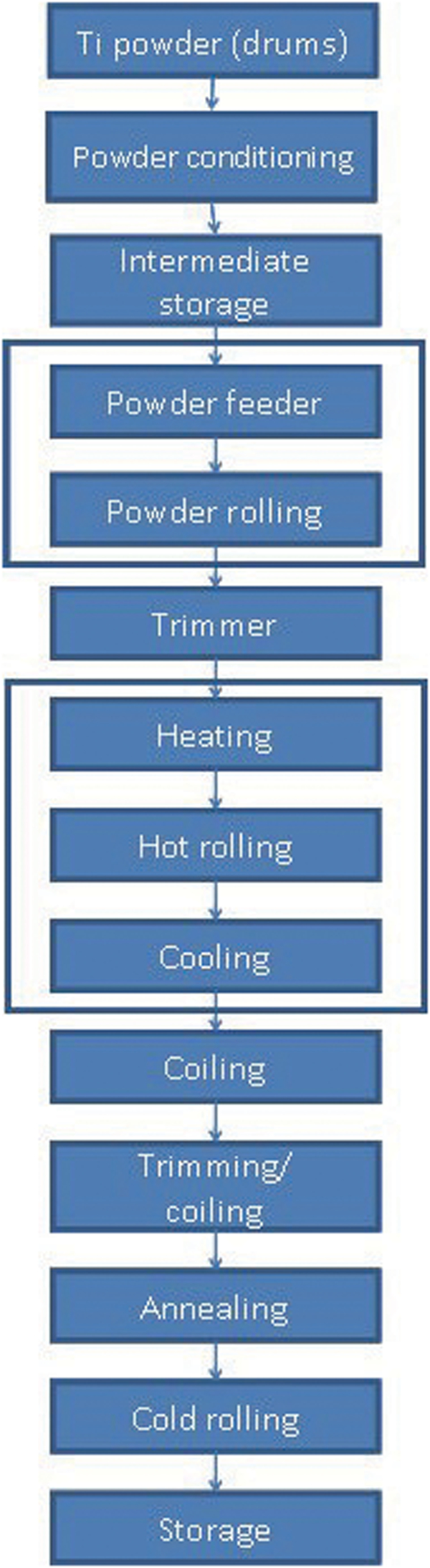
Flow diagram showing basic sequence of processes for manufacture of strip by direct powder rolling and hot roll densification
The production of cp titanium strip by this process has been reported elsewhere,4,8 and some key results are summarised below. The present paper also describes work currently in progress to investigate the procedures required to produce Ti–6Al–4V alloy strip using a blended elemental (BE) PM approach. The commercial feasibility of manufacturing titanium and titanium alloy strip using DPR/HRD is also discussed.
Experimental work
The manufacture of cp Ti strip using the DPR/HRD process has been discussed in detail elsewhere.8 In summary, strips with a density >99·5% were fabricated from powders with different morphologies and properties, including angular hydride–dehydride (Fig. 4) and sponge-like titanium powders. The pick-up of oxygen during the DPR/HRD process was measured to be low (<200 ppm). The mechanical properties of the consolidated and annealed strips were found to be dependent on the oxygen content of the strips, which was in turn influenced by the oxygen content of the powder feedstock. The tensile properties of strips made from powders with an oxygen content of approximately 0·35% and rolled to a percentage reduction of the thickness greater than 40% approach those of the ASTM B265 Grade 3 material (Table 1).
Reflected light microstructure of as rolled left and vacuum annealed (right) cp Ti sheet derived from hydride–dehydride powder
Comparison of PM derived sheet properties with those of wrought material
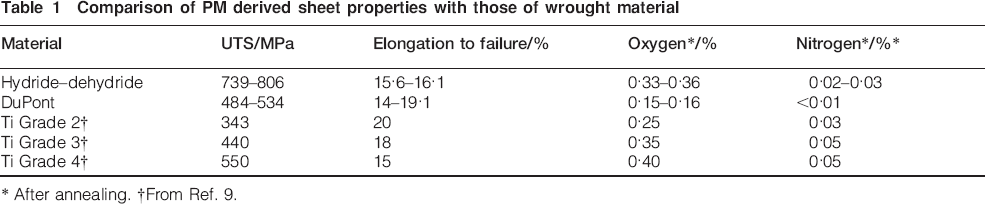
* After annealing. †From Ref. 9.
Subsequent work has focused on production of titanium alloy strip from blended elemental (BE) powders using the DPR/HRD process. The alloy Ti–6Al–4V has been chosen initially as a widely used alloy for which plentiful data exist on microstructural and mechanical properties. It is expected, however, that other titanium alloys will be processable via the DPR/DHR route also, e.g. α+β alloys that are more easily cold-workable and have been targeted for the manufacture of thin sheet, strip, foil and tubing by cold processing.10 For the BE PM approach, where titanium powder is blended with an Al–V masteralloy powder, there is a requirement for the material to be chemically homogenised during consolidation. This means that the sequence of thermo-mechanical processes outlined above for the production of cp Ti strip would have to be altered. One of the primary objectives of the present study was to determine the degree to which the process would have to be changed in terms of process parameters, sequence of processing steps and need for additional stages. The basic DPR/HRD process consists of numerous stages (Fig. 3), each characterised by parameters that are each expected to influence the material produced. As such, it was decided to employ an experimental design methodology to determine the influence of material, processing and heat treatment variables on the microstructure and mechanical properties of the Ti–6Al–4V strip. The following considerations were taken into account when designing the matrix of experiments:
the finished material should be completely homogenised, while the productivity of the overall process is maintained
it should be possible to manipulate, by thermo-mechanical processing, the microstructure of the finished strip to achieve similar microstructures and mechanical properties to those obtained for wrought Ti–6Al–4V products.
As a starting point, the parameter values were based on those typically used to manufacture Ti–6Al–4V products by ingot metallurgy. These parameters, the details of the starting powders, the blending and DPR procedures, and properties of the green strips have been reported elsewhere;11 only a brief summary is given here. The batch of BE Ti–6Al–4V powder was made by mixing −100 mesh hydride–dehydride powder with both Al–V master alloy powder and Al powder. The oxygen contents of the titanium and master alloy powders were 0·24% and 0·19%, respectively, and the nitrogen content was 0·02% for both powders. The blended powder was rolled into green strips of thickness ∼2·2 mm. In that work, because of the relatively large number of experimental conditions, and therefore specimens to be produced, a small scale facility operating in a continuous manner, as described above for the full scale process, was used for the preheating and hot rolling stages. As a result, the green strips were sectioned to produce smaller specimens, 115 mm long by 25 mm wide, for hot rolling. The green density of the specimens varied between 84% and 90%.
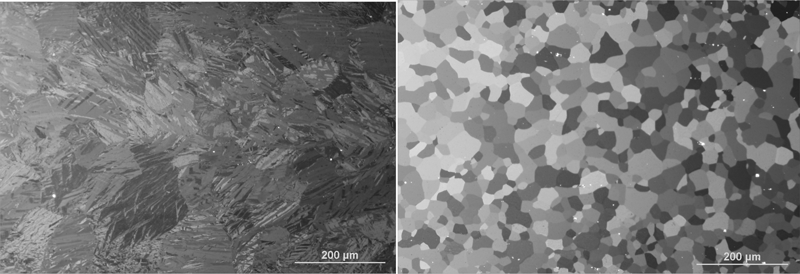
In the previous study11 it was reported that homogeneous Ti–6Al–4V strip with a density of 99·6% could be produced at the end of the annealing treatments. However, the annealing temperature had to be above the β transus (1030–1040°C), which resulted in a microstructure consisting of coarse α+β lamellae (Fig. 5, left). Tensile data obtained from specimens cut in the direction of rolling (average oxygen content 0·23%) were: UTS 1061 MPa, yield stress 970 MPa, elongation to failure 8·8%. The dimensions of the rolled strips did not allow properties transverse to the rolling direction to be determined; these will be obtained when larger scale strips are available.
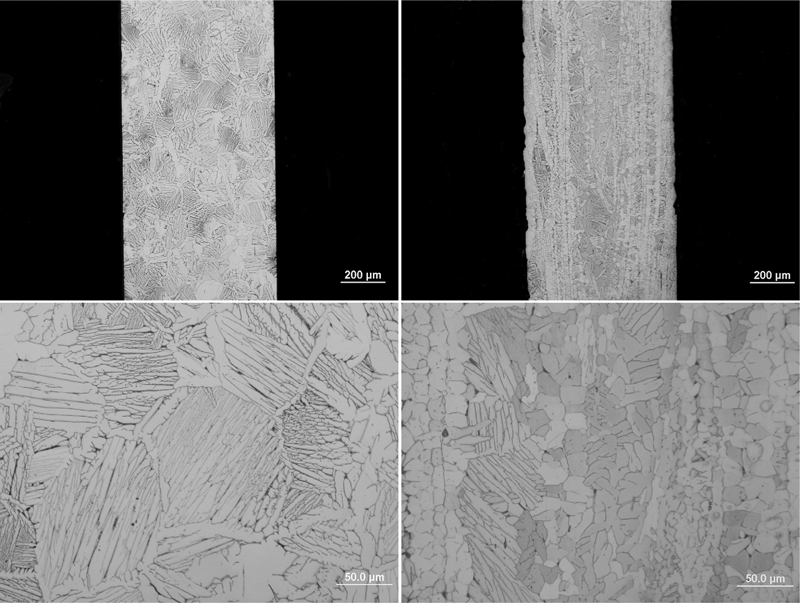
Optical micrographs of longitudinal sections of Ti–6Al–4V strips showing microstructures of the specimen obtained in case A11 (left) and case B (right)
Further work has now been undertaken to improve the properties of Ti–6Al–4V strip made by this process. This work has included a study of the effect of the particle size distribution (PSD) of the master alloy; d50 of the distribution was decreased from 42 μm (used in previous work:11 case A) to less than 30 μm (case B). In case B, −100 mesh hydride–dehydride titanium powder was blended with the Al–V master alloy powder and Al powder. The oxygen contents of the titanium and master alloy powders were 0·24% and 0·20% respectively, and the nitrogen content was 0·02% for both powders.
The same processing sequence was employed to produce strips in both cases: the strips made by DPR were hot rolled twice and a similar percentage reduction of the thickness was achieved. For the first hot rolling pass a preheat temperature high in the β phase field, but below 1320°C, was employed to avoid localised melting of the master alloy particles. The preheat temperature prior to the second hot rolling pass was, in case A, also in the β phase field, whereas it was within the α+β region in case B. Following hot rolling, the strips were annealed at close to 1040°C for case A and 995°C for case B. Furnace cooling was employed in both variants. The use of lower preheating and annealing temperatures in case B has the objective of refining the microstructure. In addition, these experiments were carried out as part of larger experimental matrices, aiming to determine parameter windows for the production of this alloy using DPR and HRD, and the effects of these parameters on the mechanical properties and microstructure.
Microstructures of material from the case B experiments are shown in Fig. 5 (right). Following the trend observed in case A, the homogeneity of the microstructure significantly increased only after annealing at a temperature near the β transus. The case B microstructure appears to consist of bands of grains with equiaxed and lamellar morphologies. The equiaxed grains are approximately 9–20 μm in size. It is possible that this banded structure reflects the as-rolled microstructure, possible causes of which are being investigated. These could include varying levels of strain through the strip thickness, the effects of temperature gradients and the process of homogenisation itself. So although it seems that a finer microstructure can be achieved in the Ti–6Al–4V alloy strip, further work is required to optimise the conditions that will fully homogenise and recrystallise the microstructure. This will be followed by a determination of the mechanical properties of the finished strips.
Commercial feasibility and application of DPR/HRD technology
The simplified DPR/HRD processing operation, with strip production at near final gauge thickness and correspondingly high yield, contributes to a low cost production route. Strip produced via this process is expected to demonstrate equivalent properties to conventional material, potentially at a lower cost, and therefore could target replacement of stainless steel. The driver for substitution in this case would be purely economic; thus, minimisation of process steps and low cost feedstock are both essential.
The ITA (International Titanium Association) reported in November 2008 that titanium applications in the plate heat exchanger (PHE) market represent only ∼30% of the market. This is an industry with good growth prospects and limited volatility, estimated to be worth in the order of $4bn globally. Factors that have been identified as limiting titanium usage in these applications are cost and lead time. Similarly, welded tube applications offer significant potential for replacing stainless steel.
In addition to targeting stainless steel replacement, the ability to manufacture strip from either pre-alloyed powder or blended elemental powders means that novel alloys, and even functionally graded materials, that would not be possible via traditional melt routes can be contemplated.
Techno-economic modelling of the DPR/HRD process has indicated that a facility producing ∼3500 t/year would have a direct conversion cost of <$4/kg. Clearly, a major factor in the production of DPR/HRD strip at reduced cost is the cost of the powder feedstock.12,13 While the economies of scale are yet to be fully demonstrated for these ‘lower cost’ powders, it is worth noting that DPR/HRD also plays a complementary role to conventional production technologies and is capable of adding to the overall growth of the titanium industry. To understand more clearly how DPR/HRD could fit into the titanium production landscape, it is useful to look at the significant volatility seen in the industry in the last 5–10 years. This volatility has been attributed to a coincidence of various supply side and demand side drivers.14
For example, on the supply side, the surge in China's steel consumption in the early 2000s increased prices for ferrotitanium, resulting in increased demand for scrap and sponge as a substitute. However, the low aircraft production rates around 2003 meant that there was a shortage of scrap. By 2005, the (US) Defense Logistics Agency (DLA) stockpile had been sold down and the surge in aircraft orders during 2005–06 intensified shortages.
On the demand side, commercial aircraft orders were running at record levels through 2005–06; these new generation aircraft had significantly higher titanium content. In the military area, full time production of the F22 had commenced and there was an increased requirement for military armour. In addition to this, industrial demand was also running at significant levels.
Having just emerged from several lean years in the late 1990s and early 2000s, and with a new sponge facility requiring $300–400m of investment and 3 years to construct, the industry could not respond fast enough to the demand. Understandably, where industry is considering such significant capital investment and lead times to increase capacity, there is also a reluctance to move too soon in case the demand is not sustained. More recently, delays in the Boeing Dreamliner and the global financial crisis of 2008/9 have also played their part in contributing to the overall volatility.
Aerospace companies are familiar with the volatility of the titanium industry and are willing to enter into long term contracts in an attempt to mitigate some of these fluctuations. However, unexpected demand pressures, limited supply and capital constraints on adding new capacity all result in significant spot price fluctuations and extended product delivery times. For many industrial applications, this level of volatility in spot price and delivery lead time is a major disincentive to use titanium. As a result, substitution by lesser performing, but cheaper or more easily obtainable materials can often occur.
Sustainable long term growth in the titanium industry requires, apart from just a reduction in the cost of alloys, the development of an industry that is more responsive to market changes and less dependent on the significant economies of volume to justify very large capital investments. To look at other industry models in this context can be enlightening. Today, for example, steel strip is made in two completely different types of mills – the differences are not just in size but also in their approach to the market and product requirements.
Conventional integrated steel mills usually have a capacity of around 3–5 Mt/year. These mills are oriented to large customers with high quality and tonnage requirements and their location is not bound to their customers geographically. The numerous operations allow for the rectification of some initial defects and thus production of high quality strip. However, the capital and labour intensive nature of the process requires throughputs of several millions tonnes to be profitable. At the other end of the scale, ‘minimills’ have production capacity of 0·5–2 Mt/year. They are based on the concept of near net shape production, for customers who are not in need of large tonnage or aerospace certified materials. The process is dependant on a different feedstock, is compact, easy to control and does not require large investment in either capital equipment or labour.
While at one level, the integrated mill and the minimill may be seen as competing for market share, it can also be demonstrated that the minimill concept can be successfully incorporated into a conventional integrated mill operation as a relatively low cost capacity upgrade.
In the context of the titanium industry, the relatively low capital cost and simplified processing in a DPR/HRD facility means that installation can be modular as the market increases and is analogous to the minimill concept. In this context, it can be seen that a DPR/HRD installation is ideally suited:
to offer greater manufacturing flexibility in terms of lead times and material grades and alloys
to serve mature markets where incremental increases in production capacity are required, e.g. the ability to add incremental capacity for industrial applications, thus freeing up more mill time for premium qualified aerospace applications (this would represent a significant alternative to capacity upgrade and flexibility for conventional mills)
developing markets where there is a demand for relatively small quantities of a wide range of alloys.
Conclusions
CSIRO is developing a process for the manufacture of titanium and titanium alloy strip products using a PM approach. The process combines, in a continuous manner, direct powder rolling of powders with hot roll densification to produce a consolidated strip.
Commercially pure titanium strip made using this process has a final density >99·5%. It has been found that contamination of the strip with atmospheric gases during processing is low. The tensile properties, therefore, of the material after annealing tend to be dependent on the oxygen content of the feedstock titanium powder.
The work being undertaken to produce Ti–6Al–4V alloy strip by this process is focused on expanding the window of parameters that will result in a homogeneous material and with the tensile properties required for the ASTM B265 Grade 5 alloy. A homogeneous but coarse microstructure is achieved after the hot rolled strip has been annealed at temperatures above the β transus. It has been found, however, that the annealed microstructure may be refined by reducing the particle size of the master alloy powder, by using a lower preheat temperature prior to the second hot rolling pass, and by decreasing the temperature for annealing closer to the β transus temperature.
In summary, the DPR/HDR process has the potential to offer:
low cost production of strip via simplified processes
the ability to manufacture novel alloys not possible via conventional melt processing
enhanced production flexibility, with lower capital and operating costs compared with traditional production routes
Efforts at CSIRO to expand its activities in this area have led to the up-scaling of the HRD facility. A new four-high hot roll mill capable of processing strip designed for 400 mm wide and <3 mm thick has been installed. This mill will be set up in-line with the existing powder rolling mill and preheating furnace.
Footnotes
Acknowledgements
This paper is an expanded version of a presentation made at the PM 2010 World Congress, organised by EPMA in Florence, Italy on 10–14 October 2010.