







Abstract
Titanium powders produced via the hydride–dehydride process are described with reference to the markets that they serve, on the basis of more than 20 years of operating experience at Reading Alloys. Raw material selection and downstream finishing play important roles in determining key characteristics of the finished powder. Resultant chemistry, morphology and particle size distributions are discussed.
The hydride–dehydride (HDH) process is long recognised and well established for the production of titanium, zirconium, vanadium and tantalum powders. These metals and their alloys readily form stable, brittle hydrides that can be easily crushed, milled and screened to produce fine metal powders.1 The focus below is on HDH titanium powders and some of the key characteristics that determine their suitability for powder consolidation.
The traditional forms of powder consolidation used in PM include press/sinter (P/S), metal injection moulding (MIM), cold isostatic pressing (CIP), and hot isostatic pressing (HIP). Newer forms of powder consolidation also include direct powder rolling (DPR), spark plasma sintering (SPS), vacuum plasma spraying (VPS), and pneumatic isostatic forging (PIF)/fast HIP as well as additive manufacturing processes such as laser engineered net shaping (LENS), direct metal laser sintering (DMLS), selective laser sintering (SLS), and electron beam melting (EBM).
HDH titanium powders can be consolidated using a range of PM methods; however, these powders normally require some level of flow to aid pre‐consolidation prior to full densification due to their relatively low tap density, and consequently high level of shrinkage during sintering. These associated pre‐compaction (CIP) costs can be offset by the lower cost of the HDH powders compared with spherical titanium powders, which exhibit higher tap density and therefore more modest shrinkage characteristics.
Hydride–dehydride process
Titanium has a strong affinity for hydrogen and forms stable hydrides when heated in a hydrogen atmosphere at temperatures in excess of ∼650°C. The HDH process takes advantage of the brittle nature of these hydrides by allowing raw materials to be readily crushed and milled to produce a fine hydride powder.2,3 When reheating the titanium hydride powders under high vacuum at temperature above ∼350°C, the hydrogen is readily liberated and can be removed, resulting in a titanium dehydride powder with the required target particle size distribution (PSD).
HDH is not a refining process so the majority of impurities remain unchanged, with the exception of interstitial elements and low levels of metallic impurities that are picked up from the milling process, most notably free iron.
The HDH process, illustrated schematically in Fig. 1, is a cost effective method to manufacture titanium powder. After the hydride and dehydride cycles, the powder must be carefully passivated under controlled conditions to minimise exothermic heat generated when exposed to air. Uncontrolled passivation results in an increased overall oxygen (and nitrogen) content relative to the theoretical oxygen content supported by its thin surface passive (TiO2) layer.

Process flow diagram of HDH process
Powder morphology
Raw material feedstocks used to manufacture HDH titanium powders can be divided into two groups, titanium sponges and commercial purity (cp) titanium. Magnesium reduced titanium sponge is manufactured in large volumes using the Kroll process. (Its predecessor was the sodium reduced titanium sponge powder, manufactured using the Hunter process, which is still produced in limited volumes.) Both of these sponges can be crushed down to <1 mm without the need for the HDH process. However, to produce a sponge powder distribution suitable for powder consolidation processes (roughly <250 μm), the sponge must be initially embrittled with hydrogen. Titanium sponge is normally a very ductile metal without hydrogen and will deform rather than fracture, causing powder production to cease.
Both the Hunter and Kroll processes reduce titanium tetra chloride into a highly porous spongy mass, containing residual chloride salts of either sodium or magnesium. The removal of these residual salts gives rise to the differences in final sponge morphology. The sodium chloride remnant from the Hunter process can be washed out of the titanium sponge using water. The resulting HDH powder is highly porous (Fig. 2). In contrast, because of its low solubility in water, magnesium chloride salt is thermally evaporated, giving a higher density sponge mass that produces the semi‐porous HDH powder shown in Fig. 3.
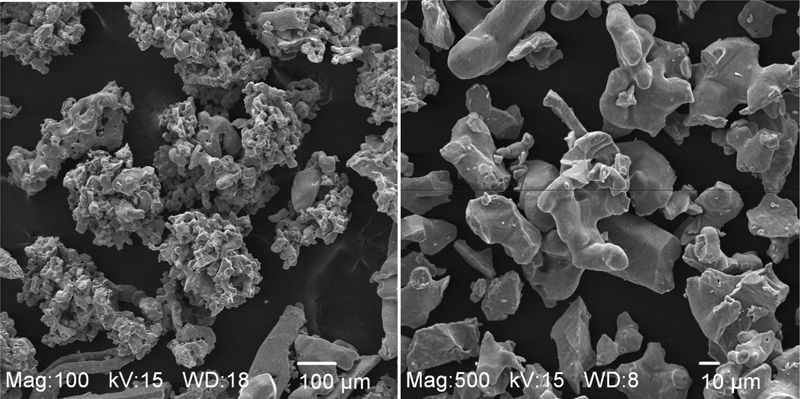
Representative SEM images of HDH sodium reduced titanium powder: 150–250 μm (left) and <45 μm (right)
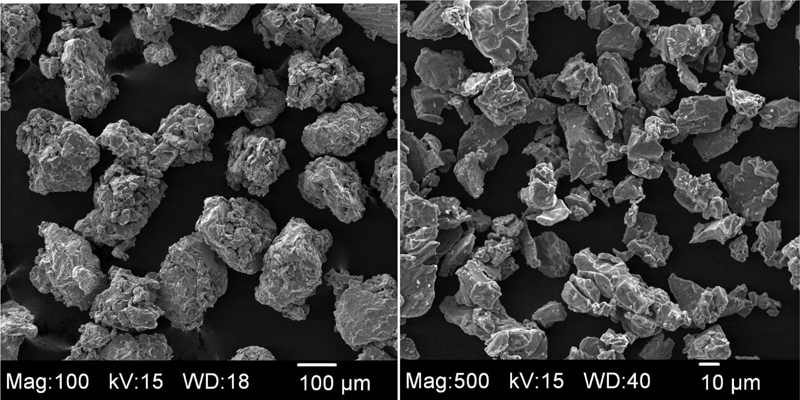
Representative SEM images of HDH magnesium reduced titanium powder: 150–250 μm (left) and <45 μm (right)
Commercial purity titanium is produced by melting the titanium sponge in an electron beam (EB) or vacuum arc remelting (VAR) furnace. Both furnaces operate under high vacuum, which refines molten titanium by evaporating residual salts and reducing the content of lower melting point residual elements such as Mg, Al, and Na. The metals‐basis purity of cp titanium is thus significantly increased over the purity of the sponge used to create it. The solidified cp titanium now exhibits a conventional cast structure with a dendritic grain structure and very low porosity. After casting, the resulting ingot can be forged, extruded, rolled, or drawn into other products such as a plate, billet, bar, sheet or wire.4
Just as the morphology of HDH sponge powder is affected by whether it was produced from the Kroll or Hunter process, HDH cp titanium powder is also impacted by the raw material, depending on whether it originated from ingot or wrought feedstock. Ingot derived cp titanium powder has an elongated, plate‐like particle morphology, whereas wrought derived HDH cp titanium powder particle morphology is more uniform, blocky and angular (Fig. 4). Ingot derived cp titanium powder is less common as the majority of ingot is converted directly into wrought products. Particles of cp titanium powder have no internal porosity, although some particles can sinter together to form semi‐porous agglomerates during the dehydride operation.
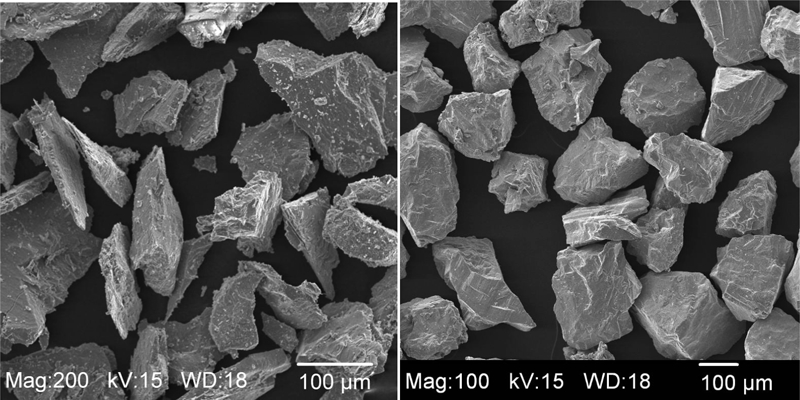
Representative SEM images of HDH cp titanium powder: 75–150 μm from ingot feedstock (left) and 150–250 μm from wrought feedstock (right)
Finer powder particles in the range <45 μm are very sinter‐reactive and difficult to recover independently after dehydriding. This sintering generally limits the <45 μm powder yield that can be achieved. Depending upon the particle size distribution (PSD) of the powders being dehydrided, some hybrid powder morphologies can be produced, often resembling an HDH sponge powder. In the left image of Fig. 5, it can be seen that the fine powder fraction has sintered with larger powder particles to produce a semi‐porous agglomerate that starts to become rounded during the attrition of the dehydrided powder. In contrast, the <45 μm particles sinter to themselves to form larger agglomerates (Fig. 5, right). Both types of agglomerated powder will have elevated levels of oxygen due to the high surface area contribution from the <45 μm particles.
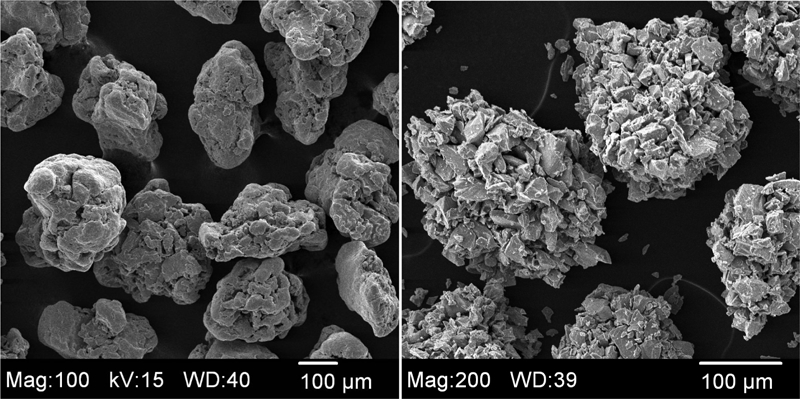
Representative SEM images of agglomerated HDH cp titanium powder: primary PSD 45–150 μm (left) and primary PSD <45 μm (right)
Chemistry
One of the most critically controlled titanium impurities is oxygen. Titanium has a high affinity for all interstitial elements, but oxygen has the largest impact on mechanical properties. For this reason, titanium powders have four specification grades. ASTM B348 grades 1–4 have maximum oxygen levels of 0·18, 0·25, 0·35 and 0·40 wt‐% respectively.5 As mentioned above, the passive surface (TiO2) film causes the oxygen level to increase as the particle size decreases and the surface area/volume ratio increases. The exponential increase in oxygen content as a function of PSD can clearly be seen in Fig. 6.
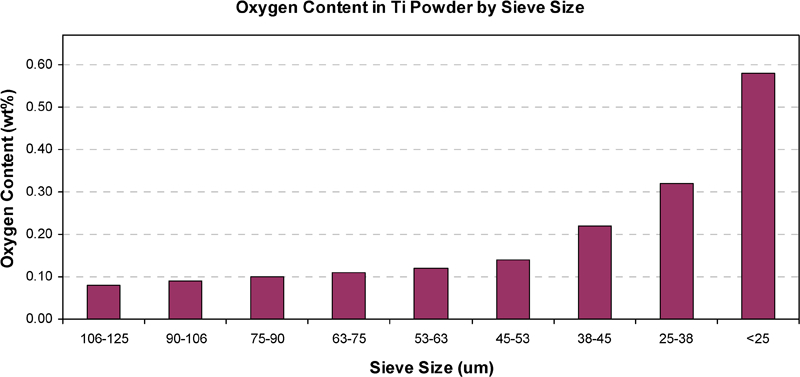
Oxygen content as function of screen fraction for magnesium reduced titanium powder
It is relatively straightforward to calculate a weighted average oxygen content for any blend of titanium powder from the data in Fig. 6; however, generally powder PSDs are not constructed by isolating each fraction and re‐blending to meet a final oxygen content. Considering that the ultra‐fine powder fraction (<25 μm) contains a disproportionally high level of oxygen, the level of ultra‐fines in any blend may significantly affect the final oxygen content. Screening out the ultra‐fine fraction is very challenging and can be achieved only using ultrasonic screening techniques.
Powder flow
All powder consolidation processes have specific powder requirements; however most of these processes rely on powder flowability, to a greater or lesser degree. Spherical titanium powders produced by the plasma rotating electrode process (PREP), gas atomisation (GA) or plasma spheroidisation (PS) all exhibit good powder flowability. These processes rely on the surface tension of the molten particle to create a spherical particle during free‐fall. The HDH process produces a powder morphology that is often described as angular and blocky powder, with no powder flow characteristics; however, even wrought derived cp titanium powders with their sharp edges, do exhibit some flowability.
Table 1 lists a range of screened cp titanium samples that have been characterised using the Malvern laser diffraction technique to determine PSD and the Hall flow test. The laser PSD data are graphically represented in Figs. 7 (histogram) and 8 (cumulative graph). The numerical d4,3 value represents the volume weighted mean particle diameter and the dx values represent the 10, 50 and 90 percentile particle diameters.
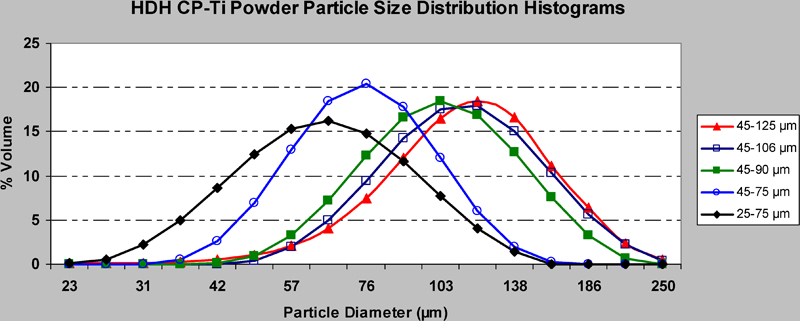
Malvern PSD histograms for range of screened cp titanium powders
Flow times and laser PSD for typical cp Ti powder screen fraction
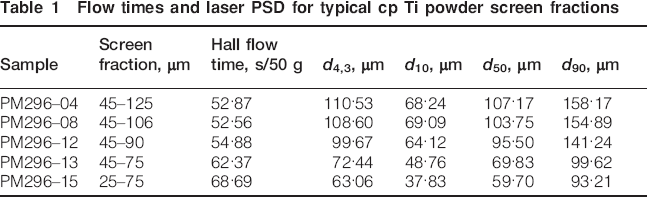
All the screened cp titanium powder samples exhibit a normal, bell‐shaped PSD. The numerical d4,3 and dx values also decrease in line with the finer screened particle size distributions, as would be expected. It can also be seen (Table 1) that all these screened samples exhibit powder flow in the range of 50–70 s/50 g or 1·0–1·4 g s−1. In Figure 8 Fig. 9, the numerical d4,3 value is plotted against powder flow; a linear relationship can be observed, which indicates that as the volume weighted mean particle diameter decreases flow time increases, reducing flowability.
This result highlights that the flowability of the cp titanium powder can be improved by reduction of finer fractions. This is in alignment with the interstitial chemistry requirements, since interstitial levels improve with reduction of the finer PSD fractions. Careful selection of the raw material and optimisation of the powder manufacturing process allows key HDH titanium powder characteristics to be enhanced for both physical and chemistry properties, as outlined above.
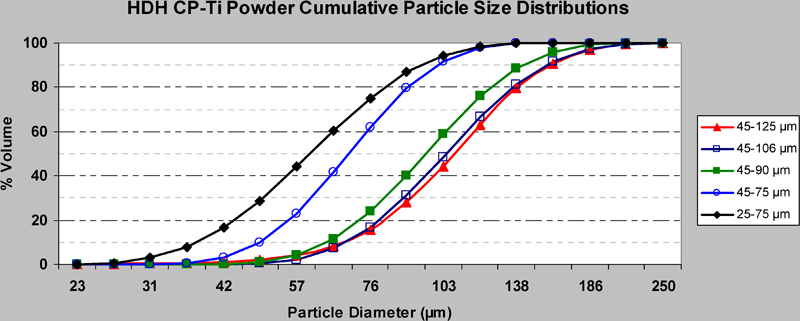
Cumulative PSDs (laser) for screened CP titanium powders
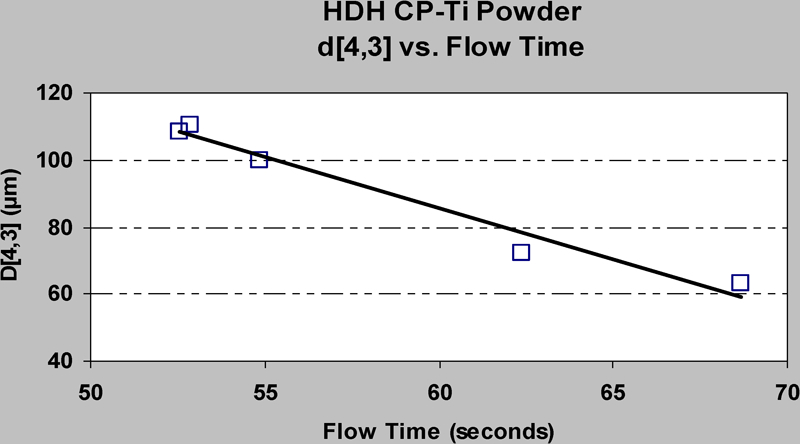
Graph of volume weighted mean particle diameter versus Hall flow time
Summary
raditionally titanium powders have been grouped into two categories, spherical and non‐spherical. Spherical titanium powders are free flowing and can be used in most PM applications; however, they are expensive due to their low production rates and high capital equipment costs.
Non‐spherical HDH titanium powders offer a wide range of PSDs and chemistry grades and their high production rates and lower capital equipment costs make them an affordable titanium powder alternative. HDH titanium powders can also be free flowing with careful selection of PSD and powder morphology. HDH titanium powders have been successfully used in a wide range of traditional PM applications to make cost effective net shape and near net shape products. The key titanium powder characteristics have been discussed and further advances are expected in the use of mixed spherical and non‐spherical titanium powders to further optimise and improve both performance and cost.
Footnotes
Acknowledgements
This contribution is based on a presentation at the PM 2010 World Congress, organised by EPMA in Florence, Italy on 10–14 October 2010.