






Abstract
The recent financial crisis and severe recession has triggered a major restructuring in the metal powder industry. The Barcelona conference, where 24 of the 80 exhibitors were powder producers or vendors, provided an opportunity to catch up on the latest developments in this rapid evolution.
In classical Darwinian style, the severe financial and market conditions of recent years have triggered an outbreak of ‘survival of the fittest’ and the pattern of ownership has changed dramatically in some sectors. This article attempts to outline the current shape of the industry, but cannot claim to be comprehensive, as many sectors were not represented at the show.
Iron powder
The iron powder industry has perhaps been less affected than some others, with the big players, GKN-Hoeganaes, Höganäs AB, and Rio Tinto Metal Powders (formerly QMP) remaining the dominant players. Kobelco of Japan has pulled out of North America, selling its Indiana plant to North American Höganäs (NAH), which closed it down. NAH also closed Pyron shortly after setting up its own large facility in Hollsopple, PA and has recently announced an expansion of annealing capacity at Hollsopple, signalling the revival of the local market following the crisis. Domfer in Montreal has also closed down, so there are now only three major producers, all global giants, in North America, down from five (Pyron, Domfer, Kobelco, Hoeganaes, QMP) 10–15 years ago. In Europe, Höganäs has to compete with Hoeganaes's Romanian plant, the Pometon plant in Italy and imports from Rio Tinto Metal Powders. In the rest of the world Höganäs has a big presence (Brazil, India, Japan, China) and there are many smaller local operations, although some Chinese plants are substantial (possibly over 30 000 t/year) It was reported at Barcelona that ∼60% of Chinese PM parts for automotive customers were still made from imported powders, due to quality demands. All three global giants have blending stations, some with annealing facilities, in China.
Non-ferrous: Copper
The non-ferrous metal industry was particularly severely affected by the crisis, which combined a collapse in markets with wild gyrations in metal prices. Cu, Ni, Al, Zn, Pb and Sn all varied in price by factors of 2–5, playing havoc with cash flow. The biggest casualty was Ecka-Granulat, which had expanded (using considerable borrowings) to have 52 subsidiary companies and some 18 significant plants around the world, with sales of over €300m/year. The company entered administration in 2010 and a number of parts were sold off. The biggest part was bought by Platinum Equity, owners of SCM Metal Powders, while the Poudmet operation in France (making a wide range of non-ferrous powders) was sold to Aurea, a private company in recycling. The Trautenfurt plant for electrolytic powder production was sold to an MBO (management buyout) backed by interests from the giant Russian copper producer, Uralelektromed, which had a long-standing joint venture with Ecka, now presumably at an end. Some other minor operations, such as a magnesium operation, were also sold off.
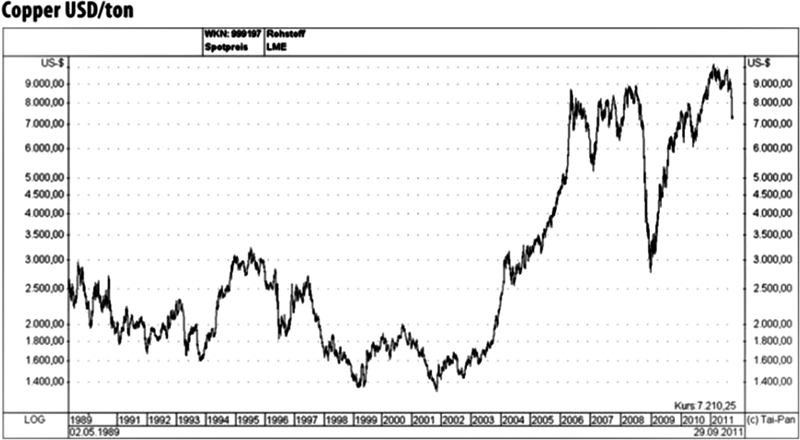
Variation of LME copper spot price since 1989
This leaves Platinum Equity owning, under the SCM Metal Products badge, some eight production facilities, including copper and alloys in North Carolina and Suzhou, China; stainless and thermal spray powders in Birmingham, UK (formerly BSA Metal Powders); copper and aluminium powders at Velden, Germany; and aluminium powders at Mepura of Ranshofen in Austria, Kranj in Slovenia, Bahrain and Tasmania. Aluminium powder capacity is of the order of 50 000 t/year, vying with Alcoa to be the largest in the world.
In the UK, Makin Metal Powders, owned by US Bronze Powders, went bankrupt in 2010 and was bought by an MBO and re-started. US Bronze Powders sold its own name and its gold bronze flake business to Altana, which bought the very large Eckart pigment and flake business about 10 years ago. It became US Metal Powders Inc. and closed down its copper powder activities, which were later bought by Chemet and moved to Tennessee. This state is, or was, a hive of copper producers, with Greenback Industries and Ligonier Metal Powders having been acquired by Pyron in the 1990s before Pyron itself was acquired by Höganäs, and the copper interests sold to ACuPowder Inc. The remaining activities were then consolidated onto one site. ACuPowder itself, formerly Alcan Metal Powders, and run by the formidable Ed Daver, was recently partly sold by him to Platinum Equity. ACuPowder produces copper and alloy powders and a number of other non-ferrous powders (not Al). Ametek produces some special copper alloys (e.g. spinodal alloys). In mainland Europe, the other major producer of copper and other non-ferrous (Zn, Sn, etc.) powders is Toniolo of Mestre (near Venice) Italy. Ames of Spain produces copper alloy powders for in-house use. There is a sadly run-down copper powder plant in Uzice – Sinter AS, a revived facility at Kovohuty Dolny Kubin in Slovakia (affiliated with Mineralmühle Leun, Rau of Germany) and several small operations in the Ukraine and Russia, as well as a significant electrolytic and atomising plant at Uralelektromed near Ekaterinberg in the Urals (now associated with GGB in Germany – see above).
Aluminium
The aluminium powder industry is rather a small one (in numbers of players) in advanced countries, due largely to the hazardous nature of its production. Toyal of Japan has plants in Japan, the USA, and France to feed its flake and pigment operations. Eckart (Altana) also has an in-house facility in Germany for flake feedstock. Alcoa continues to operate its very large Rockdale plant in Texas and a large plant in Brazil. Alpoco of the UK, which was bought some years ago by its largest customer, London Scandinavian Metallurgical, also has a 50% stake in a Polish plant with Benda Lutz, an Austrian firm specialising in flake and pigments, which also has a venture in Russia. Following the closure or disposal of its copper powder interests, US Metal Powders (formerly US Bronze Powders) is now a pure aluminium powder company with the Ampal operation in the USA and the Hermillon plant in France, acquired some years ago from Pechiney.
Special alloys (Fe, Ni, Co)
In special alloys there are still many players in the rather large and specialist thermal spray market which were not represented at the conference and will not be discussed here. In the PM area, Carpenter Technology bought Anval of Sweden many years ago, and more recently acquired Ultrafine Powders in the USA, with a view to boosting capacity for gas atomised MIM powders, a significant market for the company. Carpenter Powder Products (CPP) operates a number of gas atomisers in the USA with both air and vacuum melting. Ametek continues to produce a lot of water atomised powder for its in-house powder rolling plant, as well as selling water atomised high alloy powders.
During this year it was announced that CPP had agreed to work with Sandvik (owners of Osprey Metals in the UK) to expand capacity for gas atomised hot isostatic pressing feedstock in Sweden, mainly to feed the ‘MegaHIP’ installed by Bodycote HIP at Surahammar, close to the CPP Nyby plant which has a 5 t furnace. Sandvik continues to operate the Surahammar 2 t horizontal gas atomiser (formerly ABB Powdermet). Last year Osprey Metals announced a major expansion of its fine powder capability, aimed at the MIM market. The other major player in gas atomisation in Sweden, Erasteel (a major high speed steel (HSS) producer), was exhibiting and reported that it had just opened, and was expecting to commission very shortly, a major new gas atomisation plant for HSS and possibly other steel powders which would raise its capacity to 14 000 t/year (see p. 551). It is also operating its ‘Flexiplant’ with a 1 t melter, offering a range of powders. Erasteel also announced at the conference that it had acquired a major interest in Metallied, a small Basque start-up company making gas atomised powders and currently installing a water atomiser for special powder production. Clearly this complements the much larger facilities in Sweden, and the vacuum melting gas atomisation facilities at Aubert and Duval (Tecphy), also part of Eramet. Meanwhile Eramet also owns Eurotungstene Metal Powders, which shared a stand with Erasteel and supplies ultrafine chemically produced powders of Co, Fe–Co, etc. to the hardmetal and diamond tool industries. Also in the high speed and tool steel market, Böhler of Austria operates an in-house gas atomiser of several thousand tonnes annual capacity to feed its HIP PM steel operation, but does not sell powder as such.
In Germany, the long established Europowders plant at Thale was acquired by Mineralmuhle R, which also owns PMC Tec, a powder distributor, and has interests in Kovohuty of Slovakia which makes large amounts of FeSi15 dense medium powder. Europowders produces a wide range of water atomised alloy powders for the welding and other industries. In Norway, the former Hafslund AS plant for FeSi15 (dense medium) and FeSi45 (welding rod industry) powders was recently 100% acquired by local firm Nordox, which makes large amounts of copper oxide powders. It has a 4 t water atomising plant.
Superalloys and titanium
Few of the major US superalloy powder producers were represented, and they will not be discussed here. At the show was Reading Alloys (now part of Ametek), which makes Ti powder by the hydride–dehydride process, among other products, and also Raymor Industries, which makes plasma atomised titanium powders of spherical shape that are finding extensive use in MIM and additive manufacturing markets. Raymor recently changed ownership from a quoted company to private ownership.
Stainless steels
Meanwhile, in North America, the crisis saw the stainless steel operation of Hoeganaes (GKN) sold to Ametek and closed down, reducing capacity to the extent that the rebound of demand made all players strain to meet it. The former SCM plant at Johnstown, bought several years ago by NAH, continues to be a major supplier (5 t furnace). NAH recently announced a major (∼30%) expansion of capacity. Ametek also continues to be active in this market, but the only major news of late was the company's acquisition of Reading Alloys. In Europe the major producer of stainless steel powders is Höganäs AB at its Belgian plant, with some smaller production at SCM in Birmingham (formerly BSA Metal Powders) and Europowders in Thale. In Japan, Daido steel dominates the stainless steel market.
Summary
From the above, by no means exhaustive, description of the global industry, it can be seen that metal powder producers may be forgiven for feeling that they ‘live in interesting times’, to quote the old Chinese curse. The trend for a reduction in the number of producers has not been entirely one way, with the break-up of Ecka Granulat spinning off some new players, as well as making Platinum Equity into a major player in the copper and aluminium powder markets. The iron powder business has continued to consolidation, although this trend is countered by the growth of new Chinese producers, while the high alloy steel business seems to be growing and relatively stable in ownership terms.
Stainless steel and MIM powders seem to be in short supply, due to growth in demand, and new capacity is coming on stream at Osprey in the MIM field. Sweden continues to be a very major player with Höganäs, Sandvik and Erasteel (French owned) all in good health and expanding, especially to serve the developing HIP business.
Ferrosilicon powder for dense media and other applications is a rather low profile, but major tonnage (c. 10 000 t/year) market. Altogether an encouraging situation – and most producers seem very happy with levels of business, as well they might be following the catastrophic drop in sales during 2009, often of more than 50% for some months. The interest of buyers in acquiring most of Ecka Granulat's operations shows confidence in continuing demand for powders.