






Abstract

Erasteel developments
High alloy and specialist steel powder producer Erasteel has acquired a majority share in Metallied, a specialist producer of small batches of fine powders. Metallied, based in Irun, Spain, was created in 2007 and is a spin-off of CEIT research organisation in San Sebastian.
With less than 10 employees, Metallied uses innovative atomisation equipment to produce small batches of tailor made fine powders in a wide range of alloys, including high speed steels, master alloys and cobalt and cobalt-free binders for diamond tools. The acquisition is designed to assist the expansion of Metallied's activities while extending Erasteel's R&D resources in powder metallurgy.
Erasteel also, on 6 October, inaugurated a new gas atomising tower at its Söderfors plant in Sweden. The new facility will allow Erasteel to extend its product range to new steel grades, including stainless steels, and to nickel and cobalt alloys. It represents an investment of about €20m which will increase the gas atomisation capacity of the Söderfors plant to 14 000 t/year. This investment is part of an expenditure of €120m made by Erasteel's parent group, Eramet Alloys, during 2011 to commission four strategic facilities (the others being for titanium, aluminium and nickel alloy production in France) to serve rapidly growing markets in areas such as tooling, energy and in particular oil and gas.
Further information at www.erasteel.com or contact
Plansee Korean acquisition
Plansee has expanded its presence in Asia with the acquisition of Korean company TCB Korea Co. Ltd, concluded on 20 October for an undisclosed price. Plansee has been running its own sales office in Korea for the past six years, but the acquisition of TCB will allow the supply of coating materials directly to Korean display, electronics and solar companies. TCB specialises in the bonding operation, by which materials manufactured by Plansee are soldered onto carrier materials before they can be used in coating plants. Its technologies and patents are said to make it one of the few independent providers capable of bonding all types of coating material currently required by manufacturers. The company, which currently employs ten people, is to be merged with the existing sales organisation in Korea. Plansee has run a similar company, PBKK, in Japan for the past eight years.
Further information at www.plansee.com.
Höganäs strategic investment
Höganäs has announced plans to reinforce its facilities in Asia by building a new mixing plant. Viewed as a long-term investment to enhance the company's ability to deliver differentiated products with shorter lead-times, the project is scheduled for completion by the end of 2012.
At the same time, the company reported third quarter 2011 sales of SEK1810m, up 5% year on year, with sales volumes 8% higher (3% excluding deliveries resulting from the incapacity of Hoeganaes's Gallatin plant). Market conditions were reported as better than in the corresponding period of the previous year in America, but weaker in Europe. In Asia, demand improved gradually during the quarter, as the effects of the Japanese tsunami disaster tapered off.
Höganäs has also announced enhancements to its PoP Centre in Sweden relating to the ability to test and prototype brazing applications. The laboratory can now assess critical factors for screen printing and roller coating applications, drying of printed or roller-coated parts, and vacuum, hydrogen, H2–N2 or argon brazing in a laboratory furnace.
Further information at www.hoganas.com.
PM standards newsletter launched
Recent discussions at Euro PM in Barcelona have resulted in the launch of a new newsletter on ISO standards. The newsletter will report on the activities of the technical committee ISO TC119, which has responsibility for developing global standards in the field of PM. It will have the aim of increasing awareness of TC119's activities and encouraging interested persons or companies to contribute to them or to suggest new activities, including the development of new standards and the revision of existing standards.
The first issue includes an overview of the importance of ISO standards and an introduction to the organisation and responsibilities of ISO TC119, the secretariat of which is held by Sweden. Jan Tengzelius acts as Chairman and Sanna Edlund as Secretary. Contact information and more background on the TC119 and its five subgroups is available at www.iso.org/iso/standards_development.
The newsletter also gives a summary of the plenary meeting of ISO TC119 held in Madrid during October, attended by 18 persons representing Japan, the USA, Germany, Spain and Sweden. The business conducted included:
final drafts of ‘Specification of sintered metal materials’ (ISO 5755) – extended with more than 10 new materials – and ‘Specification of MIM materials’ (ISO 22068) have been completed and will be published in 2012 subject to approval by ISO members
a working group will be formed to make recommendations for the development of a material standard for porous filter materials
‘Determination of density’ (ISO 2738): investigations will be conducted to compare reproducibility using different methods to seal the metal surface for the purpose of updating the existing standard
the possibility of a new standard for testing criteria of PM gears, i.e. pitting and tooth root fatigue, will be considered, initially through an expert review
a proposal for revision of ‘Determination of compressive yield strength’ (ISO 14317) was put forward
the possibility of holding a seminar/workshop on test methods for ejection characteristics of PM compacts alongside the PM World Congress in Yokohama will be explored
a new (‘Gustafsson method’) flow meter design to overcome the fact that flow measurements using the Hall method are not possible for many powder mixes used today has been developed and assessed by round robin tests. A guideline for the use of different funnel designs is being compiled before a draft of a new standard is compiled
additions to the PM vocabulary since the publication of ISO 3252 in1999 will be considered.
The first edition of the newsletter is available at www.epma.com/pdfs/Newsletter_ISO_Standards.pdf.
Radiography of green parts
DIRA-GREEN is an EU funded project having the objective to develop a fast and reliable inspection tool based on digital radiography for the inspection of green PM parts. The developed tool will be aimed at small and medium sized enterprises where ‘real time’ inspection can save vital resources. Funding of €3m over three years has been granted under the ‘Research for the benefit of SMEs’ call issued under Framework Programme 7. The project involves a consortium of 13 organisations comprising technical and end-user SMEs supported by associations from both PM and the NDT sector, together with research centres and a university at which the development work will be carried out.
The first step in the project, which started on 1 October, is to finalise the system specification on the basis of industry needs. A two-step market survey has been set up, first, to determine the required accuracy and speed requirements of the end product while taking into consideration cost issues and other factors; and, second, to gain a comprehensive overview of the complex aspects of PM non-destructive testing. The results of the survey will be shared with those taking the time to participate. The responses collected will guide the project objectives but will also serve as an important source of information for the whole PM sector in the field of non-destructive testing.
Further information at http://diragreen.eu.
PM HIP brochure launched
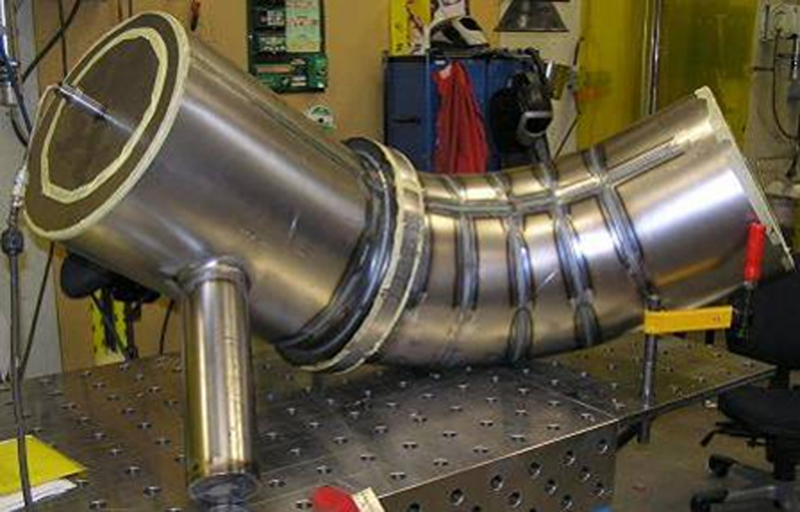
The European PM HIP Group (EPHG), part of EPMA, has launched an ‘Introduction to PM HIP technology’ brochure to help explain and promote the capabilities of hot isostatic pressing of metal powders. The brochure lays out the benefits of the process and provides case studies of the complex near net shape components and semi-products it can generate.
The brochure been developed in coordination with, and with sponsorship from, the EPHG membership which includes many of the leading international companies in the PM HIP sector. It can be downloaded free as a PDF file from the EPMA website (www.epma.com/onlinepublications) and free hard copies can be obtained by contacting the EPMA Secretariat, 2nd Floor Talbot House, Market Street, Shrewsbury SY1 1LG, UK.
For more information on EPHG, contact Jonathan Wroe (jw@epma.com), Anders Eklund (anders.eklund@avure.com) or Adeline Riou (adeline.riou@eramet-erasteel.com).
Large bore pipe elbow with integral branch produced by PM HIP
Atomisation course
Perdac Ltd and Atomising Systems Ltd will hold a further manifestation of their two day course on ‘Atomization for metal powders’ on 1 and 2 March 2012 in central Manchester. The course is designed to provide a detailed and wide ranging insight into the technology, practice and economics of metal powder production by atomisation. The 2011 course attracted delegates from Europe, North America, South America and Africa, including specialists from both industry and university/research backgrounds. Typically 70% of registrants are from the metal processing industry.
Full information and online registration is available at www.perdac.com, or contact: Andrew Yule, Perdac Ltd, Technology House, Lissadel Street, Salford M6 6AP, UK, email
Powders 2011 rescheduled
Because of conflicting commitments among potential speakers, the UK community Powders 2011 meeting due to take place on 30 November has been rescheduled for 22 March 2012, again at Holywell Park, Loughborough. Organised by the Materials KTN and Particulate Engineering Committee of the Institute of Materials, Mineral and Mining, the meeting is a successor to the successful PowdermatriX annual meetings. Involving contributors from key sectors including medical, power and aerospace, it aims to raise awareness of new technologies and services in particulate materials, review the technology needs of key industry sectors and assess current and emerging priority areas.
Further information from: David Whittaker, Materials KTN, email