






Abstract

Industrial ion sources, developments and challenges
Introduction
For a number of years, ion sources became one of major physical tools in modern thin film technology. Various industries for production numerous chemical compounds on surfaces: metal oxides, nitrides, oxynitrides, diamond-like carbon (DLC) depositions and many others, including completely new materials, have been developed with the ion sources. Thin films made with ion sources are utilised in various fields such as optics, medicine, tribology, aerospace, new materials, etc.
Viacheslav V. Zhurin
Short history
Ion sources appeared from electric propulsion devices that have been a subject of extensive investigations with beginning of space travel, because electrical propulsion promised to generate much higher exhaust velocities in comparison with chemical rockets. One type was gridded thruster with electrostatic acceleration of ions; another one was electrical thruster with electromagnetic acceleration of ions based on magnetised closed drift electrons principle. Both types of electric propulsion thrusters served as prototypes for gridded and gridless ion sources. All research and development was begun during the early 1960s in the USA and the USSR. In the USA, main efforts were directed to the electrostatic gridded and in the USSR to the gridless thrusters. Gridded thrusters gave birth to high energy well collimated ion sources with the ion beams energy from about 100 eV to 1500–2000 eV, though gridded ion sources have quite low ion beam current at low energies caused by the space charge limit. Gridless ion sources came from Hall current thrusters with closed electron drift. These ion sources can operate at low discharge voltages (energies) from about 50 V and up to 300–500 V; they have no limit on the ion beam current due to the space charge, because ions travel in discharge channel neutralised by electrons.
Most scientific information about gridded thruster ion sources was published in International Electric Propulsion and Joint Propulsion Conferences.1 At the same time, the best information about the closed drift technology and varieties of Hall current thruster ion sources was published in the 1970s and 1980s in the Proceedings of the All-Union Conferences on Accelerators and Ion Injectors.2 One of the most widely used ion source that called as end-Hall ion source is quite similar to a low voltage, high current magnetoplasma dynamic thruster schemes that were extensively investigated in the USSR. However, the versions that became most widely used in the thin film technology are of comparatively low current (1–5 A) and medium range voltage (50–300 V) devices.7,9,10
Applications
Since the early 1980s, ion sources became one of the most powerful tools in modern science and technology of new materials and together with lasers, electron beams and magnetrons perform heavy work with varieties of applications. The important advantages of ion beam material processing are that this type of technology can deposit, or etch or smooth at very low level of material's surface from a few to hundreds and thousands of Angstroms that will be practically impossible to do with any other high mass and volume material processing devices, like magnetrons and electron beams. The ion energy with new modern specialised ion sources can be varied from the low tenths to hundreds and thousands of electron volts. The ion sources found applications in the following areas:
optics that include design and fabrication optical filters, coatings and components to enhance the optical and environmental performance of electronic displays. This type of works include surface polishing, etching to achieve the aberration free optics, diffraction grids, optical filters and thin film depositions with special optical effects
microelectromechanical systems where the ion beams from sources are used for silicon etching
in very large scale integration for development of complex integrated electrical circuits in combination with transistors and fabrication of large integral systems, superhigh frequency transistors and high density capacitors for dynamic random access memory
deposition of multicomponent materials, various dielectrics and magnetic materials with improved properties in comparison with existing ones. Ion beam depositions can combine together materials that are impossible to do at regular temperatures by physical vapour deposition process. Because the ion sources ion beam energies (10–1000 eV, which are equivalent of 105–107°C) are substantially higher than in the traditional physical vapour deposition processes (0·2–0·3 eV, or 2×10³–3×10³°C)
hard magnetic discs, for cleaning, etching and polishing thin film deposition
heavy industry utilises ion sources not in a large scale, but for a fine work and small parts; however, there is practically nothing comparable with low energy ion beams that make surface of materials with corrosion resistant and friction stable depositions improving materials hardening, increasing their lifetime and enhancing performance
in acoustic electronics, for cleaning and etching materials for fabrication of devices operating with surface acoustic waves
cleaning, etching, polishing quartz resonators and thinning quartz plates for piezoquartz technologies
processing of high sensitivity sensors, deposition and polishing
for medicine, applying protective, hardening and corrosion resistant thin film depositions
R&D with development of new materials providing high temperature superconductivity17
giant magnetoresistive multilayers with 20–100 Å conductive ferromagnetic (Ni, Fe and Co) layers separated by 10–30 Å conductive (Si and Cu) layers for switching magnetic moments of two magnetic layers from antiparallel to parallel position15
DLC coatings16 where ions impact enhances surface atoms mobility and formation of metastable phases modifying deposited thin films and obtaining necessary properties. This category includes R&D for obtaining materials with hardness exceeding diamond
ion beam figuring18 is utilisation of low energy ion beams for special performance optics shaping and correction of polishing errors
R&D with materials of unknown properties exceeding existing for science and technology
utilisation of concentrated energy ion beams in technology of soldering of semiconductor devices to provide local impact on a heating area, to activate a solder and a soldering material and to intensify process of physical–chemical interaction.
Requirements for ion sources
In this article, we discuss mainly the gridless ion sources that occupied solid place in varieties of industrial applications and R&D works of many research laboratories of universities and small companies. According to our estimations, there are about 4000 industrial ion sources; among them the gridless ones are over 90% of total number, and about 10% of gridded ion sources.
In the last 30 years, ion sources were extensively investigated and there were developed several typical designs–schemes that utilised by most ion sources producers. Depending on specific applications and conditions, the main requirements that modern ion source must satisfy are:
it must be simple, inexpensive design, stable in long operation over several hundred hours providing stationary ion beam with necessary ion beam current and energy, their useful distributions in space for application to a target, or a substrate. This requirement is hard to perform
an ion beam must be of a specific composition of working gas of certain mass and charge (usually single charged particles are preferable) with minimum contaminating particles. The applied working gas should have operation conditions with low gas pressure with minimum influence of charge exchange particles and working gas backflow into an ion source
an ion beam current must be of a certain value to provide necessary number of ions per area and time
an ion beam must be of a certain mean energy with a minimum spread in the ion energy distribution. The spread of energies from the mean energy should be justified for specific thin film deposition. This requirement is hard to satisfy for the gridless ion sources
applied power into an ion source should be minimal with the maximum ion beam current and energy. It is necessary that this power would have minimum scattered in an ion source discharge channel.
Basic operational parameters
An ion source is characterised by the following main parameters:
a total ion beam current value Ii (A) and its corresponding ion beam current density to a target substrate ji (mA cm−2)
an ion beam mean energy Ei (eV).
At this time, there are three major types of ion sources that found broad practical utilisation in the thin film technology and other industrial applications. These ion sources are:
gridded high voltage (energy) ion sources (Fig. 1)3 utilised mainly for sputtering and cleaning; energy range from about 500 eV to 1500–2000 eV with ion beam currents up to about 1 A
gridless closed drift ion sources (CDIS)4,5 with magnetised electrons (Fig. 2) that so far are used by a narrow group of users for DLC coating and for sputtering–cleaning; energy range from about 100 eV to about 700–800 eV with ion beam currents of up to about 1–2 A. The linear version of CDIS is utilised quite extensively in industry with the energy range from about 500 eV to about 2000 eV for cleaning and etching before depositions
gridless end-Hall ion sources (Figs. 3 and 4)6,7 that found the most broad utilisation in optical and ion assisted deposition (IAD) tasks with ion beam currents from low under 1 A and up to 2–3 A.
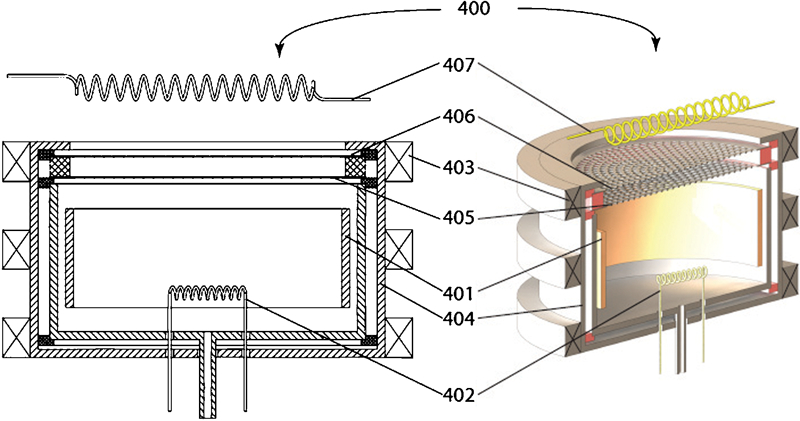
Gridded ion source. Anode: 401. Cathode in discharge chamber: 402. Hot Filament as source of electrons (400) for ion beam neutralisation. A cone shapes anode's lower part helps to substantially reduce impact of returned back from vacuum chamber particles
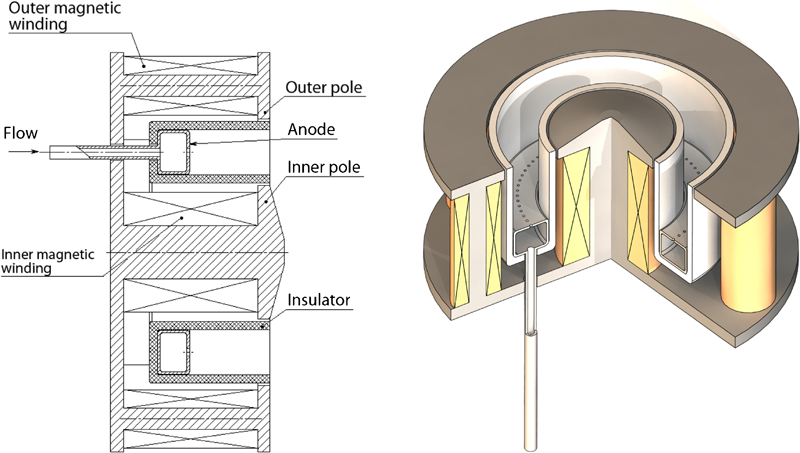
Closed drift ion source. Source of electrons is not shown
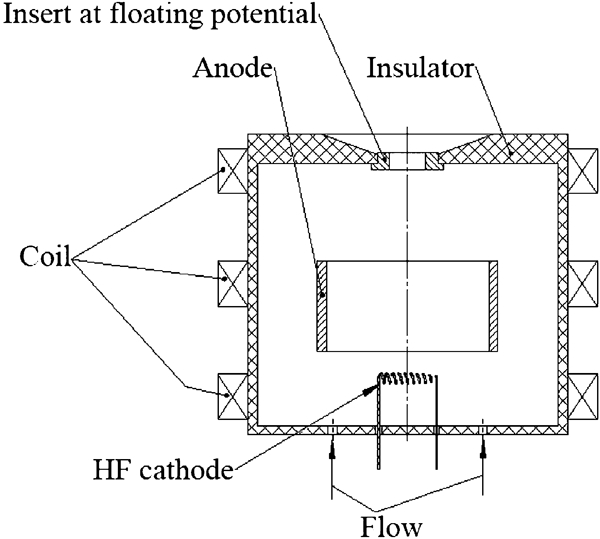
One of the first Hall current low energy ion sources. HF cathode is in discharge channel
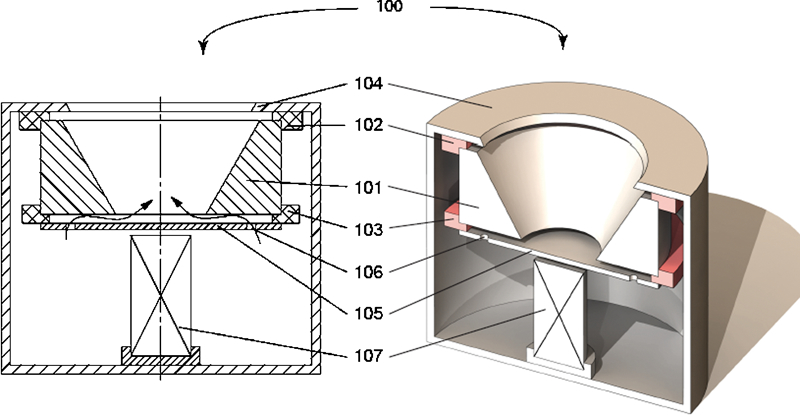
End-Hall ion source, main design utilised in optical industry. Source of electrons is not shown
It is necessary to mention that the gridded ion sources provide high energy ion beams with a very narrow ion beam energy distributions (Fig. 5).8 They are complex, expensive and cannot provide high ion beam currents especially at low energies (⩽100–200 eV). At the same time, the gridless ion sources operate at quite low discharge voltage (energies) and can deliver high ion beam currents at low energies. Gridless ion sources are much simpler, sturdier than gridded ones, but their ion beam energy distribution is very broad. For example, at the discharge voltage of about Vd = 100 V, the ion beam mean energy is about 60–70 eV, or Ei≈(0·6–0·7)eVd and its energy distribution spreads to low 20 eV and high 150–170 eV (Fig. 6).9 End-Hall ion sources have low transformation of a discharge current into an ion beam current, which is about Ii≈(0·2–0·25)Id. It means that end-Hall ion sources are very inefficiend devices.
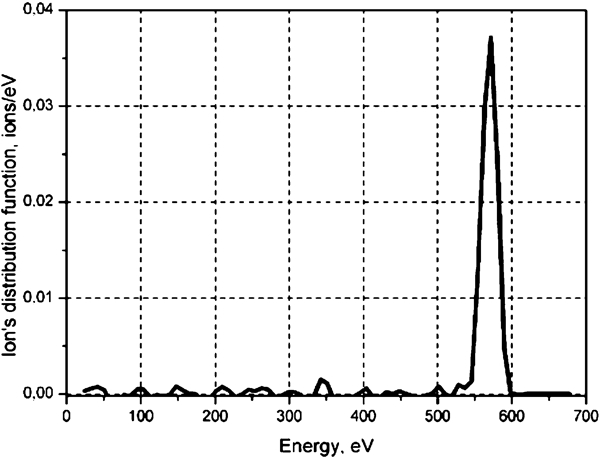
Ion beam energy distribution of a gridded ion source
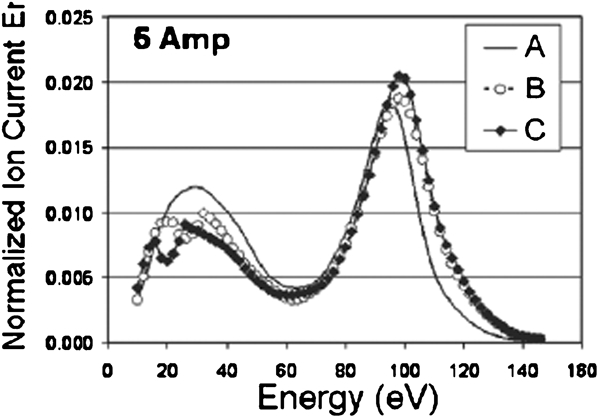
Ion beam energy distribution of a gridless end-Hall ion source Mark-2 from regular design A with hot filament to improved design B with hot filament and with hollow cathode C
CDIS of a cylindrical form, in general, are quite efficient ion sources and can provide a discharge current transformation of about Ii≈(0·8–0·9)Id. Their magnetic system is not simple and needs optimisation. CDIS linear version have comparatively low efficiency of the discharge current transformation into the ion beam, because they operate with discharge in the so called self-sustained mode, without utilisation of the external source of electrons, and the mean energy is very broad. But for cleaning, etching of big parts these factors is not important.
End-Hall ion sources, despite of their low efficiency and a broad energy distribution, have simple magnetic system (usually one permanent magnet and ion source's shell made of magnitosoft material) and because they have been introduced about 30 years ago into a practical utilisation, there are several thousands of such sources and they still work with regular simple optimisation procedures.
End-Hall ion sources are workhorses in the thin film and optical industry despite of their low efficciency. For certain problems, such as IAD, in many cases, it is necessary to provide low energy ions for compacting, compressing, stress releaving and other functions. And, as it was above mentioned, some parts of energy distribution have a quite high energy. Since a sputtering threshold for most materials is from about 20 eV to 50 eV, it means that ions with energies that over 50 eV will sputter deposited thin films provided, for example, by e-beam, magnetron or high energy ion source. Of course, there are many thin film depositions with IAD that are not sensitive to high energy ions. However, some thin films are very sensitive and with deposition and compacting, stress relieving, etc., there will be parts of thin films that could be sputtered, or damaged. Therefore, it is desirable to have the end-Hall ion sources with a narrow ion beam energy distribution. Fortunately, recently there were invented new types of end-Hall ion sources that have a narrow ion beam energy distribution similar to gridded ion sources. In Fig. 7, there is a new HCS end-Hall10 with a multichamber anode and a working gas applied through such anode. In Fig. 8, one can see a narrow ion beam energy distribution of a new end-Hall ion source with a multichamber anode.
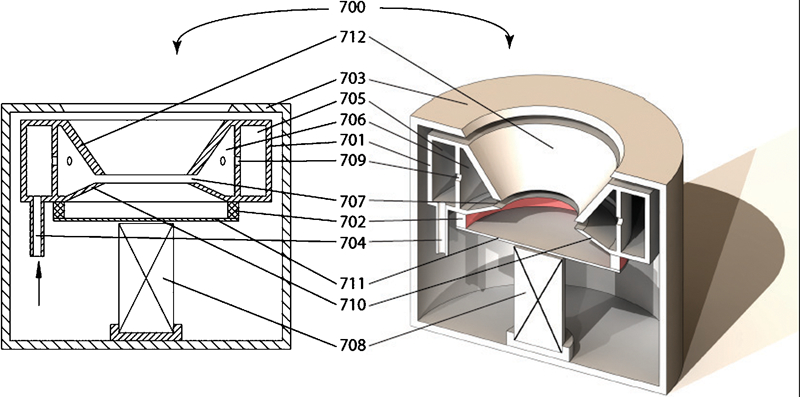
HCS end-Hall ion source design with multichamber anode for improved working gas distribution and obtaining narrow ion beam energy distributions. Source of electrons is not shown. This design with a tapered anode 708 also is practical for longer operation with reactive gases and dielectric films for longer than usual operation time, over 100 h and more
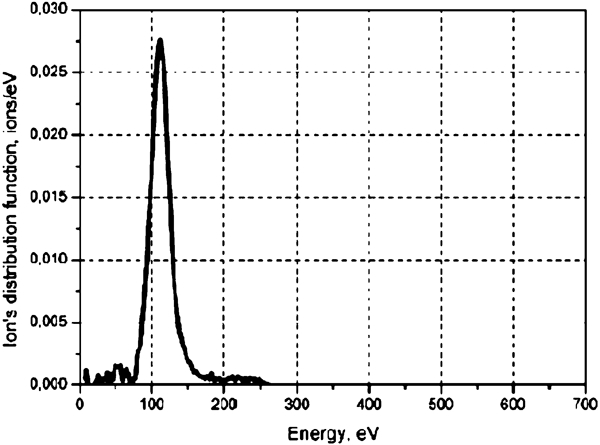
Ion beam energy distribution of gridless HCS end-Hall ion source with multichamber anode
Cost, training and understanding
Nowadays, industrial gridless ion sources made by major producers cost from $20 000 to $40 000 with a power supply depending on included varieties of expendable parts and possible applications. Here one can expect to have special types of anodes fabricated from:
graphite for inert gases
stainless steel for all kinds of working gases, including reactive ones
copper, this material that showed better performance with reactive gases and dielectric films on anode surface
grooved anode13 for operation with reactive gases and dielectric films for longer than usual time, up to 100 h and more
multichamber anode10 for improved gas distribution and obtaining narrow ion beam energy distributions.
Always, the accompanied power supply plays very important role for a normal routine ion source operation. Well designed and tested for a long period of time power supply can guarantee stable operation without much of oscillations and instabilities in a wide range of discharge currents and voltages with inert and reactive gases.
Since the industrial ion source can be considered as a unique physical device, those who use them have to learn how to operate from the manuals. Unfortunately, there are not so many publications about these devices; their utilisations for regular thin film depositions, etching, sputtering, cleaning, and what particular range of energies and ion beam currents, or current densities must be applied in various processes. Users find many such operations find from their experience; some specific operations are considered as proprietary information. Only recently Society of Vacuum Coaters organised a training course ‘Industrial Ion Sources’14 for those who wants to learn about broad beam Hall current ion sources, right ways to operate, what kind of problems exist and how to solve them.
Unfortunately, many users, and even some foreign producers of ion sources, do not give clear definitions of what is difference between, for example, the discharge current and the ion beam current, or between the discharge voltage and the mean ion beam energy. The same can be said about many users that do not understand such differences. Some users do not understand how important to have an ion beam properly neutralised, and what to do and measure the excess of positive potential (can damage substrate due to neutralising ions sparks) on the target substrate (excess of electrons, in general, for the thin film deposition, is not a problem; electrons easily spread in a vacuum chamber without any harm to depositions), and how to select correctly the hot filament's heating current and avoid ion beam underneutralisation that can lead to damage of thin film depositions.
Many users cannot correctly estimate various factors from the ion source operation that can lead to the possible thin film contamination of certain depositions. The ion source itself is a source of various contaminations of materials from the discharge channel, the gas distributing system (sometime called as reflector), the anode, and the hot filament (HF) and hollow cathode (HC) materials. All these contaminations can influence on thin films sensitive to foreign particles presence.
Many ion sources users have a vague understanding about the ion beam assisted deposition process. Since there is no clear quantitative theory at this time, but some qualitative estimations and explanations19 and many companies found experimentally their best solutions for various thin film depositions, it is very hard to follow rare publications about IAD and make exact calculations.
Needs
What users want and what can be done with the ion sources products:
a wide range of operational characteristics: Id = 0·5–20 A; Vd = 20–1000 V that correspond to the mean ion beam energies from about 15 eV to 700–900 eV. However, for this task, it is necessary to redesign the magnetic system of ion sources and to find the optimum magnetic field for each ion source, i.e. Id = Id,min and Ii = Ii,max at the same Vd and
 (mass flow). High ion beam currents due to utilisation of fluid cooled anodes and optimised magnetic system that can be delivered by higher discharge currents, Id⩽20 A and be the more efficient discharge current transformation into the ion beam current with the ratio Ii/Id≈0·8–0·9. Such a high ratio of Ii/Id can be provided by the positive magnetic field gradient in the discharge channel of ion sources in comparison with the existing negative magnetic gradient of the end-Hall ion sources
focused beam area of several mm2 can be achieved, so one can have an ion beam current density equal to ji = 100–1000 mA cm−2, or well diffused beam over a certain area (about 100–500 cm2) with ji = 1–5 mA cm−2. For this purpose, an ion source is can be equipped with a plasma optical system21 placed outside the ion source.As a good example of utilisation of focused ion beams with industrial ion sources, in Fig. 9 one can see the scheme with a focused ion beam from a CDIS and in Fig. 10 experiments with the recent new approach for soldering and cleaning of electron circuits parts.11,12
power supplies that are simple in operation and can help to deal with ion source and problems such as oscillations and instabilities caused by certain physical processes (anode ‘poisoning’ in reactive gases caused by deposition of insulating film on anode surface,22 high voltage operation with a wrongly designed magnetic field, presence of water vapours due to insufficient pumping, etc.)
power supplies must show not only a discharge voltage Vd (V), the discharge current Id (A), an emission current Iem (A), a working gas mass flow
 (sccm), but also an ion beam current Ii (A), or ion beam current density ji (mA cm−2), and a mean energy of ions Ei (eV) at certain distances from an ion source exit plane, so that a user will be not guessing about the ion source's output parameters
cathodes for working gas ionisation and ion beam neutralisation must be simple, cheap, efficient and reliable. Taking into account the complexity of a HC, they must be designed either with easy substitution of a HC insert, or the whole assembly should be substituted for a new one. HF must be optimised for a longer lifetime and reduced contamination for most ion sources and particular working gases and processes
some ion sources must be designed for certain specific technological tasks and required range of operational parameters; in other words, they must be well specialised
certain measures for standardisation of ion sources by producers of ion sources must be accepted. Because, at the present time, the world situation with ion sources can be considered as in state of anarchy and uncertainty with good exceptions of ion sources producers such as Veeco Instruments, Kaufman & Robinson Inc. and some Russian R&D enterprises.
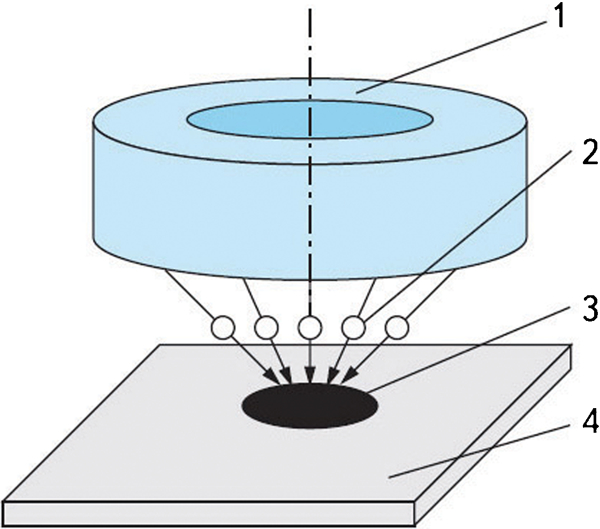
Scheme of with focused ion beam for soldering (1: ion source; 2: ion beam; 3: solder; 4: soldered part)11
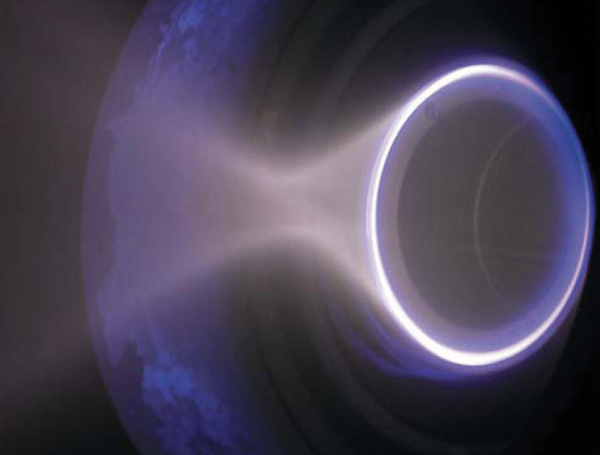
Focused ion beam applied to soldering surface (working gas argon)11
There is a quite big number of producers of ion sources (7–8 companies in the USA, 4–5 in Russia, 8 in China, 6 in Korea, 1 in Australia and 3–4 in Europe) of a variety of gridless types and these companies have practically no exchange of information, except finding opponents rarely published articles, in which ion sources are utilised for various thin film tasks, finding and examining the manuals from customers and advertising literature. It is necessary to apply certain criteria for comparison of operational parameters of ion source producers, to make users work easier, because different producers with even similar ion sources designs deliver different operational characteristics and some producers do not provide adequate measurements of main parameters determining an ion source working ability: ion beam current Ii and mean energy Ei, because there are not universally accepted ion beam current and energy probes. Only several main producers of ion sources, such as Veeco Instruments, Kaufman & Robinson Inc. and Plasma Lab,20 provide adequate measurements. There are several electrical propulsion R&D companies in the USA (Boeing, Aerojet, Loral Aerospace and Busek), several American Universities (Michigan, Texas Tech and Colorado State) and NASA, Russian major producer of electrical thrusters for space satellites, Fakel Enterprise and several Russian Universities (Bauman Technical University and Moscow Institute of Radioelectronics) that have good capabilities for such measurements, but they are not involved in the thin film technology. For certain thin film deposition processes, majority of users have to rely on inadequate manuals and forced to do themselves a lot of R&D work to clarify what optimum ion beam currents and ion energies are needed for the processes.
Users should know that the ion sources can operate sometime without oscillations, and, in some cases, only with the oscillation of main parameters, such as the discharge voltage and current, and still can deliver the necessary ion beams for thin film tasks.
Perspectives and expectations
What one can expect in new ion sources in coming 10–20 years are as follows:
There will be new designs and modifications of ion sources for certain specific technological tasks (for example, a narrow ion beam energy distribution of ±5–10 eV from the mean energy, or no charge exchange and double ionised particles, a long stable operation with reactive gases for over 100 h, influence of entrained working gas mass flow, impact of heating of discharge channel, insufficient pumping with water vapours disturbing regular operation, and many other factors that are necessary to take into account and keep in mind) with the designed range of operational parameters; in other words, the new generation of ion sources will be well specialised.
IAD technique will be developed to the level of quantitative exact recommendations with solutions of many problems with depositions and stress that will be easy to eliminate.
The existing ion sources would have substantially improved main operational characteristics of ion beam current and energy distribution with a wider range of operational characteristics: Id = 0·5–20 A and Vd = 20–1000 V, which will be easy to control. Operation at low discharge voltages will provide low mean ion energies of working gas, and at high discharge voltages and currents without oscillations and instabilities. For these tasks, it is necessary to redesign the ion source discharge channel and magnetic system.
High discharge currents due to utilisation of fluid cooled anodes and optimised magnetic system will deliver higher ion beam currents than at the present time. There will be no discharge currents over 20 A (though they are possible to deliver, in principle), because such currents require high working gas flows, and correspondingly, big expensive vacuum chambers with big expensive pumps. Operation at discharge currents under Id⩽10 A with high efficient ion sources having Ii/Id≈0·8–0·9 will be practical and quite acceptable.
Focused ion beam area of several mm2 can be achieved, so one can have an ion current beam densities equal to ji = 100–1000 mA cm−2, if necessary, or well spread uniform beam over a certain area of about 100–500 cm2 with ji = 1–5 mA cm−2. For this purpose, an ion source is going to have a plasma optical system placed outside the ion source.11,12,21
Power supplies will be simple in operation and can help to deal with ion source and developing problems such as oscillations and instabilities caused by various physical processes (anode ‘poisoning’ in reactive gases, high voltage operation with ion source's wrong designed magnetic field, etc.). Power supplies will be equipped with the proper electrical filters capable to mitigate oscillations and instabilities and adequate feedback.
Power supplies will show not only discharge voltage Vd (V), discharge current Id (A), emission current Iem (A), a working gas mass flow
 (sccm), but also an ion beam mean energy Ei and a current density ji on an ion source's axis at certain distances, so that a user will not be guessing about the ion source's output.
Cathodes for working gas ionisation and ion beam neutralisation will be simple, cheap and reliable. Taking into account the complexity of a HC, they will be designed either with easy substitution of a hollow cathode insert, or with the whole assembly for a new one. HF, as main cathode neutraliser in industrial working conditions (90% of all utilised cathodes), will be optimised for longer lifetime for most ion sources and particular working gases and processes. One of alternatives is the shielded HF that drastically reduces an ion beam contamination from a HF material (tungsten and tantalum). However, there is a lot of R&D work for improvements.